CERVICAL SPINE
GONIOMETRY
VIBHUTI NAUTIYAL
MPT (MUSCULOSKELETAL)
CERVICAL FLEXION
 Occurs in the sagittal plane
 Mediolateral axis
i. Testing position:
 Sitting position
 Thoracic and lumbar spine well supported by the back of the chair
 Head in zero degree of rotation and lateral flexion
ii. Stabilization:
 Stabilize the shoulder girdle and chest by using a strap
iii. Testing motion:
 Put one hand on the back of the subjects head
 Other hand, hold the subjects chin
 Push gently but firmly on the back of the patients head to move the head
anteriorly
 Pull the patients chin toward the chest to move the subject through flexion ROM
 End of the ROM occurs when further motion is restricted or further attempts at
flexion cause forward flexion of the trunk
iv. End feel: firm
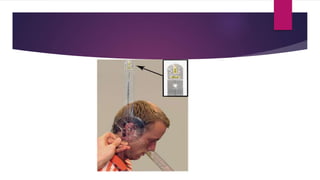
v. Goniometer alignment:
 Fulcrum: over the external auditory meatus
 Proximal arm: perpendicular to the ground
 Distal arm: base of the nares or parallel to the longitudinal axis of the tongue
depressor
vi. Tape measurement: measure the distance between the tip of the chin and the
lower edge of the sternal notch
CERVICAL EXTENSION
 Occurs in the sagittal plane
 Around a mediolateral axis
i. Testing motion:
 Sitting position
 Thoracic and lumbar spine well supported by the back of a chair
 Head in zero degree of rotation and lateral flexion
ii. Stabilization:
 Stabilize the shoulder girdle and chest to prevent external of the thoracic and lumbar
spine
 Strap also may be used
iii. Testing motion:
 Put one hand on the back of the subjects head
 Other hand, hold the subjects chin
 Push gently but firmly upward and posterior on the chin to move the head in
extension
 End of the ROM occurs when resistance to further motion is felt and further
attempts at extension cause extension of the trunk.
iv. End feel: firm
v. Goniometer alignment:
 Fulcrum: over the external auditory meatus
 Proximal arm: perpendicular to the ground
 Distal arm: base of the nares or parallel to the longitudinal axis of the tongue
depressor
vi. Tape measurement: measure the distance between the mark at the sternal
notch and tip of the chin at the end of extension ROM
CERVICAL LATERAL FLEXION
 Occurs in frontal plane
 AP axis
i. Testing position:
 Sitting
 Cervical spine in zero degree of flexion, extension and rotation
ii. Stabilisation:
 Stabilize the shoulder girdle and chest
 To prevent lateral flexion of the thoracic spine and lumbar spine
iii. Testing motion:
 Grabs the subjects head at the top and side
 Pull the head towards the shoulder
 End of the motion occurs when resistance is felt and further attempts cause lateral
flexion of trunk
iv. End feel: firm
v. Goniometer alignment:
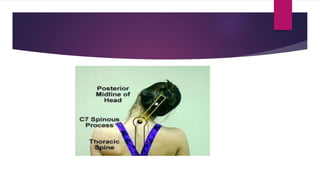
 Fulcrum: C7 spinous process
 Proximal arm: perpendicular to the ground
 Distal arm: parallel to the occiput
vi. Tape measurement: measure the distal between the tip of the acromion process
and tip of the ear at the end of the lateral flexion ROM
CERVICAL ROTATION
 Transverse plane
 Vertical axis
i. Testing position
 Sitting
 Thoracic and lumbar spine supported
 Spine in zero degree of flexion, extension and lateral flexion
ii. Stabilization:
 Shoulder girdle and chest
 Prevent rotation of the thoracic and lumbar spine
 Strap around the chest
iii. Testing motion:
 Grab the subjects chin and rotate the head to the shoulder
iv. End- feel: firm
v. Goniometer alignment:
 Fulcrum: centre of the cranial aspect
 Proximal arm: imaginary line between 2 acromion process
 Distal arm: parallel to the tip of nose or tongue depressor
vi. Tape measurement: measure the distance between chin and acromion process
Cervical spine gonio

Cervical spine gonio

  • 1.
  • 2.
    CERVICAL FLEXION  Occursin the sagittal plane  Mediolateral axis i. Testing position:  Sitting position  Thoracic and lumbar spine well supported by the back of the chair  Head in zero degree of rotation and lateral flexion ii. Stabilization:  Stabilize the shoulder girdle and chest by using a strap
  • 3.
    iii. Testing motion: Put one hand on the back of the subjects head  Other hand, hold the subjects chin  Push gently but firmly on the back of the patients head to move the head anteriorly  Pull the patients chin toward the chest to move the subject through flexion ROM  End of the ROM occurs when further motion is restricted or further attempts at flexion cause forward flexion of the trunk
  • 4.
    iv. End feel:firm v. Goniometer alignment:  Fulcrum: over the external auditory meatus  Proximal arm: perpendicular to the ground  Distal arm: base of the nares or parallel to the longitudinal axis of the tongue depressor vi. Tape measurement: measure the distance between the tip of the chin and the lower edge of the sternal notch
  • 6.
    CERVICAL EXTENSION  Occursin the sagittal plane  Around a mediolateral axis i. Testing motion:  Sitting position  Thoracic and lumbar spine well supported by the back of a chair  Head in zero degree of rotation and lateral flexion ii. Stabilization:  Stabilize the shoulder girdle and chest to prevent external of the thoracic and lumbar spine  Strap also may be used
  • 7.
    iii. Testing motion: Put one hand on the back of the subjects head  Other hand, hold the subjects chin  Push gently but firmly upward and posterior on the chin to move the head in extension  End of the ROM occurs when resistance to further motion is felt and further attempts at extension cause extension of the trunk. iv. End feel: firm
  • 8.
    v. Goniometer alignment: Fulcrum: over the external auditory meatus  Proximal arm: perpendicular to the ground  Distal arm: base of the nares or parallel to the longitudinal axis of the tongue depressor vi. Tape measurement: measure the distance between the mark at the sternal notch and tip of the chin at the end of extension ROM
  • 10.
    CERVICAL LATERAL FLEXION Occurs in frontal plane  AP axis i. Testing position:  Sitting  Cervical spine in zero degree of flexion, extension and rotation ii. Stabilisation:  Stabilize the shoulder girdle and chest  To prevent lateral flexion of the thoracic spine and lumbar spine
  • 11.
    iii. Testing motion: Grabs the subjects head at the top and side  Pull the head towards the shoulder  End of the motion occurs when resistance is felt and further attempts cause lateral flexion of trunk iv. End feel: firm v. Goniometer alignment:  Fulcrum: C7 spinous process  Proximal arm: perpendicular to the ground  Distal arm: parallel to the occiput
  • 12.
    vi. Tape measurement:measure the distal between the tip of the acromion process and tip of the ear at the end of the lateral flexion ROM
  • 14.
    CERVICAL ROTATION  Transverseplane  Vertical axis i. Testing position  Sitting  Thoracic and lumbar spine supported  Spine in zero degree of flexion, extension and lateral flexion ii. Stabilization:  Shoulder girdle and chest  Prevent rotation of the thoracic and lumbar spine  Strap around the chest
  • 15.
    iii. Testing motion: Grab the subjects chin and rotate the head to the shoulder iv. End- feel: firm v. Goniometer alignment:  Fulcrum: centre of the cranial aspect  Proximal arm: imaginary line between 2 acromion process  Distal arm: parallel to the tip of nose or tongue depressor vi. Tape measurement: measure the distance between chin and acromion process