Founder Communication
InnerSpace
Joe Greenstein & Semira Rahemtulla
July 23, 2015
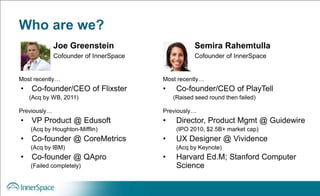
Who are we?
Most recently…
• Co-founder/CEO of Flixster
(Acq by WB, 2011)
Previously…
• VP Product @ Edusoft
(Acq by Houghton-Mifflin)
• Co-founder @ CoreMetrics
(Acq by IBM)
• Co-founder @ QApro
(Failed completely)
Joe Greenstein
Cofounder of InnerSpace
Most recently…
• Co-founder/CEO of PlayTell
(Raised seed round then failed)
Previously…
• Director, Product Mgmt @ Guidewire
(IPO 2010, $2.5B+ market cap)
• UX Designer @ Vividence
(Acq by Keynote)
• Harvard Ed.M; Stanford Computer
Science
Semira Rahemtulla
Cofounder of InnerSpace
Who are you?
First Exercise
Topics for Today
• What makes an effective leader?
• What makes an effective team?
Format: Learn together, not talk at you
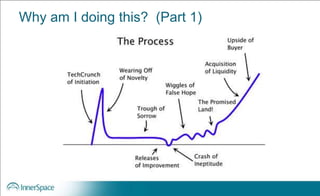
Why am I doing this? (Part 1)
Why am I doing this? (Part 2)
With special thanks to…
We will…
– Give you our best
– Take breaks
– End on time
What else would be helpful for you?
Working AgreementsWorking Agreements
We ask you to…
Respect
confidentiality
Photo by Vox Efx [link]
Working Agreements
We ask you to…
Challenge yourself
Photo by Daniel Oines [link]
Working Agreements
We ask you to…
Minimize
distractions
Photo by Robert S. Donovan [link]
Working Agreements
Photo by Luz Adriana Villa [link]
We ask you to…
Wait for breaks &
Return on time
Working Agreements
We ask you to…
– Challenge yourself
– Respect confidentiality
– Minimize distractions
– Wait for breaks & return on time
Can we all commit to this?
Working AgreementsWorking Agreements
Photo by Theresa Thompson [link]
Disclosure & Vulnerability 40 mins
Team & Culture 30 mins
Break 10 mins
Feedback & Influence, part 1 50 mins
Break 10 mins
Feedback & Influence, part 2 50 mins
Closing 15 mins
TOTAL 4 hrs
Agenda
One Big Idea
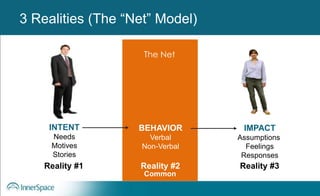
INTENT
Needs
Motives
Stories
Reality #1
BEHAVIOR
Verbal
Non-Verbal
Reality #2
Common
IMPACT
Assumptions
Feelings
Responses
Reality #3
The Net
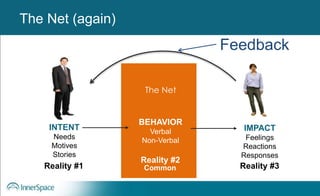
3 Realities (The “Net” Model)
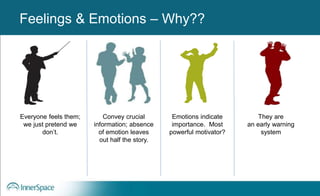
Feelings & Emotions – Why??
Everyone feels them;
we just pretend we
don’t.
Convey crucial
information; absence
of emotion leaves
out half the story.
Emotions indicate
importance. Most
powerful motivator?
They are
an early warning
system
Feelings & Emotions – Why??
Exercise #2: Introduce Yourselves
• Find a partner you DON’T KNOW
• 2 min to introduce yourself. Then switch.
How was that?
• What did you notice?
• How did it feel hearing the first intro?
• How did it feel describing yourself differently?
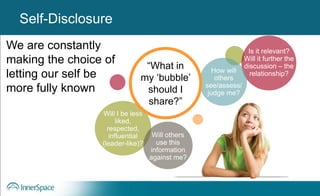
Self-Disclosure
Will I be less
liked,
respected,
influential
(leader-like)?
Is it relevant?
Will it further the
discussion – the
relationship?
Will others
use this
information
against me?
How will
others
see/assess/
judge me?
“What in
my ‘bubble’
should I
share?”
We are constantly
making the choice of
letting our self be
more fully known
Self-Disclosure
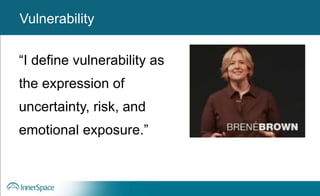
Vulnerability
“I define vulnerability as
the expression of
uncertainty, risk, and
emotional exposure.”
Vulnerability
Authentic Leaders
“The single factor distinguishing top quartile
managers from bottom quartile managers was
strength of affection – both given & received –
with their team.”
--“Encouraging the Heart: A Leader’s Guide to Recognizing and Rewarding Others”, Kouzes & Barry
Authentic Leaders
Authentic Leaders
You prefer to look strong rather than “weak.”
Problem: Everyone knows that.
Result: Willingness to show (some)
“weakness” is perceived as sign of strength.
Paradox of Trust?
Benefits of Self-Disclosure / Vulnerability
• Build connection, trust
• Repair distortions
• Avoid “progressive impoverishment”
Benefits of Self-Disclosure / Vulnerability
1. Disclosure & vulnerability are critical to
connection.
2. Effective leaders form strong connections.
Conclusion: Consider being more open.
The Bottom Line
Photo by Woodleywonderworks [link]
Team & Culture
Photo by Woodleywonderworks [link]
Effective Teams
1. Participation
2. Collaboration
3. Cooperation (Commitment)
Research: All of these are correlated to
Group EQ
“Building Emotional Intelligence”, Wolfe & Druskat, Harvard Business Review, 2004
Photo by Woodleywonderworks [link]
Inward
(my emotions)
Outward
(others’ emotions)
Emotional
Awareness
Emotional
Management
(“Regulation”)
EQ (Individual)
Photo by Woodleywonderworks [link]
Inward
(Our Team)
Outward
(Other Teams)
Emotional
Awareness
EQ (Group)
Emotional
Management
(“Regulation”)
High EQ individuals ≠ High EQ group
Group norms
determine group EQ
Photo by Woodleywonderworks [link]
Group EQ
Exercise #3
Photo by jm3 [link]
Our Norms
What norms do we have?
What norms do we need?
What can you do as leaders?
Photo by jm3 [link]
Our Norms
Feedback & Influence
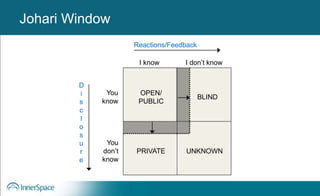
Working AgreementsJohari Window
OPEN/
PUBLIC
PRIVATE UNKNOWN
I know I don’t know
You
know
You
don’t
know
Reactions/Feedback
D
i
s
c
l
o
s
u
r
e
BLIND
Benefits of Self-Disclosure / VulnerabilityWhy is Feedback Important?
1. Personal Development
2. Team Effectiveness
3. Stronger Relationships
Bottom Line: Feedback is how we grow
Photo:RobbieGrubbs
Can I give you some feedback?
Photo by State Farm [link]
Social situations ≈ Physical threats
Threat Response
Photo by Andrew Vargas [link]
David Rock
What social
situations trigger
a threat response?
Status
Certainty
Autonomy
Relatedness
Fairness
SCARF Model
So… how do we communicate feedback
while minimizing defensiveness?
INTENT
Needs
Motives
Stories
Reality #1
BEHAVIOR
Verbal
Non-Verbal
Reality #2
Common
IMPACT
Feelings
Reactions
Responses
Reality #3
The Net
The Net (again)
Feedback
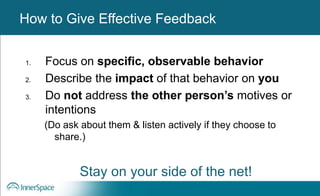
Benefits of Self-Disclosure / VulnerabilityHow to Give Effective Feedback
1. Focus on specific, observable behavior
2. Describe the impact of that behavior on you
3. Do not address the other person’s motives or
intentions
(Do ask about them & listen actively if they choose to
share.)
Stay on your side of the net!
Benefits of Self-Disclosure / VulnerabilityThe Simplest Feedback Model
When you do [x], I feel [y].
(and optionally)
The story in my head is… (z)
Can you tell me what’s going on for you?
Benefits of Self-Disclosure / VulnerabilityLet’s try some examples…
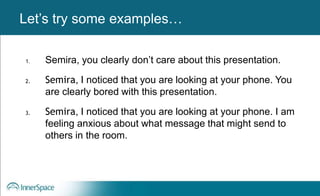
1. Semira, you clearly don’t care about this presentation.
2. Semira, I noticed that you are looking at your phone. You
are clearly bored with this presentation.
3. Semira, I noticed that you are looking at your phone. I am
feeling anxious about what message that might send to
others in the room.
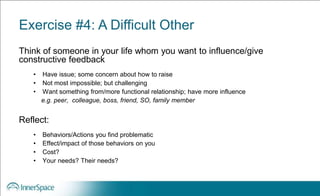
Exercise #4: A Difficult Other
Think of someone in your life whom you want to influence/give
constructive feedback
• Have issue; some concern about how to raise
• Not most impossible; but challenging
• Want something from/more functional relationship; have more influence
e.g. peer, colleague, boss, friend, SO, family member
Reflect:
• Behaviors/Actions you find problematic
• Effect/impact of those behaviors on you
• Cost?
• Your needs? Their needs?
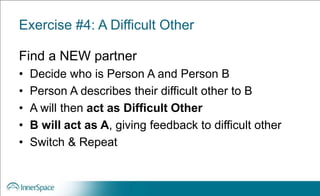
Exercise #4: A Difficult Other
Find a NEW partner
• Decide who is Person A and Person B
• Person A describes their difficult other to B
• A will then act as Difficult Other
• B will act as A, giving feedback to difficult other
• Switch & Repeat
How was that?
• What worked to influence you? What didn’t?
• Did you learn anything by playing the role of
Difficult Other?
• Are you going to give it a try for real?
Photo by Ana Karenina [link]
1:1 Feedback
Benefits of Self-Disclosure / VulnerabilityTips for Receiving Feedback
• Look for “Grains of Truth”
– Learning is better than being right
– Goal is understanding, not winning
• Listen and ask clarifying questions
• Acknowledge your feelings
• Gift mentality
– Say “Thank you!”
Benefits of Self-Disclosure / VulnerabilityTips for Complimentary Feedback
• Give more!!!
• Do not praise to buffer criticism
– Avoid “The Sandwich”
• Do not praise to overcome resistance
• Avoid platitudes. Be specific:
– Weak: “Joe, you’re killing it.”
– Strong: “Joe, I’ve noticed you’ve been on time to almost
every meeting this week. I feel grateful for the extra effort.”
Benefits of Self-Disclosure / VulnerabilityTips for Constructive Feedback
• Assume good intent; be curious
• Use a soft start
– Emphasize mutual goals & positive intent:
My intention is… / This matters to me because…
When you do [x], I feel [y].
• Be aware of your own stress
• Goal is joint problem solving
Benefits of Self-Disclosure / VulnerabilityLast Reminder
Stay on your side of the net
When you do [x], I feel [y].
Use the Vocabulary of Emotions.
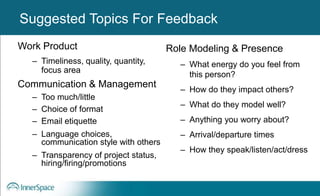
Benefits of Self-Disclosure / VulnerabilitySuggested Topics For Feedback
Work Product
– Timeliness, quality, quantity,
focus area
Communication & Management
– Too much/little
– Choice of format
– Email etiquette
– Language choices,
communication style with others
– Transparency of project status,
hiring/firing/promotions
Role Modeling & Presence
– What energy do you feel from
this person?
– How do they impact others?
– What do they model well?
– Anything you worry about?
– Arrival/departure times
– How they speak/listen/act/dress
Photo by Daniel Oines [link]
Challenge Yourself
Thanks, good-bye, and stay on
your side of the net 

Founder leadershipworkshop july2015

  • 1.
    Founder Communication InnerSpace Joe Greenstein& Semira Rahemtulla July 23, 2015
  • 2.
    Who are we? Mostrecently… • Co-founder/CEO of Flixster (Acq by WB, 2011) Previously… • VP Product @ Edusoft (Acq by Houghton-Mifflin) • Co-founder @ CoreMetrics (Acq by IBM) • Co-founder @ QApro (Failed completely) Joe Greenstein Cofounder of InnerSpace Most recently… • Co-founder/CEO of PlayTell (Raised seed round then failed) Previously… • Director, Product Mgmt @ Guidewire (IPO 2010, $2.5B+ market cap) • UX Designer @ Vividence (Acq by Keynote) • Harvard Ed.M; Stanford Computer Science Semira Rahemtulla Cofounder of InnerSpace
  • 3.
  • 4.
  • 5.
    Topics for Today •What makes an effective leader? • What makes an effective team? Format: Learn together, not talk at you
  • 6.
    Why am Idoing this? (Part 1)
  • 7.
    Why am Idoing this? (Part 2)
  • 8.
  • 9.
    We will… – Giveyou our best – Take breaks – End on time What else would be helpful for you? Working AgreementsWorking Agreements
  • 10.
    We ask youto… Respect confidentiality Photo by Vox Efx [link] Working Agreements
  • 11.
    We ask youto… Challenge yourself Photo by Daniel Oines [link] Working Agreements
  • 12.
    We ask youto… Minimize distractions Photo by Robert S. Donovan [link] Working Agreements
  • 13.
    Photo by LuzAdriana Villa [link] We ask you to… Wait for breaks & Return on time Working Agreements
  • 14.
    We ask youto… – Challenge yourself – Respect confidentiality – Minimize distractions – Wait for breaks & return on time Can we all commit to this? Working AgreementsWorking Agreements
  • 15.
    Photo by TheresaThompson [link] Disclosure & Vulnerability 40 mins Team & Culture 30 mins Break 10 mins Feedback & Influence, part 1 50 mins Break 10 mins Feedback & Influence, part 2 50 mins Closing 15 mins TOTAL 4 hrs Agenda
  • 16.
  • 17.
  • 18.
    Feelings & Emotions– Why?? Everyone feels them; we just pretend we don’t. Convey crucial information; absence of emotion leaves out half the story. Emotions indicate importance. Most powerful motivator? They are an early warning system Feelings & Emotions – Why??
  • 19.
    Exercise #2: IntroduceYourselves • Find a partner you DON’T KNOW • 2 min to introduce yourself. Then switch.
  • 20.
    How was that? •What did you notice? • How did it feel hearing the first intro? • How did it feel describing yourself differently?
  • 21.
    Self-Disclosure Will I beless liked, respected, influential (leader-like)? Is it relevant? Will it further the discussion – the relationship? Will others use this information against me? How will others see/assess/ judge me? “What in my ‘bubble’ should I share?” We are constantly making the choice of letting our self be more fully known Self-Disclosure
  • 22.
    Vulnerability “I define vulnerabilityas the expression of uncertainty, risk, and emotional exposure.” Vulnerability
  • 23.
    Authentic Leaders “The singlefactor distinguishing top quartile managers from bottom quartile managers was strength of affection – both given & received – with their team.” --“Encouraging the Heart: A Leader’s Guide to Recognizing and Rewarding Others”, Kouzes & Barry Authentic Leaders
  • 24.
    Authentic Leaders You preferto look strong rather than “weak.” Problem: Everyone knows that. Result: Willingness to show (some) “weakness” is perceived as sign of strength. Paradox of Trust?
  • 25.
    Benefits of Self-Disclosure/ Vulnerability • Build connection, trust • Repair distortions • Avoid “progressive impoverishment” Benefits of Self-Disclosure / Vulnerability
  • 26.
    Benefits of Self-Disclosure/ Vulnerability 1. Disclosure & vulnerability are critical to connection. 2. Effective leaders form strong connections. Conclusion: Consider being more open. The Bottom Line
  • 27.
    Photo by Woodleywonderworks[link] Team & Culture
  • 28.
    Photo by Woodleywonderworks[link] Effective Teams 1. Participation 2. Collaboration 3. Cooperation (Commitment) Research: All of these are correlated to Group EQ “Building Emotional Intelligence”, Wolfe & Druskat, Harvard Business Review, 2004
  • 29.
    Photo by Woodleywonderworks[link] Inward (my emotions) Outward (others’ emotions) Emotional Awareness Emotional Management (“Regulation”) EQ (Individual)
  • 30.
    Photo by Woodleywonderworks[link] Inward (Our Team) Outward (Other Teams) Emotional Awareness EQ (Group) Emotional Management (“Regulation”)
  • 31.
    High EQ individuals≠ High EQ group Group norms determine group EQ Photo by Woodleywonderworks [link] Group EQ
  • 32.
  • 33.
    Photo by jm3[link] Our Norms
  • 34.
    What norms dowe have? What norms do we need? What can you do as leaders? Photo by jm3 [link] Our Norms
  • 35.
  • 36.
    Working AgreementsJohari Window OPEN/ PUBLIC PRIVATEUNKNOWN I know I don’t know You know You don’t know Reactions/Feedback D i s c l o s u r e BLIND
  • 37.
    Benefits of Self-Disclosure/ VulnerabilityWhy is Feedback Important? 1. Personal Development 2. Team Effectiveness 3. Stronger Relationships Bottom Line: Feedback is how we grow
  • 38.
  • 39.
    Photo by StateFarm [link] Social situations ≈ Physical threats Threat Response
  • 40.
    Photo by AndrewVargas [link] David Rock What social situations trigger a threat response? Status Certainty Autonomy Relatedness Fairness SCARF Model
  • 41.
    So… how dowe communicate feedback while minimizing defensiveness?
  • 42.
  • 43.
    Benefits of Self-Disclosure/ VulnerabilityHow to Give Effective Feedback 1. Focus on specific, observable behavior 2. Describe the impact of that behavior on you 3. Do not address the other person’s motives or intentions (Do ask about them & listen actively if they choose to share.) Stay on your side of the net!
  • 44.
    Benefits of Self-Disclosure/ VulnerabilityThe Simplest Feedback Model When you do [x], I feel [y]. (and optionally) The story in my head is… (z) Can you tell me what’s going on for you?
  • 45.
    Benefits of Self-Disclosure/ VulnerabilityLet’s try some examples… 1. Semira, you clearly don’t care about this presentation. 2. Semira, I noticed that you are looking at your phone. You are clearly bored with this presentation. 3. Semira, I noticed that you are looking at your phone. I am feeling anxious about what message that might send to others in the room.
  • 46.
    Exercise #4: ADifficult Other Think of someone in your life whom you want to influence/give constructive feedback • Have issue; some concern about how to raise • Not most impossible; but challenging • Want something from/more functional relationship; have more influence e.g. peer, colleague, boss, friend, SO, family member Reflect: • Behaviors/Actions you find problematic • Effect/impact of those behaviors on you • Cost? • Your needs? Their needs?
  • 47.
    Exercise #4: ADifficult Other Find a NEW partner • Decide who is Person A and Person B • Person A describes their difficult other to B • A will then act as Difficult Other • B will act as A, giving feedback to difficult other • Switch & Repeat
  • 48.
    How was that? •What worked to influence you? What didn’t? • Did you learn anything by playing the role of Difficult Other? • Are you going to give it a try for real?
  • 49.
    Photo by AnaKarenina [link] 1:1 Feedback
  • 50.
    Benefits of Self-Disclosure/ VulnerabilityTips for Receiving Feedback • Look for “Grains of Truth” – Learning is better than being right – Goal is understanding, not winning • Listen and ask clarifying questions • Acknowledge your feelings • Gift mentality – Say “Thank you!”
  • 51.
    Benefits of Self-Disclosure/ VulnerabilityTips for Complimentary Feedback • Give more!!! • Do not praise to buffer criticism – Avoid “The Sandwich” • Do not praise to overcome resistance • Avoid platitudes. Be specific: – Weak: “Joe, you’re killing it.” – Strong: “Joe, I’ve noticed you’ve been on time to almost every meeting this week. I feel grateful for the extra effort.”
  • 52.
    Benefits of Self-Disclosure/ VulnerabilityTips for Constructive Feedback • Assume good intent; be curious • Use a soft start – Emphasize mutual goals & positive intent: My intention is… / This matters to me because… When you do [x], I feel [y]. • Be aware of your own stress • Goal is joint problem solving
  • 53.
    Benefits of Self-Disclosure/ VulnerabilityLast Reminder Stay on your side of the net When you do [x], I feel [y]. Use the Vocabulary of Emotions.
  • 54.
    Benefits of Self-Disclosure/ VulnerabilitySuggested Topics For Feedback Work Product – Timeliness, quality, quantity, focus area Communication & Management – Too much/little – Choice of format – Email etiquette – Language choices, communication style with others – Transparency of project status, hiring/firing/promotions Role Modeling & Presence – What energy do you feel from this person? – How do they impact others? – What do they model well? – Anything you worry about? – Arrival/departure times – How they speak/listen/act/dress
  • 55.
    Photo by DanielOines [link] Challenge Yourself
  • 56.
    Thanks, good-bye, andstay on your side of the net 