Communication Workshop
Semira Rahemtulla
March 28, 2018
Who am I?
• Executive coach to startup founders
• Co-founder/CEO of PlayTell
• Director, Product Mgmt @ Guidewire
(IPO 2010, $4B+ market cap)
• UX Designer @ multiple startups
• Harvard Ed.M Technology In Education
• Stanford B.S. Computer Science
Semira Rahemtulla
Cofounder of InnerSpace
One Big Idea
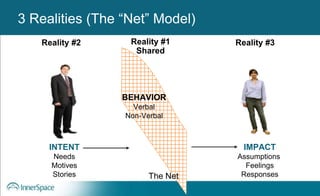
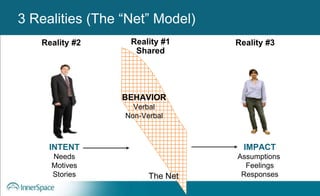
INTENT
Needs
Motives
Stories
Reality #2
IMPACT
Assumptions
Feelings
Responses
Reality #3
3 Realities (The “Net” Model)
The Net
BEHAVIOR
Verbal
Non-Verbal
Reality #1
Shared
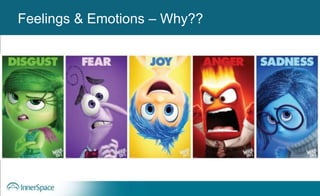
Feelings & Emotions – Why??Feelings & Emotions – Why??
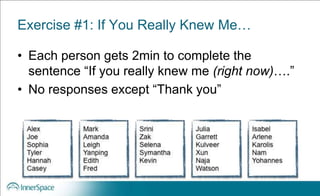
Exercise #1: If You Really Knew Me…
• Each person gets 2min to complete the
sentence “If you really knew me (right now)….”
• No responses except “Thank you”
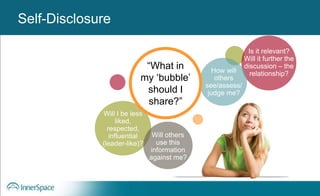
Self-Disclosure
Will I be less
liked,
respected,
influential
(leader-like)?
Is it relevant?
Will it further the
discussion – the
relationship?
Will others
use this
information
against me?
How will
others
see/assess/
judge me?
“What in
my ‘bubble’
should I
share?”
Self-Disclosure
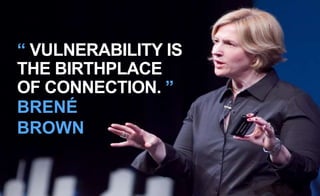
“ VULNERABILITY IS
THE BIRTHPLACE
OF CONNECTION. ”
BRENÉ
BROWN
Google’s
Project
Aristotle
Team norms that foster psychological safety
Psychological safety is ‘‘a sense of confidence that the team will
not embarrass, reject or punish someone for speaking up,’’
‘‘It describes a team climate characterized by interpersonal trust
and mutual respect in which people are comfortable being
themselves.’’
Working AgreementsEffective Teams
Feedback & Influence
Photo:RobbieGrubbs
Can I give you some feedback?
Feedback is a gift
So… how do we communicate feedback
while minimizing defensiveness?
INTENT
Needs
Motives
Stories
Reality #2
IMPACT
Assumptions
Feelings
Responses
Reality #3
3 Realities (The “Net” Model)
The Net
BEHAVIOR
Verbal
Non-Verbal
Reality #1
Shared
Benefits of Self-Disclosure / VulnerabilityHow to Give Effective Feedback
“When you do [x]…”
Focus on specific, observable behavior
"I feel [y]…”
Describe the impact of that behavior on you (disclosure)
“Can you tell me what’s going on for you?”
Ask about the other person’s intentions and perspective
Stay on your side of the net!
FACTS
Focus on specific, observable behavior
FEELINGS
What emotions came up for you?
THOUGHTS
Your beliefs, assumptions, stories,
conclusions, etc
Can you tell me what was
going on for you?
Ask about their side of the net
Benefits of Self-Disclosure / VulnerabilityLet’s try some examples…
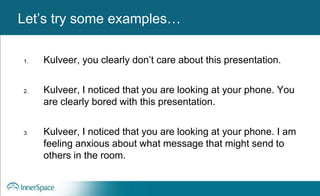
1. Kulveer, you clearly don’t care about this presentation.
2. Kulveer, I noticed that you are looking at your phone. You
are clearly bored with this presentation.
3. Kulveer, I noticed that you are looking at your phone. I am
feeling anxious about what message that might send to
others in the room.
Benefits of Self-Disclosure / VulnerabilityLet’s try another example…
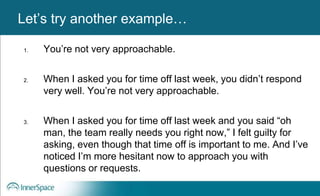
1. You’re not very approachable.
2. When I asked you for time off last week, you didn’t respond
very well. You’re not very approachable.
3. When I asked you for time off last week and you said “oh
man, the team really needs you right now,” I felt guilty for
asking, even though that time off is important to me. And I’ve
noticed I’m more hesitant now to approach you with
questions or requests.
Benefits of Self-Disclosure / VulnerabilityHow to Give Effective Feedback
Step 1: Open with mutual goals and positive intent.
What do you really want for this relationship?
What is your intention in giving this feedback?
Step 2: Stay on your side of the net
a. Stick to observable behavior (“When you did [x]…”)
b. Share your reaction (“I felt [y], and my story is [z]”)
c. Ask for their perspective (“What was going on for you?”)
Step 3: Enter joint problem-solving.
State your requests and preferences: What do you want?
Aim for solutions that are a win-for-all
Design some experiments.
Photo by Ana Karenina [link]
1:1 Feedback
Exercise #4: Complimentary Feedback
Think of one thing your coworker does that
you really appreciate
1. Describe the behavior as specifically as
possible
2. Describe the impact the behavior has on
you
#1 Factor for Happiness
on the Job:
Feeling appreciated
-- 2014 BCG/The Network survey of 200K employees
Benefits of Self-Disclosure / VulnerabilityBuilding a culture of appreciation
1. Create a space for it
2. Lead by example
Benefits of Self-Disclosure / VulnerabilityReceiving Feedback
Manage your own defensiveness
• Notice it
• Name it: “Affect Labeling”
Goal is understanding, not winning
• “What I heard you say…”
• “Can you tell me more about that?"
Gift mentality: Say “Thank you!”
Benefits of Self-Disclosure / VulnerabilityLast Reminder
Stay on your side of the net:
When you do [x]…
I feel [y]…
And my thoughts are [z].
Can you tell me what’s going on for you?
Use the Vocabulary of Emotions.
Thanks, good-bye, and stay on
your side of the net 

Zeus Communication Workshop

  • 1.
  • 2.
    Who am I? •Executive coach to startup founders • Co-founder/CEO of PlayTell • Director, Product Mgmt @ Guidewire (IPO 2010, $4B+ market cap) • UX Designer @ multiple startups • Harvard Ed.M Technology In Education • Stanford B.S. Computer Science Semira Rahemtulla Cofounder of InnerSpace
  • 3.
  • 4.
    INTENT Needs Motives Stories Reality #2 IMPACT Assumptions Feelings Responses Reality #3 3Realities (The “Net” Model) The Net BEHAVIOR Verbal Non-Verbal Reality #1 Shared
  • 5.
    Feelings & Emotions– Why??Feelings & Emotions – Why??
  • 6.
    Exercise #1: IfYou Really Knew Me… • Each person gets 2min to complete the sentence “If you really knew me (right now)….” • No responses except “Thank you”
  • 7.
    Self-Disclosure Will I beless liked, respected, influential (leader-like)? Is it relevant? Will it further the discussion – the relationship? Will others use this information against me? How will others see/assess/ judge me? “What in my ‘bubble’ should I share?” Self-Disclosure
  • 8.
    “ VULNERABILITY IS THEBIRTHPLACE OF CONNECTION. ” BRENÉ BROWN
  • 9.
  • 10.
    Team norms thatfoster psychological safety Psychological safety is ‘‘a sense of confidence that the team will not embarrass, reject or punish someone for speaking up,’’ ‘‘It describes a team climate characterized by interpersonal trust and mutual respect in which people are comfortable being themselves.’’ Working AgreementsEffective Teams
  • 11.
  • 12.
  • 13.
  • 14.
    So… how dowe communicate feedback while minimizing defensiveness?
  • 15.
    INTENT Needs Motives Stories Reality #2 IMPACT Assumptions Feelings Responses Reality #3 3Realities (The “Net” Model) The Net BEHAVIOR Verbal Non-Verbal Reality #1 Shared
  • 16.
    Benefits of Self-Disclosure/ VulnerabilityHow to Give Effective Feedback “When you do [x]…” Focus on specific, observable behavior "I feel [y]…” Describe the impact of that behavior on you (disclosure) “Can you tell me what’s going on for you?” Ask about the other person’s intentions and perspective Stay on your side of the net!
  • 17.
    FACTS Focus on specific,observable behavior
  • 18.
  • 19.
    THOUGHTS Your beliefs, assumptions,stories, conclusions, etc
  • 20.
    Can you tellme what was going on for you? Ask about their side of the net
  • 21.
    Benefits of Self-Disclosure/ VulnerabilityLet’s try some examples… 1. Kulveer, you clearly don’t care about this presentation. 2. Kulveer, I noticed that you are looking at your phone. You are clearly bored with this presentation. 3. Kulveer, I noticed that you are looking at your phone. I am feeling anxious about what message that might send to others in the room.
  • 22.
    Benefits of Self-Disclosure/ VulnerabilityLet’s try another example… 1. You’re not very approachable. 2. When I asked you for time off last week, you didn’t respond very well. You’re not very approachable. 3. When I asked you for time off last week and you said “oh man, the team really needs you right now,” I felt guilty for asking, even though that time off is important to me. And I’ve noticed I’m more hesitant now to approach you with questions or requests.
  • 23.
    Benefits of Self-Disclosure/ VulnerabilityHow to Give Effective Feedback Step 1: Open with mutual goals and positive intent. What do you really want for this relationship? What is your intention in giving this feedback? Step 2: Stay on your side of the net a. Stick to observable behavior (“When you did [x]…”) b. Share your reaction (“I felt [y], and my story is [z]”) c. Ask for their perspective (“What was going on for you?”) Step 3: Enter joint problem-solving. State your requests and preferences: What do you want? Aim for solutions that are a win-for-all Design some experiments.
  • 24.
    Photo by AnaKarenina [link] 1:1 Feedback
  • 25.
    Exercise #4: ComplimentaryFeedback Think of one thing your coworker does that you really appreciate 1. Describe the behavior as specifically as possible 2. Describe the impact the behavior has on you
  • 26.
    #1 Factor forHappiness on the Job: Feeling appreciated -- 2014 BCG/The Network survey of 200K employees
  • 27.
    Benefits of Self-Disclosure/ VulnerabilityBuilding a culture of appreciation 1. Create a space for it 2. Lead by example
  • 28.
    Benefits of Self-Disclosure/ VulnerabilityReceiving Feedback Manage your own defensiveness • Notice it • Name it: “Affect Labeling” Goal is understanding, not winning • “What I heard you say…” • “Can you tell me more about that?" Gift mentality: Say “Thank you!”
  • 29.
    Benefits of Self-Disclosure/ VulnerabilityLast Reminder Stay on your side of the net: When you do [x]… I feel [y]… And my thoughts are [z]. Can you tell me what’s going on for you? Use the Vocabulary of Emotions.
  • 30.
    Thanks, good-bye, andstay on your side of the net 

Editor's Notes

  • #3 who are we lucky to be part of a team that took this stuff seriously (communication & culture) fortunate to be involved in the early part of a company that was well run and had a successful exit and was the founder of a company that may or may not have been well run, but didn't have a successful exit
  • #6 ***feelings & emotions music has treble and clef 1. if you only have cognition and words without feelings, you don't have the full score, the full story 2. most of the time, people are "leaky" -- however they are feeling, they are emoting non-verbally. incongruence btwn words v behavior comes at the expense of credibility. therefore want congruence (so you dont want *only* thoughts or *only* feelings -- you want to communicate both) 3. "there's no room for feelings in business" -- is inspiring pple important in business? how do you inspire people without making them feel something?  important for motivation  Suppressing leads to lack of congruence – we are leaky.
  • #7 I’d like everyone to pause for a moment.  In your 2-min introduction, think about what you chose to say… and what you chose not to say. Out of your entire life – your past, your future, your personal life, your hobbies, everything there is to know about you as a person…  what did you choose to share.  Why? pause  What decisions did you make about what was relevant or interesting or safe to share with this person in this context? Now you’re going to introduce yourself again… and this time I want you to step outside of your comfort zone and share something you didn’t the first time. Imagine my hand on your back gently encouraging you to challenge yourself a bit.
  • #10 Individuals (A+ players, etc) Makeup of group (functional v x-functional, introverts v extroverts) How they organized their work (goals, waterfall/agile, meeting protocols, etc) They kept coming across research by psychologists and sociologists that focused on what are known as ‘‘group norms.’’ Norms are the traditions, behavioral standards and unwritten rules that govern how we function when we gather. So they started looking for and listening for group norms.
  • #12 1:21- 1:21
  • #13 Write down some feedback you have for someone What makes giving feedback scary? Why do we avoid it? Why should we do it?
  • #14 1:21- 1:21
  • #25 Setting the Context for Feedback Groundrules Discussion (What groundrules would help me be an effective participant in giving and receiving feedback)   Organize folks so that each person has two people they work with/know well Give them time to plan feedback with each Bring them back and do “speed dating” format feedback– two rounds so that every person has done it twice Facilitator calls out time for switching "Second conversation" about feedback