Civil Engineering Department Saad.bilbas@epu.edu.iq 130
Civil Engineering Department Saad.bilbas@epu.edu.iq 131
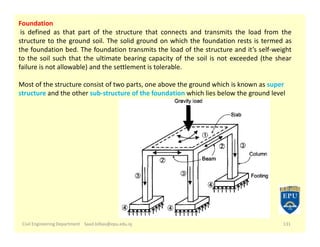
Foundation
is defined as that part of the structure that connects and transmits the load from the
structure to the ground soil. The solid ground on which the foundation rests is termed as
the foundation bed. The foundation transmits the load of the structure and it’s self-weight
to the soil such that the ultimate bearing capacity of the soil is not exceeded (the shear
failure is not allowable) and the settlement is tolerable.
Most of the structure consist of two parts, one above the ground which is known as super
structure and the other sub-structure of the foundation which lies below the ground level
Civil Engineering Department Saad.bilbas@epu.edu.iq 132
Every structures are provide with foundation at the base to fulfill the following objectives
and purposes:
1. To distribute the load of the structure over a large bearing area.
2. To load the bearing surface at uniform rate so as to avoid unequal settlement.
3. To prevent the lateral movement of the supporting material.
4. To increase the stability of the structure as a whole
 Types of Foundation:
A. Shallow Foundation
1. Wall Footing
2. Isolated column/Column Footing
3. Combined Footing
4. Cantilever (Strap) Footing
5. Mat (Raft) Foundation
Civil Engineering Department Saad.bilbas@epu.edu.iq 133
B. Deep Foundation
1. Pile Foundation
2. Pier Foundation
3. Well (Caissons) Foundation
A. Shallow Foundations
Are those foundations which the depth is placed less than the width of the foundation (D < B).
Shallow foundations are generally termed as spread footing as they transmit the load of the
super structure laterally into the ground.
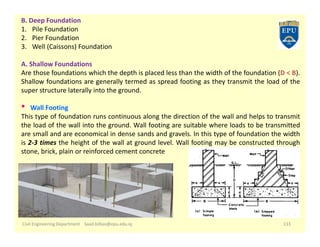
• Wall Footing
This type of foundation runs continuous along the direction of the wall and helps to transmit
the load of the wall into the ground. Wall footing are suitable where loads to be transmitted
are small and are economical in dense sands and gravels. In this type of foundation the width
is 2-3 times the height of the wall at ground level. Wall footing may be constructed through
stone, brick, plain or reinforced cement concrete
Civil Engineering Department Saad.bilbas@epu.edu.iq 134
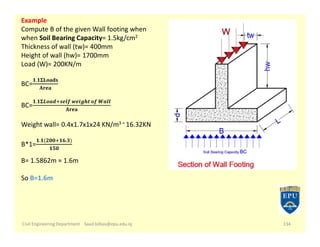
Example
Compute B of the given Wall footing when
when Soil Bearing Capacity= 1.5kg/cm2
Thickness of wall (tw)= 400mm
Height of wall (hw)= 1700mm
Load (W)= 200KN/m
BC=
𝟏.𝟏𝚺𝐋𝐨𝐚𝐝𝐬
𝐀𝐫𝐞𝐚
BC=
𝟏.𝟏𝚺𝑳𝒐𝒂𝒅 𝒔𝒆𝒍𝒇 𝒘𝒆𝒊𝒈𝒉𝒕 𝒐𝒇 𝑾𝒂𝒍𝒍
𝐀𝐫𝐞𝐚
Weight wall= 0.4x1.7x1x24 KN/m3 = 16.32KN
B*1=
𝟏.𝟏(𝟐𝟎𝟎 𝟏𝟔.𝟑)
𝟏𝟓𝟎
B= 1.5862m ≈ 1.6m
So B=1.6m
Civil Engineering Department Saad.bilbas@epu.edu.iq 135
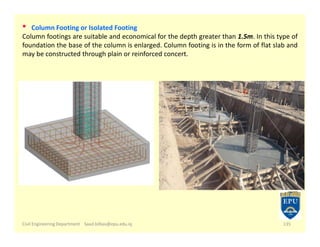
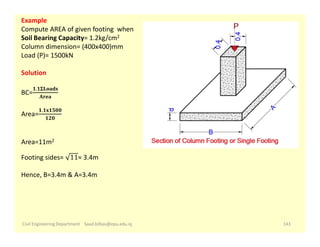
• Column Footing or Isolated Footing
Column footings are suitable and economical for the depth greater than 1.5m. In this type of
foundation the base of the column is enlarged. Column footing is in the form of flat slab and
may be constructed through plain or reinforced concert.
Civil Engineering Department Saad.bilbas@epu.edu.iq 136
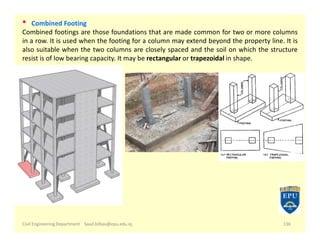
• Combined Footing
Combined footings are those foundations that are made common for two or more columns
in a row. It is used when the footing for a column may extend beyond the property line. It is
also suitable when the two columns are closely spaced and the soil on which the structure
resist is of low bearing capacity. It may be rectangular or trapezoidal in shape.
Civil Engineering Department Saad.bilbas@epu.edu.iq 137
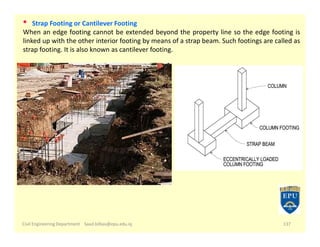
• Strap Footing or Cantilever Footing
When an edge footing cannot be extended beyond the property line so the edge footing is
linked up with the other interior footing by means of a strap beam. Such footings are called as
strap footing. It is also known as cantilever footing.
Civil Engineering Department Saad.bilbas@epu.edu.iq 138
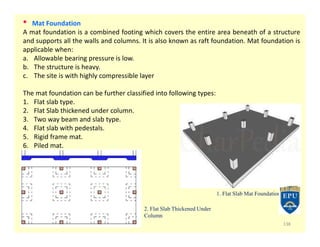
• Mat Foundation
A mat foundation is a combined footing which covers the entire area beneath of a structure
and supports all the walls and columns. It is also known as raft foundation. Mat foundation is
applicable when:
a. Allowable bearing pressure is low.
b. The structure is heavy.
c. The site is with highly compressible layer
The mat foundation can be further classified into following types:
1. Flat slab type.
2. Flat Slab thickened under column.
3. Two way beam and slab type.
4. Flat slab with pedestals.
5. Rigid frame mat.
6. Piled mat.
1. Flat Slab Mat Foundation
2. Flat Slab Thickened Under
Column
Civil Engineering Department Saad.bilbas@epu.edu.iq 139
2. Flat Slab Thickened Under Column
3. Two way beam and slab type
Civil Engineering Department Saad.bilbas@epu.edu.iq 140
4. Flat slab with pedestals
5. Rigid Frame mat
5. Rigid Frame mat
Civil Engineering Department Saad.bilbas@epu.edu.iq 141
6. Piled mat
Civil Engineering Department Saad.bilbas@epu.edu.iq 142
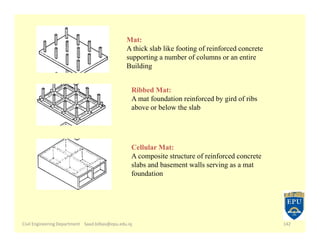
Mat:
A thick slab like footing of reinforced concrete
supporting a number of columns or an entire
Building
Ribbed Mat:
A mat foundation reinforced by gird of ribs
above or below the slab
Cellular Mat:
A composite structure of reinforced concrete
slabs and basement walls serving as a mat
foundation
Civil Engineering Department Saad.bilbas@epu.edu.iq 143
Example
Compute AREA of given footing when
Soil Bearing Capacity= 1.2kg/cm2
Column dimension= (400x400)mm
Load (P)= 1500kN
Solution
BC=
𝟏.𝟏𝚺𝐋𝐨𝐚𝐝𝐬
𝐀𝐫𝐞𝐚
Area=
𝟏.𝟏𝐱𝟏𝟓𝟎𝟎
𝟏𝟐𝟎
Area=11m2
Footing sides=
 
≈ 3.4m
Hence, B=3.4m & A=3.4m
Civil Engineering Department Saad.bilbas@epu.edu.iq 144
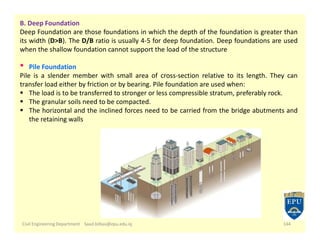
B. Deep Foundation
Deep Foundation are those foundations in which the depth of the foundation is greater than
its width (D>B). The D/B ratio is usually 4-5 for deep foundation. Deep foundations are used
when the shallow foundation cannot support the load of the structure
• Pile Foundation
Pile is a slender member with small area of cross-section relative to its length. They can
transfer load either by friction or by bearing. Pile foundation are used when:
 The load is to be transferred to stronger or less compressible stratum, preferably rock.
 The granular soils need to be compacted.
 The horizontal and the inclined forces need to be carried from the bridge abutments and
the retaining walls
Civil Engineering Department Saad.bilbas@epu.edu.iq 145
Classification of Pile Foundation
The pile foundation can be further classified into following types on various basis such as
 Functions
 material
 method of installation , which are listed below:
Based on Function:
a. Bearing piles
b. Friction piles
c. Combined piles
(Both bearing and friction)
Civil Engineering Department Saad.bilbas@epu.edu.iq 146
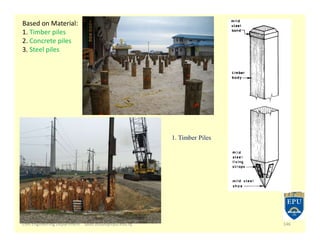
Based on Material:
1. Timber piles
2. Concrete piles
3. Steel piles
1. Timber Piles
Civil Engineering Department Saad.bilbas@epu.edu.iq 147
2. Concrete Piles
Civil Engineering Department Saad.bilbas@epu.edu.iq 148
3. Steel Piles
Civil Engineering Department Saad.bilbas@epu.edu.iq 149
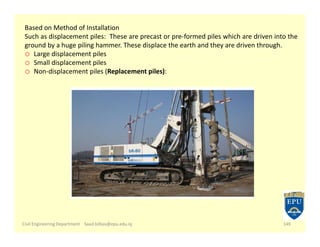
Based on Method of Installation
Such as displacement piles: These are precast or pre-formed piles which are driven into the
ground by a huge piling hammer. These displace the earth and they are driven through.
o Large displacement piles
o Small displacement piles
o Non-displacement piles (Replacement piles):
Civil Engineering Department Saad.bilbas@epu.edu.iq 150
When choosing a piling system for foundation use 4 main things to base a decision on
• The load (or weight) of the building or structure to be supported
• The Cost of piling versus other foundation types
• The physical possibilities of getting very heavy piling equipment to the site without causing
more disruption such as noise or further instability to a structure etc…. than necessary
• The condition of the ground and surrounding strata
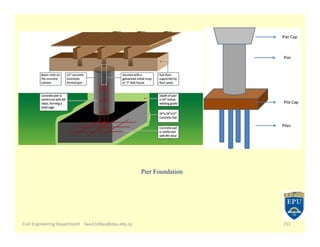
• Pier Foundation
Pier foundation are underground cylindrical structural member that support heavier load of
the structure which shallow foundations cannot resist. Unlike pile foundation, pier foundation
can only transfer load by bearing. Pier foundation are shallower in depth than the pile
foundation. Pier foundation are used when:
a. The top strata is a decomposed rock underlying as sound rock strata
b. The soil is a stiff clay that occurs large resistance for driving the bearing pile
Civil Engineering Department Saad.bilbas@epu.edu.iq 151
Pier Foundation
Civil Engineering Department Saad.bilbas@epu.edu.iq 152
• Well (Caissons) Foundation
The term caisson refers to box or a case. These are hollow inside and are usually constructed at
the site and sunk in place into a hard bearing strata. As they are expensive in construction, they
are usually restricted to major foundation works. Well foundation are suitable when the soil
contains large boulders obstructing the penetration during installation of pier or pile
foundations. Caissons are used for bridge piers, abutments in rivers and lakes and other shore
protection works. They are used to resist heavy vertical and horizontal loads and are used in the
construction of large water front structures as pump houses.
Classification of Well Foundation
1. Open Caissons
2. Pneumatic Caissons
3. Box Caisson
Open Caissons

Foundation

  • 1.
    Civil Engineering DepartmentSaad.bilbas@epu.edu.iq 130
  • 2.
    Civil Engineering DepartmentSaad.bilbas@epu.edu.iq 131 Foundation is defined as that part of the structure that connects and transmits the load from the structure to the ground soil. The solid ground on which the foundation rests is termed as the foundation bed. The foundation transmits the load of the structure and it’s self-weight to the soil such that the ultimate bearing capacity of the soil is not exceeded (the shear failure is not allowable) and the settlement is tolerable. Most of the structure consist of two parts, one above the ground which is known as super structure and the other sub-structure of the foundation which lies below the ground level
  • 3.
    Civil Engineering DepartmentSaad.bilbas@epu.edu.iq 132 Every structures are provide with foundation at the base to fulfill the following objectives and purposes: 1. To distribute the load of the structure over a large bearing area. 2. To load the bearing surface at uniform rate so as to avoid unequal settlement. 3. To prevent the lateral movement of the supporting material. 4. To increase the stability of the structure as a whole  Types of Foundation: A. Shallow Foundation 1. Wall Footing 2. Isolated column/Column Footing 3. Combined Footing 4. Cantilever (Strap) Footing 5. Mat (Raft) Foundation
  • 4.
    Civil Engineering DepartmentSaad.bilbas@epu.edu.iq 133 B. Deep Foundation 1. Pile Foundation 2. Pier Foundation 3. Well (Caissons) Foundation A. Shallow Foundations Are those foundations which the depth is placed less than the width of the foundation (D < B). Shallow foundations are generally termed as spread footing as they transmit the load of the super structure laterally into the ground. • Wall Footing This type of foundation runs continuous along the direction of the wall and helps to transmit the load of the wall into the ground. Wall footing are suitable where loads to be transmitted are small and are economical in dense sands and gravels. In this type of foundation the width is 2-3 times the height of the wall at ground level. Wall footing may be constructed through stone, brick, plain or reinforced cement concrete
  • 5.
    Civil Engineering DepartmentSaad.bilbas@epu.edu.iq 134 Example Compute B of the given Wall footing when when Soil Bearing Capacity= 1.5kg/cm2 Thickness of wall (tw)= 400mm Height of wall (hw)= 1700mm Load (W)= 200KN/m BC= 𝟏.𝟏𝚺𝐋𝐨𝐚𝐝𝐬 𝐀𝐫𝐞𝐚 BC= 𝟏.𝟏𝚺𝑳𝒐𝒂𝒅 𝒔𝒆𝒍𝒇 𝒘𝒆𝒊𝒈𝒉𝒕 𝒐𝒇 𝑾𝒂𝒍𝒍 𝐀𝐫𝐞𝐚 Weight wall= 0.4x1.7x1x24 KN/m3 = 16.32KN B*1= 𝟏.𝟏(𝟐𝟎𝟎 𝟏𝟔.𝟑) 𝟏𝟓𝟎 B= 1.5862m ≈ 1.6m So B=1.6m
  • 6.
    Civil Engineering DepartmentSaad.bilbas@epu.edu.iq 135 • Column Footing or Isolated Footing Column footings are suitable and economical for the depth greater than 1.5m. In this type of foundation the base of the column is enlarged. Column footing is in the form of flat slab and may be constructed through plain or reinforced concert.
  • 7.
    Civil Engineering DepartmentSaad.bilbas@epu.edu.iq 136 • Combined Footing Combined footings are those foundations that are made common for two or more columns in a row. It is used when the footing for a column may extend beyond the property line. It is also suitable when the two columns are closely spaced and the soil on which the structure resist is of low bearing capacity. It may be rectangular or trapezoidal in shape.
  • 8.
    Civil Engineering DepartmentSaad.bilbas@epu.edu.iq 137 • Strap Footing or Cantilever Footing When an edge footing cannot be extended beyond the property line so the edge footing is linked up with the other interior footing by means of a strap beam. Such footings are called as strap footing. It is also known as cantilever footing.
  • 9.
    Civil Engineering DepartmentSaad.bilbas@epu.edu.iq 138 • Mat Foundation A mat foundation is a combined footing which covers the entire area beneath of a structure and supports all the walls and columns. It is also known as raft foundation. Mat foundation is applicable when: a. Allowable bearing pressure is low. b. The structure is heavy. c. The site is with highly compressible layer The mat foundation can be further classified into following types: 1. Flat slab type. 2. Flat Slab thickened under column. 3. Two way beam and slab type. 4. Flat slab with pedestals. 5. Rigid frame mat. 6. Piled mat. 1. Flat Slab Mat Foundation 2. Flat Slab Thickened Under Column
  • 10.
    Civil Engineering DepartmentSaad.bilbas@epu.edu.iq 139 2. Flat Slab Thickened Under Column 3. Two way beam and slab type
  • 11.
    Civil Engineering DepartmentSaad.bilbas@epu.edu.iq 140 4. Flat slab with pedestals 5. Rigid Frame mat 5. Rigid Frame mat
  • 12.
    Civil Engineering DepartmentSaad.bilbas@epu.edu.iq 141 6. Piled mat
  • 13.
    Civil Engineering DepartmentSaad.bilbas@epu.edu.iq 142 Mat: A thick slab like footing of reinforced concrete supporting a number of columns or an entire Building Ribbed Mat: A mat foundation reinforced by gird of ribs above or below the slab Cellular Mat: A composite structure of reinforced concrete slabs and basement walls serving as a mat foundation
  • 14.
    Civil Engineering DepartmentSaad.bilbas@epu.edu.iq 143 Example Compute AREA of given footing when Soil Bearing Capacity= 1.2kg/cm2 Column dimension= (400x400)mm Load (P)= 1500kN Solution BC= 𝟏.𝟏𝚺𝐋𝐨𝐚𝐝𝐬 𝐀𝐫𝐞𝐚 Area= 𝟏.𝟏𝐱𝟏𝟓𝟎𝟎 𝟏𝟐𝟎 Area=11m2 Footing sides=   ≈ 3.4m Hence, B=3.4m & A=3.4m
  • 15.
    Civil Engineering DepartmentSaad.bilbas@epu.edu.iq 144 B. Deep Foundation Deep Foundation are those foundations in which the depth of the foundation is greater than its width (D>B). The D/B ratio is usually 4-5 for deep foundation. Deep foundations are used when the shallow foundation cannot support the load of the structure • Pile Foundation Pile is a slender member with small area of cross-section relative to its length. They can transfer load either by friction or by bearing. Pile foundation are used when:  The load is to be transferred to stronger or less compressible stratum, preferably rock.  The granular soils need to be compacted.  The horizontal and the inclined forces need to be carried from the bridge abutments and the retaining walls
  • 16.
    Civil Engineering DepartmentSaad.bilbas@epu.edu.iq 145 Classification of Pile Foundation The pile foundation can be further classified into following types on various basis such as  Functions  material  method of installation , which are listed below: Based on Function: a. Bearing piles b. Friction piles c. Combined piles (Both bearing and friction)
  • 17.
    Civil Engineering DepartmentSaad.bilbas@epu.edu.iq 146 Based on Material: 1. Timber piles 2. Concrete piles 3. Steel piles 1. Timber Piles
  • 18.
    Civil Engineering DepartmentSaad.bilbas@epu.edu.iq 147 2. Concrete Piles
  • 19.
    Civil Engineering DepartmentSaad.bilbas@epu.edu.iq 148 3. Steel Piles
  • 20.
    Civil Engineering DepartmentSaad.bilbas@epu.edu.iq 149 Based on Method of Installation Such as displacement piles: These are precast or pre-formed piles which are driven into the ground by a huge piling hammer. These displace the earth and they are driven through. o Large displacement piles o Small displacement piles o Non-displacement piles (Replacement piles):
  • 21.
    Civil Engineering DepartmentSaad.bilbas@epu.edu.iq 150 When choosing a piling system for foundation use 4 main things to base a decision on • The load (or weight) of the building or structure to be supported • The Cost of piling versus other foundation types • The physical possibilities of getting very heavy piling equipment to the site without causing more disruption such as noise or further instability to a structure etc…. than necessary • The condition of the ground and surrounding strata • Pier Foundation Pier foundation are underground cylindrical structural member that support heavier load of the structure which shallow foundations cannot resist. Unlike pile foundation, pier foundation can only transfer load by bearing. Pier foundation are shallower in depth than the pile foundation. Pier foundation are used when: a. The top strata is a decomposed rock underlying as sound rock strata b. The soil is a stiff clay that occurs large resistance for driving the bearing pile
  • 22.
    Civil Engineering DepartmentSaad.bilbas@epu.edu.iq 151 Pier Foundation
  • 23.
    Civil Engineering DepartmentSaad.bilbas@epu.edu.iq 152 • Well (Caissons) Foundation The term caisson refers to box or a case. These are hollow inside and are usually constructed at the site and sunk in place into a hard bearing strata. As they are expensive in construction, they are usually restricted to major foundation works. Well foundation are suitable when the soil contains large boulders obstructing the penetration during installation of pier or pile foundations. Caissons are used for bridge piers, abutments in rivers and lakes and other shore protection works. They are used to resist heavy vertical and horizontal loads and are used in the construction of large water front structures as pump houses. Classification of Well Foundation 1. Open Caissons 2. Pneumatic Caissons 3. Box Caisson Open Caissons