PES’s MCOP, nigdi, pune
(Academic year 2020-21)
F. Y. M. Pharm. (Semester 1)
Composition & formulation methods of
transdermal patches
Demonstrated by:
Shraddha R. Lakambare
Table of contents
1) Introduction to transdermal patch
2) Selection of drug for transdermal drug delivery system (TDDS)
3) Components require to formulate transdermal patch
• Backing layer/ laminate
• Polymer
• Drug
• Adhesive
• Plasticizers
• Rate controlling membrane
• Release liner
• Permeation enhancers
5) Types of transdermal patches
• Membrane permeation controlled system (drug in reservoir)
• Matrix diffusion system (drug in matrix)
• Adhesive dispersion system (Drug in adhesive)
• Microreservoir system (Drug in microreservoir)
6) Various trandermal patches approved by USFDA
4) Methods for the preparation of
transdermal patches
• Asymmetric TPX membrane method
• Circular Teflon mould method
• Mercury substrate method
• IPM membranes method
• EVAC membranes method
• Aluminium backed adhesive film method
Introduction to transdermal patch
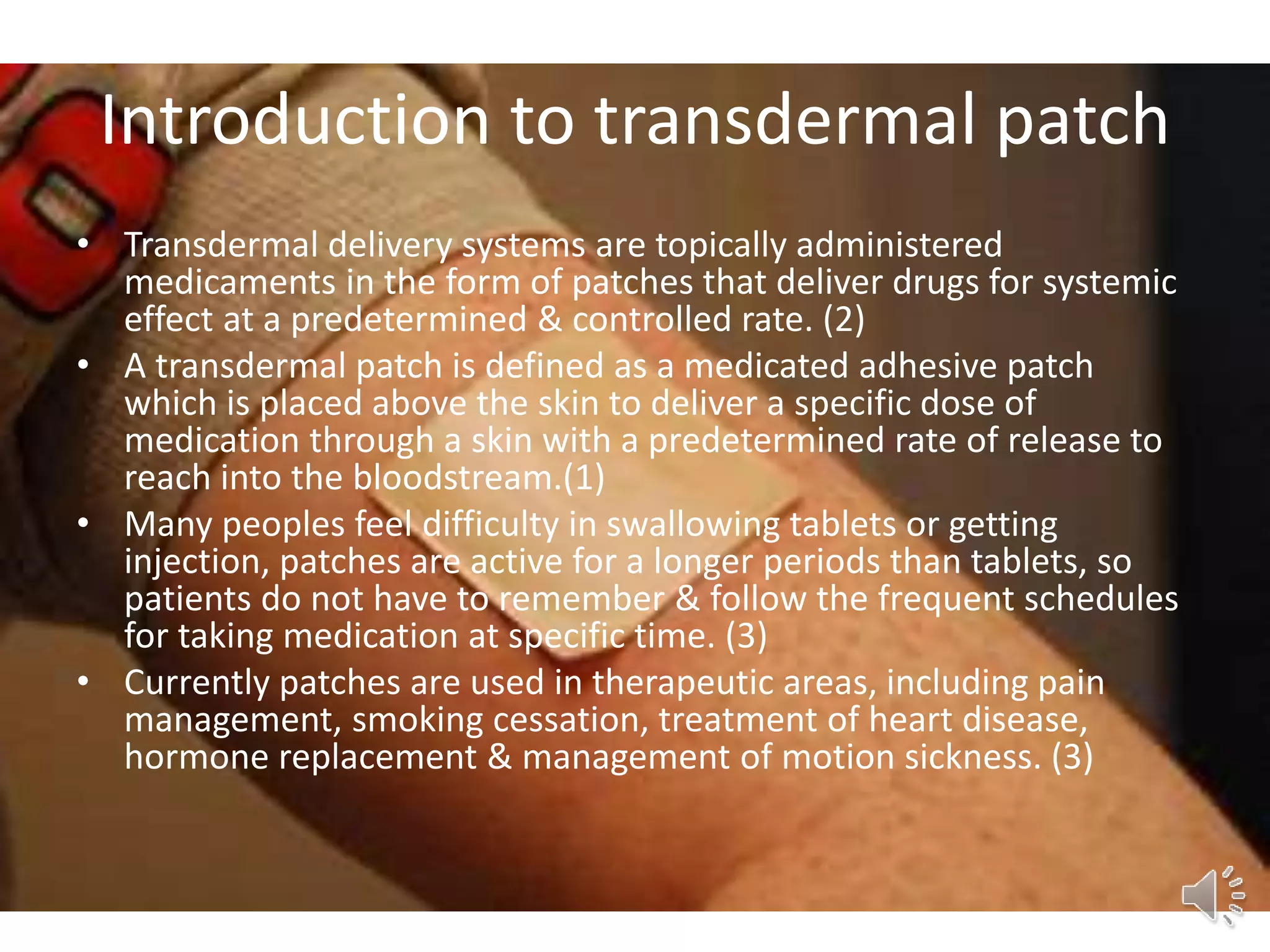
• Transdermal delivery systems are topically administered
medicaments in the form of patches that deliver drugs for systemic
effect at a predetermined & controlled rate. (2)
• A transdermal patch is defined as a medicated adhesive patch
which is placed above the skin to deliver a specific dose of
medication through a skin with a predetermined rate of release to
reach into the bloodstream.(1)
• Many peoples feel difficulty in swallowing tablets or getting
injection, patches are active for a longer periods than tablets, so
patients do not have to remember & follow the frequent schedules
for taking medication at specific time. (3)
• Currently patches are used in therapeutic areas, including pain
management, smoking cessation, treatment of heart disease,
hormone replacement & management of motion sickness. (3)
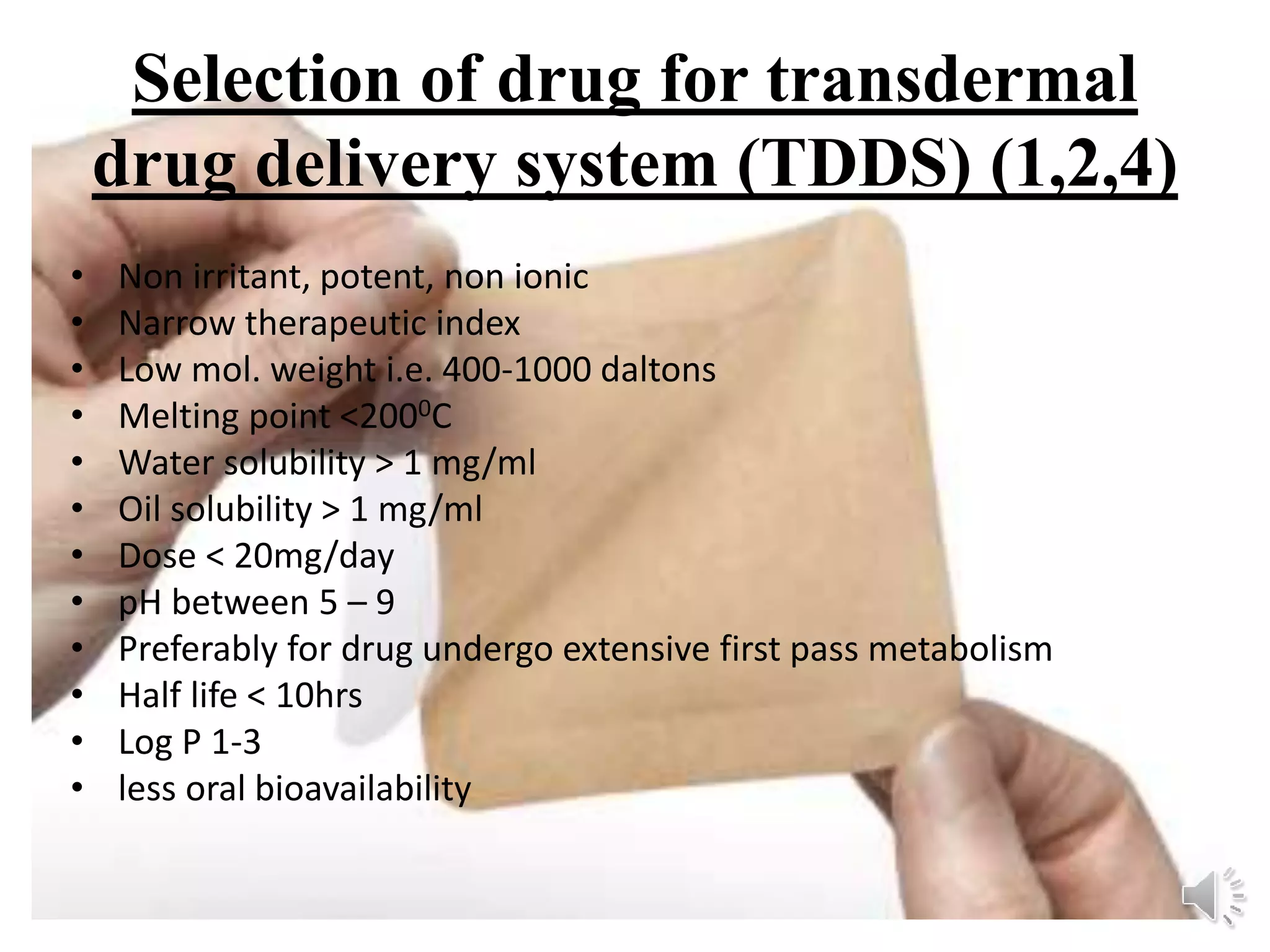
Selection of drug for transdermal
drug delivery system (TDDS) (1,2,4)
• Non irritant, potent, non ionic
• Narrow therapeutic index
• Low mol. weight i.e. 400-1000 daltons
• Melting point <2000C
• Water solubility > 1 mg/ml
• Oil solubility > 1 mg/ml
• Dose < 20mg/day
• pH between 5 – 9
• Preferably for drug undergo extensive first pass metabolism
• Half life < 10hrs
• Log P 1-3
• less oral bioavailability
Backing layer/ laminate
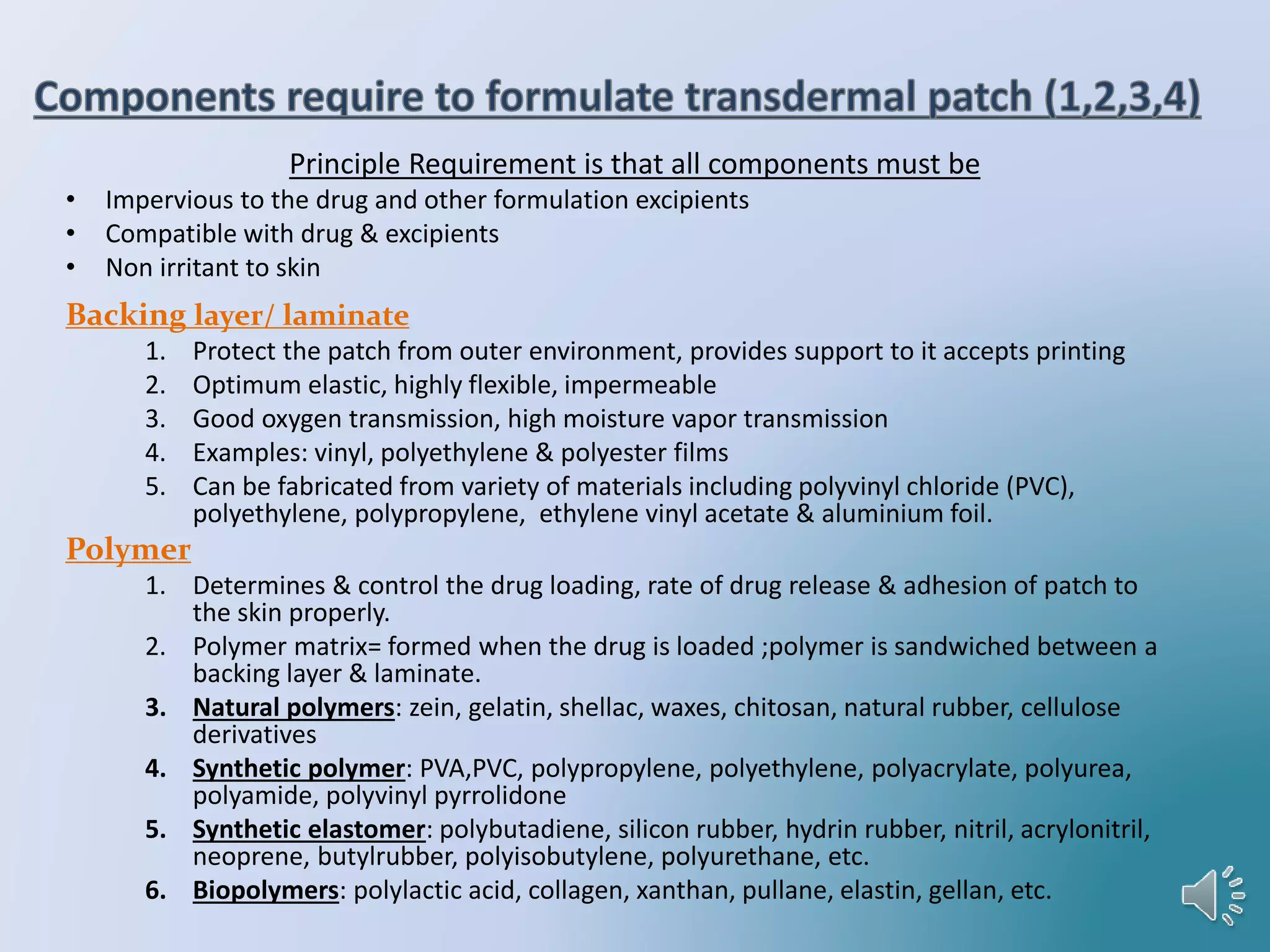
1. Protect the patch from outer environment, provides support to it accepts printing
2. Optimum elastic, highly flexible, impermeable
3. Good oxygen transmission, high moisture vapor transmission
4. Examples: vinyl, polyethylene & polyester films
5. Can be fabricated from variety of materials including polyvinyl chloride (PVC),
polyethylene, polypropylene, ethylene vinyl acetate & aluminium foil.
Polymer
1. Determines & control the drug loading, rate of drug release & adhesion of patch to
the skin properly.
2. Polymer matrix= formed when the drug is loaded ;polymer is sandwiched between a
backing layer & laminate.
3. Natural polymers: zein, gelatin, shellac, waxes, chitosan, natural rubber, cellulose
derivatives
4. Synthetic polymer: PVA,PVC, polypropylene, polyethylene, polyacrylate, polyurea,
polyamide, polyvinyl pyrrolidone
5. Synthetic elastomer: polybutadiene, silicon rubber, hydrin rubber, nitril, acrylonitril,
neoprene, butylrubber, polyisobutylene, polyurethane, etc.
6. Biopolymers: polylactic acid, collagen, xanthan, pullane, elastin, gellan, etc.
Principle Requirement is that all components must be
• Impervious to the drug and other formulation excipients
• Compatible with drug & excipients
• Non irritant to skin
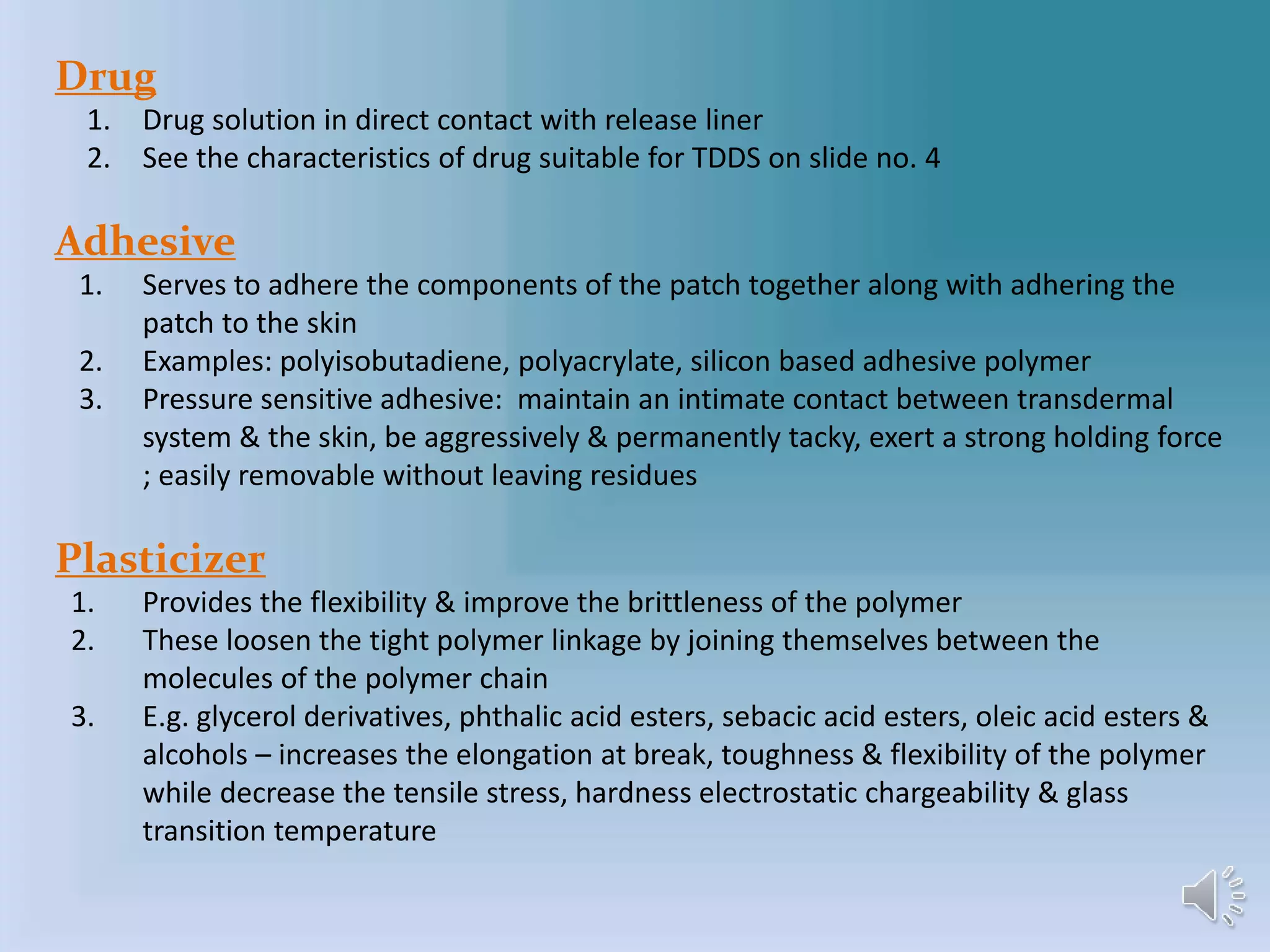
Drug
1. Drug solution in direct contact with release liner
2. See the characteristics of drug suitable for TDDS on slide no. 4
Adhesive
1. Serves to adhere the components of the patch together along with adhering the
patch to the skin
2. Examples: polyisobutadiene, polyacrylate, silicon based adhesive polymer
3. Pressure sensitive adhesive: maintain an intimate contact between transdermal
system & the skin, be aggressively & permanently tacky, exert a strong holding force
; easily removable without leaving residues
Plasticizer
1. Provides the flexibility & improve the brittleness of the polymer
2. These loosen the tight polymer linkage by joining themselves between the
molecules of the polymer chain
3. E.g. glycerol derivatives, phthalic acid esters, sebacic acid esters, oleic acid esters &
alcohols – increases the elongation at break, toughness & flexibility of the polymer
while decrease the tensile stress, hardness electrostatic chargeability & glass
transition temperature
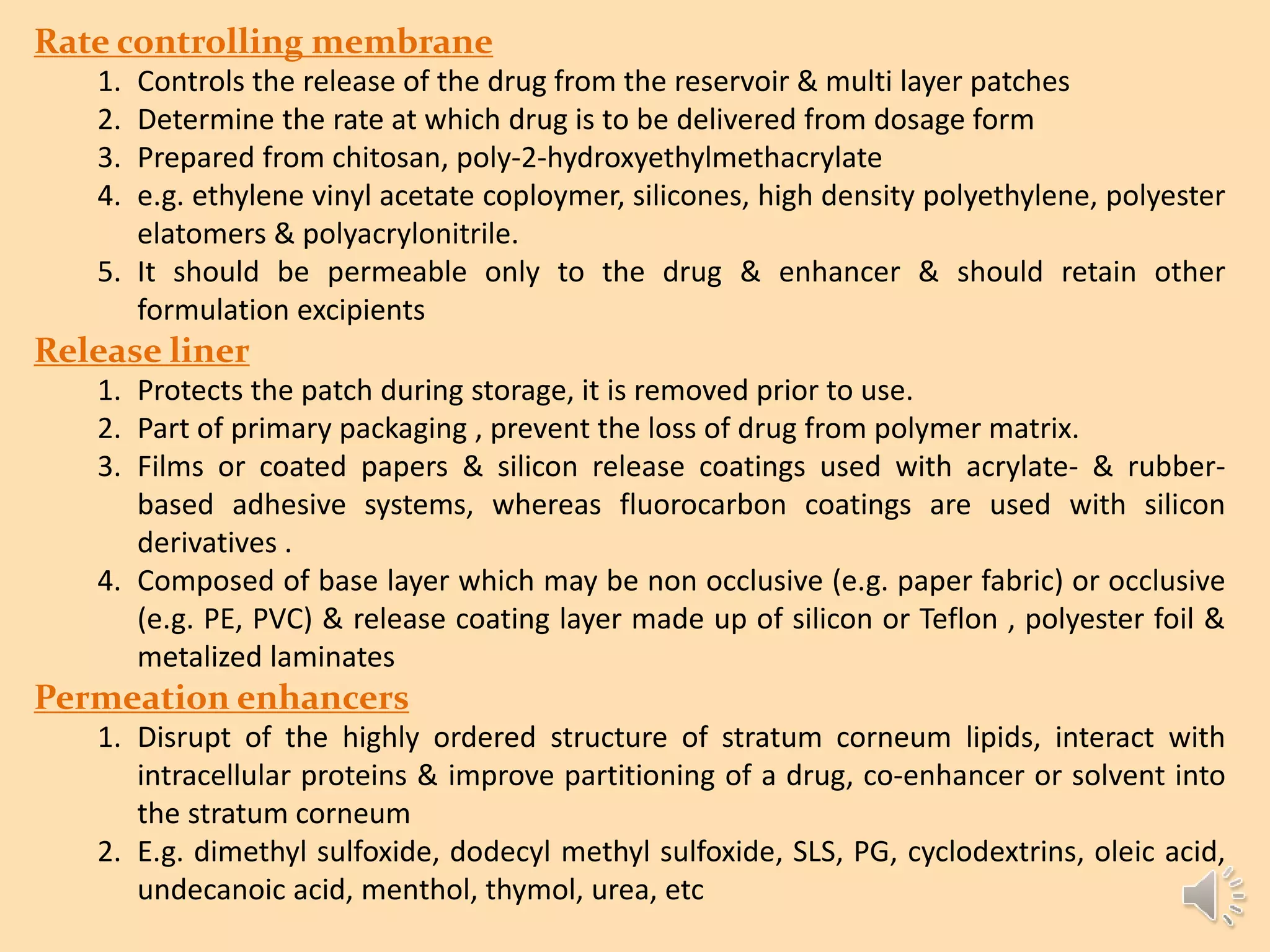
Rate controlling membrane
1. Controls the release of the drug from the reservoir & multi layer patches
2. Determine the rate at which drug is to be delivered from dosage form
3. Prepared from chitosan, poly-2-hydroxyethylmethacrylate
4. e.g. ethylene vinyl acetate coploymer, silicones, high density polyethylene, polyester
elatomers & polyacrylonitrile.
5. It should be permeable only to the drug & enhancer & should retain other
formulation excipients
Release liner
1. Protects the patch during storage, it is removed prior to use.
2. Part of primary packaging , prevent the loss of drug from polymer matrix.
3. Films or coated papers & silicon release coatings used with acrylate- & rubber-
based adhesive systems, whereas fluorocarbon coatings are used with silicon
derivatives .
4. Composed of base layer which may be non occlusive (e.g. paper fabric) or occlusive
(e.g. PE, PVC) & release coating layer made up of silicon or Teflon , polyester foil &
metalized laminates
Permeation enhancers
1. Disrupt of the highly ordered structure of stratum corneum lipids, interact with
intracellular proteins & improve partitioning of a drug, co-enhancer or solvent into
the stratum corneum
2. E.g. dimethyl sulfoxide, dodecyl methyl sulfoxide, SLS, PG, cyclodextrins, oleic acid,
undecanoic acid, menthol, thymol, urea, etc
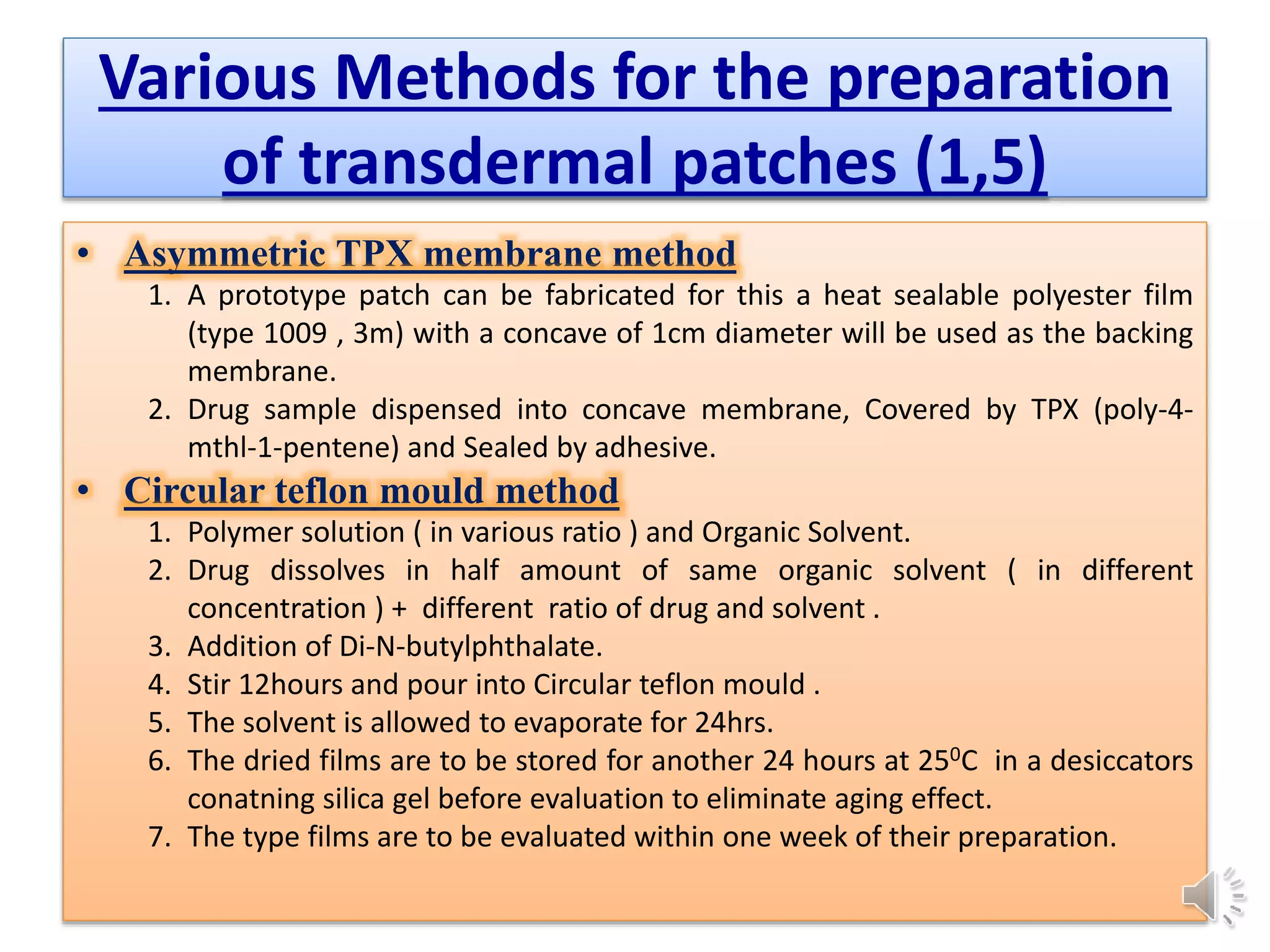
Various Methods for the preparation
of transdermal patches (1,5)
• Asymmetric TPX membrane method
1. A prototype patch can be fabricated for this a heat sealable polyester film
(type 1009 , 3m) with a concave of 1cm diameter will be used as the backing
membrane.
2. Drug sample dispensed into concave membrane, Covered by TPX (poly-4-
mthl-1-pentene) and Sealed by adhesive.
• Circular teflon mould method
1. Polymer solution ( in various ratio ) and Organic Solvent.
2. Drug dissolves in half amount of same organic solvent ( in different
concentration ) + different ratio of drug and solvent .
3. Addition of Di-N-butylphthalate.
4. Stir 12hours and pour into Circular teflon mould .
5. The solvent is allowed to evaporate for 24hrs.
6. The dried films are to be stored for another 24 hours at 250C in a desiccators
conatning silica gel before evaluation to eliminate aging effect.
7. The type films are to be evaluated within one week of their preparation.
• Mercury substrate method
1. Drug is dissolve in polymer solution along with plasticizer
2. Stir for 10-15 min to produce a homogeneous dispersion
3. Pour it into a leveled mercury surface, covered with
inverted funnel to control solvent evaporation
• IPM membrane method
1. drug is dispersed in a mixture of water and propylene
glycol containing carbomer 940 polymer
2. Stir for 12 hrs in magnetic stirrer
3. Dispersion is to be neutralized & made viscous by the
addition of triethanolamine
4. Buffer pH 7.4 can be used in order to obtain solution gel
5. The formed gel will be incorporated in the IPM membrane
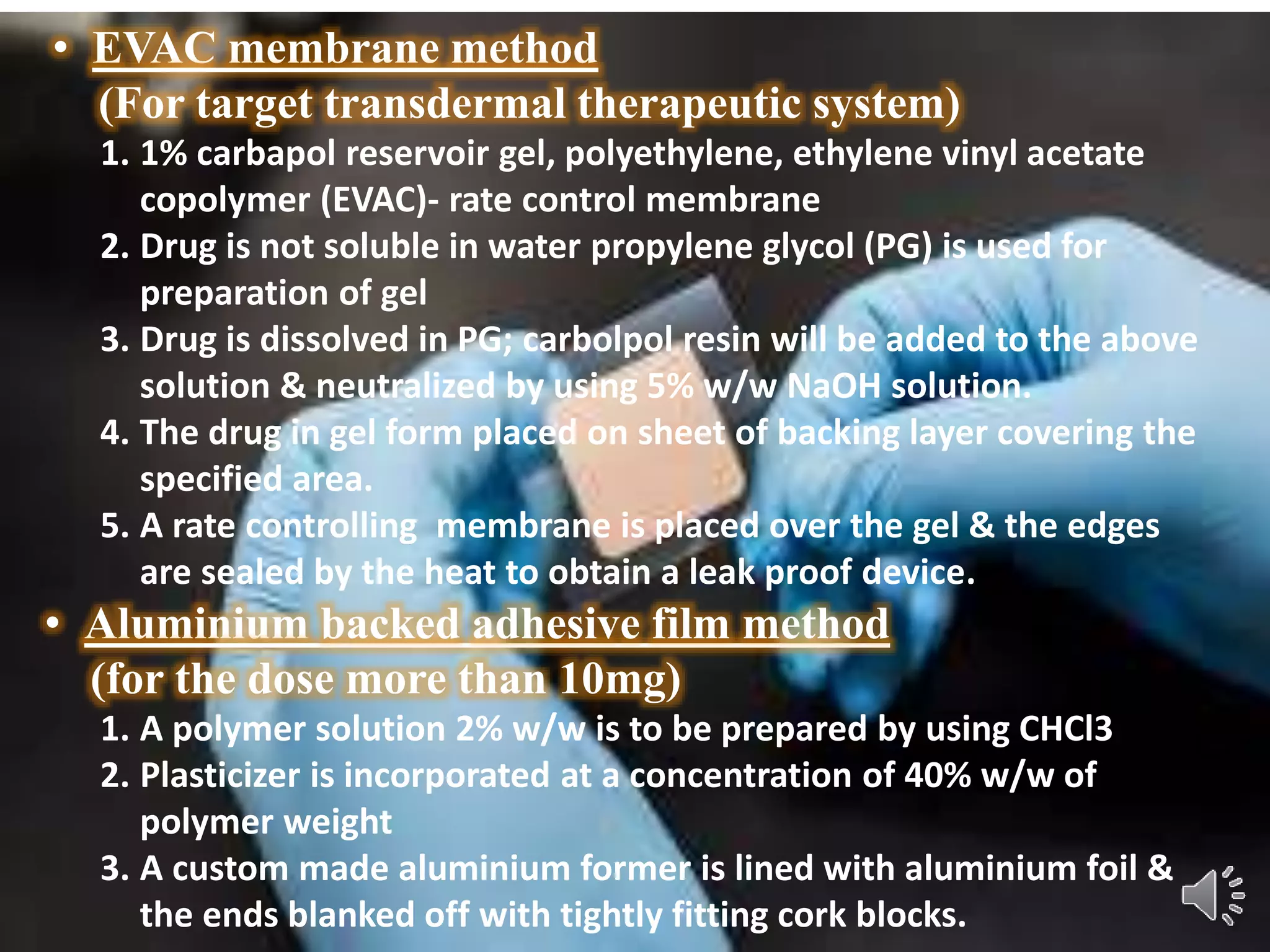
• EVAC membrane method
(For target transdermal therapeutic system)
1. 1% carbapol reservoir gel, polyethylene, ethylene vinyl acetate
copolymer (EVAC)- rate control membrane
2. Drug is not soluble in water propylene glycol (PG) is used for
preparation of gel
3. Drug is dissolved in PG; carbolpol resin will be added to the above
solution & neutralized by using 5% w/w NaOH solution.
4. The drug in gel form placed on sheet of backing layer covering the
specified area.
5. A rate controlling membrane is placed over the gel & the edges
are sealed by the heat to obtain a leak proof device.
• Aluminium backed adhesive film method
(for the dose more than 10mg)
1. A polymer solution 2% w/w is to be prepared by using CHCl3
2. Plasticizer is incorporated at a concentration of 40% w/w of
polymer weight
3. A custom made aluminium former is lined with aluminium foil &
the ends blanked off with tightly fitting cork blocks.
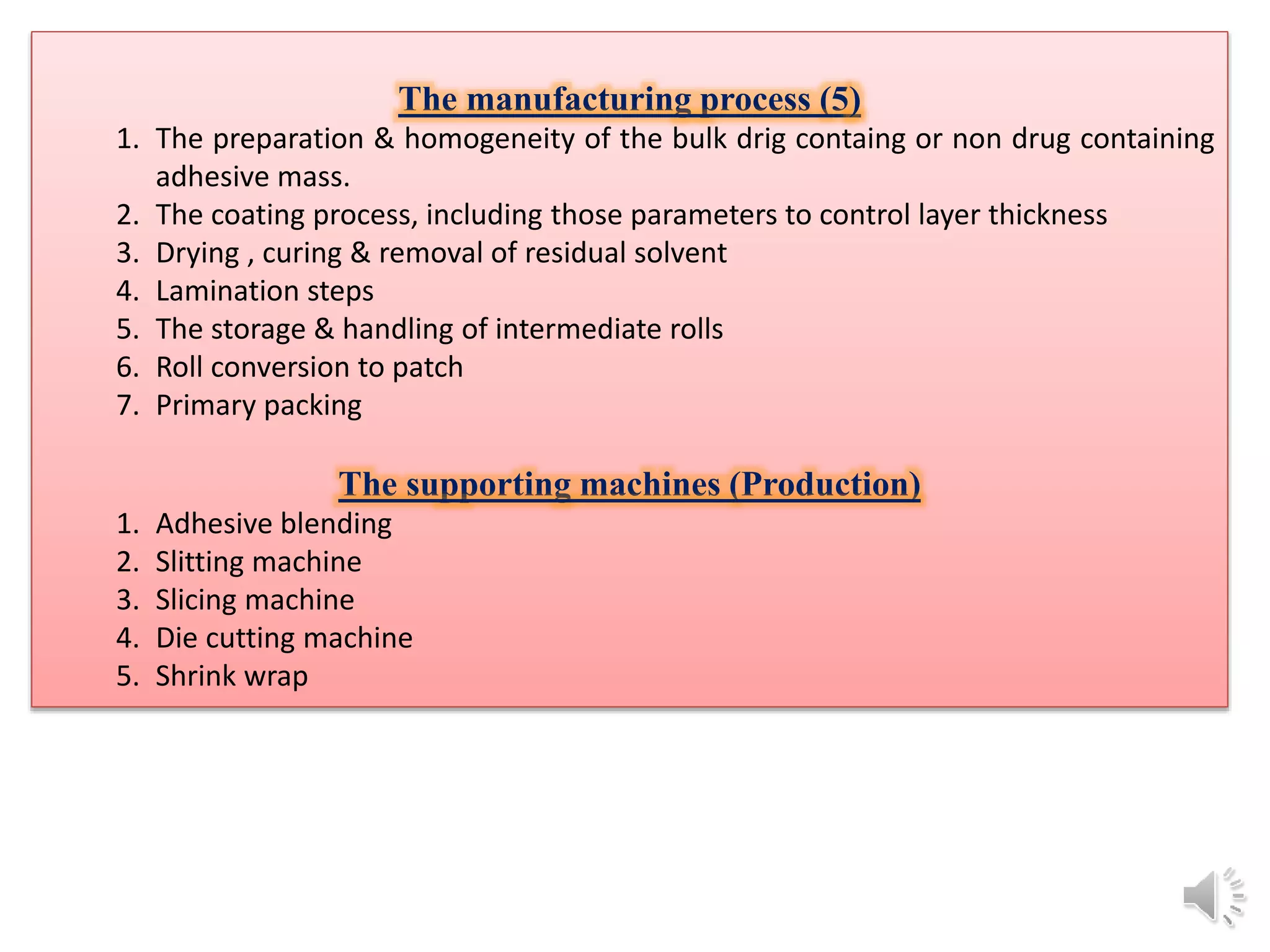
The manufacturing process (5)
1. The preparation & homogeneity of the bulk drig containg or non drug containing
adhesive mass.
2. The coating process, including those parameters to control layer thickness
3. Drying , curing & removal of residual solvent
4. Lamination steps
5. The storage & handling of intermediate rolls
6. Roll conversion to patch
7. Primary packing
The supporting machines (Production)
1. Adhesive blending
2. Slitting machine
3. Slicing machine
4. Die cutting machine
5. Shrink wrap
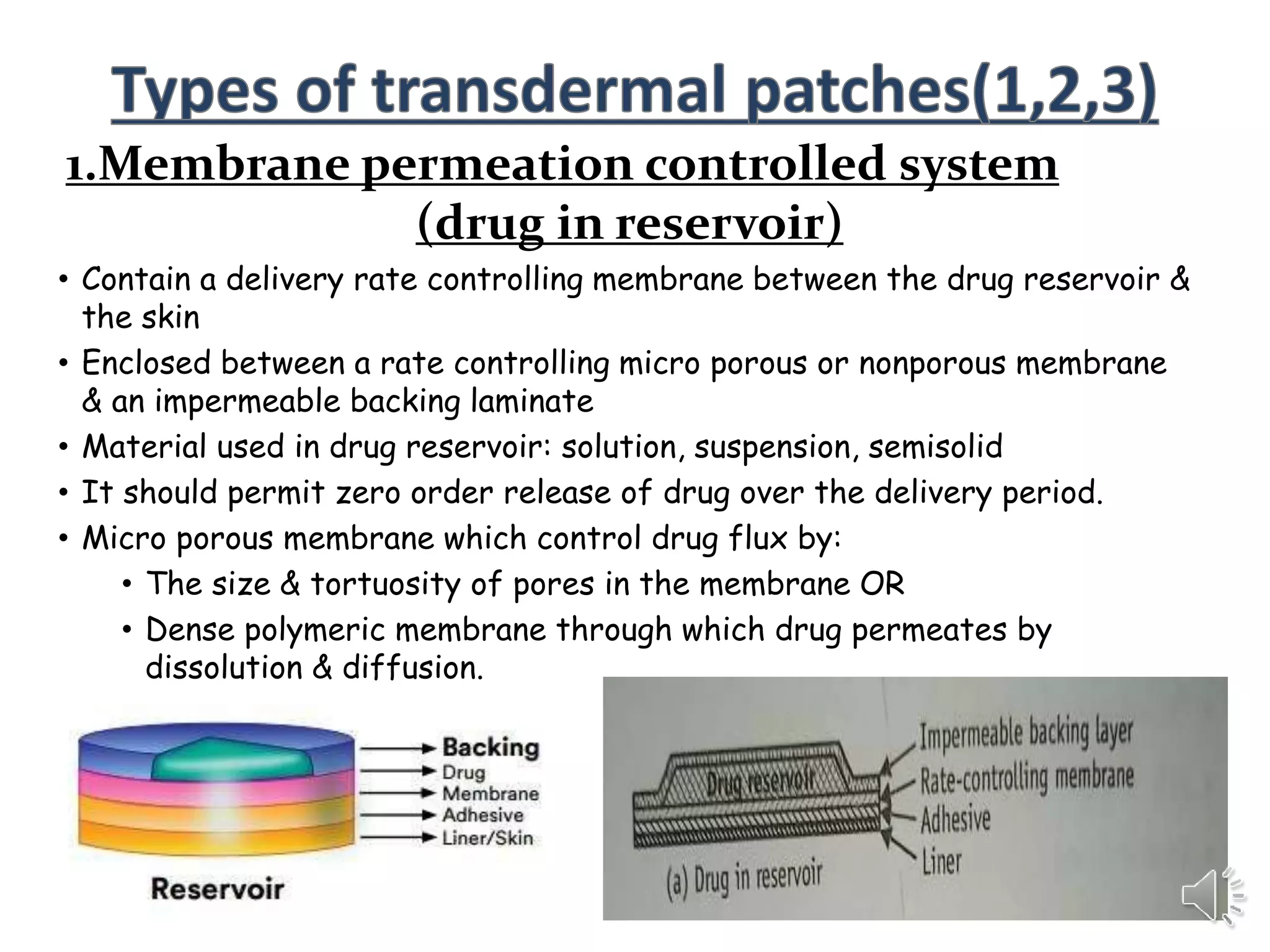
1.Membrane permeation controlled system
(drug in reservoir)
• Contain a delivery rate controlling membrane between the drug reservoir &
the skin
• Enclosed between a rate controlling micro porous or nonporous membrane
& an impermeable backing laminate
• Material used in drug reservoir: solution, suspension, semisolid
• It should permit zero order release of drug over the delivery period.
• Micro porous membrane which control drug flux by:
• The size & tortuosity of pores in the membrane OR
• Dense polymeric membrane through which drug permeates by
dissolution & diffusion.
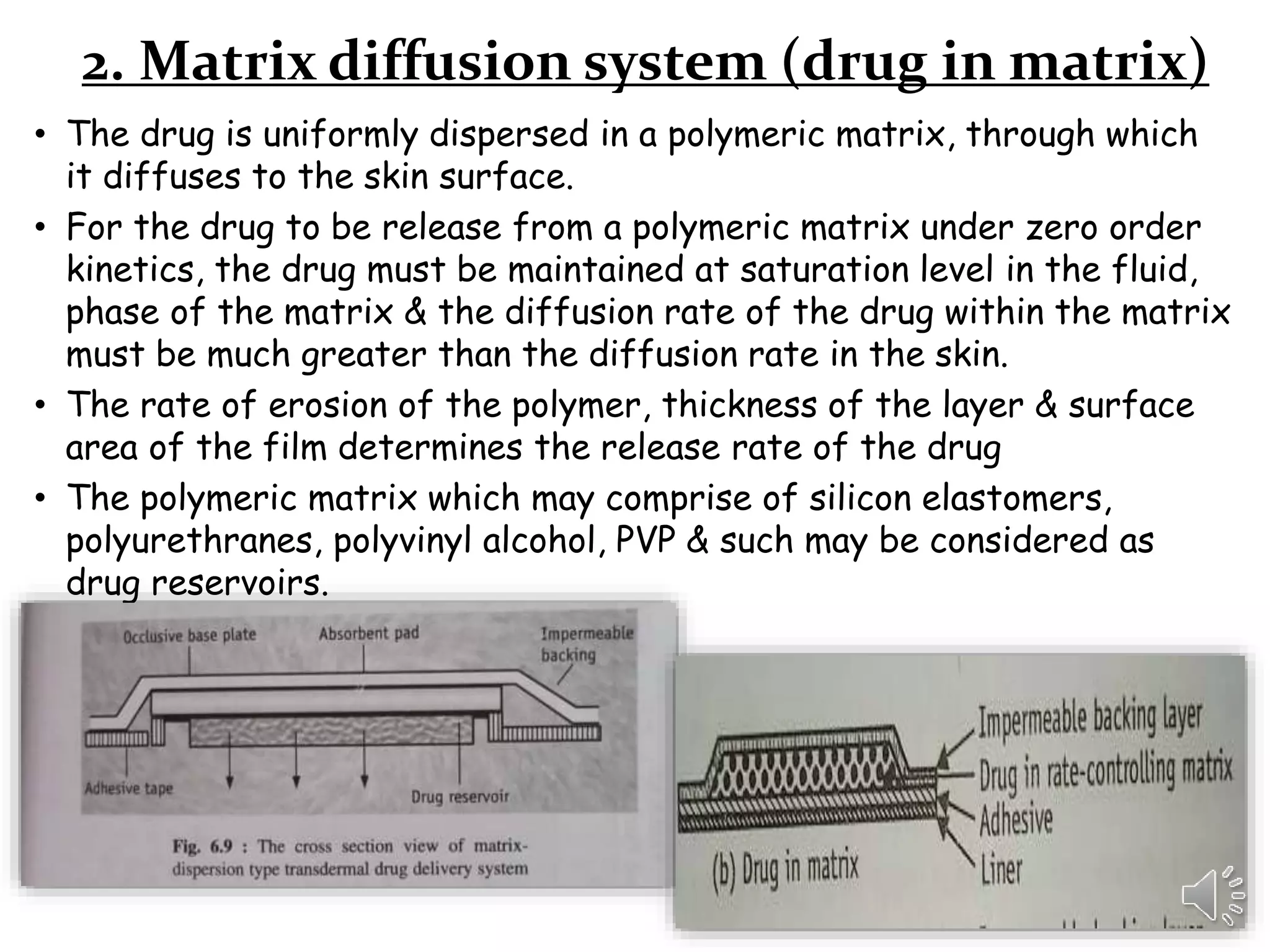
2. Matrix diffusion system (drug in matrix)
• The drug is uniformly dispersed in a polymeric matrix, through which
it diffuses to the skin surface.
• For the drug to be release from a polymeric matrix under zero order
kinetics, the drug must be maintained at saturation level in the fluid,
phase of the matrix & the diffusion rate of the drug within the matrix
must be much greater than the diffusion rate in the skin.
• The rate of erosion of the polymer, thickness of the layer & surface
area of the film determines the release rate of the drug
• The polymeric matrix which may comprise of silicon elastomers,
polyurethranes, polyvinyl alcohol, PVP & such may be considered as
drug reservoirs.
1) drug is dispersed in an insoluble matrix of rigid non swellable hydrophobic
material. Materials used for rigid matrix are insoluble plastics such as PVC
and fatty and materials like stearic and beeswax.
2) With the plastic materials the drug is generally kneaded with the solution of
Polyvinyl chloride in an organic solvent and granulated waxy matrix is
prepared by dispersing the drug in molten fat followed by congealing.
3) The granules are then compressed into tablets swellable matrix system are
popular for sustaining the release of highly water soluble drug.
4) The material for such matrices are generally hydrophilic gums and may be of
natural origin (guar gum, tragacanth) semi synthetic (HPMC, CMC) or
synthetic (poly acryamides).
5) The drug and the gum are granulated together with a solvent such as alcohol
and compressed into tablets.
6) The release of drug from such initially dehydrated hydro gels involves
simultaneous absorption of water and desorption of drug via a swelling
controlled diffusion mechanism. The gum swells and the drug diffuse out of it
the swollen mass devoid of drug appears transport.
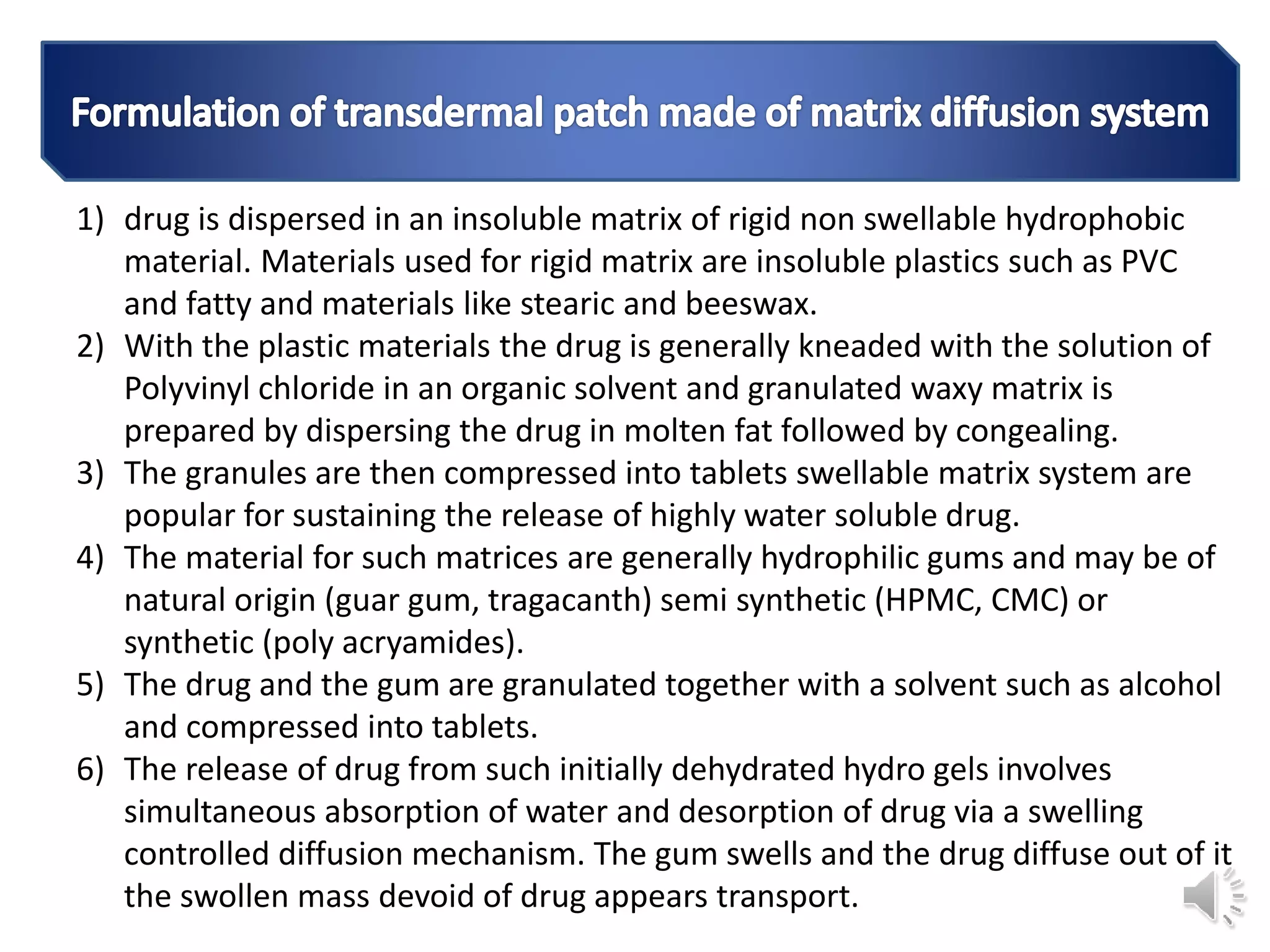
Dissociation of the drug
molecule from the crystal
lattice
Solubilization / partitioning of
the drug in polymer matrix
Diffusion of the drug molecules
through the matrix to the
surface of the skin
Several steps involved in drug delivery process :
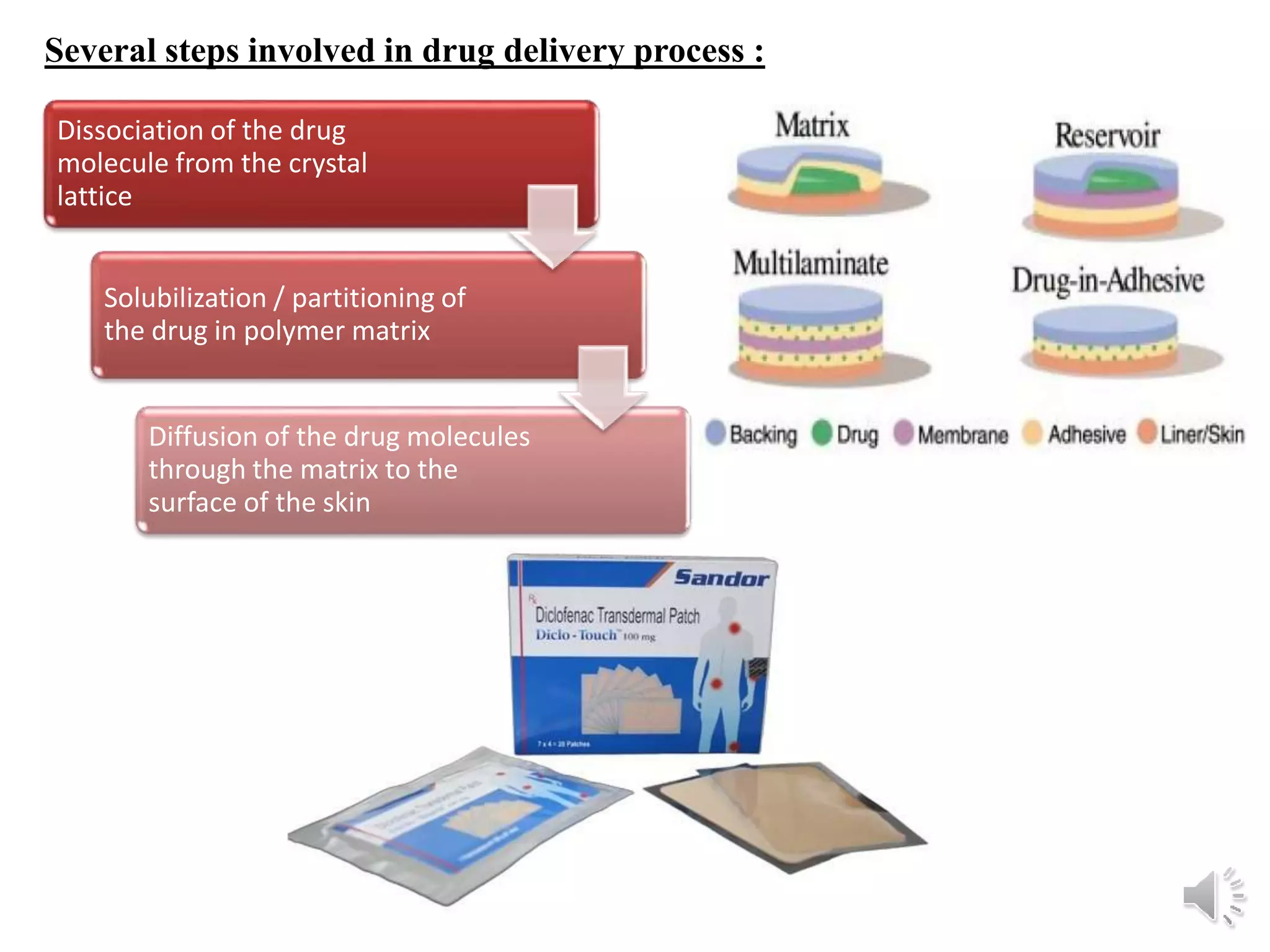
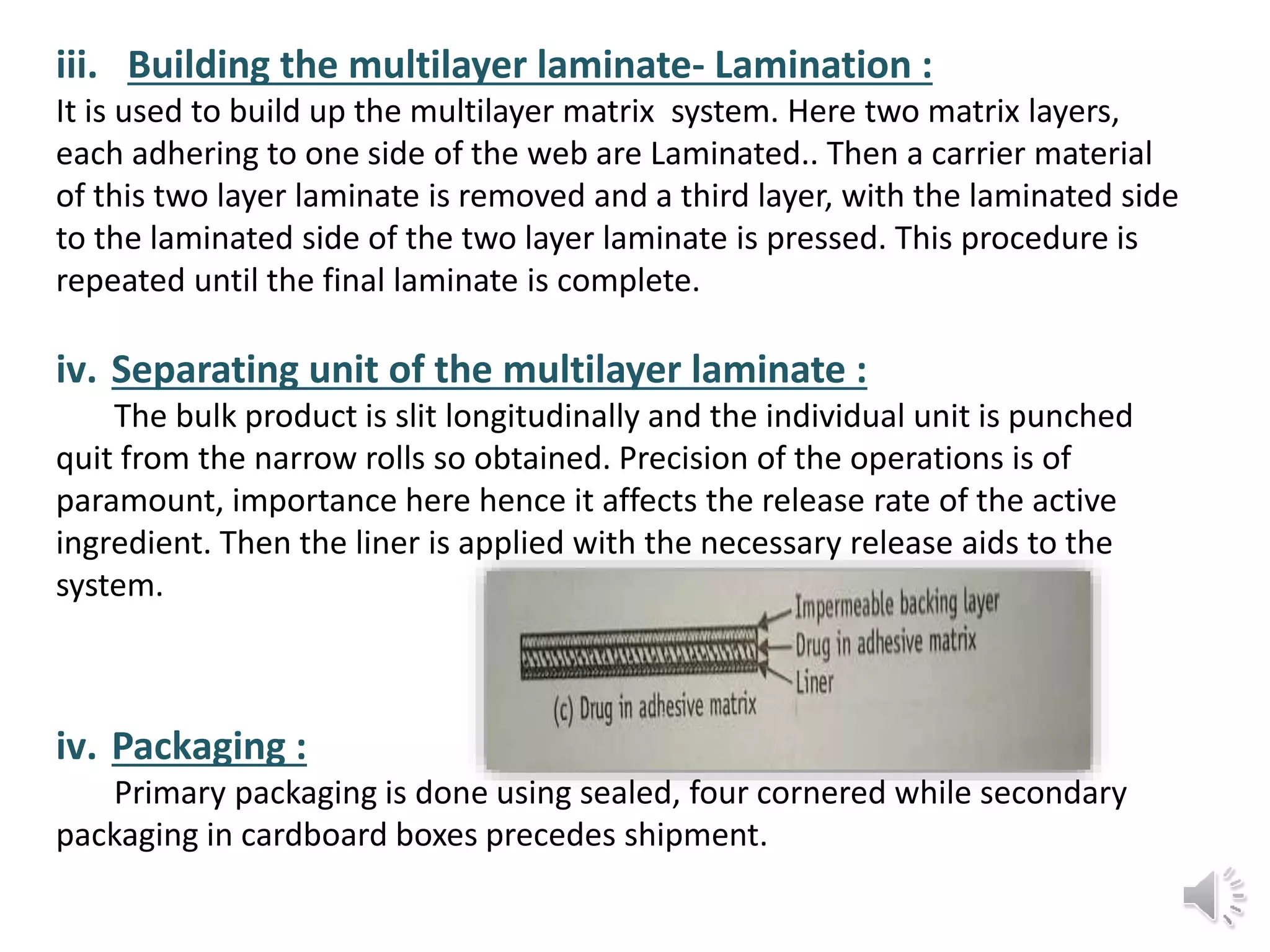
3. Adhesive dispersion system
(Drug in adhesive)
• Simplest system
• It involve formulating drug, & enhancer if present, in an adhesive mixture
that is subsequently coated on to a backing membrane, such as a
polyester film, to produce an adhesive tape.
• In a single layer patch- a single drug in adhesive layer is present
• In multilayer patch, one layer for immediate release of drug & other layer
is for controlled release of drug
These systems can be divided into following parts :
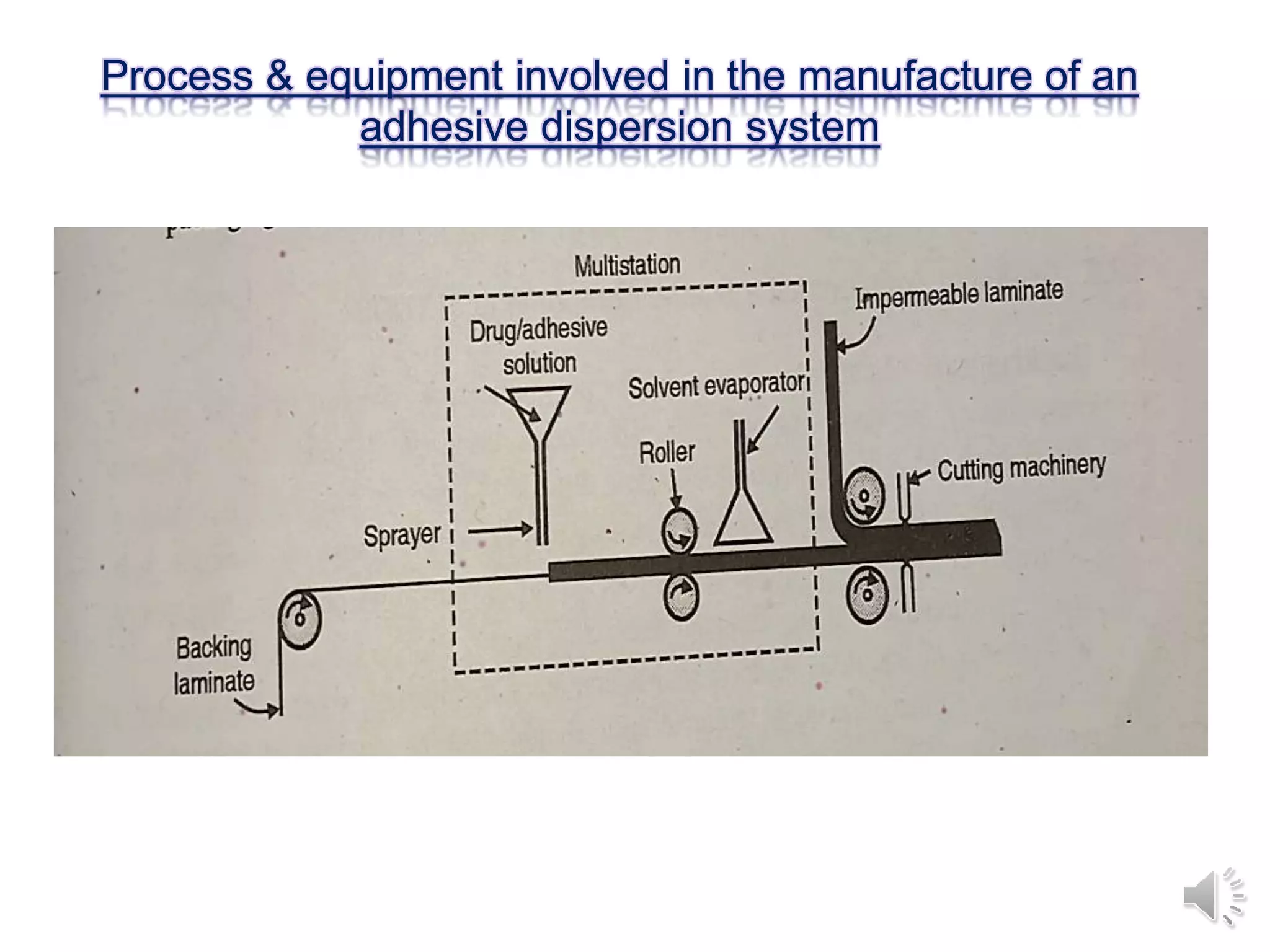
i. Preparation of individual matrix solution :
Raw material [Polymer, tackifier, softening agent) is dissolved in an organic
solvent to obtain a standard or stock soln. The matrix solution then prepared from
the stock solution by mixing it with ingredients specified by the formulation. The
active ingredient and other non-soluble additives are added.
i. Coating the individual matrix layers :
A. The individual layers are made by coating the solution (above). On the
smooth paper or film web and removing the solvent by drying using
coating machine.
B. This machine consists of two units
a. Coating unit : The solvent based formulations are coated depending
on the viscosity, solid contents, flow ability and surface tension of the
matrix solution.
b. Drying unit : Closed to the environment and is directly connected to
the drying unit to avoid solvent. The solvent is evaporated from the
adhesive mass by running the coated web through a drying channel
using a transport system like cranked shaft, conveyor belt.
iii. Building the multilayer laminate- Lamination :
It is used to build up the multilayer matrix system. Here two matrix layers,
each adhering to one side of the web are Laminated.. Then a carrier material
of this two layer laminate is removed and a third layer, with the laminated side
to the laminated side of the two layer laminate is pressed. This procedure is
repeated until the final laminate is complete.
iv. Separating unit of the multilayer laminate :
The bulk product is slit longitudinally and the individual unit is punched
quit from the narrow rolls so obtained. Precision of the operations is of
paramount, importance here hence it affects the release rate of the active
ingredient. Then the liner is applied with the necessary release aids to the
system.
iv. Packaging :
Primary packaging is done using sealed, four cornered while secondary
packaging in cardboard boxes precedes shipment.
Process & equipment involved in the manufacture of an
adhesive dispersion system
4. Microreservior system
(Drug in microreservior)
• Combination of the matrix and reservoir system.
• The drug reservoir is formed by first suspending the drug in an aqueous
solution of water soluble polymer & then dispersing the solution
homogeneously in a lipophilic polymer to form thousands of
nonleachable, microscopic spheres of drug reservoirs.
• The thermodynamically unstable dispersion is stabilized quickly by
immediately cross linking polymer.
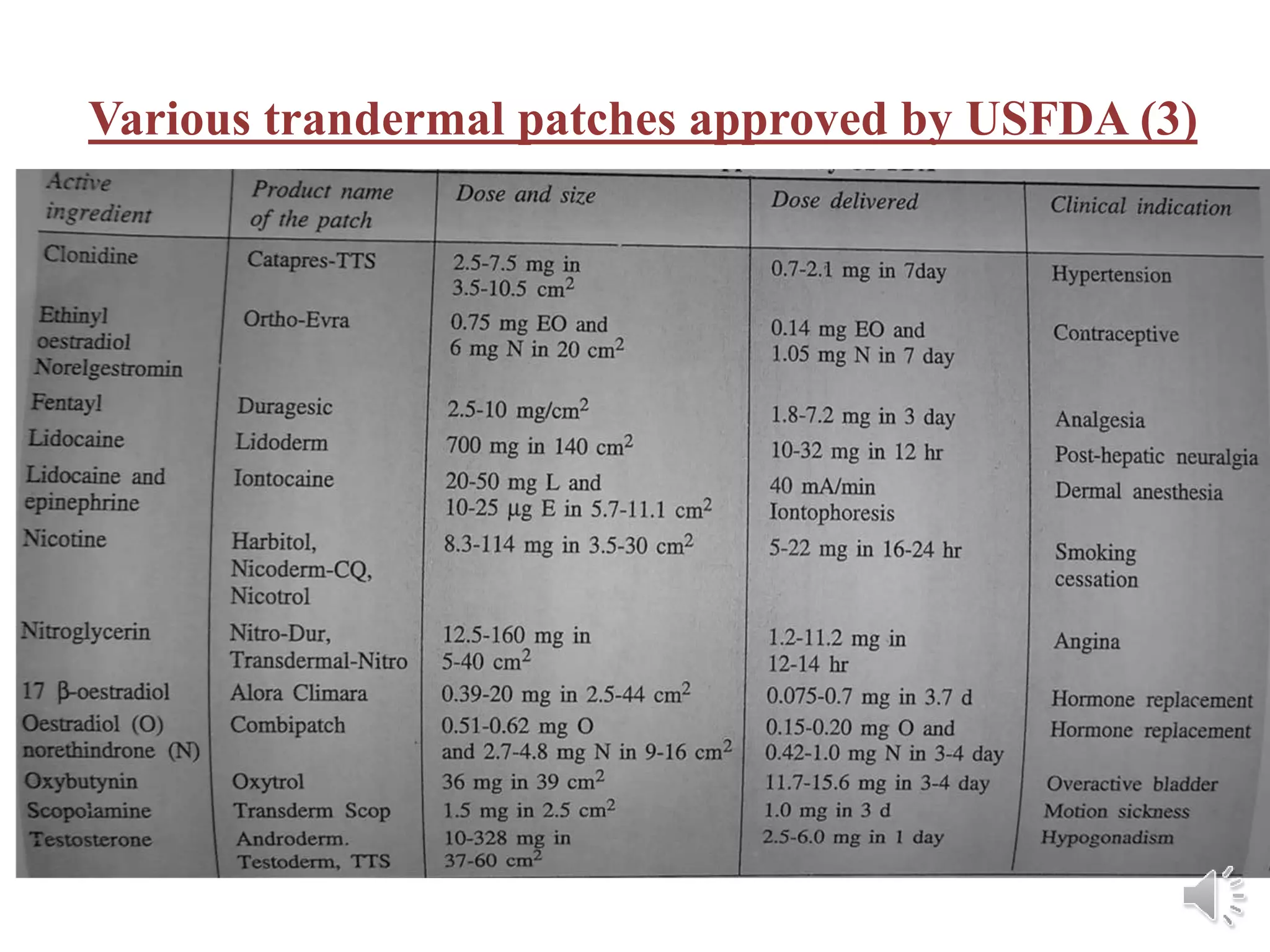
Various trandermal patches approved by USFDA (3)
References
1) Advanced Drug Delivery System, Nilima A. Chaudhari-bhadre & Dr.
Ganesh R. Godge, Tech Neo Publications, Chapter 3.3-transdermal
Drug Delivery System, Page No.3.19-3.30
2) Biopharmaceutics & Pharmacokinetics-a Treatise, D. M.
Brahmankar & Sunil B. Jaiswal, Second Edition, Vallabh Prakashan,
Chapter 14- Controlled Released Medication, Page No. 496-500
3) Introduction To Novel Drug Delivery System, N. K. Jain, Vallabh
Prakashan, Chapter 6-transdermal Drug Delivery, Page No.97-115
4) Transdermal Drug Delivery System: An Overview, Vaibhav Rastogi
& Pragya Yadav, Asian Journal Of Pharmaceutics (July-sept 2012),
Page No. 161-169
5) https://www.slideshare.net/optimpharma/transdermal-drug-
delivery-system-11813407
formulation of transdermal patches

formulation of transdermal patches

  • 1.
    PES’s MCOP, nigdi,pune (Academic year 2020-21) F. Y. M. Pharm. (Semester 1) Composition & formulation methods of transdermal patches Demonstrated by: Shraddha R. Lakambare
  • 2.
    Table of contents 1)Introduction to transdermal patch 2) Selection of drug for transdermal drug delivery system (TDDS) 3) Components require to formulate transdermal patch • Backing layer/ laminate • Polymer • Drug • Adhesive • Plasticizers • Rate controlling membrane • Release liner • Permeation enhancers 5) Types of transdermal patches • Membrane permeation controlled system (drug in reservoir) • Matrix diffusion system (drug in matrix) • Adhesive dispersion system (Drug in adhesive) • Microreservoir system (Drug in microreservoir) 6) Various trandermal patches approved by USFDA 4) Methods for the preparation of transdermal patches • Asymmetric TPX membrane method • Circular Teflon mould method • Mercury substrate method • IPM membranes method • EVAC membranes method • Aluminium backed adhesive film method
  • 3.
    Introduction to transdermalpatch • Transdermal delivery systems are topically administered medicaments in the form of patches that deliver drugs for systemic effect at a predetermined & controlled rate. (2) • A transdermal patch is defined as a medicated adhesive patch which is placed above the skin to deliver a specific dose of medication through a skin with a predetermined rate of release to reach into the bloodstream.(1) • Many peoples feel difficulty in swallowing tablets or getting injection, patches are active for a longer periods than tablets, so patients do not have to remember & follow the frequent schedules for taking medication at specific time. (3) • Currently patches are used in therapeutic areas, including pain management, smoking cessation, treatment of heart disease, hormone replacement & management of motion sickness. (3)
  • 4.
    Selection of drugfor transdermal drug delivery system (TDDS) (1,2,4) • Non irritant, potent, non ionic • Narrow therapeutic index • Low mol. weight i.e. 400-1000 daltons • Melting point <2000C • Water solubility > 1 mg/ml • Oil solubility > 1 mg/ml • Dose < 20mg/day • pH between 5 – 9 • Preferably for drug undergo extensive first pass metabolism • Half life < 10hrs • Log P 1-3 • less oral bioavailability
  • 5.
    Backing layer/ laminate 1.Protect the patch from outer environment, provides support to it accepts printing 2. Optimum elastic, highly flexible, impermeable 3. Good oxygen transmission, high moisture vapor transmission 4. Examples: vinyl, polyethylene & polyester films 5. Can be fabricated from variety of materials including polyvinyl chloride (PVC), polyethylene, polypropylene, ethylene vinyl acetate & aluminium foil. Polymer 1. Determines & control the drug loading, rate of drug release & adhesion of patch to the skin properly. 2. Polymer matrix= formed when the drug is loaded ;polymer is sandwiched between a backing layer & laminate. 3. Natural polymers: zein, gelatin, shellac, waxes, chitosan, natural rubber, cellulose derivatives 4. Synthetic polymer: PVA,PVC, polypropylene, polyethylene, polyacrylate, polyurea, polyamide, polyvinyl pyrrolidone 5. Synthetic elastomer: polybutadiene, silicon rubber, hydrin rubber, nitril, acrylonitril, neoprene, butylrubber, polyisobutylene, polyurethane, etc. 6. Biopolymers: polylactic acid, collagen, xanthan, pullane, elastin, gellan, etc. Principle Requirement is that all components must be • Impervious to the drug and other formulation excipients • Compatible with drug & excipients • Non irritant to skin
  • 6.
    Drug 1. Drug solutionin direct contact with release liner 2. See the characteristics of drug suitable for TDDS on slide no. 4 Adhesive 1. Serves to adhere the components of the patch together along with adhering the patch to the skin 2. Examples: polyisobutadiene, polyacrylate, silicon based adhesive polymer 3. Pressure sensitive adhesive: maintain an intimate contact between transdermal system & the skin, be aggressively & permanently tacky, exert a strong holding force ; easily removable without leaving residues Plasticizer 1. Provides the flexibility & improve the brittleness of the polymer 2. These loosen the tight polymer linkage by joining themselves between the molecules of the polymer chain 3. E.g. glycerol derivatives, phthalic acid esters, sebacic acid esters, oleic acid esters & alcohols – increases the elongation at break, toughness & flexibility of the polymer while decrease the tensile stress, hardness electrostatic chargeability & glass transition temperature
  • 7.
    Rate controlling membrane 1.Controls the release of the drug from the reservoir & multi layer patches 2. Determine the rate at which drug is to be delivered from dosage form 3. Prepared from chitosan, poly-2-hydroxyethylmethacrylate 4. e.g. ethylene vinyl acetate coploymer, silicones, high density polyethylene, polyester elatomers & polyacrylonitrile. 5. It should be permeable only to the drug & enhancer & should retain other formulation excipients Release liner 1. Protects the patch during storage, it is removed prior to use. 2. Part of primary packaging , prevent the loss of drug from polymer matrix. 3. Films or coated papers & silicon release coatings used with acrylate- & rubber- based adhesive systems, whereas fluorocarbon coatings are used with silicon derivatives . 4. Composed of base layer which may be non occlusive (e.g. paper fabric) or occlusive (e.g. PE, PVC) & release coating layer made up of silicon or Teflon , polyester foil & metalized laminates Permeation enhancers 1. Disrupt of the highly ordered structure of stratum corneum lipids, interact with intracellular proteins & improve partitioning of a drug, co-enhancer or solvent into the stratum corneum 2. E.g. dimethyl sulfoxide, dodecyl methyl sulfoxide, SLS, PG, cyclodextrins, oleic acid, undecanoic acid, menthol, thymol, urea, etc
  • 8.
    Various Methods forthe preparation of transdermal patches (1,5) • Asymmetric TPX membrane method 1. A prototype patch can be fabricated for this a heat sealable polyester film (type 1009 , 3m) with a concave of 1cm diameter will be used as the backing membrane. 2. Drug sample dispensed into concave membrane, Covered by TPX (poly-4- mthl-1-pentene) and Sealed by adhesive. • Circular teflon mould method 1. Polymer solution ( in various ratio ) and Organic Solvent. 2. Drug dissolves in half amount of same organic solvent ( in different concentration ) + different ratio of drug and solvent . 3. Addition of Di-N-butylphthalate. 4. Stir 12hours and pour into Circular teflon mould . 5. The solvent is allowed to evaporate for 24hrs. 6. The dried films are to be stored for another 24 hours at 250C in a desiccators conatning silica gel before evaluation to eliminate aging effect. 7. The type films are to be evaluated within one week of their preparation.
  • 9.
    • Mercury substratemethod 1. Drug is dissolve in polymer solution along with plasticizer 2. Stir for 10-15 min to produce a homogeneous dispersion 3. Pour it into a leveled mercury surface, covered with inverted funnel to control solvent evaporation • IPM membrane method 1. drug is dispersed in a mixture of water and propylene glycol containing carbomer 940 polymer 2. Stir for 12 hrs in magnetic stirrer 3. Dispersion is to be neutralized & made viscous by the addition of triethanolamine 4. Buffer pH 7.4 can be used in order to obtain solution gel 5. The formed gel will be incorporated in the IPM membrane
  • 10.
    • EVAC membranemethod (For target transdermal therapeutic system) 1. 1% carbapol reservoir gel, polyethylene, ethylene vinyl acetate copolymer (EVAC)- rate control membrane 2. Drug is not soluble in water propylene glycol (PG) is used for preparation of gel 3. Drug is dissolved in PG; carbolpol resin will be added to the above solution & neutralized by using 5% w/w NaOH solution. 4. The drug in gel form placed on sheet of backing layer covering the specified area. 5. A rate controlling membrane is placed over the gel & the edges are sealed by the heat to obtain a leak proof device. • Aluminium backed adhesive film method (for the dose more than 10mg) 1. A polymer solution 2% w/w is to be prepared by using CHCl3 2. Plasticizer is incorporated at a concentration of 40% w/w of polymer weight 3. A custom made aluminium former is lined with aluminium foil & the ends blanked off with tightly fitting cork blocks.
  • 11.
    The manufacturing process(5) 1. The preparation & homogeneity of the bulk drig containg or non drug containing adhesive mass. 2. The coating process, including those parameters to control layer thickness 3. Drying , curing & removal of residual solvent 4. Lamination steps 5. The storage & handling of intermediate rolls 6. Roll conversion to patch 7. Primary packing The supporting machines (Production) 1. Adhesive blending 2. Slitting machine 3. Slicing machine 4. Die cutting machine 5. Shrink wrap
  • 12.
    1.Membrane permeation controlledsystem (drug in reservoir) • Contain a delivery rate controlling membrane between the drug reservoir & the skin • Enclosed between a rate controlling micro porous or nonporous membrane & an impermeable backing laminate • Material used in drug reservoir: solution, suspension, semisolid • It should permit zero order release of drug over the delivery period. • Micro porous membrane which control drug flux by: • The size & tortuosity of pores in the membrane OR • Dense polymeric membrane through which drug permeates by dissolution & diffusion.
  • 14.
    2. Matrix diffusionsystem (drug in matrix) • The drug is uniformly dispersed in a polymeric matrix, through which it diffuses to the skin surface. • For the drug to be release from a polymeric matrix under zero order kinetics, the drug must be maintained at saturation level in the fluid, phase of the matrix & the diffusion rate of the drug within the matrix must be much greater than the diffusion rate in the skin. • The rate of erosion of the polymer, thickness of the layer & surface area of the film determines the release rate of the drug • The polymeric matrix which may comprise of silicon elastomers, polyurethranes, polyvinyl alcohol, PVP & such may be considered as drug reservoirs.
  • 15.
    1) drug isdispersed in an insoluble matrix of rigid non swellable hydrophobic material. Materials used for rigid matrix are insoluble plastics such as PVC and fatty and materials like stearic and beeswax. 2) With the plastic materials the drug is generally kneaded with the solution of Polyvinyl chloride in an organic solvent and granulated waxy matrix is prepared by dispersing the drug in molten fat followed by congealing. 3) The granules are then compressed into tablets swellable matrix system are popular for sustaining the release of highly water soluble drug. 4) The material for such matrices are generally hydrophilic gums and may be of natural origin (guar gum, tragacanth) semi synthetic (HPMC, CMC) or synthetic (poly acryamides). 5) The drug and the gum are granulated together with a solvent such as alcohol and compressed into tablets. 6) The release of drug from such initially dehydrated hydro gels involves simultaneous absorption of water and desorption of drug via a swelling controlled diffusion mechanism. The gum swells and the drug diffuse out of it the swollen mass devoid of drug appears transport.
  • 16.
    Dissociation of thedrug molecule from the crystal lattice Solubilization / partitioning of the drug in polymer matrix Diffusion of the drug molecules through the matrix to the surface of the skin Several steps involved in drug delivery process :
  • 17.
    3. Adhesive dispersionsystem (Drug in adhesive) • Simplest system • It involve formulating drug, & enhancer if present, in an adhesive mixture that is subsequently coated on to a backing membrane, such as a polyester film, to produce an adhesive tape. • In a single layer patch- a single drug in adhesive layer is present • In multilayer patch, one layer for immediate release of drug & other layer is for controlled release of drug
  • 18.
    These systems canbe divided into following parts : i. Preparation of individual matrix solution : Raw material [Polymer, tackifier, softening agent) is dissolved in an organic solvent to obtain a standard or stock soln. The matrix solution then prepared from the stock solution by mixing it with ingredients specified by the formulation. The active ingredient and other non-soluble additives are added. i. Coating the individual matrix layers : A. The individual layers are made by coating the solution (above). On the smooth paper or film web and removing the solvent by drying using coating machine. B. This machine consists of two units a. Coating unit : The solvent based formulations are coated depending on the viscosity, solid contents, flow ability and surface tension of the matrix solution. b. Drying unit : Closed to the environment and is directly connected to the drying unit to avoid solvent. The solvent is evaporated from the adhesive mass by running the coated web through a drying channel using a transport system like cranked shaft, conveyor belt.
  • 19.
    iii. Building themultilayer laminate- Lamination : It is used to build up the multilayer matrix system. Here two matrix layers, each adhering to one side of the web are Laminated.. Then a carrier material of this two layer laminate is removed and a third layer, with the laminated side to the laminated side of the two layer laminate is pressed. This procedure is repeated until the final laminate is complete. iv. Separating unit of the multilayer laminate : The bulk product is slit longitudinally and the individual unit is punched quit from the narrow rolls so obtained. Precision of the operations is of paramount, importance here hence it affects the release rate of the active ingredient. Then the liner is applied with the necessary release aids to the system. iv. Packaging : Primary packaging is done using sealed, four cornered while secondary packaging in cardboard boxes precedes shipment.
  • 20.
    Process & equipmentinvolved in the manufacture of an adhesive dispersion system
  • 21.
    4. Microreservior system (Drugin microreservior) • Combination of the matrix and reservoir system. • The drug reservoir is formed by first suspending the drug in an aqueous solution of water soluble polymer & then dispersing the solution homogeneously in a lipophilic polymer to form thousands of nonleachable, microscopic spheres of drug reservoirs. • The thermodynamically unstable dispersion is stabilized quickly by immediately cross linking polymer.
  • 22.
    Various trandermal patchesapproved by USFDA (3)
  • 23.
    References 1) Advanced DrugDelivery System, Nilima A. Chaudhari-bhadre & Dr. Ganesh R. Godge, Tech Neo Publications, Chapter 3.3-transdermal Drug Delivery System, Page No.3.19-3.30 2) Biopharmaceutics & Pharmacokinetics-a Treatise, D. M. Brahmankar & Sunil B. Jaiswal, Second Edition, Vallabh Prakashan, Chapter 14- Controlled Released Medication, Page No. 496-500 3) Introduction To Novel Drug Delivery System, N. K. Jain, Vallabh Prakashan, Chapter 6-transdermal Drug Delivery, Page No.97-115 4) Transdermal Drug Delivery System: An Overview, Vaibhav Rastogi & Pragya Yadav, Asian Journal Of Pharmaceutics (July-sept 2012), Page No. 161-169 5) https://www.slideshare.net/optimpharma/transdermal-drug- delivery-system-11813407