TRANSDERMAL DRUG DELIVERY
SYSTEMS
Presented By
RANJEET SINGH
M.Pharm 1st Yr
1
CONTENTS :
• Introduction
• Basic components of Transdermal drug delivery
systems
• Formulation approaches used in development of
TDDS
• Evaluation of Transdermal products.
2
Definition :
Transdermal drug delivery systems (TDDS) are
topically administered medicaments in the form of
patches, which when applied to intact skin, allows the
delivery of contained drugs into the systemic
circulation via permeation through skin layers at a
predetermined and controlled rate.
.
3
ADVANTAGES OF TDDS:
1. Avoidance of ‘first-pass’ metabolism of drug.
2. Reduction of fluctuations in plasma levels.
3. Reduction of dosing frequency.
4. Enhancement of patient compliance.
5. Termination of therapy is easy at any point of
time.
6. Suitability for self-administration.
7. Ability to deliver drug more selectively to a
specific site.
4
LIMITATIONS OF TDDS:
1. Drugs with very low or high partition
coefficient fail to reach blood circulation.
2. Limited skin permeability.
3. Significant lag time.
4. Skin irritation and allergic response.
5. Heavy drug molecules usually difficult to
penetrate the stratum corneum.
5
BASIC COMPONENTS OF TRANSDERMAL DRUG DELIVERY
SYSTEMS
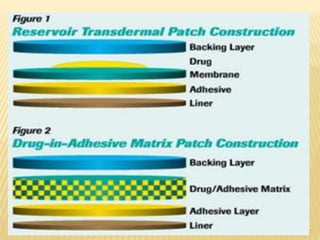
1. Drug reservoir
2. Rate controlling membrane
3. Adhesives
4. Backing membrane
5. Protective liner.
6
7
1. DRUG RESERVOIR :
The most important part of TDDS is drug reservoir. It consists of
drug particles dispersed in the matrix. To make the drug soluble,
solvents and co-solvents are used. The effect of solvent and co-
solvents should be considered while doing.
2. Rate controlling membrane:
 Membrane controls the release of the drug from the reservoir and
multi-layer patches.
 It should be flexible enough not split or crack on bending or
stretching.
 Some of the rate controlling membrane are polyethylene sheets,
ethylene vinyl acetate copolymer and cellulose acetate.
8
3. ADHESIVE:
 To adhere the components of the patch
together along with the skin. The adhesive
must posse’s sufficient adhesion property so
that the TDDS should remain in place for a
long time.
 Pressure sensitive adhesives are commonly
used for transdermal patch to hold skin.
 Commonly used adhesives are silicone
adhesives, poly iso-butylenes adhesives etc.
9
4. BACKING MEMBRANE:
 Protects the patch from outer environments.
 The backing layer should be impermeable to
drug and permeation enhancers.
 Its serves a function of holding the entire system
and protects drug reservoir from atmosphere.
 The commonly used backing materials are
polyesters, aluminized polyethylene terepthalate
etc.
5. RELEASE LINER:
 Protects the patch during storage.
 The liner is removed prior to use.
10
TECHNOLOGIES FOR DEVELOPING
TRANSDERMAL DRUG DELIVERY SYSTEMS
These technologies can be classified into 4 basic approaches :
1. Polymer Membrane partition–controlled TDD systems.
2. Polymer Matrix diffusion–controlled TDD systems.
3. Drug reservoir gradient – controlled TDD systems.
4. Micro reservoir dissolution – controlled TDD systems.
11
1. Polymer membrane partition-controlled TDD system :
 In this type of systems, the drug reservoir is sandwiched between a
drug impermeable backing laminate a rate controlling polymer.
 The drug is allowed to permeate only through the rate controlling
membrane.
 Permeability coefficient and thickness of rate controlling membrane
can alter the drug release rate.
E.g.;transderm-nitro for angina pectoris, transderm-scop for
motion sickness etc.
12
13
 The rate of drug release is defined by :
dQ/ dt =
CR = drug concentration in reservoir compartment
Km/r = partition coefficient for the interfacial partitioning of drug
from the reservoir to the membrane.
Ka/m=partition coefficient for the interfacial partitioning of drug
from the membrane to adhesive.
Dm = diffusion coefficient in adhesive layer.
Da = diffusion coefficient in rate controlling membrane.
ha = thickness of rate controlling membrane.
hm = thickness of adhesive layer.
CR
Km/r Ka/m Da Dm
Km/r Dm ha + Ka/m Da hm
14
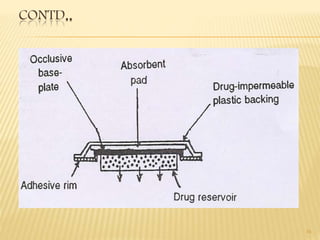
2. Polymer matrix diffusion controlled TDD Systems :
 Drug reservoir is prepared by homogeneously dispersing drug
particle in rate controlling polymer matrix from either a lipophilic
or a hydrophilic polymer.
Release of drug molecule is controlled by:
 loading dose
 polymer solubility of drug
 drug diffusivity in polymer matrix.
15
CONTD..
16
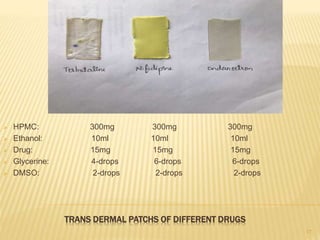
TRANS DERMAL PATCHS OF DIFFERENT DRUGS
 HPMC: 300mg 300mg 300mg
 Ethanol: 10ml 10ml 10ml
 Drug: 15mg 15mg 15mg
 Glycerine: 4-drops 6-drops 6-drops
 DMSO: 2-drops 2-drops 2-drops
17
The rate of drug release from this type of TDD system is defined as :
dQ/dt =
Ld = drug loading dose initially dispersed in the polymer matrix.
Cp = solubility of drug in polymer matrix.
Dp = diffusivity of drug in polymer matrix.
Example: Nitroglycerine-releasing Transdermal system
(Nitro- Dur & Nitro- Dur II ) at a daily dose of
0.5 g/cm2 for therapy of angina pectoris.
Ld Cp Dp
2t( )
1/2
18
3. drug reservoir gradient – controlled TDD Systems
 Polymer matrix drug dispersion-type TDDS can be modified to have
the drug loding level varied in an incremental manner, forming a
gradient of drug reservoir along the diffusional path across the
multilaminate adhesive layers.
 Example: Isosorbide dinitrate-releasing Transdermal therapeutic
system (Frandol tape) for once a day medication of angina pectoris.
19
20
4. MICRO RESERVOIR DISSOLUTION CONTROLLED TDDS
 This system is a hybrid of reservoir & matrix dispersion type DDS
 Drug reservoir is formed by first suspending the drug solids in an
aqueous soln of a water miscible drug solubilizer eg : PEG.
 The drug suspension is then homogenously dispersed with controlled
aqueous solubility, in a lipophilic polymer, by high shear mechanical
force, to form thousands of unleachable microscopic drug reservoirs.
 Egs : Nitrodisc system.
21
22
Evaluation parameters
1. Thickness of the patch: digital micrometer is used to measure the thickness of the drug
loaded patch in different point and to ensure the thickness of the prepared patch, the average
thickness and standard deviation are determined.
2. Weight uniformity test: the formulated patch are dried at 60°C for 4hrs. before testing a
patch for a particular area is to be cut in different parts of the patch and weighed in the digital
balance. Calculation of average weight and standard deviation value are to be carrying out from
the individual weights.
3. Folding endurance: a film for specific area is to be cut evenly repeatedly folded at the same
place till it broke. The value of the folding endurance can be determine by the number of times
the film could be folded at the same place without breaking.
23
4. Percentage moisture contents: the prepared film are to be weighed individually and to be
kept in a desiccator containing fused calcium chloride at the room temperature 24 hrs. the film
are to be reweighed 24 hrs. and the percentage moisture content is determined from the
below mentioned formula.
Percentage moisture content= (initial wt.- final wt./final wt.)×100
5. Drug content: a suitable solvent with specific volume is taken and a patch of specified area
is to be dissolve in it. Then filter medium is used to filter the solution and a suitable method UV
or HPLC technique is used to analyse the drug content. Each value represents an average of 3
different samples.
6. Shear adhesion test: the measurement of the cohesive strength of an adhesive polymer is
performed by this test. Onto a stainless steel plate an adhesive coated tape is applied; a specific
weight is hung from the tape, to affect in pulling in a direction parallel to the plate. By
measuring the time it takes to tape off the plate shear adhesion is determined. The longer the
time taken for removal, greater is the shear strength.
24
7. In vitro skin permeation studies:
diffusion cell is used to carryout in vitro permeation study. Abdominal
skin of male wistar rats is taken hair is carefully removed by using an
electric clipper; the skin is cleaned with distilled water. Before starting
the experiment it was equilibrate for 1hrs in dissolution medium or
phosphate buffer pH7.4.for uniform distribution of diffusant it was
placed on magnetic stirrer with a small magnetic needle.
Thermostatically controlled heater was used to maintain the
temperature of the cell at 32±0.5°C the isolated rat skin mounted
between the compartments of diffusion cell, with the epidermis facing
upward into donor compartment. At regular interval sample volume of
definite volume is to be removed from the receptors compartment,
and is to be replaced by the fresh medium of equal volume. Filter the
sample and analysed by UV or HPLC.
25
26
8. Skin irritation studies: it is performed on healthy rabbits. Dorsal
surface of the rabbit is cleaned and formulation applied over the
skin. After 24hrs. the patch is to be removed and skin is to be
observed and classified into 5 grades on the basis of the severity of
the skin injury.
9. Stability studies: according to the ICH guideline, stability studies
are to be conducted by storing the TDDS samples at 40±0.5°C and
75±5% RH for 6 months. At 0,30,60,90 and 180 days the sample are
withdrawn and analysed suitably for drug content.
References:
• Dr. dheeraj T. baviskar, Dr. dinesh K. jain; Novel
drug delivery. Nirali prakashan;2016 .
• Jonathan hadgraft, Richard H. guy; transdermal
drug delivery. Marcel dekker, newyork;1989 .
• Joseph R. robinson, Vincent H.L.Lee; controlled
drug delivery. Informa health care, newyork
[Edition 2]; 2009 .
27
28

TDDS by Ranjeet singh

  • 1.
    TRANSDERMAL DRUG DELIVERY SYSTEMS PresentedBy RANJEET SINGH M.Pharm 1st Yr 1
  • 2.
    CONTENTS : • Introduction •Basic components of Transdermal drug delivery systems • Formulation approaches used in development of TDDS • Evaluation of Transdermal products. 2
  • 3.
    Definition : Transdermal drugdelivery systems (TDDS) are topically administered medicaments in the form of patches, which when applied to intact skin, allows the delivery of contained drugs into the systemic circulation via permeation through skin layers at a predetermined and controlled rate. . 3
  • 4.
    ADVANTAGES OF TDDS: 1.Avoidance of ‘first-pass’ metabolism of drug. 2. Reduction of fluctuations in plasma levels. 3. Reduction of dosing frequency. 4. Enhancement of patient compliance. 5. Termination of therapy is easy at any point of time. 6. Suitability for self-administration. 7. Ability to deliver drug more selectively to a specific site. 4
  • 5.
    LIMITATIONS OF TDDS: 1.Drugs with very low or high partition coefficient fail to reach blood circulation. 2. Limited skin permeability. 3. Significant lag time. 4. Skin irritation and allergic response. 5. Heavy drug molecules usually difficult to penetrate the stratum corneum. 5
  • 6.
    BASIC COMPONENTS OFTRANSDERMAL DRUG DELIVERY SYSTEMS 1. Drug reservoir 2. Rate controlling membrane 3. Adhesives 4. Backing membrane 5. Protective liner. 6
  • 7.
  • 8.
    1. DRUG RESERVOIR: The most important part of TDDS is drug reservoir. It consists of drug particles dispersed in the matrix. To make the drug soluble, solvents and co-solvents are used. The effect of solvent and co- solvents should be considered while doing. 2. Rate controlling membrane:  Membrane controls the release of the drug from the reservoir and multi-layer patches.  It should be flexible enough not split or crack on bending or stretching.  Some of the rate controlling membrane are polyethylene sheets, ethylene vinyl acetate copolymer and cellulose acetate. 8
  • 9.
    3. ADHESIVE:  Toadhere the components of the patch together along with the skin. The adhesive must posse’s sufficient adhesion property so that the TDDS should remain in place for a long time.  Pressure sensitive adhesives are commonly used for transdermal patch to hold skin.  Commonly used adhesives are silicone adhesives, poly iso-butylenes adhesives etc. 9
  • 10.
    4. BACKING MEMBRANE: Protects the patch from outer environments.  The backing layer should be impermeable to drug and permeation enhancers.  Its serves a function of holding the entire system and protects drug reservoir from atmosphere.  The commonly used backing materials are polyesters, aluminized polyethylene terepthalate etc. 5. RELEASE LINER:  Protects the patch during storage.  The liner is removed prior to use. 10
  • 11.
    TECHNOLOGIES FOR DEVELOPING TRANSDERMALDRUG DELIVERY SYSTEMS These technologies can be classified into 4 basic approaches : 1. Polymer Membrane partition–controlled TDD systems. 2. Polymer Matrix diffusion–controlled TDD systems. 3. Drug reservoir gradient – controlled TDD systems. 4. Micro reservoir dissolution – controlled TDD systems. 11
  • 12.
    1. Polymer membranepartition-controlled TDD system :  In this type of systems, the drug reservoir is sandwiched between a drug impermeable backing laminate a rate controlling polymer.  The drug is allowed to permeate only through the rate controlling membrane.  Permeability coefficient and thickness of rate controlling membrane can alter the drug release rate. E.g.;transderm-nitro for angina pectoris, transderm-scop for motion sickness etc. 12
  • 13.
  • 14.
     The rateof drug release is defined by : dQ/ dt = CR = drug concentration in reservoir compartment Km/r = partition coefficient for the interfacial partitioning of drug from the reservoir to the membrane. Ka/m=partition coefficient for the interfacial partitioning of drug from the membrane to adhesive. Dm = diffusion coefficient in adhesive layer. Da = diffusion coefficient in rate controlling membrane. ha = thickness of rate controlling membrane. hm = thickness of adhesive layer. CR Km/r Ka/m Da Dm Km/r Dm ha + Ka/m Da hm 14
  • 15.
    2. Polymer matrixdiffusion controlled TDD Systems :  Drug reservoir is prepared by homogeneously dispersing drug particle in rate controlling polymer matrix from either a lipophilic or a hydrophilic polymer. Release of drug molecule is controlled by:  loading dose  polymer solubility of drug  drug diffusivity in polymer matrix. 15
  • 16.
  • 17.
    TRANS DERMAL PATCHSOF DIFFERENT DRUGS  HPMC: 300mg 300mg 300mg  Ethanol: 10ml 10ml 10ml  Drug: 15mg 15mg 15mg  Glycerine: 4-drops 6-drops 6-drops  DMSO: 2-drops 2-drops 2-drops 17
  • 18.
    The rate ofdrug release from this type of TDD system is defined as : dQ/dt = Ld = drug loading dose initially dispersed in the polymer matrix. Cp = solubility of drug in polymer matrix. Dp = diffusivity of drug in polymer matrix. Example: Nitroglycerine-releasing Transdermal system (Nitro- Dur & Nitro- Dur II ) at a daily dose of 0.5 g/cm2 for therapy of angina pectoris. Ld Cp Dp 2t( ) 1/2 18
  • 19.
    3. drug reservoirgradient – controlled TDD Systems  Polymer matrix drug dispersion-type TDDS can be modified to have the drug loding level varied in an incremental manner, forming a gradient of drug reservoir along the diffusional path across the multilaminate adhesive layers.  Example: Isosorbide dinitrate-releasing Transdermal therapeutic system (Frandol tape) for once a day medication of angina pectoris. 19
  • 20.
  • 21.
    4. MICRO RESERVOIRDISSOLUTION CONTROLLED TDDS  This system is a hybrid of reservoir & matrix dispersion type DDS  Drug reservoir is formed by first suspending the drug solids in an aqueous soln of a water miscible drug solubilizer eg : PEG.  The drug suspension is then homogenously dispersed with controlled aqueous solubility, in a lipophilic polymer, by high shear mechanical force, to form thousands of unleachable microscopic drug reservoirs.  Egs : Nitrodisc system. 21
  • 22.
  • 23.
    Evaluation parameters 1. Thicknessof the patch: digital micrometer is used to measure the thickness of the drug loaded patch in different point and to ensure the thickness of the prepared patch, the average thickness and standard deviation are determined. 2. Weight uniformity test: the formulated patch are dried at 60°C for 4hrs. before testing a patch for a particular area is to be cut in different parts of the patch and weighed in the digital balance. Calculation of average weight and standard deviation value are to be carrying out from the individual weights. 3. Folding endurance: a film for specific area is to be cut evenly repeatedly folded at the same place till it broke. The value of the folding endurance can be determine by the number of times the film could be folded at the same place without breaking. 23
  • 24.
    4. Percentage moisturecontents: the prepared film are to be weighed individually and to be kept in a desiccator containing fused calcium chloride at the room temperature 24 hrs. the film are to be reweighed 24 hrs. and the percentage moisture content is determined from the below mentioned formula. Percentage moisture content= (initial wt.- final wt./final wt.)×100 5. Drug content: a suitable solvent with specific volume is taken and a patch of specified area is to be dissolve in it. Then filter medium is used to filter the solution and a suitable method UV or HPLC technique is used to analyse the drug content. Each value represents an average of 3 different samples. 6. Shear adhesion test: the measurement of the cohesive strength of an adhesive polymer is performed by this test. Onto a stainless steel plate an adhesive coated tape is applied; a specific weight is hung from the tape, to affect in pulling in a direction parallel to the plate. By measuring the time it takes to tape off the plate shear adhesion is determined. The longer the time taken for removal, greater is the shear strength. 24
  • 25.
    7. In vitroskin permeation studies: diffusion cell is used to carryout in vitro permeation study. Abdominal skin of male wistar rats is taken hair is carefully removed by using an electric clipper; the skin is cleaned with distilled water. Before starting the experiment it was equilibrate for 1hrs in dissolution medium or phosphate buffer pH7.4.for uniform distribution of diffusant it was placed on magnetic stirrer with a small magnetic needle. Thermostatically controlled heater was used to maintain the temperature of the cell at 32±0.5°C the isolated rat skin mounted between the compartments of diffusion cell, with the epidermis facing upward into donor compartment. At regular interval sample volume of definite volume is to be removed from the receptors compartment, and is to be replaced by the fresh medium of equal volume. Filter the sample and analysed by UV or HPLC. 25
  • 26.
    26 8. Skin irritationstudies: it is performed on healthy rabbits. Dorsal surface of the rabbit is cleaned and formulation applied over the skin. After 24hrs. the patch is to be removed and skin is to be observed and classified into 5 grades on the basis of the severity of the skin injury. 9. Stability studies: according to the ICH guideline, stability studies are to be conducted by storing the TDDS samples at 40±0.5°C and 75±5% RH for 6 months. At 0,30,60,90 and 180 days the sample are withdrawn and analysed suitably for drug content.
  • 27.
    References: • Dr. dheerajT. baviskar, Dr. dinesh K. jain; Novel drug delivery. Nirali prakashan;2016 . • Jonathan hadgraft, Richard H. guy; transdermal drug delivery. Marcel dekker, newyork;1989 . • Joseph R. robinson, Vincent H.L.Lee; controlled drug delivery. Informa health care, newyork [Edition 2]; 2009 . 27
  • 28.