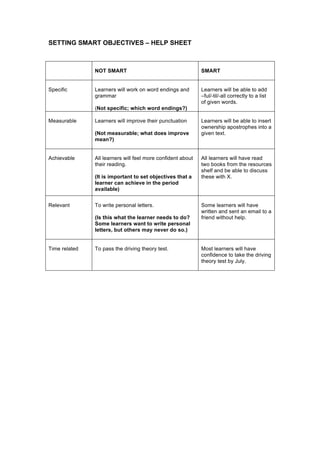
SETTING SMART OBJECTIVES – HELP SHEET
NOT SMART SMART
Specific Learners will work on word endings and
grammar
(Not specific; which word endings?)
Learners will be able to add
–ful/-til/-all correctly to a list
of given words.
Measurable Learners will improve their punctuation
(Not measurable; what does improve
mean?)
Learners will be able to insert
ownership apostrophes into a
given text.
Achievable All learners will feel more confident about
their reading.
(It is important to set objectives that a
learner can achieve in the period
available)
All learners will have read
two books from the resources
shelf and be able to discuss
these with X.
Relevant To write personal letters.
(Is this what the learner needs to do?
Some learners want to write personal
letters, but others may never do so.)
Some learners will have
written and sent an email to a
friend without help.
Time related To pass the driving theory test. Most learners will have
confidence to take the driving
theory test by July.
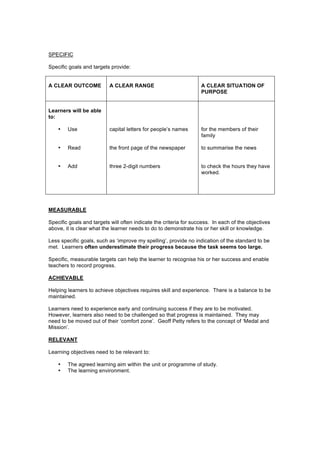
SPECIFIC
Specific goals and targets provide:
A CLEAR OUTCOME A CLEAR RANGE A CLEAR SITUATION OF
PURPOSE
Learners will be able
to:
• Use
• Read
• Add
capital letters for people’s names
the front page of the newspaper
three 2-digit numbers
for the members of their
family
to summarise the news
to check the hours they have
worked.
MEASURABLE
Specific goals and targets will often indicate the criteria for success. In each of the objectives
above, it is clear what the learner needs to do to demonstrate his or her skill or knowledge.
Less specific goals, such as ‘improve my spelling’, provide no indication of the standard to be
met. Learners often underestimate their progress because the task seems too large.
Specific, measurable targets can help the learner to recognise his or her success and enable
teachers to record progress.
ACHIEVABLE
Helping learners to achieve objectives requires skill and experience. There is a balance to be
maintained.
Learners need to experience early and continuing success if they are to be motivated.
However, learners also need to be challenged so that progress is maintained. They may
need to be moved out of their ‘comfort zone’. Geoff Petty refers to the concept of ‘Medal and
Mission’.
RELEVANT
Learning objectives need to be relevant to:
• The agreed learning aim within the unit or programme of study.
• The learning environment.

Setting smart objectives help sheet

  • 1.
    SETTING SMART OBJECTIVES– HELP SHEET NOT SMART SMART Specific Learners will work on word endings and grammar (Not specific; which word endings?) Learners will be able to add –ful/-til/-all correctly to a list of given words. Measurable Learners will improve their punctuation (Not measurable; what does improve mean?) Learners will be able to insert ownership apostrophes into a given text. Achievable All learners will feel more confident about their reading. (It is important to set objectives that a learner can achieve in the period available) All learners will have read two books from the resources shelf and be able to discuss these with X. Relevant To write personal letters. (Is this what the learner needs to do? Some learners want to write personal letters, but others may never do so.) Some learners will have written and sent an email to a friend without help. Time related To pass the driving theory test. Most learners will have confidence to take the driving theory test by July.
  • 2.
    SPECIFIC Specific goals andtargets provide: A CLEAR OUTCOME A CLEAR RANGE A CLEAR SITUATION OF PURPOSE Learners will be able to: • Use • Read • Add capital letters for people’s names the front page of the newspaper three 2-digit numbers for the members of their family to summarise the news to check the hours they have worked. MEASURABLE Specific goals and targets will often indicate the criteria for success. In each of the objectives above, it is clear what the learner needs to do to demonstrate his or her skill or knowledge. Less specific goals, such as ‘improve my spelling’, provide no indication of the standard to be met. Learners often underestimate their progress because the task seems too large. Specific, measurable targets can help the learner to recognise his or her success and enable teachers to record progress. ACHIEVABLE Helping learners to achieve objectives requires skill and experience. There is a balance to be maintained. Learners need to experience early and continuing success if they are to be motivated. However, learners also need to be challenged so that progress is maintained. They may need to be moved out of their ‘comfort zone’. Geoff Petty refers to the concept of ‘Medal and Mission’. RELEVANT Learning objectives need to be relevant to: • The agreed learning aim within the unit or programme of study. • The learning environment.