Breast feeding
Dr Nishi Sood
• Anatomy of breast
• Colostrum and milk
• Endocrinology of lactation
• Benefits of breast feeding
• Techniques of breastfeeding
• Drugs which are contraindicated
• Care of nipples
• Breast fever,cracked nipples,mastitis,abcess
• Contraception during breast feeding
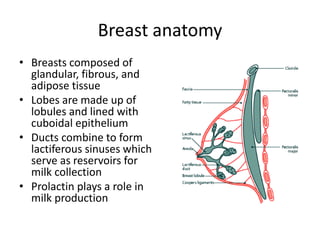
Breast anatomy
• Breasts composed of
glandular, fibrous, and
adipose tissue
• Lobes are made up of
lobules and lined with
cuboidal epithelium
• Ducts combine to form
lactiferous sinuses which
serve as reservoirs for
milk collection
• Prolactin plays a role in
milk production
Endocrinology of lactation
• Mammogenesis –
progesterone,estrogen,HPL,prolactin ,cortisol,
insulin
• Secreation-inhibitory effect of progesterone is
removed
• Lactation depends on stimulous
• Milk ejection/letting down reflex
Human Milk Facts
• Isotonic Solution
– milk and plasma are of similar ion concentration
– Suspension of fat& protein in carbohydrate mineral solution
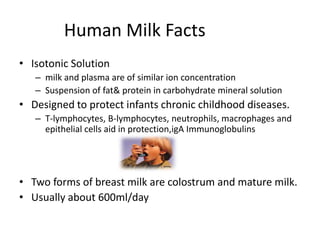
• Designed to protect infants chronic childhood diseases.
– T-lymphocytes, B-lymphocytes, neutrophils, macrophages and
epithelial cells aid in protection,igA Immunoglobulins
• Two forms of breast milk are colostrum and mature milk.
• Usually about 600ml/day
Colostrum in Human Milk
• Thick, yellow fluid
• Produced during lactogenesis II (2-3 days after
birth)
• Provides 58-70 cal/100 ml
• High in protein, electrolytes, sodium,
potassium, chloride and vitamin A
• Low in fat and carbohydrate
• Lactobacillus bifidus factor
Mature Human Milk
• Thin and watery texture
• Provides 2,730-2,940 cal/L
• High in linoleic acid and cholesterol content for brain
development
• High in fat content and lactose
• Docosahexaenoic acids (DHA)
– Long chain omega-3 fatty acids.
– Used for synthesis of brain tissues, central nervous
system and eyes
• DHA and cholesterol not found in human milk substitutes
Mature Human Milk- PRO
• Protein
– Low content
• Dependent on infant’s age
– Antiviral and antimicrobial effects
– Alpha lactalbumin,beta lactoglobulin
– Casein
• Major protein in mature milk
• Casein, calcium phosphate, and other ions such as
magnesium and citrate is what makes milk appear
white.
Mature Human Milk- CHO
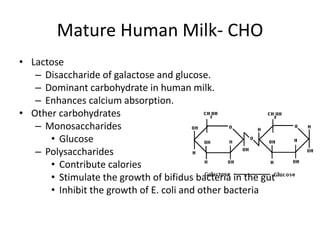
• Lactose
– Disaccharide of galactose and glucose.
– Dominant carbohydrate in human milk.
– Enhances calcium absorption.
• Other carbohydrates
– Monosaccharides
• Glucose
– Polysaccharides
• Contribute calories
• Stimulate the growth of bifidus bacteria in the gut
• Inhibit the growth of E. coli and other bacteria
Change in Milk Composition During
Feeding
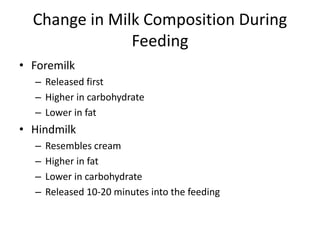
• Foremilk
– Released first
– Higher in carbohydrate
– Lower in fat
• Hindmilk
– Resembles cream
– Higher in fat
– Lower in carbohydrate
– Released 10-20 minutes into the feeding
Effects on breast milk composition
• Alcohol
• Nicotine
• Caffeine
• Marijuana and other drug abuse
• Cytotoxicdrugs,ergotamine,lithium,phenobarb
itone,atenolol,acebutolol,radioactive isotopes
• Environmental Exposures
• Genes
Benefits For Mother If
Breastfeeding:
•Reduces the risk of breast cancer.
•Reduces the risk of uterine and ovarian cancer.
•Lessens osteoporosis.
•Benefits child spacing.
•Promotes emotional health.
•Promotes postpartum weight loss.
•Costs less to breastfeed.
•Maternal-infant interaction and closeness.
Benefits For Baby When Breastfed
• Immunologic properties of breast milk.
• Increases your baby's intelligence level.
• Better pain relief and less stress.
• Build stronger bones.
• Gets plenty of cholesterol.
• Reduces risk of asthma.
• Stronger immune systems.
• Reduces risk of allergies.
Benefits For Baby Breastfed (con’t)
• Reduces the risk of becoming obese later in life.
- Kids fed mainly on breast milk for the first 6
months of life were 22% less likely to be
overweight by age 14.
- Those who were breast-fed for at least 7 months
were 20% less likely to be overweight than those
babies who were given breast milk for 3 months.
- Research shows how high levels of the protein
hormone leptin abundant in mother's milk
which influences a baby's growth and body
composition development.
Possible Disadvantages For Baby If
Breastfed:
• HIV transmission.
• Inadequate milk supply.
• Baby’s inability to suck.
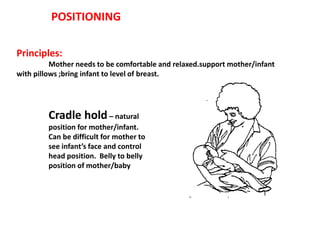
POSITIONING
Principles:
Mother needs to be comfortable and relaxed.support mother/infant
with pillows ;bring infant to level of breast.
Cradle hold – natural
position for mother/infant.
Can be difficult for mother to
see infant’s face and control
head position. Belly to belly
position of mother/baby.
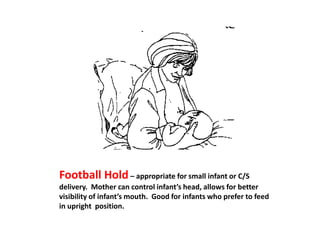
Football Hold– appropriate for small infant or C/S
delivery. Mother can control infant’s head, allows for better
visibility of infant’s mouth. Good for infants who prefer to feed
in upright position.
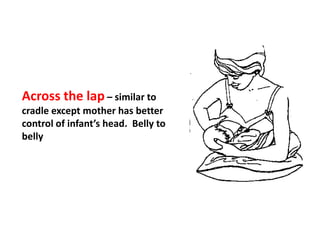
Across the lap – similar to
cradle except mother has better
control of infant’s head. Belly to
belly
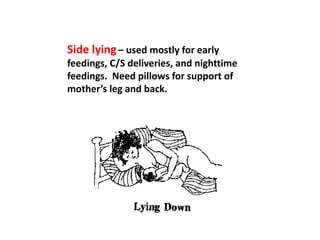
Side lying– used mostly for early
feedings, C/S deliveries, and nighttime
feedings. Need pillows for support of
mother’s leg and back.
LATCHING
• When mouth is open, bring baby to the breast, not
breast to the baby
• Baby should take in as much of the areola as
possible-”fish lips”
• Nose is almost touching
• See and hear baby swallowing
• Feels like a tug
• Sucking will increase as flow increases
COMMON PROBLEMS; HOW TO OVERCOME THEM
Sore nipples: is the most common problem during the early days of breast feeding.
This can result from:
1. Improper positioning of the infant’s mouth on the nipple.
2. Using only one position for all feedings.
3. Feedings are too far apart so that when the baby begins nursing he/she
sucks very eagerly.
4. Breast care that contributes to dry, irritated nipples.
5. Trauma to the nipple because of improper removal from the breast.
Engorgement: is an overfullness that is a result of incomplete or inadequate empty-
ing of the breasts.
All mothers are encouraged to observe the Four A’s of breastfeeding to minimize
Breastfeeding problems.
• Mastitis /Parenchymatous/ Infection of
Mammary Glands : Not until 3-4 wks
Unilateral
Marked engorgement precedes
inflammation
10% progress to Abscess
• Breast Abscess
Care of Nipples
How Long Do You Breast-feed...
• The World Health Organization recommends
that infants start breastfeeding within one
hour of life, are exclusively breastfed for six
months, with timely initiation of adequate,
safe and properly fed complementary foods
while continuing breastfeeding for up to two
years of age or beyond.

Breast feeding

  • 1.
  • 2.
    • Anatomy ofbreast • Colostrum and milk • Endocrinology of lactation • Benefits of breast feeding • Techniques of breastfeeding • Drugs which are contraindicated • Care of nipples • Breast fever,cracked nipples,mastitis,abcess • Contraception during breast feeding
  • 3.
    Breast anatomy • Breastscomposed of glandular, fibrous, and adipose tissue • Lobes are made up of lobules and lined with cuboidal epithelium • Ducts combine to form lactiferous sinuses which serve as reservoirs for milk collection • Prolactin plays a role in milk production
  • 4.
    Endocrinology of lactation •Mammogenesis – progesterone,estrogen,HPL,prolactin ,cortisol, insulin • Secreation-inhibitory effect of progesterone is removed • Lactation depends on stimulous • Milk ejection/letting down reflex
  • 5.
    Human Milk Facts •Isotonic Solution – milk and plasma are of similar ion concentration – Suspension of fat& protein in carbohydrate mineral solution • Designed to protect infants chronic childhood diseases. – T-lymphocytes, B-lymphocytes, neutrophils, macrophages and epithelial cells aid in protection,igA Immunoglobulins • Two forms of breast milk are colostrum and mature milk. • Usually about 600ml/day
  • 6.
    Colostrum in HumanMilk • Thick, yellow fluid • Produced during lactogenesis II (2-3 days after birth) • Provides 58-70 cal/100 ml • High in protein, electrolytes, sodium, potassium, chloride and vitamin A • Low in fat and carbohydrate • Lactobacillus bifidus factor
  • 7.
    Mature Human Milk •Thin and watery texture • Provides 2,730-2,940 cal/L • High in linoleic acid and cholesterol content for brain development • High in fat content and lactose • Docosahexaenoic acids (DHA) – Long chain omega-3 fatty acids. – Used for synthesis of brain tissues, central nervous system and eyes • DHA and cholesterol not found in human milk substitutes
  • 8.
    Mature Human Milk-PRO • Protein – Low content • Dependent on infant’s age – Antiviral and antimicrobial effects – Alpha lactalbumin,beta lactoglobulin – Casein • Major protein in mature milk • Casein, calcium phosphate, and other ions such as magnesium and citrate is what makes milk appear white.
  • 9.
    Mature Human Milk-CHO • Lactose – Disaccharide of galactose and glucose. – Dominant carbohydrate in human milk. – Enhances calcium absorption. • Other carbohydrates – Monosaccharides • Glucose – Polysaccharides • Contribute calories • Stimulate the growth of bifidus bacteria in the gut • Inhibit the growth of E. coli and other bacteria
  • 10.
    Change in MilkComposition During Feeding • Foremilk – Released first – Higher in carbohydrate – Lower in fat • Hindmilk – Resembles cream – Higher in fat – Lower in carbohydrate – Released 10-20 minutes into the feeding
  • 11.
    Effects on breastmilk composition • Alcohol • Nicotine • Caffeine • Marijuana and other drug abuse • Cytotoxicdrugs,ergotamine,lithium,phenobarb itone,atenolol,acebutolol,radioactive isotopes • Environmental Exposures • Genes
  • 12.
    Benefits For MotherIf Breastfeeding: •Reduces the risk of breast cancer. •Reduces the risk of uterine and ovarian cancer. •Lessens osteoporosis. •Benefits child spacing. •Promotes emotional health. •Promotes postpartum weight loss. •Costs less to breastfeed. •Maternal-infant interaction and closeness.
  • 13.
    Benefits For BabyWhen Breastfed • Immunologic properties of breast milk. • Increases your baby's intelligence level. • Better pain relief and less stress. • Build stronger bones. • Gets plenty of cholesterol. • Reduces risk of asthma. • Stronger immune systems. • Reduces risk of allergies.
  • 14.
    Benefits For BabyBreastfed (con’t) • Reduces the risk of becoming obese later in life. - Kids fed mainly on breast milk for the first 6 months of life were 22% less likely to be overweight by age 14. - Those who were breast-fed for at least 7 months were 20% less likely to be overweight than those babies who were given breast milk for 3 months. - Research shows how high levels of the protein hormone leptin abundant in mother's milk which influences a baby's growth and body composition development.
  • 15.
    Possible Disadvantages ForBaby If Breastfed: • HIV transmission. • Inadequate milk supply. • Baby’s inability to suck.
  • 16.
    POSITIONING Principles: Mother needs tobe comfortable and relaxed.support mother/infant with pillows ;bring infant to level of breast. Cradle hold – natural position for mother/infant. Can be difficult for mother to see infant’s face and control head position. Belly to belly position of mother/baby.
  • 17.
    Football Hold– appropriatefor small infant or C/S delivery. Mother can control infant’s head, allows for better visibility of infant’s mouth. Good for infants who prefer to feed in upright position.
  • 18.
    Across the lap– similar to cradle except mother has better control of infant’s head. Belly to belly
  • 19.
    Side lying– usedmostly for early feedings, C/S deliveries, and nighttime feedings. Need pillows for support of mother’s leg and back.
  • 20.
    LATCHING • When mouthis open, bring baby to the breast, not breast to the baby • Baby should take in as much of the areola as possible-”fish lips” • Nose is almost touching • See and hear baby swallowing • Feels like a tug • Sucking will increase as flow increases
  • 21.
    COMMON PROBLEMS; HOWTO OVERCOME THEM Sore nipples: is the most common problem during the early days of breast feeding. This can result from: 1. Improper positioning of the infant’s mouth on the nipple. 2. Using only one position for all feedings. 3. Feedings are too far apart so that when the baby begins nursing he/she sucks very eagerly. 4. Breast care that contributes to dry, irritated nipples. 5. Trauma to the nipple because of improper removal from the breast. Engorgement: is an overfullness that is a result of incomplete or inadequate empty- ing of the breasts. All mothers are encouraged to observe the Four A’s of breastfeeding to minimize Breastfeeding problems.
  • 22.
    • Mastitis /Parenchymatous/Infection of Mammary Glands : Not until 3-4 wks Unilateral Marked engorgement precedes inflammation 10% progress to Abscess • Breast Abscess Care of Nipples
  • 23.
    How Long DoYou Breast-feed... • The World Health Organization recommends that infants start breastfeeding within one hour of life, are exclusively breastfed for six months, with timely initiation of adequate, safe and properly fed complementary foods while continuing breastfeeding for up to two years of age or beyond.