TUCKMAN’S
MODEL:
FORMING,
STORMING,
NORMING &
PERFORMING
By: ROMMEL LUIS C. ISRAEL III
FORMING
bringing together of strangers in the hopes they’ll
eventually be able to work as a highly functioning
team.
Nobody have a clear idea of what they’re supposed
to be doing. They don’t really know each other
well, so the atmosphere is reserved yet positive.
Reference: Wallbridge, A. (2021, November 19). Tuckman’s Model - Forming, Storming, Norming & Performing.
Www.tsw.co.uk. https://www.tsw.co.uk/blog/leadership-and-management/tuckmans-model/
FORMING
They may feel nervous, excited or curious at the forming stage – it’s all new and
there’s a lot happening.
As a leader, you’ll need to be aware of how each team member feels and set
the direction, so the team can get on with the task at hand.
Expect plenty of questions as your team finds their feet.
This stage doesn’t focus so much on proper processes, or even having clearly
defined roles.
Reference: Wallbridge, A. (2021, November 19). Tuckman’s Model - Forming, Storming, Norming & Performing.
Www.tsw.co.uk. https://www.tsw.co.uk/blog/leadership-and-management/tuckmans-model/
FORMING
How can leaders help their employees at this stage?
Create a team roadmap (its purpose, how it’ll work, and the expected
outcomes)
Have team members set personal goals
Schedule informal chats so your team can get to know each other faster
Reference: Wallbridge, A. (2021, November 19). Tuckman’s Model - Forming, Storming, Norming & Performing.
Www.tsw.co.uk. https://www.tsw.co.uk/blog/leadership-and-management/tuckmans-model/
STORMING
While settling into the new team and starting the task that has been set by the
leader, the team will become more familiar.
You’ll get to know your team members’ personalities and attitudes to working.
There might be clashes, and some will start to question the leadership and
challenge decisions because they believe there’s a better way.
Understandably, this can lead to a stormier atmosphere.
Reference: Wallbridge, A. (2021, November 19). Tuckman’s Model - Forming, Storming, Norming & Performing.
Www.tsw.co.uk. https://www.tsw.co.uk/blog/leadership-and-management/tuckmans-model/
STORMING
As the leader, you’ll need to manage that social interaction and
focus the team back on their goals.
It’s important to make sure each team member has an equal voice.
This stage is necessary to iron out problems and for group members
to work out where they fit in to the wider team dynamic.
Reference: Wallbridge, A. (2021, November 19). Tuckman’s Model - Forming, Storming, Norming & Performing.
Www.tsw.co.uk. https://www.tsw.co.uk/blog/leadership-and-management/tuckmans-model/
STORMING
How can leaders help their employees at this stage?
Set up processes to track progress and success of tasks
Ask your team to help you to build trust
Don’t let disagreements linger and remember that opposing views find different faults and solutions
Make sure quieter team members get a chance to voice their opinion
Reference: Wallbridge, A. (2021, November 19). Tuckman’s Model - Forming, Storming, Norming & Performing.
Www.tsw.co.uk. https://www.tsw.co.uk/blog/leadership-and-management/tuckmans-model/
NORMING
This is where the team members have their role, understand the work and
know their fellow members.
Your group might be more interested in collaborative activities and start
interacting socially outside of work.
This is where you can work together to develop team processes.
Leadership responsibilities can be shared as you facilitate and enable your
team.
Reference: Wallbridge, A. (2021, November 19). Tuckman’s Model - Forming, Storming, Norming & Performing.
Www.tsw.co.uk. https://www.tsw.co.uk/blog/leadership-and-management/tuckmans-model/
NORMING
By establishing a routine during the storming stage,
you’ve laid down the norms of behaviour that are
accepted and understood by the team.
You’ve found your rhythm, now you’ve just got to
perform it.
Reference: Wallbridge, A. (2021, November 19). Tuckman’s Model - Forming, Storming, Norming & Performing.
Www.tsw.co.uk. https://www.tsw.co.uk/blog/leadership-and-management/tuckmans-model/
NORMING
•How can leaders help their members at this stage?
•Team building – you know your team by now, so
make sure this is something they’ll actually enjoy.
It doesn’t have to always be work-relate.
Reference: Wallbridge, A. (2021, November 19). Tuckman’s Model - Forming, Storming, Norming &
Performing. Www.tsw.co.uk. https://www.tsw.co.uk/blog/leadership-and-management/tuckmans-model/
PERFORMING
Everyone has a clear shared
vision of their roles and
processes, and they’re focused
on meeting the team’s goals.
As a leader, you’ll still need to
delegate and manage the
group, but generally they
should trust their fellow team
members and be mostly
independent with their work so
you shouldn’t need to interfere.
Reference: Wallbridge, A. (2021, November 19). Tuckman’s Model - Forming, Storming, Norming & Performing.
Www.tsw.co.uk. https://www.tsw.co.uk/blog/leadership-and-management/tuckmans-model/
PERFORMING
Disagreements are usually resolved happily, and any changes are decided
collectively.
The team will look out for each other and have an awareness of the wider
company strategy.
You might find you’re not asked for instructions or assistance as often.
Instead, your team might ask for help with personal development to help them
perform better.
Reference: Wallbridge, A. (2021, November 19). Tuckman’s Model - Forming, Storming, Norming & Performing.
Www.tsw.co.uk. https://www.tsw.co.uk/blog/leadership-and-management/tuckmans-model/
ADJOURNING-The Fifth Stage
In 1975, Tuckman outlined a fifth phase. Adjourning is where the
team’s goals have been achieved, so the members go their separate
ways to work on other teams or leave the business altogether.
Not all organizations will find this step relevant, as it’s not always
the case that teams are broken up once their objectives have been
met.
Reference: Wallbridge, A. (2021, November 19). Tuckman’s Model - Forming, Storming, Norming & Performing.
Www.tsw.co.uk. https://www.tsw.co.uk/blog/leadership-and-management/tuckmans-model/
ADJOURNING-The Fifth Stage
How can leaders help their employees at this stage?
Celebrate achievements – you worked hard, and shared experiences will make
it easier if you’re teamed up with the same people again
Boost team members’ confidence by giving them feedback and deserved praise
at company meetings. Offer to write references for them if they’re moving
elsewhere
Reference: Wallbridge, A. (2021, November 19). Tuckman’s Model - Forming, Storming, Norming & Performing.
Www.tsw.co.uk. https://www.tsw.co.uk/blog/leadership-and-management/tuckmans-model/
What effects can understanding the
Tuckman’s Model have on Team Members?
ADVANTAGES
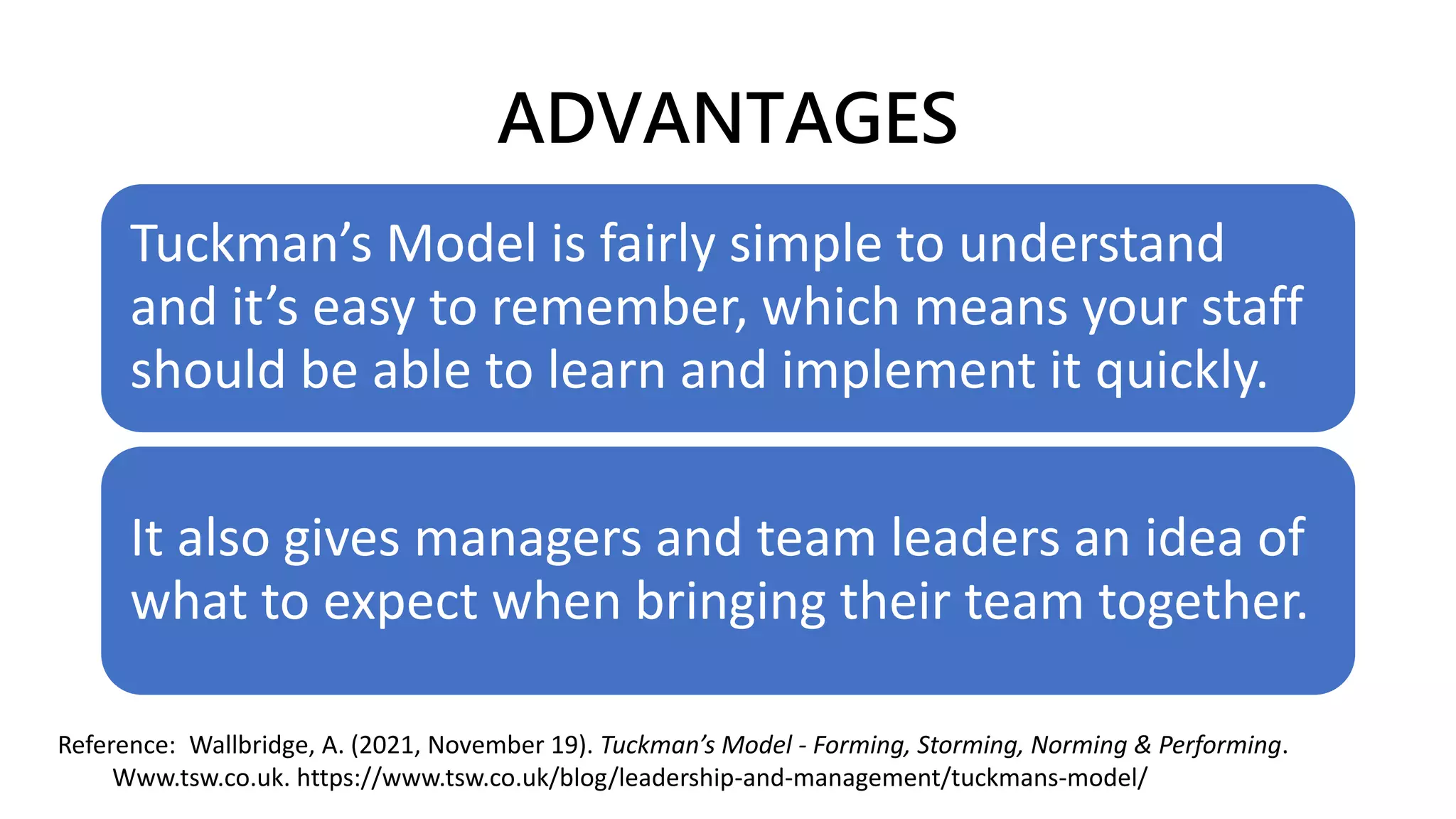
Tuckman’s Model is fairly simple to understand
and it’s easy to remember, which means your staff
should be able to learn and implement it quickly.
It also gives managers and team leaders an idea of
what to expect when bringing their team together.
Reference: Wallbridge, A. (2021, November 19). Tuckman’s Model - Forming, Storming, Norming & Performing.
Www.tsw.co.uk. https://www.tsw.co.uk/blog/leadership-and-management/tuckmans-model/
DISADVANTAGES
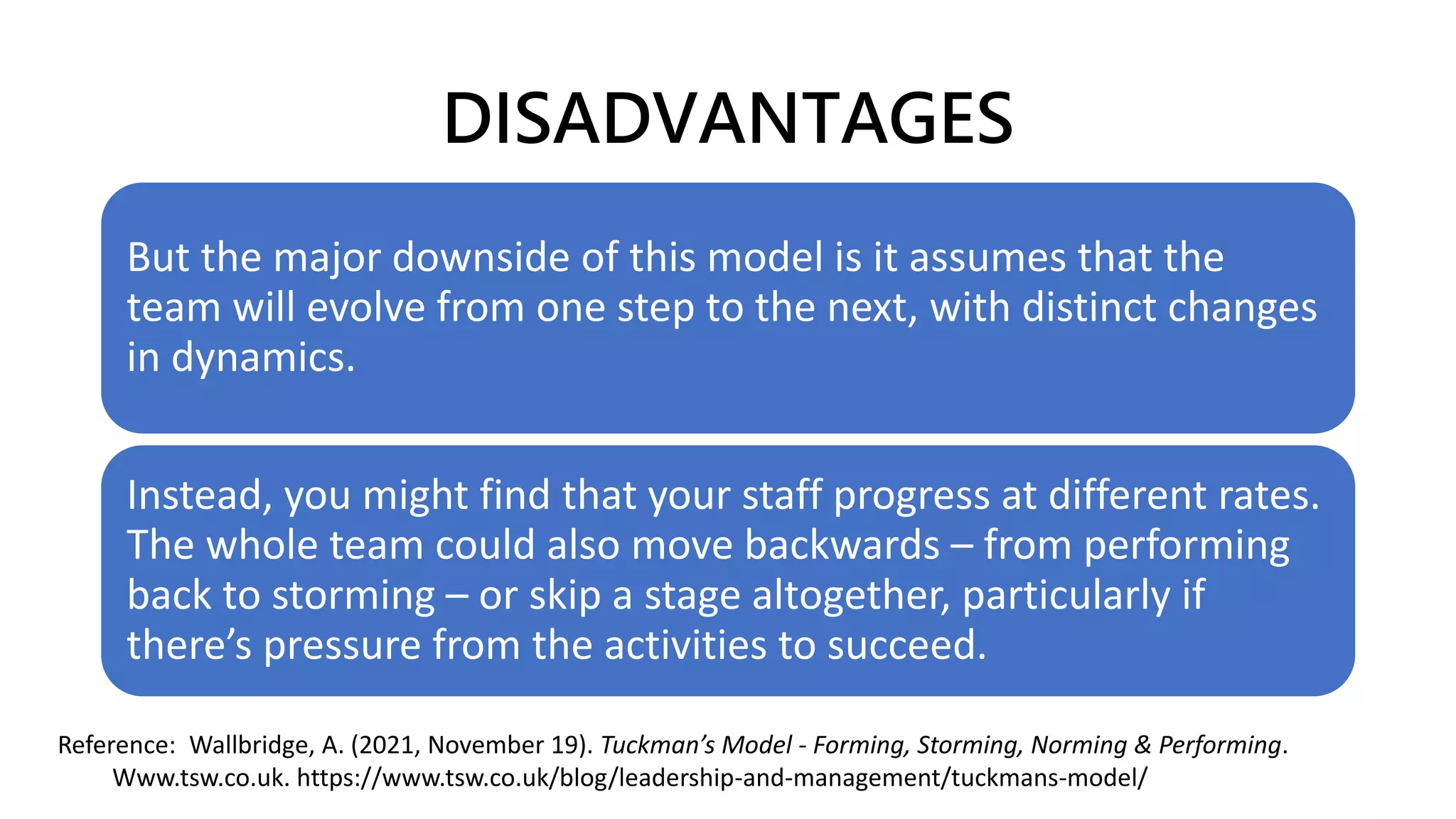
But the major downside of this model is it assumes that the
team will evolve from one step to the next, with distinct changes
in dynamics.
Instead, you might find that your staff progress at different rates.
The whole team could also move backwards – from performing
back to storming – or skip a stage altogether, particularly if
there’s pressure from the activities to succeed.
Reference: Wallbridge, A. (2021, November 19). Tuckman’s Model - Forming, Storming, Norming & Performing.
Www.tsw.co.uk. https://www.tsw.co.uk/blog/leadership-and-management/tuckmans-model/

Tuckman's Model - FORMING, STORMING, NORMING & PERFORMING

  • 1.
  • 2.
    FORMING bringing together ofstrangers in the hopes they’ll eventually be able to work as a highly functioning team. Nobody have a clear idea of what they’re supposed to be doing. They don’t really know each other well, so the atmosphere is reserved yet positive. Reference: Wallbridge, A. (2021, November 19). Tuckman’s Model - Forming, Storming, Norming & Performing. Www.tsw.co.uk. https://www.tsw.co.uk/blog/leadership-and-management/tuckmans-model/
  • 3.
    FORMING They may feelnervous, excited or curious at the forming stage – it’s all new and there’s a lot happening. As a leader, you’ll need to be aware of how each team member feels and set the direction, so the team can get on with the task at hand. Expect plenty of questions as your team finds their feet. This stage doesn’t focus so much on proper processes, or even having clearly defined roles. Reference: Wallbridge, A. (2021, November 19). Tuckman’s Model - Forming, Storming, Norming & Performing. Www.tsw.co.uk. https://www.tsw.co.uk/blog/leadership-and-management/tuckmans-model/
  • 4.
    FORMING How can leadershelp their employees at this stage? Create a team roadmap (its purpose, how it’ll work, and the expected outcomes) Have team members set personal goals Schedule informal chats so your team can get to know each other faster Reference: Wallbridge, A. (2021, November 19). Tuckman’s Model - Forming, Storming, Norming & Performing. Www.tsw.co.uk. https://www.tsw.co.uk/blog/leadership-and-management/tuckmans-model/
  • 5.
    STORMING While settling intothe new team and starting the task that has been set by the leader, the team will become more familiar. You’ll get to know your team members’ personalities and attitudes to working. There might be clashes, and some will start to question the leadership and challenge decisions because they believe there’s a better way. Understandably, this can lead to a stormier atmosphere. Reference: Wallbridge, A. (2021, November 19). Tuckman’s Model - Forming, Storming, Norming & Performing. Www.tsw.co.uk. https://www.tsw.co.uk/blog/leadership-and-management/tuckmans-model/
  • 6.
    STORMING As the leader,you’ll need to manage that social interaction and focus the team back on their goals. It’s important to make sure each team member has an equal voice. This stage is necessary to iron out problems and for group members to work out where they fit in to the wider team dynamic. Reference: Wallbridge, A. (2021, November 19). Tuckman’s Model - Forming, Storming, Norming & Performing. Www.tsw.co.uk. https://www.tsw.co.uk/blog/leadership-and-management/tuckmans-model/
  • 7.
    STORMING How can leadershelp their employees at this stage? Set up processes to track progress and success of tasks Ask your team to help you to build trust Don’t let disagreements linger and remember that opposing views find different faults and solutions Make sure quieter team members get a chance to voice their opinion Reference: Wallbridge, A. (2021, November 19). Tuckman’s Model - Forming, Storming, Norming & Performing. Www.tsw.co.uk. https://www.tsw.co.uk/blog/leadership-and-management/tuckmans-model/
  • 8.
    NORMING This is wherethe team members have their role, understand the work and know their fellow members. Your group might be more interested in collaborative activities and start interacting socially outside of work. This is where you can work together to develop team processes. Leadership responsibilities can be shared as you facilitate and enable your team. Reference: Wallbridge, A. (2021, November 19). Tuckman’s Model - Forming, Storming, Norming & Performing. Www.tsw.co.uk. https://www.tsw.co.uk/blog/leadership-and-management/tuckmans-model/
  • 9.
    NORMING By establishing aroutine during the storming stage, you’ve laid down the norms of behaviour that are accepted and understood by the team. You’ve found your rhythm, now you’ve just got to perform it. Reference: Wallbridge, A. (2021, November 19). Tuckman’s Model - Forming, Storming, Norming & Performing. Www.tsw.co.uk. https://www.tsw.co.uk/blog/leadership-and-management/tuckmans-model/
  • 10.
    NORMING •How can leadershelp their members at this stage? •Team building – you know your team by now, so make sure this is something they’ll actually enjoy. It doesn’t have to always be work-relate. Reference: Wallbridge, A. (2021, November 19). Tuckman’s Model - Forming, Storming, Norming & Performing. Www.tsw.co.uk. https://www.tsw.co.uk/blog/leadership-and-management/tuckmans-model/
  • 11.
    PERFORMING Everyone has aclear shared vision of their roles and processes, and they’re focused on meeting the team’s goals. As a leader, you’ll still need to delegate and manage the group, but generally they should trust their fellow team members and be mostly independent with their work so you shouldn’t need to interfere. Reference: Wallbridge, A. (2021, November 19). Tuckman’s Model - Forming, Storming, Norming & Performing. Www.tsw.co.uk. https://www.tsw.co.uk/blog/leadership-and-management/tuckmans-model/
  • 12.
    PERFORMING Disagreements are usuallyresolved happily, and any changes are decided collectively. The team will look out for each other and have an awareness of the wider company strategy. You might find you’re not asked for instructions or assistance as often. Instead, your team might ask for help with personal development to help them perform better. Reference: Wallbridge, A. (2021, November 19). Tuckman’s Model - Forming, Storming, Norming & Performing. Www.tsw.co.uk. https://www.tsw.co.uk/blog/leadership-and-management/tuckmans-model/
  • 13.
    ADJOURNING-The Fifth Stage In1975, Tuckman outlined a fifth phase. Adjourning is where the team’s goals have been achieved, so the members go their separate ways to work on other teams or leave the business altogether. Not all organizations will find this step relevant, as it’s not always the case that teams are broken up once their objectives have been met. Reference: Wallbridge, A. (2021, November 19). Tuckman’s Model - Forming, Storming, Norming & Performing. Www.tsw.co.uk. https://www.tsw.co.uk/blog/leadership-and-management/tuckmans-model/
  • 14.
    ADJOURNING-The Fifth Stage Howcan leaders help their employees at this stage? Celebrate achievements – you worked hard, and shared experiences will make it easier if you’re teamed up with the same people again Boost team members’ confidence by giving them feedback and deserved praise at company meetings. Offer to write references for them if they’re moving elsewhere Reference: Wallbridge, A. (2021, November 19). Tuckman’s Model - Forming, Storming, Norming & Performing. Www.tsw.co.uk. https://www.tsw.co.uk/blog/leadership-and-management/tuckmans-model/
  • 15.
    What effects canunderstanding the Tuckman’s Model have on Team Members?
  • 16.
    ADVANTAGES Tuckman’s Model isfairly simple to understand and it’s easy to remember, which means your staff should be able to learn and implement it quickly. It also gives managers and team leaders an idea of what to expect when bringing their team together. Reference: Wallbridge, A. (2021, November 19). Tuckman’s Model - Forming, Storming, Norming & Performing. Www.tsw.co.uk. https://www.tsw.co.uk/blog/leadership-and-management/tuckmans-model/
  • 17.
    DISADVANTAGES But the majordownside of this model is it assumes that the team will evolve from one step to the next, with distinct changes in dynamics. Instead, you might find that your staff progress at different rates. The whole team could also move backwards – from performing back to storming – or skip a stage altogether, particularly if there’s pressure from the activities to succeed. Reference: Wallbridge, A. (2021, November 19). Tuckman’s Model - Forming, Storming, Norming & Performing. Www.tsw.co.uk. https://www.tsw.co.uk/blog/leadership-and-management/tuckmans-model/