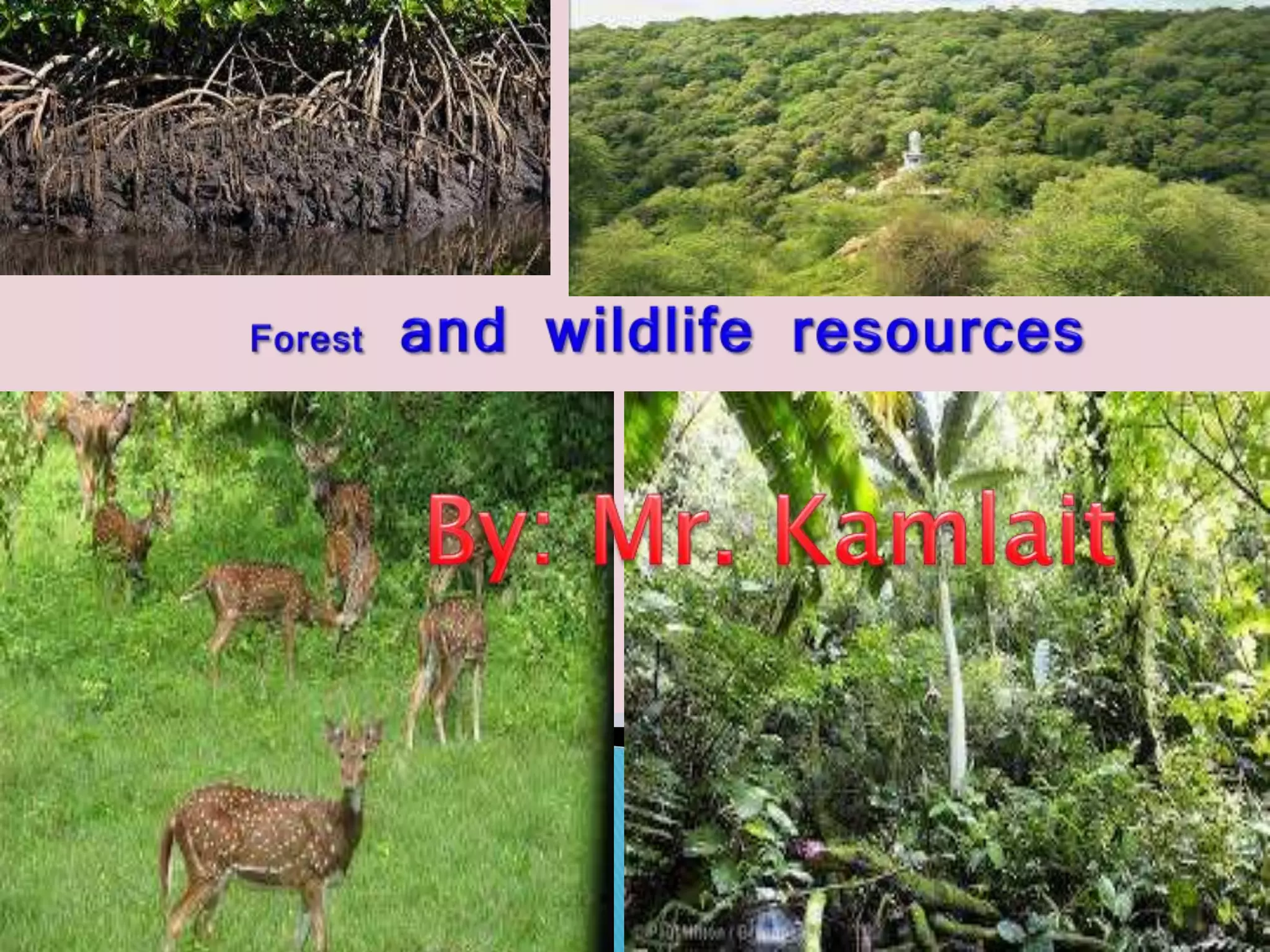
 The Earth has immense biodiversity.
 We humans along with all living
organisms form a complex web of
ecological system in which we are
only a part and very much dependent
on this system for our own existence.
 Forests play a key role in the
ecological system as these are also
the primary producers on which all
living beings depend.
 India is one of the world’s richest
countries in terms of its vast array
of biological diversity and has
nearly 8% of the total number of
species in the world.
 90,000 species of fauna, 74,000
species of Flora.
 15,000 flowering Plants, 2000
species of birds.
 10% of flora and 20% of mammals
are on threatened list.
 The forest cover 78.29 million
hectare which 23.81% of the
total geographical area.
 1.Normal Species: Species whose
population levels are considered to be
normal for their survival, such as cattle,
sal, pine, rodents, etc.
 2. Endangered Species: These are
species which are in danger of
extinction. The survival of such
species is difficult if the negative
factors that have led to a decline in
their population continue to operate.
Ex. black buck, crocodile, Indian wild
ass, Indian rhino, lion tailed macaque,
sangai etc.
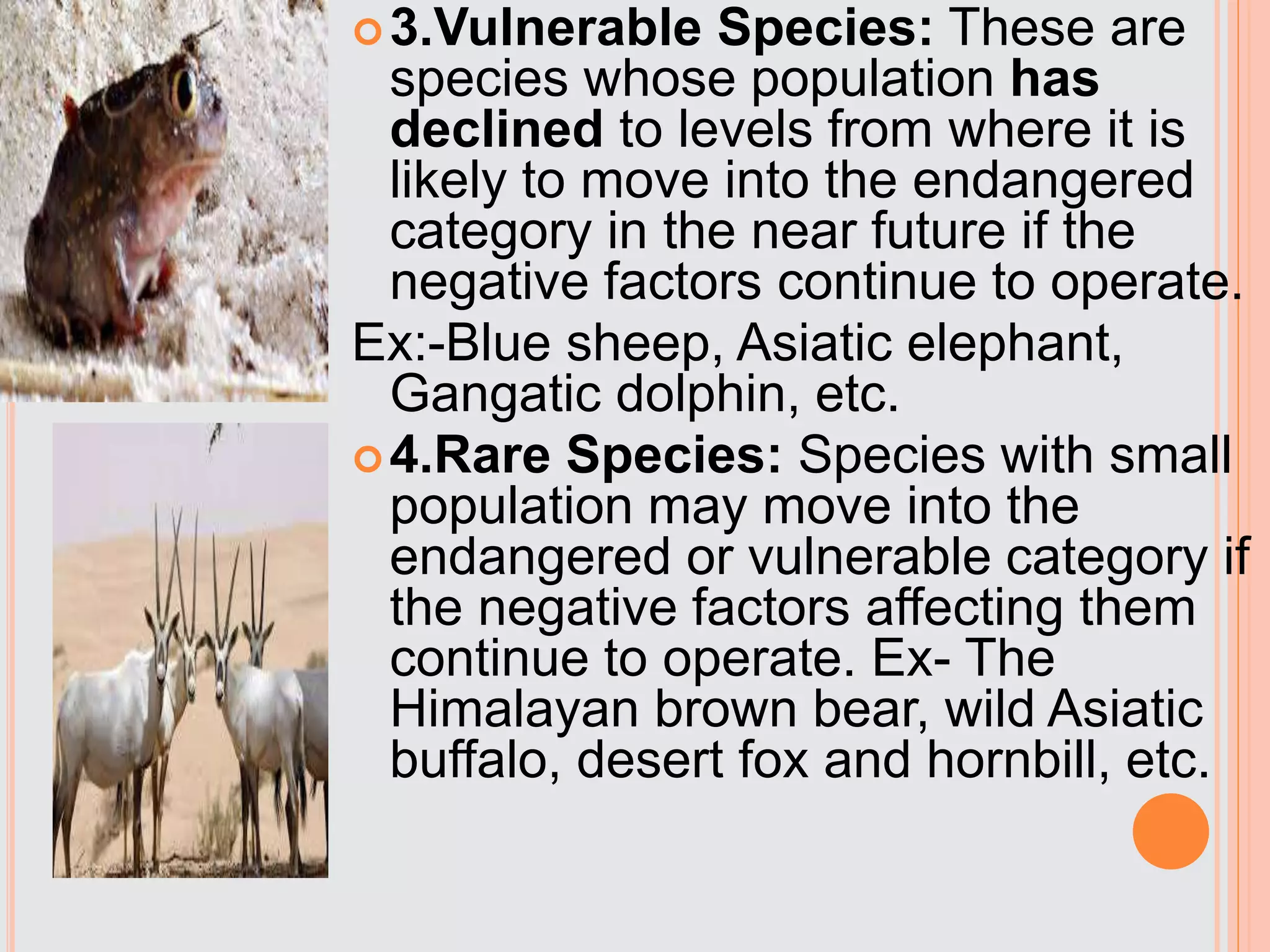
3.Vulnerable Species: These are
species whose population has
declined to levels from where it is
likely to move into the endangered
category in the near future if the
negative factors continue to operate.
Ex:-Blue sheep, Asiatic elephant,
Gangatic dolphin, etc.
4.Rare Species: Species with small
population may move into the
endangered or vulnerable category if
the negative factors affecting them
continue to operate. Ex- The
Himalayan brown bear, wild Asiatic
buffalo, desert fox and hornbill, etc.
5.Endemic Species: These are
species which are only found in
some particular areas usually
isolated by natural or geographical
barriers. Ex. The Andaman
teal, Nicobar pigeon, Andaman
wild pig, mithun in Arunachal
Pradesh.
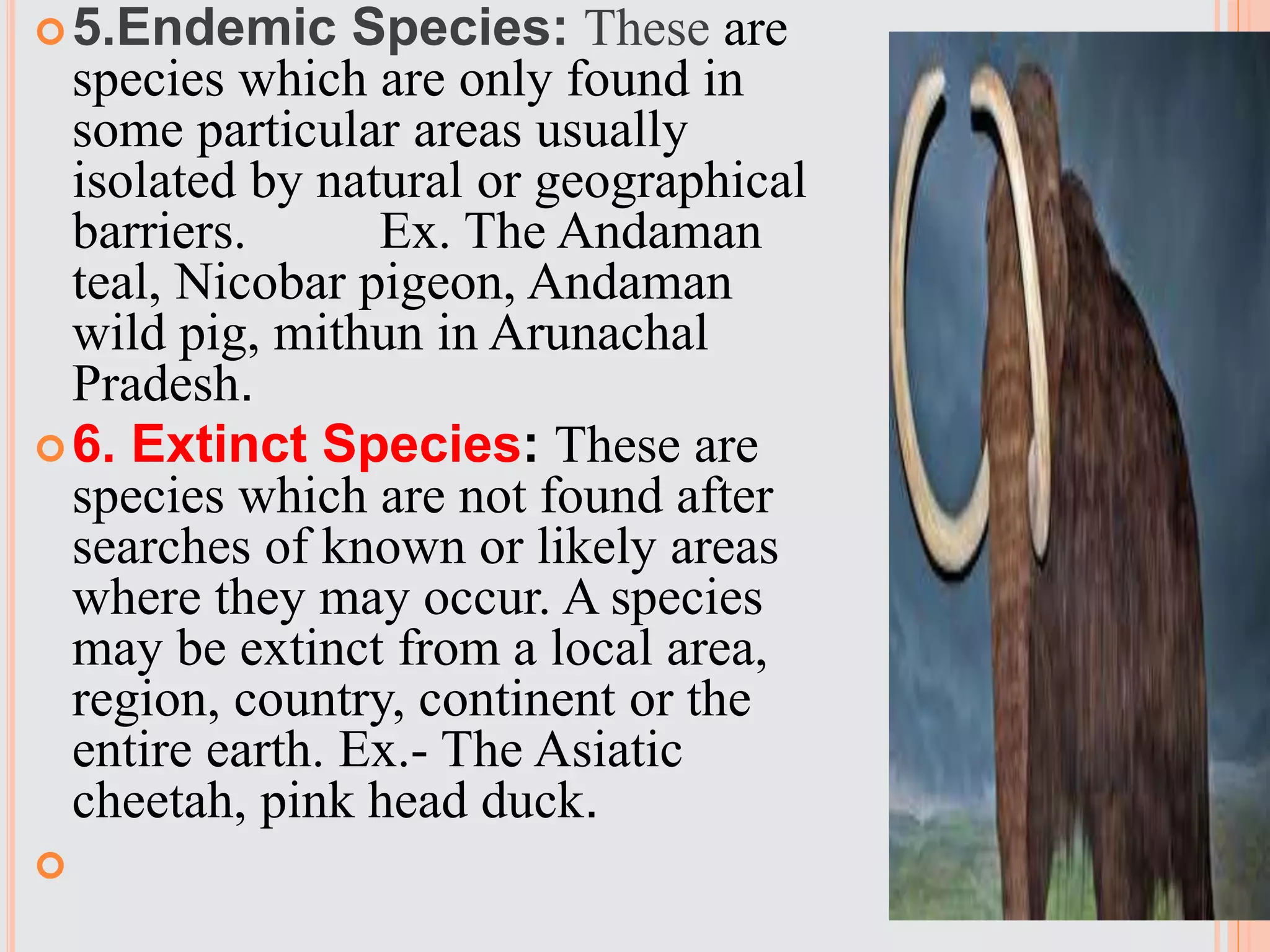
6. Extinct Species: These are
species which are not found after
searches of known or likely areas
where they may occur. A species
may be extinct from a local area,
region, country, continent or the
entire earth. Ex.- The Asiatic
cheetah, pink head duck.

1. Resources obtaining directly and indirectly
from forest and wildlife.
2. In colonial Period: the expansion of railways,
agriculture, commercial and scientific forestry
and mining activity.
3. After independence: Expansions of agriculture.
4. Plantation: Single commercially valuable
species was extensively planted.
5. Large-scale development projects.
6. Mining
7. Grazing
8. Fuel-wood collection.
9. Industrialization and urbanization.
10. Hunting, Poaching
11. Over-exploitation
12. Environmental pollution.
13. Poisoning and forest fires
14. Unequal access
15. Inequitable consumption of resources
and differential sharing of responsibility
for environmental well-being.
16. Over- population.
SOCIAL EFFECT OF RESOURCE DEPLETION:
 women bear the major responsibility of
collection of fuel, fodder, water and other
basic subsistence needs.
 As these resources are depleted, the
drudgery of women increases and
sometimes they have to walk for more than
10 km to collect these resources.
 This causes serious health problems for
women and negligence of home and
children because of the increased hours of
work, which often has serious social
implications.
 The indirect impact of degradation such as
severe drought or deforestation-induced
floods, etc.
 Poverty in these cases is a direct outcome
of environmental destruction.
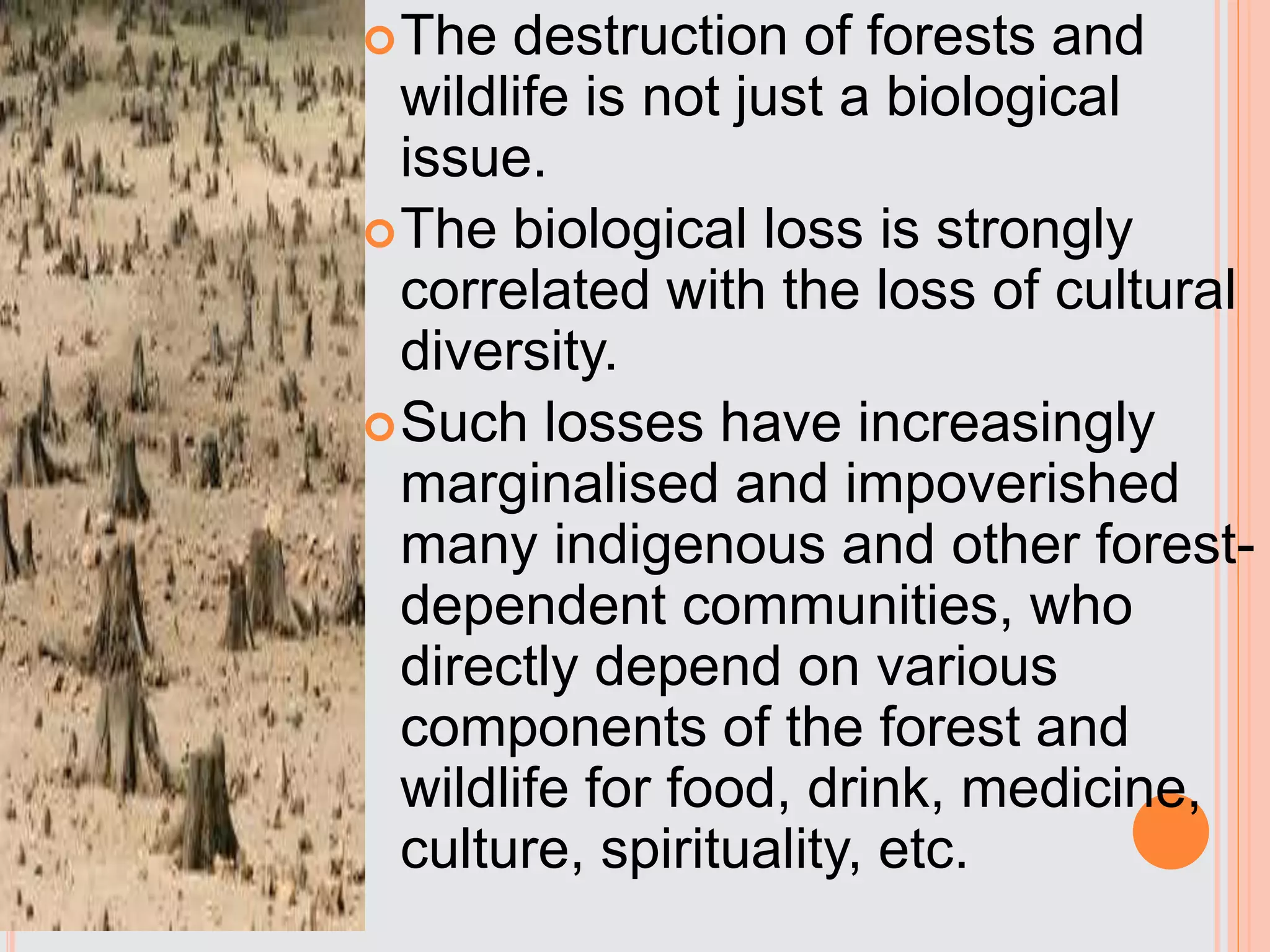
The destruction of forests and
wildlife is not just a biological
issue.
The biological loss is strongly
correlated with the loss of cultural
diversity.
Such losses have increasingly
marginalised and impoverished
many indigenous and other forest-
dependent communities, who
directly depend on various
components of the forest and
wildlife for food, drink, medicine,
culture, spirituality, etc.
WHY DO WE NEED TO
CONSERVE OUR FOREST
AND WILDLIFE?
Conservation preserves the ecological
diversity and our life support systems –
water, air and soil.
It also preserves the genetic diversity of
plants and animals for better growth of
species and breeding.
Conservation of Forest and Wildlife in
India
• The Indian Wildlife (Protection) Act was
implemented in 1972:
• The aim of the programme was towards protecting
the remaining population of certain endangered
species by banning hunting, giving legal protection
to their habitats, and restricting trade in wildlife.
• Central and many state governments established
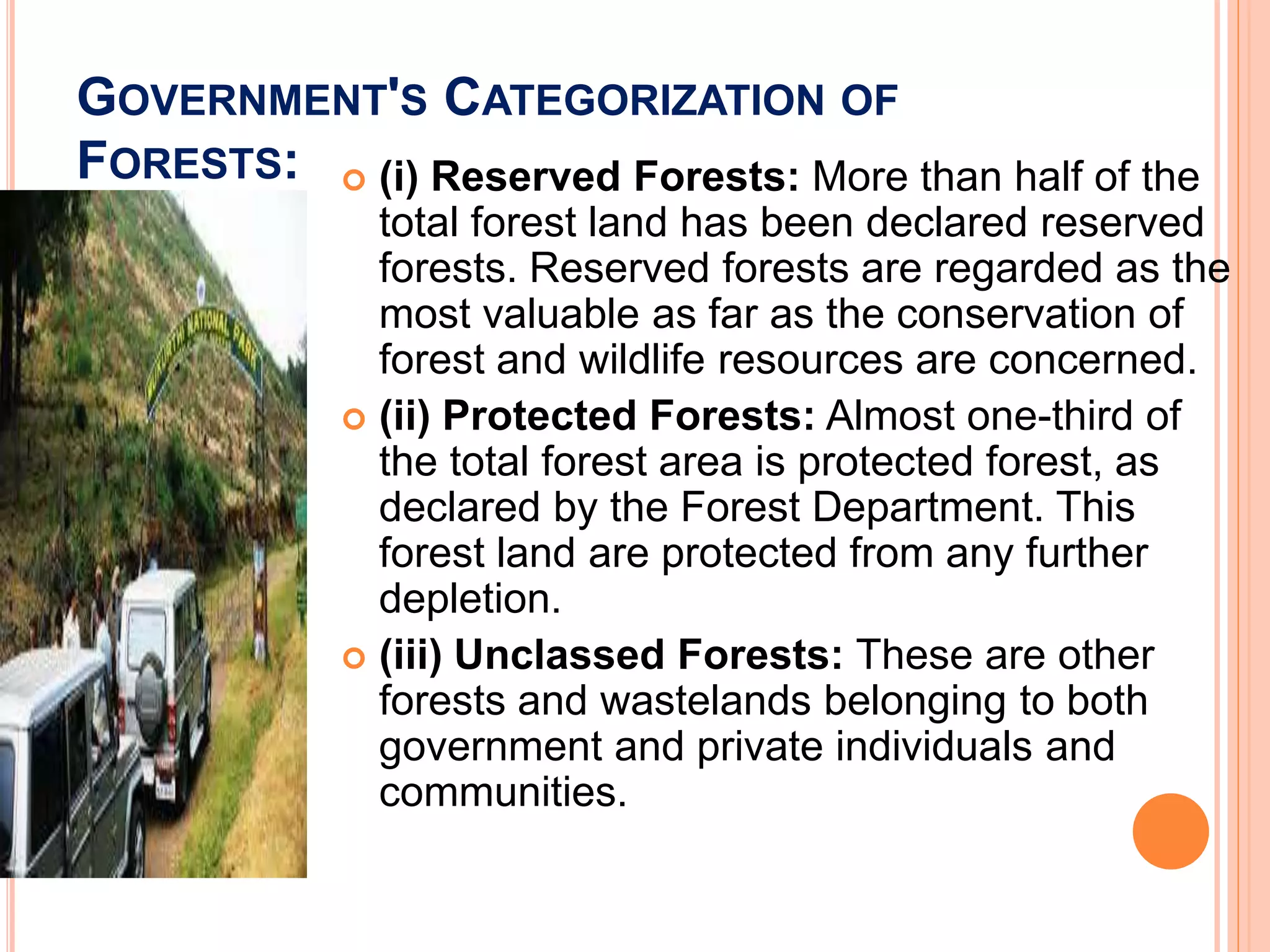
national parks and wildlife sanctuaries.
• The central government also announced several
projects for protecting specific animals, which
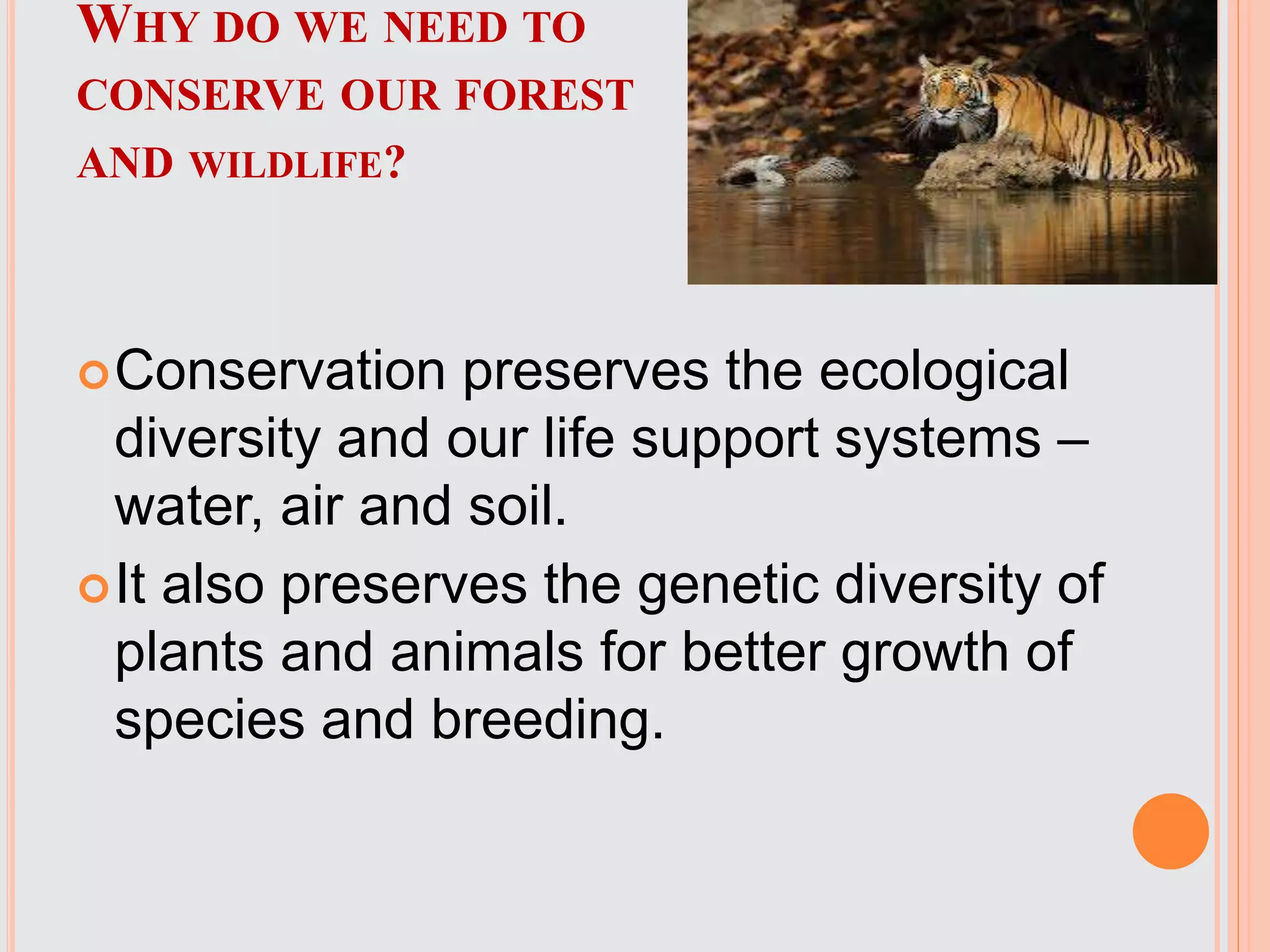
were gravely threatened, including the tiger.
GOVERNMENT'S CATEGORIZATION OF
FORESTS:  (i) Reserved Forests: More than half of the
total forest land has been declared reserved
forests. Reserved forests are regarded as the
most valuable as far as the conservation of
forest and wildlife resources are concerned.
 (ii) Protected Forests: Almost one-third of
the total forest area is protected forest, as
declared by the Forest Department. This
forest land are protected from any further
depletion.
 (iii) Unclassed Forests: These are other
forests and wastelands belonging to both
government and private individuals and
communities.
NEW TRENDS IN CONSERVATION POLICY
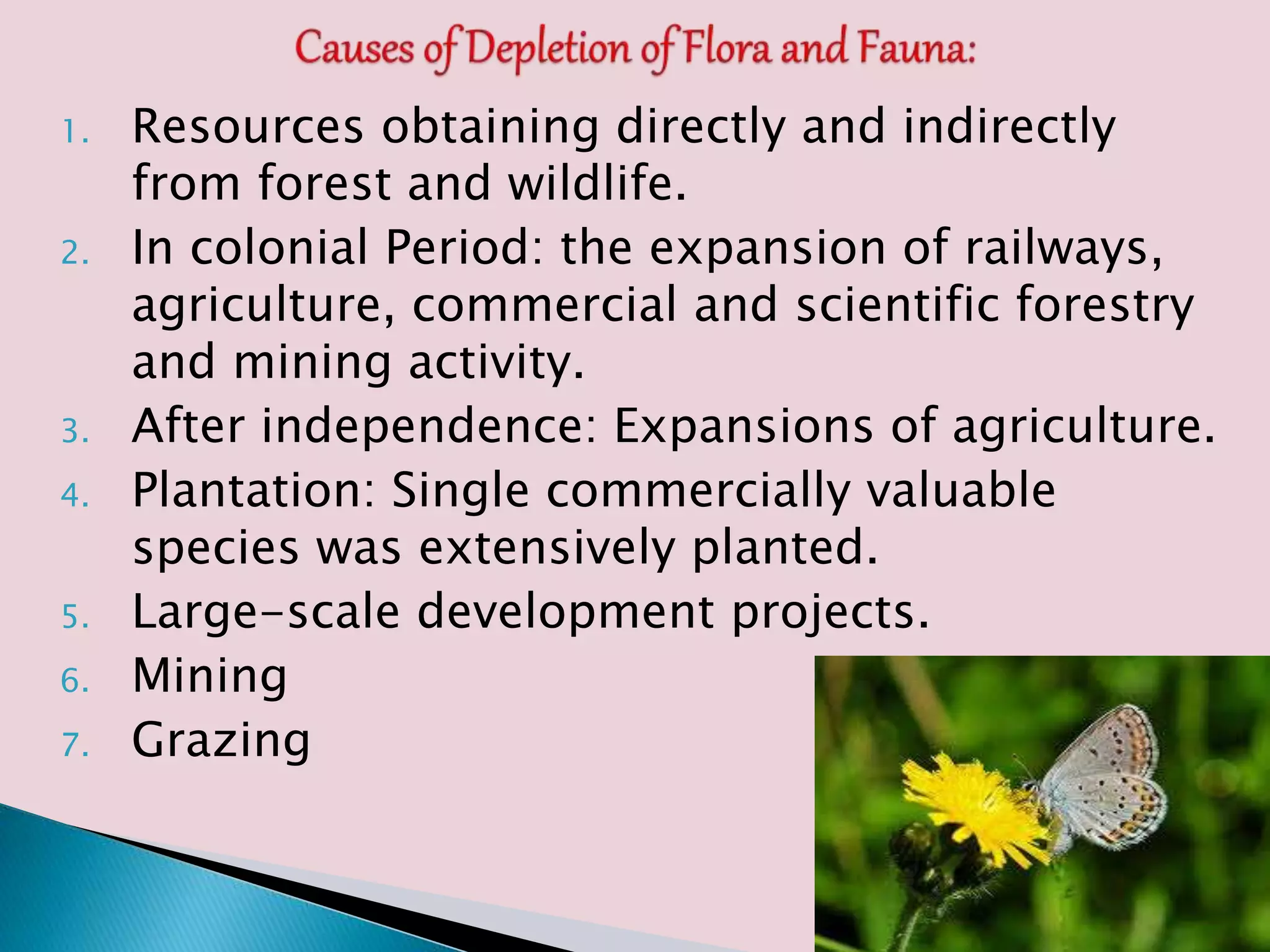
 Increase Biodiversity: The conservation projects
are now focusing on biodiversity rather than on a
few of its components. There is now a more
intensive search for different conservation
measures. Increasingly, even insects are beginning
to find a place in conservation planning. In the
notification under Wildlife Act of 1980 and 1986,
several hundred butterflies, moths, beetles, and one
dragonfly have been added to the list of protected
species. In 1991, for the first time plants were also
added to the list, starting with six species.
 In some areas of India, local communities are
struggling to conserve these habitats along with
government officials, recognising that only this will
secure their own long-term livelihood.
 • In Sariska Tiger Reserve, Rajasthan, villagers have
fought against mining by citing the Wildlife Protection
Act. In many areas, villagers themselves are protecting
habitats and explicitly rejecting government
involvement. The inhabitants of five villages in the
Alwar district of Rajasthan have declared 1,200
hectares of forest as the Bhairodev Dakav
‘Sonchuri’, declaring their own set of rules and
regulations which do not allow hunting, and are
protecting the wildlife against any outside
encroachments.
Nature worship is an age old tribal belief
based on the premise that all creations of
nature have to be protected. Such beliefs
have preserved several virgin forests in
pristine form called Sacred Groves (the
forests of God and Goddesses). These
patches of forest or parts of large forests
have been left untouched by the local
people and any interference with them is
banned
The Mundas and the Santhal of
Chhota Nagpur region worship mahua
(Bassia latifolia) and kadamba
(Anthocaphalus cadamba) trees, and
the tribals of Orissa and Bihar worship
the tamarind (Tamarindus indica) and
mango (Mangifera indica) trees during
weddings. To many of us, peepal and
banyan trees are considered sacred.
Indian society comprises several cultures,
each with its own set of traditional methods of
conserving nature and its creations. Sacred
qualities are often ascribed to springs,
mountain peaks, plants and animals which are
closely protected. You will find troops of
macaques and langurs around many temples.
They are fed daily and treated as a part of
temple devotees. In and around Bishnoi
villages in Rajasthan, herds of blackbuck,
(chinkara), nilgai and peacocks can be seen as
an integral part of the community and nobody
harm them.
The famous Chipko
movement in the
Himalayas has not only
successfully resisted
deforestation in several
areas but has also shown
that community
afforestation with
indigenous species can
be enormously
successful.
 Farmers and citizen’s groups like the Beej Bachao Andolan in
Tehri and Navdanya have shown that adequate levels of
diversified crop production without the use of synthetic
chemicals are possible and economically viable.
 In India joint forest management (JFM) programme furnishes a
good example for involving local communities in the
management and restoration of degraded forests. The
programme has been in formal existence since 1988 when the
state of Orissa passed the first resolution for joint forest
management. JFM depends on the formation of local (village)
institutions that undertake protection activities mostly on
degraded forest land managed by the forest department. In
return, the members of these communities are entitled to
intermediary benefits like non-timber forest produces and share
in the timber harvested by ‘successful protection’.
The clear lesson from the dynamics of both
environmental destruction and
reconstruction in India is that local
communities everywhere have to be
involved in some kind of natural resource
management. But there is still a long way to
go before local communities are at the
centre-stage in decision-making. Accept
only those economic or developmental
activities, that are people centric,
environment-friendly and economically
rewarding.


Forests and wildlife resources Class 10 Geography

  • 3.
     The Earthhas immense biodiversity.  We humans along with all living organisms form a complex web of ecological system in which we are only a part and very much dependent on this system for our own existence.  Forests play a key role in the ecological system as these are also the primary producers on which all living beings depend.
  • 4.
     India isone of the world’s richest countries in terms of its vast array of biological diversity and has nearly 8% of the total number of species in the world.  90,000 species of fauna, 74,000 species of Flora.  15,000 flowering Plants, 2000 species of birds.  10% of flora and 20% of mammals are on threatened list.  The forest cover 78.29 million hectare which 23.81% of the total geographical area.
  • 5.
     1.Normal Species:Species whose population levels are considered to be normal for their survival, such as cattle, sal, pine, rodents, etc.  2. Endangered Species: These are species which are in danger of extinction. The survival of such species is difficult if the negative factors that have led to a decline in their population continue to operate. Ex. black buck, crocodile, Indian wild ass, Indian rhino, lion tailed macaque, sangai etc.
  • 6.
    3.Vulnerable Species: Theseare species whose population has declined to levels from where it is likely to move into the endangered category in the near future if the negative factors continue to operate. Ex:-Blue sheep, Asiatic elephant, Gangatic dolphin, etc. 4.Rare Species: Species with small population may move into the endangered or vulnerable category if the negative factors affecting them continue to operate. Ex- The Himalayan brown bear, wild Asiatic buffalo, desert fox and hornbill, etc.
  • 7.
    5.Endemic Species: Theseare species which are only found in some particular areas usually isolated by natural or geographical barriers. Ex. The Andaman teal, Nicobar pigeon, Andaman wild pig, mithun in Arunachal Pradesh. 6. Extinct Species: These are species which are not found after searches of known or likely areas where they may occur. A species may be extinct from a local area, region, country, continent or the entire earth. Ex.- The Asiatic cheetah, pink head duck. 
  • 8.
    1. Resources obtainingdirectly and indirectly from forest and wildlife. 2. In colonial Period: the expansion of railways, agriculture, commercial and scientific forestry and mining activity. 3. After independence: Expansions of agriculture. 4. Plantation: Single commercially valuable species was extensively planted. 5. Large-scale development projects. 6. Mining 7. Grazing
  • 9.
    8. Fuel-wood collection. 9.Industrialization and urbanization. 10. Hunting, Poaching 11. Over-exploitation 12. Environmental pollution. 13. Poisoning and forest fires 14. Unequal access 15. Inequitable consumption of resources and differential sharing of responsibility for environmental well-being. 16. Over- population.
  • 10.
    SOCIAL EFFECT OFRESOURCE DEPLETION:  women bear the major responsibility of collection of fuel, fodder, water and other basic subsistence needs.  As these resources are depleted, the drudgery of women increases and sometimes they have to walk for more than 10 km to collect these resources.  This causes serious health problems for women and negligence of home and children because of the increased hours of work, which often has serious social implications.  The indirect impact of degradation such as severe drought or deforestation-induced floods, etc.  Poverty in these cases is a direct outcome of environmental destruction.
  • 11.
    The destruction offorests and wildlife is not just a biological issue. The biological loss is strongly correlated with the loss of cultural diversity. Such losses have increasingly marginalised and impoverished many indigenous and other forest- dependent communities, who directly depend on various components of the forest and wildlife for food, drink, medicine, culture, spirituality, etc.
  • 12.
    WHY DO WENEED TO CONSERVE OUR FOREST AND WILDLIFE? Conservation preserves the ecological diversity and our life support systems – water, air and soil. It also preserves the genetic diversity of plants and animals for better growth of species and breeding.
  • 13.
    Conservation of Forestand Wildlife in India • The Indian Wildlife (Protection) Act was implemented in 1972: • The aim of the programme was towards protecting the remaining population of certain endangered species by banning hunting, giving legal protection to their habitats, and restricting trade in wildlife. • Central and many state governments established national parks and wildlife sanctuaries. • The central government also announced several projects for protecting specific animals, which were gravely threatened, including the tiger.
  • 14.
    GOVERNMENT'S CATEGORIZATION OF FORESTS: (i) Reserved Forests: More than half of the total forest land has been declared reserved forests. Reserved forests are regarded as the most valuable as far as the conservation of forest and wildlife resources are concerned.  (ii) Protected Forests: Almost one-third of the total forest area is protected forest, as declared by the Forest Department. This forest land are protected from any further depletion.  (iii) Unclassed Forests: These are other forests and wastelands belonging to both government and private individuals and communities.
  • 15.
    NEW TRENDS INCONSERVATION POLICY  Increase Biodiversity: The conservation projects are now focusing on biodiversity rather than on a few of its components. There is now a more intensive search for different conservation measures. Increasingly, even insects are beginning to find a place in conservation planning. In the notification under Wildlife Act of 1980 and 1986, several hundred butterflies, moths, beetles, and one dragonfly have been added to the list of protected species. In 1991, for the first time plants were also added to the list, starting with six species.
  • 16.
     In someareas of India, local communities are struggling to conserve these habitats along with government officials, recognising that only this will secure their own long-term livelihood.  • In Sariska Tiger Reserve, Rajasthan, villagers have fought against mining by citing the Wildlife Protection Act. In many areas, villagers themselves are protecting habitats and explicitly rejecting government involvement. The inhabitants of five villages in the Alwar district of Rajasthan have declared 1,200 hectares of forest as the Bhairodev Dakav ‘Sonchuri’, declaring their own set of rules and regulations which do not allow hunting, and are protecting the wildlife against any outside encroachments.
  • 17.
    Nature worship isan age old tribal belief based on the premise that all creations of nature have to be protected. Such beliefs have preserved several virgin forests in pristine form called Sacred Groves (the forests of God and Goddesses). These patches of forest or parts of large forests have been left untouched by the local people and any interference with them is banned
  • 18.
    The Mundas andthe Santhal of Chhota Nagpur region worship mahua (Bassia latifolia) and kadamba (Anthocaphalus cadamba) trees, and the tribals of Orissa and Bihar worship the tamarind (Tamarindus indica) and mango (Mangifera indica) trees during weddings. To many of us, peepal and banyan trees are considered sacred.
  • 19.
    Indian society comprisesseveral cultures, each with its own set of traditional methods of conserving nature and its creations. Sacred qualities are often ascribed to springs, mountain peaks, plants and animals which are closely protected. You will find troops of macaques and langurs around many temples. They are fed daily and treated as a part of temple devotees. In and around Bishnoi villages in Rajasthan, herds of blackbuck, (chinkara), nilgai and peacocks can be seen as an integral part of the community and nobody harm them.
  • 20.
    The famous Chipko movementin the Himalayas has not only successfully resisted deforestation in several areas but has also shown that community afforestation with indigenous species can be enormously successful.
  • 21.
     Farmers andcitizen’s groups like the Beej Bachao Andolan in Tehri and Navdanya have shown that adequate levels of diversified crop production without the use of synthetic chemicals are possible and economically viable.  In India joint forest management (JFM) programme furnishes a good example for involving local communities in the management and restoration of degraded forests. The programme has been in formal existence since 1988 when the state of Orissa passed the first resolution for joint forest management. JFM depends on the formation of local (village) institutions that undertake protection activities mostly on degraded forest land managed by the forest department. In return, the members of these communities are entitled to intermediary benefits like non-timber forest produces and share in the timber harvested by ‘successful protection’.
  • 22.
    The clear lessonfrom the dynamics of both environmental destruction and reconstruction in India is that local communities everywhere have to be involved in some kind of natural resource management. But there is still a long way to go before local communities are at the centre-stage in decision-making. Accept only those economic or developmental activities, that are people centric, environment-friendly and economically rewarding. 