What is Mineral ?
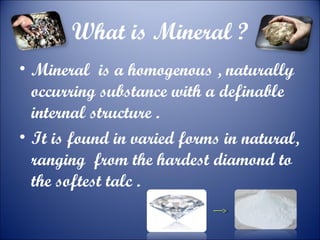
• Mineral is a homogenous , naturally
occurring substance with a definable
internal structure .
• It is found in varied forms in natural,
ranging from the hardest diamond to
the softest talc .
Importance of minerals
• They are indispensable part of our
lives.
• Life processes can’t occur without
minerals.
• The food we eat contains minerals.
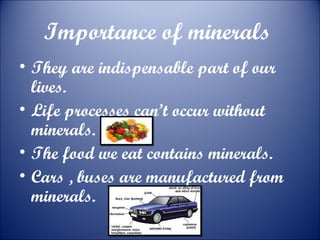
• Cars , buses are manufactured from
minerals.
Classification of minerals
Metallic
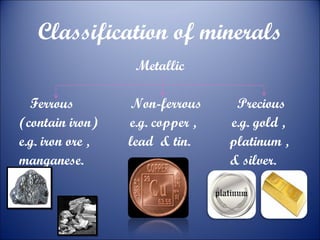
Ferrous
(contain iron)
e.g. iron ore ,
manganese.

Non-ferrous
e.g. copper ,
lead & tin.

Precious
e.g. gold ,
platinum ,
& silver.
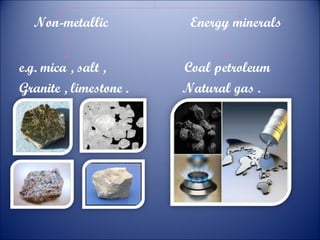
Non-metallic
e.g. mica , salt ,
Granite , limestone .

Energy minerals
Coal petroleum
Natural gas .
Occurrence of minerals
(i)Igneous & metamorphic rocks
(ii) Sedimentary rocks
(iii) Weathered rocks
(iv) Alluvial deposits
(v) Ocean water
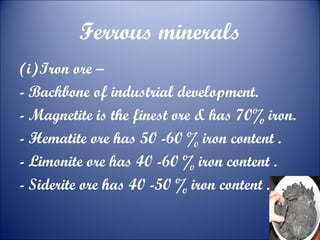
Ferrous minerals
(i)Iron ore –
- Backbone of industrial development.
- Magnetite is the finest ore & has 70% iron.
- Hematite ore has 50 -60 % iron content .
- Limonite ore has 40 -60 % iron content .
- Siderite ore has 40 -50 % iron content .
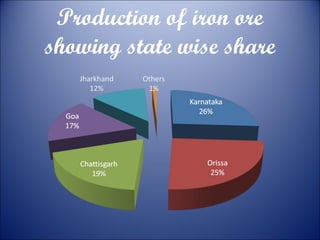
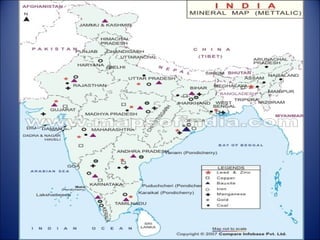
Production of iron ore
showing state wise share
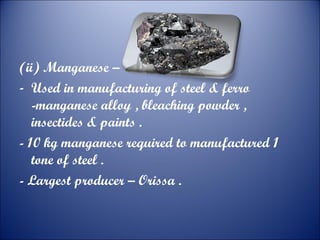
(ii) Manganese –
- Used in manufacturing of steel & ferro
-manganese alloy , bleaching powder ,
insectides & paints .
- 10 kg manganese required to manufactured 1
tone of steel .
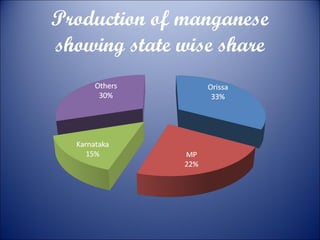
- Largest producer – Orissa .
Production of manganese
showing state wise share
Non – ferrous minerals
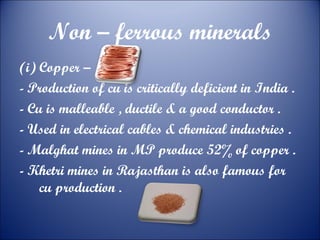
(i) Copper –
- Production of cu is critically deficient in India .
- Cu is malleable , ductile & a good conductor .
- Used in electrical cables & chemical industries .
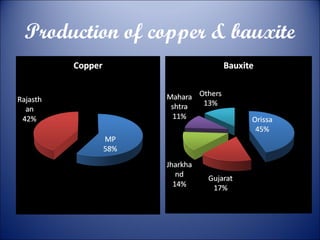
- Malghat mines in MP produce 52% of copper .
- Khetri mines in Rajasthan is also famous for
cu production .
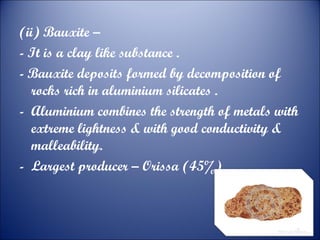
(ii) Bauxite –
- It is a clay like substance .
- Bauxite deposits formed by decomposition of
rocks rich in aluminium silicates .
- Aluminium combines the strength of metals with
extreme lightness & with good conductivity &
malleability.
- Largest producer – Orissa (45%)
Production of copper & bauxite
Non-metallic minerals
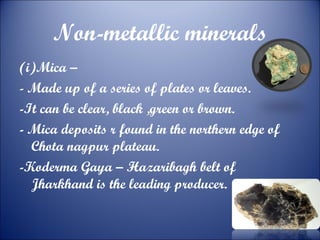
(i)Mica –
- Made up of a series of plates or leaves.
-It can be clear, black ,green or brown.
- Mica deposits r found in the northern edge of
Chota nagpur plateau.
-Koderma Gaya – Hazaribagh belt of
Jharkhand is the leading producer.
Rock mineral
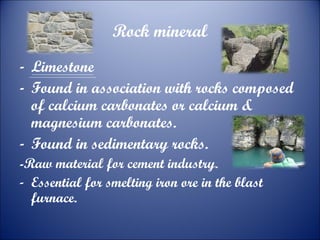
- Limestone
- Found in association with rocks composed
of calcium carbonates or calcium &
magnesium carbonates.
- Found in sedimentary rocks.
-Raw material for cement industry.
- Essential for smelting iron ore in the blast
furnace.
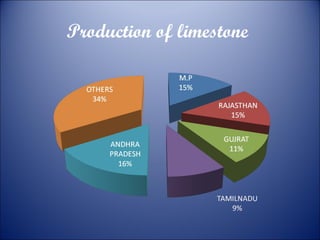
Production of limestone
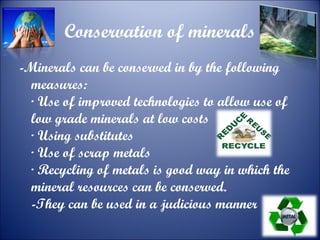
Conservation of minerals
-Minerals can be conserved in by the following
measures:
· Use of improved technologies to allow use of
low grade minerals at low costs
· Using substitutes
· Use of scrap metals
· Recycling of metals is good way in which the
mineral resources can be conserved.
-They can be used in a judicious manner
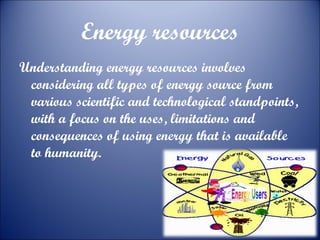
Energy resources
Understanding energy resources involves
considering all types of energy source from
various scientific and technological standpoints,
with a focus on the uses, limitations and
consequences of using energy that is available
to humanity.
Conventional sources of energy
(i) Coal –
- Used for power generation , to supply energy- to
industry as well as for domestic needs .
- India is highly dependent on coal .
- Formed due the compression of plant material over
million of years .
- Lignite is a low grade brown coal , which is soft
with high moisture content .
- Coal that has been buried deep & subjected to
increased temperaturesis bituminous coal .
- Anthracite is the highest quality hard coal .
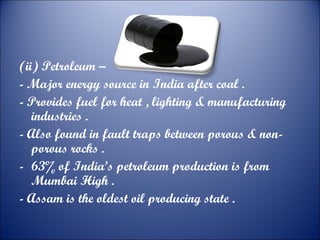
(ii) Petroleum –
- Major energy source in India after coal .
- Provides fuel for heat , lighting & manufacturing
industries .
- Also found in fault traps between porous & nonporous rocks .
- 63% of India’s petroleum production is from
Mumbai High .
- Assam is the oldest oil producing state .
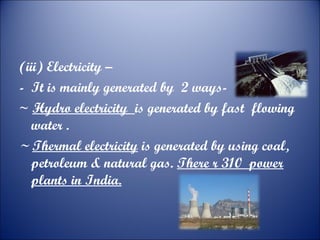
(iii) Electricity –
- It is mainly generated by 2 ways~ Hydro electricity is generated by fast flowing
water .
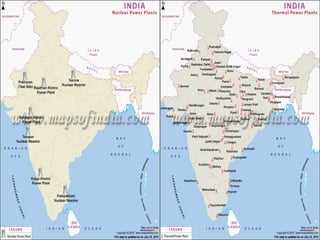
~ Thermal electricity is generated by using coal,
petroleum & natural gas. There r 310 power
plants in India.
Non – conventional sources of
energy

(i) Nuclear & atomic energy
- Obtained by altering the structure of atoms.
- Uranium & thorium r used for generating atomic or
nuclear energy .
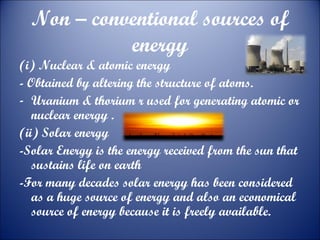
(ii) Solar energy
-Solar Energy is the energy received from the sun that
sustains life on earth
-For many decades solar energy has been considered
as a huge source of energy and also an economical
source of energy because it is freely available.
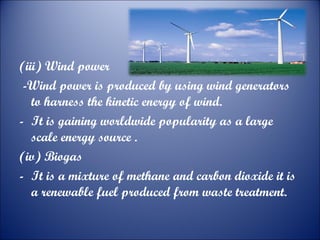
(iii) Wind power
-Wind power is produced by using wind generators
to harness the kinetic energy of wind.
- It is gaining worldwide popularity as a large
scale energy source .
(iv) Biogas
- It is a mixture of methane and carbon dioxide it is
a renewable fuel produced from waste treatment.
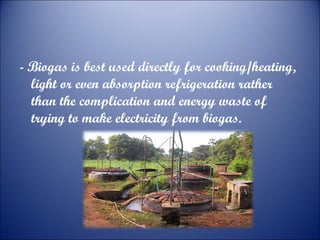
- Biogas is best used directly for cooking/heating,
light or even absorption refrigeration rather
than the complication and energy waste of
trying to make electricity from biogas.
Conservation of energy resources
- Choose energy efficient appliances when making
new purchases.
- Do not leave appliances on standby.
- Cover your pots while cooking.
- Recycle your organic waste.
- Reduce the number of miles you drive by
walking, biking, carpooling or taking mass
transit wherever possible.
The End

Minerals and energy resources 10 class

  • 2.
    What is Mineral? • Mineral is a homogenous , naturally occurring substance with a definable internal structure . • It is found in varied forms in natural, ranging from the hardest diamond to the softest talc .
  • 3.
    Importance of minerals •They are indispensable part of our lives. • Life processes can’t occur without minerals. • The food we eat contains minerals. • Cars , buses are manufactured from minerals.
  • 4.
    Classification of minerals Metallic Ferrous (containiron) e.g. iron ore , manganese. Non-ferrous e.g. copper , lead & tin. Precious e.g. gold , platinum , & silver.
  • 5.
    Non-metallic e.g. mica ,salt , Granite , limestone . Energy minerals Coal petroleum Natural gas .
  • 6.
    Occurrence of minerals (i)Igneous& metamorphic rocks (ii) Sedimentary rocks (iii) Weathered rocks (iv) Alluvial deposits (v) Ocean water
  • 7.
    Ferrous minerals (i)Iron ore– - Backbone of industrial development. - Magnetite is the finest ore & has 70% iron. - Hematite ore has 50 -60 % iron content . - Limonite ore has 40 -60 % iron content . - Siderite ore has 40 -50 % iron content .
  • 8.
    Production of ironore showing state wise share
  • 9.
    (ii) Manganese – -Used in manufacturing of steel & ferro -manganese alloy , bleaching powder , insectides & paints . - 10 kg manganese required to manufactured 1 tone of steel . - Largest producer – Orissa .
  • 10.
  • 11.
    Non – ferrousminerals (i) Copper – - Production of cu is critically deficient in India . - Cu is malleable , ductile & a good conductor . - Used in electrical cables & chemical industries . - Malghat mines in MP produce 52% of copper . - Khetri mines in Rajasthan is also famous for cu production .
  • 12.
    (ii) Bauxite – -It is a clay like substance . - Bauxite deposits formed by decomposition of rocks rich in aluminium silicates . - Aluminium combines the strength of metals with extreme lightness & with good conductivity & malleability. - Largest producer – Orissa (45%)
  • 13.
  • 14.
    Non-metallic minerals (i)Mica – -Made up of a series of plates or leaves. -It can be clear, black ,green or brown. - Mica deposits r found in the northern edge of Chota nagpur plateau. -Koderma Gaya – Hazaribagh belt of Jharkhand is the leading producer.
  • 15.
    Rock mineral - Limestone -Found in association with rocks composed of calcium carbonates or calcium & magnesium carbonates. - Found in sedimentary rocks. -Raw material for cement industry. - Essential for smelting iron ore in the blast furnace.
  • 16.
  • 18.
    Conservation of minerals -Mineralscan be conserved in by the following measures: · Use of improved technologies to allow use of low grade minerals at low costs · Using substitutes · Use of scrap metals · Recycling of metals is good way in which the mineral resources can be conserved. -They can be used in a judicious manner
  • 19.
    Energy resources Understanding energyresources involves considering all types of energy source from various scientific and technological standpoints, with a focus on the uses, limitations and consequences of using energy that is available to humanity.
  • 20.
    Conventional sources ofenergy (i) Coal – - Used for power generation , to supply energy- to industry as well as for domestic needs . - India is highly dependent on coal . - Formed due the compression of plant material over million of years . - Lignite is a low grade brown coal , which is soft with high moisture content . - Coal that has been buried deep & subjected to increased temperaturesis bituminous coal . - Anthracite is the highest quality hard coal .
  • 21.
    (ii) Petroleum – -Major energy source in India after coal . - Provides fuel for heat , lighting & manufacturing industries . - Also found in fault traps between porous & nonporous rocks . - 63% of India’s petroleum production is from Mumbai High . - Assam is the oldest oil producing state .
  • 22.
    (iii) Electricity – -It is mainly generated by 2 ways~ Hydro electricity is generated by fast flowing water . ~ Thermal electricity is generated by using coal, petroleum & natural gas. There r 310 power plants in India.
  • 24.
    Non – conventionalsources of energy (i) Nuclear & atomic energy - Obtained by altering the structure of atoms. - Uranium & thorium r used for generating atomic or nuclear energy . (ii) Solar energy -Solar Energy is the energy received from the sun that sustains life on earth -For many decades solar energy has been considered as a huge source of energy and also an economical source of energy because it is freely available.
  • 25.
    (iii) Wind power -Windpower is produced by using wind generators to harness the kinetic energy of wind. - It is gaining worldwide popularity as a large scale energy source . (iv) Biogas - It is a mixture of methane and carbon dioxide it is a renewable fuel produced from waste treatment.
  • 26.
    - Biogas isbest used directly for cooking/heating, light or even absorption refrigeration rather than the complication and energy waste of trying to make electricity from biogas.
  • 27.
    Conservation of energyresources - Choose energy efficient appliances when making new purchases. - Do not leave appliances on standby. - Cover your pots while cooking. - Recycle your organic waste. - Reduce the number of miles you drive by walking, biking, carpooling or taking mass transit wherever possible.
  • 28.