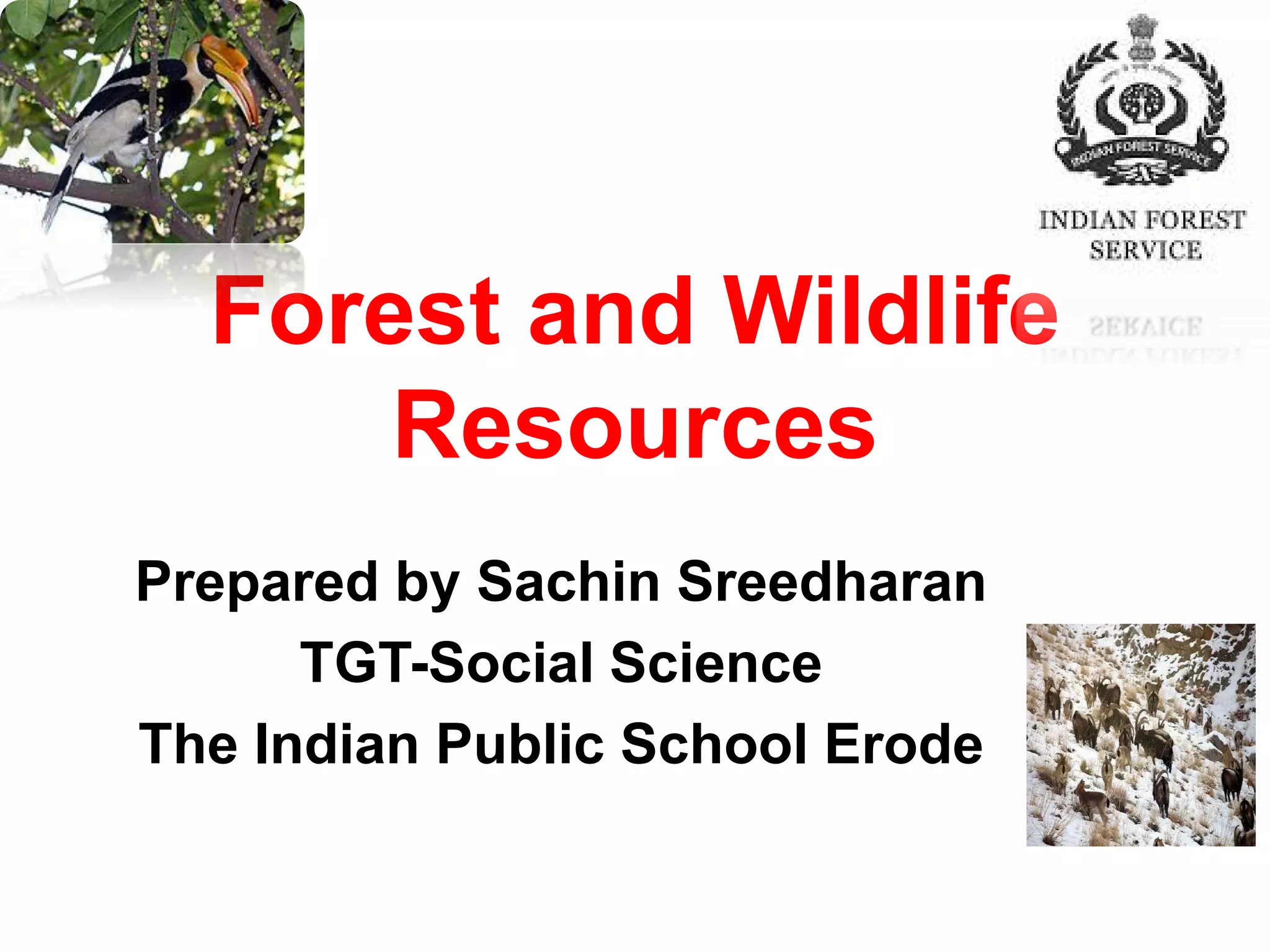
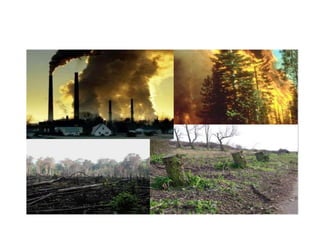
Forest and Wildlife
Resources
Prepared by Sachin Sreedharan
TGT-Social Science
The Indian Public School Erode
Learning Outcomes
• Examine the importance of conserving forests
and wild life and their interdependency in
maintaining the ecology for the sustainable
development of India.
• Analyze the role of grazing and wood cutting
in the development and degradation
• Comprehends the reasons for conservation of
biodiversity in India under sustainable
development.
Major Topics
• Flora and fauna in India.
• Conservation of forests and wild life in India.
• Types and distribution of forest and wildlife
resources
• Community and conservation
The importance of forest
• Forests act as watershed
• They are habitat for wildlife
• They give us economic benefits .
• They help in climate control
• Wildlife help in balancing ecosystem
• Maintain food chains
• They also act as a means of recreation
What Is Bio-diversity ?
• The variety of Flora and Fauna in a given
geographical area is called biodiversity of that
area.
• Refers to the variety of life. It is seen in the
number of species in an ecosystem or on the
entire Earth.
The Reasons for conserving bio-
diversity
• We humans along with all living organisms form a
complex web of ecological system in which we
are only a part and very much dependent on this
system for our own existence.
• The plants, animals and micro-organisms re-
create the quality of the air we breathe, the
water we drink and the soil that produces our
food without which we cannot survive.
• Forests play a key role in the ecological system as
these are also the primary producers on which all
other living beings depend.
The rich bio-diversity of india
• India is rich in biodiversity.
• India has 8% of the total number of species in
the world 81,000 species of fauna 47000
species of flora 15000 flowering species are
endemic to India .
Species categorised as critical-on the
verge of extinction
Madhuca insignis[Wild variety of Mahua]
Hubbardia heptaneuron(a species of grass).
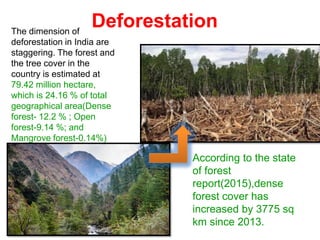
Deforestation
The dimension of
deforestation in India are
staggering. The forest and
the tree cover in the
country is estimated at
79.42 million hectare,
which is 24.16 % of total
geographical area(Dense
forest- 12.2 % ; Open
forest-9.14 %; and
Mangrove forest-0.14%)
According to the state
of forest
report(2015),dense
forest cover has
increased by 3775 sq
km since 2013.
The different categories of existing
plant and animals
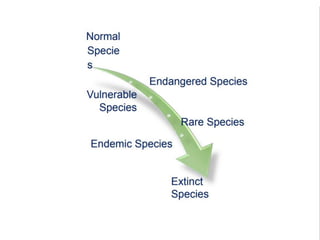
Based on the International Union for Conservation
of Nature and Natural Resources (IUCN).
•Normal species
•Endangered species
•Vulnerable species
• Rare species
•Endemic species
•Extinct species
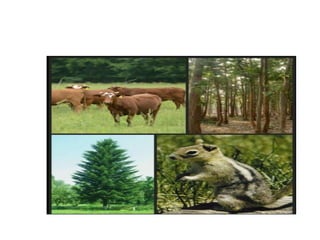
Normal species
• Species whose population levels are
considered to be normal for their survival,
such as cattle, Sal, pine, rodents, etc.
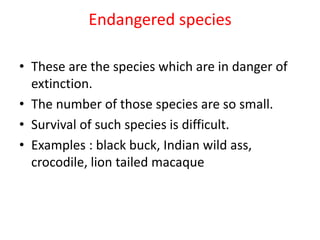
Endangered species
• These are the species which are in danger of
extinction.
• The number of those species are so small.
• Survival of such species is difficult.
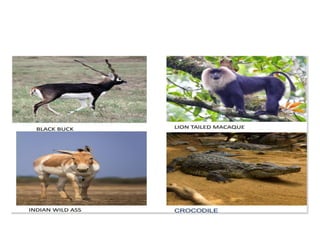
• Examples : black buck, Indian wild ass,
crocodile, lion tailed macaque
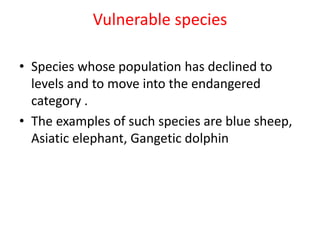
Vulnerable species
• Species whose population has declined to
levels and to move into the endangered
category .
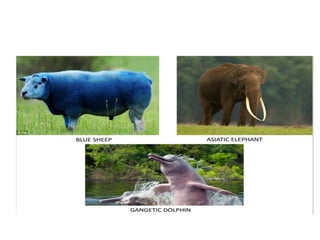
• The examples of such species are blue sheep,
Asiatic elephant, Gangetic dolphin
Rare species
• Species with small population and can move
into the endangered or vulnerable category.
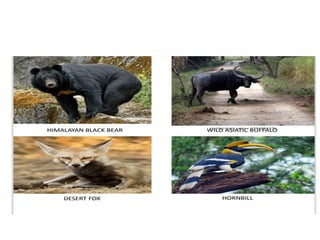
• The examples -Himalayan Brown bear, wild
Asiatic buffalo, desert fox, hornbill etc..
Endemic species
• The species which are only found in some
particular areas usually isolated by natural or
geographical barriers.
• Examples-Andaman teal, Nicobar pigeon,
Andaman wild pig, mithun in Arunachal
Pradesh
Extinct species
• Species which are not longer in existence .
• The species may be extinct from a local area,
region, country, continent or the entire Earth.
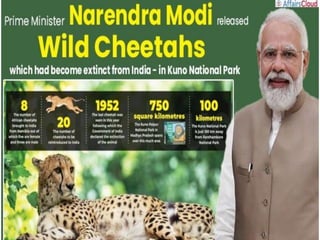
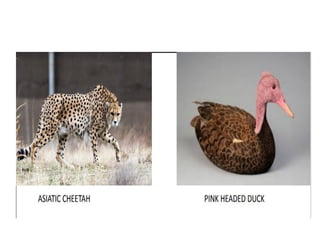
• Examples -Asiatic cheetah, pink-head duck
Asiatic cheetah: where did they go?
• The world’s fastest land mammal, the cheetah
(Acinonyx jubantus), is a unique and
specialized member of the cat family and can
move at the speed of 112 km./hr.
• The cheetah is often mistaken for a leopard.
Its distinguishing marks are the long teardrop-
shaped lines on each side of the nose from the
corner of its eyes to its mouth.
• Prior to the 20th century, cheetahs were
widely distributed throughout Africa and Asia.
• Today, the Asian cheetah is nearly extinct due
to a decline of available habitat and prey.
• The species was declared extinct in India long
back in 1952.
Reasons responsible for the depletion
of flora and funa
• Policies followed during the British period.
 Expansion of railways
Agriculture
Commercial and Scientific forestry
 Mining
Enrichment Plantation
• Developmental activities
River valley Projects
Mining activities
 Grazing and fuel wood collection
hunting and poaching
 over-exploitation
 environmental pollution
poisoning and forest fires
Factors that responsible for the decline
of india's bio diversity
• Habitat destruction
• Hunting, poaching,
• Over-exploitation
• Environmental pollution
• Poisoning and forest fires
• Unequal access,
• Inequitable consumption of resources and
differential sharing of responsibility for
environmental well-being.
• Over-population
Factors that responsible for the large
scale deforestation in India
• Rapid industrialization and urbanization
• Expansion of mining activities
• Faulty agricultural practices in tribal
area,Jumming or shifting cultivation.
• The construction of multi-purpose projects
has also led to the clearance of the forests.
“The destruction of forests and wildlife
is not just a biological issue.”
• The biological loss is correlated with the loss of
cultural diversity.
• Such losses impoverished marginalized and many
indigenous and other forest-dependent
communities.
• Within the poor, women are affected more than
men.
• As these resources are depleted, the work lord of
women increases and some times they have to
walk for more than 10 km to collect these
resources.
• Serious health problems for women and
negligence of home and children because of
the increased hours of work.
• The indirect impact of degradation -severe
drought or deforestation-induced floods, etc.
also hits the poor the hardest. It leads to
poverty
Himalayan yew
• A medicinal plant found in various parts of Himachal
Pradesh and Arunachal Pradesh.
• A chemical compound called ‘taxol’ is extracted from
the bark, needles, twigs and roots of this tree, and it
has been successfully used to treat some cancers
• The drug is now the biggest selling anti-cancer drug in
theworld.
• The species is under great threat due to over-
exploitation.
• In the last one decade, thousands of yew trees have
dried up in various parts of Himachal Pradesh and
Arunachal Pradesh.
Why do we need the conservation of
forest and wildlife?
• Preserving economically important plants and animals.
• Fuel, fodder and domestic needs of the population .
• Needs of village, small scale and large scale industries.
• Conservation preserves the ecological diversity and our
life support systems – water, air and soil.
• It also preserves the genetic diversity of plants and
animals for better growth of species and breeding.
• Fisheries too are heavily dependent on the
maintenance of aquatic biodiversity.
Measures for the conservation of
forest and wildlife
• Indian wildlife (Protection ) Act 1972.
• List of protected species was published.
• The aim of the programme was to protect
the remaining population of certain
endangered species by banning hunting,
giving legal protection to their habitats, and
restricting trade in wildlife.
• Established wildlife sanctuaries and national
parks.
• The central government has announced several
projects for protecting specific animals, which were
gravely threatened.
• It consist of projects for tiger, the one-horned
rhinoceros, the Kashmir stag or hangul, three types of
crocodiles – fresh water crocodile, saltwater crocodile
and the Gharial, the Asiatic lion, and others.
• Most recently, the government started Indian
elephant, black buck (chinkara), the great Indian
bustard (godawan) and the snow leopard, etc.
• These have been given full or partial legal protection
against hunting and trade throughout India.
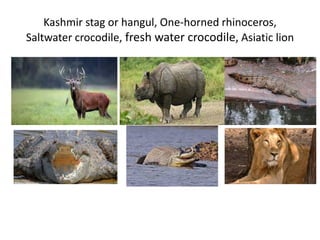
Kashmir stag or hangul, One-horned rhinoceros,
Saltwater crocodile, fresh water crocodile, Asiatic lion
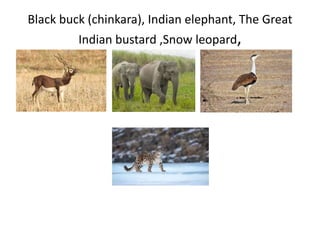
Black buck (chinkara), Indian elephant, The Great
Indian bustard ,Snow leopard,
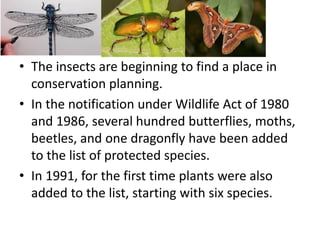
• The insects are beginning to find a place in
conservation planning.
• In the notification under Wildlife Act of 1980
and 1986, several hundred butterflies, moths,
beetles, and one dragonfly have been added
to the list of protected species.
• In 1991, for the first time plants were also
added to the list, starting with six species.
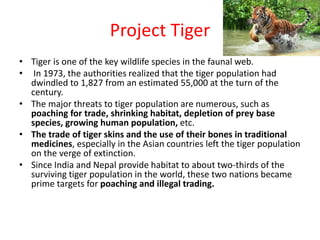
Project Tiger
• Tiger is one of the key wildlife species in the faunal web.
• In 1973, the authorities realized that the tiger population had
dwindled to 1,827 from an estimated 55,000 at the turn of the
century.
• The major threats to tiger population are numerous, such as
poaching for trade, shrinking habitat, depletion of prey base
species, growing human population, etc.
• The trade of tiger skins and the use of their bones in traditional
medicines, especially in the Asian countries left the tiger population
on the verge of extinction.
• Since India and Nepal provide habitat to about two-thirds of the
surviving tiger population in the world, these two nations became
prime targets for poaching and illegal trading.
• “Project Tiger”, one of the well publicised
wildlife campaigns in the world, was launched
in 1973.
• Tiger conservation has been viewed not only
as an effort to save an endangered species,
but with equal importance as a means of
preserving biotypes of sizeable magnitude.
The Tiger reserves in India.
• Corbett National Park in Uttarakhand.
• Sunderbans National Park in West Bengal
• Bandhavgarh National Park in Madhya
Pradesh
• Sariska Wildlife Sanctuary in Rajasthan
• Manas Tiger Reserve in Assam
• Periyar Tiger Reserve in Kerala.
Types and distribution of forest and
wildlife resources
• Reserved Forests
• Protected Forests
• Unclassed Forests
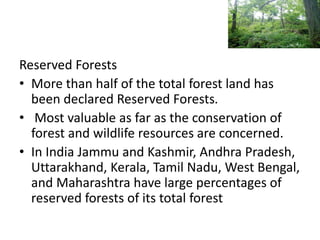
Reserved Forests
• More than half of the total forest land has
been declared Reserved Forests.
• Most valuable as far as the conservation of
forest and wildlife resources are concerned.
• In India Jammu and Kashmir, Andhra Pradesh,
Uttarakhand, Kerala, Tamil Nadu, West Bengal,
and Maharashtra have large percentages of
reserved forests of its total forest
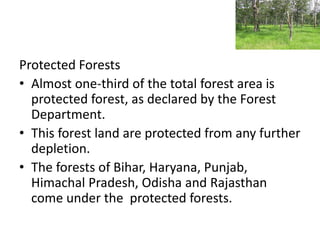
Protected Forests
• Almost one-third of the total forest area is
protected forest, as declared by the Forest
Department.
• This forest land are protected from any further
depletion.
• The forests of Bihar, Haryana, Punjab,
Himachal Pradesh, Odisha and Rajasthan
come under the protected forests.
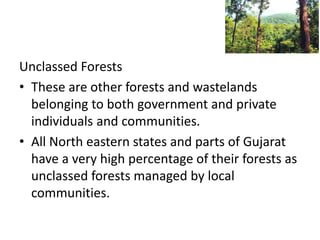
Unclassed Forests
• These are other forests and wastelands
belonging to both government and private
individuals and communities.
• All North eastern states and parts of Gujarat
have a very high percentage of their forests as
unclassed forests managed by local
communities.
Role of Community in the
Conservation Forest
• In India, forests are also home to some of the
traditional communities.
• In some areas of India, local communities are
struggling to conserve these habitats along with
government officials.
• In Sariska Tiger Reserve, Rajasthan, villagers have
fought against mining by citing the Wildlife
Protection Act.
• In many areas, villagers themselves are protecting
habitats and explicitly rejecting government
involvement.
• The inhabitants of five villages in the Alwar
district of Rajasthan have declared 1,200
hectares of forest as the Bhairodev Dakav
‘Sonchuri’, declaring their own set of rules and
regulations which do not allow hunting, and
are protecting the wildlife against any outside
encroachments.
• The Chipko movement in the Himalayas has
resisted deforestation in several areas. It showed
community afforestation with indigenous species
conservation to be successful.
• The Beej Bachao Andolan in Tehri and Navdanya
have shown that adequate levels of diversified
crop production without the use of synthetic
chemicals are possible and economically
successful .
• In India joint forest management (JFM) programme
furnishes a good example for involving local communities in
the management and restoration of degraded forests.
• The programme has been in formal existence since 1988
when the state of Odisha passed the first resolution for
joint forest management.
• JFM depends on the formation of local (village) institutions
that undertake protection activities mostly on degraded
forest land managed by the forest department.
• In return, the members of these communities are entitled
to intermediary benefits like non-timber forest produces
and share in the timber harvested by ‘successful
protection’.
Sacred groves - a wealth of diverse and
rare species
• Nature worship is an age old tribal belief based
on the premise that all creations of nature have
to be protected.
• Such beliefs have preserved several virgin forests
in ancient form called Sacred Groves (the forests
of God and Goddesses).
• These patches of forest or parts of large forests
have been left untouched by the local people and
any interference with them is banned.
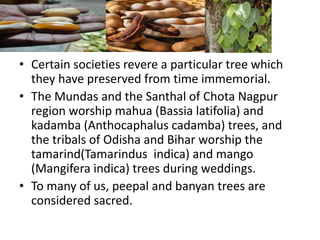
• Certain societies revere a particular tree which
they have preserved from time immemorial.
• The Mundas and the Santhal of Chota Nagpur
region worship mahua (Bassia latifolia) and
kadamba (Anthocaphalus cadamba) trees, and
the tribals of Odisha and Bihar worship the
tamarind(Tamarindus indica) and mango
(Mangifera indica) trees during weddings.
• To many of us, peepal and banyan trees are
considered sacred.
• Indian society comprises several cultures, each with its own
set of traditional methods of conserving nature and its
creations.
• Sacred qualities are often ascribed to springs, mountain
peaks, plants and animals which are closely protected.
• The troops of macaques and langurs around many
temples. They are fed daily and treated as a part of temple
devotees.
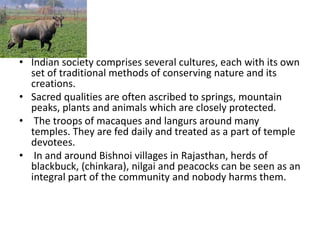
• In and around Bishnoi villages in Rajasthan, herds of
blackbuck, (chinkara), nilgai and peacocks can be seen as an
integral part of the community and nobody harms them.
THANK
YOU

Forest and Wildlife Resources -GRADE X.pdf

  • 1.
    Forest and Wildlife Resources Preparedby Sachin Sreedharan TGT-Social Science The Indian Public School Erode
  • 2.
    Learning Outcomes • Examinethe importance of conserving forests and wild life and their interdependency in maintaining the ecology for the sustainable development of India. • Analyze the role of grazing and wood cutting in the development and degradation • Comprehends the reasons for conservation of biodiversity in India under sustainable development.
  • 3.
    Major Topics • Floraand fauna in India. • Conservation of forests and wild life in India. • Types and distribution of forest and wildlife resources • Community and conservation
  • 5.
    The importance offorest • Forests act as watershed • They are habitat for wildlife • They give us economic benefits . • They help in climate control • Wildlife help in balancing ecosystem • Maintain food chains • They also act as a means of recreation
  • 6.
    What Is Bio-diversity? • The variety of Flora and Fauna in a given geographical area is called biodiversity of that area. • Refers to the variety of life. It is seen in the number of species in an ecosystem or on the entire Earth.
  • 7.
    The Reasons forconserving bio- diversity • We humans along with all living organisms form a complex web of ecological system in which we are only a part and very much dependent on this system for our own existence. • The plants, animals and micro-organisms re- create the quality of the air we breathe, the water we drink and the soil that produces our food without which we cannot survive. • Forests play a key role in the ecological system as these are also the primary producers on which all other living beings depend.
  • 8.
    The rich bio-diversityof india • India is rich in biodiversity. • India has 8% of the total number of species in the world 81,000 species of fauna 47000 species of flora 15000 flowering species are endemic to India .
  • 9.
    Species categorised ascritical-on the verge of extinction
  • 10.
    Madhuca insignis[Wild varietyof Mahua] Hubbardia heptaneuron(a species of grass).
  • 11.
    Deforestation The dimension of deforestationin India are staggering. The forest and the tree cover in the country is estimated at 79.42 million hectare, which is 24.16 % of total geographical area(Dense forest- 12.2 % ; Open forest-9.14 %; and Mangrove forest-0.14%) According to the state of forest report(2015),dense forest cover has increased by 3775 sq km since 2013.
  • 12.
    The different categoriesof existing plant and animals Based on the International Union for Conservation of Nature and Natural Resources (IUCN). •Normal species •Endangered species •Vulnerable species • Rare species •Endemic species •Extinct species
  • 13.
    Normal species • Specieswhose population levels are considered to be normal for their survival, such as cattle, Sal, pine, rodents, etc.
  • 15.
    Endangered species • Theseare the species which are in danger of extinction. • The number of those species are so small. • Survival of such species is difficult. • Examples : black buck, Indian wild ass, crocodile, lion tailed macaque
  • 17.
    Vulnerable species • Specieswhose population has declined to levels and to move into the endangered category . • The examples of such species are blue sheep, Asiatic elephant, Gangetic dolphin
  • 19.
    Rare species • Specieswith small population and can move into the endangered or vulnerable category. • The examples -Himalayan Brown bear, wild Asiatic buffalo, desert fox, hornbill etc..
  • 21.
    Endemic species • Thespecies which are only found in some particular areas usually isolated by natural or geographical barriers. • Examples-Andaman teal, Nicobar pigeon, Andaman wild pig, mithun in Arunachal Pradesh
  • 23.
    Extinct species • Specieswhich are not longer in existence . • The species may be extinct from a local area, region, country, continent or the entire Earth. • Examples -Asiatic cheetah, pink-head duck
  • 26.
    Asiatic cheetah: wheredid they go? • The world’s fastest land mammal, the cheetah (Acinonyx jubantus), is a unique and specialized member of the cat family and can move at the speed of 112 km./hr. • The cheetah is often mistaken for a leopard. Its distinguishing marks are the long teardrop- shaped lines on each side of the nose from the corner of its eyes to its mouth.
  • 27.
    • Prior tothe 20th century, cheetahs were widely distributed throughout Africa and Asia. • Today, the Asian cheetah is nearly extinct due to a decline of available habitat and prey. • The species was declared extinct in India long back in 1952.
  • 28.
    Reasons responsible forthe depletion of flora and funa • Policies followed during the British period.  Expansion of railways Agriculture Commercial and Scientific forestry  Mining Enrichment Plantation
  • 29.
    • Developmental activities Rivervalley Projects Mining activities  Grazing and fuel wood collection hunting and poaching  over-exploitation  environmental pollution poisoning and forest fires
  • 30.
    Factors that responsiblefor the decline of india's bio diversity • Habitat destruction • Hunting, poaching, • Over-exploitation • Environmental pollution • Poisoning and forest fires • Unequal access, • Inequitable consumption of resources and differential sharing of responsibility for environmental well-being. • Over-population
  • 31.
    Factors that responsiblefor the large scale deforestation in India • Rapid industrialization and urbanization • Expansion of mining activities • Faulty agricultural practices in tribal area,Jumming or shifting cultivation. • The construction of multi-purpose projects has also led to the clearance of the forests.
  • 33.
    “The destruction offorests and wildlife is not just a biological issue.” • The biological loss is correlated with the loss of cultural diversity. • Such losses impoverished marginalized and many indigenous and other forest-dependent communities. • Within the poor, women are affected more than men. • As these resources are depleted, the work lord of women increases and some times they have to walk for more than 10 km to collect these resources.
  • 34.
    • Serious healthproblems for women and negligence of home and children because of the increased hours of work. • The indirect impact of degradation -severe drought or deforestation-induced floods, etc. also hits the poor the hardest. It leads to poverty
  • 35.
    Himalayan yew • Amedicinal plant found in various parts of Himachal Pradesh and Arunachal Pradesh. • A chemical compound called ‘taxol’ is extracted from the bark, needles, twigs and roots of this tree, and it has been successfully used to treat some cancers • The drug is now the biggest selling anti-cancer drug in theworld. • The species is under great threat due to over- exploitation. • In the last one decade, thousands of yew trees have dried up in various parts of Himachal Pradesh and Arunachal Pradesh.
  • 36.
    Why do weneed the conservation of forest and wildlife? • Preserving economically important plants and animals. • Fuel, fodder and domestic needs of the population . • Needs of village, small scale and large scale industries. • Conservation preserves the ecological diversity and our life support systems – water, air and soil. • It also preserves the genetic diversity of plants and animals for better growth of species and breeding. • Fisheries too are heavily dependent on the maintenance of aquatic biodiversity.
  • 37.
    Measures for theconservation of forest and wildlife • Indian wildlife (Protection ) Act 1972. • List of protected species was published. • The aim of the programme was to protect the remaining population of certain endangered species by banning hunting, giving legal protection to their habitats, and restricting trade in wildlife. • Established wildlife sanctuaries and national parks.
  • 38.
    • The centralgovernment has announced several projects for protecting specific animals, which were gravely threatened. • It consist of projects for tiger, the one-horned rhinoceros, the Kashmir stag or hangul, three types of crocodiles – fresh water crocodile, saltwater crocodile and the Gharial, the Asiatic lion, and others. • Most recently, the government started Indian elephant, black buck (chinkara), the great Indian bustard (godawan) and the snow leopard, etc. • These have been given full or partial legal protection against hunting and trade throughout India.
  • 39.
    Kashmir stag orhangul, One-horned rhinoceros, Saltwater crocodile, fresh water crocodile, Asiatic lion
  • 40.
    Black buck (chinkara),Indian elephant, The Great Indian bustard ,Snow leopard,
  • 41.
    • The insectsare beginning to find a place in conservation planning. • In the notification under Wildlife Act of 1980 and 1986, several hundred butterflies, moths, beetles, and one dragonfly have been added to the list of protected species. • In 1991, for the first time plants were also added to the list, starting with six species.
  • 42.
    Project Tiger • Tigeris one of the key wildlife species in the faunal web. • In 1973, the authorities realized that the tiger population had dwindled to 1,827 from an estimated 55,000 at the turn of the century. • The major threats to tiger population are numerous, such as poaching for trade, shrinking habitat, depletion of prey base species, growing human population, etc. • The trade of tiger skins and the use of their bones in traditional medicines, especially in the Asian countries left the tiger population on the verge of extinction. • Since India and Nepal provide habitat to about two-thirds of the surviving tiger population in the world, these two nations became prime targets for poaching and illegal trading.
  • 43.
    • “Project Tiger”,one of the well publicised wildlife campaigns in the world, was launched in 1973. • Tiger conservation has been viewed not only as an effort to save an endangered species, but with equal importance as a means of preserving biotypes of sizeable magnitude.
  • 44.
    The Tiger reservesin India. • Corbett National Park in Uttarakhand. • Sunderbans National Park in West Bengal • Bandhavgarh National Park in Madhya Pradesh • Sariska Wildlife Sanctuary in Rajasthan • Manas Tiger Reserve in Assam • Periyar Tiger Reserve in Kerala.
  • 45.
    Types and distributionof forest and wildlife resources • Reserved Forests • Protected Forests • Unclassed Forests
  • 46.
    Reserved Forests • Morethan half of the total forest land has been declared Reserved Forests. • Most valuable as far as the conservation of forest and wildlife resources are concerned. • In India Jammu and Kashmir, Andhra Pradesh, Uttarakhand, Kerala, Tamil Nadu, West Bengal, and Maharashtra have large percentages of reserved forests of its total forest
  • 47.
    Protected Forests • Almostone-third of the total forest area is protected forest, as declared by the Forest Department. • This forest land are protected from any further depletion. • The forests of Bihar, Haryana, Punjab, Himachal Pradesh, Odisha and Rajasthan come under the protected forests.
  • 48.
    Unclassed Forests • Theseare other forests and wastelands belonging to both government and private individuals and communities. • All North eastern states and parts of Gujarat have a very high percentage of their forests as unclassed forests managed by local communities.
  • 49.
    Role of Communityin the Conservation Forest • In India, forests are also home to some of the traditional communities. • In some areas of India, local communities are struggling to conserve these habitats along with government officials. • In Sariska Tiger Reserve, Rajasthan, villagers have fought against mining by citing the Wildlife Protection Act. • In many areas, villagers themselves are protecting habitats and explicitly rejecting government involvement.
  • 50.
    • The inhabitantsof five villages in the Alwar district of Rajasthan have declared 1,200 hectares of forest as the Bhairodev Dakav ‘Sonchuri’, declaring their own set of rules and regulations which do not allow hunting, and are protecting the wildlife against any outside encroachments.
  • 51.
    • The Chipkomovement in the Himalayas has resisted deforestation in several areas. It showed community afforestation with indigenous species conservation to be successful. • The Beej Bachao Andolan in Tehri and Navdanya have shown that adequate levels of diversified crop production without the use of synthetic chemicals are possible and economically successful .
  • 52.
    • In Indiajoint forest management (JFM) programme furnishes a good example for involving local communities in the management and restoration of degraded forests. • The programme has been in formal existence since 1988 when the state of Odisha passed the first resolution for joint forest management. • JFM depends on the formation of local (village) institutions that undertake protection activities mostly on degraded forest land managed by the forest department. • In return, the members of these communities are entitled to intermediary benefits like non-timber forest produces and share in the timber harvested by ‘successful protection’.
  • 53.
    Sacred groves -a wealth of diverse and rare species • Nature worship is an age old tribal belief based on the premise that all creations of nature have to be protected. • Such beliefs have preserved several virgin forests in ancient form called Sacred Groves (the forests of God and Goddesses). • These patches of forest or parts of large forests have been left untouched by the local people and any interference with them is banned.
  • 54.
    • Certain societiesrevere a particular tree which they have preserved from time immemorial. • The Mundas and the Santhal of Chota Nagpur region worship mahua (Bassia latifolia) and kadamba (Anthocaphalus cadamba) trees, and the tribals of Odisha and Bihar worship the tamarind(Tamarindus indica) and mango (Mangifera indica) trees during weddings. • To many of us, peepal and banyan trees are considered sacred.
  • 55.
    • Indian societycomprises several cultures, each with its own set of traditional methods of conserving nature and its creations. • Sacred qualities are often ascribed to springs, mountain peaks, plants and animals which are closely protected. • The troops of macaques and langurs around many temples. They are fed daily and treated as a part of temple devotees. • In and around Bishnoi villages in Rajasthan, herds of blackbuck, (chinkara), nilgai and peacocks can be seen as an integral part of the community and nobody harms them.
  • 56.