

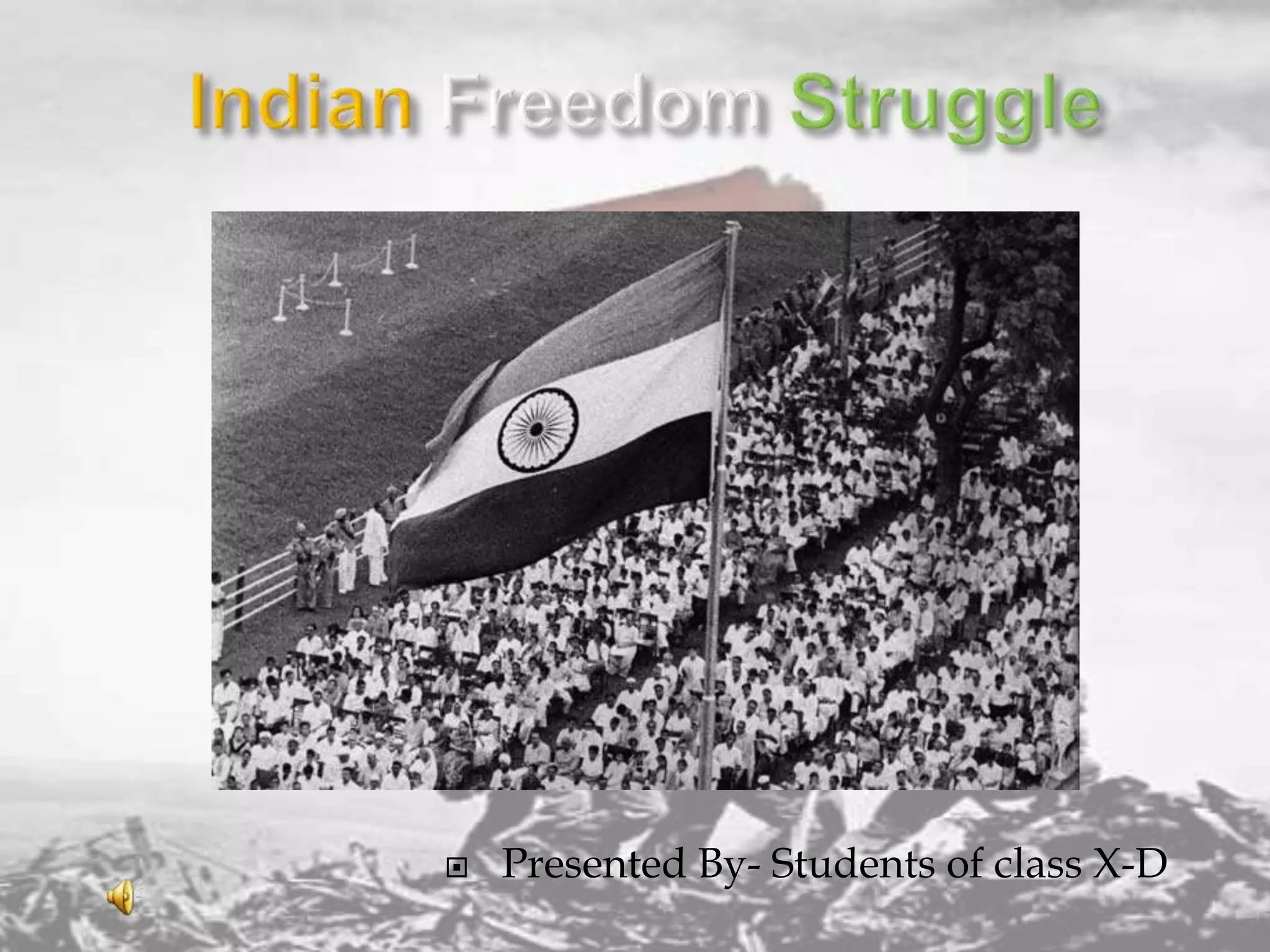
Presented By- Students of class X-D


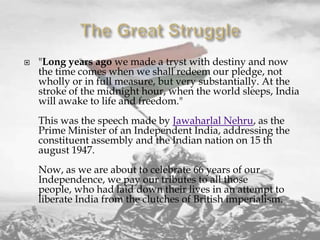
"Long years ago we made a tryst with destiny and now
the time comes when we shall redeem our pledge, not
wholly or in full measure, but very substantially. At the
stroke of the midnight hour, when the world sleeps, India
will awake to life and freedom."
This was the speech made by Jawaharlal Nehru, as the
Prime Minister of an Independent India, addressing the
constituent assembly and the Indian nation on 15 th
august 1947.
Now, as we are about to celebrate 66 years of our
Independence, we pay our tributes to all those
people, who had laid down their lives in an attempt to
liberate India from the clutches of British imperialism.




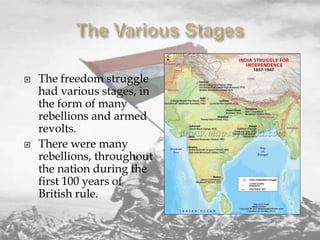
The freedom struggle
had various stages, in
the form of many
rebellions and armed
revolts.
There were many
rebellions, throughout
the nation during the
first 100 years of
British rule.






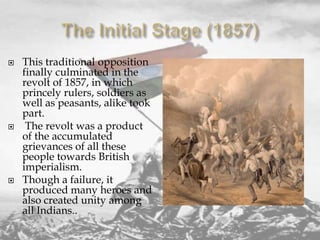
This traditional opposition
finally culminated in the
revolt of 1857, in which
princely rulers, soldiers as
well as peasants, alike took
part.
The revolt was a product
of the accumulated
grievances of all these
people towards British
imperialism.
Though a failure, it
produced many heroes and
also created unity among
all Indians..








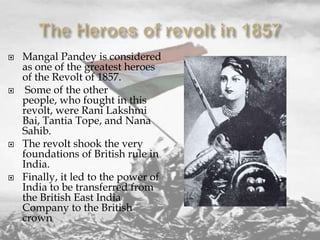
Mangal Pandey is considered
as one of the greatest heroes
of the Revolt of 1857.
Some of the other
people, who fought in this
revolt, were Rani Lakshmi
Bai, Tantia Tope, and Nana
Sahib.
The revolt shook the very
foundations of British rule in
India.
Finally, it led to the power of
India to be transferred from
the British East India
Company to the British
crown


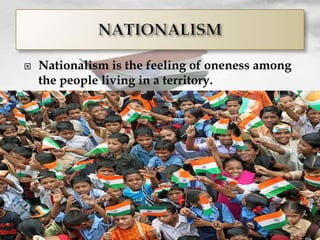
Nationalism is the feeling of oneness among
the people living in a territory.








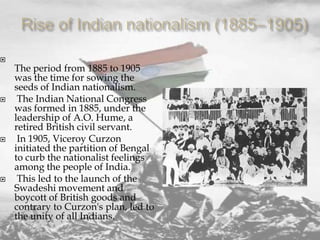
The period from 1885 to 1905
was the time for sowing the
seeds of Indian nationalism.
The Indian National Congress
was formed in 1885, under the
leadership of A.O. Hume, a
retired British civil servant.
In 1905, Viceroy Curzon
initiated the partition of Bengal
to curb the nationalist feelings
among the people of India.
This led to the launch of the
Swadeshi movement and
boycott of British goods and
contrary to Curzon's plan, led to
the unity of all Indians.




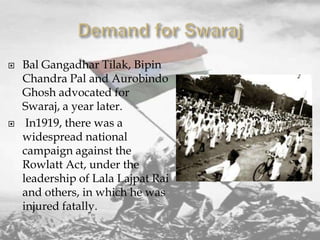
Bal Gangadhar Tilak, Bipin
Chandra Pal and Aurobindo
Ghosh advocated for
Swaraj, a year later.
In1919, there was a
widespread national
campaign against the
Rowlatt Act, under the
leadership of Lala Lajpat Rai
and others, in which he was
injured fatally.








It was at this time that
Gandhi appeared on the
scene.
His main contribution was
his non-violent revolution
and Satyagrah.
He believed in truth, nonviolence and love for fellow
human beings.
Gandhi launched the Salt
Satyagraha, starting his
march from Sabarmati
Ashram to Dandi












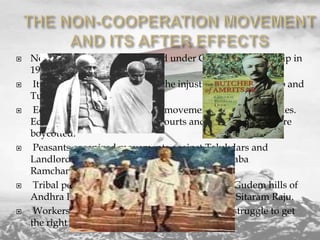
Non co operation was launched under Gandhiji’s leadership in
1920.
It aimed at protesting against the injustices done to Punjab and
Turkey and to attain Swaraj.
Educated middle class led the movement in towns and cities.
Educational institutions, Law courts and foreign goods were
boycotted.
Peasants organized movements against Talukdars and
Landlords in villages under the leadership of Baba
Ramchandra.
Tribal people started an armed struggle in the Gudem hills of
Andhra Pradesh under the leadership of Alluri Sitaram Raju.
Workers in the plantations of Assam started a struggle to get
the right to free movement.






Khadi clothes were very costly. The poor were
not able to buy them.
Indians boycotted British institutions like law
courts and educational institutions. But
alternative institutions did not come up. So
people had to stop boycott.
Gandhi ji had to call off this movement due to
widespread violence and the incident of Chauri
Chaura.








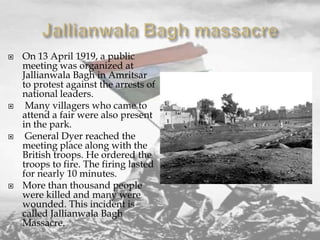
On 13 April 1919, a public
meeting was organized at
Jallianwala Bagh in Amritsar
to protest against the arrests of
national leaders.
Many villagers who came to
attend a fair were also present
in the park.
General Dyer reached the
meeting place along with the
British troops. He ordered the
troops to fire. The firing lasted
for nearly 10 minutes.
More than thousand people
were killed and many were
wounded. This incident is
called Jallianwala Bagh
Massacre.








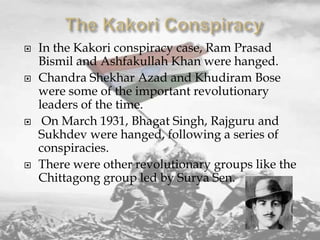
In the Kakori conspiracy case, Ram Prasad
Bismil and Ashfakullah Khan were hanged.
Chandra Shekhar Azad and Khudiram Bose
were some of the important revolutionary
leaders of the time.
On March 1931, Bhagat Singh, Rajguru and
Sukhdev were hanged, following a series of
conspiracies.
There were other revolutionary groups like the
Chittagong group led by Surya Sen.










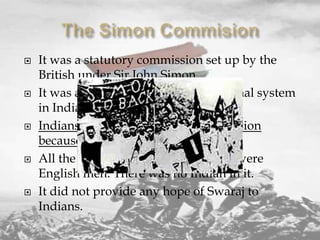
It was a statutory commission set up by the
British under Sir John Simon.
It was asked to study the constitutional system
in India and suggest changes.
Indians opposed the Simon Commission
because:
All the members of the commission were
English men. There was no Indian in it.
It did not provide any hope of Swaraj to
Indians.










It was also an important stage for our
independence.
The Congress session was held at Lahore in
1929 under the President ship of Jawaharlal
Nehru. Following decision were taken:
The Congress declared Poorna Swaraj as its
aim.
It was decided to celebrate 26 January every
year as Independence Day.
It was decided to start the Civil Disobedience
Movement to win Poorna Swaraj.








Gandhiji decided to inaugurate the Civil
Disobedience Movement by breaking the salt law.
Gandhiji and 78 of his followers started a march on
foot from Sabarmati Ashram to Dandi [Dandi
March].
When they reached Dandi. Gandhi ji prepared salt
by using sea water, broke the salt law and
inaugurated the Movement.
The government imposed heavy tax on salt.
Moreover, the production of salt was the
monopoly of the government. So the price of salt
was very high. Therefore, Gandhiji opposed the
salt law.









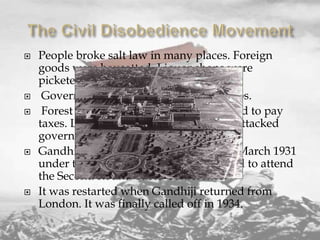
People broke salt law in many places. Foreign
goods were boycotted. Liquor shops were
picketed.
Government servants resigned their jobs.
Forest laws were broken. People refused to pay
taxes. Leaders were arrested. Workers attacked
government offices.
Gandhiji called off the movement on 5 March 1931
under the Gandhi-Irwin Pact. He agreed to attend
the Second Round Table Conference.
It was restarted when Gandhiji returned from
London. It was finally called off in 1934.








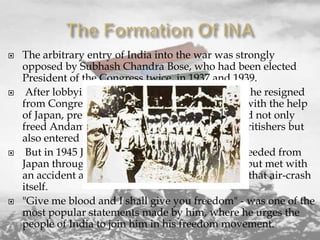
The arbitrary entry of India into the war was strongly
opposed by Subhash Chandra Bose, who had been elected
President of the Congress twice, in 1937 and 1939.
After lobbying against participation in the war, he resigned
from Congress in 1939 Subhash Chandra Bose, with the help
of Japan, preceded fighting the British forces and not only
freed Andaman and Nicobar Islands from the Britishers but
also entered the north-eastern border of India.
But in 1945 Japan was defeated and Netaji proceeded from
Japan through an aeroplane to a place of safety but met with
an accident and it was given out that he died in that air-crash
itself.
"Give me blood and I shall give you freedom" - was one of the
most popular statements made by him, where he urges the
people of India to join him in his freedom movement.








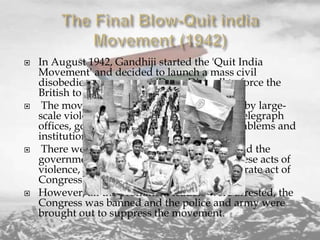
In August 1942, Gandhiji started the 'Quit India
Movement' and decided to launch a mass civil
disobedience movement 'Do or Die' call to force the
British to leave India.
The movement was followed, nonetheless, by largescale violence directed at railway stations, telegraph
offices, government buildings, and other emblems and
institutions of colonial rule.
There were widespread acts of sabotage, and the
government held Gandhi responsible for these acts of
violence, suggesting that they were a deliberate act of
Congress policy.
However, all the prominent leaders were arrested, the
Congress was banned and the police and army were
brought out to suppress the movement.








At last on June 3 1947, Viscount Louis
Mountbatten declared they would leave india.
But a Very big price was paid by people. The
Britishers left India By dividing the country in two
parts
Pakistan was officially announced to be a separate
nation and given an independent status on 14
August 1947.
At midnight, on 15 August 1947, India was
declared to be an independent nation by her first
Prime Minister Pandit Jawaharlal Nehru.
The Indian Freedom Struggle

The Indian Freedom Struggle

  • 1.
  • 2.
     "Long years agowe made a tryst with destiny and now the time comes when we shall redeem our pledge, not wholly or in full measure, but very substantially. At the stroke of the midnight hour, when the world sleeps, India will awake to life and freedom." This was the speech made by Jawaharlal Nehru, as the Prime Minister of an Independent India, addressing the constituent assembly and the Indian nation on 15 th august 1947. Now, as we are about to celebrate 66 years of our Independence, we pay our tributes to all those people, who had laid down their lives in an attempt to liberate India from the clutches of British imperialism.
  • 3.
      The freedom struggle hadvarious stages, in the form of many rebellions and armed revolts. There were many rebellions, throughout the nation during the first 100 years of British rule.
  • 4.
       This traditional opposition finallyculminated in the revolt of 1857, in which princely rulers, soldiers as well as peasants, alike took part. The revolt was a product of the accumulated grievances of all these people towards British imperialism. Though a failure, it produced many heroes and also created unity among all Indians..
  • 5.
        Mangal Pandey isconsidered as one of the greatest heroes of the Revolt of 1857. Some of the other people, who fought in this revolt, were Rani Lakshmi Bai, Tantia Tope, and Nana Sahib. The revolt shook the very foundations of British rule in India. Finally, it led to the power of India to be transferred from the British East India Company to the British crown
  • 6.
     Nationalism is thefeeling of oneness among the people living in a territory.
  • 7.
        The period from1885 to 1905 was the time for sowing the seeds of Indian nationalism. The Indian National Congress was formed in 1885, under the leadership of A.O. Hume, a retired British civil servant. In 1905, Viceroy Curzon initiated the partition of Bengal to curb the nationalist feelings among the people of India. This led to the launch of the Swadeshi movement and boycott of British goods and contrary to Curzon's plan, led to the unity of all Indians.
  • 8.
      Bal Gangadhar Tilak,Bipin Chandra Pal and Aurobindo Ghosh advocated for Swaraj, a year later. In1919, there was a widespread national campaign against the Rowlatt Act, under the leadership of Lala Lajpat Rai and others, in which he was injured fatally.
  • 9.
        It was atthis time that Gandhi appeared on the scene. His main contribution was his non-violent revolution and Satyagrah. He believed in truth, nonviolence and love for fellow human beings. Gandhi launched the Salt Satyagraha, starting his march from Sabarmati Ashram to Dandi
  • 10.
          Non co operationwas launched under Gandhiji’s leadership in 1920. It aimed at protesting against the injustices done to Punjab and Turkey and to attain Swaraj. Educated middle class led the movement in towns and cities. Educational institutions, Law courts and foreign goods were boycotted. Peasants organized movements against Talukdars and Landlords in villages under the leadership of Baba Ramchandra. Tribal people started an armed struggle in the Gudem hills of Andhra Pradesh under the leadership of Alluri Sitaram Raju. Workers in the plantations of Assam started a struggle to get the right to free movement.
  • 11.
       Khadi clothes werevery costly. The poor were not able to buy them. Indians boycotted British institutions like law courts and educational institutions. But alternative institutions did not come up. So people had to stop boycott. Gandhi ji had to call off this movement due to widespread violence and the incident of Chauri Chaura.
  • 12.
        On 13 April1919, a public meeting was organized at Jallianwala Bagh in Amritsar to protest against the arrests of national leaders. Many villagers who came to attend a fair were also present in the park. General Dyer reached the meeting place along with the British troops. He ordered the troops to fire. The firing lasted for nearly 10 minutes. More than thousand people were killed and many were wounded. This incident is called Jallianwala Bagh Massacre.
  • 13.
        In the Kakoriconspiracy case, Ram Prasad Bismil and Ashfakullah Khan were hanged. Chandra Shekhar Azad and Khudiram Bose were some of the important revolutionary leaders of the time. On March 1931, Bhagat Singh, Rajguru and Sukhdev were hanged, following a series of conspiracies. There were other revolutionary groups like the Chittagong group led by Surya Sen.
  • 14.
         It was astatutory commission set up by the British under Sir John Simon. It was asked to study the constitutional system in India and suggest changes. Indians opposed the Simon Commission because: All the members of the commission were English men. There was no Indian in it. It did not provide any hope of Swaraj to Indians.
  • 15.
         It was alsoan important stage for our independence. The Congress session was held at Lahore in 1929 under the President ship of Jawaharlal Nehru. Following decision were taken: The Congress declared Poorna Swaraj as its aim. It was decided to celebrate 26 January every year as Independence Day. It was decided to start the Civil Disobedience Movement to win Poorna Swaraj.
  • 16.
        Gandhiji decided toinaugurate the Civil Disobedience Movement by breaking the salt law. Gandhiji and 78 of his followers started a march on foot from Sabarmati Ashram to Dandi [Dandi March]. When they reached Dandi. Gandhi ji prepared salt by using sea water, broke the salt law and inaugurated the Movement. The government imposed heavy tax on salt. Moreover, the production of salt was the monopoly of the government. So the price of salt was very high. Therefore, Gandhiji opposed the salt law.
  • 17.
         People broke saltlaw in many places. Foreign goods were boycotted. Liquor shops were picketed. Government servants resigned their jobs. Forest laws were broken. People refused to pay taxes. Leaders were arrested. Workers attacked government offices. Gandhiji called off the movement on 5 March 1931 under the Gandhi-Irwin Pact. He agreed to attend the Second Round Table Conference. It was restarted when Gandhiji returned from London. It was finally called off in 1934.
  • 18.
        The arbitrary entryof India into the war was strongly opposed by Subhash Chandra Bose, who had been elected President of the Congress twice, in 1937 and 1939. After lobbying against participation in the war, he resigned from Congress in 1939 Subhash Chandra Bose, with the help of Japan, preceded fighting the British forces and not only freed Andaman and Nicobar Islands from the Britishers but also entered the north-eastern border of India. But in 1945 Japan was defeated and Netaji proceeded from Japan through an aeroplane to a place of safety but met with an accident and it was given out that he died in that air-crash itself. "Give me blood and I shall give you freedom" - was one of the most popular statements made by him, where he urges the people of India to join him in his freedom movement.
  • 19.
        In August 1942,Gandhiji started the 'Quit India Movement' and decided to launch a mass civil disobedience movement 'Do or Die' call to force the British to leave India. The movement was followed, nonetheless, by largescale violence directed at railway stations, telegraph offices, government buildings, and other emblems and institutions of colonial rule. There were widespread acts of sabotage, and the government held Gandhi responsible for these acts of violence, suggesting that they were a deliberate act of Congress policy. However, all the prominent leaders were arrested, the Congress was banned and the police and army were brought out to suppress the movement.
  • 20.
        At last onJune 3 1947, Viscount Louis Mountbatten declared they would leave india. But a Very big price was paid by people. The Britishers left India By dividing the country in two parts Pakistan was officially announced to be a separate nation and given an independent status on 14 August 1947. At midnight, on 15 August 1947, India was declared to be an independent nation by her first Prime Minister Pandit Jawaharlal Nehru.