FOREST AND WILDLIFE
INTRODUCTION
 We human beings along with all living organisms
form a complex web of ecological system in which we
are only a part and very much dependent on this
system for our very existence.
 Forest play a key role in the ecological system as
these are also the primary procedures on which all
other living beings depend upon....
BIODIVERSITY
o Biological diversity :
Rich wildlife and cultivated
species, diverse in form and function but closely
integrated in a system through multiple network of
interdependencies.
o In this planet we share immense biodiversity.
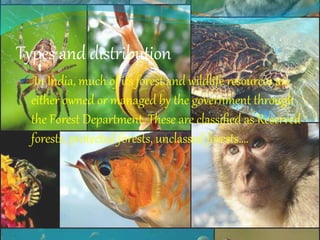
Types and distribution
 In India, much of its forest and wildlife resources are
either owned or managed by the government through
the Forest Department. These are classified as Reserved
forests, protected forests, unclassed forests….
FLORA AND FAUNA
 India is one of the world’s richest countries in terms
of its vast array of biological diversity and has nearly
8% of the total number of species in the world which
are estimated to be 1.6 million.
 These diverse flora and fauna are so well integrated
in our daily life that we take these for granted by us.
Lately, they have been under great stress mainly due to
our insensitivity to our environment .
 At least 10% of India’s recorded wild flora and
fauna are on threatened list.
DO YOU KNOw ??
Over 81,000 species of fauna and 47,000 species of flora are found in
India !!. Of the estimated 47,000 plant species, about 15,000
flowering species are endemic (indigenous) to India.
rate…
Endangered Species :
These are the species which are in danger of extinction.
The survival of such species is difficult if the negative factors that have led to
their decline continue to operate.
Ex : Black buck, crocodile, Indian Rhino, tailed macaque, Sangai, Lion, tiger
etc.
Vulnerable Species :
Species whose population has declined to levels from
where it is likely to move into the endangered category in the near future if
the negative factors continue to operate.
Ex : Blue Sheep, Asiatic Elephant, Gangetic Dolphin etc.
 Rare Species :
 Species with small population may move into the endangered or
vulnerable category if the negative factors affecting them continue to operate.
 Ex : Himalayan Brown, Wild Asiatic buffalo, Desert fox and Hornbill etc.
 Endemic Species :
 These species are only found in some particular areas usually
isolated by natural or geographical barriers.
 Ex : Andaman Teal, Nicobar Pigeon, Andaman wild Pig, Mithun in Arunachal
Pradesh.
 Extinct Species :
 These are not found after searches of known or likely
areas where they may occur. A species may be extinct from a local
area, region, country, continent or the entire earth.
 Ex : Asiatic Cheetah, Pink head Duck.
Asiatic Cheetah
 World’s fastest land mammal is a unique and specialized member of cat
family and can move at the speed of 112 km/hr.
 Cheetah is often mistaken for leopard but has distinguishing marks like the
long tear dropped shaped lines on each side of the nose from corner of its
eyes to its mouth.
 Prior to 20th century Cheetah’s were widely distributed in Asia and Africa, i.e.
today nearly extinct due to decline in habitat and prey.
 The species were declared extinct in India long back in 1952
Factors CAUSING depletion of
flora and fauna
 Mining is another important factor behind deforestation.
Example : The Buxa Tiger Reserve in West Bengal is seriously
threatened by the ongoing dolomite mining and it has disturbed
natural habitat of many species and blocked the migration route
of several others, including the great Indian Elephant.
 Many environmentalists hold the view that the greatest degrading
factors behind the depletion of forests is the grazing and fuel wood
collection and the substantial part of the fuel fodder demand is
met by lopping rather than by felling entire trees.
 Forest ecosystems are the repositories of the country’s most
valuable forests products, minerals and other resources that meet
the demand of the rapidly expanding industrial urban economy.
 ARE THE COLONIAL POLICIES TO BE BLAMED ??
 Some environmentalists say that the promotion of few favored species in
many parts of India termed as “enrichment plantation”’ in which single
commercially valuable species was extensively planted and other species
eliminated.
 For Example :
Teak mono cultural has damaged the natural forests in South
Indian and Chir Pine (Pinusroxburghii) Plantations in the Himalayas have
replaced the Himalayas oak and Rhododendron forests.
CAUSES OF WILDLIFE
DESTRUCTION
-> Human Nature……
1. HABITAT LOSS
 The second most critical factor in species extinction.
Poaching and hunting
 Another major cause of animal species extinction.
 Poaching and illegal trade in animals are worth US $2
billion to $3 billion.
Habitat loss and deforestation
 Extensive human demand resulted into habitat loss.
 Rainforests are the main habitats which are now
cleared for constructions and industries.
 Tropical rainforests are cleared for :
o Wood / timber resources
o Development of petroleum resources
o Mineral resources
o For cash crop plantations and substantial farming.
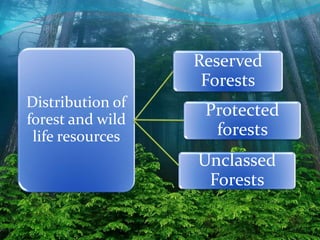
Distribution of
forest and wild
life resources
Reserved
Forests
Protected
forests
Unclassed
Forests
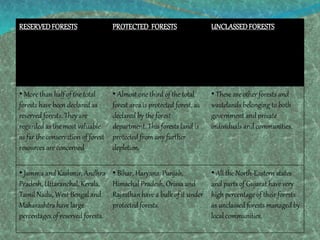
RESERVEDFORESTS PROTECTED FORESTS UNCLASSEDFORESTS
• More than half of the total
forests have been declared as
reserved forests. They are
regarded as the most valuable
as far the conservation of forest
resources are concerned
• Almost one third of the total
forest area is protected forest, as
declared by the forest
department. This forests land is
protected from any further
depletion.
• These are other forests and
wastelands belonging to both
government and private
individuals and communities.
• Jammu and Kashmir, Andhra
Pradesh, Uttaranchal, Kerala,
Tamil Nadu, West Bengal and
Maharashtra have large
percentages of reserved forests.
• Bihar, Haryana, Punjab,
Himachal Pradesh, Orissa and
Rajasthan have a bulk of it under
protected forests.
• All the North-Eastern states
and parts of Gujarat have very
high percentage of their forests
as unclassed forests managed by
local communities.
Government’s role in conservation of wildlife
 Wildlife protection act 1972
 Project Tiger 1972-73
 Forest Protection Act 1980-88
 Anti Poaching Agencies
 State wildlife dept.
 State forest dept.
 Ministry of Environment and Forest
 Army ( if applicable)
 Police
 Border security Force and Coast guards
 Wildlife Conservation Society.
SACRED GROVES
 Nature worship is an age old tribal belief based on the
premise that all creations of nature have to be
protected. Such belies have preserved several virgin
forests in pristine from called sacred groves.
 The Mundas and the Santhals of Chhota Nagpur
region worship Mahua (Bassi latifolia) and
Kadamba(Anthocaphalus cadamba) trees and the
Tribals of Orissa and Bihar worship the Tamarind
(Tamarindus indica) and Mango (Mangifra indica)
trees during weddings.
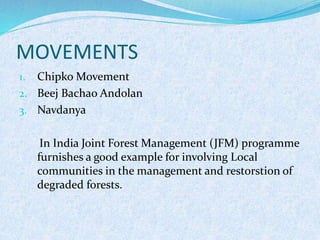
MOVEMENTS
1. Chipko Movement
2. Beej Bachao Andolan
3. Navdanya
In India Joint Forest Management (JFM) programme
furnishes a good example for involving Local
communities in the management and restorstion of
degraded forests.
Conclusion
 Forests and wildlife are the renewable natural
resources and if all the planned programmes are
effictively executed, in a few decades the flora and the
fauna will start flourishing.
Forest_and_Wildlife.pptx

Forest_and_Wildlife.pptx

  • 1.
  • 3.
    INTRODUCTION  We humanbeings along with all living organisms form a complex web of ecological system in which we are only a part and very much dependent on this system for our very existence.  Forest play a key role in the ecological system as these are also the primary procedures on which all other living beings depend upon....
  • 4.
    BIODIVERSITY o Biological diversity: Rich wildlife and cultivated species, diverse in form and function but closely integrated in a system through multiple network of interdependencies. o In this planet we share immense biodiversity.
  • 5.
    Types and distribution In India, much of its forest and wildlife resources are either owned or managed by the government through the Forest Department. These are classified as Reserved forests, protected forests, unclassed forests….
  • 6.
    FLORA AND FAUNA India is one of the world’s richest countries in terms of its vast array of biological diversity and has nearly 8% of the total number of species in the world which are estimated to be 1.6 million.
  • 7.
     These diverseflora and fauna are so well integrated in our daily life that we take these for granted by us. Lately, they have been under great stress mainly due to our insensitivity to our environment .  At least 10% of India’s recorded wild flora and fauna are on threatened list.
  • 8.
    DO YOU KNOw?? Over 81,000 species of fauna and 47,000 species of flora are found in India !!. Of the estimated 47,000 plant species, about 15,000 flowering species are endemic (indigenous) to India. rate…
  • 12.
    Endangered Species : Theseare the species which are in danger of extinction. The survival of such species is difficult if the negative factors that have led to their decline continue to operate. Ex : Black buck, crocodile, Indian Rhino, tailed macaque, Sangai, Lion, tiger etc. Vulnerable Species : Species whose population has declined to levels from where it is likely to move into the endangered category in the near future if the negative factors continue to operate. Ex : Blue Sheep, Asiatic Elephant, Gangetic Dolphin etc.
  • 13.
     Rare Species:  Species with small population may move into the endangered or vulnerable category if the negative factors affecting them continue to operate.  Ex : Himalayan Brown, Wild Asiatic buffalo, Desert fox and Hornbill etc.  Endemic Species :  These species are only found in some particular areas usually isolated by natural or geographical barriers.  Ex : Andaman Teal, Nicobar Pigeon, Andaman wild Pig, Mithun in Arunachal Pradesh.  Extinct Species :  These are not found after searches of known or likely areas where they may occur. A species may be extinct from a local area, region, country, continent or the entire earth.  Ex : Asiatic Cheetah, Pink head Duck.
  • 14.
    Asiatic Cheetah  World’sfastest land mammal is a unique and specialized member of cat family and can move at the speed of 112 km/hr.  Cheetah is often mistaken for leopard but has distinguishing marks like the long tear dropped shaped lines on each side of the nose from corner of its eyes to its mouth.  Prior to 20th century Cheetah’s were widely distributed in Asia and Africa, i.e. today nearly extinct due to decline in habitat and prey.  The species were declared extinct in India long back in 1952
  • 15.
    Factors CAUSING depletionof flora and fauna
  • 17.
     Mining isanother important factor behind deforestation. Example : The Buxa Tiger Reserve in West Bengal is seriously threatened by the ongoing dolomite mining and it has disturbed natural habitat of many species and blocked the migration route of several others, including the great Indian Elephant.  Many environmentalists hold the view that the greatest degrading factors behind the depletion of forests is the grazing and fuel wood collection and the substantial part of the fuel fodder demand is met by lopping rather than by felling entire trees.  Forest ecosystems are the repositories of the country’s most valuable forests products, minerals and other resources that meet the demand of the rapidly expanding industrial urban economy.
  • 18.
     ARE THECOLONIAL POLICIES TO BE BLAMED ??  Some environmentalists say that the promotion of few favored species in many parts of India termed as “enrichment plantation”’ in which single commercially valuable species was extensively planted and other species eliminated.  For Example : Teak mono cultural has damaged the natural forests in South Indian and Chir Pine (Pinusroxburghii) Plantations in the Himalayas have replaced the Himalayas oak and Rhododendron forests.
  • 19.
  • 20.
    1. HABITAT LOSS The second most critical factor in species extinction.
  • 21.
    Poaching and hunting Another major cause of animal species extinction.  Poaching and illegal trade in animals are worth US $2 billion to $3 billion.
  • 22.
    Habitat loss anddeforestation  Extensive human demand resulted into habitat loss.  Rainforests are the main habitats which are now cleared for constructions and industries.  Tropical rainforests are cleared for : o Wood / timber resources o Development of petroleum resources o Mineral resources o For cash crop plantations and substantial farming.
  • 23.
    Distribution of forest andwild life resources Reserved Forests Protected forests Unclassed Forests
  • 24.
    RESERVEDFORESTS PROTECTED FORESTSUNCLASSEDFORESTS • More than half of the total forests have been declared as reserved forests. They are regarded as the most valuable as far the conservation of forest resources are concerned • Almost one third of the total forest area is protected forest, as declared by the forest department. This forests land is protected from any further depletion. • These are other forests and wastelands belonging to both government and private individuals and communities. • Jammu and Kashmir, Andhra Pradesh, Uttaranchal, Kerala, Tamil Nadu, West Bengal and Maharashtra have large percentages of reserved forests. • Bihar, Haryana, Punjab, Himachal Pradesh, Orissa and Rajasthan have a bulk of it under protected forests. • All the North-Eastern states and parts of Gujarat have very high percentage of their forests as unclassed forests managed by local communities.
  • 25.
    Government’s role inconservation of wildlife  Wildlife protection act 1972  Project Tiger 1972-73  Forest Protection Act 1980-88  Anti Poaching Agencies  State wildlife dept.  State forest dept.  Ministry of Environment and Forest  Army ( if applicable)  Police  Border security Force and Coast guards  Wildlife Conservation Society.
  • 26.
    SACRED GROVES  Natureworship is an age old tribal belief based on the premise that all creations of nature have to be protected. Such belies have preserved several virgin forests in pristine from called sacred groves.  The Mundas and the Santhals of Chhota Nagpur region worship Mahua (Bassi latifolia) and Kadamba(Anthocaphalus cadamba) trees and the Tribals of Orissa and Bihar worship the Tamarind (Tamarindus indica) and Mango (Mangifra indica) trees during weddings.
  • 27.
    MOVEMENTS 1. Chipko Movement 2.Beej Bachao Andolan 3. Navdanya In India Joint Forest Management (JFM) programme furnishes a good example for involving Local communities in the management and restorstion of degraded forests.
  • 28.
    Conclusion  Forests andwildlife are the renewable natural resources and if all the planned programmes are effictively executed, in a few decades the flora and the fauna will start flourishing.