Forest fire
Dr Asim Amitabh Pradhan
Fakir Mohan University
What to learn today?
1. What is a Forest fire?
2. Types of Forest Fires
3. Cause of forest fire
4. Effects & Impacts of
Forest Fire
5. Management and
Prevention
6. Indian Statistic
7. Amazon forest fire 2019
8. Facts about forest fire
9. Conclusion
What is a Forest fire?
• A forest fire is a natural disaster consisting of a fire which
destroys a forested area, and can be a great danger to people
who live in forests as well as wildlife.
• Forest fires are generally started by lightning, but also by human
negligence or arson, and can burn thousands of square
kilometers.
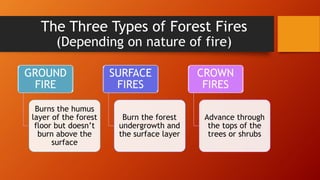
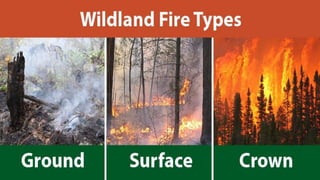
The Three Types of Forest Fires
(Depending on nature of fire)
GROUND
FIRE
Burns the humus
layer of the forest
floor but doesn’t
burn above the
surface
SURFACE
FIRES
Burn the forest
undergrowth and
the surface layer
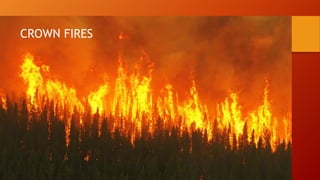
CROWN
FIRES
Advance through
the tops of the
trees or shrubs
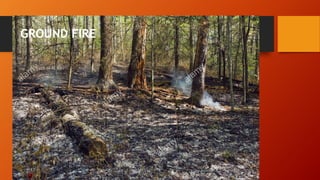
GROUND FIRE
SURFACE FIRES
CROWN FIRES
CAUSES OF FOREST FIRE
NATURAL EVENTS
• Lightening strikes,
• Drought,
• Anticyclones
HUMAN ACTIONS
• Camp fires,
• Arson,
• Picnic,
• Smoking,
• Negligence
• Fireworks
90% of forest fires are human caused.
Human Cause
90%
Natural
Cause
10%
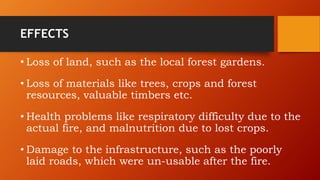
EFFECTS
• Loss of land, such as the local forest gardens.
• Loss of materials like trees, crops and forest
resources, valuable timbers etc.
• Health problems like respiratory difficulty due to the
actual fire, and malnutrition due to lost crops.
• Damage to the infrastructure, such as the poorly
laid roads, which were un-usable after the fire.
EFFECTS
• Loss of biodiversity and extinction of plants and animals
• Global warming
• Soil erosion affecting productivity of soils and production
• Ozone layer depletion
• Loss of livelihood of tribal and rural poor people who are
directly dependent upon collection of non-timber forest
products from forest areas for their livelihood.
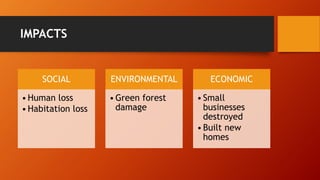
IMPACTS
SOCIAL
•Human loss
•Habitation loss
ENVIRONMENTAL
•Green forest
damage
ECONOMIC
•Small
businesses
destroyed
•Built new
homes
How do forest fires spread so quickly?
•Wind is a major factor. Some fires spread along
the dead leaves and branches at the bottom of
trees.
•Also, burning leaves and branches can get blown
ahead of the main fire causing smaller fires to
start.
MANAGEMENT & PREVENTION
• More fire fighters at risk areas.
• Media campaigns in dry months against negligence.
• Education in Schools.
• Awareness among people.
• Steep punishment for starting fire.
• Back burning in controlled conditions so fire cannot spread.
• Fire breaks e.g. stream or road which wil not pass fire from one side
to the other.
• Sprinklers on helicopters to be made available.
How can you control a fire?
• Planes and helicopters drop water and chemical fire retardant.
• Fire-fighters create a control line – an area where they remove all the fuel
so that the fire can’t travel across it.
• They then cut down dead trees to stop them falling across the fire line.
• Drip torches are used to burn the plants between the control line and the
fire to remove the fuel.
Organisation doing Survey
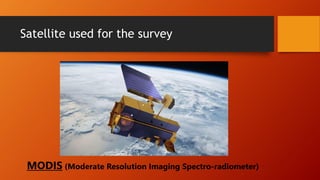
Satellite used for the survey
MODIS (Moderate Resolution Imaging Spectro-radiometer)
Indian Forest statistic
• Forest fires are a regular phenomenon in our country often
observed during the fire season.
• Every year large areas of forests are affected by fires of varying
intensity and extent.
• According to The Forest Survey of India out of the total 7,12,249 square
km of forest cover, 1,52,421 square km (21.40 percent) is either highly
or extremely fire prone depending on its geographic locations.
• The forests of Mizoram, Chhattisgarh, Manipur, Odisha and Madhya
Pradesh are most vulnerable.
Forest exposed to Fire in India
54%
8%
2%
36%
Occasional
Moderate
High
Not yet exposed
Based on the forest
inventory records, 54.40% of
forests in India are exposed
to occasional fires, 7.49% to
moderately frequent fires
and 2.405 to high incidence
levels while 35.71% of
India’s forests have not yet
been exposed to fires of any
real significance.
No. of Forest fire cases in India (Source: FSI)
0
5000
10000
15000
20000
25000
30000
35000
40000
2015 2016 2017 2018 2019
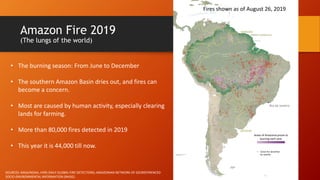
Amazon Fire 2019
(The lungs of the world)
Active fire identified
by satellite
Areas of Amazonia prone to
burning each year
• The burning season: From June to December
• The southern Amazon Basin dries out, and fires can
become a concern.
• Most are caused by human activity, especially clearing
lands for farming.
• More than 80,000 fires detected in 2019
• This year it is 44,000 till now.
Rio de Janeiro
Fires shown as of August 26, 2019
SOURCES: NASA/NOAA, VIIRS DAILY GLOBAL FIRE DETECTIONS; AMAZONIAN NETWORK OF GEOREFERENCED
SOCIO-ENVIRONMENTAL INFORMATION (RAISG)
HERE ARE 10 FACTS ABOUT FOREST FIRES
THAT MIGHT SURPRISE YOU
1. Fire is part of the natural cycle of many ecosystems.
2. About 100 cloud-to-ground lightning bolts touch the Earth every
single second, and about 24,600 fires are started by lightning each
year.
3. Approximately 9 in 10 forest fires are started by humans.
4. Naturally occurring forest and intentional controlled fires help
prevent larger fires by clearing away underbrush that easily burns.
5. A “crown fire” is one that burns quickly across the tops of trees.
HERE ARE 10 FACTS ABOUT FOREST FIRES
THAT MIGHT SURPRISE YOU
6. Surface fires burn dead leaves and brush, making more room for
animals like deer to pass through.
7. Fires move faster when traveling uphill.
8. A fire tornado can form when winds around a fire begin to spin.
9. While some animals are displaced by forest fires, burned clearings
can become perfect homes for species that benefit from sunlight
and nutrient-rich soil.
10. A large enough fire can produce its own weather system.
CONCLUSION
•Can be predicted and there are many ways of
preventing them.
•Education and awareness of people living near danger
zones is the best way to prevent forest fire.
Forest fire

Forest fire

  • 1.
    Forest fire Dr AsimAmitabh Pradhan Fakir Mohan University
  • 2.
    What to learntoday? 1. What is a Forest fire? 2. Types of Forest Fires 3. Cause of forest fire 4. Effects & Impacts of Forest Fire 5. Management and Prevention 6. Indian Statistic 7. Amazon forest fire 2019 8. Facts about forest fire 9. Conclusion
  • 3.
    What is aForest fire? • A forest fire is a natural disaster consisting of a fire which destroys a forested area, and can be a great danger to people who live in forests as well as wildlife. • Forest fires are generally started by lightning, but also by human negligence or arson, and can burn thousands of square kilometers.
  • 4.
    The Three Typesof Forest Fires (Depending on nature of fire) GROUND FIRE Burns the humus layer of the forest floor but doesn’t burn above the surface SURFACE FIRES Burn the forest undergrowth and the surface layer CROWN FIRES Advance through the tops of the trees or shrubs
  • 5.
  • 6.
  • 7.
  • 9.
    CAUSES OF FORESTFIRE NATURAL EVENTS • Lightening strikes, • Drought, • Anticyclones HUMAN ACTIONS • Camp fires, • Arson, • Picnic, • Smoking, • Negligence • Fireworks
  • 10.
    90% of forestfires are human caused. Human Cause 90% Natural Cause 10%
  • 11.
    EFFECTS • Loss ofland, such as the local forest gardens. • Loss of materials like trees, crops and forest resources, valuable timbers etc. • Health problems like respiratory difficulty due to the actual fire, and malnutrition due to lost crops. • Damage to the infrastructure, such as the poorly laid roads, which were un-usable after the fire.
  • 12.
    EFFECTS • Loss ofbiodiversity and extinction of plants and animals • Global warming • Soil erosion affecting productivity of soils and production • Ozone layer depletion • Loss of livelihood of tribal and rural poor people who are directly dependent upon collection of non-timber forest products from forest areas for their livelihood.
  • 13.
    IMPACTS SOCIAL •Human loss •Habitation loss ENVIRONMENTAL •Greenforest damage ECONOMIC •Small businesses destroyed •Built new homes
  • 14.
    How do forestfires spread so quickly? •Wind is a major factor. Some fires spread along the dead leaves and branches at the bottom of trees. •Also, burning leaves and branches can get blown ahead of the main fire causing smaller fires to start.
  • 15.
    MANAGEMENT & PREVENTION •More fire fighters at risk areas. • Media campaigns in dry months against negligence. • Education in Schools. • Awareness among people. • Steep punishment for starting fire. • Back burning in controlled conditions so fire cannot spread. • Fire breaks e.g. stream or road which wil not pass fire from one side to the other. • Sprinklers on helicopters to be made available.
  • 16.
    How can youcontrol a fire? • Planes and helicopters drop water and chemical fire retardant. • Fire-fighters create a control line – an area where they remove all the fuel so that the fire can’t travel across it. • They then cut down dead trees to stop them falling across the fire line. • Drip torches are used to burn the plants between the control line and the fire to remove the fuel.
  • 17.
  • 18.
    Satellite used forthe survey MODIS (Moderate Resolution Imaging Spectro-radiometer)
  • 19.
    Indian Forest statistic •Forest fires are a regular phenomenon in our country often observed during the fire season. • Every year large areas of forests are affected by fires of varying intensity and extent. • According to The Forest Survey of India out of the total 7,12,249 square km of forest cover, 1,52,421 square km (21.40 percent) is either highly or extremely fire prone depending on its geographic locations. • The forests of Mizoram, Chhattisgarh, Manipur, Odisha and Madhya Pradesh are most vulnerable.
  • 20.
    Forest exposed toFire in India 54% 8% 2% 36% Occasional Moderate High Not yet exposed Based on the forest inventory records, 54.40% of forests in India are exposed to occasional fires, 7.49% to moderately frequent fires and 2.405 to high incidence levels while 35.71% of India’s forests have not yet been exposed to fires of any real significance.
  • 21.
    No. of Forestfire cases in India (Source: FSI) 0 5000 10000 15000 20000 25000 30000 35000 40000 2015 2016 2017 2018 2019
  • 22.
    Amazon Fire 2019 (Thelungs of the world) Active fire identified by satellite Areas of Amazonia prone to burning each year • The burning season: From June to December • The southern Amazon Basin dries out, and fires can become a concern. • Most are caused by human activity, especially clearing lands for farming. • More than 80,000 fires detected in 2019 • This year it is 44,000 till now. Rio de Janeiro Fires shown as of August 26, 2019 SOURCES: NASA/NOAA, VIIRS DAILY GLOBAL FIRE DETECTIONS; AMAZONIAN NETWORK OF GEOREFERENCED SOCIO-ENVIRONMENTAL INFORMATION (RAISG)
  • 23.
    HERE ARE 10FACTS ABOUT FOREST FIRES THAT MIGHT SURPRISE YOU 1. Fire is part of the natural cycle of many ecosystems. 2. About 100 cloud-to-ground lightning bolts touch the Earth every single second, and about 24,600 fires are started by lightning each year. 3. Approximately 9 in 10 forest fires are started by humans. 4. Naturally occurring forest and intentional controlled fires help prevent larger fires by clearing away underbrush that easily burns. 5. A “crown fire” is one that burns quickly across the tops of trees.
  • 24.
    HERE ARE 10FACTS ABOUT FOREST FIRES THAT MIGHT SURPRISE YOU 6. Surface fires burn dead leaves and brush, making more room for animals like deer to pass through. 7. Fires move faster when traveling uphill. 8. A fire tornado can form when winds around a fire begin to spin. 9. While some animals are displaced by forest fires, burned clearings can become perfect homes for species that benefit from sunlight and nutrient-rich soil. 10. A large enough fire can produce its own weather system.
  • 25.
    CONCLUSION •Can be predictedand there are many ways of preventing them. •Education and awareness of people living near danger zones is the best way to prevent forest fire.