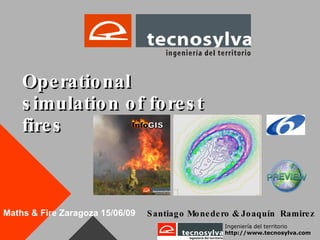
Operational simulation of forest fires Santiago Monedero & Joaquín  Ramirez Maths & Fire Zaragoza 15/06/09 Ingeniería del territorio  http://www.tecnosylva.com
p resentation outline 2. Models 5. FFDSS GIS implementation 3. Rothermel implementation 4. Operational approach GIS 1. Introduction
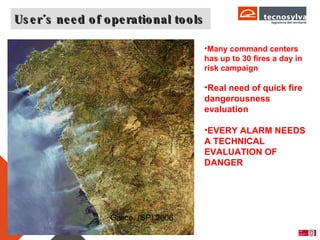
User´s need of operational tools Page  Many command centers has up to 30 fires a day in risk campaign Real need of quick fire dangerousness evaluation EVERY ALARM NEEDS A TECHNICAL EVALUATION OF DANGER Galice, (SP) 2006
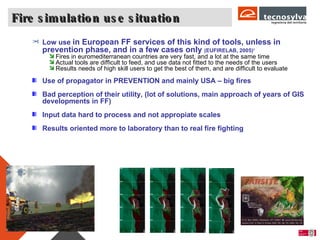
Fire simulation use situation Page  Low use  in European FF services of this kind of tools, unless in prevention phase, and in a few cases only  (EUFIRELAB, 2005) 1 Fires in euromediterranean countries are very fast, and a lot at the same time  Actual tools are difficult to feed, and use data not fitted to the needs of the users  Results needs of high skill users to get the best of them, and are difficult to evaluate Use of propagator in PREVENTION and mainly USA – big fires  Bad perception of their utility, (lot of solutions, main approach of years of GIS developments in FF) Input data hard to process and not appropiate scales  Results oriented more to laboratory than to real fire fighting
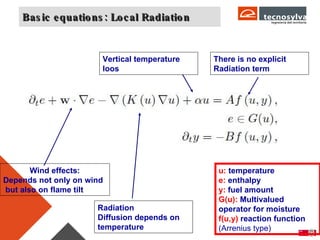
Basic equations: Local Radiation Radiation Diffusion depends on  temperature Wind effects: Depends not only on wind but also on flame tilt There is no explicit Radiation term u:  temperature e:  enthalpy y:  fuel amount G(u):  Multivalued operator for moisture f(u,y)  reaction function  (Arrenius type) Vertical temperature loos
Basic equations: Local Radiation Wind effects: Inside radiation term  r u:  temperature e:  enthalpy y:  fuel amount G(u):  Multivalued operator for moisture r  Explicit radiation Multivalued operator Moleding radiation and moisture content in fire spread L. Ferragut, M. Asensio, S. Monedero  Commun. Numer. Meth. Engng  2007;  23 :819–833 Published online 19 October 2006 in Wiley InterScience (www.interscience.wiley.com). DOI: 10.1002/cnm.927 Radiation and moisture method presented in:
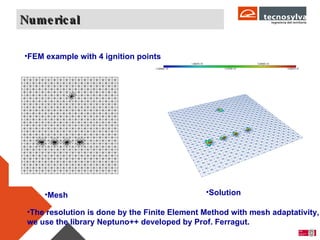
Numerical Mesh The resolution is done by the Finite Element Method with mesh adaptativity, we use the library Neptuno++ developed by Prof. Ferragut. Solution FEM example with 4 ignition points
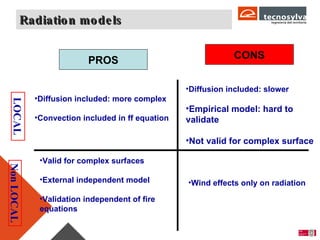
Radiation models Diffusion included: more complex  Convection included in ff equation Diffusion included: slower Empirical model: hard to validate Not valid for complex surface PROS CONS LOCAL Non LOCAL Valid for complex surfaces External independent model Validation independent of fire equations Wind effects only on radiation
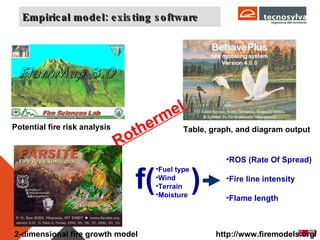
Empirical model: existing software http://www.firemodels.org/ Rothermel  Potential fire risk analysis Table, graph, and diagram output   2-dimensional fire growth model   ROS (Rate Of Spread) Fire line intensity Flame length Fuel type Wind Terrain Moisture f( )
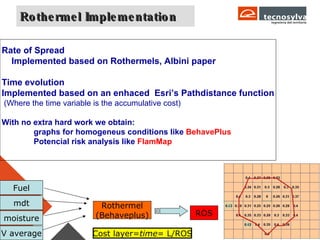
Rothermel Implementation mdt moisture Fuel V average Rothermel (Behaveplus) ROS Cost layer= time = L/ROS Rate of Spread  Implemented based on Rothermels, Albini paper Time evolution  Implemented based on an enhaced  Esri’s Pathdistance function (Where the time variable is the accumulative cost) With no extra hard work we obtain: graphs for homogeneus conditions like  BehavePlus Potencial risk analysis like  FlamMap
FireLAB  evolution : FSPro, FPA 1 fire Several fires 1 meteo scenario hundreds of meteo scenarios FARSITE FSPro FPA FlamMap
Empirical model Widely known used and tested  Based on experimental data NFFL fuel types  European fuel types Very quick resolution FREE! Surface fire, crown fire, spotting,  Fire acceleration  Very technical  Only user with training may use it. Based experimental data Bad exportability  No new effects are expected No FFDSS embeded GIS: Data conversion No operational layers Tedious file configurations No enhanced GIS capabilities PROS CONS
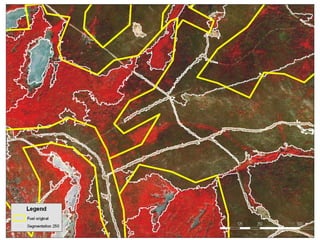
High resolution fuel models
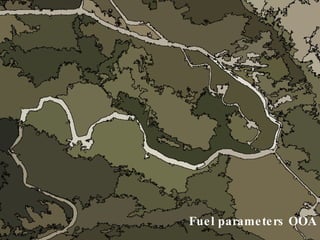
Fuel parameters OOA InfoGIS: SAD en Incendios Forestales
USERS ASSESSMENT RESULTS:  Fuel Parameters
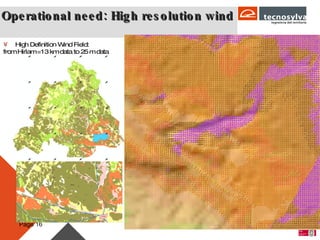
Operational need: High resolution wind High Definition Wind Field:  from Hirlam =13 km data to 25 m data Page
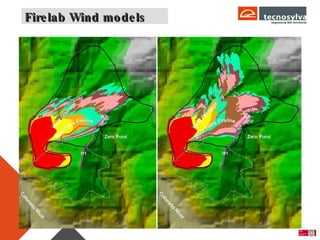
Firelab Wind models  Comparation of a  Farsite  simulation for  low  and  high  wind resolution (in white the actual perimeter of the fire).  Reference: The impact of high resolution wind field simulations on the accuracy of fire growth predictions  (B. Butler, J. Forthofer, M. Finney)
Firelab Wind models
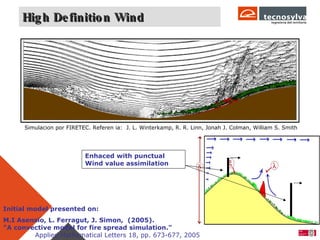
High Definition Wind  Simulacion por FIRETEC. Referen ia:  J. L. Winterkamp, R. R. Linn, Jonah J. Colman, William S. Smith M.I Asensio, L. Ferragut, J. Simon,  (2005).    "A convective model for fire spread simulation."  Applied Mathematical Letters 18, pp. 673-677, 2005   Initial model presented on: Enhaced with punctual Wind value assimilation
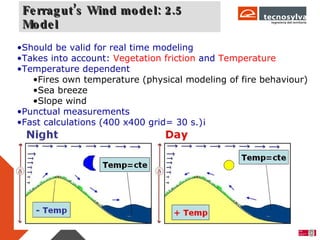
Ferragut’s Wind model: 2.5 Model Should be valid for real time modeling Takes into account:  Vegetation friction  and  Temperature Temperature dependent Fires own temperature (physical modeling of fire behaviour) Sea breeze Slope wind Punctual measurements Fast calculations (400 x400 grid= 30 s.)¡
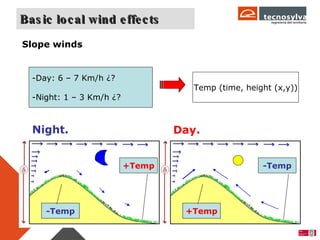
Basic local wind effects Night.   Slope winds   +Temp -Temp Day. +Temp -Temp -Day: 6 – 7 Km/h ¿? -Night: 1 – 3 Km/h ¿? Temp (time, height (x,y))
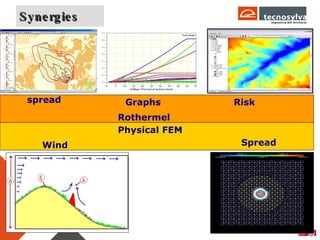
Synergies spread Graphs Risk Rothermel Physical FEM Wind Spread
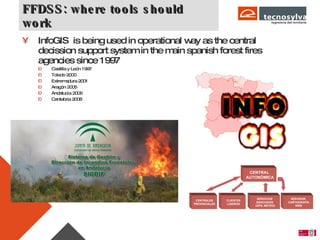
FFDSS: where tools should work InfoGIS  is being used in operational way as the central decission support system in the main spanish forest fires agencies since 1997 Castilla y León 1997  Toledo 2000 Extremadura 2001 Aragón 2005 Andalucía 2006 Cantabria 2008
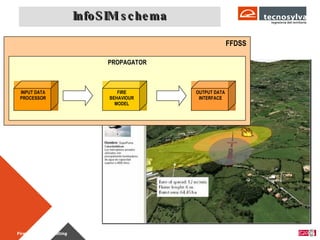
InfoSIM   schema 19-20 October 2006,  Page  Fire Platform  Meeting
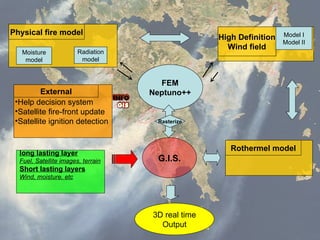
long lasting layer Fuel, Satellite images, terrain Short lasting layers Wind, moisture, etc 3D real time Output Radiation model FEM Neptuno++ G.I.S. Physical fire model Help decision system Satellite fire-front update Satellite ignition detection External Moisture model High Definition Wind field Model I Model II Rothermel model Rasterize
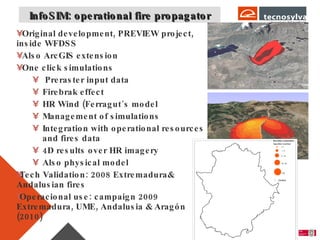
InfoSIM: operational fire propagator Original development, PREVIEW project, inside WFDSS Also ArcGIS extension One click simulations Preraster input data Firebrak effect HR Wind (Ferragut´s model Management of simulations Integration with operational resources and fires data 4D results over HR imagery Also physical model Tech Validation: 2008 Extremadura& Andalusian fires Operacional use: campaign 2009 Extremadura, UME, Andalusia & Aragón (2010)
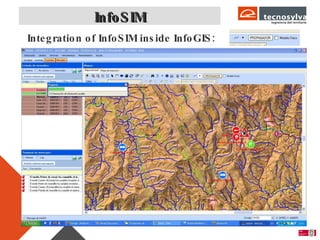
Integration of InfoSIM inside InfoGIS: InfoSIM
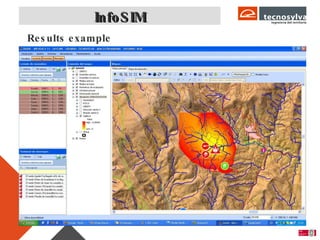
Results example InfoSIM
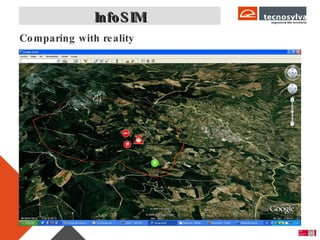
Comparing with reality InfoSIM
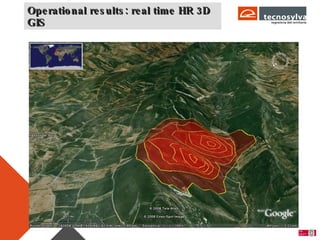
Operational results: real time HR 3D GIS
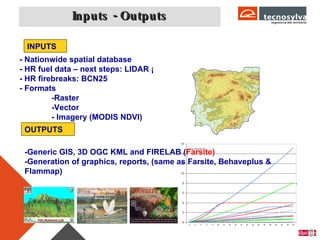
Input s   - Outputs Propagadores de Incendios Forestales - Nationwide spatial database - HR fuel data – next steps: LIDAR ¡ - HR firebreaks: BCN25 - Formats -Raster -Vector - Imagery (MODIS NDVI) -Generic GIS, 3D OGC KML and FIRELAB ( Farsite) -Generation of graphics, reports, (same as Farsite, Behaveplus & Flammap) INPUTS OUTPUTS
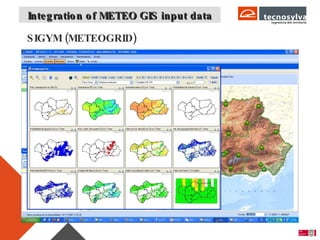
SIGYM (METEOGRID) Integration of METEO GIS input data
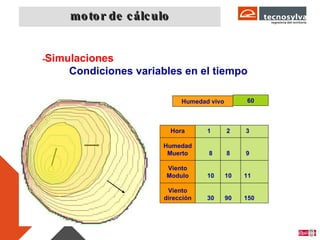
motor de cálculo Propagadores de Incendios Forestales - Simulaciones  Condiciones variables en el tiempo   Humedad vivo Hora Humedad  Muerto Viento Modulo Viento dirección 1  2  3 8  8  9 10  10  11 30  90  150 60
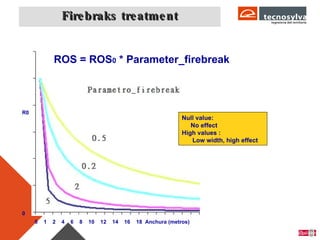
Firebraks trea tment Propagadores de Incendios Forestales 0  1  2  4  6  8  10  12  14  16  18  Anchura (metros) 0 R0 ROS = ROS 0  * Parameter_firebreak Null value:  No effect High values : Low width, high effect
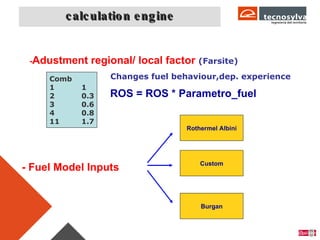
c alculation engine Propagadores de Incendios Forestales - Adustment regional/ local factor  (Farsite) ROS = ROS * Parametro_fuel - Fuel Model Inputs Rothermel Albini Custom Burgan Changes fuel behaviour,dep. experience Comb  1 1 2 0.3 3  0.6 4  0.8 11 1.7
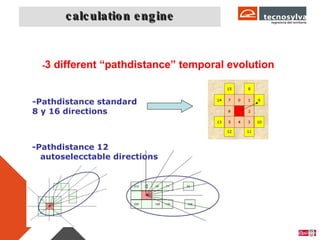
c alculation engine Propagadores de Incendios Forestales - 3 different “pathdistance” temporal evolution  -Pathdistance standard 8 y 16 directions -Pathdistance 12 autoselecctable directions
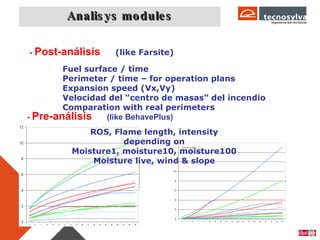
Analisys modules Propagadores de Incendios Forestales -  Post-análisis  (like Farsite) Fuel surface / time Perimeter / time – for operation plans Expansion speed (Vx,Vy) Velocidad del “centro de masas” del incendio Comparation with real perimeters -  Pre-análisis  (like BehavePlus) ROS, Flame length, intensity depending on Moisture1, moisture10, moisture100 Moisture live, wind & slope
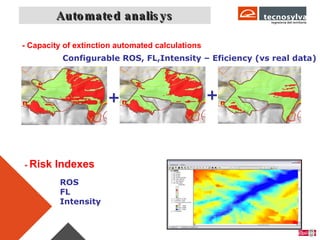
Aut omated  anali sys Propagadores de Incendios Forestales - Capacity of extinction automated calculations Configurable ROS, FL,Intensity – Eficiency (vs real data) + + -  Risk Indexes ROS FL Intensity
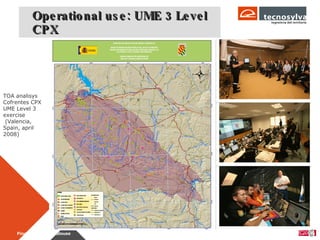
Operati onal use: UME 3 Level  CPX December 16th-17th 2008,  Page  Final Review - Toulouse TOA analisys Cofrentes CPX UME Level 3 exercise (Valencia, Spain, april 2008)
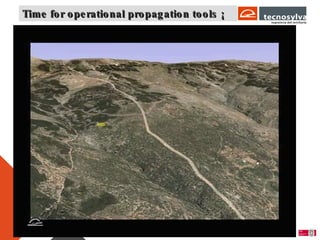
Time for operational propagation tools ¡
Conclusions Several models are available for real time forest fire modelling, but lack of use in operations FFDSS GIS based systems is the mandatory frame work to use these models for practical usefulness Rothermel model is still necessary for practical usefulness, user´s confidence is increasing A great synergy is generated by having all systems together: FFDSS GIS, Physical models, Rothermel, HR Wind. Thank you for your attention

Tsyl Zaragoza Maths Fire Jun 2009

  • 1.
    Operational simulation offorest fires Santiago Monedero & Joaquín Ramirez Maths & Fire Zaragoza 15/06/09 Ingeniería del territorio http://www.tecnosylva.com
  • 2.
    p resentation outline2. Models 5. FFDSS GIS implementation 3. Rothermel implementation 4. Operational approach GIS 1. Introduction
  • 3.
    User´s need ofoperational tools Page Many command centers has up to 30 fires a day in risk campaign Real need of quick fire dangerousness evaluation EVERY ALARM NEEDS A TECHNICAL EVALUATION OF DANGER Galice, (SP) 2006
  • 4.
    Fire simulation usesituation Page Low use in European FF services of this kind of tools, unless in prevention phase, and in a few cases only (EUFIRELAB, 2005) 1 Fires in euromediterranean countries are very fast, and a lot at the same time Actual tools are difficult to feed, and use data not fitted to the needs of the users Results needs of high skill users to get the best of them, and are difficult to evaluate Use of propagator in PREVENTION and mainly USA – big fires Bad perception of their utility, (lot of solutions, main approach of years of GIS developments in FF) Input data hard to process and not appropiate scales Results oriented more to laboratory than to real fire fighting
  • 5.
    Basic equations: LocalRadiation Radiation Diffusion depends on temperature Wind effects: Depends not only on wind but also on flame tilt There is no explicit Radiation term u: temperature e: enthalpy y: fuel amount G(u): Multivalued operator for moisture f(u,y) reaction function (Arrenius type) Vertical temperature loos
  • 6.
    Basic equations: LocalRadiation Wind effects: Inside radiation term r u: temperature e: enthalpy y: fuel amount G(u): Multivalued operator for moisture r Explicit radiation Multivalued operator Moleding radiation and moisture content in fire spread L. Ferragut, M. Asensio, S. Monedero Commun. Numer. Meth. Engng 2007; 23 :819–833 Published online 19 October 2006 in Wiley InterScience (www.interscience.wiley.com). DOI: 10.1002/cnm.927 Radiation and moisture method presented in:
  • 7.
    Numerical Mesh Theresolution is done by the Finite Element Method with mesh adaptativity, we use the library Neptuno++ developed by Prof. Ferragut. Solution FEM example with 4 ignition points
  • 8.
    Radiation models Diffusionincluded: more complex Convection included in ff equation Diffusion included: slower Empirical model: hard to validate Not valid for complex surface PROS CONS LOCAL Non LOCAL Valid for complex surfaces External independent model Validation independent of fire equations Wind effects only on radiation
  • 9.
    Empirical model: existingsoftware http://www.firemodels.org/ Rothermel Potential fire risk analysis Table, graph, and diagram output 2-dimensional fire growth model ROS (Rate Of Spread) Fire line intensity Flame length Fuel type Wind Terrain Moisture f( )
  • 10.
    Rothermel Implementation mdtmoisture Fuel V average Rothermel (Behaveplus) ROS Cost layer= time = L/ROS Rate of Spread Implemented based on Rothermels, Albini paper Time evolution Implemented based on an enhaced Esri’s Pathdistance function (Where the time variable is the accumulative cost) With no extra hard work we obtain: graphs for homogeneus conditions like BehavePlus Potencial risk analysis like FlamMap
  • 11.
    FireLAB evolution: FSPro, FPA 1 fire Several fires 1 meteo scenario hundreds of meteo scenarios FARSITE FSPro FPA FlamMap
  • 12.
    Empirical model Widelyknown used and tested Based on experimental data NFFL fuel types European fuel types Very quick resolution FREE! Surface fire, crown fire, spotting, Fire acceleration Very technical Only user with training may use it. Based experimental data Bad exportability No new effects are expected No FFDSS embeded GIS: Data conversion No operational layers Tedious file configurations No enhanced GIS capabilities PROS CONS
  • 13.
  • 14.
    Fuel parameters OOAInfoGIS: SAD en Incendios Forestales
  • 15.
    USERS ASSESSMENT RESULTS: Fuel Parameters
  • 16.
    Operational need: Highresolution wind High Definition Wind Field: from Hirlam =13 km data to 25 m data Page
  • 17.
    Firelab Wind models Comparation of a Farsite simulation for low and high wind resolution (in white the actual perimeter of the fire). Reference: The impact of high resolution wind field simulations on the accuracy of fire growth predictions (B. Butler, J. Forthofer, M. Finney)
  • 18.
  • 19.
    High Definition Wind Simulacion por FIRETEC. Referen ia: J. L. Winterkamp, R. R. Linn, Jonah J. Colman, William S. Smith M.I Asensio, L. Ferragut, J. Simon,  (2005).   "A convective model for fire spread simulation."  Applied Mathematical Letters 18, pp. 673-677, 2005 Initial model presented on: Enhaced with punctual Wind value assimilation
  • 20.
    Ferragut’s Wind model:2.5 Model Should be valid for real time modeling Takes into account: Vegetation friction and Temperature Temperature dependent Fires own temperature (physical modeling of fire behaviour) Sea breeze Slope wind Punctual measurements Fast calculations (400 x400 grid= 30 s.)¡
  • 21.
    Basic local windeffects Night.  Slope winds +Temp -Temp Day. +Temp -Temp -Day: 6 – 7 Km/h ¿? -Night: 1 – 3 Km/h ¿? Temp (time, height (x,y))
  • 22.
    Synergies spread GraphsRisk Rothermel Physical FEM Wind Spread
  • 23.
    FFDSS: where toolsshould work InfoGIS is being used in operational way as the central decission support system in the main spanish forest fires agencies since 1997 Castilla y León 1997 Toledo 2000 Extremadura 2001 Aragón 2005 Andalucía 2006 Cantabria 2008
  • 24.
    InfoSIM schema 19-20 October 2006, Page Fire Platform Meeting
  • 25.
    long lasting layerFuel, Satellite images, terrain Short lasting layers Wind, moisture, etc 3D real time Output Radiation model FEM Neptuno++ G.I.S. Physical fire model Help decision system Satellite fire-front update Satellite ignition detection External Moisture model High Definition Wind field Model I Model II Rothermel model Rasterize
  • 26.
    InfoSIM: operational firepropagator Original development, PREVIEW project, inside WFDSS Also ArcGIS extension One click simulations Preraster input data Firebrak effect HR Wind (Ferragut´s model Management of simulations Integration with operational resources and fires data 4D results over HR imagery Also physical model Tech Validation: 2008 Extremadura& Andalusian fires Operacional use: campaign 2009 Extremadura, UME, Andalusia & Aragón (2010)
  • 27.
    Integration of InfoSIMinside InfoGIS: InfoSIM
  • 28.
  • 29.
  • 30.
  • 31.
    Input s - Outputs Propagadores de Incendios Forestales - Nationwide spatial database - HR fuel data – next steps: LIDAR ¡ - HR firebreaks: BCN25 - Formats -Raster -Vector - Imagery (MODIS NDVI) -Generic GIS, 3D OGC KML and FIRELAB ( Farsite) -Generation of graphics, reports, (same as Farsite, Behaveplus & Flammap) INPUTS OUTPUTS
  • 32.
    SIGYM (METEOGRID) Integrationof METEO GIS input data
  • 33.
    motor de cálculoPropagadores de Incendios Forestales - Simulaciones Condiciones variables en el tiempo Humedad vivo Hora Humedad Muerto Viento Modulo Viento dirección 1 2 3 8 8 9 10 10 11 30 90 150 60
  • 34.
    Firebraks trea tmentPropagadores de Incendios Forestales 0 1 2 4 6 8 10 12 14 16 18 Anchura (metros) 0 R0 ROS = ROS 0 * Parameter_firebreak Null value: No effect High values : Low width, high effect
  • 35.
    c alculation enginePropagadores de Incendios Forestales - Adustment regional/ local factor (Farsite) ROS = ROS * Parametro_fuel - Fuel Model Inputs Rothermel Albini Custom Burgan Changes fuel behaviour,dep. experience Comb 1 1 2 0.3 3 0.6 4 0.8 11 1.7
  • 36.
    c alculation enginePropagadores de Incendios Forestales - 3 different “pathdistance” temporal evolution -Pathdistance standard 8 y 16 directions -Pathdistance 12 autoselecctable directions
  • 37.
    Analisys modules Propagadoresde Incendios Forestales - Post-análisis (like Farsite) Fuel surface / time Perimeter / time – for operation plans Expansion speed (Vx,Vy) Velocidad del “centro de masas” del incendio Comparation with real perimeters - Pre-análisis (like BehavePlus) ROS, Flame length, intensity depending on Moisture1, moisture10, moisture100 Moisture live, wind & slope
  • 38.
    Aut omated anali sys Propagadores de Incendios Forestales - Capacity of extinction automated calculations Configurable ROS, FL,Intensity – Eficiency (vs real data) + + - Risk Indexes ROS FL Intensity
  • 39.
    Operati onal use:UME 3 Level CPX December 16th-17th 2008, Page Final Review - Toulouse TOA analisys Cofrentes CPX UME Level 3 exercise (Valencia, Spain, april 2008)
  • 40.
    Time for operationalpropagation tools ¡
  • 41.
    Conclusions Several modelsare available for real time forest fire modelling, but lack of use in operations FFDSS GIS based systems is the mandatory frame work to use these models for practical usefulness Rothermel model is still necessary for practical usefulness, user´s confidence is increasing A great synergy is generated by having all systems together: FFDSS GIS, Physical models, Rothermel, HR Wind. Thank you for your attention