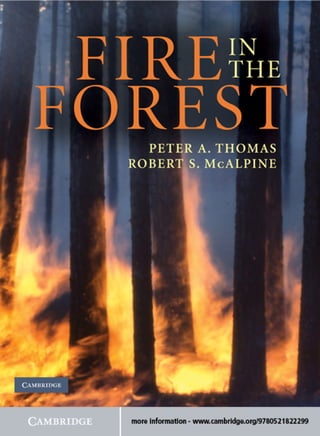
Fire In The Forest Peter A Thomas Robert S
Mcalpine download
https://ebookbell.com/product/fire-in-the-forest-peter-a-thomas-
robert-s-mcalpine-51710160
Explore and download more ebooks at ebookbell.com
Here are some recommended products that we believe you will be
interested in. You can click the link to download.
Fire In The Forest Peter A Thomas Robert S Mcalpine Kelvin Hirsch
Peter Hobson
https://ebookbell.com/product/fire-in-the-forest-peter-a-thomas-
robert-s-mcalpine-kelvin-hirsch-peter-hobson-51242124
Fire Management In The American West Forest Politics And The Rise Of
Megafires First Edition Mark Hudson
https://ebookbell.com/product/fire-management-in-the-american-west-
forest-politics-and-the-rise-of-megafires-first-edition-mark-
hudson-2443804
Fire And Water Scientific Heresy In The Forest Service Ashley L Schiff
https://ebookbell.com/product/fire-and-water-scientific-heresy-in-the-
forest-service-ashley-l-schiff-51389412
Manual For The Control Of Fire In Peatlands And Peatland Forest Wahyu
Catur Adinugroho
https://ebookbell.com/product/manual-for-the-control-of-fire-in-
peatlands-and-peatland-forest-wahyu-catur-adinugroho-1854286
Forest Fires And Abandonment Patterns From The Aguada Culture
Northwest Argentina A Paleoenvironmental Study Based On The Analysis
Of Microcharcoals In The Ambato Valley Catamarca Province Henrik B
Lindskoug
https://ebookbell.com/product/forest-fires-and-abandonment-patterns-
from-the-aguada-culture-northwest-argentina-a-paleoenvironmental-
study-based-on-the-analysis-of-microcharcoals-in-the-ambato-valley-
catamarca-province-henrik-b-lindskoug-49986810
Fir And Empire The Transformation Of Forests In Early Modern China Ian
M Miller
https://ebookbell.com/product/fir-and-empire-the-transformation-of-
forests-in-early-modern-china-ian-m-miller-24691128
The Five Faculties Putting Wisdom In Charge Of The Mind Hnissaro
Bhikkhu
https://ebookbell.com/product/the-five-faculties-putting-wisdom-in-
charge-of-the-mind-hnissaro-bhikkhu-43680930
Fire In The Hills Donna Jo Napoli
https://ebookbell.com/product/fire-in-the-hills-donna-jo-
napoli-49121264
Fire In The Dark Telling Gypsiness In North East England Sarah Sal
Buckler
https://ebookbell.com/product/fire-in-the-dark-telling-gypsiness-in-
north-east-england-sarah-sal-buckler-51746986
FIRE IN THE FOREST
How destructive or beneficial are forest fires to wildlife? Should we be trying to reduce or
increase the amount of fire in forests? How are forest fires controlled, and why does this
sometimes fail? What effect will climate change have? These and many other questions are
answered in this richly illustrated book, written in non-technical language. The journey starts
in the long geological history of fire, leading up to our present love--hate relationship with it.
Exploring the physics of how a single flame burns, the journey continues through how whole
forests burn and the anatomy of firestorms. The positive and negative ecological effects of fires
are explored, from plants and wildlife to whole landscapes. The journey ends with how fires are
controlled, and a look to the future. This book will be of interest to ecologists, biogeographers
and anyone with an interest in forest fires and the role they play.
Peter A. Thomas is Senior Lecturer in Environmental Science at Keele University, UK and has
been a Visiting Professor at the University of Alberta, Canada and a Bullard Fellow at Harvard
University, USA. His teaching encompasses a wide range of tree- and woodland-related topics
including fire behaviour and fire ecology, and he recently received an Excellence in Teaching
Award from Keele University. He is the author of Trees: Their Natural History and Ecology of
Woodlands and Forests, both published by Cambridge University Press.
Robert S. (Rob) McAlpine works with the Ontario Ministry of Natural Resources, Aviation and
Forest Fire Management Branch, where he leads the Science and Technology group. His current
research interests and activities span fire behaviour, fire economics, equipment development and
organisational effectiveness. He has worked in fire management and research for over 30 years,
from a frontline firefighter to a fire scientist.
Fire in the Forest
Peter A. Thomas and Rob McAlpine
with contributions from
Kelvin Hirsch and Peter Hobson
CAMBRIDGE UNIVERSITY PRESS
Cambridge, New York, Melbourne, Madrid, Cape Town, Singapore,
São Paulo, Delhi, Dubai, Tokyo, Mexico City
Cambridge University Press
The Edinburgh Building, Cambridge CB2 8RU, UK
Published in the United States of America by
Cambridge University Press, New York
www.cambridge.org
Information on this title: www.cambridge.org/9780521822299
# Cambridge University Press 2010
This publication is in copyright. Subject to statutory exception
and to the provisions of relevant collective licensing agreements,
no reproduction of any part may take place without
the written permission of Cambridge University Press.
First published 2010
Printed in the United Kingdom at the University Press, Cambridge
A catalogue record for this publication is available from the British Library
Library of Congress Cataloging-in-Publication Data
Thomas, Peter A.
Fire in the forest / Peter A. Thomas and Rob McAlpine ; with contributions from
Kelvin Hirsch & Peter Hobson.
p. cm.
ISBN 978-0-521-82229-9 (Hardback)
1. Forest fires. I. McAlpine, Rob. II. Title.
SD421.T49 2010
634.90
618–dc22 2010026385
ISBN 978-0-521-82229-9 Hardback
Cambridge University Press has no responsibility for the persistence or
accuracy of URLs for external or third-party internet websites referred to
in this publication, and does not guarantee that any content on such
websites is, or will remain, accurate or appropriate.
To our families who have stood with us during this project:
Caroline, Benjamin and Graeme (RSM); Judy, Matthew and Daniel (PAT).
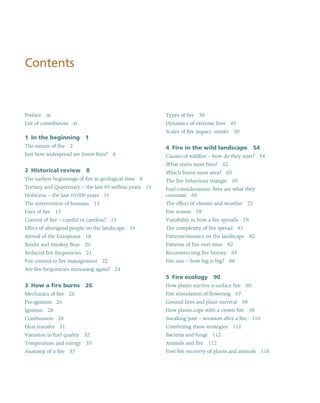
Contents
Preface ix
List of contributors xi
1 In the beginning 1
The nature of fire 2
Just how widespread are forest fires? 4
2 Historical review 8
The earliest beginnings of fire in geological time 8
Tertiary and Quaternary – the last 65 million years 11
Holocene – the last 10 000 years 11
The intervention of humans 13
Uses of fire 13
Control of fire – careful or careless? 15
Effect of aboriginal people on the landscape 16
Arrival of the Europeans 18
Bambi and Smokey Bear 20
Reduced fire frequencies 21
Fire control to fire management 22
Are fire frequencies increasing again? 24
3 How a fire burns 26
Mechanics of fire 26
Pre-ignition 26
Ignition 28
Combustion 28
Heat transfer 31
Variation in fuel quality 32
Temperature and energy 35
Anatomy of a fire 37
Types of fire 38
Dynamics of extreme fires 45
Scales of fire impact: smoke 50
4 Fire in the wild landscape 54
Causes of wildfire – how do they start? 54
What starts most fires? 62
Which burns most area? 65
The fire behaviour triangle 65
Fuel considerations: fires are what they
consume 66
The effect of climate and weather 72
Fire season 78
Variability in how a fire spreads 78
The complexity of fire spread 81
Patterns/mosaics on the landscape 82
Patterns of fire over time 82
Reconstructing fire history 85
Fire size – how big is big? 88
5 Fire ecology 90
How plants survive a surface fire 90
Fire stimulation of flowering 97
Ground fires and plant survival 98
How plants cope with a crown fire 98
Sneaking past – invasion after a fire 110
Combining these strategies 112
Bacteria and fungi 112
Animals and fire 112
Post-fire recovery of plants and animals 118
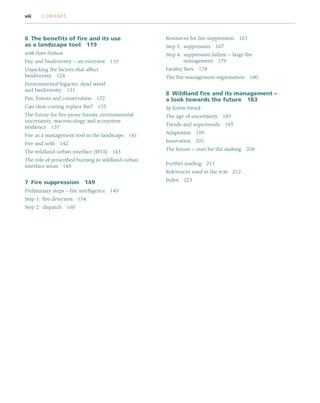
6 The benefits of fire and its use
as a landscape tool 119
with Peter Hobson
Fire and biodiversity – an overview 119
Unpicking the factors that affect
biodiversity 124
Environmental legacies: dead wood
and biodiversity 131
Fire, forests and conservation 132
Can clear-cutting replace fire? 135
The future for fire-prone forests: environmental
uncertainty, macroecology and ecosystem
resilience 137
Fire as a management tool in the landscape 141
Fire and soils 142
The wildland–urban interface (WUI) 143
The role of prescribed burning in wildland–urban
interface areas 145
7 Fire suppression 149
Preliminary steps – fire intelligence 149
Step 1: fire detection 154
Step 2: dispatch 160
Resources for fire suppression 163
Step 3: suppression 167
Step 4: suppression failure – large fire
management 176
Fatality fires 178
The fire-management organisation 180
8 Wildland fire and its management –
a look towards the future 183
by Kelvin Hirsch
The age of uncertainty 183
Trends and supertrends 185
Adaptation 199
Innovation 201
The future – ours for the making 208
Further reading 211
References used in the text 212
Index 223
viii CONTENTS
Preface
Year after year pictures in the media show towering flames threatening people’s homes, livelihoods,
and their very lives in places as diverse as North America, Europe and Australia -- why does this
happen? Conflicting stories continually appear over whether fire is rapidly destroying the animals,
habitats and plants we treasure in our forests, or whether fire is their salvation, the key to diversity and
ecosystem rebirth -- where does the truth lie? With global warming predictions, do we face more and
larger fires or will technology be able to tame this potentially savage enemy? This book delves into
these and other questions, providing a factual account and perspective of how fire burns in the forest,
what it does and how it might be controlled.
Where the published work of others is used, or where good sources of extra information are
recommended, the authors and the date of the publication are given so that the source can be found
in the references at the end of the book. This inevitably has resulted in a compromise; we’ve tried to
keep this to a minimum to help the text flow but give sufficient references to help the reader who
wishes to find out more. Our apologies if we fail you at any point.
We are indebted to the many people who provided information and insights and who read part or all
of this book. In particular we are grateful to Dave Bowman, Yeonsook Choung, Helene Cleveland,
Malcolm Gill, Jim Gould, Richard Hobbs, Scott Keelan, John Packham, Marc-André Parisien, Steve Pyne,
Tim Sheldan, Brian Stocks, Jan Volney, Mike Weber, Tim Williamson and Mike Wotton. People were
also remarkably kind in sharing pictures and photographs with us; these are gratefully acknowledged
in the figure legends. All other photographs were taken by PAT. We are very grateful to Andy Lawrence
who did his usual superb job in drawing many of the colour figures. Despite the help of others, if errors
remain they are our fault. Please do let us know where you do find errors or you disagree with the
stance taken.
PAT is happy to record that some of the background for this book was researched while a Bullard
Fellow at Harvard University, Massachusetts.
Contributors
MAIN AUTHORS
Peter A. Thomas
School of Life Sciences
Keele University
Keele
Staffordshire ST5 5BG, UK
Rob McAlpine
Fire Science and Technology
Aviation and Forest Fire Management
Ontario Ministry of Natural Resources
70 Foster Drive, Suite 400
Sault Ste. Marie, Ontario,
Canada P6A 6V5
CONTRIBUTING AUTHORS
Peter Hobson
School of Sustainable Environments
Writtle College
Chelmsford
Essex CM1 3RR, UK
Kelvin Hirsch
Canadian Forest Service
Northern Forestry Centre
5320–122nd Street
Edmonton, Alberta,
Canada T6H 3S5
1 In the beginning
Welcome to Fire in the Forest. The ancient Greeks considered fire as one of the
classical elemental forces along with water, earth and air; and indeed fire has helped
shape the world around us to such a great extent that it would be hard to argue
the point. Without a doubt, there is nothing on this planet that cannot be traced
back (many times over) to some kind of fiery origin, whether that be the Big Bang at
the origin of the universe, the atomic fires of some long dead pre-supernova star,
the liquid burning rock just below the crust of the earth or the vegetation sitting
frailly on the surface of the planet. While all of these forging fires are fascinating, a
tome that spans the fullness of fire would be many volumes thick. The focus of this
book is to explore the various facets of fires in forests: from how a single flame
works, to what determines whether a forest will burn, to why huge forest fires occur
and how they can be tackled. In this we will be dealing primarily with wildland
fires – fires in the natural or semi-natural forest rather than those in plantations or
in urban areas. These wildland fires have shaped the planet’s biotic structure so
we also focus on how plants and animals cope with fire, our own interaction with
fire and ultimately our overall relationship with the whole planet. We hope that this
book will be of use to anyone with an interest in how forest fires work and how they
affect the forest. Our aim has been to make this sometimes complex world open
and approachable to anyone with or without even a hazy knowledge of science.
When the first plants began to colonise the land of the early earth they adapted to
the variously forming environmental niches. Into this inhospitable place, plants
took hold and grew, but fire was there too. During rainless spells, when the land and
plants dried out a little, lightning and even volcanoes would ignite fires. These fires
would spread out, consuming the plants and releasing the nutrients back to the
environment. Following the fires, more plants arose, utilising the nutrients that
were now more freely available. This cycle was repeated almost endlessly, each
successive cycle consuming another generation of plant life, and slowly changing
the environment. In some climate zones, seasonal moisture would produce lush
growth only to have it dry out at another time of the year resulting in frequent,
sometimes annual burning, while other locations, due to a lack of fuel accumula-
tion, or of near-constant fire-prohibiting moisture, or an infrequent ignition source,
would see fire much less often. These climatic effects began to be drivers of
evolution for plants, with species beginning to adapt to different degrees of burning
and exploit the elemental force of fire as they would the other elements.
From the beginning our (human) relationship with fire has been two-sided. We
exploited the use of fire for hunting and warmth, and our safety was threatened by
fire. As civilisation evolved, our relationship with fire included cooking, forging of
metals and further. However, this evolution eventually began to weaken our
understanding of fire as a natural process. As civilisation has grown, fire has been
increasingly containerised, first into the hearth then into internal combustion
engines and power-generating plants, so we lost our experience and appreciation
of the benefits of open fires while keeping our fear. Thus, to many, fire in the
landscape became a wholly negative thing (more on that later!).
If we fast forward to today, we find fire is still an essential natural process in many
ecosystems across the planet. Plants have evolved since they first colonised the
land, not only into more complex organisms adapted to the weather and climate of
various regions, but also adapted to the frequency and intensity of fires. Indeed
many plants and animals have evolved to influence the fire cycle and to use fire to
their own ends, thereby out-competing other organisms not so well adapted to fire,
or adapted to a different fire regime. The range and ingenuity of these adaptations is
as varied as life itself. Certainly we know that the world would look very different
without fire. If we could completely remove all fire, grasslands would diminish
greatly in size, and forest cover would increase from 30% to an estimated 56% of
the vegetated land surface (Bond et al. 2004, Bowman 2005).
In this single volume we could not begin to address the wide range of fire effects
and cover the breadth of fire management across the globe. Instead we have chosen
some key fire-prone areas around the planet – the global fire powers of Canada, USA
and Australia – and focused on them, with occasional diversions to neighbouring
places for illustrative purposes. The boreal forest, dominated by pines and spruces,
is a large fire-prone ecosystem, encircling the northern hemisphere. Over a third of
the boreal forest lies within Canada and here lies one of our areas of focus. The USA
contains a good deal of even more flammable forest vegetation which has its own
story to tell. Australia is an island continent that perhaps lives with the most
frequent and intense fire regime on the planet. From the arid grassland to the
eucalypt forests, fire is an integral part of the land and the people.
The nature of fire
Within the ancient Greeks’ four elemental forces, all except fire are matter based –
earth, air and water are things that today are understood to be composed of matter.
Only fire is different, and rather than an ‘object’ so to speak, it is a process. Certainly
the other elements can be involved in processes (water for example can be an agent
of change in erosion), but it is only fire that is really intangible and ephemeral.
At the same time, fire is the only one of these elemental forces that we can unleash
2 IN THE BEGINNING
and to a certain extent control as a major ecological force. We can light fires but
cannot start a volcanic eruption, hurricane or widespread flood. These facts demand
a better understanding of what fire is. In chemical terms, fire is an oxidising agent –
it combines one lump of matter with oxygen to produce another form of matter.
Oxidation is often quite slow (as when oxidised iron turns to rust, for example) but
in other cases, such as fire, it is a more rapid process. Some forms of matter when
oxidised (combined with oxygen) react and release heat. In some cases (phosphorus
for example) no heat is required to start this reaction, but in most cases (including
fire) heat is required to initiate the reaction. The extra heat then generated by
oxidation is sufficient to sustain the process until all the matter is transformed (or
in the case of wood – fuel consumed).
To lay a broad background, fire is in essence the opposite of photosynthesis.
Plants grow using photosynthesis to capture the energy of the sun and convert
carbon dioxide and water into glucose (for plant structures) and release oxygen and
water back into the atmosphere.
A simplified equation for photosynthesis is:
6CO2 þ 12 H2O þ sunlight yields C6H12O6 þ 6 O2 þ 6 H2O:
Or the same equation in recipe format:
6 parts carbon dioxide (CO2) +
12 parts water (H2O) +
sunlight
Yields:
One part glucose (C6H12O6) +
6 parts oxygen (O2) +
6 parts water (H2O).
Of course, plants are composed of more than glucose, but glucose is the major
building block of most structures (e.g. cellulose, wood) and for our purposes the
essential element of concern. Additionally, there are a host of micronutrients and
minerals required for the health of the plant (supplied by the soil). Where photo-
synthesis converts water and carbon dioxide into glucose, fire reverses this reaction,
oxidising the glucose back into the original constituents and releasing the stored
solar energy as heat and light. The difference between photosynthesis and fire
(other than one being the reverse of the other) is the rate at which the two occur.
A large tree (and by extension forest) collects solar energy over decades, centuries
or millennia, while the stored energy can be released in minutes during a fire;
consequently the energy release rates can be enormous. On a large, high-intensity
wildfire, it is said that the energy equivalent of one Hiroshima-sized atomic bomb
can be released every 20 minutes. It is worth remembering that the energy released
during fire was captured from the sun and stored by the trees and vegetation;
nature’s first energy storage battery.
THE NATURE OF FIRE 3
Looking back at the Greek philosophers, they seemed again to get things right –
earth, air and water combine to form the trees and other vegetation with energy
from the sun (at its heart an atomic fire). And when the process is reversed, the
energy initially forged from the sun, and translated into form by trees and vegeta-
tion, is released by fire to consume the storage container and yield heat and light.
Just how widespread are forest fires?
A common question asked about fire is how much of the world’s land surface is
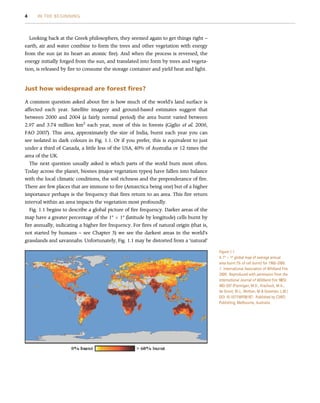
affected each year. Satellite imagery and ground-based estimates suggest that
between 2000 and 2004 (a fairly normal period) the area burnt varied between
2.97 and 3.74 million km2
each year, most of this in forests (Giglio et al. 2006,
FAO 2007). This area, approximately the size of India, burnt each year you can
see isolated in dark colours in Fig. 1.1. Or if you prefer, this is equivalent to just
under a third of Canada, a little less of the USA, 40% of Australia or 12 times the
area of the UK.
The next question usually asked is which parts of the world burn most often.
Today across the planet, biomes (major vegetation types) have fallen into balance
with the local climatic conditions, the soil richness and the preponderance of fire.
There are few places that are immune to fire (Antarctica being one) but of a higher
importance perhaps is the frequency that fires return to an area. This fire return
interval within an area impacts the vegetation most profoundly.
Fig. 1.1 begins to describe a global picture of fire frequency. Darker areas of the
map have a greater percentage of the 1º  1º (latitude by longitude) cells burnt by
fire annually, indicating a higher fire frequency. For fires of natural origin (that is,
not started by humans – see Chapter 3) we see the darkest areas in the world’s
grasslands and savannahs. Unfortunately, Fig. 1.1 may be distorted from a ‘natural’
Figure 1.1
A 1º  1º global map of average annual
area burnt (% of cell burnt) for 1960–2000.
# International Association of Wildland Fire
2009. Reproduced with permission from the
International Journal of Wildland Fire 18(5):
483–507 (Flannigan, M.D., Krachuck, M.A.,
de Groot, W.J., Wotton, M  Gowman, L.M.)
DOI 10.1071/WF08187. Published by CSIRO
Publishing, Melbourne, Australia.
4 IN THE BEGINNING
fire cycle by tropical rainforest burning activities in South America and South-East
Asia. Although the tropics are often too wet to burn, as described in Chapter 4,
people clearing the forest, aided by El Niño droughts, let in fire. These can be huge
fires: the Great Fire of Borneo between September 1982 and July 1983 burnt
between 35 and 37 thousand km2
– a hundredth of the normal global area burnt
per year in just one fire (Johnson 1984).
However, a striking fact clearly visible from Fig. 1.1 is that generally where there is
vegetation, there is fire (with few exceptions). The vast majority of these fires are not
monitored or documented due to remoteness and so go largely unnoticed by the
wider world. Some grassland areas burn almost every year (consequently keeping
them grasslands!). This link between grasslands and high fire frequency begins to
show us the linkage between the two – repeated fires on a near-annual basis do not
allow longer-lived organisms to survive – they are repeatedly burnt back and not
allowed to get a start. So the grassland ecosystem, home to many species of both
flora and fauna, is dependent on frequent fire to maintain its character. Another
example, although very different ecologically, is the eucalypt forests in many parts
of Australia (Fig. 1.2). And as we see later in Chapter 6, most ecosystems are
dependent on some level of fire frequency.
However, this understanding of the necessary role of fire in the ecosystem is only
a relatively recent revelation for modern civilisation. This raises the perennial
question of whether forest fires are indeed friend or foe. It was not until the 1960s
that the essential role of fire was first suggested, and acceptance into the main-
stream has taken decades. Even in the 1970s fire was mostly thought to be a bad
thing: a Canadian Forestry Service publication called Forest Enemies (Anon 1973)
included a section on fire. At the same time, the Canadian company Bombardier,
who build water bombers, produced an educational video that described their
machines as fighting the number one enemy of the forest. But our perspective
has changed and our depth of understanding of fire has increased so that we now
see some fires as useful and others as harmful. So the same dichotomy of the nature
of fire exists for us; fire is useful (technologically) and an essential part of the
ecosystems, but unmanaged/uncontrolled it can threaten lives, structures, infra-
structure (and the dependent economies), and our way of life. This produces a
problem; as Putz (2003) points out:
In the glare of the conflagrations that consume forests and kill firefighters in
western and northern North America every fire season, special care is
required when trying to present fire in a positive light.
We therefore try and tread carefully in this book, aiming to give you the facts on
how fires work in the landscape and why and how we try to control them, and to
leave you to decide how you feel about the pros and cons of different fires.
Acceptance of fire has been hampered by the long-time ingrained desire and
belief that nature can be tamed and dominated. This attitude not only drove fire
JUST HOW WIDESPREAD ARE FOREST FIRES? 5
and land-management policies, but facilitated attitudes that people could build
homes in ‘natural’ environments and expect their homes to be protected from fire.
Governments have met this challenge and built complex firefighting organisations.
Society now depends on these firefighters to protect people, homes, communities
and the infrastructure that the economy depends upon (pipelines, hydro lines,
telecommunication towers, railroads, crops, timber for homes etc.).
How firefighters meet the daily challenge that nature has set out, is a story unto
itself. Complex organisations utilising state-of-the-art technology, adapting to vari-
ous situations, meet the challenge of fire to protect what society demands it
protects. However, as in all cases when humans contend with nature, there are
wins and losses. New technologies improve capabilities, at an ever-increasing price
tag, but on some days, the elemental force of fire conquers all.
Fire then is a conundrum – a basic elemental force of nature that cannot be held
back, with ecosystems evolved the world over that require rebirth or rejuvenation
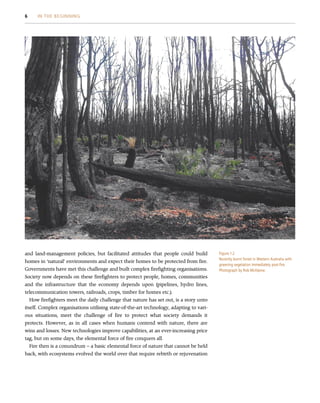
Figure 1.2
Recently burnt forest in Western Australia with
greening vegetation immediately post-fire.
Photograph by Rob McAlpine.
6 IN THE BEGINNING
through fire; and humans who need to protect their lives and property from the
destructive force of fire. Meeting that balance will challenge us all.
The Greeks recognised the fire shown in Fig. 1.3 as an element of nature. In this
book we will look at wildland fire in several key locations around the world to
understand how forest fires burn (Chapters 3 and 4), how ecosystems have integrated
fire into their function (Chapters 5 and 6) and how we humans meet the challenge of
fire (Chapter 7). From there we may start, from looking at the modern world, to
understand why fire – a process and not a physical element – became part of the
Ancients’ elements. And finally we look to the future (Chapter 8) and the continuing
and increasingly complex challenge of finding the balance for fire in the forest.
Figure 1.3
A fire burning in the boreal forest of Northern
Ontario. Ontario Ministry of Natural Resources,
copyright 2006 Queens Printer Ontario.
JUST HOW WIDESPREAD ARE FOREST FIRES? 7
2 Historical review
The earliest beginnings of fire in geological time
Fires could not blaze until there was enough oxygen in the atmosphere and enough
vegetation to burn. Oxygen began to appear in our atmosphere around 2 billion
years ago (in the Archaean subdivision of the Precambrian Era) and reached its
present-day level (21% of the atmosphere) around 600 million years ago. Life was
still in the seas at this point – in fact it was only when oxygen reached these high
levels that ozone could be formed high in the atmosphere which screened out
harmful ultraviolet radiation and allowed complex life to invade the shallows and
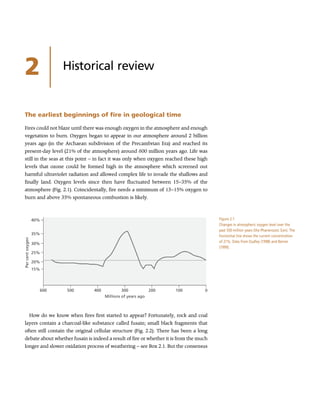
finally land. Oxygen levels since then have fluctuated between 15–35% of the
atmosphere (Fig. 2.1). Coincidentally, fire needs a minimum of 13–15% oxygen to
burn and above 35% spontaneous combustion is likely.
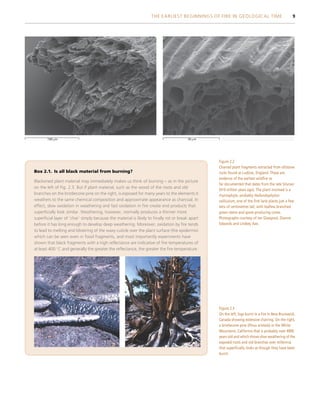
How do we know when fires first started to appear? Fortunately, rock and coal
layers contain a charcoal-like substance called fusain; small black fragments that
often still contain the original cellular structure (Fig. 2.2). There has been a long
debate about whether fusain is indeed a result of fire or whether it is from the much
longer and slower oxidation process of weathering – see Box 2.1. But the consensus
15%
600 500 400 300
Millions of years ago
200 100 0
20%
25%
Per
cent
oxygen
30%
35%
40% Figure 2.1
Changes in atmospheric oxygen level over the
past 550 million years (the Phanerozoic Eon). The
horizontal line shows the current concentration
of 21%. Data from Dudley (1998) and Berner
(1999).
100 mm 30 mm
Figure 2.2
Charred plant fragments extracted from siltstone
rocks found at Ludlow, England. These are
evidence of the earliest wildfire so
far documented that dates from the late Silurian
(419 million years ago). The plant involved is a
rhyniophyte, probably Hollandophyton
colliculum, one of the first land plants just a few
tens of centimetres tall, with leafless branched
green stems and spore-producing cones.
Photographs courtesy of Ian Glasspool, Dianne
Edwards and Lindsey Axe.
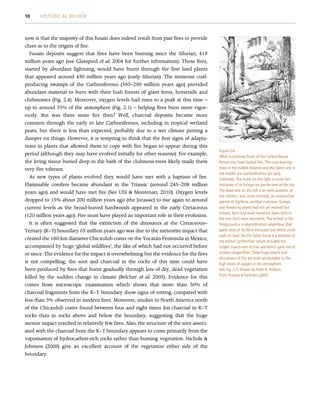
Box 2.1. Is all black material from burning?
Blackened plant material may immediately makes us think of burning – as in the picture
on the left of Fig. 2.3. But if plant material, such as the wood of the roots and old
branches on the bristlecone pine on the right, is exposed for many years to the elements it
weathers to the same chemical composition and approximate appearance as charcoal. In
effect, slow oxidation in weathering and fast oxidation in fire create end products that
superficially look similar. Weathering, however, normally produces a thinner more
superficial layer of ‘char’ simply because the material is likely to finally rot or break apart
before it has long enough to develop deep weathering. Moreover, oxidation by fire tends
to lead to melting and blistering of the waxy cuticle over the plant surface (the epidermis)
which can be seen even in fossil fragments, and most importantly experiments have
shown that black fragments with a high reflectance are indicative of fire temperatures of
at least 400 
C and generally the greater the reflectance, the greater the fire temperature.
Figure 2.3
On the left, logs burnt in a fire in New Brunswick,
Canada showing extensive charring. On the right,
a bristlecone pine (Pinus aristata) in the White
Mountains, California that is probably over 4000
years old and which shows slow weathering of the
exposed roots and old branches over millennia
that superficially looks as though they have been
burnt.
THE EARLIEST BEGINNINGS OF FIRE IN GEOLOGICAL TIME 9
now is that the majority of this fusain does indeed result from past fires to provide
clues as to the origins of fire.
Fusain deposits suggest that fires have been burning since the Silurian, 419
million years ago (see Glasspool et al. 2004 for further information). These fires,
started by abundant lightning, would have burnt through the first land plants
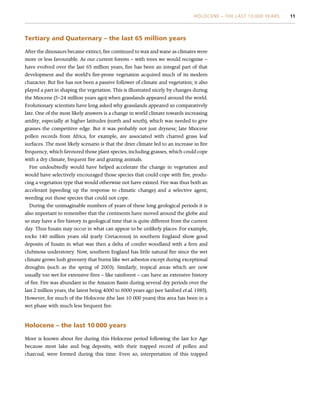
that appeared around 430 million years ago (early Silurian). The immense coal-
producing swamps of the Carboniferous (360–290 million years ago) provided
abundant material to burn with their lush forests of giant ferns, horsetails and
clubmosses (Fig. 2.4). Moreover, oxygen levels had risen to a peak at this time –
up to around 35% of the atmosphere (Fig. 2.1) – helping fires burn more vigor-
ously. But was there more fire then? Well, charcoal deposits became more
common through the early to late Carboniferous, including in tropical wetland
peats, but there is less than expected, probably due to a wet climate putting a
damper on things. However, it is tempting to think that the first signs of adapta-
tions in plants that allowed them to cope with fire began to appear during this
period (although they may have evolved initially for other reasons). For example,
the living tissue buried deep in the bark of the clubmoss-trees likely made them
very fire tolerant.
As new types of plants evolved they would have met with a baptism of fire.
Flammable conifers became abundant in the Triassic (around 245–208 million
years ago) and would have met fire (See Uhl  Montenari, 2010). Oxygen levels
dropped to 15% about 200 million years ago (the Jurassic) to rise again to around
current levels as the broad-leaved hardwoods appeared in the early Cretaceous
(120 million years ago). Fire must have played an important role in their evolution.
It is often suggested that the extinction of the dinosaurs at the Cretaceous–
Tertiary (K–T) boundary 65 million years ago was due to the meteorite impact that
created the 180-km diameter Chicxulub crater on the Yucatán Peninsula in Mexico,
accompanied by huge ‘global wildfires’, the like of which had not occurred before
or since. The evidence for the impact is overwhelming but the evidence for the fires
is not compelling; the soot and charcoal in the rocks of this time could have
been produced by fires that burnt gradually through lots of dry, dead vegetation
killed by the sudden change in climate (Belcher et al. 2005). Evidence for this
comes from microscopic examination which shows that more than 50% of
charcoal fragments from the K–T boundary show signs of rotting, compared with
less than 5% observed in modern fires. Moreover, studies in North America north
of the Chicxulub crater found between four and eight times less charcoal in K–T
rocks than in rocks above and below the boundary, suggesting that the huge
meteor impact resulted in relatively few fires. Also, the structure of the soot associ-
ated with the charcoal from the K–T boundary appears to come primarily from the
vaporisation of hydrocarbon-rich rocks rather than burning vegetation. Nichols 
Johnson (2008) give an excellent account of the vegetation either side of the
boundary.
Figure 2.4
What a clubmoss forest of the Carboniferous
Period may have looked like. The cone-bearing
trees in the middle distance and the fallen one in
the middle are Lepidodendron (an early
clubmoss). The trunk on the right is a tree fern
and some of its foliage can just be seen at the top.
The dead tree on the left is an early ancestor of
the conifers, and, more centrally, an unbranched
species of Sigillaria, another clubmoss. Grasses
and flowering plants had not yet evolved but
mosses, ferns and small horsetails (seen behind
the tree fern) were abundant. The animal in the
foreground is a labyrinthodont amphibian that
spent most of its life in the water but which could
walk on land. On the fallen trunk is a member of
the extinct ‘griffenflies’ which included the
largest insects ever to live, and which gave rise to
modern dragonflies. These huge insects and
abundance of fire are both attributable to the
high levels of oxygen in the atmosphere
(see Fig. 2.1). Drawn by Peter R. Hobson.
From Thomas  Packham (2007).
10 HISTORICAL REVIEW
Tertiary and Quaternary – the last 65 million years
After the dinosaurs became extinct, fire continued to wax and wane as climates were
more or less favourable. As our current forests – with trees we would recognise –
have evolved over the last 65 million years, fire has been an integral part of that
development and the world’s fire-prone vegetation acquired much of its modern
character. But fire has not been a passive follower of climate and vegetation; it also
played a part in shaping the vegetation. This is illustrated nicely by changes during
the Miocene (5–24 million years ago) when grasslands appeared around the world.
Evolutionary scientists have long asked why grasslands appeared so comparatively
late. One of the most likely answers is a change in world climate towards increasing
aridity, especially at higher latitudes (north and south), which was needed to give
grasses the competitive edge. But it was probably not just dryness; late Miocene
pollen records from Africa, for example, are associated with charred grass leaf
surfaces. The most likely scenario is that the drier climate led to an increase in fire
frequency, which favoured those plant species, including grasses, which could cope
with a dry climate, frequent fire and grazing animals.
Fire undoubtedly would have helped accelerate the change in vegetation and
would have selectively encouraged those species that could cope with fire, produ-
cing a vegetation type that would otherwise not have existed. Fire was thus both an
accelerant (speeding up the response to climatic change) and a selective agent,
weeding out those species that could not cope.
During the unimaginable numbers of years of these long geological periods it is
also important to remember that the continents have moved around the globe and
so may have a fire history in geological time that is quite different from the current
day. Thus fusain may occur in what can appear to be unlikely places. For example,
rocks 140 million years old (early Cretaceous) in southern England show good
deposits of fusain in what was then a delta of conifer woodland with a fern and
clubmoss understorey. Now, southern England has little natural fire since the wet
climate grows lush greenery that burns like wet asbestos except during exceptional
droughts (such as the spring of 2003). Similarly, tropical areas which are now
usually too wet for extensive fires – like rainforest – can have an extensive history
of fire. Fire was abundant in the Amazon Basin during several dry periods over the
last 2 million years, the latest being 4000 to 6000 years ago (see Sanford et al. 1985).
However, for much of the Holocene (the last 10 000 years) this area has been in a
wet phase with much less frequent fire.
Holocene – the last 10 000 years
More is known about fire during this Holocene period following the last Ice Age
because most lake and bog deposits, with their trapped record of pollen and
charcoal, were formed during this time. Even so, interpretation of this trapped
HOLOCENE – THE LAST 10 000 YEARS 11
record is not always easy. Charcoal, for example, caught in a bog may have been
transported from fires considerable distances away by wind or on water (charred
conifer needles float for many more days than uncharred ones). Certainly, charcoal
particles from the big 1988 fires in Yellowstone were found 1600 km (1000 miles)
away in Minnesota. On the positive side, palaeoecologists have a variety of methods
and techniques for teasing the true picture from these deposits, and the overall
picture of Holocene fire is continually improving.
As you would expect, warmer climatic periods generally led to more fire. Thus
we know that there was more fire during the warmer climate of the Medieval
Warm Period and less during the global period of the generally cooler and moister
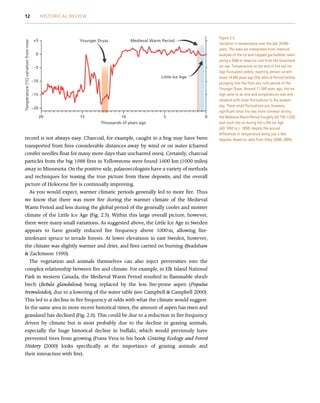
climate of the Little Ice Age (Fig. 2.5). Within this large overall picture, however,
there were many small variations. As suggested above, the Little Ice Age in Sweden
appears to have greatly reduced fire frequency above 1000 m, allowing fire-
intolerant spruce to invade forests. At lower elevations in east Sweden, however,
the climate was slightly warmer and drier, and fires carried on burning (Bradshaw
 Zackrisson 1990).
The vegetation and animals themselves can also inject perversities into the
complex relationship between fire and climate. For example, in Elk Island National
Park in western Canada, the Medieval Warm Period resulted in flammable shrub
birch (Betula glandulosa) being replaced by the less fire-prone aspen (Populus
tremuloides), due to a lowering of the water table (see Campbell  Campbell 2000).
This led to a decline in fire frequency at odds with what the climate would suggest.
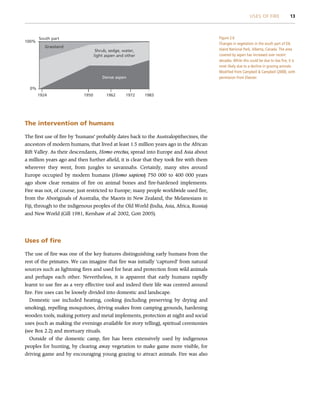
In the same area in more recent historical times, the amount of aspen has risen and
grassland has declined (Fig. 2.6). This could be due to a reduction in fire frequency
driven by climate but is most probably due to the decline in grazing animals,
especially the huge historical decline in buffalo, which would previously have
prevented trees from growing (Frans Vera in his book Grazing Ecology and Forest
History (2000) looks specifically at the importance of grazing animals and
their interaction with fire).
–20
20 15 10
Thousands of years ago
5 0
–15
–10
Temperature
(°C)
variation
from
now
–5
0
+5 Younger Dryas Medieval Warm Period
Little Ice Age
Figure 2.5
Variation in temperature over the last 20000
years. The data are interpreted from chemical
analyses of the ice and trapped gas bubbles taken
along a 3000-m deep ice core from the Greenland
ice cap. Temperatures at the end of the last Ice
Age fluctuated widely, reaching almost current
levels 14 000 years ago (the Allerd Period) before
plunging into the final very cold period of the
Younger Dryas. Around 11 500 years ago, the Ice
Age came to an end and temperatures rose and
steadied with small fluctuations to the present
day. These small fluctuations are, however,
significant since fire was more common during
the Medieval Warm Period (roughly AD 750–1250)
and much less so during the Little Ice Age
(AD 1450 to c. 1850) despite the annual
differences in temperature being just a few
degrees. Based on data from Alley (2000, 2004).
12 HISTORICAL REVIEW
The intervention of humans
The first use of fire by ‘humans’ probably dates back to the Australopithecines, the
ancestors of modern humans, that lived at least 1.5 million years ago in the African
Rift Valley. As their descendants, Homo erectus, spread into Europe and Asia about
a million years ago and then further afield, it is clear that they took fire with them
wherever they went, from jungles to savannahs. Certainly, many sites around
Europe occupied by modern humans (Homo sapiens) 750 000 to 400 000 years
ago show clear remains of fire on animal bones and fire-hardened implements.
Fire was not, of course, just restricted to Europe; many people worldwide used fire,
from the Aboriginals of Australia, the Maoris in New Zealand, the Melanesians in
Fiji, through to the indigenous peoples of the Old World (India, Asia, Africa, Russia)
and New World (Gill 1981, Kershaw et al. 2002, Gott 2005).
Uses of fire
The use of fire was one of the key features distinguishing early humans from the
rest of the primates. We can imagine that fire was initially ‘captured’ from natural
sources such as lightning fires and used for heat and protection from wild animals
and perhaps each other. Nevertheless, it is apparent that early humans rapidly
learnt to use fire as a very effective tool and indeed their life was centred around
fire. Fire uses can be loosely divided into domestic and landscape.
Domestic use included heating, cooking (including preserving by drying and
smoking), repelling mosquitoes, driving snakes from camping grounds, hardening
wooden tools, making pottery and metal implements, protection at night and social
uses (such as making the evenings available for story telling), spiritual ceremonies
(see Box 2.2) and mortuary rituals.
Outside of the domestic camp, fire has been extensively used by indigenous
peoples for hunting, by clearing away vegetation to make game more visible, for
driving game and by encouraging young grazing to attract animals. Fire was also
100%
1924 1950 1962 1972 1983
Grassland
South part
Shrub, sedge, water,
light aspen and other
Dense aspen
0%
Figure 2.6
Changes in vegetation in the south part of Elk
Island National Park, Alberta, Canada. The area
covered by aspen has increased over recent
decades. While this could be due to less fire, it is
most likely due to a decline in grazing animals.
Modified from Campbell  Campbell (2000), with
permission from Elsevier.
USES OF FIRE 13
useful for killing and cooking small mammals and insects such as grasshoppers, and
for improving access to edible plant roots and bulbs. A useful summary of the use of
fire in North America can be found in Mellars (1976).
Fire was also useful in removing accumulated vegetation, making travel easier
and creating fire breaks around camps. It is difficult to argue with the fact that the
value of fire in maintaining biodiversity was clearly recognised by early people
around the world. The Aboriginals of Australia certainly used fire in a big way to
‘clean up the country’ – returning the land to an orderly state and cleansing it of evil
spirits using ‘corrective fires’. Stephen Pyne (1993) rightly suggests that ‘Wherever
Box 2.2. Spiritual and magical uses of fire
Both the Aztecs and the Incas of Peru worshipped gods of fire. The Aztecs of Mexico used
huge ceremonial fires either kept burning permanently in the temples or just during major
religious festivals. Much later, the Greek goddess of the hearth, Hestia, was one of the
12 Olympian deities, and the worship of Vesta, her Roman counterpart, became a
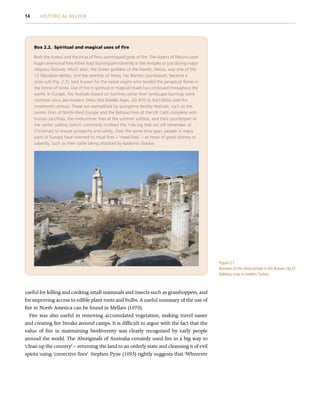
state cult (Fig. 2.7), best known for the vestal virgins who tended the perpetual flame in
the shrine of Vesta. Use of fire in spiritual or magical rituals has continued throughout the
world. In Europe, fire festivals (based on bonfires rather than landscape burning) were
common since pre-modern times (the Middle Ages, AD 410 to the1450s) until the
nineteenth century. These are exemplified by springtime fertility festivals, such as the
Lenten Fires of North-West Europe and the Beltane Fires of the UK Celts complete with
human sacrifices, the midsummer fires at the summer solstice, and their counterpart at
the winter solstice (which commonly involved the Yule log that we still remember at
Christmas) to ensure prosperity and safety. Over the same time span, people in many
parts of Europe have resorted to ritual fires – ‘need-fires’ – at times of great distress or
calamity, such as their cattle being attacked by epidemic disease.
Figure 2.7
Remains of the Vesta temple in the Roman city of
Ephesus, now in modern Turkey.
14 HISTORICAL REVIEW
humans and ecosystem have co-evolved, not to burn could be as irresponsible as
improper burning. Good citizens used fire well; bad ones, poorly, or not at all.’ This
illustrates the important influence people had over the vegetation of the land they
lived on.
As early humans learnt to use fire, they had at their fingertips a tremendous force
for modifying the landscape around them, helping pave the way for a transition
from being hunter/gatherers to being more agrarian and settled people. But how
carefully did they use fire?
Control of fire – careful or careless?
There has been a long debate about just how carefully aboriginal people used fire.
Some have argued that these people were mainly concerned with their immediate
survival with little concern for the long term, and so were careless with fire. Either
that or they lacked the skill to adequately control the fires they started. After all, fire
is the one major ecological force that can be very easily unleashed by humans, with
a huge potential impact on the landscape. This view is bolstered by the many
European observers who remarked on the casualness of fire use by North American
aboriginals, fires being left to ‘burn out of control’ and abandoned campfires left still
burning after an overnight stop. Early visitors to Australia, the tropics and many
other parts of the world in the eighteenth and nineteenth centuries similarly record
frequent dense smoke and roaring fires that seemed to cover the whole land as the
Aborigines burned with abandon.
Others – the majority – would argue that hidden in this apparently careless
attitude is tremendous knowledge and understanding, in the same way that a
concert pianist makes the playing of a complex piece look easy and effortless.
Jones (1975), looking at aboriginal use of fire, concluded that ‘People used fire
accurately, aiming them into a natural break such as an old fire scar or swamp,
timing the fire so the predictable wind changes later in the day would blow them
back into their own track, or so that the evening dew would dampen them down.’
On other continents there is also abundant evidence that the various aboriginal
people have been (and are) remarkably skilled in fire management and just ‘knew’
where and when to burn. They knew how to take advantage of the benefits of
fire while trying to avoid the dangers. Stephen Pyne’s many excellent fire history
books (Pyne 1995, 1997, 2001a, 2001b, 2004, 2007) give much more detail on this
fascinating topic.
Aboriginal peoples could carry fire with them as they travelled. Those of
North America carried fire brands or ‘slow matches’ – a tightly rolled rope of bark
smouldering at one end, and the Aboriginals of Australia had the infamous
and valuable ‘firestick’ – a slow-burning piece of wood or bark. They could also
start fire from scratch by a variety of methods. With fire being easily started and
transported, the question that arises is just how widespread were the fires of
CONTROL OF FIRE – CAREFUL OR CARELESS? 15
indigenous people: did their fires affect large areas of landscape or was this localised
around their settlements; and did they significantly alter the frequency of fire over
large areas?
Having said all this, it is important to recognise that not all aboriginal people used
fire to modify the landscape. Natcher and colleagues (2007) showed that the
Koyukon people of the western Interior of Alaska ‘considered fire a destructive
force and had no recollection or oral history of using fire for landscape manage-
ment’. In contrast, the Gwich’in of the eastern Interior actively used fires to manage
the landscape. As the authors put it: ‘These findings call into question the com-
monly held view that the native peoples of North America pervasively and near
universally modified landscapes through the use of fire.’
Effect of aboriginal people on the landscape
In areas of the world where fire has been fairly rare since the last Ice Age, such as
northern Sweden (see Carcaillet et al. 2007), it is clear that humans had little impact
on the naturally occurring cycle of fire until the last two centuries. But in more fire-
prone parts of the world, the picture appears to be very different. Nevertheless, it
has been a long-held view that even in fire-prone areas early aboriginal people were
too few to greatly influence vegetation on a large scale (Russell 1983, Parshall et al.
2003). Williams suggests in his book Deforesting the Earth (2003) that this partly
stems from the fashionable view put forward by early writers in North America who
‘extolled the idea of an untouched, virgin and virtually uninhabited wilderness’
against which the first European settlers battled. This image of heroic struggle has
‘become a part of the American heritage’ and difficult to argue against. In this
vision, the aboriginal people lived in harmony with the forest, creating a barely
perceptible human disturbance, and it was the ‘blundering European who trans-
formed, destroyed, and devastated it all’.
Given the skills that early people developed over millennia in manipulating fire
(or if you prefer, the ease with which they could ignite uncontrolled fires) the
proposition that the arrival of people in fire-prone areas resulted in significantly
more fire seems quite realistic. There was certainly more fire around their habita-
tions. For example, in eastern North America, the aboriginals cleared areas that
are recorded as being handfuls to tens of kilometres in width. And it is highly
likely (though not universally agreed) that their influence on the landscape was
much wider, in much the same way that the Aboriginals of Australia covered the
whole landscape with fire. Fires in Minnesota conifer forests were huge prior to
European settlement, with a mean size of 4000 ha and a maximum estimated size
of 160 000 ha. Moreover, it is suggested that by the time that Europeans arrived in
North America, the aboriginal peoples may have as much as doubled the number of
fires that would normally have burned due to lightning. Indeed, the Maskouten
Indians of Wisconsin used fire so often that Father Pere Marquette called them the
16 HISTORICAL REVIEW
‘Fire People’ when he met them in 1673. However, the unsupported assertion some-
times made that such people burnt every acre of the west does appear exaggerated.
It would seem, then, that in easily burnt forests, pre-European human-caused
fires (deliberate and accidental), coupled with natural fires, resulted in widespread
alteration to the landscape, changing the density and species of trees, and encour-
aging more open areas over large areas. Archaeological remains of the Iroquois
in eastern North America are associated with high charcoal levels and a change
from beech and sugar maple (Acer saccharum) to oaks and eastern white pine
(Pinus strobus). The importance of human fire in such changes would obviously
have varied; much less important in areas with few humans and more important in
areas of high habitation such as along the coastlines and river valleys of eastern
North America.
There are very impressive examples of dramatic change to the landscape by
burning. For example, giant marsupial lions and kangaroos that stood 3 m high
and weighed over 200 kg, plus other Australian giants that lived 200–400 000 years
ago, had been thought to have become extinct due to arid conditions during the
approach of the last Ice Age. However, these extinctions are now thought to be due
to the extensive fires started by the early humans who changed the landscape so
much that large herbivores ran out of food, so starving the large carnivores (Pri-
deaux et al. 2007). A more recent example stems from when the Maoris reached
New Zealand in the late thirteenth century. They lived mostly on the moas, a group
of large flightless birds that ranged in size from a small goat to giant ostrich-like
beasts up to 4 m tall, weighing 250 kg (over twice the size of an ostrich). The birds
provided food, clothing and most of their implements – a truly important group.
The moas were hunted with the aid of fire, and very successfully because it is
estimated that within 120 years the Maoris had reduced an estimated population
of over 150 000 birds to eventual extinction. Moreover, the population of around
10 000 people in the South Island had removed at least 3 million hectares (8 million
acres) of forest, primarily by fire (see Anderson 1989, Holdaway  Jacomb 2000,
Williams 2003 for more details). A similar example is seen in Patagonia in
South America. After the late nineteenth century wars decimated the fire-
using native population, the once open grassy steppes were readily invaded
by Austrocedrus (Chilean incense cedar) of ever-increasing density and area
(see Alaback et al. 2003). This does underline the point that aboriginal peoples’
use of fire could bring about large changes in the landscape, which today we would
look upon as irresponsible and ecologically unsound. This is not to say that
they were necessarily careless, unintelligent or unaware, and before we think
harshly of our ancestors, we should pause and think of how we have manipulated
the landscape for our own use (creating, for example, extensive farmland), and
our current problems over climate change. Nor is this picture of great change
always true; the Malagasy people of Madagascar took great care to conserve
their forests unchanged.
EFFECT OF ABORIGINAL PEOPLE ON THE LANDSCAPE 17
As well as introducing more fire into the landscape, aboriginal peoples also altered
the type of fire. An example is to look at the people who settled amongst the coastal
redwoods (Sequoia sempervirens) of California about 12–11 000 years ago bringing
fire with them. Fire frequency (see Chapter 4 for a review of what this means) went
from one fire in 135 years to one fire in 17–82 years and in some areas every 8 years.
Due to the consequent reductions in the build-up of fuel, the fires changed from
infrequent, large and intense surface and crown fires (again see Chapter 4) to fires
of lower intensity with just periodic high-intensity surface fires. Fortunately for us
and tourism, the change favoured the spread of the coastal redwoods and stopped
Douglas fir (Pseudotsuga menziesii) and western hemlock (Tsuga heterophylla) from
taking over (we have a lot to thank these people for!). This pattern of aboriginal
peoples being implicated in more frequent but less severe fires is fairly universal.
It can be difficult to disentangle the effect of humans on fire in the landscape from
natural changes due to climate variation because of the way these two factors affect
each other. Climate variation will have had some influence on human activity, and
large-scale human impact on vegetation has in turn led to climate change in at least
some parts of the world. Perhaps the best example of this is in Australia. Humans
are known to have occupied much of the Australian continent for at least the last
40 000 years (and possibly much longer) and they undoubtedly brought with them
a good knowledge of fire-making and its uses (see Pyne 1991). On this driest
continent (after Antarctica), Aborigines made a large impact on the vegetation of
the whole continent within a short period of time. In the fire records (see Chapter 4
for a discussion on evidence of prehistoric fires) there is a surge in charcoal peaks
and associated vegetation changes from around 40 000 years ago onwards.
However, it has been said that Aboriginal burning just accelerated an existing trend
rather than starting it, with climate change being the real driving force behind the
drastic changes in vegetation. In this case, climate variation increased the
effect of human burning, and the burning, dramatically altering the vegetation,
undoubtedly helped to speed the change in climate.
Arrival of the Europeans
Beginning with the Renaissance voyages of discovery, Europeans spread around the
world. They took with them the fire culture of their home, that is, a view that fire
was not ‘natural’ in terms of being beneficial, but was paradoxically a useful if
coarse tool for making the landscape more useable. Indeed, while fire suppression
resulted in fewer fires in Europe in the early to mid nineteenth century, European
settlers around the world used fire in a cavalier fashion, clearing land with fires that
sometimes developed into very large fires. In North America, the biggest recorded
fire – the Miramichi Fire of October 1825 – burnt 1.2 million ha (3 million acres) of
New Brunswick, Canada and Maine, USA, killing more than 160 people and making
2000 homeless (see Pyne 1982, 2007 for a more detailed description). It started
18 HISTORICAL REVIEW
as a series of small logging and settler fires during a summer of severe droughts
and high winds. The fires coalesced into one huge complex fire, made worse by the
large amounts of dried and flammable logging debris. Similarly, the Peshtigo Fire in
the Lake States region burnt about 500 000 ha (1.2 million acres) during October
1871, even though the main area burnt was (usually) non-flammable hardwood
forest. This was helped by five dry months beforehand but the primary cause was
the enormous amount of logging debris left from land clearance and logging.
Felling timber was, of course, a necessity, a means of survival, producing building
materials and fuel for domestic fires. In the early 1700s it has been estimated that
a typical family in New England would use 20–30 cords of wood a year (a cord is a
stack of cut wood 4  4  8 feet, equivalent to 128 cubic feet or 3.625 m3
).
North America was not the only place where settlers played havoc with fire. In the
early 1400s, the lush island of Madeira was colonised by Europeans and cleared
for sugar cane production by fire. So great was the initial fire that the settlers
took refuge in the sea ‘where they stayed for two days and two nights up to
their necks until the blaze burned itself out’ (Williams 2003). Plus, between 1750
and 1900, 56 million ha of forest in the tropics had been converted to grassland (54%
in Africa, 45% in Latin America and a small fraction in South-East Asia). A certain
amount of this may well have been marginal forest and the use of fire just tipped the
balance or accelerated its change to grassland – but still an incredible achievement.
In Australia, where Cook reported on the abundant use of fire by the Aboriginals,
fire became even more widespread during the early years of European settlement
to levels higher than at any other time during the last 10 000 years (i.e. since the
end of the last Ice Age). By 1850, the state of Victoria was mostly pasture land with
a European population of 77 000 – ten times that of the original Aboriginal popula-
tion, and fire was used aggressively to clear land and encourage grazing.
But catastrophes like Black Thursday (6 February 1851) – when fires burnt an
estimated 5 million ha (12 million acres) – began to make people wary of the use
of fire. But ironically, as burning declined and scrub grew, fire danger increased.
This was followed by Red Tuesday (1 February 1898) when fires burnt 260 000 ha
(600 000 acres) at the end of a dry summer.
These huge early fires were, though, an upward blip due to lack of care and
control. The underlying feeling by European colonists worldwide, aided no doubt
by the tragedy of these large fires, was that fire was a bad thing, and an alien
phenomenon in the landscape. Thus, this mindset strongly influenced fire-control
policies; fire should be suppressed and, if possible, completely prevented and
removed as an unwelcome menace.
Why were Europeans so anti-fire? A number of reasons are put forward
by Stephen Pyne (1995, 1997, 2001a). First, European agriculture had become
intensive, organised, sedentary and fire-less. This was partly pressure of space but
also due to politics – political power and taxation required an organised sedentary
population whereas fire-based cultures tend to be nomadic. Consequently, fire was
ARRIVAL OF THE EUROPEANS 19
no longer a necessary agent to staying alive; it was a threat to wooden buildings and
people’s lives. Fire was also seen as a punishment from God – what awaited people
in hell. Some thought that the Great Fire of London, 1–6 September 1666, was God’s
punishment for gluttony since it started in Pudding Lane and finished at Pie Corner.
Moreover, forestry in Europe was growing as an organised business, where again
the view of fire was that of a destructive agent. As a result of all these influences,
colonists took their fire-less culture with them as an ideal to be aimed at. Fire
suppression was also a powerful way of controlling indigenous people by taking
away from them their traditional control over the landscape.
Accordingly, in the first half of the twentieth century, thoughts and activ-
ities around the world turned to ‘fire control’ to try and remove the destructive
fire – that is, aiming at total fire exclusion. Feelings such as the following, voiced in
Australia, were common to controlling fire:
It is the first duty of a forest officer to study the best means of fighting the
greatest enemy the forests have to encounter. The fire fiend is easily raised, and
once started on its destructive career is very difficult to restrain. (Perrin 1890)
In the early 1900s the thinking and phraseology of fire was pervaded with words
such as ‘dangerous and destructive’ and burnt areas were ‘dark, dismal and deso-
late’; fire in forestry revolved around the ‘five Ds’ – devastation, depletion, deterior-
ation, decay and disappearance.
Bambi and Smokey Bear
In North America, the anti-fire feelings were fed by two powerful developments
during World War II. In the spring of 1942 (just after Pearl Harbor), a Japanese
submarine shelled an oil field along the Californian coast, near Santa Barbara.
This led to widespread concern that west coast forests were very vulnerable to
incendiary attack. Moreover, resulting fires would be difficult to fight with so many
people and resources tied up in the war effort. So a campaign was launched to
reduce this risk, part of which was to urge people to be more careful with fire
themselves. The Forest Service organised the Cooperative Forest Fire Prevention
Campaign, which was responsible for slogans such as ‘Forest Fires Aid the Enemy’
and ‘Our Carelessness, Their Secret Weapon.’
Around the same time in 1944, Walt Disney produced his now famous film,
Bambi. Disney was equally worried about the west coast and because of this it is
said that he deliberately built an anti-fire theme into the film. As you may recall, in
the film Bambi’s mother is shot by the nasty hunters. But that is not the worst.
The foolish hunters allow their campfire to escape and poor little Bambi is
threatened by towering flames, and it is only his majestic father arriving at the
eleventh hour that saves Bambi from a certain and gruesome death. The real villain
in the film is the fire – a deliberate and memorable anti-fire message.
20 HISTORICAL REVIEW
Disney allowed the Cooperative Forest Fire Prevention Campaign to use Bambi on
one of their posters. It was a great success but because Bambi was on loan from Walt
Disney studios (in that instance) for just one year the campaign looked for another
animal symbol. They settled on a bear – and so the famous symbol of Smokey Bear
was born. The first poster featuring Smokey appeared in 1946 and since then
Smokey Bear has blossomed into a national symbol recognisable by all Americans
and identified with one message: ‘Only you can prevent forest fires’.
These two icons of anti-fire, Bambi and particularly Smokey Bear, have much to
answer for instilling concern about unwanted fire in many Americans. It is sug-
gested by Ling  Storer (1990) that by 1973 Smokey’s efforts had saved timber
worth over 17 billion dollars in the National Park system alone (that was in the days
when felling was permitted in National Parks). Smokey Bear’s message underwent
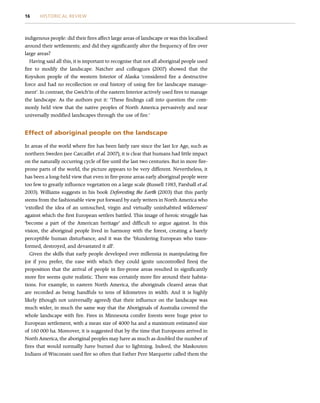
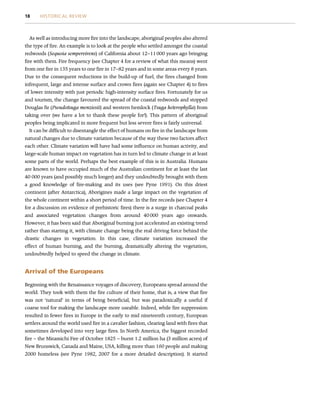
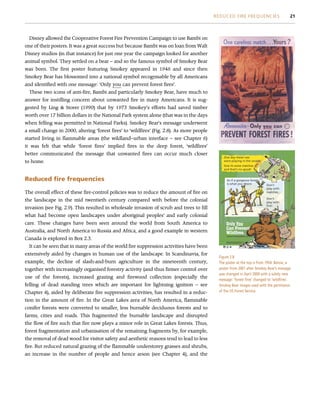
a small change in 2000, altering ‘forest fires’ to ‘wildfires’ (Fig. 2.8). As more people
started living in flammable areas (the wildland–urban interface – see Chapter 6)
it was felt that while ‘forest fires’ implied fires in the deep forest, ‘wildfires’
better communicated the message that unwanted fires can occur much closer
to home.
Reduced fire frequencies
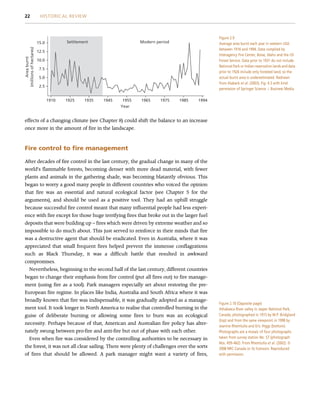
The overall effect of these fire-control policies was to reduce the amount of fire on
the landscape in the mid twentieth century compared with before the colonial
invasion (see Fig. 2.9). This resulted in wholesale invasion of scrub and trees to fill
what had become open landscapes under aboriginal peoples’ and early colonial
care. These changes have been seen around the world from South America to
Australia, and North America to Russia and Africa, and a good example in western
Canada is explored in Box 2.3.
It can be seen that in many areas of the world fire suppression activities have been
extensively aided by changes in human use of the landscape. In Scandinavia, for
example, the decline of slash-and-burn agriculture in the nineteenth century,
together with increasingly organised forestry activity (and thus firmer control over
use of the forests), increased grazing and firewood collection (especially the
felling of dead standing trees which are important for lightning ignition – see
Chapter 4), aided by deliberate fire suppression activities, has resulted in a reduc-
tion in the amount of fire. In the Great Lakes area of North America, flammable
conifer forests were converted to smaller, less burnable deciduous forests and to
farms, cities and roads. This fragmented the burnable landscape and disrupted
the flow of fire such that fire now plays a minor role in Great Lakes forests. Thus,
forest fragmentation and urbanisation of the remaining fragments by, for example,
the removal of dead wood for visitor safety and aesthetic reasons tend to lead to less
fire. But reduced natural grazing of the flammable understorey grasses and shrubs,
an increase in the number of people and hence arson (see Chapter 4), and the
One day these rats
were playing in the woods
So if a gorgeous forest
is what you desire Don’t
play with
matches…
Don’t
play with
fire!
www.smokeybear.com
One lit some matches —
and that’s no good!
Figure 2.8
The poster at the top is from 1954. Below, a
poster from 2001 after Smokey Bear’s message
was changed in April 2000 with a subtly new
message: ‘forest fires’ changed to ‘wildfires’.
Smokey Bear images used with the permission
of the US Forest Service.
REDUCED FIRE FREQUENCIES 21
effects of a changing climate (see Chapter 8) could shift the balance to an increase
once more in the amount of fire in the landscape.
Fire control to fire management
After decades of fire control in the last century, the gradual change in many of the
world’s flammable forests, becoming denser with more dead material, with fewer
plants and animals in the gathering shade, was becoming blatantly obvious. This
began to worry a good many people in different countries who voiced the opinion
that fire was an essential and natural ecological factor (see Chapter 5 for the
arguments), and should be used as a positive tool. They had an uphill struggle
because successful fire control meant that many influential people had less experi-
ence with fire except for those huge terrifying fires that broke out in the larger fuel
deposits that were building up – fires which were driven by extreme weather and so
impossible to do much about. This just served to reinforce in their minds that fire
was a destructive agent that should be eradicated. Even in Australia, where it was
appreciated that small frequent fires helped prevent the immense conflagrations
such as Black Thursday, it was a difficult battle that resulted in awkward
compromises.
Nevertheless, beginning in the second half of the last century, different countries
began to change their emphasis from fire control (put all fires out) to fire manage-
ment (using fire as a tool). Park managers especially set about restoring the pre-
European fire regime. In places like India, Australia and South Africa where it was
broadly known that fire was indispensable, it was gradually adopted as a manage-
ment tool. It took longer in North America to realise that controlled burning in the
guise of deliberate burning or allowing some fires to burn was an ecological
necessity. Perhaps because of that, American and Australian fire policy has alter-
nately swung between pro-fire and anti-fire but out of phase with each other.
Even when fire was considered by the controlling authorities to be necessary in
the forest, it was not all clear sailing. There were plenty of challenges over the sorts
of fires that should be allowed. A park manager might want a variety of fires,
1910
2.5
5.0
7.5
10.0
Area
burnt
(millions
of
hectares)
12.5
15.0 Settlement Modern period
1925 1935
Year
1945 1955 1965 1975 1985 1994
Figure 2.9
Average area burnt each year in western USA
between 1916 and 1994. Data complied by
Interagency Fire Center, Boise, Idaho and the US
Forest Service. Data prior to 1931 do not include
National Park or Indian reservation lands and data
prior to 1926 include only forested land, so the
actual burnt area is underestimated. Redrawn
from Alaback et al. (2003), Fig. 4.3 with kind
permission of Springer Science þ Business Media.
Figure 2.10 (Opposite page)
Athabasca River valley in Jasper National Park,
Canada, photographed in 1915 by M.P. Bridgland
(top) and from the same viewpoint in 1998 by
Jeanine Rhemtulla and Eric Higgs (bottom).
Photographs are a mosaic of four photographs
taken from survey station No. 57 (photograph
Nos. 459–462). From Rhemtulla et al. (2002). ©
2008 NRC Canada or its licensors. Reproduced
with permission.
22 HISTORICAL REVIEW
Box 2.3. Changes in Jasper Valley, Canada
Van Wagner and colleagues published a paper in 2006 that
showed that in the Rocky Mountain parks east of the continental
divide (primarily Banff and Jasper National Parks), there has been a
distinct reduction in the fire cycle (the average interval between
fires at any given point – see Chapter 4 for definitions) over recent
centuries. The fire cycle between 1280 and 1760 was estimated at
60–70 years. After this, with the disruption of the aboriginals’
traditional use of fire, the area burnt each decade became rather
erratic but overall was greatly reduced so that by 1940 the cycle
had increased to around 175 years. From 1940 to 2000 the area
burnt sharply decreased still further. Various reasons for this
decline were explored, including changes in weather patterns,
but it seems that improved fire control was the primary reason
for the reduction in fire. Fire suppression began around the town
of Jasper in 1913 and the present forests originated primarily
after large fires in 1889, 1847 and 1785, before fire suppression
efforts began.
It is obvious from the photographs in Fig. 2.10 that there are more
trees in the valley following fire suppression. Between the
photographs the area of forest increased from 35% to 65% with an
increase in dominance of conifers over aspen, and grassland area
decreased by almost 50% (Rhemtulla et al. 2002). This has been
taken as clear evidence that human fire suppression activities have
had a large impact in reducingthe amountof fire ( ‘fire protection this
century may be responsible for increasing fire cycles’ – Wierzchowski
et al. 2002) allowing trees to invade. But it could also be argued that
declining densities of large grazing animals, such as elk and deer, by
hunting and habitat removal, is as (or more) important in allowing
more young trees to grow unmolested.
But does fire suppression really reduce the amount of fire? It is
argued by Ed Johnson (see his 1992 book and Johnson et al. 2001)
that fire suppression has played a minor role in reducing fire
occurrence over the last century in North American conifer forests.
He argues that 97% of the landscape is burnt by the largest 3%
of fires and these are determined by large-scale dry weather,
making the fires impossible to control, even by fire breaks. Fire
suppression can put out the other 97% of fires but as these make
up only 3% of the area burnt, it makes little difference to area
burnt each year. Others have argued (e.g. Lorimer  Gough 1988)
that smouldering ‘holdover’ fires in wet periods that are now
put out would naturally have been the cause of many a large fire
once the weather was dry enough; therefore fewer large fires now
start. However, Johnson counters (see Johnson  Gutsell 1994)
that the area burnt per year in remote areas with no suppression is
similar to those areas with active suppression. David Martell
gives evidence that disputes this (Martell 2002), and in
turn Johnson’s group dispute Martell’s evidence (Miyanishi et al.
2002). The argument continues.
M.P. Bridgland 1915
J.Rhemtulla and E. Higgs 1998
FIRE CONTROL TO FIRE MANAGEMENT 23
including large intense fires, to maintain a ‘natural’ landscape with all its plants and
animals, while a nearby property owner would want frequent low-intensity fires to
keep fuel levels low without endangering their property. Or members of the public,
looking at things through their cultural eyes, might see all fires as unnatural and an
ecological disaster and challenge loudly whether fire is needed at all.
Part of this problem is that although fire is an ecological necessity in wild forests,
it is still a dangerous enemy when in the wrong place at the wrong time. Socially
and economically it can be devastating if, for example, the wood supply to a saw-
mill is destroyed by fire (the trees will regrow but how does the mill survive in the
meantime?). This helps explain why the Food and Agriculture Organization (FAO)
still despatches fire experts to Mauritania, Nepal and Patagonia to advise on forestry
and fire suppression.
Even where fire would be beneficial, it may not be practical. The 1995–2005
management plan for the Blackwood of Rannoch, a remnant of native Scots pine
forest in Perthshire, Scotland, states that
Although fire can be a natural process, the isolation of the Black Wood from
other areas of native pinewood means that any fire outbreak will be brought
under control as quickly as possible. This will require the use of helicopters
and foam application in any significant fires. Ground teams with beaters
and water pumps will also be used.
In this case because the whole forest is only around 1000 ha – a remnant of a once
much larger forest – a single fire could sweep across the whole forest, wiping out
whole populations of animals and possibly plants which would have nowhere left to
re-invade from.
Are fire frequencies increasing again?
Fire appears to be on the increase once more. The USA had its worst fire year in
50 years in 2006 (96 385 fires burnt 9 873 745 acres or 3.9 million ha) closely
followed by 2007 (85 822 fires burnt 9 321 326 acres or 3.7 million ha). Australia has
also experienced more bad fire years lately: in the state of Victoria 1.3 million ha
burnt in the summer of 2002/3, the largest area since 1939; the 2006/7 fire season
was also bad following 50 rainless days; and the season of 2007/8 was even worse.
Even the UK had extensive fire problems in the early spring of 2003, and Portugal
and Greece had record areas burnt in 2005 and 2007, respectively. Inexorably,
the area of land burnt appears to be creeping up in many places around the world.
Part of this can be attributed to drought – either long term over several years as in
Australia or short term as in the dry 2003 spring in the UK. Whether this is due to
climate change is explored further in Chapter 8. But a clear additional factor is the
build-up of fuel due to fire suppression activities. The extra fuel helps an initial
spark to develop into a fire, and helps the fire to grow quickly in size and intensity to
24 HISTORICAL REVIEW
a level that is hard to control, resulting in larger and more intense fires. A vivid
example of fuel build-up can be seen in the ponderosa pine (Pinus ponderosa)
forests of western North America. These forests evolved with low-intensity fires
creeping through at regular intervals (every 2–15 years). With fire suppression, the
forest has acquired a build-up of litter and shade-tolerant trees. One study of
northern Arizona forests found that the present-day density of trees is 40 times
that of pre-settlement times. But we should not automatically conclude that fuel
build-up is always the culprit in severe fires. The knee-jerk reaction after the 1988
fires of Yellowstone National Park which burnt an area of 730 000 ha/296 000 acres
(the largest since a ‘natural burn policy’ was instituted in 1972) was to attribute
their fierceness to the large fuel accumulation due to 50 years of fire suppression.
This undoubtedly contributed but the main factor was unusual summer drought
and strong winds on top of a steadily changing climate (see Alaback et al. 2003 for a
detailed study of the Yellowstone problem).
Even wet tropical forests are seeing more fire due to drought (caused by El Niño –
see Chapter 4). They are also becoming richer in dry burnable fuel, partly due to
drought but also due to forest clearance and logging, leaving more dead debris to
burn. Fires starting in clearings are also becoming intense enough to be able to burn
into the surrounding undisturbed forest. This usually means that successive fires
burn further and longer, spreading faster and higher into the tree canopy. It is food
for thought that satellite analysis of the Brazilian Amazon showed that in 2007
between 50 700 and 72 300 fires burnt (depending upon the satellite used), the
highest on record since 2003, and over recent years something like 20 000 to
40 000 km2
has been burnt in the whole Amazon Basin per year.
ARE FIRE FREQUENCIES INCREASING AGAIN? 25
3 How a fire burns
Fire is a chemical reaction that results in the very rapid release of the energy stored
in fuel. Plants use the sun’s energy to combine carbon dioxide with water to
produce carbon compounds (sugars, starch, cellulose etc.) and oxygen. When a
plant dies and decomposes, the reverse happens: oxygen is used up in breaking
apart the carbon compounds to release carbon dioxide, water and a gentle trickle of
heat (think about the heat produced by a good rotting compost heap or pile of
manure). Fire is a form of decomposition, just a lot quicker, releasing the carbon
dioxide, water and heat in a massive burst. In this chapter we start at the beginning
and look at how plant material burns before considering how a whole fire burns.
Mechanics of fire
When heat is applied to, for example, a piece of wood, three distinct phases are
passed through: pre-ignition, ignition and then combustion.
Pre-ignition
When heat is first applied to our piece of wood, the energy will initially be
absorbed by water contained in the wood (which has a large capacity to store heat).
Then as the temperature rises further (Fig. 3.1a), the heat evaporates the water at
the surface of the wood (it may even steam as the water vapour condenses in
the air) which keeps the wood surface around 100 
C (see Box 3.1 for a demonstra-
tion of this). The water is thus driven away from the surface of the wood – the
‘combustion zone’ – by moving both into the air and deeper into the wood (and so
increasing the moisture content deeper down). When the wood surface is dry, its
temperature is no longer maintained at 100 
C by water evaporation, and as a result
it will get hotter and other substances in the wood such as terpenes (these give the
piney smell of woods), fats, oils and resins start to evaporate. These form a cloud
of flammable gases over the fuel (Fig. 3.1b). When the wood reaches around
130–190 
C it starts to break down chemically and over 260 
C the cellulose in the
wood starts to scorch, producing a blackened surface of char (almost pure carbon)
and a grey smoke of wood alcohol and tar gases. Lignin in the wood also joins in but
needs a higher temperature of 280–500 
C, producing fewer gases and more char
than cellulose. The scorching is just like burning the toast – you get blackened
bread from scorching and a puff of smoke but no flames (unless you go to
the ignition phase). Tars in gas and condensed droplets contribute greatly to the
Box 3.1. Setting fire to a bank note without burning it
If you hold a match to a bank note it will obviously burn, being
made of paper. The heat of the match will raise the temperature of
the paper past its ignition temperature until it catches fire.
Similarly, if you soak the note in pure alcohol, the note and the
alcohol will both rapidly go up in flames since both are flammable.
However, try soaking the note in a mix of water and alcohol. When
you hold a match to it, a flame burns brightly which eventually
goes out leaving you with a wet and warm but unburnt note.
Why? The key comes from the large heat capacity of water.
The flame comes from the alcohol; as it burns the heat is absorbed
by the water and, as it gets warmer, is used in evaporating some
water. All this keeps the paper of the note below its ignition
temperature until all the alcohol is used up and the flame goes out.
The alcohol and water mix needs to be just right, usually around
equal volumes of each. Too much water, no flames; too little water
and it will all be evaporated before the flame goes out and the
paper will catch fire. Try experimenting with strips of paper until
you’ve got it right!
combustion
reaction
zone
charred fuel
(a)
(b)
(c)
(d)
(e)
water
collapsing
reaction
zone
oxygen
reaction zone oxygen
water
fuel cloud
pilot heat
pilot heat
Figure 3.1
Stages in the burning of a piece of wood. (a) Heat
applied from the outside (pilot heat) causes water
to evaporate then (b) the fuel is chemically
decomposed to form a fuel gas cloud. (c) When
this is ignited by the pilot heat (see the text for
other ways in which this can happen) a flame is
formed which burns at the junction of the fuel gas
and oxygen (the combustion reaction zone). As
the fuel is used up (d) the supply of flammable
gases gets less and char (unburnt carbon) builds
up sealing the gases in. Eventually the flame goes
out and (e) the remaining fuel burns by glowing
combustion without a flame. From Cottrell (2004).
PRE-IGNITION 27
build-up of flammable gases around the wood. This breakdown of the fuel to
flammable gases is called pyrolysis (pyro-lysis, heat-divided).
Ignition
If a pilot flame touches the flammable cloud it will be ignited and a self-supporting
flame (i.e. the pilot flame is no longer needed) develops over the piece of wood
(Fig. 3.1c, d). Sudden ignition can be seen to happen in a domestic fireplace. If new
wood is added to glowing embers it will start to smoke quite violently; if a match is
thrown in, the smoke erupts in flame and you see no more smoke, just flames
because the only things left are water and carbon dioxide, both invisible. This
is the cloud of pyrolysed gases catching fire. If you wait longer before applying a
match and the temperature gets higher, the unpiloted (or spontaneous) ignition
temperature is reached and the smoke bursts into flame without a match. The piloted
ignition temperature of gases from wood is around 320–350 
C, but the ‘flash-point’
for unpiloted ignition is about 600 
C (Babrauskas 2002).
Combustion
The radiant heat from the flaming combustion continues the process of pyrolysis,
boiling off more short carbon-chain fragments of gas which enter the fuel cloud
and eventually burn. The radiant heat also preheats and ignites unburnt wood, and
the wood is consumed by the fire in a run-away process.
In this flaming combustion it is not the wood itself that is burning but the gases
released by pyrolysis that burn just above the wood. The flame itself consists of
a central core of unburnt gases surrounded by a thin burning envelope (the
‘reaction zone’) where enough oxygen mixes with the gases to allow combustion.
The hotter the fire the more the quantity of flammable gas being produced, the
further it will travel before mixing with enough oxygen to burn, so the longer the
resulting flame. It is also why a puff of wind over a campfire results in suddenly
smaller flames – more oxygen is mixed into the gases lower down near the fuel
and it burns there instead. It is clear from this that three things are needed for a
flame: fuel, heat and oxygen (this is the fire triangle described in Box 3.2).
By-products of the flame are primarily carbon dioxide and water. It may
seem surprising that fire produces water but burning is a simple reversal of photo-
synthesis in plants (see above). In fact burning 1 kg of dry plant material produces
around 0.56 kg of water plus any moisture that was in the fuel at the time
of burning, which explains why something like a paraffin/kerosene stove which
vents into the room (rather than a chimney) will steam up the windows. In a forest
fire the water vapour billowing around can be important as a dilutant of the
combustible gases.
Box 3.2. The fire triangle
The fire triangle has been used
to describe the three important
constituents of fire – fuel, heat
and oxygen. You can see from
this description that if you take
any one of these away the fire
cannot burn. The most basic
principle of firefighting is to
remove one or more of these
elements. From Cottrell (2004).
28 HOW A FIRE BURNS
Normally 50–95% of the carbon released from the fuel is as carbon dioxide but
the remainder goes to make up the constituents of smoke, a complex mixture of
gases and sooty particles mixed with water vapour. Soot is made of fragments
of carbon, tar and other chemicals that clump together or around tiny fragments of
unburnt fuel and ash to form less-burnable lumps. These clumps absorb heat from
the surrounding reaction zone and glow, giving the orange to red colour of
the flame centre. Soot particles that escape unburnt above the flame rapidly cool,
giving the black colour to smoke above the fire. Generally, more vigorous fires
produce more smoke because it seems that with bigger flames there is more
turbulent airflow and more pockets of gas and soot escape unburnt above the
flames. Soot particles need to be exposed to temperatures above 800 
C with high
oxygen levels to be effectively burnt and so can easily escape burning.
As the wood burns, charred carbon (char) and ash builds up in a layer covering
the wood surface and although pyrolysis is still going on, it is not sufficient to
support the flames (Fig. 3.1d). At this point the flames die down and flaming
combustion ends. But if the surface of the wood is above 500–600 
C and oxygen
can reach the surface (volatile gases and flames may prevent this before) the carbon
itself starts burning by smouldering or glowing combustion (Fig. 3.1e).
In glowing combustion, it is the remaining solid carbon that burns rather than
gases burning above the wood. Heat continues to break down the carbon chains in
the charred wood, which mix with oxygen at the charred surface to burn with an
orange glow rather than with flames. If the supply of oxygen is limited, carbon
monoxide rather than carbon dioxide is produced inside the fuel. As this escapes
and mixes with more oxygen, it is burnt to produce carbon dioxide, producing
a very small blue flame. Glowing combustion is just the way that charcoal in a
barbecue burns – a hot glow but no smoke or flames. Charcoal for a barbecue is
produced by heating wood in an atmosphere largely devoid of oxygen to drive off
the volatile gases without allowing ignition. The solid fuel coke is produced in the
same way from coal for use in urban areas where smoke is unwanted.
Although glowing combustion itself produces little visible smoke, you will see
some smoke if some of the log is unburnt. The energy of the glowing combus-
tion heats the adjacent unburnt wood, releasing grey tarry smoke (the pyrolysed
but unignited gas cloud). Usually there is not enough heat in the glowing
combustion to ignite the fuel cloud (but see the section below on Ground Fires).
This is why smouldering logs in a fireplace result in tar gases which condense
inside the chimney forming a dangerous flammable layer which can cause a
chimney fire if they ever catch light. Indeed, glowing combustion (in both wood
and the organic matter on the soil) can produce significantly more soot and tar (i.e.
smoke), along with such gases as carbon monoxide and methane than the
flaming part of a fire where they are destroyed by burning. Ironically then, low
smouldering fires and really big flaming fires produce more smoke than intermedi-
ate fires.
COMBUSTION 29
The relatively cool burning of glowing combustion (usually around 600 
C
compared with around 800–1200 
C in a flame) converts the carbon in the fuel to
carbon monoxide which is usually converted in turn to carbon dioxide in the
oxygen-richer air above the glowing fuel. These two stages each produce about a
third of the heat (i.e. two-thirds overall) as burning the same amount of fuel in
flaming combustion. Glowing combustion thus has a relatively low heat yield.
As the wood burns, carbon is consumed as fast as char is formed and it should
continue until all the wood is used up. Two main things will stop it. First, if part of
the wood is wetter, the glowing combustion will go out if more heat is needed to
evaporate the water than is generated by the combustion zone. Second, a layer of
grey ash – the unburnable ‘mineral’ component of the wood that generally makes
up less than 1–2% of the weight of wood (detailed below) – is left behind after
combustion. The ash has no structural strength and collapses to form an ash barrier
that, as it becomes thicker, progressively stops oxygen from getting to the glowing
zone. At this point, starved of oxygen, the glowing combustion goes out, leaving a
partially burnt log as in Fig. 3.2b. This is why stirring a fire helps it burn better, by
knocking off the build-up of ash. This is also why fallen logs in a forest fire usually
burn mostly from the bottom to the top since the ash falls away from the burning
zone allowing it to continue (Fig. 3.2c).
As an aside, the charring and consequent slow combustion of wood means rather
ironically that in a building fire, wooden beams remain more structurally sound
that do metal ones. Metal beams lose about half their strength at 500 
C while wood
loses very little strength at that temperature.
tarry
smoke
(a)
(c)
(b)
tarry
smoke
oxygen
white ash line
charcoal remnants
oxygen
oxygen
mineral
ash mineral
ash barrier
Figure 3.2
As the glowing combustion in Fig. 3.1e carries on,
ash gradually accumulates (a, b diagrams) and
creates a barrier to oxygen reaching the
combustion zone, and so the fire goes out.
But if the ash is removed or falls away (c) then
combustion can continue until all the wood is
consumed. From Cottrell (2004).
30 HOW A FIRE BURNS
Heat transfer
To understand how fire spreads from a single burning piece of wood to many other
pieces of fuel, the process of heat transfer becomes important. Once a piece of fuel is
burning, for the fire to continue heat must be passed or transferred to the next
yet-to-be-burnt pieces. Heat is transferred in three different ways from a flaming
combustion zone; conduction, convection and radiation. Each of these processes
has its own special little place in fire propagation.
If fuel particles touch then conduction of heat from piece to piece can help, but
generally, wood and other plant materials are very poor conductors of heat and
conduction is most important in heat penetrating into a large piece of fuel and fires
burning below ground level. Very rotten wood has a low density and conducts
heat even more poorly than sound wood. So when ignited the heat stays in one
place, little flammable gas is produced from surrounding wood, any flames soon
go out and it burns by glowing combustion. And this is why dry, rotten logs and
stumps are a major player in spot fires (described later in this chapter) – embers that
cannot ignite litter or sound wood (because the heat is too rapidly dispersed) will
readily ignite the rotten wood.
Movement of hot air as it rises and is blown by the wind (convection) is more
important in heating new pieces of fuel above the flame, possibly the crowns of
trees above a surface fire, or fuels on steep ground. Convection of heat also plays an
important role in very large fires where a plume or convection column forms (again,
described later in this chapter). (As an aside, convection is indispensable to a flame.
A candle will not burn for very long in space because without gravity there is no
convection, and without convection, the carbon dioxide and water vapour pro-
duced by the flame stay around the flame and put it out.)
The last major way of heat spread is by radiation – the feeling of warmth on your face
when standing in front of a fire which can be cut off by a hand in front of your face
blocking off the radiation. Heat radiating from burning fuel is important in preheating
fuel ahead of the fire. Radiation travels in all directions from a combustion zone, and as
the fire develops from a single point (e.g. a campfire radiating heat in a circle) to a line
(e.g. a forest-fire flame front) the effectiveness of the radiation changes. A point (or
campfire) radiates energy in all directions, with the amount of energy received being
dependent on the distance from the source. The relationship between distance and
energy received is the inverse square of the distance; that is, as you double your
distance from the fire, you receive one-quarter the energy. A line of fire also shows a
reduction of radiant energy with distance, but the rate of reduction with distance is
roughly equal – that is, each doubling of distance halves the energy received. Why is
radiation important and considered the major force in governing fire spread rates?
Because when wind tilts the flames over from their natural vertical angle, the radiant
energy received by the fuel ahead of the fire greatly increases; this preheats the fuel
much more effectively and speeds the spread of fire.
HEAT TRANSFER 31
Heat can also be transferred directly by the movement of burning fuel, for example
a burnt log rolling down a hill, or embers (bits of burning debris) carried aloft in hot
air currents and deposited ahead of the fire front, sometimes literally miles away.
Variation in fuel quality
Flammability can be defined as the ease of burning. But what does this really mean?
There are various views but here we will define flammability as ignitability or ignition
delay time – the time taken from the start of heating to the point where the fuel is
sufficiently chemically decomposed for ignition to occur. The readily flammable parts
of a plant include live and dead leaves, twigs, bark and to a lesser extent wood.
Different plants will have these in different proportions at different times of the year.
Dead litter, twigs and branches too will accumulate underneath forest canopies at
different rates and lie on the ground in different ways (e.g. the leaves of broadleaved
trees like oak form a compact layer while needles from a pine tree form a more airy, less
compact mat). The effect of the arrangement, amount and timing of fuel will be dealt
with in the next chapter; here we will look at the factors affecting the flammability of
individual bits of fuel.
Three main factors affect flammability: the moisture content of the fuel, its
chemical make-up and its size and shape.
Moisture
The moisture contained within a piece of fuel is of overriding importance in that it
affects all aspects of fire: whether the fuel will burn, the fire’s speed in spreading,
intensity, smoke production, fuel consumption and the mortality of live plants.
In terms of flammability, a fire will only continue if there is enough heat to evaporate
the moisture so that pyrolysis can happen; and evaporation is expensive in energy.
For every gram of water evaporated from a piece of fuel, an extra 2260 joules of energy
(540 calories) is required before ignition (termed the latent heat of vaporisation).
The maximum moisture content that a fuel can have and still burn is referred to as
the moisture of extinction. This is not fixed since fuels that burn more easily (for
example if they have a high oil content, or are in smaller pieces) or are in a hotter fire
either generate or receive more heat and thus will burn at a higher moisture content.
Nevertheless, approximate figures can be used – see Box 3.3. Fuel moisture can vary
from as little as 1–2% (Box 3.3 explains what this means) in dead litter in arid deserts to
300% in rotting wood and soil organic matter, and even 1000% in some living tissue.
Even below the moisture of extinction threshold, the amount of moisture still
makes a difference to how things burn. In fine forest litter, fire spread slows as
moisture increases between 0% and 20%. Between 20% and 34–40% the rate of
spread decreases very little but at the upper limit it becomes zero and the fire goes
out – the moisture of extinction.
Box 3.3. Moisture of
extinction
Moisture of extinction for
different fuels is the maximum
amount of water that a fuel
can hold and still burn. These
are expressed as a percentage
of dry weight. For example,
50% moisture means that for
every 100 g of dry fuel, there
are 50 g of water.
Grasses 12%
Dead forest fuels 25–49%
Soil organic
matter
40–50%
Living fuels 120–160%
Resinous conifer
needles
Nearly 200%
32 HOW A FIRE BURNS
Chemical make-up
As a rule of thumb, plant tissue is composed of approximately 50% carbon, 45%
oxygen and 5% hydrogen (by weight). Wood is made up of 41–53% cellulose
(50–75% if you include the shorter chains of hemicelluloses) and 15–35% lignin.
Lignin is harder to decompose than cellulose and so dead fuels become progres-
sively higher in lignin; soft rotten (‘punky’) wood may be up to 75% lignin. The
variations in composition reflect to some degree how well different fuels burn.
However, two other small components of fuel are by far the most important – the
quantity of ‘extractives’ and the amount of ash.
Extractives Extractible compounds (alcohols, fats, waxes, oils, gums, sugars etc. –
called extractives because they can be chemically or physically extracted from plant
material with ease) are a minor component of fuel weight making up just 0.27% of
the total weight of some grasses to more than 15% in some pines and aromatic shrubs.
But the extractives are generally very flammable and produce lots of heat when
they burn (they have a high calorific value). Even small differences in extractives have
a very important influence on the flammability of different species, and flammability
of a species in different seasons. Many plants are most flammable (for a given amount
of moisture) in early spring and summer due to variation in chemical composition.
Several examples illustrate the importance of extractives. In Californian chaparral,
herbicides have been used in a set of experiments to kill the shrubs, allowing them to
dry out and make them more flammable. It did not work, because although the foliage
moisture fell from 114% to 8%, the extractives also fell from 16% to 3% and the treated
shrubs were less flammable than untreated controls! Similarly, Malcolm Gill and Peter
Moore (1996) tested the flammability of a wide range of cultivated plants in Australia
in a furnace at 400 o
C with a spark ignitor and found that some species (including two
Hakea species and a Podocarpus species) were quick to ignite when fresh but slow after
drying in an oven at 95 
C for 22 hours, presumably due to a loss of volatile oils.
For the same reason, the foliage of Eucalyptus species burns as well green as
dry due to the high oil content. Webb (1968) remarked that fire damage may be
increased by the explosive gases composed of Eucalyptus oils. Indeed, it was shown
in the 1950s by McLaren (1959) that in Australia certain mixes of eucalyptus oil
vapour and air form an explosive mix which, under special circumstances, could be
responsible for forest fires erupting up to 10 km (6 miles) ahead of the main fire
front, when combined with strong winds. Webb also noted that the leaves from
Eucalyptus species in southern Australia, where crown fires are more common,
are richer in more flammable oils with a lower boiling point than those of eucalypts
farther north where crown fires are generally lacking.
Ash The ash content of plant material (what is left after everything combustible
is gone – see Fig. 3.2) is less than 1–2% in wood but rises to 5–10% in foliage and even
up to 40% in arid or harsh environments. The minerals in ash tend to reduce tar
formation and increase char, and hence retard flammability and increase glowing
VARIATION IN FUEL QUALITY 33
combustion. It may be the phosphates that are mainly responsible for suppressing
flammability (certainly phosphates are used in fire-retarding compounds).
Ash content proportionately increases with decomposition as the easily rotted
carbon in cellulose is broken down and removed. Thus, in forest litter in southern
USA, ash content has been found to increase by a third after one year of weathering
and the lowest litter layers can have 2–8 times the ash content of fresh litter. This
goes some way to explaining why ground fires (see below) in well-rotted organic
material accumulated at the soil surface tend to burn by glowing combustion. But,
be warned, ash content does not always reduce flammability. As with many limiting
factors, ash content is only limiting under certain ranges; when other factors increas-
ing flammability are added up, they can override the retarding effect of the ash.
Size and shape
Size matters with fuel. Or perhaps not so much size as the surface area-to-volume
ratio. That is, the amount of exposed surface area on a fuel piece in ratio to the
volume of space that fuel piece occupies. Typically, smaller fuel pieces have higher
surface area-to-volume ratios (see Box 3.4). Why is surface area-to-volume ratio
important? Essentially for two reasons:
1. Remembering that burning or pyrolysis is chemically the oxidation of fuel, the
higher the surface area-to-volume ratio the larger the relative amount of fuel
exposed to heat and oxygen, providing more opportunity for the fuel to become
involved.
2. Larger fuel pieces, given their larger mass, can absorb more heat, conducting it
away from the ‘fuel–air interface’ and slowing the preheating phase of wood in
the combustion zone.
Box 3.4. Idealised surface area-to-volume ratio
Consider three cylinders of wood all 1 m long, 0.1 cm, 1.0 cm and 10 cm, respectively,
in diameter.
Diameter (cm) 0.1 1.0 10.0
Surface area (cm2
) 62.8 630 6440
Volume (cm3
) 0.79 79.0 7900
Surface area-to-volume Ratio 80 8.0 0.8
Note: Each order of magnitude increase in diameter produces an identical order of magnitude
reduction in surface-area-to-volume ratio.
34 HOW A FIRE BURNS
Other things being equal, the surface area-to-volume ratio relationship described
above reflects a simple cylinder, but fuel particles come in all shapes and sizes. As the
shape changes from a cylinder to something else (an extreme case would be a thin, flat
fuel piece) the surface area-to-volume-ratio increases dramatically and the fuel burns
all the more vigorously. The length of time a piece of fuel will burn is proportional
to its thickness. So, for wood at 4–10% moisture, the residence time of flaming
combustion – how long it will burn with flames – is around three times its thickness
in centimetres; so a log 10 cm in diameter will flame for 30 minutes after ignition.
Smaller pieces ignite more easily because they need less heat to quickly increase
their temperature. Larger pieces absorb more heat and conduct it away from the
heat source, and so need more to get them to the ignition point. This is why we start
fires with small bits of kindling and not whole large logs. Small fuels (referred to as
fine fuels) are typically described as 5–6 mm (1/4 inch) in diameter or less – for
example, small dead twigs or needles.
Temperature and energy
When people are asked to guess how hot a candle flame is, the answer is usually a few
hundred degrees centigrade. In reality, flame temperatures burning in open air (i.e.
not artificially fed extra oxygen as in an oxyacetylene torch) are somewhat hotter
and, whether from a candle or a huge forest fire, are remarkably similar. Temperature
can be estimated by the colour of the flame. A flame is hotter as it moves from a
dull red (700 
C) to cherry red (900 
C) to bright yellow (1200 
C) to white (1300 
C)
and finally blue-white (1400 
C/2550 
F). (The exception to this is the startlingly
blue but cool flame found above glowing combustion where carbon monoxide is
oxidised to carbon dioxide.) So the blue outer layer of a candle (where the fuel gas
and oxygen mix) is at 1400 
C and the red portion in the middle near the wick is
around 800 
C. Flames in forest fires, whether conifers in the north or eucalypts in
the south, are normally of the same order, between 800–1200 
C (1500–2000 
F).
Even the hottest forest fires are unlikely to go much above 1650 
C although
temperatures up to around 2000 
C are possible under controlled laboratory condi-
tions. (An oxyacetylene torch, which thoroughly mixes pure oxygen and acetylene
gas under pressure, reaches almost 3500 
C.)
What is perhaps more important is not the absolute temperature but how much
energy is involved in the fire. A forest fire clearly has much more energy than a
candle flame. If you were crossing a road and a cyclist and a large truck were both
coming at you at 10 miles per hour, you would probably prefer to be hit by the
cyclist rather than the truck. Both are going at the same speed but the truck has a
lot more energy behind it and dissipating that energy in stopping the vehicle will do
you a lot more harm. In the same way the flame of a candle and a forest fire may
have the same temperature but the forest fire contains a lot more energy.
TEMPERATURE AND ENERGY 35
So, how do we measure the rate of energy release of a fire, normally referred to as
the ‘fire intensity’? There are several ways of measuring this but the commonest is as
‘fireline intensity’, how much heat is being produced from a set length of burning
fire front, expressed as kW/m (kilowatts per metre of fire front). (Americans use Btu/
ft/s: 1 kW/m ¼ 0.29 Btu/ft/s.) Mathematically, fireline intensity is the product of
the weight of fuel consumed, the energy (calorific) content of the fuel (by weight)
and the rate of fuel consumption.1
In short, assuming a constant energy content,
intensity is calculated by how much fuel is burning and how fast is it burning. As we
will see later, fire intensity is one of the most important and widespread concepts in
fire management. Not only is it used for suppression planning and action, it has
been used extensively in developing an understanding of fire effects and fire regime
(see Chapters 5, 6 and 7). Fire intensity has been described as the single most descrip-
tive term for wildland fires (those that burn in the natural or semi-natural forest).
The lowest intensity of a fire still able to trickle along is around 10 kW/m and
even modest fires (Fig. 3.3a) can develop several hundred kW/m. Fireline intensity
can be fairly accurately predicted from the height of the flames (flame length). Thus
a fire with the highest flames around 1.2 m high is burning at around 400 kW/m,
just at the limit for control by hand tools. Flames up to 2.3 m tall will be at an
(a)
(b)
(c) Figure 3.3
A series of experimental fires were ignited in jack
pine (Pinus banksiana) stands in Alberta, Canada
in 1974 to test the link between fire behaviour
and the Canadian Forest Fire Weather Index
(FWI, described in Chapter 7). The resulting
photographs show a series of fires at different fire
intensities. (a) A creeping surface fire with flames
only occasionally above a few centimetres high.
The FWI was 8.5, the fire intensity 190 kW/m
and the rate of spread of the front of the fire
(the head fire) was 0.6 m/min. (b) A very intense
surface fire, difficult to control even with heavy
mechanical equipment with a number of
individual trees igniting along their lengths
(torching). FWI 24, fire intensity 1900 kW/m,
rate of spread 3.4 m/min). (c) An active crown
fire with 30-m high flames (10 m higher than the
trees). FWI 34, fire intensity 7460 kW/m, rate of
spread 6.1 m/min. From Alexander  De Groot
(1988). Source: Canadian Forest Service (Natural
Resources Canada), reproduced with permission.
1. Fire intensity is calculated as I ¼ Hwr where I is the intensity in kilowatts per metre (kW/m); H is the energy
content of the fuel (treated as a constant) expressed in kilojoules per kilogram (kJ/kg); w is the weight
of fuel consumed over a set area, expressed as kilograms per square metre (kg/m2
); and r is the rate of spread of
the fire in metres per second (m/s). For further information see Alexander (1982).
36 HOW A FIRE BURNS
Random documents with unrelated
content Scribd suggests to you:
The Project Gutenberg eBook of De
Sobremesa; crónicas, Segunda Parte (de 5)
This ebook is for the use of anyone anywhere in the United
States and most other parts of the world at no cost and with
almost no restrictions whatsoever. You may copy it, give it away
or re-use it under the terms of the Project Gutenberg License
included with this ebook or online at www.gutenberg.org. If you
are not located in the United States, you will have to check the
laws of the country where you are located before using this
eBook.
Title: De Sobremesa; crónicas, Segunda Parte (de 5)
Author: Jacinto Benavente
Release date: July 3, 2017 [eBook #55038]
Most recently updated: October 23, 2024
Language: Spanish
Credits: Produced by Nahum Maso i Carcases, Josep Cols
Canals,
Carlos Colón and the Online Distributed Proofreading
Team
at http://www.pgdp.net (This file was produced from
images
generously made available by The Internet
Archive/Canadian
Libraries)
*** START OF THE PROJECT GUTENBERG EBOOK DE SOBREMESA;
CRÓNICAS, SEGUNDA PARTE (DE 5) ***
Notas del Transcriptor
Se han respetado la ortografía y la acentuación del
original.
Los errores obvios de puntuación y de imprenta se han
corregido.
Las páginas en blanco presentes en el original se han
eliminado en la versión electrónica.
De sobremesa
CRÓNICAS
Segunda serie
Jacinto Benavente
De sobremesa
CRÓNICAS
SEGUNDA SERIE
MADRID
LIBRERÍA DE FERNANDO FÉ
Puerta del Sol, 15
1910
ES PROPIEDAD.—DERECHOS RESERVADOS
MADRID.—Imprenta Española, calle del Olivar, 8
De sobremesa.
I
l señor ministro de la Gobernación ha propuesto el mejor
remedio para evitar conflictos en la Plaza de Toros; que el
público se abstenga de asistir á las corridas si tanto le
disgustan. El remedio es excelente, pero ya dijo el sabio
que: Á trueque de quejarse, habían las desdichas de
buscarse. Y el gustazo de protestar nunca se paga bastante caro.
Tiene además, ese remedio, el peligro de caer el público en su
eficacia y en ese caso, bien pudiera dar en aplicarlo á otros muchos
espectáculos caros y malos, que él sostiene con su buen dinero. Pero
ha de comprenderse que lo de ver al público echarse al redondel, no
puede ser del gusto de ningún gobierno. Aunque bien pudieran
pensar los espectadores que siendo ellos los toreados, ningún sitio
mejor que el redondel les corresponde.
Y á propósito de plazas de toros; los sombreros de señora van
alcanzando sus dimensiones. En Londres acaba de presentarse una
actriz con uno que mide un metro ochenta de diámetro, y sobre él
se levantan todavía culminantes dos magníficas plumas de avestruz,
de sesenta centímetros. Semejante edificio, por más señas es de
color malva y de las plumas, una azul y la otra «assortié» al
sombrero. No hay que decir si habrá causado sensación. Supongo
que la obra en que se ha presentado, llevará esta acotación: La
escena representa un sombrero. La moda es graciosa y en una
mujer alta y de esbelto talle, esos sombreros circundan como una
gran flor la linda cabecita que parece nimbada. Pero las mujeres
bajas y rechonchillas deben evitarnos el espectáculo de una
monstruosa seta que anda. Por fortuna, nuestras señoras, han sido
las más dóciles en atender el ruego, más que la orden de
presentarse en los teatros sin sombrero. En otros países, donde las
mujeres se la dan más de «superhembras», ni ruegos, ni censuras,
ni órdenes, han podido apear los sombreros de su cabeza... Siempre
se dijo que cuando á una mujer se le pone una cosa en la cabeza, es
difícil quitársela. En este caso particular, las nuestras merecen los
mayores elogios. Nuestras mujeres son muy gobernables; no suelen
ser de oposición más que cuando sus maridos están en el gobierno:
dígalo la ley de asociaciones.
* * *
Menos mal; en la manifestación conmemorativa de la revolución
de Septiembre hubo algunas levitas de buen corte y algunos
pantalones de airosa caída y bastante camisa limpia... Menos mal,
que de otro modo ya hubiera salido á relucir lo de ¡Cuatro
desarrapados! ¡Populacherías! No, justamente la blusa—tan
apreciada cuando vota con los gobiernos, tan despreciada cuando se
manifiesta en contra,—es la prenda más retraída de manifestaciones
liberales. ¡Pobre gente! Ha oído la voz del taimado cocodrilo ¡Bebe
quieto! Dejaos de libertades y de derechos políticos; al pobre lo que
le conviene es tener trabajo, dinero, lo material, lo positivo...
ustedes á lo suyo... Y el pobre, bastante desagradecido con los que
trajeron las libertades, gracias á las que ha podido y podrá
conquistar poco á poco algo de lo suyo, se cree hoy más listo y más
avisado, porque, como él dice: Á mí ya no me la da nadie. No,
¡pobrecito!, te la dan los otros; que te hacen instrumento suyo
cuando les conviene... ¡Ah, pueblo, pueblo! Has vendido tu
primogenitura por un plato de lentejas.
* * *
Contra los pronósticos metereológicos teatrales, «La Nube» pasó
sin la menor protesta de los aludidos. Lo suponía; es gente que sabe
con quién ha de gastarse los cuartos y de la que dice: «Dame pan y
llámame... lo que quieras». Que la obra á más de haber sido
aplaudida, es muy plausible, por la valentía que supone en un autor
empresario, ponerse enfrente del público más decorativo y más
saneado metálicamente, no hay para qué decirlo. En cuanto á su
eficacia, ya es más discutible. En esta ocasión, como en otras, por
ser más aparente van dirigidos los ataques á lo que parece causa y
no es sino efecto. Las nubes, de cualquier género que sean, solo se
forman en determinadas condiciones atmosféricas. La patología
social debe distinguir las enfermedades sintomaticas de las
esenciales y la nube, esa nube negra que entenebrece el aire de
España y parece causa de muchos males, es solo efecto de ellos. No
es ella la que tiene culpa de nuestro atraso, es nuestro atraso el
culpable de que la nube exista. Poco se consigue con atacar al
parásito si no se robustece la naturaleza que hace posible su vida.
Esos espíritus, dominados por la nube, lo serían del mismo modo por
la «cocotte» ó por la echadora de cartas ó por cualquier inventor de
la fabricación de diamantes. Nadie abrió jamás tienda de género que
nadie solicita. ¿Qué culpa tiene el fabricante de naipes de que se
juegue? Excelente es la obra de Ceferino Palencia, pero, créame el
distinguido autor, tantas veces aplaudido, la nube es algo, pero no
es todo. ¡Á los cascos, á los cascos! ¡Dejad las arboladuras!
* * *
En cuanto deja uno Madrid por algún tiempo y vuelve á pasear
por sus calles, cada día encuentra un teatro y una iglesia ó capilla de
nueva planta. Así dice un señor: «Yo no sé cómo en Madrid pueden
sostenerse tantos espectáculos». Pero hay público para todo. Como
antes al estanco, ya cada vecino puede permitirse la comodidad de ir
al teatro de la esquina. De este modo se establece cierta cordialidad
de relaciones entre los actores y su público. Ya que Madrid no
llenaba los teatros, los teatros han decidido llenar á Madrid. Y no
hay duda que en este caso, como con el anuncio prodigado, la
sugestión triunfa... No entrará usted en el primer teatro que se
encuentra, pero al noveno ó décimo, cae usted. Y una vez que se
entró usted en uno, ya cae usted en la manía coleccionista y acaba
usted por recorrerlos todos.
Es un error de los empresarios creer que tan formidable
competencia les perjudica. Cuanto mayor sea el número de teatros,
más irán todos ganando, aunque no sea más que en la comparación.
Por malos que parezcan algunos siempre hay otros peores.
* * *
Las reformas en la indumentaria de nuestro ejército, ha dado
algo que decir y más que murmurar. Hasta verlas realizadas no
sabremos si en ellas se ha atendido más á lo práctico que á lo
estético ó viceversa. Si fué á lo práctico, bien estará, si lo estético no
padece. Si fué á lo estético, quiera Marte y no pese á su amante
Venus, diosa de la belleza; que lo estético no sea tan alemán ó tan
inglés ó tan japonés, que al físico nacional le caiga malamente.
Un uniforme puede ser elegante en un arrogante mocetón de
una guardia imperial, y sentarle desgarbado al airoso soldado
español. La gorra de plato, por ejemplo, necesita elevada estatura,
que no es lo general en nuestra raza. El soldado español es el más
naturalmente elegante del mundo, sin afectación, sin empaque;
sería lastimoso que en estas reformas no se hubiera tenido en
cuenta lo que mas importa, el elemento natural, la figura. Un
ejército para ser verdaderamente nacional, debe vestir
«nacionalmente». ¿Hubiera estorbado algún artista, algún pintor
ilustre, en la comisión reformadora? Napoleón fué un genio militar,
pero también fué un gran maestro en estética. ¿Se figuran ustedes á
Napoleón con un gran casco ó con un gran morrión sobre su
cabeza? ¿No basta su inmortal sombrero para evocar toda su figura
y todo su genio?
* * *
Á lo mejor recibo cartas de personas desconocidas para mí,
cartas que yo agradezco, porque suponen más atención de la que
ello merece, á estos ligeros apuntes semanales. Lo mismo á los que
me celebran, porque dije lo que ellos pensaban—¡qué fácil es
agradar á los lectores cuando se piensa lo mismo que ellos!—como á
los que se indignan tal vez por alguna de mis apreciaciones, les diré
que, yo no pretendo sustentar aquí doctrina de ninguna clase; que
todo cuanto aquí digo es... semanal, y muy bien pudiera decir lo
contrario á la semana siguiente; aunque no soy hombre de grandes
contradicciones, acaso por no serlo tampoco de grandes
afirmaciones ni negaciones.
Tengan unos y otros en cuenta, que todo esto no es más que
charla de sobremesa; que alguna vez estoy entre personas de
confianza y puedo decir lo que pienso, pero otras, me atengo á la
opinión de los comensales. Y ¿no eres tú siempre, lector amigo, el
verdadero convidado de piedra, con cubierto puesto siempre á la
mesa de todo escritor? ¡Pues si tú no te aparecieras de cuando en
cuando, aun habrías de leer cosas que te agradaran ó te indignaran
mucho más, según los casos! Como Polonio aseguraba á Hamlet, de
los cómicos, al temer si no se atreverían á representar cierta
comedia, también yo pudiera decirte: Señor, como vos no os
avergoncéis de oirla, ellos tampoco se avergonzarán de
representarla.
* * *
Este último viaje de nuestros reyes á Barcelona, tal vez haya sido
el más provechoso. La bella, la noble princesa inglesa, hoy reina de
España, sólo habrá podido juzgar desde aquí, que tal vez Cataluña
era una despoblada y lamentable Irlanda... ¡Tales eran sus quejas y
clamores! Al contemplar la riqueza y prosperidad de Barcelona, su
aspecto de gran ciudad europea, lo ameno de sus alrededores, que
no habla de tristezas ni abandonos, no podrá por menos de pensar,
que de Cataluña á Irlanda hay mucha distancia, y que, absolutista ó
parlamentario, monárquico ó republicano, no habrá padecido
grandes tiranías, ni grandes vejaciones, bajo ningún régimen de
gobierno nacional, región que entre todas las de España sobresale
por adelantada y por próspera.
Mucho, no obstante, se han suavizado asperezas de allá, en
estos últimos tiempos. Bien está así, que de nada nos asustamos
como que puestos á pedir todos estamos en el mismo caso, sin
salirnos de las aspiraciones legítimas. En cuanto á la ley de
jurisdicciones, la más pronunciada arruga en el ceño catalanista...
¡Es tan fácil derogarla! El legislador espartano no consignó en sus
leyes pena alguna contra el parricida; juzgó que en Esparta no había
nadie capaz de cometer ese delito. Cierto que los delitos que dieron
razón á esta ley—que no debió existir nunca en España, por el
mismo motivo que aquella otra en Esparta,—por su falta de
grandeza y lo mezquino de sus manifestaciones, tal vez no merecía
mayor sanción que la de un agravio á la buena educación y al buen
gusto; que no otra cosa eran aquellas caricaturas y aquellos
dicharachos ofensivos para la patria y para el ejército, su más alta y
noble representación.
Justamente, nuestro ejército tuvo siempre el más amplio espíritu
de tolerancia para admitir discusión sobre su organización, sobre sus
condiciones; no digamos sobre el pacifista antimilitarismo de
sociólogos y socialistas. Si dictadores hubo en España fueron civiles
ó clericales; al ejército se debe cuanta libertad gozamos, él fué
siempre freno de la reacción y acicate del progreso. Nada más
injusto que considerarle instrumento de tiranía. Y conste que no soy
nada militarista, que no soy de los que creen la guerra un mal
necesario, sino muy innecesario; de los que esperan y confían en
que los ejércitos serán en lo porvenir una decorativa policía
internacional; pero esto solo ha de conseguirse por el mismo
ejército; por eso, en su bandera, que aprendí á saludar desde niño,
cuando aun no se acostumbraba en España, no saludo sólo la
bandera de la patria, sino la bandera futura de ese ideal estado de
paz, que sólo el ejército puede asegurarnos.
* * *
La distinguida escritora que firma con el risueño nombre de
«Colombine», propone en un artículo, publicado en «España
Artística», la fundación de un teatro para los niños.
En España, ¡triste es decirlo!, no se sabe amar á los niños. Si no
hubiera otras pruebas, bastaría esta falta de una literatura y de un
arte dedicada á ellos. ¿Qué libros españoles pueden leer nuestros
niños? De la literatura clásica, ninguno. El «Quijote» es una obra de
desencanto, de desilusión, propia para la edad razonadora. Sería
cruel que los niños rieran con «Don Quijote», y más cruel que
pensaran. De los escritores modernos, tal vez Galdós, en la primera
parte de sus Episodios Nacionales, fué el único que escribió para los
niños, sin proponérselo; quizás, por lo mismo, con mayor acierto.
Digo por lo mismo, porque los escritores que deliberadamente
intentan escribir para niños, suelen padecer el error de considerarlos
demasiado pueriles y se creen en el caso de puerilizar su espíritu.
Por esto las mejores obras para la infancia, son las que no fueron
escritas con intención de conquistarla. «Robinsón Crusoé», algunas
novelas de Dickens... En cambio, ¡cuánta ñoñería, cuánta bobada en
muchos cuentos y narraciones pensados y escritos especialmente
para los niños, que no pueden por menos de aburrirles!
¡Un teatro para los niños! Sí, es preciso, tan preciso como un
teatro para el pueblo. ¡Ese otro niño grande, tan poco amado
también y tan mal entendido!
Y en ese teatro, nada de ironías; la ironía, tan á propósito para
endulzar verdades agrias ó amargas á los poderosos de la tierra, que
de otro modo no consentirían en escucharlas, es criminal con los
niños y con el pueblo. Para ello, entusiasmo y fe y cantos de
esperanza llenos de poesía...
Y nada de esa moral practicona, que á cada virtud ofrece su
recompensa y cada pecadillo su castigo; esa moral que convierte el
mundo en una distribución de premios y pudiera resumirse en un
dístico por el estilo:
No comáis melocotones
porque dan indigestiones.
La verdadera moral del teatro consiste, en que, aun suponiendo
que Yago consumara su obra de perfidia, coronándose Dux de
Venecia, sobre los cadáveres de Otelo y Desdémona, no haya
espectador que entre la suerte de uno y otros no prefiera la de las
víctimas sacrificadas á la del triunfador glorioso.
La verdadera moral esta sobre los premios y sobre los castigos,
está en lo mas hondo, en lo más íntimo de nosotros mismos, allí,
donde está Dios, siempre que queremos verle y oirle... Consiste en
una limpieza espiritual de la que solo nosotros gozamos. Nadie
piensa al lavarse todo su cuerpo en que ha de ir desnudo por la
calle, se lava uno por propia satisfacción y limpieza... Y aunque la
ropa sea mala, va más tranquilo el que así se ha lavado, que los que,
muy bien vestidos, solo se lavaron la cara y las manos.
Esta moral es la que conviene al teatro y al arte dedicado á los
niños y al pueblo.
La amable escritora cita mi nombre entre los de otros escritores
que, seguramente, no dejarán de escribir obras para ese teatro. Por
mi parte, ¡nunca con mayor ilusión, nunca también con mayor
respeto á mi público!
II
Un periódico de la cascara dulce, ya sabemos cuáles son los de la
amarga, celebra determinadas obras de determinados escritores, por
juzgarlas aproximación á sus ideales. Tiene el buen sentido de no
cantar victoria definitiva. Con no tan buen sentido y en un artículo,
por lo menos indiscreto, otro periódico liberal muy significado, se
desata en denuestos contra los aludidos escritores y contra gran
parte de la juventud literaria, pluralizando de un modo lastimoso,
pues bien sabe el que escribió ese artículo, que eso de las casas de
huéspedes y sus cocidos indigestos—aparte de no ser delito
imputable y menos por un buen demócrata,—eso de los busca-dotes
y del «Se alquila» levantado no reza con la mayoría de los literatos
de la actual hornada. Eso de suponer á dos escritores poco menos
que á punto de levantar partida porque uno eligió por asunto de una
novela episodios de las guerras carlistas, y el otro presentó en el
teatro á una hermana de la Caridad, que no baila la machicha, es
mostrar una intransigencia indigna de espíritus que se juzgan por
liberales. Yo no sé que mi obra—«La fuerza bruta»,—sea distinta de
otras muchas mías, como «Alma triunfante», «Más fuerte que el
amor», etc. Sé, en cambio, que en otras muchas obras, en todas, no
se me ha quedado por decir nada que deje lugar á dudas sobre mi
espíritu reaccionario. No así muchos autores cucos, de los que sería
difícil saber por sus obras lo que piensan de lo divino y aun de lo
humano. Si algún remordimiento escarabajea mi conciencia artística,
es haber sacrificado muchas veces el arte á la predicación; pero en
España... ¡hay que predicar tanto, y el teatro es tan buen púlpito!
Bien puedo exigir algo más de reflexión al que lanza
excomuniones tan de ligero. Ya sé que estas palabras escritas no
lograrán convencerle, á él que solo en la oratoria cree como fuerza
persuasiva y abomina de los que leemos cuartillas en vez de
pronunciar discursos. Por eso, todo lo fío de su elocuencia, ella sabrá
persuadirle mejor que cuanto yo escriba, de que fué injusto y de que
fué ligero y que en momento de alistar fuerzas, no es la mejor
ocasión para restarlas, porque, francamente, ¡hablar de libertad y
negar libertad al arte, no es para convencer ni á los convencidos,
cuanto más á los desconfiados!
* * *
Y ahora... El juglar caminaba por la vida y vió pasar á los
soldados; marchaban á la guerra temerosos los bisoños; jóvenes,
casi niños, arrancados á todos sus amores; trazando ardides para
medrar sin peligro, los veteranos; todos ellos sin ardor y sin fe. El
juglar, al verlos, entonó una canción á la patria, á la guerra, y sobre
los soldados pasó con ala de fuego la visión de la gloria y sus
corazones despreciaron la muerte...
—Ven con nosotros—dijeron al juglar...—Quien canta así la guerra
será buen soldado...
—No—dijo el poeta.—En la batalla quizás sería el más cobarde.
Supe infundiros valor... No pidáis otra cosa...—Y el juglar quedó solo
y los soldados marcharon repitiendo las estrofas vibrantes de la
canción guerrera.
Por el camino pasaron unos monjes; unos con otros murmuraban
de asuntos mundanos.
El juglar entonó una canción religiosa, toda caridad, toda amor
divino, toda fe y esperanza.
Los monjes miraban al cielo.
—Ven con nosotros—dijeron al juglar,—serás gloria de nuestra
orden y de nuestra casa.
—No—dijo el juglar,—hoy no; mañana volvería á dudar. En vez de
ejemplo tal vez fuera escándalo...
Los monjes siguieron rezando y el juglar quedó solo.
Y así pasaron trabajadores y jóvenes enamorados y cortejos de
boda y cortejos de duelo, y para todos tuvo el juglar canción
adecuada y en todo dejó la música de sus canciones y todos le
dijeron:
—Ven con nosotros, trabaja, ama, ríe, llora.
Y él á todos dejó proseguir su camino y él siempre siguió solo...
—No me pidáis que vaya con vosotros. Despreciadme ó amadme,
pero respetad mi libre canción, que solo sabe sentir y comprender
vuestros afanes, vuestros amores, vuestras alegrías y vuestras
tristezas...
¿No es la Venus de Milo la expresión más sublime del Arte, no
tanto por ser bella y por ser diosa, como por no tener brazos?
* * *
Los obreros inauguran su palacio, señal de poderío y de riquezas.
Ahora que el elogio pudiera parecer adulación, lo mejor que
podemos desear es que en ese palacio no entre nunca la lisonja
cortesana, como en los palacios de los reyes y los grandes señores;
que por todas sus puertas y ventanas llegue á todas horas la verdad,
que esclarece el pasado y muestra el porvenir como un camino
seguro. ¡Y el porvenir!... Las sombras son muchas. Acaso será como
asegura Anatole France, en su «Isla de los pingüinos», el
anarquismo; acaso, después—como tras la revolución francesa la
reacción del Imperio,—será un socialismo despótico, una absorción
del individuo por el Estado, absoluta y tiránica, pero después... será
el verdadero socialismo, el socialismo individualista, en el que nadie
hablará de derechos, porque todos comprenderán sus deberes;
porque el bienestar de cada uno dependerá del bienestar de todos y
será el reino de Dios sobre la tierra; Dios, hijo del hombre, el
hombre mismo divinizado... ¿Cuando? No mañana, ni al otro siglo, ni
al otro... Muchos, muchos siglos, muchas vidas... ¿qué importa?
Será, y... ¿si no fuera? Basta creerlo. ¿No es la mejor verdad la más
bella mentira?
* * *
Todo está compensado en el mundo: Carreras vuelve al teatro de
Apolo y el señor obispo de Jaca se ausenta del Senado. No se juzgue
la comparación irreverente. Amenizar la vida es, según va el mundo
de triste, obra meritoria, ya sea en el teatro, ya en sesiones de
Cortes. ¿No fué siempre la risa el mejor vehículo de las verdades? La
risa es la gran demoledora. Cuando se ríe de un asunto... asunto
terminado. Por algo todos preferimos dar que llorar á dar que reir.
Que se nos tome en serio ante todo. Perdonaremos la injuria, la
calumnia, por monstruosas que sean. Ya es suponernos grandeza si
nos juzgan capaces de grandes crímenes. Pero no perdonaremos
nunca el ridículo. Llegaremos á reconciliarnos con el que nos llamó
ladrones ó asesinos, nunca sinceramente con el que se permitió
observar que nuestras corbatas eran de mal gusto.
Los oradores que cultivan la nota jocosa son siempre temibles
para las huestes políticas. La risa es rebelde á toda disciplina. Puede
resistirse impávido las más tremendas imprecaciones, pero la
hilaridad general...
Lamentemos la decisión del señor obispo de Jaca. ¿Cuándo
volverá á reir el Senado? Y es que ya sólo las palabras sinceras
tienen la virtud de hacernos reir; por lo raras y por lo inútiles.—Es
verdad, es verdad; decimos todos... Y como es verdad, nos reímos
mucho.
* * *
¿Si estaremos desengañados de todo los españoles que, lo que
nunca ha sucedido, á estas fechas todavía quedan billetes de
Navidad en las loterías? Es la bancarrota de la ilusión, mas triste que
la bancarrota de la ciencia, de que nos habló Brunetière.
Poco á poco nos vamos haciendo trabajadores y formalitos.
Verdad es que los grandes capitalistas tienen otras loterías en que
emplear su dinero. Todos los billetes premiados. Caseros,
arquitectos, maestros de obras, con la Gran Vía; autores dramáticos
y actores, con la fundación del Teatro Nacional. ¡Esto es Jauja!
¿Quién quiere morirse? Sólo algún adorador sin esperanzas de
alguna tiple. La verdad es que, cuando todo está tan caro, el amor
inclusive, no debía permitirse la exhibición de carne pecadora en
esas especies de tablajerías que han llegado á ser algunos
escenarios. Es una crueldad ofrecer de continuo aperitivos á los que
no han de saciar después su apetito. No se puede jugar con ninguna
clase de hambre. Los escaparates de todo género son grandes
desmoralizadores. Á mí me da tanta pena ver á un golfo hambriento
extasiado ante el escaparate de Lhardy, como á una obrerilla ante el
de una joyería, como á un estudiante ó humilde empleado en su
delantera de anfiteatro, congestionado por un garrotín ó unas
coplillas bien salpimentadas...
Estoy seguro de que la última visión de casi todos los suicidas es
la de algún escaparate deslumbrador, con sus luces eléctricas,
brillantes en la sombra devoradora de la eternidad, como la
esperanza de un Paraíso entreabierto.
* * *
De la Argentina, y escrita por un argentino, llega una historia de
la vieja España, triste y consoladora al mismo tiempo. Lo segundo,
por que su autor, Enrique Larreta, muestra en su obra—«La gloria de
Don Ramiro»—un profundo y cuidadoso estudio de nuestra historia,
y sabido es que comprender es amar. Lo primero porque las páginas
de esa nuestra historia no son todo luz y alegría, aunque sean
grandeza. «Una vida en tiempos de Felipe II», subtitula su autor á
esta novela interesantísima para nosotros, como lo es siempre el
concepto que merecemos á los extraños, y si el extraño es persona
de quien nos importa mucho la simpatía, con mayor causa.
Evita el autor, con excelente criterio artístico, los juicios
personales. La historia, mas ó menos novelesca, habla por sí sola, y
habla de pasiones violentas, de austeridad, de misticismos y de
fanatismos, de torpezas políticas y de heroísmos guerreros... Tal vez
no fué todo así, ni tan heroico, ni tan torpe, ni tan cruel, ni tan
místico... La distancia, en el tiempo y en el espacio, acusa con mayor
relieve los contrastes de luz y de sombra, que de cerca parecen mas
fundidos, apenas perceptibles, en ese claro obscuro de los hechos
cercanos, que, por serlo, nos parecen siempre menos heroicos,
menos poéticos, más insignificantes... Pero ¿somos otra cosa que lo
que parecemos? Si la verdad de nuestra historia ha de perderse
entre leyendas, ¿no es preferible que sea entre leyendas de poesía
que entre falsedades del vulgo?
Enrique Larreta es un historiador poeta; es además un excelente
escritor, de un estilo cuya severidad no excluye lo pintoresco, y sobre
todo hay en su obra palpitaciones de admiración y de amor á
nuestra España... á pesar de todo. Y esa es nuestra gloria, como fué
la gloria de Don Ramiro la flor que una mujer enamorada dejó caer
sobre su cuerpo muerto, en que un alma española alentó en vida,
con todo lo que fué vida de España en aquel tiempo.
* * *
Yo no sé si la intención del autor puso el simbolismo. Propiedad
de toda obra fuerte es tener vida propia y decirnos más de lo que su
autor quiso decir en ella.
En el Pedro Minio, de la admirable comedia de Galdós, yo veo un
símbolo de nuestra España. Como Pedro Minio, el viejo paisano de
Don Quijote—¡oh, la Mancha, tierra de ensueños!—el eterno
enamorador, el eterno idealista, mal comerciante y peor trabajador;
así España, envejecida, derrotada, aun quiere vivir alegre en la
ilusión de su juventud, aun se embriaga de optimismo, y ante
cualquier ofrecimiento, piensa, proyecta como Pedro Minio,
edificaciones, pabellones, mejoras... El ideal apto de la indulgencia
ofrece á los viejos la ilusión de la vida integral y en ella prolongan
dichosos su ruinoso existir. Pero llegan los severos reformadores, los
graves moralistas y á la ilusión y al alegre ensueño quieren
sustituirlos con la disciplina monástica, con la austeridad
penitenciaria; la alegría les parece indecorosa; nada de
esparcimientos, nada de deshonestas promiscuidades de hombres y
mujeres; acabó el reir y el bromear:—Sólo hablará usted con los
frailes y de los temas que ellos propongan, dice la señora
improvisada—símbolo de nuestra plutocracia—al viejo soñador, Pedro
Minio. ¿No es esto lo que nos dicen á todas horas los que pretenden
ser nuestros directores? Pedro Minio, como buen español, prefiere
continuar en el ideal y alegre asilo de la Indulgencia, donde la
ruinosa vejez goza las ilusiones de la juventud.
¡Oh, excelentes reformadores y moralistas! Pedro Minio es
España. Si no sabéis hacer cosa mejor, dejadle en el asilo de sus
ilusiones. Mejor una vejez alegre que una juventud triste. Preferible
siempre el asilo de la Indulgencia al de la Paciencia... que es preciso
para soportaros.
* * *
Pérez Galdós, en mi opinión, nuestro primer autor dramático, no
acaba de serlo en opinión de todos, acaso por ser nuestro primer
novelista y haberse declarado en nuestro país incompatible el
ejercicio de dos soberanías.
Este es el país del encasillado y de las especialidades.
Se estima en más al que entiende poco de una sola cosa, que al
que entiende mucho de todas. La insistencia en un mismo asunto,
basta á darnos autoridad en la materia. Fulano pasó su vida
hablándonos de antigüedades fenicias ó asirias ó caldeas. ¿Quién
duda que sabe de ellas? Mengano pintó siempre los mismos
borregos: para borregos, Mengano. Á nadie que quiera tener unos
borregos bien pintados se le ocurrirá encargárselos más que á
Mengano. El día en que se le ocurra pintar una vaca, así este
mugiendo de propia, todo el mundo dirá: Esto no es lo suyo, que
vuelva á pintar borregos... ¡En borregos, el único!
Somos poco amigos de trastornar nuestras ideas á cada paso;
preferimos creer por fe á meternos en averiguaciones. Sabiendo que
cada cual no hace más que una cosa, y siempre lo mismo, nos
ahorramos el trabajo de examinar lo que hace.
¡Y no se diga de nuestro agradecimiento á los que no hacen
nada! Esos sí que nos ahorran quebraderos de cabeza. Por supuesto,
ellos sí que se quitan de muchos. Para los ociosos y los vagos, la
envidia es siempre admiración, nunca censura. ¡Bienaventurados los
que jamás trabajaron, porque de ellos será el reino de España!
Welcome to our website – the perfect destination for book lovers and
knowledge seekers. We believe that every book holds a new world,
offering opportunities for learning, discovery, and personal growth.
That’s why we are dedicated to bringing you a diverse collection of
books, ranging from classic literature and specialized publications to
self-development guides and children's books.
More than just a book-buying platform, we strive to be a bridge
connecting you with timeless cultural and intellectual values. With an
elegant, user-friendly interface and a smart search system, you can
quickly find the books that best suit your interests. Additionally,
our special promotions and home delivery services help you save time
and fully enjoy the joy of reading.
Join us on a journey of knowledge exploration, passion nurturing, and
personal growth every day!
ebookbell.com

Fire In The Forest Peter A Thomas Robert S Mcalpine

  • 1.
    Fire In TheForest Peter A Thomas Robert S Mcalpine download https://ebookbell.com/product/fire-in-the-forest-peter-a-thomas- robert-s-mcalpine-51710160 Explore and download more ebooks at ebookbell.com
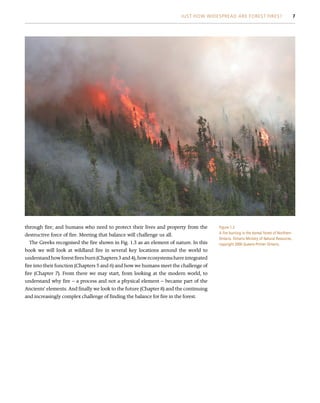
  • 2.
    Here are somerecommended products that we believe you will be interested in. You can click the link to download. Fire In The Forest Peter A Thomas Robert S Mcalpine Kelvin Hirsch Peter Hobson https://ebookbell.com/product/fire-in-the-forest-peter-a-thomas- robert-s-mcalpine-kelvin-hirsch-peter-hobson-51242124 Fire Management In The American West Forest Politics And The Rise Of Megafires First Edition Mark Hudson https://ebookbell.com/product/fire-management-in-the-american-west- forest-politics-and-the-rise-of-megafires-first-edition-mark- hudson-2443804 Fire And Water Scientific Heresy In The Forest Service Ashley L Schiff https://ebookbell.com/product/fire-and-water-scientific-heresy-in-the- forest-service-ashley-l-schiff-51389412 Manual For The Control Of Fire In Peatlands And Peatland Forest Wahyu Catur Adinugroho https://ebookbell.com/product/manual-for-the-control-of-fire-in- peatlands-and-peatland-forest-wahyu-catur-adinugroho-1854286
  • 3.
    Forest Fires AndAbandonment Patterns From The Aguada Culture Northwest Argentina A Paleoenvironmental Study Based On The Analysis Of Microcharcoals In The Ambato Valley Catamarca Province Henrik B Lindskoug https://ebookbell.com/product/forest-fires-and-abandonment-patterns- from-the-aguada-culture-northwest-argentina-a-paleoenvironmental- study-based-on-the-analysis-of-microcharcoals-in-the-ambato-valley- catamarca-province-henrik-b-lindskoug-49986810 Fir And Empire The Transformation Of Forests In Early Modern China Ian M Miller https://ebookbell.com/product/fir-and-empire-the-transformation-of- forests-in-early-modern-china-ian-m-miller-24691128 The Five Faculties Putting Wisdom In Charge Of The Mind Hnissaro Bhikkhu https://ebookbell.com/product/the-five-faculties-putting-wisdom-in- charge-of-the-mind-hnissaro-bhikkhu-43680930 Fire In The Hills Donna Jo Napoli https://ebookbell.com/product/fire-in-the-hills-donna-jo- napoli-49121264 Fire In The Dark Telling Gypsiness In North East England Sarah Sal Buckler https://ebookbell.com/product/fire-in-the-dark-telling-gypsiness-in- north-east-england-sarah-sal-buckler-51746986
  • 7.
    FIRE IN THEFOREST How destructive or beneficial are forest fires to wildlife? Should we be trying to reduce or increase the amount of fire in forests? How are forest fires controlled, and why does this sometimes fail? What effect will climate change have? These and many other questions are answered in this richly illustrated book, written in non-technical language. The journey starts in the long geological history of fire, leading up to our present love--hate relationship with it. Exploring the physics of how a single flame burns, the journey continues through how whole forests burn and the anatomy of firestorms. The positive and negative ecological effects of fires are explored, from plants and wildlife to whole landscapes. The journey ends with how fires are controlled, and a look to the future. This book will be of interest to ecologists, biogeographers and anyone with an interest in forest fires and the role they play. Peter A. Thomas is Senior Lecturer in Environmental Science at Keele University, UK and has been a Visiting Professor at the University of Alberta, Canada and a Bullard Fellow at Harvard University, USA. His teaching encompasses a wide range of tree- and woodland-related topics including fire behaviour and fire ecology, and he recently received an Excellence in Teaching Award from Keele University. He is the author of Trees: Their Natural History and Ecology of Woodlands and Forests, both published by Cambridge University Press. Robert S. (Rob) McAlpine works with the Ontario Ministry of Natural Resources, Aviation and Forest Fire Management Branch, where he leads the Science and Technology group. His current research interests and activities span fire behaviour, fire economics, equipment development and organisational effectiveness. He has worked in fire management and research for over 30 years, from a frontline firefighter to a fire scientist.
  • 9.
    Fire in theForest Peter A. Thomas and Rob McAlpine with contributions from Kelvin Hirsch and Peter Hobson
  • 10.
    CAMBRIDGE UNIVERSITY PRESS Cambridge,New York, Melbourne, Madrid, Cape Town, Singapore, São Paulo, Delhi, Dubai, Tokyo, Mexico City Cambridge University Press The Edinburgh Building, Cambridge CB2 8RU, UK Published in the United States of America by Cambridge University Press, New York www.cambridge.org Information on this title: www.cambridge.org/9780521822299 # Cambridge University Press 2010 This publication is in copyright. Subject to statutory exception and to the provisions of relevant collective licensing agreements, no reproduction of any part may take place without the written permission of Cambridge University Press. First published 2010 Printed in the United Kingdom at the University Press, Cambridge A catalogue record for this publication is available from the British Library Library of Congress Cataloging-in-Publication Data Thomas, Peter A. Fire in the forest / Peter A. Thomas and Rob McAlpine ; with contributions from Kelvin Hirsch & Peter Hobson. p. cm. ISBN 978-0-521-82229-9 (Hardback) 1. Forest fires. I. McAlpine, Rob. II. Title. SD421.T49 2010 634.90 618–dc22 2010026385 ISBN 978-0-521-82229-9 Hardback Cambridge University Press has no responsibility for the persistence or accuracy of URLs for external or third-party internet websites referred to in this publication, and does not guarantee that any content on such websites is, or will remain, accurate or appropriate.
  • 11.
    To our familieswho have stood with us during this project: Caroline, Benjamin and Graeme (RSM); Judy, Matthew and Daniel (PAT).
  • 13.
    Contents Preface ix List ofcontributors xi 1 In the beginning 1 The nature of fire 2 Just how widespread are forest fires? 4 2 Historical review 8 The earliest beginnings of fire in geological time 8 Tertiary and Quaternary – the last 65 million years 11 Holocene – the last 10 000 years 11 The intervention of humans 13 Uses of fire 13 Control of fire – careful or careless? 15 Effect of aboriginal people on the landscape 16 Arrival of the Europeans 18 Bambi and Smokey Bear 20 Reduced fire frequencies 21 Fire control to fire management 22 Are fire frequencies increasing again? 24 3 How a fire burns 26 Mechanics of fire 26 Pre-ignition 26 Ignition 28 Combustion 28 Heat transfer 31 Variation in fuel quality 32 Temperature and energy 35 Anatomy of a fire 37 Types of fire 38 Dynamics of extreme fires 45 Scales of fire impact: smoke 50 4 Fire in the wild landscape 54 Causes of wildfire – how do they start? 54 What starts most fires? 62 Which burns most area? 65 The fire behaviour triangle 65 Fuel considerations: fires are what they consume 66 The effect of climate and weather 72 Fire season 78 Variability in how a fire spreads 78 The complexity of fire spread 81 Patterns/mosaics on the landscape 82 Patterns of fire over time 82 Reconstructing fire history 85 Fire size – how big is big? 88 5 Fire ecology 90 How plants survive a surface fire 90 Fire stimulation of flowering 97 Ground fires and plant survival 98 How plants cope with a crown fire 98 Sneaking past – invasion after a fire 110 Combining these strategies 112 Bacteria and fungi 112 Animals and fire 112 Post-fire recovery of plants and animals 118
  • 14.
    6 The benefitsof fire and its use as a landscape tool 119 with Peter Hobson Fire and biodiversity – an overview 119 Unpicking the factors that affect biodiversity 124 Environmental legacies: dead wood and biodiversity 131 Fire, forests and conservation 132 Can clear-cutting replace fire? 135 The future for fire-prone forests: environmental uncertainty, macroecology and ecosystem resilience 137 Fire as a management tool in the landscape 141 Fire and soils 142 The wildland–urban interface (WUI) 143 The role of prescribed burning in wildland–urban interface areas 145 7 Fire suppression 149 Preliminary steps – fire intelligence 149 Step 1: fire detection 154 Step 2: dispatch 160 Resources for fire suppression 163 Step 3: suppression 167 Step 4: suppression failure – large fire management 176 Fatality fires 178 The fire-management organisation 180 8 Wildland fire and its management – a look towards the future 183 by Kelvin Hirsch The age of uncertainty 183 Trends and supertrends 185 Adaptation 199 Innovation 201 The future – ours for the making 208 Further reading 211 References used in the text 212 Index 223 viii CONTENTS
  • 15.
    Preface Year after yearpictures in the media show towering flames threatening people’s homes, livelihoods, and their very lives in places as diverse as North America, Europe and Australia -- why does this happen? Conflicting stories continually appear over whether fire is rapidly destroying the animals, habitats and plants we treasure in our forests, or whether fire is their salvation, the key to diversity and ecosystem rebirth -- where does the truth lie? With global warming predictions, do we face more and larger fires or will technology be able to tame this potentially savage enemy? This book delves into these and other questions, providing a factual account and perspective of how fire burns in the forest, what it does and how it might be controlled. Where the published work of others is used, or where good sources of extra information are recommended, the authors and the date of the publication are given so that the source can be found in the references at the end of the book. This inevitably has resulted in a compromise; we’ve tried to keep this to a minimum to help the text flow but give sufficient references to help the reader who wishes to find out more. Our apologies if we fail you at any point. We are indebted to the many people who provided information and insights and who read part or all of this book. In particular we are grateful to Dave Bowman, Yeonsook Choung, Helene Cleveland, Malcolm Gill, Jim Gould, Richard Hobbs, Scott Keelan, John Packham, Marc-André Parisien, Steve Pyne, Tim Sheldan, Brian Stocks, Jan Volney, Mike Weber, Tim Williamson and Mike Wotton. People were also remarkably kind in sharing pictures and photographs with us; these are gratefully acknowledged in the figure legends. All other photographs were taken by PAT. We are very grateful to Andy Lawrence who did his usual superb job in drawing many of the colour figures. Despite the help of others, if errors remain they are our fault. Please do let us know where you do find errors or you disagree with the stance taken. PAT is happy to record that some of the background for this book was researched while a Bullard Fellow at Harvard University, Massachusetts.
  • 17.
    Contributors MAIN AUTHORS Peter A.Thomas School of Life Sciences Keele University Keele Staffordshire ST5 5BG, UK Rob McAlpine Fire Science and Technology Aviation and Forest Fire Management Ontario Ministry of Natural Resources 70 Foster Drive, Suite 400 Sault Ste. Marie, Ontario, Canada P6A 6V5 CONTRIBUTING AUTHORS Peter Hobson School of Sustainable Environments Writtle College Chelmsford Essex CM1 3RR, UK Kelvin Hirsch Canadian Forest Service Northern Forestry Centre 5320–122nd Street Edmonton, Alberta, Canada T6H 3S5
  • 19.
    1 In thebeginning Welcome to Fire in the Forest. The ancient Greeks considered fire as one of the classical elemental forces along with water, earth and air; and indeed fire has helped shape the world around us to such a great extent that it would be hard to argue the point. Without a doubt, there is nothing on this planet that cannot be traced back (many times over) to some kind of fiery origin, whether that be the Big Bang at the origin of the universe, the atomic fires of some long dead pre-supernova star, the liquid burning rock just below the crust of the earth or the vegetation sitting frailly on the surface of the planet. While all of these forging fires are fascinating, a tome that spans the fullness of fire would be many volumes thick. The focus of this book is to explore the various facets of fires in forests: from how a single flame works, to what determines whether a forest will burn, to why huge forest fires occur and how they can be tackled. In this we will be dealing primarily with wildland fires – fires in the natural or semi-natural forest rather than those in plantations or in urban areas. These wildland fires have shaped the planet’s biotic structure so we also focus on how plants and animals cope with fire, our own interaction with fire and ultimately our overall relationship with the whole planet. We hope that this book will be of use to anyone with an interest in how forest fires work and how they affect the forest. Our aim has been to make this sometimes complex world open and approachable to anyone with or without even a hazy knowledge of science. When the first plants began to colonise the land of the early earth they adapted to the variously forming environmental niches. Into this inhospitable place, plants took hold and grew, but fire was there too. During rainless spells, when the land and plants dried out a little, lightning and even volcanoes would ignite fires. These fires would spread out, consuming the plants and releasing the nutrients back to the environment. Following the fires, more plants arose, utilising the nutrients that were now more freely available. This cycle was repeated almost endlessly, each successive cycle consuming another generation of plant life, and slowly changing the environment. In some climate zones, seasonal moisture would produce lush growth only to have it dry out at another time of the year resulting in frequent, sometimes annual burning, while other locations, due to a lack of fuel accumula- tion, or of near-constant fire-prohibiting moisture, or an infrequent ignition source, would see fire much less often. These climatic effects began to be drivers of
  • 20.
    evolution for plants,with species beginning to adapt to different degrees of burning and exploit the elemental force of fire as they would the other elements. From the beginning our (human) relationship with fire has been two-sided. We exploited the use of fire for hunting and warmth, and our safety was threatened by fire. As civilisation evolved, our relationship with fire included cooking, forging of metals and further. However, this evolution eventually began to weaken our understanding of fire as a natural process. As civilisation has grown, fire has been increasingly containerised, first into the hearth then into internal combustion engines and power-generating plants, so we lost our experience and appreciation of the benefits of open fires while keeping our fear. Thus, to many, fire in the landscape became a wholly negative thing (more on that later!). If we fast forward to today, we find fire is still an essential natural process in many ecosystems across the planet. Plants have evolved since they first colonised the land, not only into more complex organisms adapted to the weather and climate of various regions, but also adapted to the frequency and intensity of fires. Indeed many plants and animals have evolved to influence the fire cycle and to use fire to their own ends, thereby out-competing other organisms not so well adapted to fire, or adapted to a different fire regime. The range and ingenuity of these adaptations is as varied as life itself. Certainly we know that the world would look very different without fire. If we could completely remove all fire, grasslands would diminish greatly in size, and forest cover would increase from 30% to an estimated 56% of the vegetated land surface (Bond et al. 2004, Bowman 2005). In this single volume we could not begin to address the wide range of fire effects and cover the breadth of fire management across the globe. Instead we have chosen some key fire-prone areas around the planet – the global fire powers of Canada, USA and Australia – and focused on them, with occasional diversions to neighbouring places for illustrative purposes. The boreal forest, dominated by pines and spruces, is a large fire-prone ecosystem, encircling the northern hemisphere. Over a third of the boreal forest lies within Canada and here lies one of our areas of focus. The USA contains a good deal of even more flammable forest vegetation which has its own story to tell. Australia is an island continent that perhaps lives with the most frequent and intense fire regime on the planet. From the arid grassland to the eucalypt forests, fire is an integral part of the land and the people. The nature of fire Within the ancient Greeks’ four elemental forces, all except fire are matter based – earth, air and water are things that today are understood to be composed of matter. Only fire is different, and rather than an ‘object’ so to speak, it is a process. Certainly the other elements can be involved in processes (water for example can be an agent of change in erosion), but it is only fire that is really intangible and ephemeral. At the same time, fire is the only one of these elemental forces that we can unleash 2 IN THE BEGINNING
  • 21.
    and to acertain extent control as a major ecological force. We can light fires but cannot start a volcanic eruption, hurricane or widespread flood. These facts demand a better understanding of what fire is. In chemical terms, fire is an oxidising agent – it combines one lump of matter with oxygen to produce another form of matter. Oxidation is often quite slow (as when oxidised iron turns to rust, for example) but in other cases, such as fire, it is a more rapid process. Some forms of matter when oxidised (combined with oxygen) react and release heat. In some cases (phosphorus for example) no heat is required to start this reaction, but in most cases (including fire) heat is required to initiate the reaction. The extra heat then generated by oxidation is sufficient to sustain the process until all the matter is transformed (or in the case of wood – fuel consumed). To lay a broad background, fire is in essence the opposite of photosynthesis. Plants grow using photosynthesis to capture the energy of the sun and convert carbon dioxide and water into glucose (for plant structures) and release oxygen and water back into the atmosphere. A simplified equation for photosynthesis is: 6CO2 þ 12 H2O þ sunlight yields C6H12O6 þ 6 O2 þ 6 H2O: Or the same equation in recipe format: 6 parts carbon dioxide (CO2) + 12 parts water (H2O) + sunlight Yields: One part glucose (C6H12O6) + 6 parts oxygen (O2) + 6 parts water (H2O). Of course, plants are composed of more than glucose, but glucose is the major building block of most structures (e.g. cellulose, wood) and for our purposes the essential element of concern. Additionally, there are a host of micronutrients and minerals required for the health of the plant (supplied by the soil). Where photo- synthesis converts water and carbon dioxide into glucose, fire reverses this reaction, oxidising the glucose back into the original constituents and releasing the stored solar energy as heat and light. The difference between photosynthesis and fire (other than one being the reverse of the other) is the rate at which the two occur. A large tree (and by extension forest) collects solar energy over decades, centuries or millennia, while the stored energy can be released in minutes during a fire; consequently the energy release rates can be enormous. On a large, high-intensity wildfire, it is said that the energy equivalent of one Hiroshima-sized atomic bomb can be released every 20 minutes. It is worth remembering that the energy released during fire was captured from the sun and stored by the trees and vegetation; nature’s first energy storage battery. THE NATURE OF FIRE 3
  • 22.
    Looking back atthe Greek philosophers, they seemed again to get things right – earth, air and water combine to form the trees and other vegetation with energy from the sun (at its heart an atomic fire). And when the process is reversed, the energy initially forged from the sun, and translated into form by trees and vegeta- tion, is released by fire to consume the storage container and yield heat and light. Just how widespread are forest fires? A common question asked about fire is how much of the world’s land surface is affected each year. Satellite imagery and ground-based estimates suggest that between 2000 and 2004 (a fairly normal period) the area burnt varied between 2.97 and 3.74 million km2 each year, most of this in forests (Giglio et al. 2006, FAO 2007). This area, approximately the size of India, burnt each year you can see isolated in dark colours in Fig. 1.1. Or if you prefer, this is equivalent to just under a third of Canada, a little less of the USA, 40% of Australia or 12 times the area of the UK. The next question usually asked is which parts of the world burn most often. Today across the planet, biomes (major vegetation types) have fallen into balance with the local climatic conditions, the soil richness and the preponderance of fire. There are few places that are immune to fire (Antarctica being one) but of a higher importance perhaps is the frequency that fires return to an area. This fire return interval within an area impacts the vegetation most profoundly. Fig. 1.1 begins to describe a global picture of fire frequency. Darker areas of the map have a greater percentage of the 1º 1º (latitude by longitude) cells burnt by fire annually, indicating a higher fire frequency. For fires of natural origin (that is, not started by humans – see Chapter 3) we see the darkest areas in the world’s grasslands and savannahs. Unfortunately, Fig. 1.1 may be distorted from a ‘natural’ Figure 1.1 A 1º 1º global map of average annual area burnt (% of cell burnt) for 1960–2000. # International Association of Wildland Fire 2009. Reproduced with permission from the International Journal of Wildland Fire 18(5): 483–507 (Flannigan, M.D., Krachuck, M.A., de Groot, W.J., Wotton, M Gowman, L.M.) DOI 10.1071/WF08187. Published by CSIRO Publishing, Melbourne, Australia. 4 IN THE BEGINNING
  • 23.
    fire cycle bytropical rainforest burning activities in South America and South-East Asia. Although the tropics are often too wet to burn, as described in Chapter 4, people clearing the forest, aided by El Niño droughts, let in fire. These can be huge fires: the Great Fire of Borneo between September 1982 and July 1983 burnt between 35 and 37 thousand km2 – a hundredth of the normal global area burnt per year in just one fire (Johnson 1984). However, a striking fact clearly visible from Fig. 1.1 is that generally where there is vegetation, there is fire (with few exceptions). The vast majority of these fires are not monitored or documented due to remoteness and so go largely unnoticed by the wider world. Some grassland areas burn almost every year (consequently keeping them grasslands!). This link between grasslands and high fire frequency begins to show us the linkage between the two – repeated fires on a near-annual basis do not allow longer-lived organisms to survive – they are repeatedly burnt back and not allowed to get a start. So the grassland ecosystem, home to many species of both flora and fauna, is dependent on frequent fire to maintain its character. Another example, although very different ecologically, is the eucalypt forests in many parts of Australia (Fig. 1.2). And as we see later in Chapter 6, most ecosystems are dependent on some level of fire frequency. However, this understanding of the necessary role of fire in the ecosystem is only a relatively recent revelation for modern civilisation. This raises the perennial question of whether forest fires are indeed friend or foe. It was not until the 1960s that the essential role of fire was first suggested, and acceptance into the main- stream has taken decades. Even in the 1970s fire was mostly thought to be a bad thing: a Canadian Forestry Service publication called Forest Enemies (Anon 1973) included a section on fire. At the same time, the Canadian company Bombardier, who build water bombers, produced an educational video that described their machines as fighting the number one enemy of the forest. But our perspective has changed and our depth of understanding of fire has increased so that we now see some fires as useful and others as harmful. So the same dichotomy of the nature of fire exists for us; fire is useful (technologically) and an essential part of the ecosystems, but unmanaged/uncontrolled it can threaten lives, structures, infra- structure (and the dependent economies), and our way of life. This produces a problem; as Putz (2003) points out: In the glare of the conflagrations that consume forests and kill firefighters in western and northern North America every fire season, special care is required when trying to present fire in a positive light. We therefore try and tread carefully in this book, aiming to give you the facts on how fires work in the landscape and why and how we try to control them, and to leave you to decide how you feel about the pros and cons of different fires. Acceptance of fire has been hampered by the long-time ingrained desire and belief that nature can be tamed and dominated. This attitude not only drove fire JUST HOW WIDESPREAD ARE FOREST FIRES? 5
  • 24.
    and land-management policies,but facilitated attitudes that people could build homes in ‘natural’ environments and expect their homes to be protected from fire. Governments have met this challenge and built complex firefighting organisations. Society now depends on these firefighters to protect people, homes, communities and the infrastructure that the economy depends upon (pipelines, hydro lines, telecommunication towers, railroads, crops, timber for homes etc.). How firefighters meet the daily challenge that nature has set out, is a story unto itself. Complex organisations utilising state-of-the-art technology, adapting to vari- ous situations, meet the challenge of fire to protect what society demands it protects. However, as in all cases when humans contend with nature, there are wins and losses. New technologies improve capabilities, at an ever-increasing price tag, but on some days, the elemental force of fire conquers all. Fire then is a conundrum – a basic elemental force of nature that cannot be held back, with ecosystems evolved the world over that require rebirth or rejuvenation Figure 1.2 Recently burnt forest in Western Australia with greening vegetation immediately post-fire. Photograph by Rob McAlpine. 6 IN THE BEGINNING
  • 25.
    through fire; andhumans who need to protect their lives and property from the destructive force of fire. Meeting that balance will challenge us all. The Greeks recognised the fire shown in Fig. 1.3 as an element of nature. In this book we will look at wildland fire in several key locations around the world to understand how forest fires burn (Chapters 3 and 4), how ecosystems have integrated fire into their function (Chapters 5 and 6) and how we humans meet the challenge of fire (Chapter 7). From there we may start, from looking at the modern world, to understand why fire – a process and not a physical element – became part of the Ancients’ elements. And finally we look to the future (Chapter 8) and the continuing and increasingly complex challenge of finding the balance for fire in the forest. Figure 1.3 A fire burning in the boreal forest of Northern Ontario. Ontario Ministry of Natural Resources, copyright 2006 Queens Printer Ontario. JUST HOW WIDESPREAD ARE FOREST FIRES? 7
  • 26.
    2 Historical review Theearliest beginnings of fire in geological time Fires could not blaze until there was enough oxygen in the atmosphere and enough vegetation to burn. Oxygen began to appear in our atmosphere around 2 billion years ago (in the Archaean subdivision of the Precambrian Era) and reached its present-day level (21% of the atmosphere) around 600 million years ago. Life was still in the seas at this point – in fact it was only when oxygen reached these high levels that ozone could be formed high in the atmosphere which screened out harmful ultraviolet radiation and allowed complex life to invade the shallows and finally land. Oxygen levels since then have fluctuated between 15–35% of the atmosphere (Fig. 2.1). Coincidentally, fire needs a minimum of 13–15% oxygen to burn and above 35% spontaneous combustion is likely. How do we know when fires first started to appear? Fortunately, rock and coal layers contain a charcoal-like substance called fusain; small black fragments that often still contain the original cellular structure (Fig. 2.2). There has been a long debate about whether fusain is indeed a result of fire or whether it is from the much longer and slower oxidation process of weathering – see Box 2.1. But the consensus 15% 600 500 400 300 Millions of years ago 200 100 0 20% 25% Per cent oxygen 30% 35% 40% Figure 2.1 Changes in atmospheric oxygen level over the past 550 million years (the Phanerozoic Eon). The horizontal line shows the current concentration of 21%. Data from Dudley (1998) and Berner (1999).
  • 27.
    100 mm 30mm Figure 2.2 Charred plant fragments extracted from siltstone rocks found at Ludlow, England. These are evidence of the earliest wildfire so far documented that dates from the late Silurian (419 million years ago). The plant involved is a rhyniophyte, probably Hollandophyton colliculum, one of the first land plants just a few tens of centimetres tall, with leafless branched green stems and spore-producing cones. Photographs courtesy of Ian Glasspool, Dianne Edwards and Lindsey Axe. Box 2.1. Is all black material from burning? Blackened plant material may immediately makes us think of burning – as in the picture on the left of Fig. 2.3. But if plant material, such as the wood of the roots and old branches on the bristlecone pine on the right, is exposed for many years to the elements it weathers to the same chemical composition and approximate appearance as charcoal. In effect, slow oxidation in weathering and fast oxidation in fire create end products that superficially look similar. Weathering, however, normally produces a thinner more superficial layer of ‘char’ simply because the material is likely to finally rot or break apart before it has long enough to develop deep weathering. Moreover, oxidation by fire tends to lead to melting and blistering of the waxy cuticle over the plant surface (the epidermis) which can be seen even in fossil fragments, and most importantly experiments have shown that black fragments with a high reflectance are indicative of fire temperatures of at least 400 C and generally the greater the reflectance, the greater the fire temperature. Figure 2.3 On the left, logs burnt in a fire in New Brunswick, Canada showing extensive charring. On the right, a bristlecone pine (Pinus aristata) in the White Mountains, California that is probably over 4000 years old and which shows slow weathering of the exposed roots and old branches over millennia that superficially looks as though they have been burnt. THE EARLIEST BEGINNINGS OF FIRE IN GEOLOGICAL TIME 9
  • 28.
    now is thatthe majority of this fusain does indeed result from past fires to provide clues as to the origins of fire. Fusain deposits suggest that fires have been burning since the Silurian, 419 million years ago (see Glasspool et al. 2004 for further information). These fires, started by abundant lightning, would have burnt through the first land plants that appeared around 430 million years ago (early Silurian). The immense coal- producing swamps of the Carboniferous (360–290 million years ago) provided abundant material to burn with their lush forests of giant ferns, horsetails and clubmosses (Fig. 2.4). Moreover, oxygen levels had risen to a peak at this time – up to around 35% of the atmosphere (Fig. 2.1) – helping fires burn more vigor- ously. But was there more fire then? Well, charcoal deposits became more common through the early to late Carboniferous, including in tropical wetland peats, but there is less than expected, probably due to a wet climate putting a damper on things. However, it is tempting to think that the first signs of adapta- tions in plants that allowed them to cope with fire began to appear during this period (although they may have evolved initially for other reasons). For example, the living tissue buried deep in the bark of the clubmoss-trees likely made them very fire tolerant. As new types of plants evolved they would have met with a baptism of fire. Flammable conifers became abundant in the Triassic (around 245–208 million years ago) and would have met fire (See Uhl Montenari, 2010). Oxygen levels dropped to 15% about 200 million years ago (the Jurassic) to rise again to around current levels as the broad-leaved hardwoods appeared in the early Cretaceous (120 million years ago). Fire must have played an important role in their evolution. It is often suggested that the extinction of the dinosaurs at the Cretaceous– Tertiary (K–T) boundary 65 million years ago was due to the meteorite impact that created the 180-km diameter Chicxulub crater on the Yucatán Peninsula in Mexico, accompanied by huge ‘global wildfires’, the like of which had not occurred before or since. The evidence for the impact is overwhelming but the evidence for the fires is not compelling; the soot and charcoal in the rocks of this time could have been produced by fires that burnt gradually through lots of dry, dead vegetation killed by the sudden change in climate (Belcher et al. 2005). Evidence for this comes from microscopic examination which shows that more than 50% of charcoal fragments from the K–T boundary show signs of rotting, compared with less than 5% observed in modern fires. Moreover, studies in North America north of the Chicxulub crater found between four and eight times less charcoal in K–T rocks than in rocks above and below the boundary, suggesting that the huge meteor impact resulted in relatively few fires. Also, the structure of the soot associ- ated with the charcoal from the K–T boundary appears to come primarily from the vaporisation of hydrocarbon-rich rocks rather than burning vegetation. Nichols Johnson (2008) give an excellent account of the vegetation either side of the boundary. Figure 2.4 What a clubmoss forest of the Carboniferous Period may have looked like. The cone-bearing trees in the middle distance and the fallen one in the middle are Lepidodendron (an early clubmoss). The trunk on the right is a tree fern and some of its foliage can just be seen at the top. The dead tree on the left is an early ancestor of the conifers, and, more centrally, an unbranched species of Sigillaria, another clubmoss. Grasses and flowering plants had not yet evolved but mosses, ferns and small horsetails (seen behind the tree fern) were abundant. The animal in the foreground is a labyrinthodont amphibian that spent most of its life in the water but which could walk on land. On the fallen trunk is a member of the extinct ‘griffenflies’ which included the largest insects ever to live, and which gave rise to modern dragonflies. These huge insects and abundance of fire are both attributable to the high levels of oxygen in the atmosphere (see Fig. 2.1). Drawn by Peter R. Hobson. From Thomas Packham (2007). 10 HISTORICAL REVIEW
  • 29.
    Tertiary and Quaternary– the last 65 million years After the dinosaurs became extinct, fire continued to wax and wane as climates were more or less favourable. As our current forests – with trees we would recognise – have evolved over the last 65 million years, fire has been an integral part of that development and the world’s fire-prone vegetation acquired much of its modern character. But fire has not been a passive follower of climate and vegetation; it also played a part in shaping the vegetation. This is illustrated nicely by changes during the Miocene (5–24 million years ago) when grasslands appeared around the world. Evolutionary scientists have long asked why grasslands appeared so comparatively late. One of the most likely answers is a change in world climate towards increasing aridity, especially at higher latitudes (north and south), which was needed to give grasses the competitive edge. But it was probably not just dryness; late Miocene pollen records from Africa, for example, are associated with charred grass leaf surfaces. The most likely scenario is that the drier climate led to an increase in fire frequency, which favoured those plant species, including grasses, which could cope with a dry climate, frequent fire and grazing animals. Fire undoubtedly would have helped accelerate the change in vegetation and would have selectively encouraged those species that could cope with fire, produ- cing a vegetation type that would otherwise not have existed. Fire was thus both an accelerant (speeding up the response to climatic change) and a selective agent, weeding out those species that could not cope. During the unimaginable numbers of years of these long geological periods it is also important to remember that the continents have moved around the globe and so may have a fire history in geological time that is quite different from the current day. Thus fusain may occur in what can appear to be unlikely places. For example, rocks 140 million years old (early Cretaceous) in southern England show good deposits of fusain in what was then a delta of conifer woodland with a fern and clubmoss understorey. Now, southern England has little natural fire since the wet climate grows lush greenery that burns like wet asbestos except during exceptional droughts (such as the spring of 2003). Similarly, tropical areas which are now usually too wet for extensive fires – like rainforest – can have an extensive history of fire. Fire was abundant in the Amazon Basin during several dry periods over the last 2 million years, the latest being 4000 to 6000 years ago (see Sanford et al. 1985). However, for much of the Holocene (the last 10 000 years) this area has been in a wet phase with much less frequent fire. Holocene – the last 10 000 years More is known about fire during this Holocene period following the last Ice Age because most lake and bog deposits, with their trapped record of pollen and charcoal, were formed during this time. Even so, interpretation of this trapped HOLOCENE – THE LAST 10 000 YEARS 11
  • 30.
    record is notalways easy. Charcoal, for example, caught in a bog may have been transported from fires considerable distances away by wind or on water (charred conifer needles float for many more days than uncharred ones). Certainly, charcoal particles from the big 1988 fires in Yellowstone were found 1600 km (1000 miles) away in Minnesota. On the positive side, palaeoecologists have a variety of methods and techniques for teasing the true picture from these deposits, and the overall picture of Holocene fire is continually improving. As you would expect, warmer climatic periods generally led to more fire. Thus we know that there was more fire during the warmer climate of the Medieval Warm Period and less during the global period of the generally cooler and moister climate of the Little Ice Age (Fig. 2.5). Within this large overall picture, however, there were many small variations. As suggested above, the Little Ice Age in Sweden appears to have greatly reduced fire frequency above 1000 m, allowing fire- intolerant spruce to invade forests. At lower elevations in east Sweden, however, the climate was slightly warmer and drier, and fires carried on burning (Bradshaw Zackrisson 1990). The vegetation and animals themselves can also inject perversities into the complex relationship between fire and climate. For example, in Elk Island National Park in western Canada, the Medieval Warm Period resulted in flammable shrub birch (Betula glandulosa) being replaced by the less fire-prone aspen (Populus tremuloides), due to a lowering of the water table (see Campbell Campbell 2000). This led to a decline in fire frequency at odds with what the climate would suggest. In the same area in more recent historical times, the amount of aspen has risen and grassland has declined (Fig. 2.6). This could be due to a reduction in fire frequency driven by climate but is most probably due to the decline in grazing animals, especially the huge historical decline in buffalo, which would previously have prevented trees from growing (Frans Vera in his book Grazing Ecology and Forest History (2000) looks specifically at the importance of grazing animals and their interaction with fire). –20 20 15 10 Thousands of years ago 5 0 –15 –10 Temperature (°C) variation from now –5 0 +5 Younger Dryas Medieval Warm Period Little Ice Age Figure 2.5 Variation in temperature over the last 20000 years. The data are interpreted from chemical analyses of the ice and trapped gas bubbles taken along a 3000-m deep ice core from the Greenland ice cap. Temperatures at the end of the last Ice Age fluctuated widely, reaching almost current levels 14 000 years ago (the Allerd Period) before plunging into the final very cold period of the Younger Dryas. Around 11 500 years ago, the Ice Age came to an end and temperatures rose and steadied with small fluctuations to the present day. These small fluctuations are, however, significant since fire was more common during the Medieval Warm Period (roughly AD 750–1250) and much less so during the Little Ice Age (AD 1450 to c. 1850) despite the annual differences in temperature being just a few degrees. Based on data from Alley (2000, 2004). 12 HISTORICAL REVIEW
  • 31.
    The intervention ofhumans The first use of fire by ‘humans’ probably dates back to the Australopithecines, the ancestors of modern humans, that lived at least 1.5 million years ago in the African Rift Valley. As their descendants, Homo erectus, spread into Europe and Asia about a million years ago and then further afield, it is clear that they took fire with them wherever they went, from jungles to savannahs. Certainly, many sites around Europe occupied by modern humans (Homo sapiens) 750 000 to 400 000 years ago show clear remains of fire on animal bones and fire-hardened implements. Fire was not, of course, just restricted to Europe; many people worldwide used fire, from the Aboriginals of Australia, the Maoris in New Zealand, the Melanesians in Fiji, through to the indigenous peoples of the Old World (India, Asia, Africa, Russia) and New World (Gill 1981, Kershaw et al. 2002, Gott 2005). Uses of fire The use of fire was one of the key features distinguishing early humans from the rest of the primates. We can imagine that fire was initially ‘captured’ from natural sources such as lightning fires and used for heat and protection from wild animals and perhaps each other. Nevertheless, it is apparent that early humans rapidly learnt to use fire as a very effective tool and indeed their life was centred around fire. Fire uses can be loosely divided into domestic and landscape. Domestic use included heating, cooking (including preserving by drying and smoking), repelling mosquitoes, driving snakes from camping grounds, hardening wooden tools, making pottery and metal implements, protection at night and social uses (such as making the evenings available for story telling), spiritual ceremonies (see Box 2.2) and mortuary rituals. Outside of the domestic camp, fire has been extensively used by indigenous peoples for hunting, by clearing away vegetation to make game more visible, for driving game and by encouraging young grazing to attract animals. Fire was also 100% 1924 1950 1962 1972 1983 Grassland South part Shrub, sedge, water, light aspen and other Dense aspen 0% Figure 2.6 Changes in vegetation in the south part of Elk Island National Park, Alberta, Canada. The area covered by aspen has increased over recent decades. While this could be due to less fire, it is most likely due to a decline in grazing animals. Modified from Campbell Campbell (2000), with permission from Elsevier. USES OF FIRE 13
  • 32.
    useful for killingand cooking small mammals and insects such as grasshoppers, and for improving access to edible plant roots and bulbs. A useful summary of the use of fire in North America can be found in Mellars (1976). Fire was also useful in removing accumulated vegetation, making travel easier and creating fire breaks around camps. It is difficult to argue with the fact that the value of fire in maintaining biodiversity was clearly recognised by early people around the world. The Aboriginals of Australia certainly used fire in a big way to ‘clean up the country’ – returning the land to an orderly state and cleansing it of evil spirits using ‘corrective fires’. Stephen Pyne (1993) rightly suggests that ‘Wherever Box 2.2. Spiritual and magical uses of fire Both the Aztecs and the Incas of Peru worshipped gods of fire. The Aztecs of Mexico used huge ceremonial fires either kept burning permanently in the temples or just during major religious festivals. Much later, the Greek goddess of the hearth, Hestia, was one of the 12 Olympian deities, and the worship of Vesta, her Roman counterpart, became a state cult (Fig. 2.7), best known for the vestal virgins who tended the perpetual flame in the shrine of Vesta. Use of fire in spiritual or magical rituals has continued throughout the world. In Europe, fire festivals (based on bonfires rather than landscape burning) were common since pre-modern times (the Middle Ages, AD 410 to the1450s) until the nineteenth century. These are exemplified by springtime fertility festivals, such as the Lenten Fires of North-West Europe and the Beltane Fires of the UK Celts complete with human sacrifices, the midsummer fires at the summer solstice, and their counterpart at the winter solstice (which commonly involved the Yule log that we still remember at Christmas) to ensure prosperity and safety. Over the same time span, people in many parts of Europe have resorted to ritual fires – ‘need-fires’ – at times of great distress or calamity, such as their cattle being attacked by epidemic disease. Figure 2.7 Remains of the Vesta temple in the Roman city of Ephesus, now in modern Turkey. 14 HISTORICAL REVIEW
  • 33.
    humans and ecosystemhave co-evolved, not to burn could be as irresponsible as improper burning. Good citizens used fire well; bad ones, poorly, or not at all.’ This illustrates the important influence people had over the vegetation of the land they lived on. As early humans learnt to use fire, they had at their fingertips a tremendous force for modifying the landscape around them, helping pave the way for a transition from being hunter/gatherers to being more agrarian and settled people. But how carefully did they use fire? Control of fire – careful or careless? There has been a long debate about just how carefully aboriginal people used fire. Some have argued that these people were mainly concerned with their immediate survival with little concern for the long term, and so were careless with fire. Either that or they lacked the skill to adequately control the fires they started. After all, fire is the one major ecological force that can be very easily unleashed by humans, with a huge potential impact on the landscape. This view is bolstered by the many European observers who remarked on the casualness of fire use by North American aboriginals, fires being left to ‘burn out of control’ and abandoned campfires left still burning after an overnight stop. Early visitors to Australia, the tropics and many other parts of the world in the eighteenth and nineteenth centuries similarly record frequent dense smoke and roaring fires that seemed to cover the whole land as the Aborigines burned with abandon. Others – the majority – would argue that hidden in this apparently careless attitude is tremendous knowledge and understanding, in the same way that a concert pianist makes the playing of a complex piece look easy and effortless. Jones (1975), looking at aboriginal use of fire, concluded that ‘People used fire accurately, aiming them into a natural break such as an old fire scar or swamp, timing the fire so the predictable wind changes later in the day would blow them back into their own track, or so that the evening dew would dampen them down.’ On other continents there is also abundant evidence that the various aboriginal people have been (and are) remarkably skilled in fire management and just ‘knew’ where and when to burn. They knew how to take advantage of the benefits of fire while trying to avoid the dangers. Stephen Pyne’s many excellent fire history books (Pyne 1995, 1997, 2001a, 2001b, 2004, 2007) give much more detail on this fascinating topic. Aboriginal peoples could carry fire with them as they travelled. Those of North America carried fire brands or ‘slow matches’ – a tightly rolled rope of bark smouldering at one end, and the Aboriginals of Australia had the infamous and valuable ‘firestick’ – a slow-burning piece of wood or bark. They could also start fire from scratch by a variety of methods. With fire being easily started and transported, the question that arises is just how widespread were the fires of CONTROL OF FIRE – CAREFUL OR CARELESS? 15
  • 34.
    indigenous people: didtheir fires affect large areas of landscape or was this localised around their settlements; and did they significantly alter the frequency of fire over large areas? Having said all this, it is important to recognise that not all aboriginal people used fire to modify the landscape. Natcher and colleagues (2007) showed that the Koyukon people of the western Interior of Alaska ‘considered fire a destructive force and had no recollection or oral history of using fire for landscape manage- ment’. In contrast, the Gwich’in of the eastern Interior actively used fires to manage the landscape. As the authors put it: ‘These findings call into question the com- monly held view that the native peoples of North America pervasively and near universally modified landscapes through the use of fire.’ Effect of aboriginal people on the landscape In areas of the world where fire has been fairly rare since the last Ice Age, such as northern Sweden (see Carcaillet et al. 2007), it is clear that humans had little impact on the naturally occurring cycle of fire until the last two centuries. But in more fire- prone parts of the world, the picture appears to be very different. Nevertheless, it has been a long-held view that even in fire-prone areas early aboriginal people were too few to greatly influence vegetation on a large scale (Russell 1983, Parshall et al. 2003). Williams suggests in his book Deforesting the Earth (2003) that this partly stems from the fashionable view put forward by early writers in North America who ‘extolled the idea of an untouched, virgin and virtually uninhabited wilderness’ against which the first European settlers battled. This image of heroic struggle has ‘become a part of the American heritage’ and difficult to argue against. In this vision, the aboriginal people lived in harmony with the forest, creating a barely perceptible human disturbance, and it was the ‘blundering European who trans- formed, destroyed, and devastated it all’. Given the skills that early people developed over millennia in manipulating fire (or if you prefer, the ease with which they could ignite uncontrolled fires) the proposition that the arrival of people in fire-prone areas resulted in significantly more fire seems quite realistic. There was certainly more fire around their habita- tions. For example, in eastern North America, the aboriginals cleared areas that are recorded as being handfuls to tens of kilometres in width. And it is highly likely (though not universally agreed) that their influence on the landscape was much wider, in much the same way that the Aboriginals of Australia covered the whole landscape with fire. Fires in Minnesota conifer forests were huge prior to European settlement, with a mean size of 4000 ha and a maximum estimated size of 160 000 ha. Moreover, it is suggested that by the time that Europeans arrived in North America, the aboriginal peoples may have as much as doubled the number of fires that would normally have burned due to lightning. Indeed, the Maskouten Indians of Wisconsin used fire so often that Father Pere Marquette called them the 16 HISTORICAL REVIEW
  • 35.
    ‘Fire People’ whenhe met them in 1673. However, the unsupported assertion some- times made that such people burnt every acre of the west does appear exaggerated. It would seem, then, that in easily burnt forests, pre-European human-caused fires (deliberate and accidental), coupled with natural fires, resulted in widespread alteration to the landscape, changing the density and species of trees, and encour- aging more open areas over large areas. Archaeological remains of the Iroquois in eastern North America are associated with high charcoal levels and a change from beech and sugar maple (Acer saccharum) to oaks and eastern white pine (Pinus strobus). The importance of human fire in such changes would obviously have varied; much less important in areas with few humans and more important in areas of high habitation such as along the coastlines and river valleys of eastern North America. There are very impressive examples of dramatic change to the landscape by burning. For example, giant marsupial lions and kangaroos that stood 3 m high and weighed over 200 kg, plus other Australian giants that lived 200–400 000 years ago, had been thought to have become extinct due to arid conditions during the approach of the last Ice Age. However, these extinctions are now thought to be due to the extensive fires started by the early humans who changed the landscape so much that large herbivores ran out of food, so starving the large carnivores (Pri- deaux et al. 2007). A more recent example stems from when the Maoris reached New Zealand in the late thirteenth century. They lived mostly on the moas, a group of large flightless birds that ranged in size from a small goat to giant ostrich-like beasts up to 4 m tall, weighing 250 kg (over twice the size of an ostrich). The birds provided food, clothing and most of their implements – a truly important group. The moas were hunted with the aid of fire, and very successfully because it is estimated that within 120 years the Maoris had reduced an estimated population of over 150 000 birds to eventual extinction. Moreover, the population of around 10 000 people in the South Island had removed at least 3 million hectares (8 million acres) of forest, primarily by fire (see Anderson 1989, Holdaway Jacomb 2000, Williams 2003 for more details). A similar example is seen in Patagonia in South America. After the late nineteenth century wars decimated the fire- using native population, the once open grassy steppes were readily invaded by Austrocedrus (Chilean incense cedar) of ever-increasing density and area (see Alaback et al. 2003). This does underline the point that aboriginal peoples’ use of fire could bring about large changes in the landscape, which today we would look upon as irresponsible and ecologically unsound. This is not to say that they were necessarily careless, unintelligent or unaware, and before we think harshly of our ancestors, we should pause and think of how we have manipulated the landscape for our own use (creating, for example, extensive farmland), and our current problems over climate change. Nor is this picture of great change always true; the Malagasy people of Madagascar took great care to conserve their forests unchanged. EFFECT OF ABORIGINAL PEOPLE ON THE LANDSCAPE 17
  • 36.
    As well asintroducing more fire into the landscape, aboriginal peoples also altered the type of fire. An example is to look at the people who settled amongst the coastal redwoods (Sequoia sempervirens) of California about 12–11 000 years ago bringing fire with them. Fire frequency (see Chapter 4 for a review of what this means) went from one fire in 135 years to one fire in 17–82 years and in some areas every 8 years. Due to the consequent reductions in the build-up of fuel, the fires changed from infrequent, large and intense surface and crown fires (again see Chapter 4) to fires of lower intensity with just periodic high-intensity surface fires. Fortunately for us and tourism, the change favoured the spread of the coastal redwoods and stopped Douglas fir (Pseudotsuga menziesii) and western hemlock (Tsuga heterophylla) from taking over (we have a lot to thank these people for!). This pattern of aboriginal peoples being implicated in more frequent but less severe fires is fairly universal. It can be difficult to disentangle the effect of humans on fire in the landscape from natural changes due to climate variation because of the way these two factors affect each other. Climate variation will have had some influence on human activity, and large-scale human impact on vegetation has in turn led to climate change in at least some parts of the world. Perhaps the best example of this is in Australia. Humans are known to have occupied much of the Australian continent for at least the last 40 000 years (and possibly much longer) and they undoubtedly brought with them a good knowledge of fire-making and its uses (see Pyne 1991). On this driest continent (after Antarctica), Aborigines made a large impact on the vegetation of the whole continent within a short period of time. In the fire records (see Chapter 4 for a discussion on evidence of prehistoric fires) there is a surge in charcoal peaks and associated vegetation changes from around 40 000 years ago onwards. However, it has been said that Aboriginal burning just accelerated an existing trend rather than starting it, with climate change being the real driving force behind the drastic changes in vegetation. In this case, climate variation increased the effect of human burning, and the burning, dramatically altering the vegetation, undoubtedly helped to speed the change in climate. Arrival of the Europeans Beginning with the Renaissance voyages of discovery, Europeans spread around the world. They took with them the fire culture of their home, that is, a view that fire was not ‘natural’ in terms of being beneficial, but was paradoxically a useful if coarse tool for making the landscape more useable. Indeed, while fire suppression resulted in fewer fires in Europe in the early to mid nineteenth century, European settlers around the world used fire in a cavalier fashion, clearing land with fires that sometimes developed into very large fires. In North America, the biggest recorded fire – the Miramichi Fire of October 1825 – burnt 1.2 million ha (3 million acres) of New Brunswick, Canada and Maine, USA, killing more than 160 people and making 2000 homeless (see Pyne 1982, 2007 for a more detailed description). It started 18 HISTORICAL REVIEW
  • 37.
    as a seriesof small logging and settler fires during a summer of severe droughts and high winds. The fires coalesced into one huge complex fire, made worse by the large amounts of dried and flammable logging debris. Similarly, the Peshtigo Fire in the Lake States region burnt about 500 000 ha (1.2 million acres) during October 1871, even though the main area burnt was (usually) non-flammable hardwood forest. This was helped by five dry months beforehand but the primary cause was the enormous amount of logging debris left from land clearance and logging. Felling timber was, of course, a necessity, a means of survival, producing building materials and fuel for domestic fires. In the early 1700s it has been estimated that a typical family in New England would use 20–30 cords of wood a year (a cord is a stack of cut wood 4 4 8 feet, equivalent to 128 cubic feet or 3.625 m3 ). North America was not the only place where settlers played havoc with fire. In the early 1400s, the lush island of Madeira was colonised by Europeans and cleared for sugar cane production by fire. So great was the initial fire that the settlers took refuge in the sea ‘where they stayed for two days and two nights up to their necks until the blaze burned itself out’ (Williams 2003). Plus, between 1750 and 1900, 56 million ha of forest in the tropics had been converted to grassland (54% in Africa, 45% in Latin America and a small fraction in South-East Asia). A certain amount of this may well have been marginal forest and the use of fire just tipped the balance or accelerated its change to grassland – but still an incredible achievement. In Australia, where Cook reported on the abundant use of fire by the Aboriginals, fire became even more widespread during the early years of European settlement to levels higher than at any other time during the last 10 000 years (i.e. since the end of the last Ice Age). By 1850, the state of Victoria was mostly pasture land with a European population of 77 000 – ten times that of the original Aboriginal popula- tion, and fire was used aggressively to clear land and encourage grazing. But catastrophes like Black Thursday (6 February 1851) – when fires burnt an estimated 5 million ha (12 million acres) – began to make people wary of the use of fire. But ironically, as burning declined and scrub grew, fire danger increased. This was followed by Red Tuesday (1 February 1898) when fires burnt 260 000 ha (600 000 acres) at the end of a dry summer. These huge early fires were, though, an upward blip due to lack of care and control. The underlying feeling by European colonists worldwide, aided no doubt by the tragedy of these large fires, was that fire was a bad thing, and an alien phenomenon in the landscape. Thus, this mindset strongly influenced fire-control policies; fire should be suppressed and, if possible, completely prevented and removed as an unwelcome menace. Why were Europeans so anti-fire? A number of reasons are put forward by Stephen Pyne (1995, 1997, 2001a). First, European agriculture had become intensive, organised, sedentary and fire-less. This was partly pressure of space but also due to politics – political power and taxation required an organised sedentary population whereas fire-based cultures tend to be nomadic. Consequently, fire was ARRIVAL OF THE EUROPEANS 19
  • 38.
    no longer anecessary agent to staying alive; it was a threat to wooden buildings and people’s lives. Fire was also seen as a punishment from God – what awaited people in hell. Some thought that the Great Fire of London, 1–6 September 1666, was God’s punishment for gluttony since it started in Pudding Lane and finished at Pie Corner. Moreover, forestry in Europe was growing as an organised business, where again the view of fire was that of a destructive agent. As a result of all these influences, colonists took their fire-less culture with them as an ideal to be aimed at. Fire suppression was also a powerful way of controlling indigenous people by taking away from them their traditional control over the landscape. Accordingly, in the first half of the twentieth century, thoughts and activ- ities around the world turned to ‘fire control’ to try and remove the destructive fire – that is, aiming at total fire exclusion. Feelings such as the following, voiced in Australia, were common to controlling fire: It is the first duty of a forest officer to study the best means of fighting the greatest enemy the forests have to encounter. The fire fiend is easily raised, and once started on its destructive career is very difficult to restrain. (Perrin 1890) In the early 1900s the thinking and phraseology of fire was pervaded with words such as ‘dangerous and destructive’ and burnt areas were ‘dark, dismal and deso- late’; fire in forestry revolved around the ‘five Ds’ – devastation, depletion, deterior- ation, decay and disappearance. Bambi and Smokey Bear In North America, the anti-fire feelings were fed by two powerful developments during World War II. In the spring of 1942 (just after Pearl Harbor), a Japanese submarine shelled an oil field along the Californian coast, near Santa Barbara. This led to widespread concern that west coast forests were very vulnerable to incendiary attack. Moreover, resulting fires would be difficult to fight with so many people and resources tied up in the war effort. So a campaign was launched to reduce this risk, part of which was to urge people to be more careful with fire themselves. The Forest Service organised the Cooperative Forest Fire Prevention Campaign, which was responsible for slogans such as ‘Forest Fires Aid the Enemy’ and ‘Our Carelessness, Their Secret Weapon.’ Around the same time in 1944, Walt Disney produced his now famous film, Bambi. Disney was equally worried about the west coast and because of this it is said that he deliberately built an anti-fire theme into the film. As you may recall, in the film Bambi’s mother is shot by the nasty hunters. But that is not the worst. The foolish hunters allow their campfire to escape and poor little Bambi is threatened by towering flames, and it is only his majestic father arriving at the eleventh hour that saves Bambi from a certain and gruesome death. The real villain in the film is the fire – a deliberate and memorable anti-fire message. 20 HISTORICAL REVIEW
  • 39.
    Disney allowed theCooperative Forest Fire Prevention Campaign to use Bambi on one of their posters. It was a great success but because Bambi was on loan from Walt Disney studios (in that instance) for just one year the campaign looked for another animal symbol. They settled on a bear – and so the famous symbol of Smokey Bear was born. The first poster featuring Smokey appeared in 1946 and since then Smokey Bear has blossomed into a national symbol recognisable by all Americans and identified with one message: ‘Only you can prevent forest fires’. These two icons of anti-fire, Bambi and particularly Smokey Bear, have much to answer for instilling concern about unwanted fire in many Americans. It is sug- gested by Ling Storer (1990) that by 1973 Smokey’s efforts had saved timber worth over 17 billion dollars in the National Park system alone (that was in the days when felling was permitted in National Parks). Smokey Bear’s message underwent a small change in 2000, altering ‘forest fires’ to ‘wildfires’ (Fig. 2.8). As more people started living in flammable areas (the wildland–urban interface – see Chapter 6) it was felt that while ‘forest fires’ implied fires in the deep forest, ‘wildfires’ better communicated the message that unwanted fires can occur much closer to home. Reduced fire frequencies The overall effect of these fire-control policies was to reduce the amount of fire on the landscape in the mid twentieth century compared with before the colonial invasion (see Fig. 2.9). This resulted in wholesale invasion of scrub and trees to fill what had become open landscapes under aboriginal peoples’ and early colonial care. These changes have been seen around the world from South America to Australia, and North America to Russia and Africa, and a good example in western Canada is explored in Box 2.3. It can be seen that in many areas of the world fire suppression activities have been extensively aided by changes in human use of the landscape. In Scandinavia, for example, the decline of slash-and-burn agriculture in the nineteenth century, together with increasingly organised forestry activity (and thus firmer control over use of the forests), increased grazing and firewood collection (especially the felling of dead standing trees which are important for lightning ignition – see Chapter 4), aided by deliberate fire suppression activities, has resulted in a reduc- tion in the amount of fire. In the Great Lakes area of North America, flammable conifer forests were converted to smaller, less burnable deciduous forests and to farms, cities and roads. This fragmented the burnable landscape and disrupted the flow of fire such that fire now plays a minor role in Great Lakes forests. Thus, forest fragmentation and urbanisation of the remaining fragments by, for example, the removal of dead wood for visitor safety and aesthetic reasons tend to lead to less fire. But reduced natural grazing of the flammable understorey grasses and shrubs, an increase in the number of people and hence arson (see Chapter 4), and the One day these rats were playing in the woods So if a gorgeous forest is what you desire Don’t play with matches… Don’t play with fire! www.smokeybear.com One lit some matches — and that’s no good! Figure 2.8 The poster at the top is from 1954. Below, a poster from 2001 after Smokey Bear’s message was changed in April 2000 with a subtly new message: ‘forest fires’ changed to ‘wildfires’. Smokey Bear images used with the permission of the US Forest Service. REDUCED FIRE FREQUENCIES 21
  • 40.
    effects of achanging climate (see Chapter 8) could shift the balance to an increase once more in the amount of fire in the landscape. Fire control to fire management After decades of fire control in the last century, the gradual change in many of the world’s flammable forests, becoming denser with more dead material, with fewer plants and animals in the gathering shade, was becoming blatantly obvious. This began to worry a good many people in different countries who voiced the opinion that fire was an essential and natural ecological factor (see Chapter 5 for the arguments), and should be used as a positive tool. They had an uphill struggle because successful fire control meant that many influential people had less experi- ence with fire except for those huge terrifying fires that broke out in the larger fuel deposits that were building up – fires which were driven by extreme weather and so impossible to do much about. This just served to reinforce in their minds that fire was a destructive agent that should be eradicated. Even in Australia, where it was appreciated that small frequent fires helped prevent the immense conflagrations such as Black Thursday, it was a difficult battle that resulted in awkward compromises. Nevertheless, beginning in the second half of the last century, different countries began to change their emphasis from fire control (put all fires out) to fire manage- ment (using fire as a tool). Park managers especially set about restoring the pre- European fire regime. In places like India, Australia and South Africa where it was broadly known that fire was indispensable, it was gradually adopted as a manage- ment tool. It took longer in North America to realise that controlled burning in the guise of deliberate burning or allowing some fires to burn was an ecological necessity. Perhaps because of that, American and Australian fire policy has alter- nately swung between pro-fire and anti-fire but out of phase with each other. Even when fire was considered by the controlling authorities to be necessary in the forest, it was not all clear sailing. There were plenty of challenges over the sorts of fires that should be allowed. A park manager might want a variety of fires, 1910 2.5 5.0 7.5 10.0 Area burnt (millions of hectares) 12.5 15.0 Settlement Modern period 1925 1935 Year 1945 1955 1965 1975 1985 1994 Figure 2.9 Average area burnt each year in western USA between 1916 and 1994. Data complied by Interagency Fire Center, Boise, Idaho and the US Forest Service. Data prior to 1931 do not include National Park or Indian reservation lands and data prior to 1926 include only forested land, so the actual burnt area is underestimated. Redrawn from Alaback et al. (2003), Fig. 4.3 with kind permission of Springer Science þ Business Media. Figure 2.10 (Opposite page) Athabasca River valley in Jasper National Park, Canada, photographed in 1915 by M.P. Bridgland (top) and from the same viewpoint in 1998 by Jeanine Rhemtulla and Eric Higgs (bottom). Photographs are a mosaic of four photographs taken from survey station No. 57 (photograph Nos. 459–462). From Rhemtulla et al. (2002). © 2008 NRC Canada or its licensors. Reproduced with permission. 22 HISTORICAL REVIEW
  • 41.
    Box 2.3. Changesin Jasper Valley, Canada Van Wagner and colleagues published a paper in 2006 that showed that in the Rocky Mountain parks east of the continental divide (primarily Banff and Jasper National Parks), there has been a distinct reduction in the fire cycle (the average interval between fires at any given point – see Chapter 4 for definitions) over recent centuries. The fire cycle between 1280 and 1760 was estimated at 60–70 years. After this, with the disruption of the aboriginals’ traditional use of fire, the area burnt each decade became rather erratic but overall was greatly reduced so that by 1940 the cycle had increased to around 175 years. From 1940 to 2000 the area burnt sharply decreased still further. Various reasons for this decline were explored, including changes in weather patterns, but it seems that improved fire control was the primary reason for the reduction in fire. Fire suppression began around the town of Jasper in 1913 and the present forests originated primarily after large fires in 1889, 1847 and 1785, before fire suppression efforts began. It is obvious from the photographs in Fig. 2.10 that there are more trees in the valley following fire suppression. Between the photographs the area of forest increased from 35% to 65% with an increase in dominance of conifers over aspen, and grassland area decreased by almost 50% (Rhemtulla et al. 2002). This has been taken as clear evidence that human fire suppression activities have had a large impact in reducingthe amountof fire ( ‘fire protection this century may be responsible for increasing fire cycles’ – Wierzchowski et al. 2002) allowing trees to invade. But it could also be argued that declining densities of large grazing animals, such as elk and deer, by hunting and habitat removal, is as (or more) important in allowing more young trees to grow unmolested. But does fire suppression really reduce the amount of fire? It is argued by Ed Johnson (see his 1992 book and Johnson et al. 2001) that fire suppression has played a minor role in reducing fire occurrence over the last century in North American conifer forests. He argues that 97% of the landscape is burnt by the largest 3% of fires and these are determined by large-scale dry weather, making the fires impossible to control, even by fire breaks. Fire suppression can put out the other 97% of fires but as these make up only 3% of the area burnt, it makes little difference to area burnt each year. Others have argued (e.g. Lorimer Gough 1988) that smouldering ‘holdover’ fires in wet periods that are now put out would naturally have been the cause of many a large fire once the weather was dry enough; therefore fewer large fires now start. However, Johnson counters (see Johnson Gutsell 1994) that the area burnt per year in remote areas with no suppression is similar to those areas with active suppression. David Martell gives evidence that disputes this (Martell 2002), and in turn Johnson’s group dispute Martell’s evidence (Miyanishi et al. 2002). The argument continues. M.P. Bridgland 1915 J.Rhemtulla and E. Higgs 1998 FIRE CONTROL TO FIRE MANAGEMENT 23
  • 42.
    including large intensefires, to maintain a ‘natural’ landscape with all its plants and animals, while a nearby property owner would want frequent low-intensity fires to keep fuel levels low without endangering their property. Or members of the public, looking at things through their cultural eyes, might see all fires as unnatural and an ecological disaster and challenge loudly whether fire is needed at all. Part of this problem is that although fire is an ecological necessity in wild forests, it is still a dangerous enemy when in the wrong place at the wrong time. Socially and economically it can be devastating if, for example, the wood supply to a saw- mill is destroyed by fire (the trees will regrow but how does the mill survive in the meantime?). This helps explain why the Food and Agriculture Organization (FAO) still despatches fire experts to Mauritania, Nepal and Patagonia to advise on forestry and fire suppression. Even where fire would be beneficial, it may not be practical. The 1995–2005 management plan for the Blackwood of Rannoch, a remnant of native Scots pine forest in Perthshire, Scotland, states that Although fire can be a natural process, the isolation of the Black Wood from other areas of native pinewood means that any fire outbreak will be brought under control as quickly as possible. This will require the use of helicopters and foam application in any significant fires. Ground teams with beaters and water pumps will also be used. In this case because the whole forest is only around 1000 ha – a remnant of a once much larger forest – a single fire could sweep across the whole forest, wiping out whole populations of animals and possibly plants which would have nowhere left to re-invade from. Are fire frequencies increasing again? Fire appears to be on the increase once more. The USA had its worst fire year in 50 years in 2006 (96 385 fires burnt 9 873 745 acres or 3.9 million ha) closely followed by 2007 (85 822 fires burnt 9 321 326 acres or 3.7 million ha). Australia has also experienced more bad fire years lately: in the state of Victoria 1.3 million ha burnt in the summer of 2002/3, the largest area since 1939; the 2006/7 fire season was also bad following 50 rainless days; and the season of 2007/8 was even worse. Even the UK had extensive fire problems in the early spring of 2003, and Portugal and Greece had record areas burnt in 2005 and 2007, respectively. Inexorably, the area of land burnt appears to be creeping up in many places around the world. Part of this can be attributed to drought – either long term over several years as in Australia or short term as in the dry 2003 spring in the UK. Whether this is due to climate change is explored further in Chapter 8. But a clear additional factor is the build-up of fuel due to fire suppression activities. The extra fuel helps an initial spark to develop into a fire, and helps the fire to grow quickly in size and intensity to 24 HISTORICAL REVIEW
  • 43.
    a level thatis hard to control, resulting in larger and more intense fires. A vivid example of fuel build-up can be seen in the ponderosa pine (Pinus ponderosa) forests of western North America. These forests evolved with low-intensity fires creeping through at regular intervals (every 2–15 years). With fire suppression, the forest has acquired a build-up of litter and shade-tolerant trees. One study of northern Arizona forests found that the present-day density of trees is 40 times that of pre-settlement times. But we should not automatically conclude that fuel build-up is always the culprit in severe fires. The knee-jerk reaction after the 1988 fires of Yellowstone National Park which burnt an area of 730 000 ha/296 000 acres (the largest since a ‘natural burn policy’ was instituted in 1972) was to attribute their fierceness to the large fuel accumulation due to 50 years of fire suppression. This undoubtedly contributed but the main factor was unusual summer drought and strong winds on top of a steadily changing climate (see Alaback et al. 2003 for a detailed study of the Yellowstone problem). Even wet tropical forests are seeing more fire due to drought (caused by El Niño – see Chapter 4). They are also becoming richer in dry burnable fuel, partly due to drought but also due to forest clearance and logging, leaving more dead debris to burn. Fires starting in clearings are also becoming intense enough to be able to burn into the surrounding undisturbed forest. This usually means that successive fires burn further and longer, spreading faster and higher into the tree canopy. It is food for thought that satellite analysis of the Brazilian Amazon showed that in 2007 between 50 700 and 72 300 fires burnt (depending upon the satellite used), the highest on record since 2003, and over recent years something like 20 000 to 40 000 km2 has been burnt in the whole Amazon Basin per year. ARE FIRE FREQUENCIES INCREASING AGAIN? 25
  • 44.
    3 How afire burns Fire is a chemical reaction that results in the very rapid release of the energy stored in fuel. Plants use the sun’s energy to combine carbon dioxide with water to produce carbon compounds (sugars, starch, cellulose etc.) and oxygen. When a plant dies and decomposes, the reverse happens: oxygen is used up in breaking apart the carbon compounds to release carbon dioxide, water and a gentle trickle of heat (think about the heat produced by a good rotting compost heap or pile of manure). Fire is a form of decomposition, just a lot quicker, releasing the carbon dioxide, water and heat in a massive burst. In this chapter we start at the beginning and look at how plant material burns before considering how a whole fire burns. Mechanics of fire When heat is applied to, for example, a piece of wood, three distinct phases are passed through: pre-ignition, ignition and then combustion. Pre-ignition When heat is first applied to our piece of wood, the energy will initially be absorbed by water contained in the wood (which has a large capacity to store heat). Then as the temperature rises further (Fig. 3.1a), the heat evaporates the water at the surface of the wood (it may even steam as the water vapour condenses in the air) which keeps the wood surface around 100 C (see Box 3.1 for a demonstra- tion of this). The water is thus driven away from the surface of the wood – the ‘combustion zone’ – by moving both into the air and deeper into the wood (and so increasing the moisture content deeper down). When the wood surface is dry, its temperature is no longer maintained at 100 C by water evaporation, and as a result it will get hotter and other substances in the wood such as terpenes (these give the piney smell of woods), fats, oils and resins start to evaporate. These form a cloud of flammable gases over the fuel (Fig. 3.1b). When the wood reaches around 130–190 C it starts to break down chemically and over 260 C the cellulose in the wood starts to scorch, producing a blackened surface of char (almost pure carbon) and a grey smoke of wood alcohol and tar gases. Lignin in the wood also joins in but
  • 45.
    needs a highertemperature of 280–500 C, producing fewer gases and more char than cellulose. The scorching is just like burning the toast – you get blackened bread from scorching and a puff of smoke but no flames (unless you go to the ignition phase). Tars in gas and condensed droplets contribute greatly to the Box 3.1. Setting fire to a bank note without burning it If you hold a match to a bank note it will obviously burn, being made of paper. The heat of the match will raise the temperature of the paper past its ignition temperature until it catches fire. Similarly, if you soak the note in pure alcohol, the note and the alcohol will both rapidly go up in flames since both are flammable. However, try soaking the note in a mix of water and alcohol. When you hold a match to it, a flame burns brightly which eventually goes out leaving you with a wet and warm but unburnt note. Why? The key comes from the large heat capacity of water. The flame comes from the alcohol; as it burns the heat is absorbed by the water and, as it gets warmer, is used in evaporating some water. All this keeps the paper of the note below its ignition temperature until all the alcohol is used up and the flame goes out. The alcohol and water mix needs to be just right, usually around equal volumes of each. Too much water, no flames; too little water and it will all be evaporated before the flame goes out and the paper will catch fire. Try experimenting with strips of paper until you’ve got it right! combustion reaction zone charred fuel (a) (b) (c) (d) (e) water collapsing reaction zone oxygen reaction zone oxygen water fuel cloud pilot heat pilot heat Figure 3.1 Stages in the burning of a piece of wood. (a) Heat applied from the outside (pilot heat) causes water to evaporate then (b) the fuel is chemically decomposed to form a fuel gas cloud. (c) When this is ignited by the pilot heat (see the text for other ways in which this can happen) a flame is formed which burns at the junction of the fuel gas and oxygen (the combustion reaction zone). As the fuel is used up (d) the supply of flammable gases gets less and char (unburnt carbon) builds up sealing the gases in. Eventually the flame goes out and (e) the remaining fuel burns by glowing combustion without a flame. From Cottrell (2004). PRE-IGNITION 27
  • 46.
    build-up of flammablegases around the wood. This breakdown of the fuel to flammable gases is called pyrolysis (pyro-lysis, heat-divided). Ignition If a pilot flame touches the flammable cloud it will be ignited and a self-supporting flame (i.e. the pilot flame is no longer needed) develops over the piece of wood (Fig. 3.1c, d). Sudden ignition can be seen to happen in a domestic fireplace. If new wood is added to glowing embers it will start to smoke quite violently; if a match is thrown in, the smoke erupts in flame and you see no more smoke, just flames because the only things left are water and carbon dioxide, both invisible. This is the cloud of pyrolysed gases catching fire. If you wait longer before applying a match and the temperature gets higher, the unpiloted (or spontaneous) ignition temperature is reached and the smoke bursts into flame without a match. The piloted ignition temperature of gases from wood is around 320–350 C, but the ‘flash-point’ for unpiloted ignition is about 600 C (Babrauskas 2002). Combustion The radiant heat from the flaming combustion continues the process of pyrolysis, boiling off more short carbon-chain fragments of gas which enter the fuel cloud and eventually burn. The radiant heat also preheats and ignites unburnt wood, and the wood is consumed by the fire in a run-away process. In this flaming combustion it is not the wood itself that is burning but the gases released by pyrolysis that burn just above the wood. The flame itself consists of a central core of unburnt gases surrounded by a thin burning envelope (the ‘reaction zone’) where enough oxygen mixes with the gases to allow combustion. The hotter the fire the more the quantity of flammable gas being produced, the further it will travel before mixing with enough oxygen to burn, so the longer the resulting flame. It is also why a puff of wind over a campfire results in suddenly smaller flames – more oxygen is mixed into the gases lower down near the fuel and it burns there instead. It is clear from this that three things are needed for a flame: fuel, heat and oxygen (this is the fire triangle described in Box 3.2). By-products of the flame are primarily carbon dioxide and water. It may seem surprising that fire produces water but burning is a simple reversal of photo- synthesis in plants (see above). In fact burning 1 kg of dry plant material produces around 0.56 kg of water plus any moisture that was in the fuel at the time of burning, which explains why something like a paraffin/kerosene stove which vents into the room (rather than a chimney) will steam up the windows. In a forest fire the water vapour billowing around can be important as a dilutant of the combustible gases. Box 3.2. The fire triangle The fire triangle has been used to describe the three important constituents of fire – fuel, heat and oxygen. You can see from this description that if you take any one of these away the fire cannot burn. The most basic principle of firefighting is to remove one or more of these elements. From Cottrell (2004). 28 HOW A FIRE BURNS
  • 47.
    Normally 50–95% ofthe carbon released from the fuel is as carbon dioxide but the remainder goes to make up the constituents of smoke, a complex mixture of gases and sooty particles mixed with water vapour. Soot is made of fragments of carbon, tar and other chemicals that clump together or around tiny fragments of unburnt fuel and ash to form less-burnable lumps. These clumps absorb heat from the surrounding reaction zone and glow, giving the orange to red colour of the flame centre. Soot particles that escape unburnt above the flame rapidly cool, giving the black colour to smoke above the fire. Generally, more vigorous fires produce more smoke because it seems that with bigger flames there is more turbulent airflow and more pockets of gas and soot escape unburnt above the flames. Soot particles need to be exposed to temperatures above 800 C with high oxygen levels to be effectively burnt and so can easily escape burning. As the wood burns, charred carbon (char) and ash builds up in a layer covering the wood surface and although pyrolysis is still going on, it is not sufficient to support the flames (Fig. 3.1d). At this point the flames die down and flaming combustion ends. But if the surface of the wood is above 500–600 C and oxygen can reach the surface (volatile gases and flames may prevent this before) the carbon itself starts burning by smouldering or glowing combustion (Fig. 3.1e). In glowing combustion, it is the remaining solid carbon that burns rather than gases burning above the wood. Heat continues to break down the carbon chains in the charred wood, which mix with oxygen at the charred surface to burn with an orange glow rather than with flames. If the supply of oxygen is limited, carbon monoxide rather than carbon dioxide is produced inside the fuel. As this escapes and mixes with more oxygen, it is burnt to produce carbon dioxide, producing a very small blue flame. Glowing combustion is just the way that charcoal in a barbecue burns – a hot glow but no smoke or flames. Charcoal for a barbecue is produced by heating wood in an atmosphere largely devoid of oxygen to drive off the volatile gases without allowing ignition. The solid fuel coke is produced in the same way from coal for use in urban areas where smoke is unwanted. Although glowing combustion itself produces little visible smoke, you will see some smoke if some of the log is unburnt. The energy of the glowing combus- tion heats the adjacent unburnt wood, releasing grey tarry smoke (the pyrolysed but unignited gas cloud). Usually there is not enough heat in the glowing combustion to ignite the fuel cloud (but see the section below on Ground Fires). This is why smouldering logs in a fireplace result in tar gases which condense inside the chimney forming a dangerous flammable layer which can cause a chimney fire if they ever catch light. Indeed, glowing combustion (in both wood and the organic matter on the soil) can produce significantly more soot and tar (i.e. smoke), along with such gases as carbon monoxide and methane than the flaming part of a fire where they are destroyed by burning. Ironically then, low smouldering fires and really big flaming fires produce more smoke than intermedi- ate fires. COMBUSTION 29
  • 48.
    The relatively coolburning of glowing combustion (usually around 600 C compared with around 800–1200 C in a flame) converts the carbon in the fuel to carbon monoxide which is usually converted in turn to carbon dioxide in the oxygen-richer air above the glowing fuel. These two stages each produce about a third of the heat (i.e. two-thirds overall) as burning the same amount of fuel in flaming combustion. Glowing combustion thus has a relatively low heat yield. As the wood burns, carbon is consumed as fast as char is formed and it should continue until all the wood is used up. Two main things will stop it. First, if part of the wood is wetter, the glowing combustion will go out if more heat is needed to evaporate the water than is generated by the combustion zone. Second, a layer of grey ash – the unburnable ‘mineral’ component of the wood that generally makes up less than 1–2% of the weight of wood (detailed below) – is left behind after combustion. The ash has no structural strength and collapses to form an ash barrier that, as it becomes thicker, progressively stops oxygen from getting to the glowing zone. At this point, starved of oxygen, the glowing combustion goes out, leaving a partially burnt log as in Fig. 3.2b. This is why stirring a fire helps it burn better, by knocking off the build-up of ash. This is also why fallen logs in a forest fire usually burn mostly from the bottom to the top since the ash falls away from the burning zone allowing it to continue (Fig. 3.2c). As an aside, the charring and consequent slow combustion of wood means rather ironically that in a building fire, wooden beams remain more structurally sound that do metal ones. Metal beams lose about half their strength at 500 C while wood loses very little strength at that temperature. tarry smoke (a) (c) (b) tarry smoke oxygen white ash line charcoal remnants oxygen oxygen mineral ash mineral ash barrier Figure 3.2 As the glowing combustion in Fig. 3.1e carries on, ash gradually accumulates (a, b diagrams) and creates a barrier to oxygen reaching the combustion zone, and so the fire goes out. But if the ash is removed or falls away (c) then combustion can continue until all the wood is consumed. From Cottrell (2004). 30 HOW A FIRE BURNS
  • 49.
    Heat transfer To understandhow fire spreads from a single burning piece of wood to many other pieces of fuel, the process of heat transfer becomes important. Once a piece of fuel is burning, for the fire to continue heat must be passed or transferred to the next yet-to-be-burnt pieces. Heat is transferred in three different ways from a flaming combustion zone; conduction, convection and radiation. Each of these processes has its own special little place in fire propagation. If fuel particles touch then conduction of heat from piece to piece can help, but generally, wood and other plant materials are very poor conductors of heat and conduction is most important in heat penetrating into a large piece of fuel and fires burning below ground level. Very rotten wood has a low density and conducts heat even more poorly than sound wood. So when ignited the heat stays in one place, little flammable gas is produced from surrounding wood, any flames soon go out and it burns by glowing combustion. And this is why dry, rotten logs and stumps are a major player in spot fires (described later in this chapter) – embers that cannot ignite litter or sound wood (because the heat is too rapidly dispersed) will readily ignite the rotten wood. Movement of hot air as it rises and is blown by the wind (convection) is more important in heating new pieces of fuel above the flame, possibly the crowns of trees above a surface fire, or fuels on steep ground. Convection of heat also plays an important role in very large fires where a plume or convection column forms (again, described later in this chapter). (As an aside, convection is indispensable to a flame. A candle will not burn for very long in space because without gravity there is no convection, and without convection, the carbon dioxide and water vapour pro- duced by the flame stay around the flame and put it out.) The last major way of heat spread is by radiation – the feeling of warmth on your face when standing in front of a fire which can be cut off by a hand in front of your face blocking off the radiation. Heat radiating from burning fuel is important in preheating fuel ahead of the fire. Radiation travels in all directions from a combustion zone, and as the fire develops from a single point (e.g. a campfire radiating heat in a circle) to a line (e.g. a forest-fire flame front) the effectiveness of the radiation changes. A point (or campfire) radiates energy in all directions, with the amount of energy received being dependent on the distance from the source. The relationship between distance and energy received is the inverse square of the distance; that is, as you double your distance from the fire, you receive one-quarter the energy. A line of fire also shows a reduction of radiant energy with distance, but the rate of reduction with distance is roughly equal – that is, each doubling of distance halves the energy received. Why is radiation important and considered the major force in governing fire spread rates? Because when wind tilts the flames over from their natural vertical angle, the radiant energy received by the fuel ahead of the fire greatly increases; this preheats the fuel much more effectively and speeds the spread of fire. HEAT TRANSFER 31
  • 50.
    Heat can alsobe transferred directly by the movement of burning fuel, for example a burnt log rolling down a hill, or embers (bits of burning debris) carried aloft in hot air currents and deposited ahead of the fire front, sometimes literally miles away. Variation in fuel quality Flammability can be defined as the ease of burning. But what does this really mean? There are various views but here we will define flammability as ignitability or ignition delay time – the time taken from the start of heating to the point where the fuel is sufficiently chemically decomposed for ignition to occur. The readily flammable parts of a plant include live and dead leaves, twigs, bark and to a lesser extent wood. Different plants will have these in different proportions at different times of the year. Dead litter, twigs and branches too will accumulate underneath forest canopies at different rates and lie on the ground in different ways (e.g. the leaves of broadleaved trees like oak form a compact layer while needles from a pine tree form a more airy, less compact mat). The effect of the arrangement, amount and timing of fuel will be dealt with in the next chapter; here we will look at the factors affecting the flammability of individual bits of fuel. Three main factors affect flammability: the moisture content of the fuel, its chemical make-up and its size and shape. Moisture The moisture contained within a piece of fuel is of overriding importance in that it affects all aspects of fire: whether the fuel will burn, the fire’s speed in spreading, intensity, smoke production, fuel consumption and the mortality of live plants. In terms of flammability, a fire will only continue if there is enough heat to evaporate the moisture so that pyrolysis can happen; and evaporation is expensive in energy. For every gram of water evaporated from a piece of fuel, an extra 2260 joules of energy (540 calories) is required before ignition (termed the latent heat of vaporisation). The maximum moisture content that a fuel can have and still burn is referred to as the moisture of extinction. This is not fixed since fuels that burn more easily (for example if they have a high oil content, or are in smaller pieces) or are in a hotter fire either generate or receive more heat and thus will burn at a higher moisture content. Nevertheless, approximate figures can be used – see Box 3.3. Fuel moisture can vary from as little as 1–2% (Box 3.3 explains what this means) in dead litter in arid deserts to 300% in rotting wood and soil organic matter, and even 1000% in some living tissue. Even below the moisture of extinction threshold, the amount of moisture still makes a difference to how things burn. In fine forest litter, fire spread slows as moisture increases between 0% and 20%. Between 20% and 34–40% the rate of spread decreases very little but at the upper limit it becomes zero and the fire goes out – the moisture of extinction. Box 3.3. Moisture of extinction Moisture of extinction for different fuels is the maximum amount of water that a fuel can hold and still burn. These are expressed as a percentage of dry weight. For example, 50% moisture means that for every 100 g of dry fuel, there are 50 g of water. Grasses 12% Dead forest fuels 25–49% Soil organic matter 40–50% Living fuels 120–160% Resinous conifer needles Nearly 200% 32 HOW A FIRE BURNS
  • 51.
    Chemical make-up As arule of thumb, plant tissue is composed of approximately 50% carbon, 45% oxygen and 5% hydrogen (by weight). Wood is made up of 41–53% cellulose (50–75% if you include the shorter chains of hemicelluloses) and 15–35% lignin. Lignin is harder to decompose than cellulose and so dead fuels become progres- sively higher in lignin; soft rotten (‘punky’) wood may be up to 75% lignin. The variations in composition reflect to some degree how well different fuels burn. However, two other small components of fuel are by far the most important – the quantity of ‘extractives’ and the amount of ash. Extractives Extractible compounds (alcohols, fats, waxes, oils, gums, sugars etc. – called extractives because they can be chemically or physically extracted from plant material with ease) are a minor component of fuel weight making up just 0.27% of the total weight of some grasses to more than 15% in some pines and aromatic shrubs. But the extractives are generally very flammable and produce lots of heat when they burn (they have a high calorific value). Even small differences in extractives have a very important influence on the flammability of different species, and flammability of a species in different seasons. Many plants are most flammable (for a given amount of moisture) in early spring and summer due to variation in chemical composition. Several examples illustrate the importance of extractives. In Californian chaparral, herbicides have been used in a set of experiments to kill the shrubs, allowing them to dry out and make them more flammable. It did not work, because although the foliage moisture fell from 114% to 8%, the extractives also fell from 16% to 3% and the treated shrubs were less flammable than untreated controls! Similarly, Malcolm Gill and Peter Moore (1996) tested the flammability of a wide range of cultivated plants in Australia in a furnace at 400 o C with a spark ignitor and found that some species (including two Hakea species and a Podocarpus species) were quick to ignite when fresh but slow after drying in an oven at 95 C for 22 hours, presumably due to a loss of volatile oils. For the same reason, the foliage of Eucalyptus species burns as well green as dry due to the high oil content. Webb (1968) remarked that fire damage may be increased by the explosive gases composed of Eucalyptus oils. Indeed, it was shown in the 1950s by McLaren (1959) that in Australia certain mixes of eucalyptus oil vapour and air form an explosive mix which, under special circumstances, could be responsible for forest fires erupting up to 10 km (6 miles) ahead of the main fire front, when combined with strong winds. Webb also noted that the leaves from Eucalyptus species in southern Australia, where crown fires are more common, are richer in more flammable oils with a lower boiling point than those of eucalypts farther north where crown fires are generally lacking. Ash The ash content of plant material (what is left after everything combustible is gone – see Fig. 3.2) is less than 1–2% in wood but rises to 5–10% in foliage and even up to 40% in arid or harsh environments. The minerals in ash tend to reduce tar formation and increase char, and hence retard flammability and increase glowing VARIATION IN FUEL QUALITY 33
  • 52.
    combustion. It maybe the phosphates that are mainly responsible for suppressing flammability (certainly phosphates are used in fire-retarding compounds). Ash content proportionately increases with decomposition as the easily rotted carbon in cellulose is broken down and removed. Thus, in forest litter in southern USA, ash content has been found to increase by a third after one year of weathering and the lowest litter layers can have 2–8 times the ash content of fresh litter. This goes some way to explaining why ground fires (see below) in well-rotted organic material accumulated at the soil surface tend to burn by glowing combustion. But, be warned, ash content does not always reduce flammability. As with many limiting factors, ash content is only limiting under certain ranges; when other factors increas- ing flammability are added up, they can override the retarding effect of the ash. Size and shape Size matters with fuel. Or perhaps not so much size as the surface area-to-volume ratio. That is, the amount of exposed surface area on a fuel piece in ratio to the volume of space that fuel piece occupies. Typically, smaller fuel pieces have higher surface area-to-volume ratios (see Box 3.4). Why is surface area-to-volume ratio important? Essentially for two reasons: 1. Remembering that burning or pyrolysis is chemically the oxidation of fuel, the higher the surface area-to-volume ratio the larger the relative amount of fuel exposed to heat and oxygen, providing more opportunity for the fuel to become involved. 2. Larger fuel pieces, given their larger mass, can absorb more heat, conducting it away from the ‘fuel–air interface’ and slowing the preheating phase of wood in the combustion zone. Box 3.4. Idealised surface area-to-volume ratio Consider three cylinders of wood all 1 m long, 0.1 cm, 1.0 cm and 10 cm, respectively, in diameter. Diameter (cm) 0.1 1.0 10.0 Surface area (cm2 ) 62.8 630 6440 Volume (cm3 ) 0.79 79.0 7900 Surface area-to-volume Ratio 80 8.0 0.8 Note: Each order of magnitude increase in diameter produces an identical order of magnitude reduction in surface-area-to-volume ratio. 34 HOW A FIRE BURNS
  • 53.
    Other things beingequal, the surface area-to-volume ratio relationship described above reflects a simple cylinder, but fuel particles come in all shapes and sizes. As the shape changes from a cylinder to something else (an extreme case would be a thin, flat fuel piece) the surface area-to-volume-ratio increases dramatically and the fuel burns all the more vigorously. The length of time a piece of fuel will burn is proportional to its thickness. So, for wood at 4–10% moisture, the residence time of flaming combustion – how long it will burn with flames – is around three times its thickness in centimetres; so a log 10 cm in diameter will flame for 30 minutes after ignition. Smaller pieces ignite more easily because they need less heat to quickly increase their temperature. Larger pieces absorb more heat and conduct it away from the heat source, and so need more to get them to the ignition point. This is why we start fires with small bits of kindling and not whole large logs. Small fuels (referred to as fine fuels) are typically described as 5–6 mm (1/4 inch) in diameter or less – for example, small dead twigs or needles. Temperature and energy When people are asked to guess how hot a candle flame is, the answer is usually a few hundred degrees centigrade. In reality, flame temperatures burning in open air (i.e. not artificially fed extra oxygen as in an oxyacetylene torch) are somewhat hotter and, whether from a candle or a huge forest fire, are remarkably similar. Temperature can be estimated by the colour of the flame. A flame is hotter as it moves from a dull red (700 C) to cherry red (900 C) to bright yellow (1200 C) to white (1300 C) and finally blue-white (1400 C/2550 F). (The exception to this is the startlingly blue but cool flame found above glowing combustion where carbon monoxide is oxidised to carbon dioxide.) So the blue outer layer of a candle (where the fuel gas and oxygen mix) is at 1400 C and the red portion in the middle near the wick is around 800 C. Flames in forest fires, whether conifers in the north or eucalypts in the south, are normally of the same order, between 800–1200 C (1500–2000 F). Even the hottest forest fires are unlikely to go much above 1650 C although temperatures up to around 2000 C are possible under controlled laboratory condi- tions. (An oxyacetylene torch, which thoroughly mixes pure oxygen and acetylene gas under pressure, reaches almost 3500 C.) What is perhaps more important is not the absolute temperature but how much energy is involved in the fire. A forest fire clearly has much more energy than a candle flame. If you were crossing a road and a cyclist and a large truck were both coming at you at 10 miles per hour, you would probably prefer to be hit by the cyclist rather than the truck. Both are going at the same speed but the truck has a lot more energy behind it and dissipating that energy in stopping the vehicle will do you a lot more harm. In the same way the flame of a candle and a forest fire may have the same temperature but the forest fire contains a lot more energy. TEMPERATURE AND ENERGY 35
  • 54.
    So, how dowe measure the rate of energy release of a fire, normally referred to as the ‘fire intensity’? There are several ways of measuring this but the commonest is as ‘fireline intensity’, how much heat is being produced from a set length of burning fire front, expressed as kW/m (kilowatts per metre of fire front). (Americans use Btu/ ft/s: 1 kW/m ¼ 0.29 Btu/ft/s.) Mathematically, fireline intensity is the product of the weight of fuel consumed, the energy (calorific) content of the fuel (by weight) and the rate of fuel consumption.1 In short, assuming a constant energy content, intensity is calculated by how much fuel is burning and how fast is it burning. As we will see later, fire intensity is one of the most important and widespread concepts in fire management. Not only is it used for suppression planning and action, it has been used extensively in developing an understanding of fire effects and fire regime (see Chapters 5, 6 and 7). Fire intensity has been described as the single most descrip- tive term for wildland fires (those that burn in the natural or semi-natural forest). The lowest intensity of a fire still able to trickle along is around 10 kW/m and even modest fires (Fig. 3.3a) can develop several hundred kW/m. Fireline intensity can be fairly accurately predicted from the height of the flames (flame length). Thus a fire with the highest flames around 1.2 m high is burning at around 400 kW/m, just at the limit for control by hand tools. Flames up to 2.3 m tall will be at an (a) (b) (c) Figure 3.3 A series of experimental fires were ignited in jack pine (Pinus banksiana) stands in Alberta, Canada in 1974 to test the link between fire behaviour and the Canadian Forest Fire Weather Index (FWI, described in Chapter 7). The resulting photographs show a series of fires at different fire intensities. (a) A creeping surface fire with flames only occasionally above a few centimetres high. The FWI was 8.5, the fire intensity 190 kW/m and the rate of spread of the front of the fire (the head fire) was 0.6 m/min. (b) A very intense surface fire, difficult to control even with heavy mechanical equipment with a number of individual trees igniting along their lengths (torching). FWI 24, fire intensity 1900 kW/m, rate of spread 3.4 m/min). (c) An active crown fire with 30-m high flames (10 m higher than the trees). FWI 34, fire intensity 7460 kW/m, rate of spread 6.1 m/min. From Alexander De Groot (1988). Source: Canadian Forest Service (Natural Resources Canada), reproduced with permission. 1. Fire intensity is calculated as I ¼ Hwr where I is the intensity in kilowatts per metre (kW/m); H is the energy content of the fuel (treated as a constant) expressed in kilojoules per kilogram (kJ/kg); w is the weight of fuel consumed over a set area, expressed as kilograms per square metre (kg/m2 ); and r is the rate of spread of the fire in metres per second (m/s). For further information see Alexander (1982). 36 HOW A FIRE BURNS
  • 55.
    Random documents withunrelated content Scribd suggests to you:
  • 59.
    The Project GutenbergeBook of De Sobremesa; crónicas, Segunda Parte (de 5)
  • 60.
    This ebook isfor the use of anyone anywhere in the United States and most other parts of the world at no cost and with almost no restrictions whatsoever. You may copy it, give it away or re-use it under the terms of the Project Gutenberg License included with this ebook or online at www.gutenberg.org. If you are not located in the United States, you will have to check the laws of the country where you are located before using this eBook. Title: De Sobremesa; crónicas, Segunda Parte (de 5) Author: Jacinto Benavente Release date: July 3, 2017 [eBook #55038] Most recently updated: October 23, 2024 Language: Spanish Credits: Produced by Nahum Maso i Carcases, Josep Cols Canals, Carlos Colón and the Online Distributed Proofreading Team at http://www.pgdp.net (This file was produced from images generously made available by The Internet Archive/Canadian Libraries) *** START OF THE PROJECT GUTENBERG EBOOK DE SOBREMESA; CRÓNICAS, SEGUNDA PARTE (DE 5) ***
  • 61.
    Notas del Transcriptor Sehan respetado la ortografía y la acentuación del original. Los errores obvios de puntuación y de imprenta se han corregido. Las páginas en blanco presentes en el original se han eliminado en la versión electrónica.
  • 62.
  • 63.
    Jacinto Benavente De sobremesa CRÓNICAS SEGUNDASERIE MADRID LIBRERÍA DE FERNANDO FÉ Puerta del Sol, 15 1910
  • 64.
  • 65.
  • 66.
    I l señor ministrode la Gobernación ha propuesto el mejor remedio para evitar conflictos en la Plaza de Toros; que el público se abstenga de asistir á las corridas si tanto le disgustan. El remedio es excelente, pero ya dijo el sabio que: Á trueque de quejarse, habían las desdichas de buscarse. Y el gustazo de protestar nunca se paga bastante caro. Tiene además, ese remedio, el peligro de caer el público en su eficacia y en ese caso, bien pudiera dar en aplicarlo á otros muchos espectáculos caros y malos, que él sostiene con su buen dinero. Pero ha de comprenderse que lo de ver al público echarse al redondel, no puede ser del gusto de ningún gobierno. Aunque bien pudieran pensar los espectadores que siendo ellos los toreados, ningún sitio mejor que el redondel les corresponde. Y á propósito de plazas de toros; los sombreros de señora van alcanzando sus dimensiones. En Londres acaba de presentarse una actriz con uno que mide un metro ochenta de diámetro, y sobre él se levantan todavía culminantes dos magníficas plumas de avestruz, de sesenta centímetros. Semejante edificio, por más señas es de color malva y de las plumas, una azul y la otra «assortié» al sombrero. No hay que decir si habrá causado sensación. Supongo que la obra en que se ha presentado, llevará esta acotación: La escena representa un sombrero. La moda es graciosa y en una mujer alta y de esbelto talle, esos sombreros circundan como una gran flor la linda cabecita que parece nimbada. Pero las mujeres bajas y rechonchillas deben evitarnos el espectáculo de una
  • 67.
    monstruosa seta queanda. Por fortuna, nuestras señoras, han sido las más dóciles en atender el ruego, más que la orden de presentarse en los teatros sin sombrero. En otros países, donde las mujeres se la dan más de «superhembras», ni ruegos, ni censuras, ni órdenes, han podido apear los sombreros de su cabeza... Siempre se dijo que cuando á una mujer se le pone una cosa en la cabeza, es difícil quitársela. En este caso particular, las nuestras merecen los mayores elogios. Nuestras mujeres son muy gobernables; no suelen ser de oposición más que cuando sus maridos están en el gobierno: dígalo la ley de asociaciones. * * * Menos mal; en la manifestación conmemorativa de la revolución de Septiembre hubo algunas levitas de buen corte y algunos pantalones de airosa caída y bastante camisa limpia... Menos mal, que de otro modo ya hubiera salido á relucir lo de ¡Cuatro desarrapados! ¡Populacherías! No, justamente la blusa—tan apreciada cuando vota con los gobiernos, tan despreciada cuando se manifiesta en contra,—es la prenda más retraída de manifestaciones liberales. ¡Pobre gente! Ha oído la voz del taimado cocodrilo ¡Bebe quieto! Dejaos de libertades y de derechos políticos; al pobre lo que le conviene es tener trabajo, dinero, lo material, lo positivo... ustedes á lo suyo... Y el pobre, bastante desagradecido con los que trajeron las libertades, gracias á las que ha podido y podrá conquistar poco á poco algo de lo suyo, se cree hoy más listo y más avisado, porque, como él dice: Á mí ya no me la da nadie. No, ¡pobrecito!, te la dan los otros; que te hacen instrumento suyo cuando les conviene... ¡Ah, pueblo, pueblo! Has vendido tu primogenitura por un plato de lentejas. * * * Contra los pronósticos metereológicos teatrales, «La Nube» pasó sin la menor protesta de los aludidos. Lo suponía; es gente que sabe con quién ha de gastarse los cuartos y de la que dice: «Dame pan y
  • 68.
    llámame... lo quequieras». Que la obra á más de haber sido aplaudida, es muy plausible, por la valentía que supone en un autor empresario, ponerse enfrente del público más decorativo y más saneado metálicamente, no hay para qué decirlo. En cuanto á su eficacia, ya es más discutible. En esta ocasión, como en otras, por ser más aparente van dirigidos los ataques á lo que parece causa y no es sino efecto. Las nubes, de cualquier género que sean, solo se forman en determinadas condiciones atmosféricas. La patología social debe distinguir las enfermedades sintomaticas de las esenciales y la nube, esa nube negra que entenebrece el aire de España y parece causa de muchos males, es solo efecto de ellos. No es ella la que tiene culpa de nuestro atraso, es nuestro atraso el culpable de que la nube exista. Poco se consigue con atacar al parásito si no se robustece la naturaleza que hace posible su vida. Esos espíritus, dominados por la nube, lo serían del mismo modo por la «cocotte» ó por la echadora de cartas ó por cualquier inventor de la fabricación de diamantes. Nadie abrió jamás tienda de género que nadie solicita. ¿Qué culpa tiene el fabricante de naipes de que se juegue? Excelente es la obra de Ceferino Palencia, pero, créame el distinguido autor, tantas veces aplaudido, la nube es algo, pero no es todo. ¡Á los cascos, á los cascos! ¡Dejad las arboladuras! * * * En cuanto deja uno Madrid por algún tiempo y vuelve á pasear por sus calles, cada día encuentra un teatro y una iglesia ó capilla de nueva planta. Así dice un señor: «Yo no sé cómo en Madrid pueden sostenerse tantos espectáculos». Pero hay público para todo. Como antes al estanco, ya cada vecino puede permitirse la comodidad de ir al teatro de la esquina. De este modo se establece cierta cordialidad de relaciones entre los actores y su público. Ya que Madrid no llenaba los teatros, los teatros han decidido llenar á Madrid. Y no hay duda que en este caso, como con el anuncio prodigado, la sugestión triunfa... No entrará usted en el primer teatro que se encuentra, pero al noveno ó décimo, cae usted. Y una vez que se
  • 69.
    entró usted enuno, ya cae usted en la manía coleccionista y acaba usted por recorrerlos todos. Es un error de los empresarios creer que tan formidable competencia les perjudica. Cuanto mayor sea el número de teatros, más irán todos ganando, aunque no sea más que en la comparación. Por malos que parezcan algunos siempre hay otros peores. * * * Las reformas en la indumentaria de nuestro ejército, ha dado algo que decir y más que murmurar. Hasta verlas realizadas no sabremos si en ellas se ha atendido más á lo práctico que á lo estético ó viceversa. Si fué á lo práctico, bien estará, si lo estético no padece. Si fué á lo estético, quiera Marte y no pese á su amante Venus, diosa de la belleza; que lo estético no sea tan alemán ó tan inglés ó tan japonés, que al físico nacional le caiga malamente. Un uniforme puede ser elegante en un arrogante mocetón de una guardia imperial, y sentarle desgarbado al airoso soldado español. La gorra de plato, por ejemplo, necesita elevada estatura, que no es lo general en nuestra raza. El soldado español es el más naturalmente elegante del mundo, sin afectación, sin empaque; sería lastimoso que en estas reformas no se hubiera tenido en cuenta lo que mas importa, el elemento natural, la figura. Un ejército para ser verdaderamente nacional, debe vestir «nacionalmente». ¿Hubiera estorbado algún artista, algún pintor ilustre, en la comisión reformadora? Napoleón fué un genio militar, pero también fué un gran maestro en estética. ¿Se figuran ustedes á Napoleón con un gran casco ó con un gran morrión sobre su cabeza? ¿No basta su inmortal sombrero para evocar toda su figura y todo su genio? * * * Á lo mejor recibo cartas de personas desconocidas para mí, cartas que yo agradezco, porque suponen más atención de la que
  • 70.
    ello merece, áestos ligeros apuntes semanales. Lo mismo á los que me celebran, porque dije lo que ellos pensaban—¡qué fácil es agradar á los lectores cuando se piensa lo mismo que ellos!—como á los que se indignan tal vez por alguna de mis apreciaciones, les diré que, yo no pretendo sustentar aquí doctrina de ninguna clase; que todo cuanto aquí digo es... semanal, y muy bien pudiera decir lo contrario á la semana siguiente; aunque no soy hombre de grandes contradicciones, acaso por no serlo tampoco de grandes afirmaciones ni negaciones. Tengan unos y otros en cuenta, que todo esto no es más que charla de sobremesa; que alguna vez estoy entre personas de confianza y puedo decir lo que pienso, pero otras, me atengo á la opinión de los comensales. Y ¿no eres tú siempre, lector amigo, el verdadero convidado de piedra, con cubierto puesto siempre á la mesa de todo escritor? ¡Pues si tú no te aparecieras de cuando en cuando, aun habrías de leer cosas que te agradaran ó te indignaran mucho más, según los casos! Como Polonio aseguraba á Hamlet, de los cómicos, al temer si no se atreverían á representar cierta comedia, también yo pudiera decirte: Señor, como vos no os avergoncéis de oirla, ellos tampoco se avergonzarán de representarla. * * * Este último viaje de nuestros reyes á Barcelona, tal vez haya sido el más provechoso. La bella, la noble princesa inglesa, hoy reina de España, sólo habrá podido juzgar desde aquí, que tal vez Cataluña era una despoblada y lamentable Irlanda... ¡Tales eran sus quejas y clamores! Al contemplar la riqueza y prosperidad de Barcelona, su aspecto de gran ciudad europea, lo ameno de sus alrededores, que no habla de tristezas ni abandonos, no podrá por menos de pensar, que de Cataluña á Irlanda hay mucha distancia, y que, absolutista ó parlamentario, monárquico ó republicano, no habrá padecido grandes tiranías, ni grandes vejaciones, bajo ningún régimen de
  • 71.
    gobierno nacional, regiónque entre todas las de España sobresale por adelantada y por próspera. Mucho, no obstante, se han suavizado asperezas de allá, en estos últimos tiempos. Bien está así, que de nada nos asustamos como que puestos á pedir todos estamos en el mismo caso, sin salirnos de las aspiraciones legítimas. En cuanto á la ley de jurisdicciones, la más pronunciada arruga en el ceño catalanista... ¡Es tan fácil derogarla! El legislador espartano no consignó en sus leyes pena alguna contra el parricida; juzgó que en Esparta no había nadie capaz de cometer ese delito. Cierto que los delitos que dieron razón á esta ley—que no debió existir nunca en España, por el mismo motivo que aquella otra en Esparta,—por su falta de grandeza y lo mezquino de sus manifestaciones, tal vez no merecía mayor sanción que la de un agravio á la buena educación y al buen gusto; que no otra cosa eran aquellas caricaturas y aquellos dicharachos ofensivos para la patria y para el ejército, su más alta y noble representación. Justamente, nuestro ejército tuvo siempre el más amplio espíritu de tolerancia para admitir discusión sobre su organización, sobre sus condiciones; no digamos sobre el pacifista antimilitarismo de sociólogos y socialistas. Si dictadores hubo en España fueron civiles ó clericales; al ejército se debe cuanta libertad gozamos, él fué siempre freno de la reacción y acicate del progreso. Nada más injusto que considerarle instrumento de tiranía. Y conste que no soy nada militarista, que no soy de los que creen la guerra un mal necesario, sino muy innecesario; de los que esperan y confían en que los ejércitos serán en lo porvenir una decorativa policía internacional; pero esto solo ha de conseguirse por el mismo ejército; por eso, en su bandera, que aprendí á saludar desde niño, cuando aun no se acostumbraba en España, no saludo sólo la bandera de la patria, sino la bandera futura de ese ideal estado de paz, que sólo el ejército puede asegurarnos. * * *
  • 72.
    La distinguida escritoraque firma con el risueño nombre de «Colombine», propone en un artículo, publicado en «España Artística», la fundación de un teatro para los niños. En España, ¡triste es decirlo!, no se sabe amar á los niños. Si no hubiera otras pruebas, bastaría esta falta de una literatura y de un arte dedicada á ellos. ¿Qué libros españoles pueden leer nuestros niños? De la literatura clásica, ninguno. El «Quijote» es una obra de desencanto, de desilusión, propia para la edad razonadora. Sería cruel que los niños rieran con «Don Quijote», y más cruel que pensaran. De los escritores modernos, tal vez Galdós, en la primera parte de sus Episodios Nacionales, fué el único que escribió para los niños, sin proponérselo; quizás, por lo mismo, con mayor acierto. Digo por lo mismo, porque los escritores que deliberadamente intentan escribir para niños, suelen padecer el error de considerarlos demasiado pueriles y se creen en el caso de puerilizar su espíritu. Por esto las mejores obras para la infancia, son las que no fueron escritas con intención de conquistarla. «Robinsón Crusoé», algunas novelas de Dickens... En cambio, ¡cuánta ñoñería, cuánta bobada en muchos cuentos y narraciones pensados y escritos especialmente para los niños, que no pueden por menos de aburrirles! ¡Un teatro para los niños! Sí, es preciso, tan preciso como un teatro para el pueblo. ¡Ese otro niño grande, tan poco amado también y tan mal entendido! Y en ese teatro, nada de ironías; la ironía, tan á propósito para endulzar verdades agrias ó amargas á los poderosos de la tierra, que de otro modo no consentirían en escucharlas, es criminal con los niños y con el pueblo. Para ello, entusiasmo y fe y cantos de esperanza llenos de poesía... Y nada de esa moral practicona, que á cada virtud ofrece su recompensa y cada pecadillo su castigo; esa moral que convierte el mundo en una distribución de premios y pudiera resumirse en un dístico por el estilo:
  • 73.
    No comáis melocotones porquedan indigestiones. La verdadera moral del teatro consiste, en que, aun suponiendo que Yago consumara su obra de perfidia, coronándose Dux de Venecia, sobre los cadáveres de Otelo y Desdémona, no haya espectador que entre la suerte de uno y otros no prefiera la de las víctimas sacrificadas á la del triunfador glorioso. La verdadera moral esta sobre los premios y sobre los castigos, está en lo mas hondo, en lo más íntimo de nosotros mismos, allí, donde está Dios, siempre que queremos verle y oirle... Consiste en una limpieza espiritual de la que solo nosotros gozamos. Nadie piensa al lavarse todo su cuerpo en que ha de ir desnudo por la calle, se lava uno por propia satisfacción y limpieza... Y aunque la ropa sea mala, va más tranquilo el que así se ha lavado, que los que, muy bien vestidos, solo se lavaron la cara y las manos. Esta moral es la que conviene al teatro y al arte dedicado á los niños y al pueblo. La amable escritora cita mi nombre entre los de otros escritores que, seguramente, no dejarán de escribir obras para ese teatro. Por mi parte, ¡nunca con mayor ilusión, nunca también con mayor respeto á mi público!
  • 75.
    II Un periódico dela cascara dulce, ya sabemos cuáles son los de la amarga, celebra determinadas obras de determinados escritores, por juzgarlas aproximación á sus ideales. Tiene el buen sentido de no cantar victoria definitiva. Con no tan buen sentido y en un artículo, por lo menos indiscreto, otro periódico liberal muy significado, se desata en denuestos contra los aludidos escritores y contra gran parte de la juventud literaria, pluralizando de un modo lastimoso, pues bien sabe el que escribió ese artículo, que eso de las casas de huéspedes y sus cocidos indigestos—aparte de no ser delito imputable y menos por un buen demócrata,—eso de los busca-dotes y del «Se alquila» levantado no reza con la mayoría de los literatos de la actual hornada. Eso de suponer á dos escritores poco menos que á punto de levantar partida porque uno eligió por asunto de una novela episodios de las guerras carlistas, y el otro presentó en el teatro á una hermana de la Caridad, que no baila la machicha, es mostrar una intransigencia indigna de espíritus que se juzgan por liberales. Yo no sé que mi obra—«La fuerza bruta»,—sea distinta de otras muchas mías, como «Alma triunfante», «Más fuerte que el amor», etc. Sé, en cambio, que en otras muchas obras, en todas, no se me ha quedado por decir nada que deje lugar á dudas sobre mi espíritu reaccionario. No así muchos autores cucos, de los que sería difícil saber por sus obras lo que piensan de lo divino y aun de lo humano. Si algún remordimiento escarabajea mi conciencia artística, es haber sacrificado muchas veces el arte á la predicación; pero en España... ¡hay que predicar tanto, y el teatro es tan buen púlpito!
  • 76.
    Bien puedo exigiralgo más de reflexión al que lanza excomuniones tan de ligero. Ya sé que estas palabras escritas no lograrán convencerle, á él que solo en la oratoria cree como fuerza persuasiva y abomina de los que leemos cuartillas en vez de pronunciar discursos. Por eso, todo lo fío de su elocuencia, ella sabrá persuadirle mejor que cuanto yo escriba, de que fué injusto y de que fué ligero y que en momento de alistar fuerzas, no es la mejor ocasión para restarlas, porque, francamente, ¡hablar de libertad y negar libertad al arte, no es para convencer ni á los convencidos, cuanto más á los desconfiados! * * * Y ahora... El juglar caminaba por la vida y vió pasar á los soldados; marchaban á la guerra temerosos los bisoños; jóvenes, casi niños, arrancados á todos sus amores; trazando ardides para medrar sin peligro, los veteranos; todos ellos sin ardor y sin fe. El juglar, al verlos, entonó una canción á la patria, á la guerra, y sobre los soldados pasó con ala de fuego la visión de la gloria y sus corazones despreciaron la muerte... —Ven con nosotros—dijeron al juglar...—Quien canta así la guerra será buen soldado... —No—dijo el poeta.—En la batalla quizás sería el más cobarde. Supe infundiros valor... No pidáis otra cosa...—Y el juglar quedó solo y los soldados marcharon repitiendo las estrofas vibrantes de la canción guerrera. Por el camino pasaron unos monjes; unos con otros murmuraban de asuntos mundanos. El juglar entonó una canción religiosa, toda caridad, toda amor divino, toda fe y esperanza. Los monjes miraban al cielo. —Ven con nosotros—dijeron al juglar,—serás gloria de nuestra orden y de nuestra casa.
  • 77.
    —No—dijo el juglar,—hoyno; mañana volvería á dudar. En vez de ejemplo tal vez fuera escándalo... Los monjes siguieron rezando y el juglar quedó solo. Y así pasaron trabajadores y jóvenes enamorados y cortejos de boda y cortejos de duelo, y para todos tuvo el juglar canción adecuada y en todo dejó la música de sus canciones y todos le dijeron: —Ven con nosotros, trabaja, ama, ríe, llora. Y él á todos dejó proseguir su camino y él siempre siguió solo... —No me pidáis que vaya con vosotros. Despreciadme ó amadme, pero respetad mi libre canción, que solo sabe sentir y comprender vuestros afanes, vuestros amores, vuestras alegrías y vuestras tristezas... ¿No es la Venus de Milo la expresión más sublime del Arte, no tanto por ser bella y por ser diosa, como por no tener brazos? * * * Los obreros inauguran su palacio, señal de poderío y de riquezas. Ahora que el elogio pudiera parecer adulación, lo mejor que podemos desear es que en ese palacio no entre nunca la lisonja cortesana, como en los palacios de los reyes y los grandes señores; que por todas sus puertas y ventanas llegue á todas horas la verdad, que esclarece el pasado y muestra el porvenir como un camino seguro. ¡Y el porvenir!... Las sombras son muchas. Acaso será como asegura Anatole France, en su «Isla de los pingüinos», el anarquismo; acaso, después—como tras la revolución francesa la reacción del Imperio,—será un socialismo despótico, una absorción del individuo por el Estado, absoluta y tiránica, pero después... será el verdadero socialismo, el socialismo individualista, en el que nadie hablará de derechos, porque todos comprenderán sus deberes; porque el bienestar de cada uno dependerá del bienestar de todos y será el reino de Dios sobre la tierra; Dios, hijo del hombre, el hombre mismo divinizado... ¿Cuando? No mañana, ni al otro siglo, ni
  • 78.
    al otro... Muchos,muchos siglos, muchas vidas... ¿qué importa? Será, y... ¿si no fuera? Basta creerlo. ¿No es la mejor verdad la más bella mentira? * * * Todo está compensado en el mundo: Carreras vuelve al teatro de Apolo y el señor obispo de Jaca se ausenta del Senado. No se juzgue la comparación irreverente. Amenizar la vida es, según va el mundo de triste, obra meritoria, ya sea en el teatro, ya en sesiones de Cortes. ¿No fué siempre la risa el mejor vehículo de las verdades? La risa es la gran demoledora. Cuando se ríe de un asunto... asunto terminado. Por algo todos preferimos dar que llorar á dar que reir. Que se nos tome en serio ante todo. Perdonaremos la injuria, la calumnia, por monstruosas que sean. Ya es suponernos grandeza si nos juzgan capaces de grandes crímenes. Pero no perdonaremos nunca el ridículo. Llegaremos á reconciliarnos con el que nos llamó ladrones ó asesinos, nunca sinceramente con el que se permitió observar que nuestras corbatas eran de mal gusto. Los oradores que cultivan la nota jocosa son siempre temibles para las huestes políticas. La risa es rebelde á toda disciplina. Puede resistirse impávido las más tremendas imprecaciones, pero la hilaridad general... Lamentemos la decisión del señor obispo de Jaca. ¿Cuándo volverá á reir el Senado? Y es que ya sólo las palabras sinceras tienen la virtud de hacernos reir; por lo raras y por lo inútiles.—Es verdad, es verdad; decimos todos... Y como es verdad, nos reímos mucho. * * * ¿Si estaremos desengañados de todo los españoles que, lo que nunca ha sucedido, á estas fechas todavía quedan billetes de Navidad en las loterías? Es la bancarrota de la ilusión, mas triste que la bancarrota de la ciencia, de que nos habló Brunetière.
  • 79.
    Poco á poconos vamos haciendo trabajadores y formalitos. Verdad es que los grandes capitalistas tienen otras loterías en que emplear su dinero. Todos los billetes premiados. Caseros, arquitectos, maestros de obras, con la Gran Vía; autores dramáticos y actores, con la fundación del Teatro Nacional. ¡Esto es Jauja! ¿Quién quiere morirse? Sólo algún adorador sin esperanzas de alguna tiple. La verdad es que, cuando todo está tan caro, el amor inclusive, no debía permitirse la exhibición de carne pecadora en esas especies de tablajerías que han llegado á ser algunos escenarios. Es una crueldad ofrecer de continuo aperitivos á los que no han de saciar después su apetito. No se puede jugar con ninguna clase de hambre. Los escaparates de todo género son grandes desmoralizadores. Á mí me da tanta pena ver á un golfo hambriento extasiado ante el escaparate de Lhardy, como á una obrerilla ante el de una joyería, como á un estudiante ó humilde empleado en su delantera de anfiteatro, congestionado por un garrotín ó unas coplillas bien salpimentadas... Estoy seguro de que la última visión de casi todos los suicidas es la de algún escaparate deslumbrador, con sus luces eléctricas, brillantes en la sombra devoradora de la eternidad, como la esperanza de un Paraíso entreabierto. * * * De la Argentina, y escrita por un argentino, llega una historia de la vieja España, triste y consoladora al mismo tiempo. Lo segundo, por que su autor, Enrique Larreta, muestra en su obra—«La gloria de Don Ramiro»—un profundo y cuidadoso estudio de nuestra historia, y sabido es que comprender es amar. Lo primero porque las páginas de esa nuestra historia no son todo luz y alegría, aunque sean grandeza. «Una vida en tiempos de Felipe II», subtitula su autor á esta novela interesantísima para nosotros, como lo es siempre el concepto que merecemos á los extraños, y si el extraño es persona de quien nos importa mucho la simpatía, con mayor causa.
  • 80.
    Evita el autor,con excelente criterio artístico, los juicios personales. La historia, mas ó menos novelesca, habla por sí sola, y habla de pasiones violentas, de austeridad, de misticismos y de fanatismos, de torpezas políticas y de heroísmos guerreros... Tal vez no fué todo así, ni tan heroico, ni tan torpe, ni tan cruel, ni tan místico... La distancia, en el tiempo y en el espacio, acusa con mayor relieve los contrastes de luz y de sombra, que de cerca parecen mas fundidos, apenas perceptibles, en ese claro obscuro de los hechos cercanos, que, por serlo, nos parecen siempre menos heroicos, menos poéticos, más insignificantes... Pero ¿somos otra cosa que lo que parecemos? Si la verdad de nuestra historia ha de perderse entre leyendas, ¿no es preferible que sea entre leyendas de poesía que entre falsedades del vulgo? Enrique Larreta es un historiador poeta; es además un excelente escritor, de un estilo cuya severidad no excluye lo pintoresco, y sobre todo hay en su obra palpitaciones de admiración y de amor á nuestra España... á pesar de todo. Y esa es nuestra gloria, como fué la gloria de Don Ramiro la flor que una mujer enamorada dejó caer sobre su cuerpo muerto, en que un alma española alentó en vida, con todo lo que fué vida de España en aquel tiempo. * * * Yo no sé si la intención del autor puso el simbolismo. Propiedad de toda obra fuerte es tener vida propia y decirnos más de lo que su autor quiso decir en ella. En el Pedro Minio, de la admirable comedia de Galdós, yo veo un símbolo de nuestra España. Como Pedro Minio, el viejo paisano de Don Quijote—¡oh, la Mancha, tierra de ensueños!—el eterno enamorador, el eterno idealista, mal comerciante y peor trabajador; así España, envejecida, derrotada, aun quiere vivir alegre en la ilusión de su juventud, aun se embriaga de optimismo, y ante cualquier ofrecimiento, piensa, proyecta como Pedro Minio, edificaciones, pabellones, mejoras... El ideal apto de la indulgencia ofrece á los viejos la ilusión de la vida integral y en ella prolongan
  • 81.
    dichosos su ruinosoexistir. Pero llegan los severos reformadores, los graves moralistas y á la ilusión y al alegre ensueño quieren sustituirlos con la disciplina monástica, con la austeridad penitenciaria; la alegría les parece indecorosa; nada de esparcimientos, nada de deshonestas promiscuidades de hombres y mujeres; acabó el reir y el bromear:—Sólo hablará usted con los frailes y de los temas que ellos propongan, dice la señora improvisada—símbolo de nuestra plutocracia—al viejo soñador, Pedro Minio. ¿No es esto lo que nos dicen á todas horas los que pretenden ser nuestros directores? Pedro Minio, como buen español, prefiere continuar en el ideal y alegre asilo de la Indulgencia, donde la ruinosa vejez goza las ilusiones de la juventud. ¡Oh, excelentes reformadores y moralistas! Pedro Minio es España. Si no sabéis hacer cosa mejor, dejadle en el asilo de sus ilusiones. Mejor una vejez alegre que una juventud triste. Preferible siempre el asilo de la Indulgencia al de la Paciencia... que es preciso para soportaros. * * * Pérez Galdós, en mi opinión, nuestro primer autor dramático, no acaba de serlo en opinión de todos, acaso por ser nuestro primer novelista y haberse declarado en nuestro país incompatible el ejercicio de dos soberanías. Este es el país del encasillado y de las especialidades. Se estima en más al que entiende poco de una sola cosa, que al que entiende mucho de todas. La insistencia en un mismo asunto, basta á darnos autoridad en la materia. Fulano pasó su vida hablándonos de antigüedades fenicias ó asirias ó caldeas. ¿Quién duda que sabe de ellas? Mengano pintó siempre los mismos borregos: para borregos, Mengano. Á nadie que quiera tener unos borregos bien pintados se le ocurrirá encargárselos más que á Mengano. El día en que se le ocurra pintar una vaca, así este mugiendo de propia, todo el mundo dirá: Esto no es lo suyo, que vuelva á pintar borregos... ¡En borregos, el único!
  • 82.
    Somos poco amigosde trastornar nuestras ideas á cada paso; preferimos creer por fe á meternos en averiguaciones. Sabiendo que cada cual no hace más que una cosa, y siempre lo mismo, nos ahorramos el trabajo de examinar lo que hace. ¡Y no se diga de nuestro agradecimiento á los que no hacen nada! Esos sí que nos ahorran quebraderos de cabeza. Por supuesto, ellos sí que se quitan de muchos. Para los ociosos y los vagos, la envidia es siempre admiración, nunca censura. ¡Bienaventurados los que jamás trabajaron, porque de ellos será el reino de España!
  • 83.
    Welcome to ourwebsite – the perfect destination for book lovers and knowledge seekers. We believe that every book holds a new world, offering opportunities for learning, discovery, and personal growth. That’s why we are dedicated to bringing you a diverse collection of books, ranging from classic literature and specialized publications to self-development guides and children's books. More than just a book-buying platform, we strive to be a bridge connecting you with timeless cultural and intellectual values. With an elegant, user-friendly interface and a smart search system, you can quickly find the books that best suit your interests. Additionally, our special promotions and home delivery services help you save time and fully enjoy the joy of reading. Join us on a journey of knowledge exploration, passion nurturing, and personal growth every day! ebookbell.com