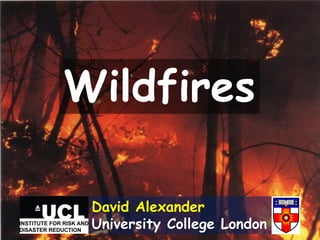
Wildfires
David Alexander
University College London
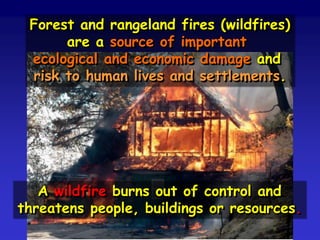
Forest and rangeland fires (wildfires)
are a source of important
ecological and economic damage and
risk to human lives and settlements.
A wildfire burns out of control and
threatens people, buildings or resources.
Synonyms:-
• bushfire (Australia)
• forest fire, range fire (North America)
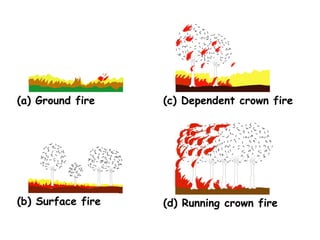
• environmental fire
• wildfire.
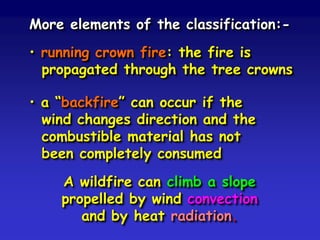
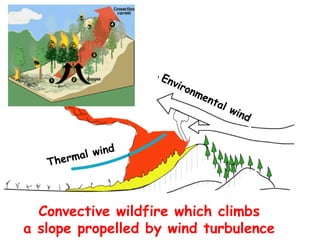
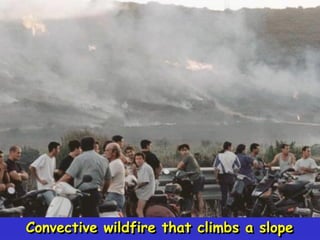
Phases of wildfire:-
• confined - limited to a
predetermined area using
natural and man-made barriers
• contained - surrounded by a control
line so that it cannot spread further
• under control - completely
encircled by the control line
and burning in predictable ways.
The causes of wildfires:-
• lightning strikes (a natural
cause of varied importance)
• human negligence and vandalism
(greatest at the
urban-rural interface)
• vegetative fermentation leading to
spontaneous combustion are possible
but not probable causes of wildfires.
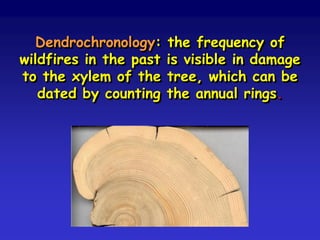
Dendrochronology: the frequency of
wildfires in the past is visible in damage
to the xylem of the tree, which can be
dated by counting the annual rings.
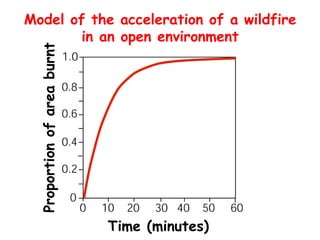
Model of the acceleration of a wildfire
in an open environment
Time (minutes)
Proportionofareaburnt
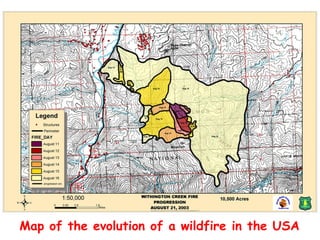
Map of the evolution of a wildfire in the USA
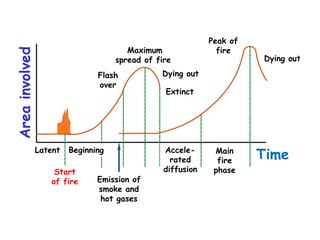
Areainvolved
Maximum
spread of fire
Peak of
fire
Dying out
Dying out
Extinct
Flash
over
Latent
Start
of fire
Accele-
rated
diffusion
Main
fire
phase
Time
Emission of
smoke and
hot gases
Beginning
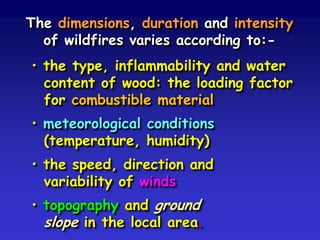
The dimensions, duration and intensity
of wildfires varies according to:-
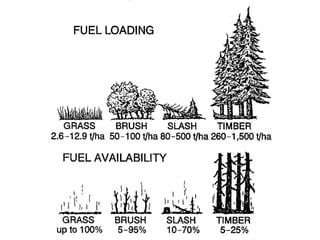
• the type, inflammability and water
content of wood: the loading factor
for combustible material
• meteorological conditions
(temperature, humidity)
• the speed, direction and
variability of winds
• topography and ground
slope in the local area.
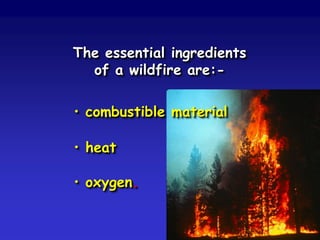
The essential ingredients
of a wildfire are:-
• combustible material
• heat
• oxygen.
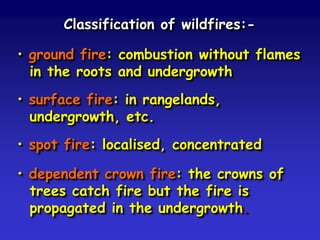
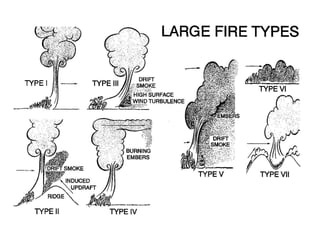
Classification of wildfires:-
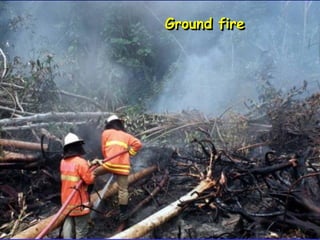
• ground fire: combustion without flames
in the roots and undergrowth
• surface fire: in rangelands,
undergrowth, etc.
• spot fire: localised, concentrated
• dependent crown fire: the crowns of
trees catch fire but the fire is
propagated in the undergrowth.
(a) Ground fire (c) Dependent crown fire
(d) Running crown fire(b) Surface fire
More elements of the classification:-
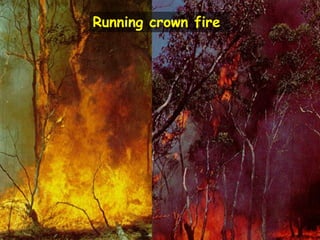
• running crown fire: the fire is
propagated through the tree crowns
• a “backfire” can occur if the
wind changes direction and the
combustible material has not
been completely consumed
A wildfire can climb a slope
propelled by wind convection
and by heat radiation.
Convective wildfire which climbs
a slope propelled by wind turbulence
Convective wildfire that climbs a slope
Ground fire
Running crown fire
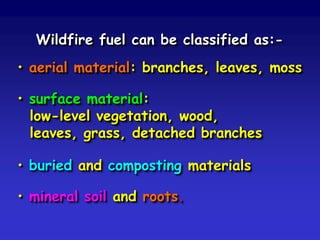
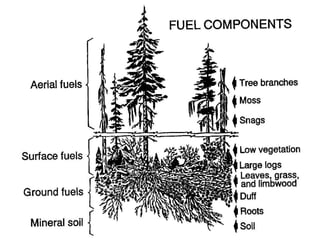
Wildfire fuel can be classified as:-
• aerial material: branches, leaves, moss
• surface material:
low-level vegetation, wood,
leaves, grass, detached branches
• buried and composting materials
• mineral soil and roots.
Some environmental effects
of wildfires:-
.... on vegetation:
• can stimulate the growth
of rangelands and meadows
• can encourage the germination of seeds
• can stimulate flowering
of bushes and plants
• but can restrict the
growth of woody plants.
.... on soil:
• they can purify soil by destroying
toxins, fungi and parasites
• but can accelerate erosion of the soil
.... on birds:
• can destroy nests and cause
fragmentation of habitats
Ecological environments created
or maintained by wildfire show
the greatest diversity of species.
Environmental effects of wildfires:-
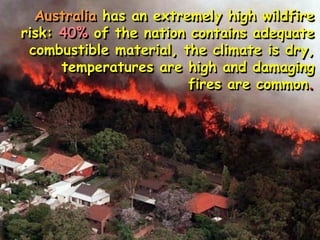
Australia has an extremely high wildfire
risk: 40% of the nation contains adequate
combustible material, the climate is dry,
temperatures are high and damaging
fires are common.
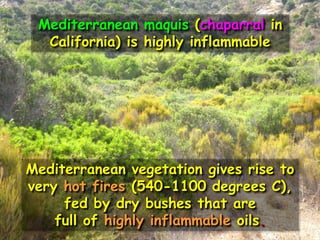
Mediterranean maquis (chaparral in
California) is highly inflammable
Mediterranean vegetation gives rise to
very hot fires (540-1100 degrees C),
fed by dry bushes that are
full of highly inflammable oils.
The elimination of Mediterranean
vegetation by wildfire can:-
• impermeabilise surfaces by depositing
natural polymers (hydrophobic residues)
• cause surface slides of dry ravel
• cause mudflows and debris flows
• contribute to the formation of gullies.
Mitigation of wildfire:-
• controlled fire - can reduce fuel
loading levels, but it remains
controversial and can cause damage
• total elimination of wildfires allows
massive accumulations of inflammable
material and therefore leads
to much bigger and hotter
fires that spread more rapidly.
Monitoring of wildfire risk:-
• lookout towers and field patrols
• aerial surveillance
• infrared monitoring from the
ground, the air and satellites.
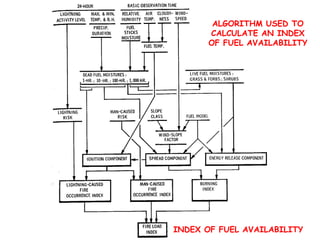
INDEX OF FUEL AVAILABILITY
ALGORITHM USED TO
CALCULATE AN INDEX
OF FUEL AVAILABILITY
Wildfire fighting:-
• one needs to reduce the supply of
heat, oxygen or fuel to the fire
The attack:
• train personnel
• use parachute brigades in areas
that are difficult to reach
• construct corridors of low fuel loading.
The attack:
• dump water or flame retardant
chemicals from aircraft
• Canadair CL-215 "Super Scooper"
aircraft are able to take up
6,000 litres of water in 12 seconds
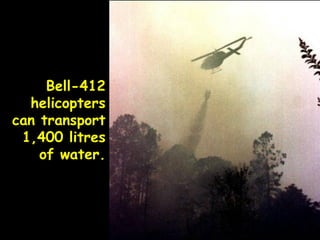
• drop water on flames from helicopters.
Bell-412
helicopters
can transport
1,400 litres
of water.
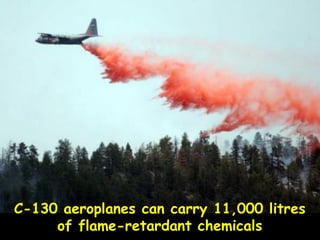
C-130 aeroplanes can carry 11,000 litres
of flame-retardant chemicals
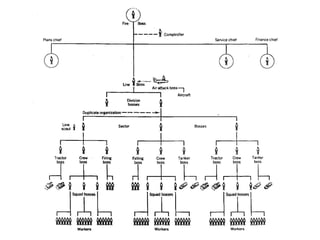
California Firescope, a centralised
system of fire fighting:-
• an Incident Command System (ICS)
• a coordination system for various
agencies that work in the field
(Multi-Agency Coordinating System,
MACS) -- for 28 agencies
• an Operations Coordination
Center (OCC) for field attacks.
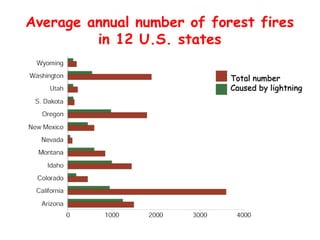
Average annual number of forest fires
in 12 U.S. states
Total number
Caused by lightning
California Firescope includes an information
system and data bank, which covers:-
• weather forecasting
• infrared surveillance of areas
at greatest risk of wildfires
• immediate reports on the state
of fires and suppression activities
• advice on the best tactics
to adopt for fighting fires.
[X]

Natural hazards wildfires

  • 1.
  • 2.
    Forest and rangelandfires (wildfires) are a source of important ecological and economic damage and risk to human lives and settlements. A wildfire burns out of control and threatens people, buildings or resources.
  • 3.
    Synonyms:- • bushfire (Australia) •forest fire, range fire (North America) • environmental fire • wildfire.
  • 4.
    Phases of wildfire:- •confined - limited to a predetermined area using natural and man-made barriers • contained - surrounded by a control line so that it cannot spread further • under control - completely encircled by the control line and burning in predictable ways.
  • 5.
    The causes ofwildfires:- • lightning strikes (a natural cause of varied importance) • human negligence and vandalism (greatest at the urban-rural interface) • vegetative fermentation leading to spontaneous combustion are possible but not probable causes of wildfires.
  • 6.
    Dendrochronology: the frequencyof wildfires in the past is visible in damage to the xylem of the tree, which can be dated by counting the annual rings.
  • 7.
    Model of theacceleration of a wildfire in an open environment Time (minutes) Proportionofareaburnt
  • 8.
    Map of theevolution of a wildfire in the USA
  • 9.
    Areainvolved Maximum spread of fire Peakof fire Dying out Dying out Extinct Flash over Latent Start of fire Accele- rated diffusion Main fire phase Time Emission of smoke and hot gases Beginning
  • 10.
    The dimensions, durationand intensity of wildfires varies according to:- • the type, inflammability and water content of wood: the loading factor for combustible material • meteorological conditions (temperature, humidity) • the speed, direction and variability of winds • topography and ground slope in the local area.
  • 11.
    The essential ingredients ofa wildfire are:- • combustible material • heat • oxygen.
  • 12.
    Classification of wildfires:- •ground fire: combustion without flames in the roots and undergrowth • surface fire: in rangelands, undergrowth, etc. • spot fire: localised, concentrated • dependent crown fire: the crowns of trees catch fire but the fire is propagated in the undergrowth.
  • 13.
    (a) Ground fire(c) Dependent crown fire (d) Running crown fire(b) Surface fire
  • 14.
    More elements ofthe classification:- • running crown fire: the fire is propagated through the tree crowns • a “backfire” can occur if the wind changes direction and the combustible material has not been completely consumed A wildfire can climb a slope propelled by wind convection and by heat radiation.
  • 15.
    Convective wildfire whichclimbs a slope propelled by wind turbulence
  • 16.
  • 17.
  • 18.
  • 20.
    Wildfire fuel canbe classified as:- • aerial material: branches, leaves, moss • surface material: low-level vegetation, wood, leaves, grass, detached branches • buried and composting materials • mineral soil and roots.
  • 23.
    Some environmental effects ofwildfires:- .... on vegetation: • can stimulate the growth of rangelands and meadows • can encourage the germination of seeds • can stimulate flowering of bushes and plants • but can restrict the growth of woody plants.
  • 24.
    .... on soil: •they can purify soil by destroying toxins, fungi and parasites • but can accelerate erosion of the soil .... on birds: • can destroy nests and cause fragmentation of habitats Ecological environments created or maintained by wildfire show the greatest diversity of species. Environmental effects of wildfires:-
  • 25.
    Australia has anextremely high wildfire risk: 40% of the nation contains adequate combustible material, the climate is dry, temperatures are high and damaging fires are common.
  • 26.
    Mediterranean maquis (chaparralin California) is highly inflammable Mediterranean vegetation gives rise to very hot fires (540-1100 degrees C), fed by dry bushes that are full of highly inflammable oils.
  • 27.
    The elimination ofMediterranean vegetation by wildfire can:- • impermeabilise surfaces by depositing natural polymers (hydrophobic residues) • cause surface slides of dry ravel • cause mudflows and debris flows • contribute to the formation of gullies.
  • 28.
    Mitigation of wildfire:- •controlled fire - can reduce fuel loading levels, but it remains controversial and can cause damage • total elimination of wildfires allows massive accumulations of inflammable material and therefore leads to much bigger and hotter fires that spread more rapidly.
  • 29.
    Monitoring of wildfirerisk:- • lookout towers and field patrols • aerial surveillance • infrared monitoring from the ground, the air and satellites.
  • 30.
    INDEX OF FUELAVAILABILITY ALGORITHM USED TO CALCULATE AN INDEX OF FUEL AVAILABILITY
  • 31.
    Wildfire fighting:- • oneneeds to reduce the supply of heat, oxygen or fuel to the fire The attack: • train personnel • use parachute brigades in areas that are difficult to reach • construct corridors of low fuel loading.
  • 32.
    The attack: • dumpwater or flame retardant chemicals from aircraft • Canadair CL-215 "Super Scooper" aircraft are able to take up 6,000 litres of water in 12 seconds • drop water on flames from helicopters.
  • 33.
  • 34.
    C-130 aeroplanes cancarry 11,000 litres of flame-retardant chemicals
  • 35.
    California Firescope, acentralised system of fire fighting:- • an Incident Command System (ICS) • a coordination system for various agencies that work in the field (Multi-Agency Coordinating System, MACS) -- for 28 agencies • an Operations Coordination Center (OCC) for field attacks.
  • 37.
    Average annual numberof forest fires in 12 U.S. states Total number Caused by lightning
  • 38.
    California Firescope includesan information system and data bank, which covers:- • weather forecasting • infrared surveillance of areas at greatest risk of wildfires • immediate reports on the state of fires and suppression activities • advice on the best tactics to adopt for fighting fires. [X]