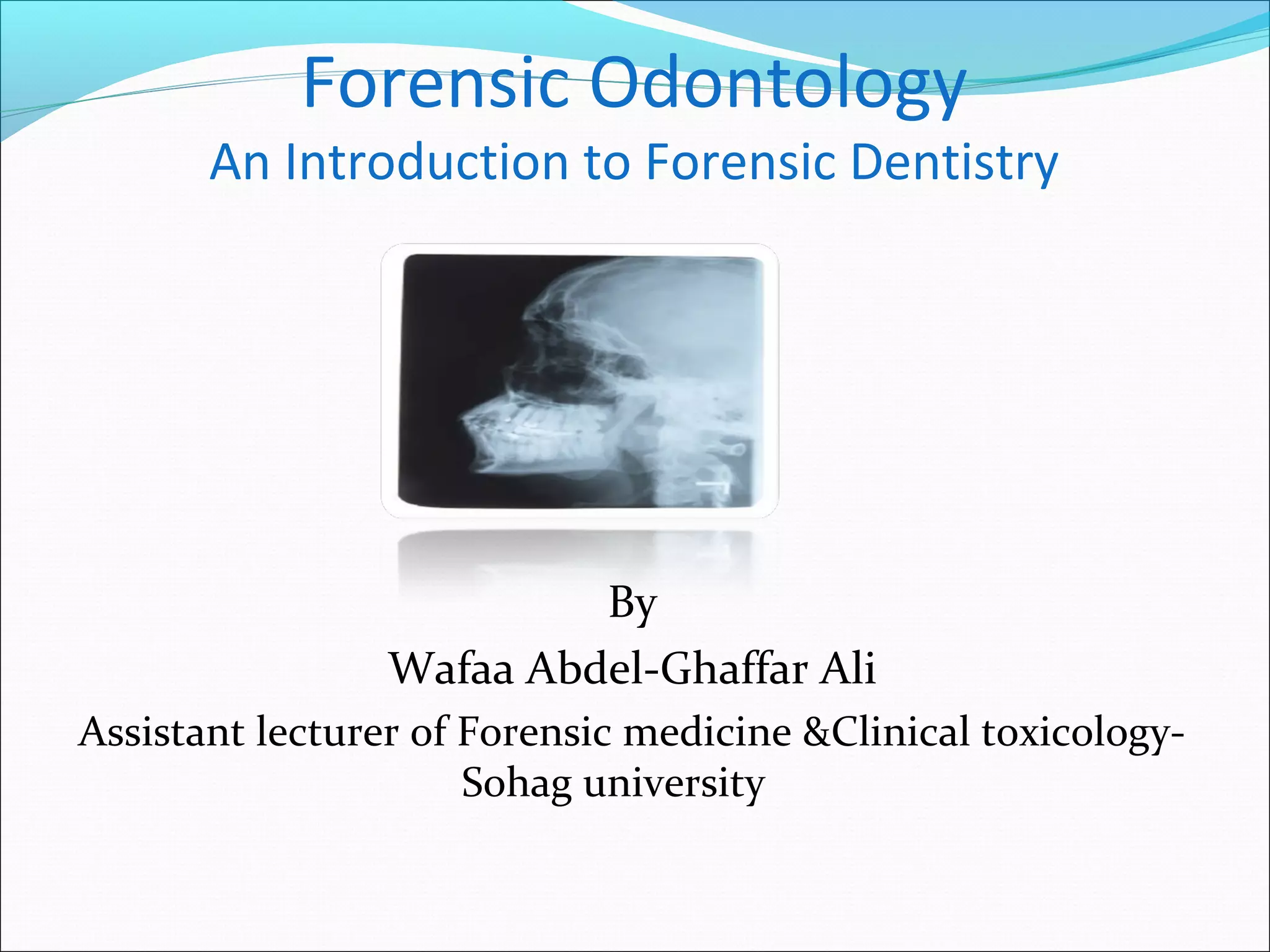
Forensic Odontology
An Introduction to Forensic Dentistry
By
Wafaa Abdel-Ghaffar Ali
Assistant lecturer of Forensic medicine &Clinical toxicology-
Sohag university
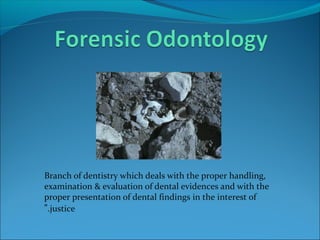
Branch of dentistry which deals with the proper handling,
examination & evaluation of dental evidences and with the
proper presentation of dental findings in the interest of
justice.”
Why Teeth?
Every human body ages in a similar manner, the teeth also
follow a semi-standardized pattern. These measurements help
relative age estimation of person.
Each human has an individual set of teeth which can be traced
back to established dental records to find missing individuals.
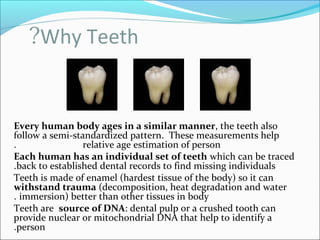
Teeth is made of enamel (hardest tissue of the body) so it can
withstand trauma (decomposition, heat degradation and water
immersion) better than other tissues in body.
Teeth are source of DNA: dental pulp or a crushed tooth can
provide nuclear or mitochondrial DNA that help to identify a
person.
Role of forensic odontology
1.identifying unknown human remains through dental
records & cranio-facial bones
2.age estimation of both the living and deceased
3.recognition and analysis of bite marks found on victims
4.analysis of oro-facial trauma associated with person abuse
5.determining the gender of unidentified individual
6.eliciting the ethnicity from the skeletal remains
7.building up a picture of lifestyle and diet of skeletal
remains
Historic milestones in forensic dentistry
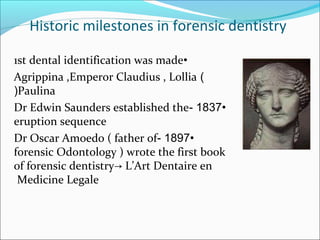
•1st dental identification was made
)Agrippina ,Emperor Claudius , Lollia
Paulina(
•1837-Dr Edwin Saunders established the
eruption sequence
•1897-Dr Oscar Amoedo ( father of
forensic Odontology ) wrote the first book
of forensic dentistry L’Art Dentaire en→
Medicine Legale
Historic milestones in forensic dentistry
•AMERICAN SOCIETY OF FORENSIC DENTISTRY
(1970(
•INTERNATIONAL SOCIETY FOR FORENSIC
ODONTO-STOMATOLOGY (1976(
•Similar organizations exist in various countries
Organizations of Forensic
Odontology
Bureau of Legal Dentistry (BOLD(
American Board of Forensic
Odontology (ABFO(
International Organization for
Forensic Odonto-Stomatology
(IOFOS(
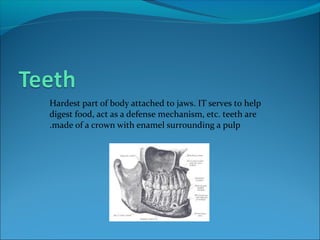
Hardest part of body attached to jaws. IT serves to help
digest food, act as a defense mechanism, etc. teeth are
made of a crown with enamel surrounding a pulp.
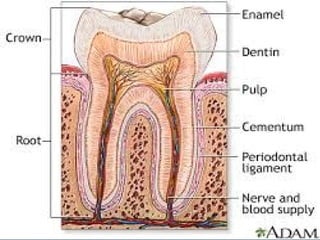
•Each tooth has a crown (visible portion that protrudes
above gum) and a root (embedded into the socket in the jaw
bone(
•Crown is capped by enamel , under the enamel is a layer of
dentin which surrounds the pulp cavity
•The root is surrounded by cementum
•Periodontal ligament present between cementum and bone
of the jaw holds the tooth in jaw
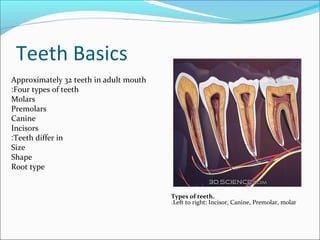
Teeth Basics
Approximately 32 teeth in adult mouth
Four types of teeth:
Molars
Premolars
Canine
Incisors
Teeth differ in:
Size
Shape
Root type
Types of teeth.
Left to right: Incisor, Canine, Premolar, molar.
:Each tooth has 5 surfaces
•Incisal/occlusal Surface
•Buccal/labial/facial surface
•Lingual/palatal surface
•Mesial surface
•Distal surface
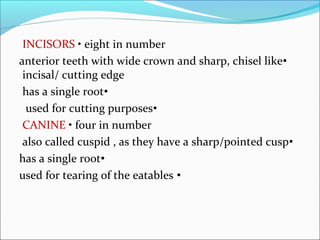
INCISORS • eight in number
•anterior teeth with wide crown and sharp, chisel like
incisal/ cutting edge
•has a single root
•used for cutting purposes
CANINE • four in number
•also called cuspid , as they have a sharp/pointed cusp
•has a single root
•used for tearing of the eatables
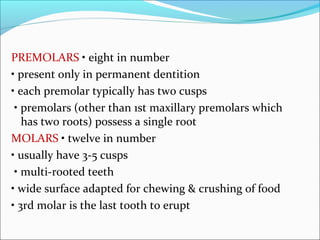
PREMOLARS • eight in number
• present only in permanent dentition
• each premolar typically has two cusps
• premolars (other than 1st maxillary premolars which
has two roots) possess a single root
MOLARS • twelve in number
• usually have 3-5 cusps
• multi-rooted teeth
• wide surface adapted for chewing & crushing of food
• 3rd molar is the last tooth to erupt
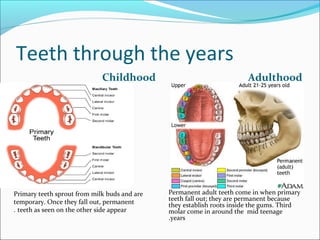
Teeth through the years
Childhood Adulthood
Primary teeth sprout from milk buds and are
temporary. Once they fall out, permanent
teeth as seen on the other side appear.
Permanent adult teeth come in when primary
teeth fall out; they are permanent because
they establish roots inside the gums. Third
molar come in around the mid teenage
years.
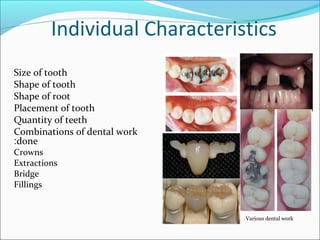
Individual Characteristics
Size of tooth
Shape of tooth
Shape of root
Placement of tooth
Quantity of teeth
Combinations of dental work
done:
Crowns
Extractions
Bridge
Fillings
Various dental work
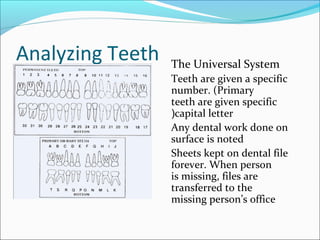
Analyzing Teeth The Universal System
Teeth are given a specific
number. (Primary
teeth are given specific
capital letter(
Any dental work done on
surface is noted
Sheets kept on dental file
forever. When person
is missing, files are
transferred to the
missing person’s office
Personal identification based on
dentition
Reconstructive identification (DENTAL PROFILING( :
when ante-mortem records are not available
•includes a triad of ethnic origin , gender , age
Identifying ethnic origin from teeth
characteristic dental features have evolved over time as
a result of genetic and environmental factors that
have influenced different population groups
(Caucasoid, Negroid, Mongoloid(.
•categorized as -metric (tooth size(
-non metric (tooth shape(.
•Metric features are based on measurements
•Non metric in terms of presence or absence of a
particular feature
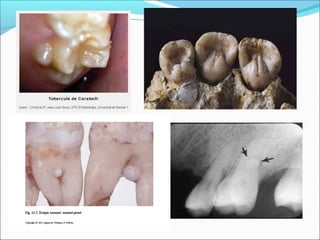
In Caucasian races:
-lateral incisors in the upper jaw smaller than
central especially in females.
-long pointed canine roots.
-carabelli’s cusp
In Mongoloid races:
-shovel –shaped upper central incisors.
-enamel –pearls
Sex determination by forensic
odontologist
•Gender can be determined based on data from
1-Craniofacial morphology and dimensions
2-Sex differences in tooth size
3-Tooth morphology
4-Sex determination by DNA analysis.
Sex determination
•Mandibular cuspid shows the maximum sexual
dimorphism.
It’s usually smaller and more pointed in females
relative to males.
Root length of maxillary cuspid is >3 mm in males
Mandibular first molar often lacks afifth cusp in
females, which is almost always present in males.
Dental age estimation
•Examining teeth eruption patterns
•Gustafson method (looking for six signs of wear(
•Lamendin method (looking at transparency of
roots/dentin translucency(
•Amino acid racemisation
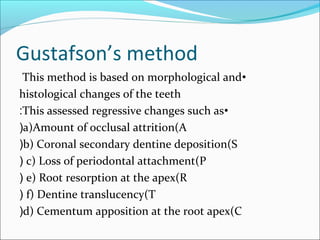
Gustafson’s method
•This method is based on morphological and
histological changes of the teeth
•This assessed regressive changes such as:
a)Amount of occlusal attrition(A(
b) Coronal secondary dentine deposition(S(
c) Loss of periodontal attachment(P(
e) Root resorption at the apex(R(
f) Dentine translucency(T(
d) Cementum apposition at the root apex(C(
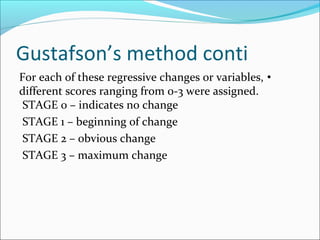
Gustafson’s method conti
•For each of these regressive changes or variables,
different scores ranging from 0-3 were assigned.
STAGE 0 – indicates no change
STAGE 1 – beginning of change
STAGE 2 – obvious change
STAGE 3 – maximum change
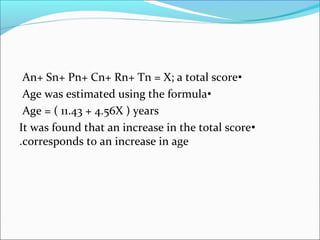
•An+ Sn+ Pn+ Cn+ Rn+ Tn = X; a total score
•Age was estimated using the formula
Age = ( 11.43 + 4.56X ) years
•It was found that an increase in the total score
corresponds to an increase in age.
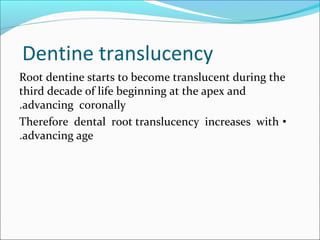
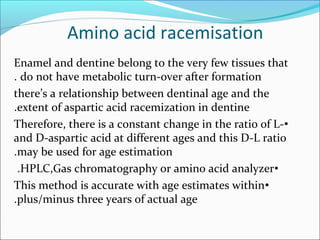
Dentine translucency
Root dentine starts to become translucent during the
third decade of life beginning at the apex and
advancing coronally.
•Therefore dental root translucency increases with
advancing age.
Amino acid racemisation
Enamel and dentine belong to the very few tissues that
do not have metabolic turn-over after formation.
there’s a relationship between dentinal age and the
extent of aspartic acid racemization in dentine.
•Therefore, there is a constant change in the ratio of L-
and D-aspartic acid at different ages and this D-L ratio
may be used for age estimation.
•HPLC,Gas chromatography or amino acid analyzer.
•This method is accurate with age estimates within
plus/minus three years of actual age.
Shortcomings of dental identification method
•Difficult to locate than fingerprints
•Records may be inadequate
•No standardization of dental records (no recognized
minimum no. of concordant features required for
positive identification(
•Alterations (decayed , filled or extracted) after the last
ante-mortem entry
Identification from dental DNA
•Since teeth can resist extreme conditions, they are the
excellent source of DNA.
•This facilitates comparison with the known biological
ante-mortem sample of the person such as hair,
epithelial cells from a tooth brush or a biopsy
specimen.
•If the persons ante-mortem sample is unavailable, the
DNA pattern may be compared to a parent or a
sibling, .thus allowing identification
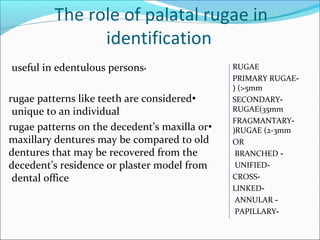
The role of palatal rugae in
identification
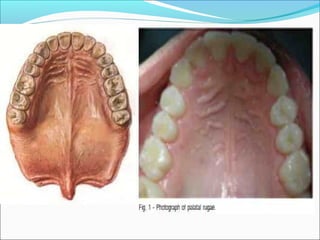
•useful in edentulous persons
•rugae patterns like teeth are considered
unique to an individual
•rugae patterns on the decedent’s maxilla or
maxillary dentures may be compared to old
dentures that may be recovered from the
decedent’s residence or plaster model from
dental office
RUGAE
-PRIMARY RUGAE
(>5mm(
-SECONDARY
RUGAE(35mm
-FRAGMANTARY
RUGAE (2-3mm(
OR
-BRANCHED
-UNIFIED
-CROSS
-LINKED
-ANNULAR
-PAPILLARY
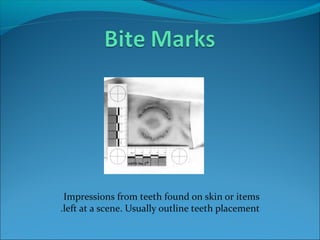
Impressions from teeth found on skin or items
left at a scene. Usually outline teeth placement.
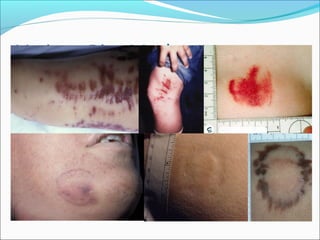
•A mark caused by teeth either alone or in combination with
other mouth parts.
•May be caused by humans or animals; may be on tissue, food
items or other objects.
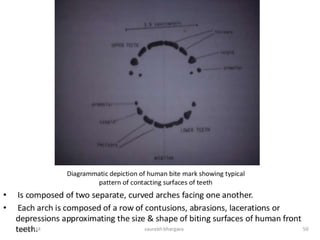
Human bite ››››broad, U-shaped somewhat circular or oval.
•Animal bite ›››› V-shaped and elongated also morphology of the
teeth is different
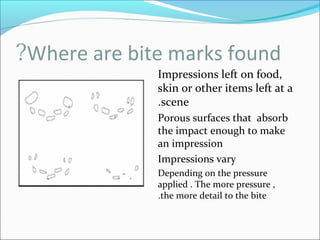
Where are bite marks found?
Impressions left on food,
skin or other items left at a
scene.
Porous surfaces that absorb
the impact enough to make
an impression
Impressions vary
Depending on the pressure
applied . The more pressure ,
the more detail to the bite.
twins. identical even in • Each human dentition is unique,
•Its imprint in skin can show this individualization, making
the identification of perpetrator possible
•For this reason, bite marks have been referred to as “dental
fingerprints”.
•Human bite is described as an elliptical or circular injury that
records the specific characteristics of the teeth
Class features:
◊Incisor ›››› rectangular
◊Canines ›››› triangular or rectangular
◊Premolars and molars ›››› spherical or point shaped
Individual features: Rotation, Dental work, fracture etc.
•Alternatively, it may be composed of two U-shaped arches that
are separated at their bases by an open space.
•The diameter of the injury typically ranges from 25-40 mm.
)Sexual assault(
◊• Females ››› Breast, inner sides of thigh and legs
)◊• Children ››› genitals, oral & paraoral regions (child abuse
◊• Adult Males ››› finger, arms and shoulders (fight(
1.Cameron and Sims Classification
A)Causing Agents -Humans -Animals
B)Substrate Materials -Skin , body tissue -Food stuff -Other
materials
2.Mac Donald’s classifications
-Tooth pressure mark
-Tongue pressure mark
-Tooth scrape mark
3.
a. hemorrhage -- small bleeding spot
b. abrasion -- undamaging mark on skin
c. contusion -- ruptured blood vessel, bruise
d. laceration -- torn skin
e. incision -- neat puncture of skin
f. avulsion -- removal of skin
•Bite mark evidence collection from the victims:
Steps: 1.Visual examination
2.Photography -Orientation photographs -close-up photographs
3.Saliva swab: -WBC and sloughed epithelial cells, potential
source of DNA
4.Impression: dental acrylic & plaster
•Evidence collection from suspect:
using informed consents or a court order , also include
photograph, two casts, bite registration and saliva swab from
buccal vestibule
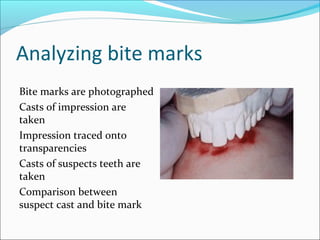
Analyzing bite marks
Bite marks are photographed
Casts of impression are
taken
Impression traced onto
transparencies
Casts of suspects teeth are
taken
Comparison between
suspect cast and bite mark
Comparison features
•distance from cuspid to cuspid
•tooth alignment
•teeth width, thickness, spacing
•missing teeth
•wear patterns
•dental history including fillings, crowns, etc.
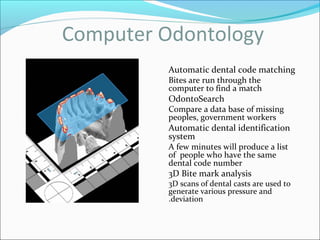
Computer Odontology
Automatic dental code matching
Bites are run through the
computer to find a match
OdontoSearch
Compare a data base of missing
peoples, government workers
Automatic dental identification
system
A few minutes will produce a list
of people who have the same
dental code number
3D Bite mark analysis
3D scans of dental casts are used to
generate various pressure and
deviation.
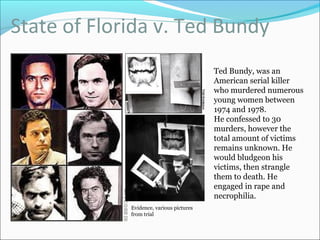
State of Florida v. Ted Bundy
Evidence, various pictures
from trial
Ted Bundy, was an
American serial killer
who murdered numerous
young women between
1974 and 1978.
He confessed to 30
murders, however the
total amount of victims
remains unknown. He
would bludgeon his
victims, then strangle
them to death. He
engaged in rape and
necrophilia.
THANK YOUTHANK YOU

Forensic odontology

  • 1.
    Forensic Odontology An Introductionto Forensic Dentistry By Wafaa Abdel-Ghaffar Ali Assistant lecturer of Forensic medicine &Clinical toxicology- Sohag university
  • 2.
    Branch of dentistrywhich deals with the proper handling, examination & evaluation of dental evidences and with the proper presentation of dental findings in the interest of justice.”
  • 3.
    Why Teeth? Every humanbody ages in a similar manner, the teeth also follow a semi-standardized pattern. These measurements help relative age estimation of person. Each human has an individual set of teeth which can be traced back to established dental records to find missing individuals. Teeth is made of enamel (hardest tissue of the body) so it can withstand trauma (decomposition, heat degradation and water immersion) better than other tissues in body. Teeth are source of DNA: dental pulp or a crushed tooth can provide nuclear or mitochondrial DNA that help to identify a person.
  • 4.
    Role of forensicodontology 1.identifying unknown human remains through dental records & cranio-facial bones 2.age estimation of both the living and deceased 3.recognition and analysis of bite marks found on victims 4.analysis of oro-facial trauma associated with person abuse 5.determining the gender of unidentified individual 6.eliciting the ethnicity from the skeletal remains 7.building up a picture of lifestyle and diet of skeletal remains
  • 5.
    Historic milestones inforensic dentistry •1st dental identification was made )Agrippina ,Emperor Claudius , Lollia Paulina( •1837-Dr Edwin Saunders established the eruption sequence •1897-Dr Oscar Amoedo ( father of forensic Odontology ) wrote the first book of forensic dentistry L’Art Dentaire en→ Medicine Legale
  • 6.
    Historic milestones inforensic dentistry •AMERICAN SOCIETY OF FORENSIC DENTISTRY (1970( •INTERNATIONAL SOCIETY FOR FORENSIC ODONTO-STOMATOLOGY (1976( •Similar organizations exist in various countries
  • 7.
    Organizations of Forensic Odontology Bureauof Legal Dentistry (BOLD( American Board of Forensic Odontology (ABFO( International Organization for Forensic Odonto-Stomatology (IOFOS(
  • 8.
    Hardest part ofbody attached to jaws. IT serves to help digest food, act as a defense mechanism, etc. teeth are made of a crown with enamel surrounding a pulp.
  • 9.
    •Each tooth hasa crown (visible portion that protrudes above gum) and a root (embedded into the socket in the jaw bone( •Crown is capped by enamel , under the enamel is a layer of dentin which surrounds the pulp cavity •The root is surrounded by cementum •Periodontal ligament present between cementum and bone of the jaw holds the tooth in jaw
  • 11.
    Teeth Basics Approximately 32teeth in adult mouth Four types of teeth: Molars Premolars Canine Incisors Teeth differ in: Size Shape Root type Types of teeth. Left to right: Incisor, Canine, Premolar, molar.
  • 12.
    :Each tooth has5 surfaces •Incisal/occlusal Surface •Buccal/labial/facial surface •Lingual/palatal surface •Mesial surface •Distal surface
  • 13.
    INCISORS • eightin number •anterior teeth with wide crown and sharp, chisel like incisal/ cutting edge •has a single root •used for cutting purposes CANINE • four in number •also called cuspid , as they have a sharp/pointed cusp •has a single root •used for tearing of the eatables
  • 14.
    PREMOLARS • eightin number • present only in permanent dentition • each premolar typically has two cusps • premolars (other than 1st maxillary premolars which has two roots) possess a single root MOLARS • twelve in number • usually have 3-5 cusps • multi-rooted teeth • wide surface adapted for chewing & crushing of food • 3rd molar is the last tooth to erupt
  • 15.
    Teeth through theyears Childhood Adulthood Primary teeth sprout from milk buds and are temporary. Once they fall out, permanent teeth as seen on the other side appear. Permanent adult teeth come in when primary teeth fall out; they are permanent because they establish roots inside the gums. Third molar come in around the mid teenage years.
  • 16.
    Individual Characteristics Size oftooth Shape of tooth Shape of root Placement of tooth Quantity of teeth Combinations of dental work done: Crowns Extractions Bridge Fillings Various dental work
  • 17.
    Analyzing Teeth TheUniversal System Teeth are given a specific number. (Primary teeth are given specific capital letter( Any dental work done on surface is noted Sheets kept on dental file forever. When person is missing, files are transferred to the missing person’s office
  • 18.
    Personal identification basedon dentition Reconstructive identification (DENTAL PROFILING( : when ante-mortem records are not available •includes a triad of ethnic origin , gender , age
  • 19.
    Identifying ethnic originfrom teeth characteristic dental features have evolved over time as a result of genetic and environmental factors that have influenced different population groups (Caucasoid, Negroid, Mongoloid(. •categorized as -metric (tooth size( -non metric (tooth shape(. •Metric features are based on measurements •Non metric in terms of presence or absence of a particular feature
  • 20.
    In Caucasian races: -lateralincisors in the upper jaw smaller than central especially in females. -long pointed canine roots. -carabelli’s cusp In Mongoloid races: -shovel –shaped upper central incisors. -enamel –pearls
  • 22.
    Sex determination byforensic odontologist •Gender can be determined based on data from 1-Craniofacial morphology and dimensions 2-Sex differences in tooth size 3-Tooth morphology 4-Sex determination by DNA analysis.
  • 23.
    Sex determination •Mandibular cuspidshows the maximum sexual dimorphism. It’s usually smaller and more pointed in females relative to males. Root length of maxillary cuspid is >3 mm in males Mandibular first molar often lacks afifth cusp in females, which is almost always present in males.
  • 24.
    Dental age estimation •Examiningteeth eruption patterns •Gustafson method (looking for six signs of wear( •Lamendin method (looking at transparency of roots/dentin translucency( •Amino acid racemisation
  • 25.
    Gustafson’s method •This methodis based on morphological and histological changes of the teeth •This assessed regressive changes such as: a)Amount of occlusal attrition(A( b) Coronal secondary dentine deposition(S( c) Loss of periodontal attachment(P( e) Root resorption at the apex(R( f) Dentine translucency(T( d) Cementum apposition at the root apex(C(
  • 26.
    Gustafson’s method conti •Foreach of these regressive changes or variables, different scores ranging from 0-3 were assigned. STAGE 0 – indicates no change STAGE 1 – beginning of change STAGE 2 – obvious change STAGE 3 – maximum change
  • 27.
    •An+ Sn+ Pn+Cn+ Rn+ Tn = X; a total score •Age was estimated using the formula Age = ( 11.43 + 4.56X ) years •It was found that an increase in the total score corresponds to an increase in age.
  • 28.
    Dentine translucency Root dentinestarts to become translucent during the third decade of life beginning at the apex and advancing coronally. •Therefore dental root translucency increases with advancing age.
  • 30.
    Amino acid racemisation Enameland dentine belong to the very few tissues that do not have metabolic turn-over after formation. there’s a relationship between dentinal age and the extent of aspartic acid racemization in dentine. •Therefore, there is a constant change in the ratio of L- and D-aspartic acid at different ages and this D-L ratio may be used for age estimation. •HPLC,Gas chromatography or amino acid analyzer. •This method is accurate with age estimates within plus/minus three years of actual age.
  • 31.
    Shortcomings of dentalidentification method •Difficult to locate than fingerprints •Records may be inadequate •No standardization of dental records (no recognized minimum no. of concordant features required for positive identification( •Alterations (decayed , filled or extracted) after the last ante-mortem entry
  • 32.
    Identification from dentalDNA •Since teeth can resist extreme conditions, they are the excellent source of DNA. •This facilitates comparison with the known biological ante-mortem sample of the person such as hair, epithelial cells from a tooth brush or a biopsy specimen. •If the persons ante-mortem sample is unavailable, the DNA pattern may be compared to a parent or a sibling, .thus allowing identification
  • 33.
    The role ofpalatal rugae in identification •useful in edentulous persons •rugae patterns like teeth are considered unique to an individual •rugae patterns on the decedent’s maxilla or maxillary dentures may be compared to old dentures that may be recovered from the decedent’s residence or plaster model from dental office RUGAE -PRIMARY RUGAE (>5mm( -SECONDARY RUGAE(35mm -FRAGMANTARY RUGAE (2-3mm( OR -BRANCHED -UNIFIED -CROSS -LINKED -ANNULAR -PAPILLARY
  • 35.
    Impressions from teethfound on skin or items left at a scene. Usually outline teeth placement.
  • 36.
    •A mark causedby teeth either alone or in combination with other mouth parts. •May be caused by humans or animals; may be on tissue, food items or other objects. Human bite ››››broad, U-shaped somewhat circular or oval. •Animal bite ›››› V-shaped and elongated also morphology of the teeth is different
  • 37.
    Where are bitemarks found? Impressions left on food, skin or other items left at a scene. Porous surfaces that absorb the impact enough to make an impression Impressions vary Depending on the pressure applied . The more pressure , the more detail to the bite.
  • 38.
    twins. identical evenin • Each human dentition is unique, •Its imprint in skin can show this individualization, making the identification of perpetrator possible •For this reason, bite marks have been referred to as “dental fingerprints”.
  • 40.
    •Human bite isdescribed as an elliptical or circular injury that records the specific characteristics of the teeth Class features: ◊Incisor ›››› rectangular ◊Canines ›››› triangular or rectangular ◊Premolars and molars ›››› spherical or point shaped Individual features: Rotation, Dental work, fracture etc. •Alternatively, it may be composed of two U-shaped arches that are separated at their bases by an open space. •The diameter of the injury typically ranges from 25-40 mm.
  • 41.
    )Sexual assault( ◊• Females››› Breast, inner sides of thigh and legs )◊• Children ››› genitals, oral & paraoral regions (child abuse ◊• Adult Males ››› finger, arms and shoulders (fight(
  • 42.
    1.Cameron and SimsClassification A)Causing Agents -Humans -Animals B)Substrate Materials -Skin , body tissue -Food stuff -Other materials 2.Mac Donald’s classifications -Tooth pressure mark -Tongue pressure mark -Tooth scrape mark
  • 43.
    3. a. hemorrhage --small bleeding spot b. abrasion -- undamaging mark on skin c. contusion -- ruptured blood vessel, bruise d. laceration -- torn skin e. incision -- neat puncture of skin f. avulsion -- removal of skin
  • 45.
    •Bite mark evidencecollection from the victims: Steps: 1.Visual examination 2.Photography -Orientation photographs -close-up photographs 3.Saliva swab: -WBC and sloughed epithelial cells, potential source of DNA 4.Impression: dental acrylic & plaster •Evidence collection from suspect: using informed consents or a court order , also include photograph, two casts, bite registration and saliva swab from buccal vestibule
  • 46.
    Analyzing bite marks Bitemarks are photographed Casts of impression are taken Impression traced onto transparencies Casts of suspects teeth are taken Comparison between suspect cast and bite mark
  • 47.
    Comparison features •distance fromcuspid to cuspid •tooth alignment •teeth width, thickness, spacing •missing teeth •wear patterns •dental history including fillings, crowns, etc.
  • 48.
    Computer Odontology Automatic dentalcode matching Bites are run through the computer to find a match OdontoSearch Compare a data base of missing peoples, government workers Automatic dental identification system A few minutes will produce a list of people who have the same dental code number 3D Bite mark analysis 3D scans of dental casts are used to generate various pressure and deviation.
  • 49.
    State of Floridav. Ted Bundy Evidence, various pictures from trial Ted Bundy, was an American serial killer who murdered numerous young women between 1974 and 1978. He confessed to 30 murders, however the total amount of victims remains unknown. He would bludgeon his victims, then strangle them to death. He engaged in rape and necrophilia.
  • 50.