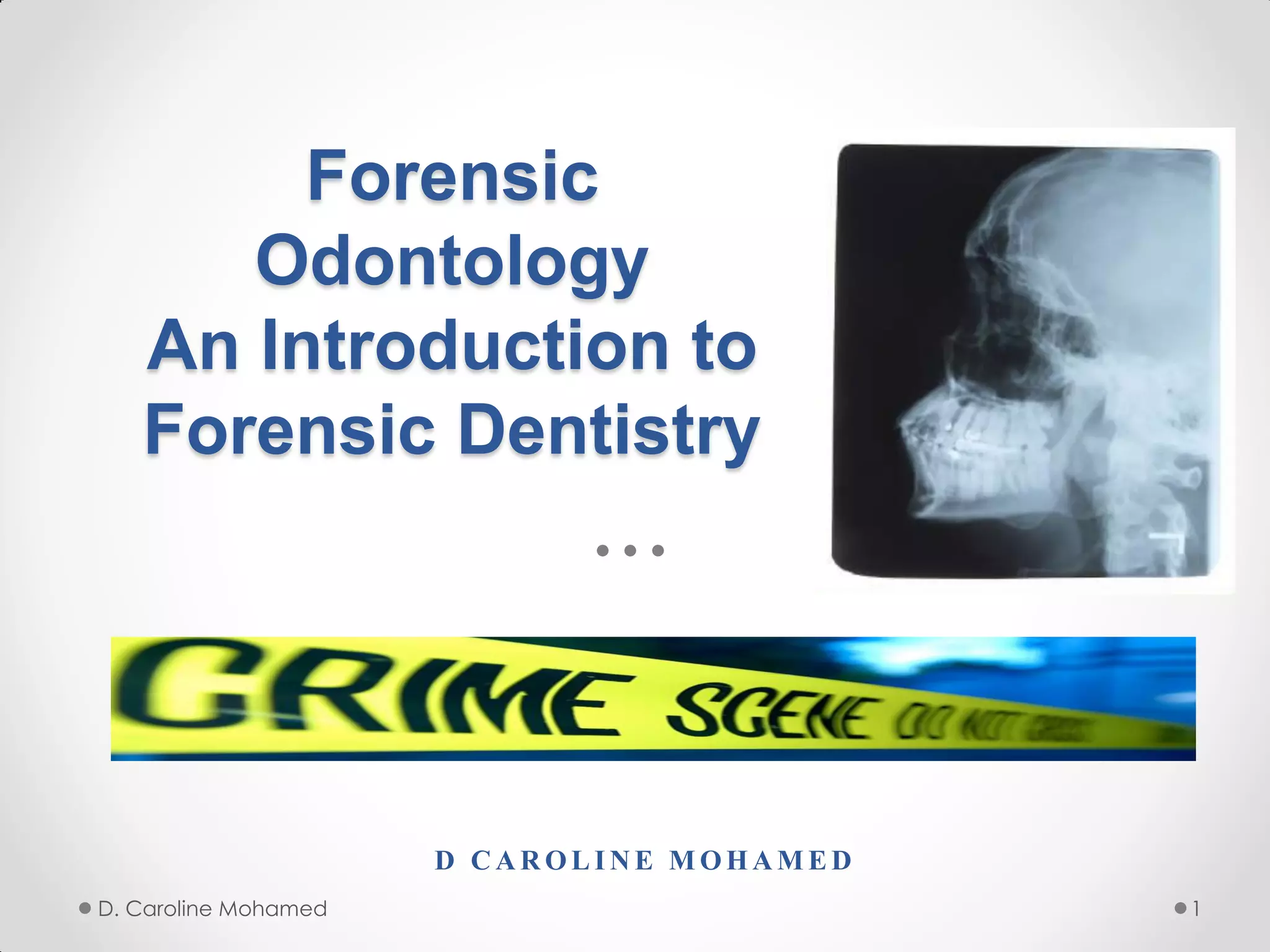
Forensic
Odontology
An Introduction to
Forensic Dentistry
D. Caroline Mohamed 1
D C A R O L I N E M O H A M E D
Objectives:
Students should be able to explain and
discuss:
o Definition of forensic dentistry
o Responsibility of forensic dentists
o Training for forensic odontology
o History of forensic odontology
o Bite marks
o Cases
o Computer aided forensic odontology
D. Caroline Mohamed 2
Forensic Odontology
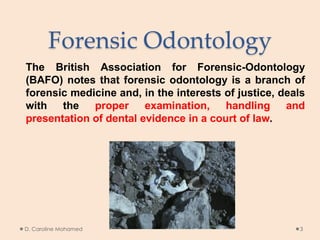
The British Association for Forensic-Odontology
(BAFO) notes that forensic odontology is a branch of
forensic medicine and, in the interests of justice, deals
with the proper examination, handling and
presentation of dental evidence in a court of law.
D. Caroline Mohamed 3
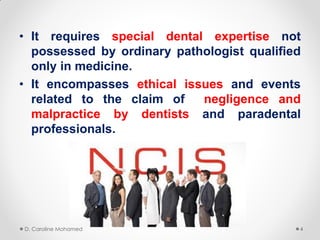
• It requires special dental expertise not
possessed by ordinary pathologist qualified
only in medicine.
• It encompasses ethical issues and events
related to the claim of negligence and
malpractice by dentists and paradental
professionals.
D. Caroline Mohamed 4
• To assist with forensic dentistry, dental
professionals need to
be aware of the importance of
keeping accurate,
current, detailed
and legible
dental records for the use of
identification.
D. Caroline Mohamed 5
Who practices Forensic Odontology and what do
they do?
 Forensic
Odontologists
• Must have DDS
degree
• Should have
specialized
training in the
field.
D. Caroline Mohamed 6
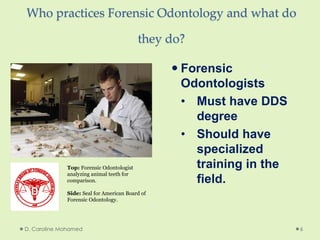
Top: Forensic Odontologist
analyzing animal teeth for
comparison.
Side: Seal for American Board of
Forensic Odontology.
Responsibility of forensic
odontology
1. Identification of found human remains
2. Identification in mass fatalities
3. Assessment of bite mark injuries
4. Assessment of cases of abuse (child,
spousal, elder)
5. Civil cases involving malpractice
6. Age estimation
D. Caroline Mohamed 7
History
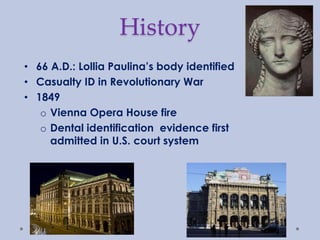
• 66 A.D.: Lollia Paulina’s body identified
• Casualty ID in Revolutionary War
• 1849
o Vienna Opera House fire
o Dental identification evidence first
admitted in U.S. court system
D. Caroline Mohamed 9
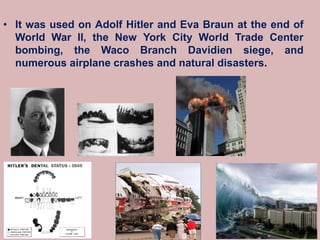
• It was used on Adolf Hitler and Eva Braun at the end of
World War II, the New York City World Trade Center
bombing, the Waco Branch Davidien siege, and
numerous airplane crashes and natural disasters.
Different situations for
identification
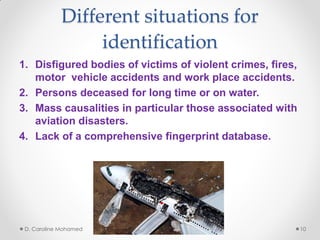
1. Disfigured bodies of victims of violent crimes, fires,
motor vehicle accidents and work place accidents.
2. Persons deceased for long time or on water.
3. Mass causalities in particular those associated with
aviation disasters.
4. Lack of a comprehensive fingerprint database.
D. Caroline Mohamed 10
Common reasons for identification of
found humans remains
• Criminal:
• An investigation to a criminal death cannot begin
until the victim has been positively identified.
• Marriage:
• Individuals from many religious backgrounds cannot
remarry unless their partners are confirmed
deceased.
• Monetary:
• The payment of pensions, life assurance and other
benefits relies upon positive confirmation of death.
D. Caroline Mohamed 11
• Burial:
• Many religious require that a positive identification
be made prior to burial.
• Social:
• Society’s duty to preserve human rights and dignity
beyond life begins with the basic premise of an
identity.
• Closure:
• The identification of individuals missed for
prolonged periods can bring sorrowful relief to
family members.
D. Caroline Mohamed 12
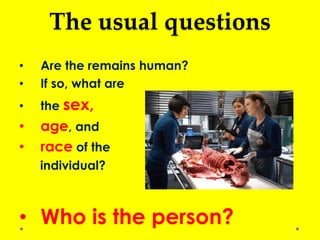
The usual questions
• Are the remains human?
• If so, what are
• the sex,
• age, and
• race of the
individual?
• Who is the person?
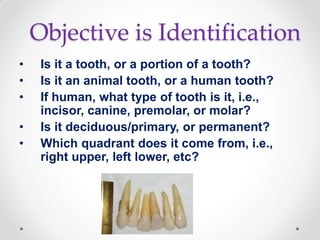
Objective is Identification
• Is it a tooth, or a portion of a tooth?
• Is it an animal tooth, or a human tooth?
• If human, what type of tooth is it, i.e.,
incisor, canine, premolar, or molar?
• Is it deciduous/primary, or permanent?
• Which quadrant does it come from, i.e.,
right upper, left lower, etc?
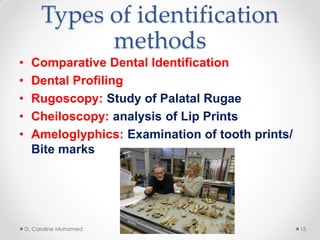
Types of identification
methods
• Comparative Dental Identification
• Dental Profiling
• Rugoscopy: Study of Palatal Rugae
• Cheiloscopy: analysis of Lip Prints
• Ameloglyphics: Examination of tooth prints/
Bite marks
D. Caroline Mohamed 15
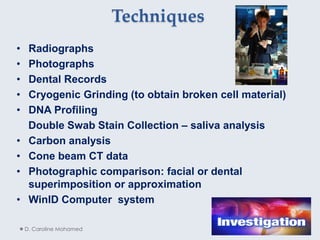
Techniques
• Radiographs
• Photographs
• Dental Records
• Cryogenic Grinding (to obtain broken cell material)
• DNA Profiling
Double Swab Stain Collection – saliva analysis
• Carbon analysis
• Cone beam CT data
• Photographic comparison: facial or dental
superimposition or approximation
• WinID Computer system
D. Caroline Mohamed 16
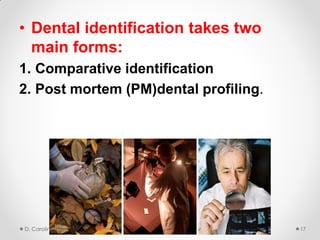
• Dental identification takes two
main forms:
1. Comparative identification
2. Post mortem (PM)dental profiling.
D. Caroline Mohamed 17
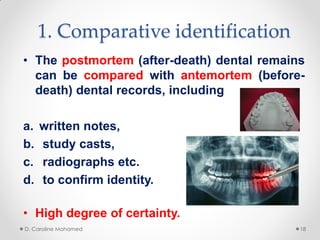
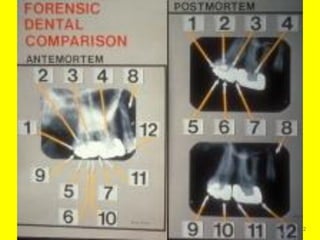
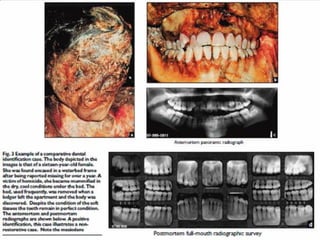
1. Comparative identification
• The postmortem (after-death) dental remains
can be compared with antemortem (before-
death) dental records, including
a. written notes,
b. study casts,
c. radiographs etc.
d. to confirm identity.
• High degree of certainty.
D. Caroline Mohamed 18
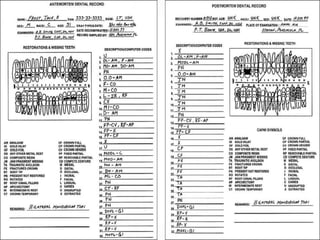
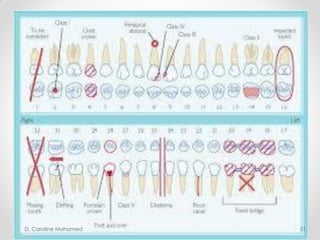
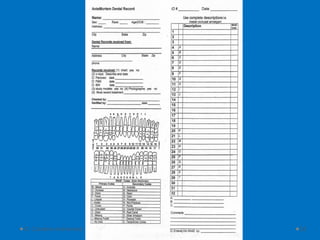
Be careful when filling
dental chart
D. Caroline Mohamed 19
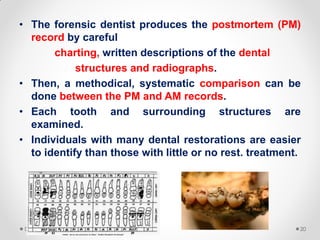
• The forensic dentist produces the postmortem (PM)
record by careful
charting, written descriptions of the dental
structures and radiographs.
• Then, a methodical, systematic comparison can be
done between the PM and AM records.
• Each tooth and surrounding structures are
examined.
• Individuals with many dental restorations are easier
to identify than those with little or no rest. treatment.
D. Caroline Mohamed 20
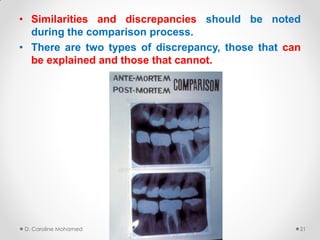
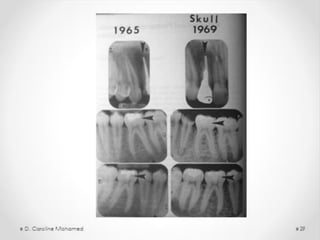
• Similarities and discrepancies should be noted
during the comparison process.
• There are two types of discrepancy, those that can
be explained and those that cannot.
D. Caroline Mohamed 21
D. Caroline Mohamed 22
D. Caroline Mohamed 23
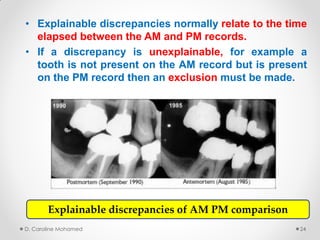
• Explainable discrepancies normally relate to the time
elapsed between the AM and PM records.
• If a discrepancy is unexplainable, for example a
tooth is not present on the AM record but is present
on the PM record then an exclusion must be made.
D. Caroline Mohamed 24
Explainable discrepancies of AM PM comparison
D. Caroline Mohamed 25
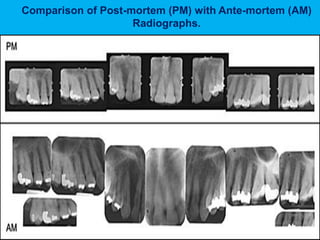
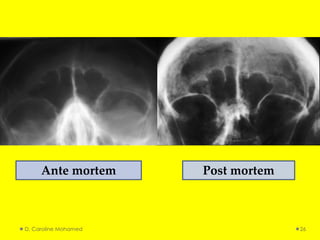
Comparison of Post-mortem (PM) with Ante-mortem (AM)
Radiographs.
D. Caroline Mohamed 26
Ante mortem Post mortem
D. Caroline Mohamed 27
Case
D. Caroline Mohamed 28
D. Caroline Mohamed 29
• When reporting dental identification, The American
Board of Forensic Odontology recommends that the
conclusions should be limited to the following four:
1. Positive identification
The AM and PM data match in sufficient detail to
establish that they are from the same person.
2. Possible identification
The AM and PM data has consistent features but,
because of the quality of either the PM or the AM
remains or the AM evidence, it is not possible to
establish identity positively.
D. Caroline Mohamed 30
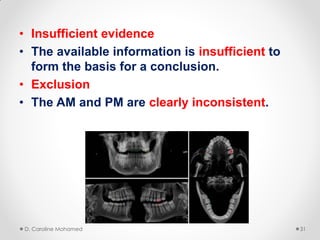
• Insufficient evidence
• The available information is insufficient to
form the basis for a conclusion.
• Exclusion
• The AM and PM are clearly inconsistent.
D. Caroline Mohamed 31
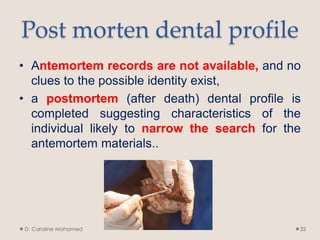
Post morten dental profile
• Antemortem records are not available, and no
clues to the possible identity exist,
• a postmortem (after death) dental profile is
completed suggesting characteristics of the
individual likely to narrow the search for the
antemortem materials..
D. Caroline Mohamed 32
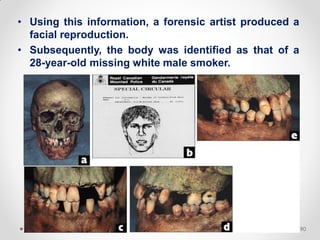
• Features like:
• age,
• sex,
• SES,
• sometimes habits,
• occupation,
• diet and
• diseases,
• can be acknowledged.
D. Caroline Mohamed 33
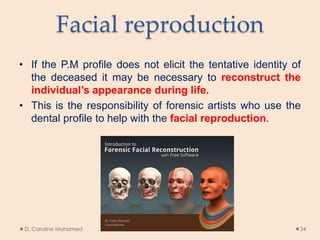
Facial reproduction
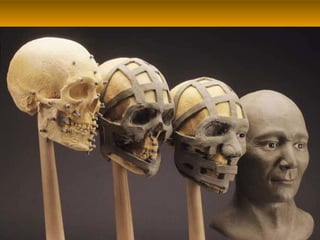
• If the P.M profile does not elicit the tentative identity of
the deceased it may be necessary to reconstruct the
individual’s appearance during life.
• This is the responsibility of forensic artists who use the
dental profile to help with the facial reproduction.
D. Caroline Mohamed 34
D. Caroline Mohamed 35
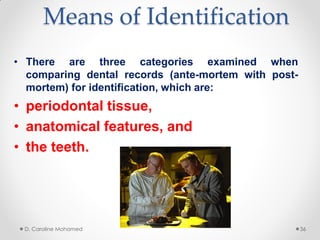
Means of Identification
• There are three categories examined when
comparing dental records (ante-mortem with post-
mortem) for identification, which are:
• periodontal tissue,
• anatomical features, and
• the teeth.
D. Caroline Mohamed 36
Means of Identification
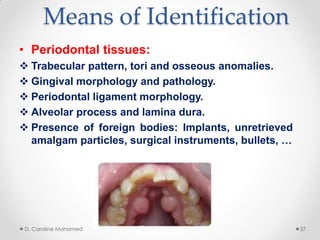
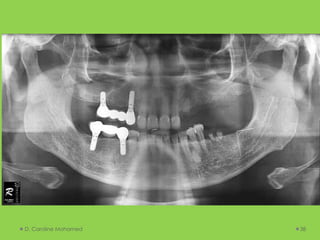
• Periodontal tissues:
 Trabecular pattern, tori and osseous anomalies.
 Gingival morphology and pathology.
 Periodontal ligament morphology.
 Alveolar process and lamina dura.
 Presence of foreign bodies: Implants, unretrieved
amalgam particles, surgical instruments, bullets, …
D. Caroline Mohamed 37
D. Caroline Mohamed 38
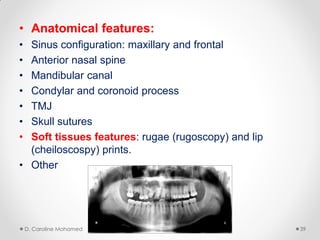
• Anatomical features:
• Sinus configuration: maxillary and frontal
• Anterior nasal spine
• Mandibular canal
• Condylar and coronoid process
• TMJ
• Skull sutures
• Soft tissues features: rugae (rugoscopy) and lip
(cheiloscospy) prints.
• Other
D. Caroline Mohamed 39
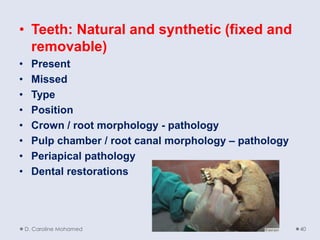
• Teeth: Natural and synthetic (fixed and
removable)
• Present
• Missed
• Type
• Position
• Crown / root morphology - pathology
• Pulp chamber / root canal morphology – pathology
• Periapical pathology
• Dental restorations
D. Caroline Mohamed 40
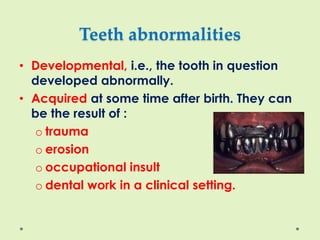
Teeth abnormalities
• Developmental, i.e., the tooth in question
developed abnormally.
• Acquired at some time after birth. They can
be the result of :
o trauma
o erosion
o occupational insult
o dental work in a clinical setting.
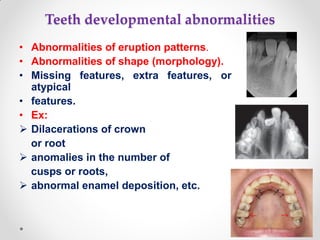
Teeth developmental abnormalities
• Abnormalities of eruption patterns.
• Abnormalities of shape (morphology).
• Missing features, extra features, or
atypical
• features.
• Ex:
 Dilacerations of crown
or root
 anomalies in the number of
cusps or roots,
 abnormal enamel deposition, etc.
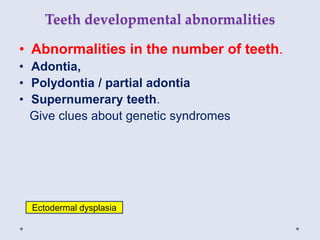
Teeth developmental abnormalities
• Abnormalities in the number of teeth.
• Adontia,
• Polydontia / partial adontia
• Supernumerary teeth.
Give clues about genetic syndromes
Ectodermal dysplasia
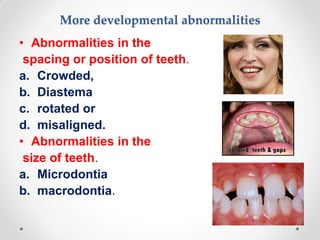
More developmental abnormalities
• Abnormalities in the
spacing or position of teeth.
a. Crowded,
b. Diastema
c. rotated or
d. misaligned.
• Abnormalities in the
size of teeth.
a. Microdontia
b. macrodontia.
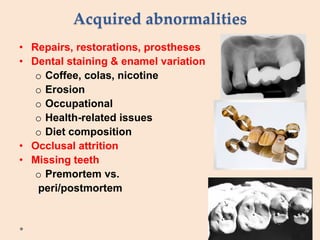
Acquired abnormalities
• Repairs, restorations, prostheses
• Dental staining & enamel variation
o Coffee, colas, nicotine
o Erosion
o Occupational
o Health-related issues
o Diet composition
• Occlusal attrition
• Missing teeth
o Premortem vs.
peri/postmortem
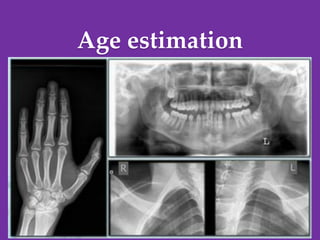
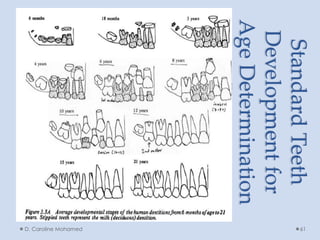
Age estimation
D. Caroline Mohamed 46
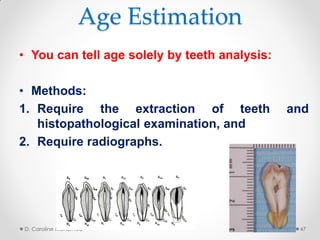
Age Estimation
• You can tell age solely by teeth analysis:
• Methods:
1. Require the extraction of teeth and
histopathological examination, and
2. Require radiographs.
D. Caroline Mohamed 47
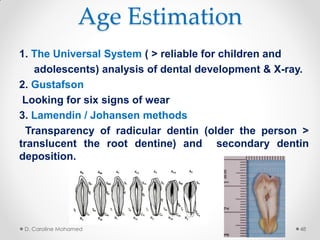
Age Estimation
1. The Universal System ( > reliable for children and
adolescents) analysis of dental development & X-ray.
2. Gustafson
Looking for six signs of wear
3. Lamendin / Johansen methods
Transparency of radicular dentin (older the person >
translucent the root dentine) and secondary dentin
deposition.
D. Caroline Mohamed 48
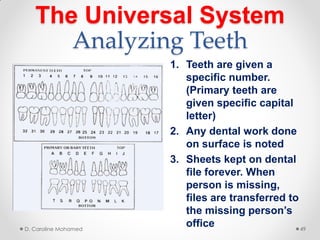
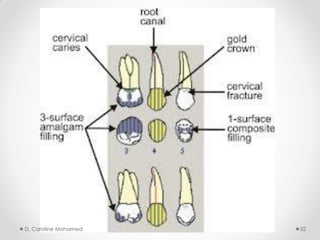
The Universal System
Analyzing Teeth
1. Teeth are given a
specific number.
(Primary teeth are
given specific capital
letter)
2. Any dental work done
on surface is noted
3. Sheets kept on dental
file forever. When
person is missing,
files are transferred to
the missing person’s
officeD. Caroline Mohamed 49
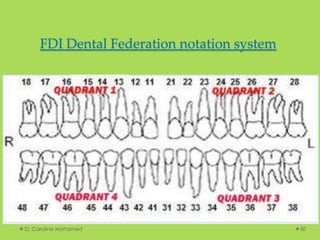
FDI Dental Federation notation system
D. Caroline Mohamed 50
D. Caroline Mohamed 51
D. Caroline Mohamed 52
D. Caroline Mohamed 53
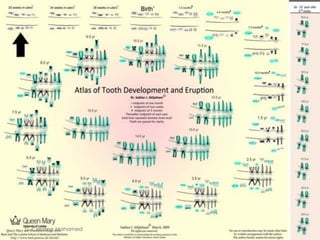
Teeth identification and
chronology
D. Caroline Mohamed 54
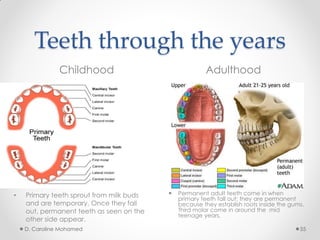
Teeth through the years
Childhood Adulthood
D. Caroline Mohamed 55
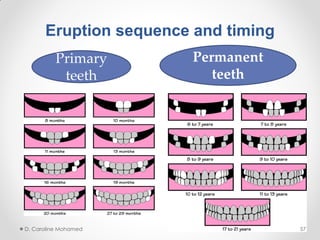
• Primary teeth sprout from milk buds
and are temporary. Once they fall
out, permanent teeth as seen on the
other side appear.
 Permanent adult teeth come in when
primary teeth fall out; they are permanent
because they establish roots inside the gums.
Third molar come in around the mid
teenage years.
D. Caroline Mohamed 56
Eruption sequence and timing
Primary
teeth
Permanent
teeth
D. Caroline Mohamed 57
D. Caroline Mohamed 58
D. Caroline Mohamed 59
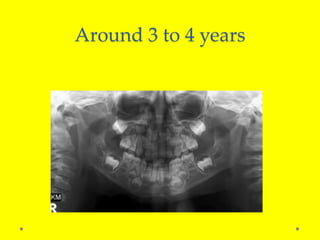
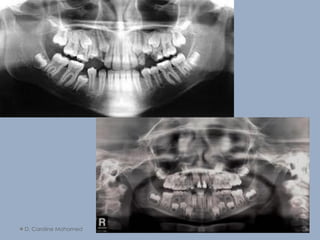
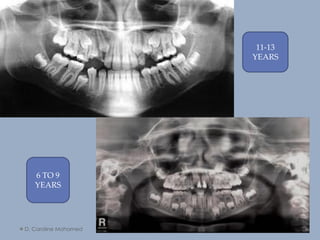
May you help me to
solve those cases?
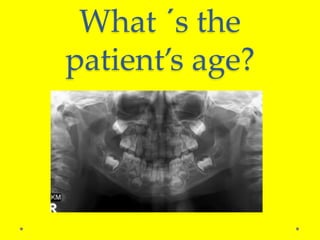
What ´s the
patient’s age?
StandardTeeth
Developmentfor
AgeDeterminationD. Caroline Mohamed 61
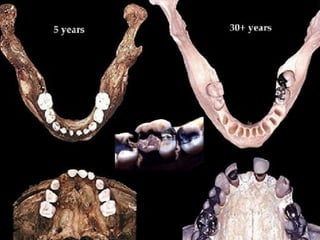
Around 3 to 4 years
D. Caroline Mohamed 63
D. Caroline Mohamed 64
11-13
YEARS
6 TO 9
YEARS
D. Caroline Mohamed 65
D. Caroline Mohamed 66
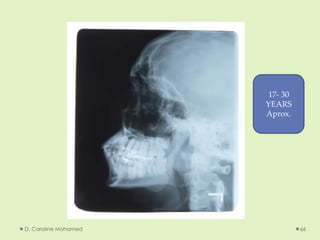
17- 30
YEARS
Aprox.
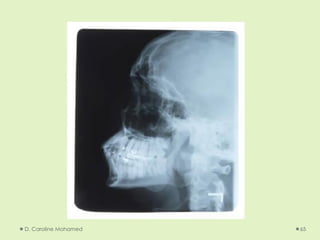
Estimating age
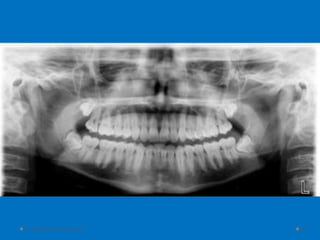
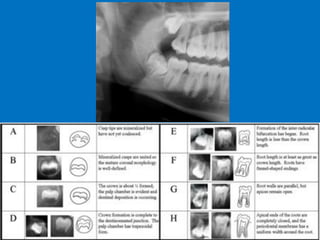
• Third molar in age estimation:
• A valuable indicator in the age 16-23 years but
questionable now a days due
to great variation in genesis, position,
morphology and time of formation
D. Caroline Mohamed 67
Estimating age
• The third molar may provide reasonable accuracy for
the likelihood that a person is
at least 18 years of age,
rather than giving the exact chronological age,
due to the absence of any other marker
in the late adolescence.
• Regression formulas can be calculated and
statistical analyses gives the correlation between the
findings and possible age for a specific population.
D. Caroline Mohamed 68
D. Caroline Mohamed 69
D. Caroline Mohamed 70
D. Caroline Mohamed 71
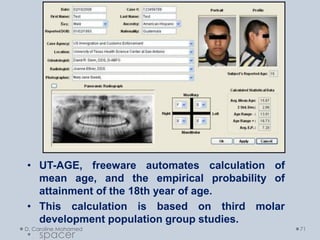
• UT-AGE, freeware automates calculation of
mean age, and the empirical probability of
attainment of the 18th year of age.
• This calculation is based on third molar
development population group studies.
• spacer
Estimating age
• The presence of erosion can suggest:
 alcohol or substance abuse,
 an eating disorder or
 even hiatus hernia
• while stains can indicate smoking,
tetracycline use or betel nut chewing.
• Unusual wear patterns
 pipe stems, cigarette holders, hairpins,
carpet tacks or previous orthodontic
treatment.
D. Caroline Mohamed 72
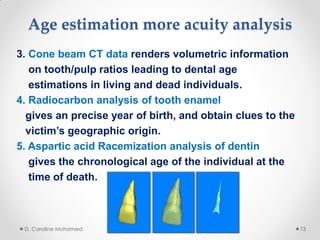
Age estimation more acuity analysis
3. Cone beam CT data renders volumetric information
on tooth/pulp ratios leading to dental age
estimations in living and dead individuals.
4. Radiocarbon analysis of tooth enamel
gives an precise year of birth, and obtain clues to the
victim’s geographic origin.
5. Aspartic acid Racemization analysis of dentin
gives the chronological age of the individual at the
time of death.
D. Caroline Mohamed 73
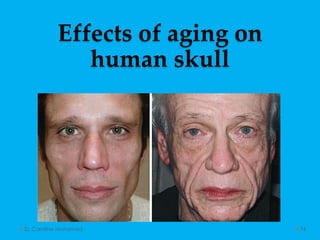
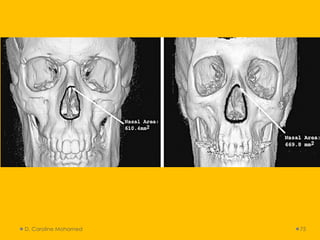
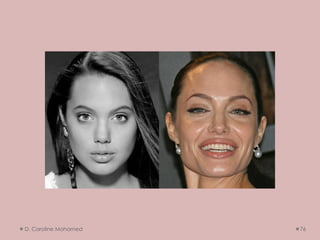
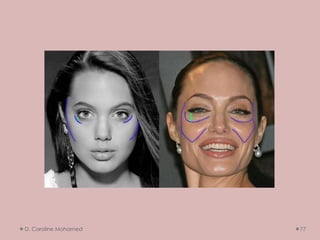
Effects of aging on
human skull
D. Caroline Mohamed 74
D. Caroline Mohamed 75
D. Caroline Mohamed 76
D. Caroline Mohamed 77
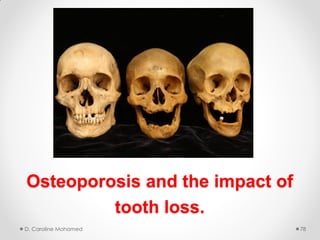
Osteoporosis and the impact of
tooth loss.
D. Caroline Mohamed 78
Socio Economic Status
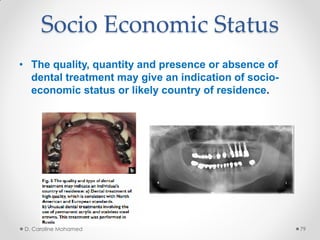
• The quality, quantity and presence or absence of
dental treatment may give an indication of socio-
economic status or likely country of residence.
D. Caroline Mohamed 79
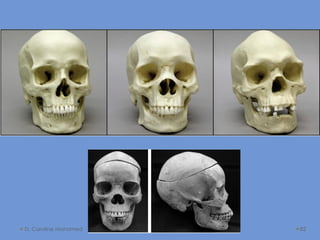
Sex and ancestry
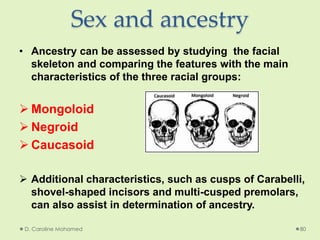
• Ancestry can be assessed by studying the facial
skeleton and comparing the features with the main
characteristics of the three racial groups:
 Mongoloid
 Negroid
 Caucasoid
 Additional characteristics, such as cusps of Carabelli,
shovel-shaped incisors and multi-cusped premolars,
can also assist in determination of ancestry.
D. Caroline Mohamed 80
D. Caroline Mohamed 81
D. Caroline Mohamed 82
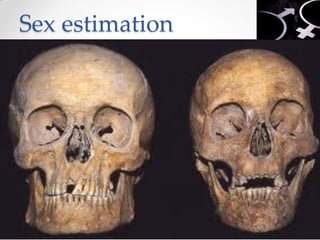
Sex estimation
D. Caroline Mohamed 83
D. Caroline Mohamed 84
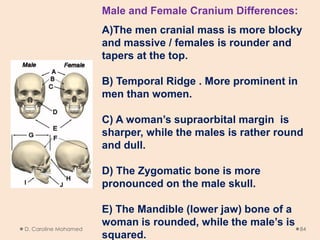
Male and Female Cranium Differences:
A)The men cranial mass is more blocky
and massive / females is rounder and
tapers at the top.
B) Temporal Ridge . More prominent in
men than women.
C) A woman’s supraorbital margin is
sharper, while the males is rather round
and dull.
D) The Zygomatic bone is more
pronounced on the male skull.
E) The Mandible (lower jaw) bone of a
woman is rounded, while the male’s is
squared.
D. Caroline Mohamed 85
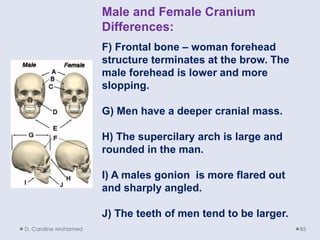
Male and Female Cranium
Differences:
F) Frontal bone – woman forehead
structure terminates at the brow. The
male forehead is lower and more
slopping.
G) Men have a deeper cranial mass.
H) The supercilary arch is large and
rounded in the man.
I) A males gonion is more flared out
and sharply angled.
J) The teeth of men tend to be larger.
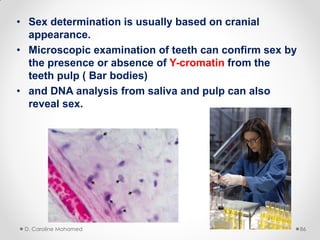
• Sex determination is usually based on cranial
appearance.
• Microscopic examination of teeth can confirm sex by
the presence or absence of Y-cromatin from the
teeth pulp ( Bar bodies)
• and DNA analysis from saliva and pulp can also
reveal sex.
D. Caroline Mohamed 86
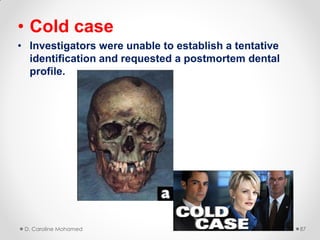
• Cold case
• Investigators were unable to establish a tentative
identification and requested a postmortem dental
profile.
D. Caroline Mohamed 87
Analyzing the skull and
teeth can you tell me the
sex, age, some habits and
maybe where did he live?
D. Caroline Mohamed 88
 Skeletal pattern and dental characteristics
suggested the following profile:
 Caucasian,
 male,
 aged 25–35 years at death,
 moderate adult periodontitis,
 nicotine stains,
 lack of recent dental treatment and
 previous treatment to Canadian standards.
D. Caroline Mohamed 89
• Using this information, a forensic artist produced a
facial reproduction.
• Subsequently, the body was identified as that of a
28-year-old missing white male smoker.
D. Caroline Mohamed 90
D. Caroline Mohamed 91
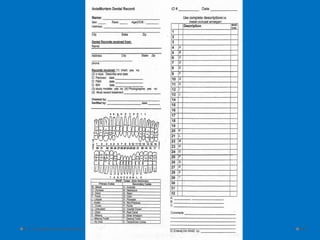
1.Activity
• Look at a printed OPG and mark major
features on the dental chart provided as you
doing a comparative AM profile.
• Look for :
• Cavities
• Fillings
• Bridegework
• Missing teeth
• Malocclusion
D. Caroline Mohamed 92
D. Caroline Mohamed 93
2.Activity
• Have an alginate impression of your upper and low
dentition and make a case study model.
• Take a picture of the model ( 90 degree) and bring
with you the model and picture for next lecture.
D. Caroline Mohamed 94

33.forensic

  • 1.
    Forensic Odontology An Introduction to ForensicDentistry D. Caroline Mohamed 1 D C A R O L I N E M O H A M E D
  • 2.
    Objectives: Students should beable to explain and discuss: o Definition of forensic dentistry o Responsibility of forensic dentists o Training for forensic odontology o History of forensic odontology o Bite marks o Cases o Computer aided forensic odontology D. Caroline Mohamed 2
  • 3.
    Forensic Odontology The BritishAssociation for Forensic-Odontology (BAFO) notes that forensic odontology is a branch of forensic medicine and, in the interests of justice, deals with the proper examination, handling and presentation of dental evidence in a court of law. D. Caroline Mohamed 3
  • 4.
    • It requiresspecial dental expertise not possessed by ordinary pathologist qualified only in medicine. • It encompasses ethical issues and events related to the claim of negligence and malpractice by dentists and paradental professionals. D. Caroline Mohamed 4
  • 5.
    • To assistwith forensic dentistry, dental professionals need to be aware of the importance of keeping accurate, current, detailed and legible dental records for the use of identification. D. Caroline Mohamed 5
  • 6.
    Who practices ForensicOdontology and what do they do?  Forensic Odontologists • Must have DDS degree • Should have specialized training in the field. D. Caroline Mohamed 6 Top: Forensic Odontologist analyzing animal teeth for comparison. Side: Seal for American Board of Forensic Odontology.
  • 7.
    Responsibility of forensic odontology 1.Identification of found human remains 2. Identification in mass fatalities 3. Assessment of bite mark injuries 4. Assessment of cases of abuse (child, spousal, elder) 5. Civil cases involving malpractice 6. Age estimation D. Caroline Mohamed 7
  • 8.
    History • 66 A.D.:Lollia Paulina’s body identified • Casualty ID in Revolutionary War • 1849 o Vienna Opera House fire o Dental identification evidence first admitted in U.S. court system
  • 9.
    D. Caroline Mohamed9 • It was used on Adolf Hitler and Eva Braun at the end of World War II, the New York City World Trade Center bombing, the Waco Branch Davidien siege, and numerous airplane crashes and natural disasters.
  • 10.
    Different situations for identification 1.Disfigured bodies of victims of violent crimes, fires, motor vehicle accidents and work place accidents. 2. Persons deceased for long time or on water. 3. Mass causalities in particular those associated with aviation disasters. 4. Lack of a comprehensive fingerprint database. D. Caroline Mohamed 10
  • 11.
    Common reasons foridentification of found humans remains • Criminal: • An investigation to a criminal death cannot begin until the victim has been positively identified. • Marriage: • Individuals from many religious backgrounds cannot remarry unless their partners are confirmed deceased. • Monetary: • The payment of pensions, life assurance and other benefits relies upon positive confirmation of death. D. Caroline Mohamed 11
  • 12.
    • Burial: • Manyreligious require that a positive identification be made prior to burial. • Social: • Society’s duty to preserve human rights and dignity beyond life begins with the basic premise of an identity. • Closure: • The identification of individuals missed for prolonged periods can bring sorrowful relief to family members. D. Caroline Mohamed 12
  • 13.
    The usual questions •Are the remains human? • If so, what are • the sex, • age, and • race of the individual? • Who is the person?
  • 14.
    Objective is Identification •Is it a tooth, or a portion of a tooth? • Is it an animal tooth, or a human tooth? • If human, what type of tooth is it, i.e., incisor, canine, premolar, or molar? • Is it deciduous/primary, or permanent? • Which quadrant does it come from, i.e., right upper, left lower, etc?
  • 15.
    Types of identification methods •Comparative Dental Identification • Dental Profiling • Rugoscopy: Study of Palatal Rugae • Cheiloscopy: analysis of Lip Prints • Ameloglyphics: Examination of tooth prints/ Bite marks D. Caroline Mohamed 15
  • 16.
    Techniques • Radiographs • Photographs •Dental Records • Cryogenic Grinding (to obtain broken cell material) • DNA Profiling Double Swab Stain Collection – saliva analysis • Carbon analysis • Cone beam CT data • Photographic comparison: facial or dental superimposition or approximation • WinID Computer system D. Caroline Mohamed 16
  • 17.
    • Dental identificationtakes two main forms: 1. Comparative identification 2. Post mortem (PM)dental profiling. D. Caroline Mohamed 17
  • 18.
    1. Comparative identification •The postmortem (after-death) dental remains can be compared with antemortem (before- death) dental records, including a. written notes, b. study casts, c. radiographs etc. d. to confirm identity. • High degree of certainty. D. Caroline Mohamed 18
  • 19.
    Be careful whenfilling dental chart D. Caroline Mohamed 19
  • 20.
    • The forensicdentist produces the postmortem (PM) record by careful charting, written descriptions of the dental structures and radiographs. • Then, a methodical, systematic comparison can be done between the PM and AM records. • Each tooth and surrounding structures are examined. • Individuals with many dental restorations are easier to identify than those with little or no rest. treatment. D. Caroline Mohamed 20
  • 21.
    • Similarities anddiscrepancies should be noted during the comparison process. • There are two types of discrepancy, those that can be explained and those that cannot. D. Caroline Mohamed 21
  • 22.
  • 23.
  • 24.
    • Explainable discrepanciesnormally relate to the time elapsed between the AM and PM records. • If a discrepancy is unexplainable, for example a tooth is not present on the AM record but is present on the PM record then an exclusion must be made. D. Caroline Mohamed 24 Explainable discrepancies of AM PM comparison
  • 25.
    D. Caroline Mohamed25 Comparison of Post-mortem (PM) with Ante-mortem (AM) Radiographs.
  • 26.
    D. Caroline Mohamed26 Ante mortem Post mortem
  • 27.
  • 28.
  • 29.
  • 30.
    • When reportingdental identification, The American Board of Forensic Odontology recommends that the conclusions should be limited to the following four: 1. Positive identification The AM and PM data match in sufficient detail to establish that they are from the same person. 2. Possible identification The AM and PM data has consistent features but, because of the quality of either the PM or the AM remains or the AM evidence, it is not possible to establish identity positively. D. Caroline Mohamed 30
  • 31.
    • Insufficient evidence •The available information is insufficient to form the basis for a conclusion. • Exclusion • The AM and PM are clearly inconsistent. D. Caroline Mohamed 31
  • 32.
    Post morten dentalprofile • Antemortem records are not available, and no clues to the possible identity exist, • a postmortem (after death) dental profile is completed suggesting characteristics of the individual likely to narrow the search for the antemortem materials.. D. Caroline Mohamed 32
  • 33.
    • Features like: •age, • sex, • SES, • sometimes habits, • occupation, • diet and • diseases, • can be acknowledged. D. Caroline Mohamed 33
  • 34.
    Facial reproduction • Ifthe P.M profile does not elicit the tentative identity of the deceased it may be necessary to reconstruct the individual’s appearance during life. • This is the responsibility of forensic artists who use the dental profile to help with the facial reproduction. D. Caroline Mohamed 34
  • 35.
  • 36.
    Means of Identification •There are three categories examined when comparing dental records (ante-mortem with post- mortem) for identification, which are: • periodontal tissue, • anatomical features, and • the teeth. D. Caroline Mohamed 36
  • 37.
    Means of Identification •Periodontal tissues:  Trabecular pattern, tori and osseous anomalies.  Gingival morphology and pathology.  Periodontal ligament morphology.  Alveolar process and lamina dura.  Presence of foreign bodies: Implants, unretrieved amalgam particles, surgical instruments, bullets, … D. Caroline Mohamed 37
  • 38.
  • 39.
    • Anatomical features: •Sinus configuration: maxillary and frontal • Anterior nasal spine • Mandibular canal • Condylar and coronoid process • TMJ • Skull sutures • Soft tissues features: rugae (rugoscopy) and lip (cheiloscospy) prints. • Other D. Caroline Mohamed 39
  • 40.
    • Teeth: Naturaland synthetic (fixed and removable) • Present • Missed • Type • Position • Crown / root morphology - pathology • Pulp chamber / root canal morphology – pathology • Periapical pathology • Dental restorations D. Caroline Mohamed 40
  • 41.
    Teeth abnormalities • Developmental,i.e., the tooth in question developed abnormally. • Acquired at some time after birth. They can be the result of : o trauma o erosion o occupational insult o dental work in a clinical setting.
  • 42.
    Teeth developmental abnormalities •Abnormalities of eruption patterns. • Abnormalities of shape (morphology). • Missing features, extra features, or atypical • features. • Ex:  Dilacerations of crown or root  anomalies in the number of cusps or roots,  abnormal enamel deposition, etc.
  • 43.
    Teeth developmental abnormalities •Abnormalities in the number of teeth. • Adontia, • Polydontia / partial adontia • Supernumerary teeth. Give clues about genetic syndromes Ectodermal dysplasia
  • 44.
    More developmental abnormalities •Abnormalities in the spacing or position of teeth. a. Crowded, b. Diastema c. rotated or d. misaligned. • Abnormalities in the size of teeth. a. Microdontia b. macrodontia.
  • 45.
    Acquired abnormalities • Repairs,restorations, prostheses • Dental staining & enamel variation o Coffee, colas, nicotine o Erosion o Occupational o Health-related issues o Diet composition • Occlusal attrition • Missing teeth o Premortem vs. peri/postmortem
  • 46.
  • 47.
    Age Estimation • Youcan tell age solely by teeth analysis: • Methods: 1. Require the extraction of teeth and histopathological examination, and 2. Require radiographs. D. Caroline Mohamed 47
  • 48.
    Age Estimation 1. TheUniversal System ( > reliable for children and adolescents) analysis of dental development & X-ray. 2. Gustafson Looking for six signs of wear 3. Lamendin / Johansen methods Transparency of radicular dentin (older the person > translucent the root dentine) and secondary dentin deposition. D. Caroline Mohamed 48
  • 49.
    The Universal System AnalyzingTeeth 1. Teeth are given a specific number. (Primary teeth are given specific capital letter) 2. Any dental work done on surface is noted 3. Sheets kept on dental file forever. When person is missing, files are transferred to the missing person’s officeD. Caroline Mohamed 49
  • 50.
    FDI Dental Federationnotation system D. Caroline Mohamed 50
  • 51.
  • 52.
  • 53.
  • 54.
  • 55.
    Teeth through theyears Childhood Adulthood D. Caroline Mohamed 55 • Primary teeth sprout from milk buds and are temporary. Once they fall out, permanent teeth as seen on the other side appear.  Permanent adult teeth come in when primary teeth fall out; they are permanent because they establish roots inside the gums. Third molar come in around the mid teenage years.
  • 56.
  • 57.
    Eruption sequence andtiming Primary teeth Permanent teeth D. Caroline Mohamed 57
  • 58.
  • 59.
    D. Caroline Mohamed59 May you help me to solve those cases?
  • 60.
  • 61.
  • 62.
    Around 3 to4 years
  • 63.
  • 64.
    D. Caroline Mohamed64 11-13 YEARS 6 TO 9 YEARS
  • 65.
  • 66.
    D. Caroline Mohamed66 17- 30 YEARS Aprox.
  • 67.
    Estimating age • Thirdmolar in age estimation: • A valuable indicator in the age 16-23 years but questionable now a days due to great variation in genesis, position, morphology and time of formation D. Caroline Mohamed 67
  • 68.
    Estimating age • Thethird molar may provide reasonable accuracy for the likelihood that a person is at least 18 years of age, rather than giving the exact chronological age, due to the absence of any other marker in the late adolescence. • Regression formulas can be calculated and statistical analyses gives the correlation between the findings and possible age for a specific population. D. Caroline Mohamed 68
  • 69.
  • 70.
  • 71.
    D. Caroline Mohamed71 • UT-AGE, freeware automates calculation of mean age, and the empirical probability of attainment of the 18th year of age. • This calculation is based on third molar development population group studies. • spacer
  • 72.
    Estimating age • Thepresence of erosion can suggest:  alcohol or substance abuse,  an eating disorder or  even hiatus hernia • while stains can indicate smoking, tetracycline use or betel nut chewing. • Unusual wear patterns  pipe stems, cigarette holders, hairpins, carpet tacks or previous orthodontic treatment. D. Caroline Mohamed 72
  • 73.
    Age estimation moreacuity analysis 3. Cone beam CT data renders volumetric information on tooth/pulp ratios leading to dental age estimations in living and dead individuals. 4. Radiocarbon analysis of tooth enamel gives an precise year of birth, and obtain clues to the victim’s geographic origin. 5. Aspartic acid Racemization analysis of dentin gives the chronological age of the individual at the time of death. D. Caroline Mohamed 73
  • 74.
    Effects of agingon human skull D. Caroline Mohamed 74
  • 75.
  • 76.
  • 77.
  • 78.
    Osteoporosis and theimpact of tooth loss. D. Caroline Mohamed 78
  • 79.
    Socio Economic Status •The quality, quantity and presence or absence of dental treatment may give an indication of socio- economic status or likely country of residence. D. Caroline Mohamed 79
  • 80.
    Sex and ancestry •Ancestry can be assessed by studying the facial skeleton and comparing the features with the main characteristics of the three racial groups:  Mongoloid  Negroid  Caucasoid  Additional characteristics, such as cusps of Carabelli, shovel-shaped incisors and multi-cusped premolars, can also assist in determination of ancestry. D. Caroline Mohamed 80
  • 81.
  • 82.
  • 83.
  • 84.
    D. Caroline Mohamed84 Male and Female Cranium Differences: A)The men cranial mass is more blocky and massive / females is rounder and tapers at the top. B) Temporal Ridge . More prominent in men than women. C) A woman’s supraorbital margin is sharper, while the males is rather round and dull. D) The Zygomatic bone is more pronounced on the male skull. E) The Mandible (lower jaw) bone of a woman is rounded, while the male’s is squared.
  • 85.
    D. Caroline Mohamed85 Male and Female Cranium Differences: F) Frontal bone – woman forehead structure terminates at the brow. The male forehead is lower and more slopping. G) Men have a deeper cranial mass. H) The supercilary arch is large and rounded in the man. I) A males gonion is more flared out and sharply angled. J) The teeth of men tend to be larger.
  • 86.
    • Sex determinationis usually based on cranial appearance. • Microscopic examination of teeth can confirm sex by the presence or absence of Y-cromatin from the teeth pulp ( Bar bodies) • and DNA analysis from saliva and pulp can also reveal sex. D. Caroline Mohamed 86
  • 87.
    • Cold case •Investigators were unable to establish a tentative identification and requested a postmortem dental profile. D. Caroline Mohamed 87
  • 88.
    Analyzing the skulland teeth can you tell me the sex, age, some habits and maybe where did he live? D. Caroline Mohamed 88
  • 89.
     Skeletal patternand dental characteristics suggested the following profile:  Caucasian,  male,  aged 25–35 years at death,  moderate adult periodontitis,  nicotine stains,  lack of recent dental treatment and  previous treatment to Canadian standards. D. Caroline Mohamed 89
  • 90.
    • Using thisinformation, a forensic artist produced a facial reproduction. • Subsequently, the body was identified as that of a 28-year-old missing white male smoker. D. Caroline Mohamed 90
  • 91.
  • 92.
    1.Activity • Look ata printed OPG and mark major features on the dental chart provided as you doing a comparative AM profile. • Look for : • Cavities • Fillings • Bridegework • Missing teeth • Malocclusion D. Caroline Mohamed 92
  • 93.
  • 94.
    2.Activity • Have analginate impression of your upper and low dentition and make a case study model. • Take a picture of the model ( 90 degree) and bring with you the model and picture for next lecture. D. Caroline Mohamed 94