Forensic aspect
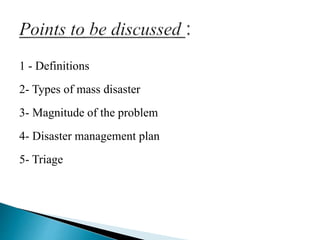
1 - Definitions
2- Types of mass disaster
3- Magnitude of the problem
4- Disaster management plan
5- Triage
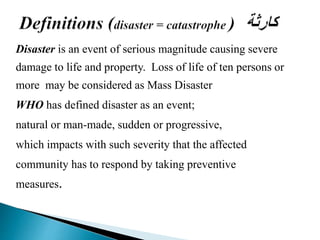
Disaster is an event of serious magnitude causing severe
damage to life and property. Loss of life of ten persons or
more may be considered as Mass Disaster
WHO has defined disaster as an event;
natural or man-made, sudden or progressive,
which impacts with such severity that the affected
community has to respond by taking preventive
measures.
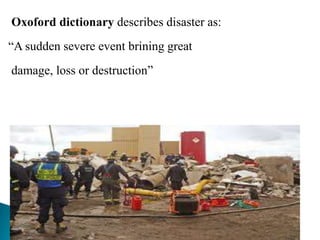
Oxoford dictionary describes disaster as:
“A sudden severe event brining great
damage, loss or destruction”
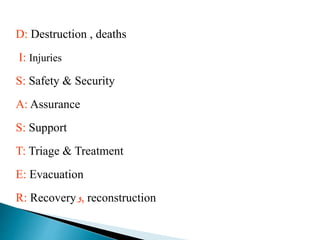
D: Destruction , deaths
I: Injuries
S: Safety & Security
A: Assurance
S: Support
T: Triage & Treatment
E: Evacuation
, reconstruction‫و‬R: Recovery
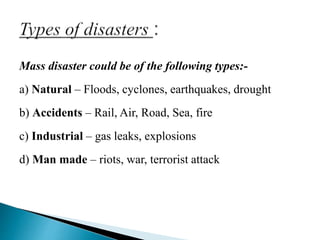
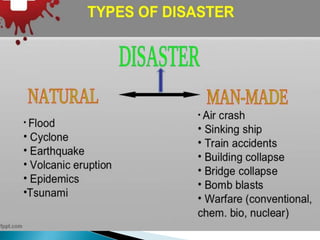
Mass disaster could be of the following types:-
a) Natural – Floods, cyclones, earthquakes, drought
b) Accidents – Rail, Air, Road, Sea, fire
c) Industrial – gas leaks, explosions
d) Man made – riots, war, terrorist attack
In the last decade more than 2.6 billion persons have
become casualties of natural disasters. Acute events such

as earthquakes, cyclones, heat waves, floods and severe
cold weather can result in significant numbers of
casualties.
An estimated 1.2 million person killed and as many as 50
million are injured each year in road crashes, of which a
large number are mass casualty incidents. Projections
indicate that these figures will increase by about 65%
over the next 20 years.
Unfortunately such disasters are becoming increasing
due to increase terrorism , expansion of travel facilities
, large size of means of passenger transport and bizzare
climatic conditions
Include two main items
1- Preparation for disaster
2- Response to disaster
The effectiveness of the response for disaster is greatly
enhanced by regular training , exercise , continous
updating of the plan and modification of the plan
The investigation carried out by a well coordinated team,
such a team should
consist of:
1- Police service
2- Ambulance service
3- Fire service
4- Forensic examiners team
5- Social workers , volunteers
Forensic examiners team consists of
a. Forensic Pathologist
b. Forensic Odontologist
c. Finger print experts
d. Other experts, relevant to the nature of the disaster
The Disaster plan should have following
features:
• It should be simple and understandable by all.
• It should be flexible and fit in different types of
disasters.
• It should clear and concise
A temporary mortuary should be constructed with
facilities for refrigeration . Tables or make shift tables,
instruments, gloves, cotton, packing and labeling
materials, preservatives, disinfectants, antiseptic, whole
body size polythene bags or paper bags , sutures,
needles and additional supply of water and light etc.
Communication systems like telephones, computers,
internet
Adequate security arrangements should be there to avoid
secondary disaster
1- Examination of the scene of disaster
2- Examination of the victim
3- Identify the cause of death
4- Assist in reconstruction of the cause of disaster
Ensure the following measures:-
a) Secure the disaster site
b) Prepare a sketch plan of the site, showing parts of the
wreckage and position of the bodies
c) Take photographs of the site.
d) Locate each body and label it with a “Mass casualty card”,
giving it serial number
Note: - Mutilated bodies and fragmentary remains should also
be labeled and numbered.
Search for blood stains , finger print , identity card
remains of explosive materials in case of explosions
The site may be required to be attached for radiological
examination which help in identification and detection
of foreign bodies impacted in clothes or inside the
body
1- Clothes examination
2- Identification
3- Diagnosis of the types of injuries
4- Diagnosis of the cause of death
Clothes examined in details , photographed and takes the
same serial number of the victim and keep them in safe
custody for further identification by relatives
Personal properties such as identity card , any papers help in
identification . Jewelleries such as rings , ear rings may be
useful .
If the body is mutilated or burned jewelleries may be found
inside the body ex . Necklace in the thorax
Why identify remains ?
Three main reasons:
1.Help reconstruct the crime scene by determining
everyone that was present
2.For the official death certificate to be issued
requires positive proof that the remains were found and
identified
3.Giving the victim’s family members closure and
information
Any human remains should be collected and takes
serial number
The main identifying criteria
First option: Visual identification
Second option : General and Dental features
Third option : Fingerprint
Fourth option : Radiological examination
Final option : DNA fingerprinting
1- Visual identification : useful in case of intact bodies
but is useless in case of mutilated , fragmented remains
and burned bodies
2- General and dental data :-
Age , sex , ethnic featuresa)
b) Height and Weight
c) Colour of eyes.
d) Hair : colour, length and other features with regard to
both scalp and body hair.
e) Special marks : scars, moles, tattoo marks , deformities
F) Dental data : complete and detailed dental data is to be
recorded. This will be of paramount importance in
establishing identify
this stageA Forensic odontologist may be coopted at
3- Finger prints , Palm print , Foot print :
Compared with prints retained on criminal records or
files of armed forces
4- Radiological examination
Radiology help in identification of age of the individual
especially in children , sex , anatomical abnormalities as
cervical rib , metallic foreign bodies as prostheses , metallic
sutures .
If there is possibility of explosions or gun shot injuries
extensive radiology is used to identify such device and
material impacted inside the body
The best material is said to be muscle or the spleen and , if
decomposition is advancing, the bone marrow is
recommended. At least 0.5 g of tissue should be cut from
the parenchyma of an organ and placed in a small plastic
tube with no fixative or preservative. This should be frozen
at -20°C if there is likely to delay intransmission to the
laboratory then compared with samples taken from relatives
or with reference samples from the victim
3- Diagnosis of the types of injuries : type , site ,
number
special character if present. Injuries differs according to
the type of disaster
a) According to gross post-mortem findings of majority
of bodies.
b) Study the special investigation results and correlate
with the morbid findings
c) Give opinion as to the cause of death based on the
above and nature of disaster
Medical opinion, in this regard can only be partial and
contributory to other investigations.
However, an opinion regarding the cause of disaster may
be given in the case of Airplane disasters, train mishaps
and vehicular accidents, based on the following data:-
a) autopsy findings of the body of pilot/driver
i. Evidence of organic disease, like coronary occlusion,
cerebrovascular accident or any other disease which
could produce sudden collapse or blunting of mental
faculties
ii. Evidence of poisoning due to alcohol or other
psychotropic drugs affecting higher mental functions.
iii. Evidence of gun-shot injuries. in case of air piracy
b) Nature of injuries of the victims.
Explosion injuries with evidence of retained explosive
material, suggest explosions
Triage is derived from Old French word “trier” which means
“to sort”
A process for sorting injured people into groups based on the
need for or likely benefit from immediate medical
treatment . Triage is used in hospital emergency rooms, on
battlefields, and at disaster sites when limited medical
resources must be allocated (The American Heritage
Dictionary)
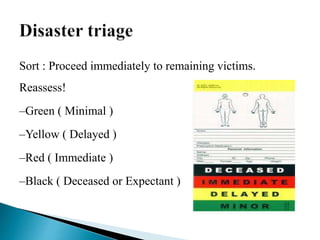
Sort : Proceed immediately to remaining victims.
Reassess!
–Green ( Minimal )
–Yellow ( Delayed )
–Red ( Immediate )
–Black ( Deceased or Expectant )
:Green ( Minimal )
Ambulatory patients ( no impaired function, can self-treat
or be cared by non-professional )
Walking Wounded
Abrasions, contusions , minor lacerations etc.
Yellow ( Delayed )
Can wait for care after simple first aid
( I.e., wounds dressed, splints applied )
Clearly need medical attention, but should not
decompensate rapidly if care is delayed.
Red ( Immediate )
Critical ( seriously injured, but have a reasonable chance of
survival )
Obvious threat to life
Complications in their ABC’s
Black (Deceased or Expectant)
Expectant; This patient shows obvious signs of death.
–unresponsive patients with no pulse
–or with catastrophic head injuries and / or chest injuries.
Thank you
‫ط‬/‫على‬ ‫احمد‬ ‫احمد‬ ‫حسناء‬

Mass disaster management

  • 2.
  • 3.
    1 - Definitions 2-Types of mass disaster 3- Magnitude of the problem 4- Disaster management plan 5- Triage
  • 4.
    Disaster is anevent of serious magnitude causing severe damage to life and property. Loss of life of ten persons or more may be considered as Mass Disaster WHO has defined disaster as an event; natural or man-made, sudden or progressive, which impacts with such severity that the affected community has to respond by taking preventive measures.
  • 5.
    Oxoford dictionary describesdisaster as: “A sudden severe event brining great damage, loss or destruction”
  • 6.
    D: Destruction ,deaths I: Injuries S: Safety & Security A: Assurance S: Support T: Triage & Treatment E: Evacuation , reconstruction‫و‬R: Recovery
  • 7.
    Mass disaster couldbe of the following types:- a) Natural – Floods, cyclones, earthquakes, drought b) Accidents – Rail, Air, Road, Sea, fire c) Industrial – gas leaks, explosions d) Man made – riots, war, terrorist attack
  • 9.
    In the lastdecade more than 2.6 billion persons have become casualties of natural disasters. Acute events such as earthquakes, cyclones, heat waves, floods and severe cold weather can result in significant numbers of casualties. An estimated 1.2 million person killed and as many as 50 million are injured each year in road crashes, of which a large number are mass casualty incidents. Projections indicate that these figures will increase by about 65% over the next 20 years.
  • 10.
    Unfortunately such disastersare becoming increasing due to increase terrorism , expansion of travel facilities , large size of means of passenger transport and bizzare climatic conditions
  • 12.
    Include two mainitems 1- Preparation for disaster 2- Response to disaster
  • 13.
    The effectiveness ofthe response for disaster is greatly enhanced by regular training , exercise , continous updating of the plan and modification of the plan
  • 16.
    The investigation carriedout by a well coordinated team, such a team should consist of: 1- Police service 2- Ambulance service 3- Fire service 4- Forensic examiners team 5- Social workers , volunteers
  • 17.
    Forensic examiners teamconsists of a. Forensic Pathologist b. Forensic Odontologist c. Finger print experts d. Other experts, relevant to the nature of the disaster
  • 18.
    The Disaster planshould have following features: • It should be simple and understandable by all. • It should be flexible and fit in different types of disasters. • It should clear and concise
  • 19.
    A temporary mortuaryshould be constructed with facilities for refrigeration . Tables or make shift tables, instruments, gloves, cotton, packing and labeling materials, preservatives, disinfectants, antiseptic, whole body size polythene bags or paper bags , sutures, needles and additional supply of water and light etc. Communication systems like telephones, computers, internet Adequate security arrangements should be there to avoid secondary disaster
  • 20.
    1- Examination ofthe scene of disaster 2- Examination of the victim 3- Identify the cause of death 4- Assist in reconstruction of the cause of disaster
  • 21.
    Ensure the followingmeasures:- a) Secure the disaster site b) Prepare a sketch plan of the site, showing parts of the wreckage and position of the bodies c) Take photographs of the site. d) Locate each body and label it with a “Mass casualty card”, giving it serial number Note: - Mutilated bodies and fragmentary remains should also be labeled and numbered.
  • 22.
    Search for bloodstains , finger print , identity card remains of explosive materials in case of explosions The site may be required to be attached for radiological examination which help in identification and detection of foreign bodies impacted in clothes or inside the body
  • 23.
    1- Clothes examination 2-Identification 3- Diagnosis of the types of injuries 4- Diagnosis of the cause of death
  • 24.
    Clothes examined indetails , photographed and takes the same serial number of the victim and keep them in safe custody for further identification by relatives Personal properties such as identity card , any papers help in identification . Jewelleries such as rings , ear rings may be useful . If the body is mutilated or burned jewelleries may be found inside the body ex . Necklace in the thorax
  • 25.
    Why identify remains? Three main reasons: 1.Help reconstruct the crime scene by determining everyone that was present 2.For the official death certificate to be issued requires positive proof that the remains were found and identified 3.Giving the victim’s family members closure and information
  • 26.
    Any human remainsshould be collected and takes serial number The main identifying criteria First option: Visual identification Second option : General and Dental features Third option : Fingerprint Fourth option : Radiological examination Final option : DNA fingerprinting
  • 27.
    1- Visual identification: useful in case of intact bodies but is useless in case of mutilated , fragmented remains and burned bodies 2- General and dental data :- Age , sex , ethnic featuresa) b) Height and Weight
  • 28.
    c) Colour ofeyes. d) Hair : colour, length and other features with regard to both scalp and body hair. e) Special marks : scars, moles, tattoo marks , deformities F) Dental data : complete and detailed dental data is to be recorded. This will be of paramount importance in establishing identify this stageA Forensic odontologist may be coopted at
  • 29.
    3- Finger prints, Palm print , Foot print : Compared with prints retained on criminal records or files of armed forces 4- Radiological examination Radiology help in identification of age of the individual especially in children , sex , anatomical abnormalities as cervical rib , metallic foreign bodies as prostheses , metallic sutures . If there is possibility of explosions or gun shot injuries extensive radiology is used to identify such device and material impacted inside the body
  • 30.
    The best materialis said to be muscle or the spleen and , if decomposition is advancing, the bone marrow is recommended. At least 0.5 g of tissue should be cut from the parenchyma of an organ and placed in a small plastic tube with no fixative or preservative. This should be frozen at -20°C if there is likely to delay intransmission to the laboratory then compared with samples taken from relatives or with reference samples from the victim
  • 31.
    3- Diagnosis ofthe types of injuries : type , site , number special character if present. Injuries differs according to the type of disaster
  • 32.
    a) According togross post-mortem findings of majority of bodies. b) Study the special investigation results and correlate with the morbid findings c) Give opinion as to the cause of death based on the above and nature of disaster
  • 33.
    Medical opinion, inthis regard can only be partial and contributory to other investigations. However, an opinion regarding the cause of disaster may be given in the case of Airplane disasters, train mishaps and vehicular accidents, based on the following data:- a) autopsy findings of the body of pilot/driver i. Evidence of organic disease, like coronary occlusion, cerebrovascular accident or any other disease which could produce sudden collapse or blunting of mental faculties
  • 34.
    ii. Evidence ofpoisoning due to alcohol or other psychotropic drugs affecting higher mental functions. iii. Evidence of gun-shot injuries. in case of air piracy b) Nature of injuries of the victims. Explosion injuries with evidence of retained explosive material, suggest explosions
  • 35.
    Triage is derivedfrom Old French word “trier” which means “to sort” A process for sorting injured people into groups based on the need for or likely benefit from immediate medical treatment . Triage is used in hospital emergency rooms, on battlefields, and at disaster sites when limited medical resources must be allocated (The American Heritage Dictionary)
  • 36.
    Sort : Proceedimmediately to remaining victims. Reassess! –Green ( Minimal ) –Yellow ( Delayed ) –Red ( Immediate ) –Black ( Deceased or Expectant )
  • 37.
    :Green ( Minimal) Ambulatory patients ( no impaired function, can self-treat or be cared by non-professional ) Walking Wounded Abrasions, contusions , minor lacerations etc. Yellow ( Delayed ) Can wait for care after simple first aid ( I.e., wounds dressed, splints applied ) Clearly need medical attention, but should not decompensate rapidly if care is delayed.
  • 38.
    Red ( Immediate) Critical ( seriously injured, but have a reasonable chance of survival ) Obvious threat to life Complications in their ABC’s Black (Deceased or Expectant) Expectant; This patient shows obvious signs of death. –unresponsive patients with no pulse –or with catastrophic head injuries and / or chest injuries.
  • 39.
    Thank you ‫ط‬/‫على‬ ‫احمد‬‫احمد‬ ‫حسناء‬