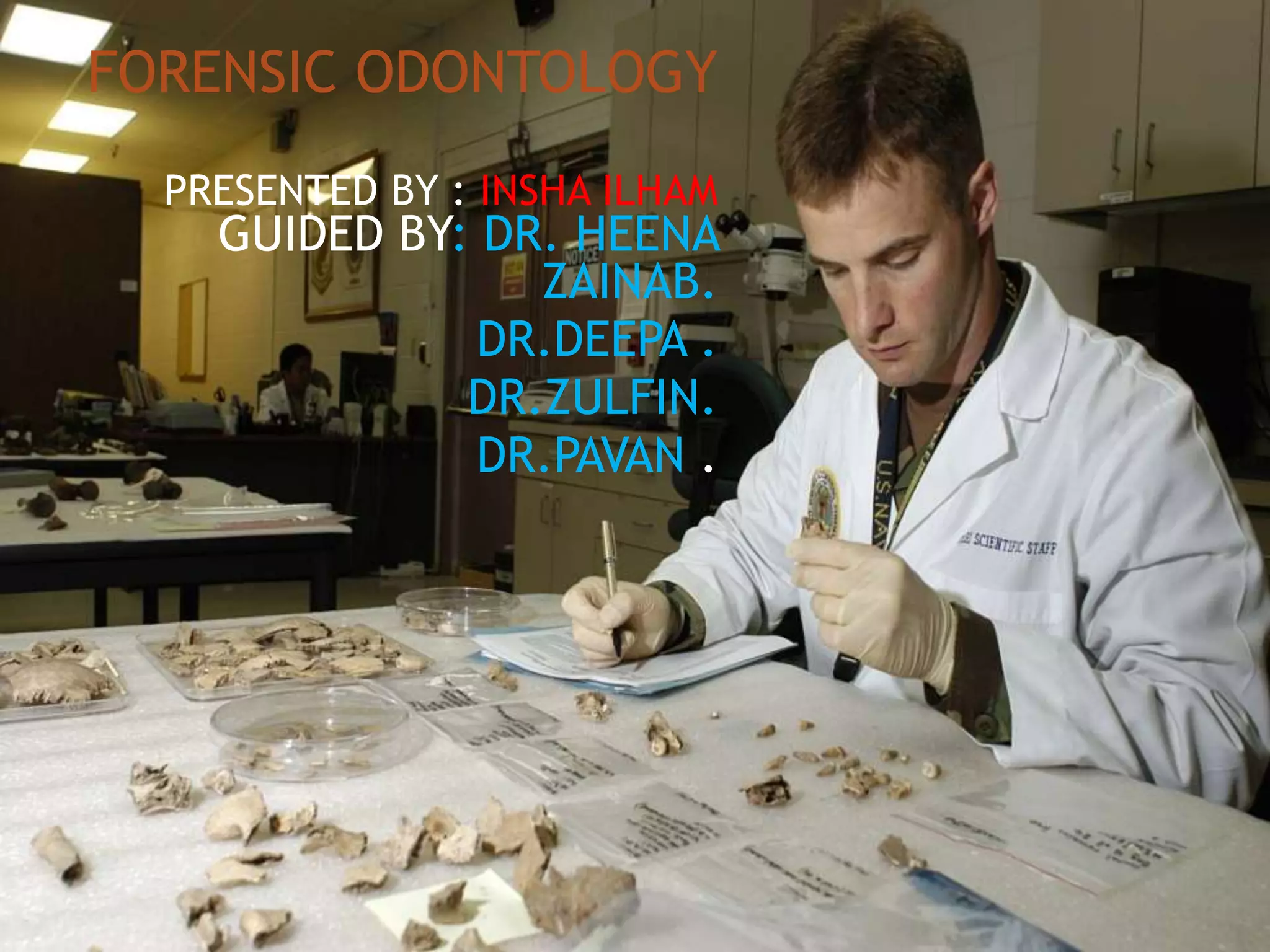
FORENSIC ODONTOLOGY
PRESENTED BY : INSHA ILHAM
GUIDED BY: DR. HEENA
ZAINAB.
DR.DEEPA .
DR.ZULFIN.
DR.PAVAN .
 INTRODUCTION TO FORENSIC.
 DENTAL IDENTIFICATION PROCEDURES.
1. COMPARATIVE DENTAL IDENTIFICATION.
 IDENTIFICATION IN DISASTERS.
 IDENTIFICATION FROM DENTAL DNA.
 IDENTIFICATION FROM PALATAL RUGAE .
2.DENTAL PROFILING.
 IDENTIFYING ETHNIC ORIGIN FROM TEETH.
 SEX DIFFERENTIATION.
 BY CRANIOFACIAL MORPHOLOGY &
DIMENSIONS.
 BY TOOTH SIZE.
 BY DNA ANALYSIS.
 The word FORENSIC is derived from the latin
word forensis ,which means “before the
forum”.
 Forensic odontology is defined by Federation
Dentaire Internationale ( FDI ) as ‘that branch
of dentistry which , in the interest of justice,
deals with the proper handling and
examination of dental evidence , and with the
proper evaluation and presentation of dental
findings’ .
 Role of forensic Odontology :
1. Record preparation :the correct handling and
examination ,the proper preparation of
dental evidence in both civil and criminal
legal procedures .
2. Identification: Personal identification,
either individually or in content of mass
disaster.
3. Bite mark investigation: Identification of
criminal cases where the bite marks are
involved and the interpretation of bite
marks.
4. Human abuse: recognition of domestic and
child abuse.
5.Legal aspect of dental traumatology.
6.Others: forensic odontology also deals with
age assessment of patient & comparison &
identification of lip print.
 Forensic odontology is concerned with the
identification of both living and deceased
person.
ISSUES OF DEATH INVESTIGATION
1. Cause of death :The Sequence which initiated
the death of person like physical, chemical
injury or disease of person.
2. Mechanism of death: the pathological process
which result in death.
3. Mode or manner of death: whether it is
natural, accidental, suicidal or homicide.
4. Undetermined death: the manner of death is
not established due to decomposition,
dismemberment or post-mortem destruction
remains by insect or fetal animals.
 There are two forms of dental identification :
1. Comparative dental identification .
2. Dental profiling .
1.COMPARATIVE DENTAL IDENTIFICATION :
The circumstances of death may give adequate
information of possible identity of decedent.
It is conventional method of Postmortem dental
identification & include 4 steps :
1.Oral autopsy.
2.Obtaining dental records.
3.Comparing post & Antemortem dental data.
4.Writing a report &drawing conclusion.
 It is also known as post-mortem examination ,
involves examining the deceased usually with
dissection to expose the organs to determine
the cause of death.
 Oral examination is ideally an essential part of
the Postmortem examination.
 Forensic dentist who conduct oral autopsy
should have adequate knowledge about
common Postmortem findings such as rigor
mortis ,livor mortis, decomposition &
Postmortem artefacts
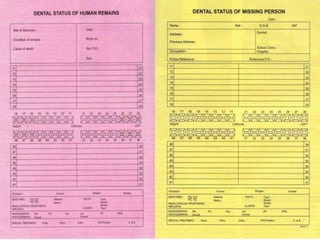
2.OBTAINING DENTAL RECORDS :
• Dental records contain information of treatment
undergone & dental status of a person during
his/her lifetime & constitute the ante-mortem
dental data .
3.COMPARING POST &
ANTEMORTEM DENTAL DATA :
Following postmortem examination &
transcription of antemortem data,the two
odontograms are compared .
Featured evaluated include tooth morphology &
associated bony structures pathology & dental
restorations .
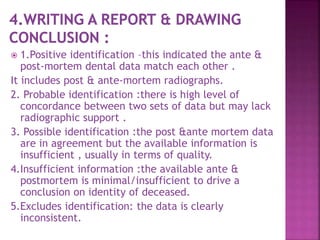
 1.Positive identification –this indicated the ante &
post-mortem dental data match each other .
It includes post & ante-mortem radiographs.
2. Probable identification :there is high level of
concordance between two sets of data but may lack
radiographic support .
3. Possible identification :the post &ante mortem data
are in agreement but the available information is
insufficient , usually in terms of quality.
4.Insufficient information :the available ante &
postmortem is minimal/insufficient to drive a
conclusion on identity of deceased.
5.Excludes identification: the data is clearly
inconsistent.
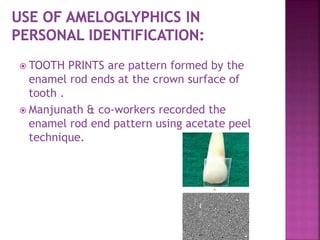
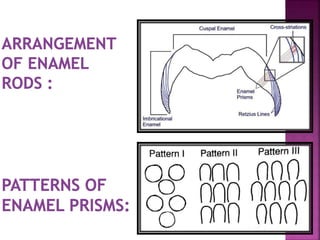
 TOOTH PRINTS are pattern formed by the
enamel rod ends at the crown surface of
tooth .
 Manjunath & co-workers recorded the
enamel rod end pattern using acetate peel
technique.
 Disaster refers to natural calamities such as earth
quake ,floods & tsunami & accidental, man-made
events such as air plane clashes or terrorist
attacks – that result in multiple human fatalities.
DENTAL SECTION :
Forensic dentists are part of a team of
identification specialist that include
anthropologists & finger print experts , to name a
few:
The division of odontology section are in 3
subsections
1.Postmortem unit.
2.Antemortem unit.
3.Comparison & identification unit.
 The conventional method of dental identification
described thus far requires one base element
that may not always be readily available –DENTAL
RECORDS.
 Pretty & sweet state that TEETH are an excellent
source of DNA
 Potsh & co workers successfully extracted DNA
from the pulp of teeth recovered from
decomposed & burned bodies , as well as victims
of air crashes.

 Techniques: Polymerase chain reaction allows
amplification of highly degraded DNA.
 Types of DNA :pretty & sweet have pointed out
use of 2types of DNA.
 1. Genomic or nuclear DNA : located in nucleus
of cells & commonly used in forensic cases .
 2.mitochondrial DNA :present in Mitochondria of
cells.
 Sweet & Hildebrand- method known as
cryogenic grinding for extraction of DNA.
Major drawback of cryogenic grinding is that
the tooth needs to be completely crushed .
Since then....
 Trivedi & coworkers have sugessted a less
destructive method for DNA isolation . This
involve accessing the root canals through an
opening similar to that made during RCT .
 This is a useful method of identifying
edentulous individuals.
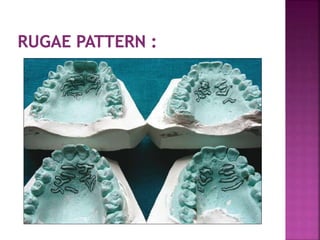
 Palatal rugae are ridges on the anterior part
of the palatal mucosa on each side of mid-
palatine raphae , behind the incissive papilla.
 CLASSIFICATION of palatal rugae :-lysel
quoted & he measured rugae in straight
line,from their origin on the medial side to
terminus on the lateral and divided them into
3 types:
1.Primary Rugae (more than 5mm).
2.Secondary Rugae (3-5mm).
3.Fragmentary Rugae (less than 3mm).
 Analysis of rugae pattern :
 Thomas & van wyk manually traced rugae
patterns from ante mortem & post mortem
dentures onto clear acetate (transparent
plastic sheets)
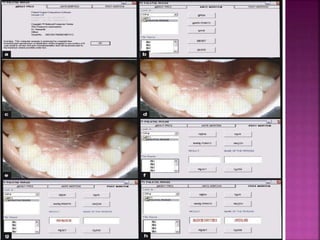
 Limson & julion developed a computer
software program which makes use of
principal commonly employed in fingerprint
analysis( 97% accuracy)
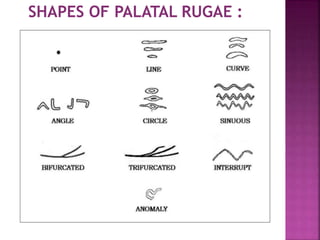
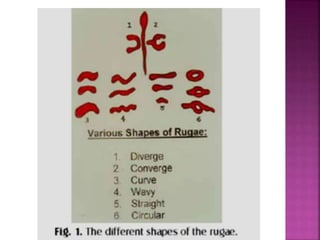
SHAPES OF PALATAL RUGAE :
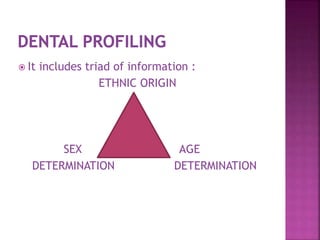
 It includes triad of information :
ETHNIC ORIGIN
SEX AGE
DETERMINATION DETERMINATION
1.GENETIC & ENVIRONMENTAL INFLUENCE ON
TEETH :
 Teeth have proven to be significant in the study
of human variation.
 Dental features used to describe population
differences are broadly categorized as METRIC
(Tooth size ) & NON METRIC ( Tooth shape)traits.
 METRIC TRAITS are based on measurements.
• Townsend cities numerous studies which indicate
metric triats as being considerably influenced by
intraoral environment factors (e.g., missing
lateral incisor )cause compensatory increase in
central incisor.
 Non metric traits defined in terms of presence
& absence of a particular feature of a tooth.
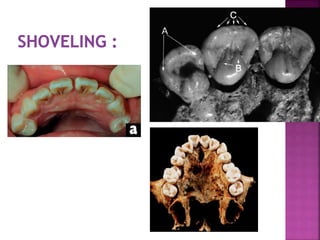
 Shoveling : it refers to the presence of mesial
& distal marginal ridge on the lingual surfaces
of the maxillary & mandibular anterior teeth.
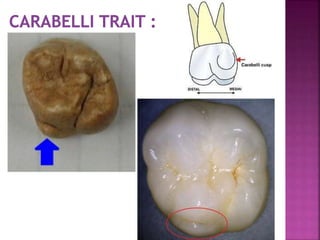
 Carabelli‘s trait : the carabelli’s cusp, or
tubercle of carabelli ,is a cingular derivative
expressed on the mesiolingual /mesiopalatal
cusp of maxillary molar. In Indians , it is
reported to be present in 26% of the
population.
 Three cusped maxillary second molar : the
distopalatal cusp of maxillary molars is usually
retained on the first molar , but tensed to be
reduced size or absent on the second
molar.(34%)
 Wingling :it is an indirect crown trait.it is
characterized by the bilateral labial rotation of
the distal margins of maxillary central incisor.
The Incisal edge of the central incisor taken
together, appears ‘V’ shaped from the occlusal
aspect (16% of Indians ).
 Cusp 5: This is characterized by the presence
of occlusal tubercles on the distal marginal
ridge of maxillary molar(S),particularly first
molar .(75% of indians)
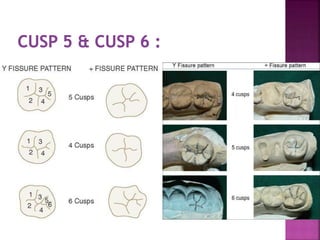
 Cusp 6 : an additional cusp between distal &
distolingual cusp of mandibular molar
(S),particularly the first molar ,is referred to as
cusp 6.(57% of indians)
 Cusp 7 : an additional cusp expressed between the
lingual cusps of mandibular molar(S) ,particularly
first molar .(21% of Indians)
 Mandibular groove pattern : occlusal groove
pattern on the mandibular molars , particularly
the second molar , is the result of varying modes
of cusp contact at the central fossa.
• When the mesiolingual & distobuccal cusp are in
contact ,the resultant groove pattern is referred
to as ‘Y’ groove.
• When the mesiobuccal & distolingual cusp are in
contact at the central fossa , the groove pattern is
known as ‘X’ groove.
• When all major cusps are in contact at the central
fossa , the groove pattern takes the form of a ‘+’
sign.
• Four cusped mandibular molars : conventionally
,the mandibular first molar is considered to have
5cusps while the second molar is regarded as
having four.
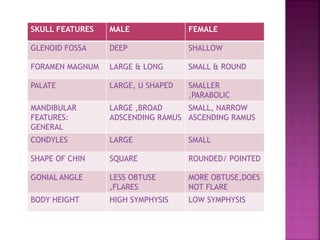
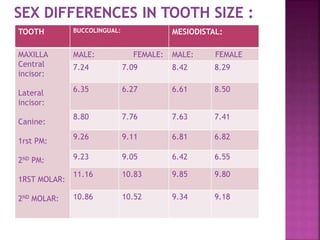
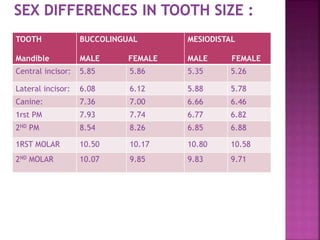
 Assessing the sex, of unknown human
skeletal remains in the second step in the
triad of building a dental profile. Sex can be
assessed based on data from morphology of
skull & mandible ,tooth measurement and by
analysis of DNA from teeth.
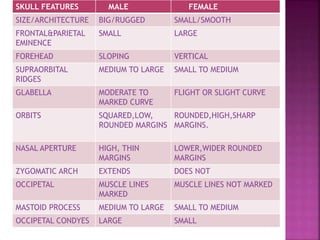
SKULL FEATURES MALE FEMALE
SIZE/ARCHITECTURE BIG/RUGGED SMALL/SMOOTH
FRONTAL&PARIETAL
EMINENCE
SMALL LARGE
FOREHEAD SLOPING VERTICAL
SUPRAORBITAL
RIDGES
MEDIUM TO LARGE SMALL TO MEDIUM
GLABELLA MODERATE TO
MARKED CURVE
FLIGHT OR SLIGHT CURVE
ORBITS SQUARED,LOW,
ROUNDED MARGINS
ROUNDED,HIGH,SHARP
MARGINS.
NASAL APERTURE HIGH, THIN
MARGINS
LOWER,WIDER ROUNDED
MARGINS
ZYGOMATIC ARCH EXTENDS DOES NOT
OCCIPETAL MUSCLE LINES
MARKED
MUSCLE LINES NOT MARKED
MASTOID PROCESS MEDIUM TO LARGE SMALL TO MEDIUM
OCCIPETAL CONDYES LARGE SMALL
SKULL FEATURES MALE FEMALE
GLENOID FOSSA DEEP SHALLOW
FORAMEN MAGNUM LARGE & LONG SMALL & ROUND
PALATE LARGE, U SHAPED SMALLER
,PARABOLIC
MANDIBULAR
FEATURES:
GENERAL
LARGE ,BROAD
ADSCENDING RAMUS
SMALL, NARROW
ASCENDING RAMUS
CONDYLES LARGE SMALL
SHAPE OF CHIN SQUARE ROUNDED/ POINTED
GONIAL ANGLE LESS OBTUSE
,FLARES
MORE OBTUSE,DOES
NOT FLARE
BODY HEIGHT HIGH SYMPHYSIS LOW SYMPHYSIS
TOOTH BUCCOLINGUAL: MESIODISTAL:
MAXILLA
Central
incisor:
Lateral
incisor:
Canine:
1rst PM:
2ND PM:
1RST MOLAR:
2ND MOLAR:
MALE: FEMALE: MALE: FEMALE
7.24 7.09 8.42 8.29
6.35 6.27 6.61 8.50
8.80 7.76 7.63 7.41
9.26 9.11 6.81 6.82
9.23 9.05 6.42 6.55
11.16 10.83 9.85 9.80
10.86 10.52 9.34 9.18
TOOTH
Mandible
BUCCOLINGUAL
MALE FEMALE
MESIODISTAL
MALE FEMALE
Central incisor: 5.85 5.86 5.35 5.26
Lateral incisor: 6.08 6.12 5.88 5.78
Canine: 7.36 7.00 6.66 6.46
1rst PM 7.93 7.74 6.77 6.82
2ND PM 8.54 8.26 6.85 6.88
1RST MOLAR 10.50 10.17 10.80 10.58
2ND MOLAR 10.07 9.85 9.83 9.71
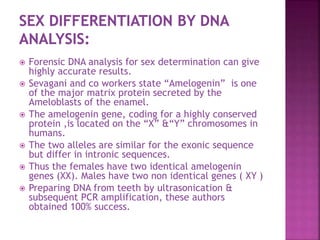
 Forensic DNA analysis for sex determination can give
highly accurate results.
 Sevagani and co workers state “Amelogenin” is one
of the major matrix protein secreted by the
Ameloblasts of the enamel.
 The amelogenin gene, coding for a highly conserved
protein ,is located on the “X” &“Y” chromosomes in
humans.
 The two alleles are similar for the exonic sequence
but differ in intronic sequences.
 Thus the females have two identical amelogenin
genes (XX). Males have two non identical genes ( XY )
 Preparing DNA from teeth by ultrasonication &
subsequent PCR amplification, these authors
obtained 100% success.
Forensic odontology
Forensic odontology

Forensic odontology

  • 1.
    FORENSIC ODONTOLOGY PRESENTED BY: INSHA ILHAM GUIDED BY: DR. HEENA ZAINAB. DR.DEEPA . DR.ZULFIN. DR.PAVAN .
  • 2.
     INTRODUCTION TOFORENSIC.  DENTAL IDENTIFICATION PROCEDURES. 1. COMPARATIVE DENTAL IDENTIFICATION.  IDENTIFICATION IN DISASTERS.  IDENTIFICATION FROM DENTAL DNA.  IDENTIFICATION FROM PALATAL RUGAE . 2.DENTAL PROFILING.  IDENTIFYING ETHNIC ORIGIN FROM TEETH.  SEX DIFFERENTIATION.  BY CRANIOFACIAL MORPHOLOGY & DIMENSIONS.  BY TOOTH SIZE.  BY DNA ANALYSIS.
  • 3.
     The wordFORENSIC is derived from the latin word forensis ,which means “before the forum”.  Forensic odontology is defined by Federation Dentaire Internationale ( FDI ) as ‘that branch of dentistry which , in the interest of justice, deals with the proper handling and examination of dental evidence , and with the proper evaluation and presentation of dental findings’ .  Role of forensic Odontology : 1. Record preparation :the correct handling and examination ,the proper preparation of dental evidence in both civil and criminal legal procedures .
  • 4.
    2. Identification: Personalidentification, either individually or in content of mass disaster. 3. Bite mark investigation: Identification of criminal cases where the bite marks are involved and the interpretation of bite marks. 4. Human abuse: recognition of domestic and child abuse. 5.Legal aspect of dental traumatology. 6.Others: forensic odontology also deals with age assessment of patient & comparison & identification of lip print.
  • 5.
     Forensic odontologyis concerned with the identification of both living and deceased person. ISSUES OF DEATH INVESTIGATION 1. Cause of death :The Sequence which initiated the death of person like physical, chemical injury or disease of person. 2. Mechanism of death: the pathological process which result in death. 3. Mode or manner of death: whether it is natural, accidental, suicidal or homicide. 4. Undetermined death: the manner of death is not established due to decomposition, dismemberment or post-mortem destruction remains by insect or fetal animals.
  • 6.
     There aretwo forms of dental identification : 1. Comparative dental identification . 2. Dental profiling . 1.COMPARATIVE DENTAL IDENTIFICATION : The circumstances of death may give adequate information of possible identity of decedent. It is conventional method of Postmortem dental identification & include 4 steps : 1.Oral autopsy. 2.Obtaining dental records. 3.Comparing post & Antemortem dental data. 4.Writing a report &drawing conclusion.
  • 7.
     It isalso known as post-mortem examination , involves examining the deceased usually with dissection to expose the organs to determine the cause of death.  Oral examination is ideally an essential part of the Postmortem examination.  Forensic dentist who conduct oral autopsy should have adequate knowledge about common Postmortem findings such as rigor mortis ,livor mortis, decomposition & Postmortem artefacts
  • 8.
    2.OBTAINING DENTAL RECORDS: • Dental records contain information of treatment undergone & dental status of a person during his/her lifetime & constitute the ante-mortem dental data . 3.COMPARING POST & ANTEMORTEM DENTAL DATA : Following postmortem examination & transcription of antemortem data,the two odontograms are compared . Featured evaluated include tooth morphology & associated bony structures pathology & dental restorations .
  • 9.
     1.Positive identification–this indicated the ante & post-mortem dental data match each other . It includes post & ante-mortem radiographs. 2. Probable identification :there is high level of concordance between two sets of data but may lack radiographic support . 3. Possible identification :the post &ante mortem data are in agreement but the available information is insufficient , usually in terms of quality. 4.Insufficient information :the available ante & postmortem is minimal/insufficient to drive a conclusion on identity of deceased. 5.Excludes identification: the data is clearly inconsistent.
  • 11.
     TOOTH PRINTSare pattern formed by the enamel rod ends at the crown surface of tooth .  Manjunath & co-workers recorded the enamel rod end pattern using acetate peel technique.
  • 13.
     Disaster refersto natural calamities such as earth quake ,floods & tsunami & accidental, man-made events such as air plane clashes or terrorist attacks – that result in multiple human fatalities. DENTAL SECTION : Forensic dentists are part of a team of identification specialist that include anthropologists & finger print experts , to name a few: The division of odontology section are in 3 subsections 1.Postmortem unit. 2.Antemortem unit. 3.Comparison & identification unit.
  • 14.
     The conventionalmethod of dental identification described thus far requires one base element that may not always be readily available –DENTAL RECORDS.  Pretty & sweet state that TEETH are an excellent source of DNA  Potsh & co workers successfully extracted DNA from the pulp of teeth recovered from decomposed & burned bodies , as well as victims of air crashes.  Techniques: Polymerase chain reaction allows amplification of highly degraded DNA.  Types of DNA :pretty & sweet have pointed out use of 2types of DNA.  1. Genomic or nuclear DNA : located in nucleus of cells & commonly used in forensic cases .  2.mitochondrial DNA :present in Mitochondria of cells.
  • 15.
     Sweet &Hildebrand- method known as cryogenic grinding for extraction of DNA. Major drawback of cryogenic grinding is that the tooth needs to be completely crushed . Since then....  Trivedi & coworkers have sugessted a less destructive method for DNA isolation . This involve accessing the root canals through an opening similar to that made during RCT .
  • 16.
     This isa useful method of identifying edentulous individuals.  Palatal rugae are ridges on the anterior part of the palatal mucosa on each side of mid- palatine raphae , behind the incissive papilla.  CLASSIFICATION of palatal rugae :-lysel quoted & he measured rugae in straight line,from their origin on the medial side to terminus on the lateral and divided them into 3 types: 1.Primary Rugae (more than 5mm). 2.Secondary Rugae (3-5mm). 3.Fragmentary Rugae (less than 3mm).
  • 17.
     Analysis ofrugae pattern :  Thomas & van wyk manually traced rugae patterns from ante mortem & post mortem dentures onto clear acetate (transparent plastic sheets)  Limson & julion developed a computer software program which makes use of principal commonly employed in fingerprint analysis( 97% accuracy)
  • 20.
  • 22.
     It includestriad of information : ETHNIC ORIGIN SEX AGE DETERMINATION DETERMINATION
  • 23.
    1.GENETIC & ENVIRONMENTALINFLUENCE ON TEETH :  Teeth have proven to be significant in the study of human variation.  Dental features used to describe population differences are broadly categorized as METRIC (Tooth size ) & NON METRIC ( Tooth shape)traits.  METRIC TRAITS are based on measurements. • Townsend cities numerous studies which indicate metric triats as being considerably influenced by intraoral environment factors (e.g., missing lateral incisor )cause compensatory increase in central incisor.
  • 24.
     Non metrictraits defined in terms of presence & absence of a particular feature of a tooth.  Shoveling : it refers to the presence of mesial & distal marginal ridge on the lingual surfaces of the maxillary & mandibular anterior teeth.  Carabelli‘s trait : the carabelli’s cusp, or tubercle of carabelli ,is a cingular derivative expressed on the mesiolingual /mesiopalatal cusp of maxillary molar. In Indians , it is reported to be present in 26% of the population.  Three cusped maxillary second molar : the distopalatal cusp of maxillary molars is usually retained on the first molar , but tensed to be reduced size or absent on the second molar.(34%)
  • 25.
     Wingling :itis an indirect crown trait.it is characterized by the bilateral labial rotation of the distal margins of maxillary central incisor. The Incisal edge of the central incisor taken together, appears ‘V’ shaped from the occlusal aspect (16% of Indians ).  Cusp 5: This is characterized by the presence of occlusal tubercles on the distal marginal ridge of maxillary molar(S),particularly first molar .(75% of indians)  Cusp 6 : an additional cusp between distal & distolingual cusp of mandibular molar (S),particularly the first molar ,is referred to as cusp 6.(57% of indians)
  • 26.
     Cusp 7: an additional cusp expressed between the lingual cusps of mandibular molar(S) ,particularly first molar .(21% of Indians)  Mandibular groove pattern : occlusal groove pattern on the mandibular molars , particularly the second molar , is the result of varying modes of cusp contact at the central fossa. • When the mesiolingual & distobuccal cusp are in contact ,the resultant groove pattern is referred to as ‘Y’ groove. • When the mesiobuccal & distolingual cusp are in contact at the central fossa , the groove pattern is known as ‘X’ groove. • When all major cusps are in contact at the central fossa , the groove pattern takes the form of a ‘+’ sign. • Four cusped mandibular molars : conventionally ,the mandibular first molar is considered to have 5cusps while the second molar is regarded as having four.
  • 30.
     Assessing thesex, of unknown human skeletal remains in the second step in the triad of building a dental profile. Sex can be assessed based on data from morphology of skull & mandible ,tooth measurement and by analysis of DNA from teeth.
  • 31.
    SKULL FEATURES MALEFEMALE SIZE/ARCHITECTURE BIG/RUGGED SMALL/SMOOTH FRONTAL&PARIETAL EMINENCE SMALL LARGE FOREHEAD SLOPING VERTICAL SUPRAORBITAL RIDGES MEDIUM TO LARGE SMALL TO MEDIUM GLABELLA MODERATE TO MARKED CURVE FLIGHT OR SLIGHT CURVE ORBITS SQUARED,LOW, ROUNDED MARGINS ROUNDED,HIGH,SHARP MARGINS. NASAL APERTURE HIGH, THIN MARGINS LOWER,WIDER ROUNDED MARGINS ZYGOMATIC ARCH EXTENDS DOES NOT OCCIPETAL MUSCLE LINES MARKED MUSCLE LINES NOT MARKED MASTOID PROCESS MEDIUM TO LARGE SMALL TO MEDIUM OCCIPETAL CONDYES LARGE SMALL
  • 32.
    SKULL FEATURES MALEFEMALE GLENOID FOSSA DEEP SHALLOW FORAMEN MAGNUM LARGE & LONG SMALL & ROUND PALATE LARGE, U SHAPED SMALLER ,PARABOLIC MANDIBULAR FEATURES: GENERAL LARGE ,BROAD ADSCENDING RAMUS SMALL, NARROW ASCENDING RAMUS CONDYLES LARGE SMALL SHAPE OF CHIN SQUARE ROUNDED/ POINTED GONIAL ANGLE LESS OBTUSE ,FLARES MORE OBTUSE,DOES NOT FLARE BODY HEIGHT HIGH SYMPHYSIS LOW SYMPHYSIS
  • 33.
    TOOTH BUCCOLINGUAL: MESIODISTAL: MAXILLA Central incisor: Lateral incisor: Canine: 1rstPM: 2ND PM: 1RST MOLAR: 2ND MOLAR: MALE: FEMALE: MALE: FEMALE 7.24 7.09 8.42 8.29 6.35 6.27 6.61 8.50 8.80 7.76 7.63 7.41 9.26 9.11 6.81 6.82 9.23 9.05 6.42 6.55 11.16 10.83 9.85 9.80 10.86 10.52 9.34 9.18
  • 34.
    TOOTH Mandible BUCCOLINGUAL MALE FEMALE MESIODISTAL MALE FEMALE Centralincisor: 5.85 5.86 5.35 5.26 Lateral incisor: 6.08 6.12 5.88 5.78 Canine: 7.36 7.00 6.66 6.46 1rst PM 7.93 7.74 6.77 6.82 2ND PM 8.54 8.26 6.85 6.88 1RST MOLAR 10.50 10.17 10.80 10.58 2ND MOLAR 10.07 9.85 9.83 9.71
  • 35.
     Forensic DNAanalysis for sex determination can give highly accurate results.  Sevagani and co workers state “Amelogenin” is one of the major matrix protein secreted by the Ameloblasts of the enamel.  The amelogenin gene, coding for a highly conserved protein ,is located on the “X” &“Y” chromosomes in humans.  The two alleles are similar for the exonic sequence but differ in intronic sequences.  Thus the females have two identical amelogenin genes (XX). Males have two non identical genes ( XY )  Preparing DNA from teeth by ultrasonication & subsequent PCR amplification, these authors obtained 100% success.