Estimation of Age at Death Using Teeth 39Variability and Evolution, 2000, Vol. 8: 39–49
ANALYSIS
MICHAELA VYSTRÈILOVÁ1
, VLADIMÍR NOVOTNÝ1,2
1
Department of Anthropology, Faculty of Science, Masaryk University in Brno, Kotláøská 2, 611 37
Brno, Czech Republic
2
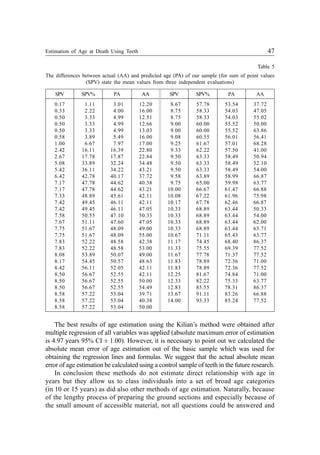
“Membre associé” UMR 5809 – CNRS, Laboratoire d’Anthropologie des Populations du Passé,
Université Bordeaux 1
ESTIMATION OF AGE AT DEATH USING TEETH
VYSTRÈILOVÁ M., NOVOTNÝ V. 2000. Estimation of age at death using teeth. Variability and Evolution,
Vol. 8: 39–49, Tabs. 5, Figs. 4. Adam Mickiewicz University, Faculty of Biology, Institute of
Anthropology, Poznañ.
Abstract. Our research is based on the confrontation of modifications of Gustafson’s
aging method with the aim of producing of up to date identification tables for practical
anthropology. Sixty three ground sections were evaluated following the methods of
Kilian and Kashyap – Koteswara Rao. Kilian’s method is based on the subjective
evaluation of six markers: the degree of attrition, the secondary dentine, the secondary
cementum, the resorption, the transparency and the position of epithelial attachment.
Future study, the evaluation of the position of epithelial attachment was not taken into
account. Kashyap and Koteswara Rao’s method is based on the quantitative evaluation
of four markers: the abrasion, the secondary dentine, the secondary cementum and the
transparency. The best results of age estimation were obtained using the Kilian’s method
after multiple regression of all studied changes were applied (absolute mean error of estimation
4.97 years – 95% CI ±1.00). The identification tables were produced using the mutual
relationship of the sum of point values and age (absolute mean error of estimation 6.58
years – 95% CI ±1.14 years). Whenever any of the variables are not included, the error of
estimation increases. These methods do not estimate the actual age in years, but only
class the individuals in relatively broad categories.
Key words: teeth, estimation of age, Gustafson’s method, modifications, identification
tables
40 M. Vystrèilová, V. Novotný
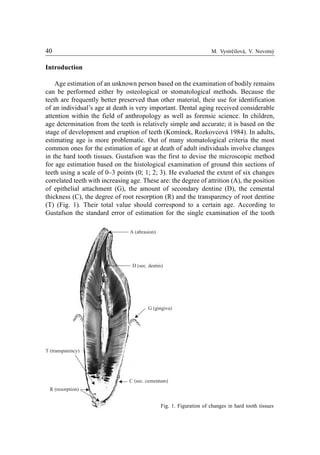
A (abrasion)
G (gingiva)
D (sec. dentin)
C (sec. cementum)
R (resorption)
T (transparency)
Introduction
Age estimation of an unknown person based on the examination of bodily remains
can be performed either by osteological or stomatological methods. Because the
teeth are frequently better preserved than other material, their use for identification
of an individual’s age at death is very important. Dental aging received considerable
attention within the field of anthropology as well as forensic science. In children,
age determination from the teeth is relatively simple and accurate; it is based on the
stage of development and eruption of teeth (Komínek, Rozkovcová 1984). In adults,
estimating age is more problematic. Out of many stomatological criteria the most
common ones for the estimation of age at death of adult individuals involve changes
in the hard tooth tissues. Gustafson was the first to devise the microscopic method
for age estimation based on the histological examination of ground thin sections of
teeth using a scale of 0–3 points (0; 1; 2; 3). He evalueted the extent of six changes
correlated teeth with increasing age. These are: the degree of attrition (A), the position
of epithelial attachment (G), the amount of secondary dentine (D), the cemental
thickness (C), the degree of root resorption (R) and the transparency of root dentine
(T) (Fig. 1). Their total value should correspond to a certain age. According to
Gustafson the standard error of estimation for the single examination of the tooth
Fig. 1. Figuration of changes in hard tooth tissues
Estimation of Age at Death Using Teeth 41
is ± 3.6 years (Gustafson 1950). However, this statement has been contested
(Nkhumeleni et al. 1989; Lucy and Pollard 1995). The estimation of age performed
on the basis of histological examination and evaluation of morphological changes in
hard tooth tissues was believed to be one of the most reliable methods, yet it has
become the subject of heavy criticism especially when used with past populations
(Brùžek, Novotný 1999; Kilian et al. 1984; Vlèek, Kilian 1975). Nevertheless, the
principle of the histological evaluation of the changes introduced by Gustafson has
become the basis for all other techniques which aim at the increase of precision of
measurement (Kilian 1986; Kashyap and Koteswara Rao 1990).
Materials and methods
The dental sample was collected from October 1997 to September 1998 with
the help of dental surgeries. Acquired through extractions, the teeth were consecutively
disinfected by 75% ethanol, provided by tablets with number and saved in boxes
with the description until the histological examination. The following information
was collected: exact date of birth of the patient, date of extraction of the tooth, sex,
profession, type and place of the tooth in the dentition. In total, 147 one rooted
teeth from 112 individuals were collected. Because the teeth were often pathological,
many could not be used, mostly because of the missing crown or root. The final
number of the teeth was 63 (31 of males and 32 of females).
Ground sections were prepared at the Stomatological hospital of Charles University
in Plzeò using Kilian’s grinding method on an instrument of his own construction
(Kilian 1975). Following grinding and dehydratation, tooth sections were embed in
Solakryl BMX (Penta, Prague) between a slide and a cover glass for microscopic
observation. A substantial drawback of the technique is that the tooth is practically
destroyed in the process of grinding. This disadvantage can be compensated by
making exact copies of the tooth, before the grinding process. The ground sections
were evaluated by two modifications of Gustafson’s method using the light
microscope (Olympus BX 60) with the possibility of image analysis (Videotip –
Tescan, Brno). When the research and evaluations of individual ground sections
changes were performed the age, sex and profession of the individuals were not
known (blind experiment).
Kilian’s method is based on the evaluation of five of the six Gustafson markers.
We did not score the epithelial attachment position because this evaluation is very
difficult especially with the historical material (Vlèek, Mrklas 1975). The individual
changes were classified using a seven point scale (0, 0.5, 1, ..., 3) in the
Kilian’s method. We used the Kilian’s atlas of the histological changes for the evaluation
(Kilian 1986). In the cases, where we could not decide if the change is 1 point or
1.5 point, the change was rated as 1.25 point. The ground sections were examined
four times at low magnification (faktor 3.5; larger for details). The subsequent
evaluation was always performed after a certain amount of time had elapsed. Only
42 M. Vystrèilová, V. Novotný
the last three measurements were used for the statistical evaluation and were
expressed in percentages. (The maximum sum of point values regarding all five
evaluated changes is 15, i.e. 100%).
Because many authors recommend to replace the subjective point classification
by objective data (Xu Xiaohu et al. 1992), we performed also the evaluation after
Kashyap and Koteswara Rao’s method. This evaluation was performed with the use
of image analysis (Videotip – Tescan, Brno). This method takes advantage of index
values of various parameters of examined changes (i.e. A; D; C and T), which are
calculated by relating the measured change to a fixed measurement of the tooth
(Kashyap, Koteswara Rao 1990).
All the statistical analyses were performed using SPSS software package
(version 6.1) and the Microsoft Excel for Windows 95 (version 7.0). The relationships
between measured histological changes (or sum of point values at the Kilian’s method)
and age were analysed by computing the Pearson (r) and the Spearman (rs) rank
correlation coefficient. Equations for age prediction were derived using least squares
regression analysis. Absolute mean error of estimation was counted from absolute
values of residuals (i.e. the actual value of the dependent variable minus the value
predicted by the regression equation). The formulas for age prediction were also
calculated from multiple regression analysis in both methods.
Results
Kilian’s method evaluation
The correlation between individual histological changes and age is shown in the
Table 1, 2.
The resulting formula of age calculation for relationship between sum of point
values (SPV) and age using the regression analysis was established as follows:
AGE =
SPV% + 2.27
1.12
r2
= 0.84; absolute mean error of estimation 6.58 years; 95% CI ± 1.14 (Fig. 2).
Where r2
is the coefficient of determination, CI is the confidence interval.
Table 1
Correlation (r – Pearson correlation coeficient)
between individual histological changes and age of
transformed values using Kilian’s evaluation
ÖA ÖC ÖD ÖR ÖT
In Age 0.76 0.84 0.90 0.83 0.84
Table 2
Correlation (r – Pearson correlation coefficient)
between individual histological changes and age of
transformed values in the evaluation after Kashyap
and Koteswara Rao’s
ÖAi lnCi lnDi ÖTi
In Age 0.73 0.58 0.83 0.75
Xi – index value of an change, ln – natural logarithm
Estimation of Age at Death Using Teeth 43
Fig. 2. A graphic expression of the relations between the sum of point values of five researched
changes (attrition, secondary dentine, secondary cementum, resorption and transparency) and age
The resulting formula of age calculation for relationship between sum of point
values with transparency not regarded (SPV–T) and age using the regression analysis
was established as follows:
AGE =
(SPV – T%) + 3.42
1.16
r2
= 0.79; absolute mean error of estimation 7.08 years; 95% CI ± 2.08 (Fig. 3).
Using these equations the identification tables for practical use in the field
anthropology were calculated (Table 3, 4). However, the accuracy of these tables is
limited to the error given about. The differences between the actual and predicted
age of our sample are shown in the Table 5.
Better results of age estimation were obtained after multiple regression analysis
of all five changes was applied. The formula of age estimation from all studied
changes using the multiple regression analysis was obtained as follows:
AGE = e(2.47 + 0.01ÖA% +0.04ÖC% + 0.06ÖD% + 0.03ÖR% + 0.06ÖT%)
where “e” is the base of natural logarithm (ln).
r2
= 0.94; absolute mean error of estimation 4.97 years; 95% CI ± 1.00.
The resulting formula of age estimation with transparency not regarded using
the multiple regression analysis was established as follows:
AGE = e(2.59 + 0.02ÖA% + 0.05ÖC% + 0.08ÖD% + 0.03ÖR%)
r2
= 0.91; absolute mean error of estimation 5.97 years; 95% CI ± 1.23.
0
10
20
30
40
50
60
70
80
90
100
0 10 20 30 40 50 60 70 80 90 100
Age (years)
Sumofpointvalues[%]
44 M. Vystrèilová, V. Novotný
Kashyap and Koteswara Rao’s evaluation
We also run multiple regression analysis regarding all observed changes (their
transformated index values) with age as dependent variable. The resulting formula
of age estimation was then established as follows:
AGE = e(2.41 + 0.04ÖAi% + 0.20lnDi% + 0.18lnCi% + 0.06ÖTi%)
r2
= 0.81; absolute mean error of estimation 8.32 years; 95% CI ± 1.61.
The resulting formula of age estimation with transparency not regarded was
then established as follows:
AGE = e(2.43 + 0.06ÖAi% + 0.22lnDi% + 0.20 lnCi%)
r2
= 0.80; absolute mean error of estimation 8.85, 95% CI ± 1.76.
(“i” is the index value of the change, for example “Ai” is the index value of the
attrition, all index values were counted after formulas presented by Kashyap and
Koteswara Rao in their study of 1990)
Discussion and conclusions
The teeth used in this study have been collected from different places and were
extracted for many reasons. This variety of origins was considered suitable for
computing the formulas for age prediction as it might better reflect the biological
variation. Teeth from heterogeneous sources were used by Solheim (1993) as well.
Fig. 3. A graphic expression of the relations between the sum of point values of four researched
changes (attrition, secondary dentine, secondary cementum and resorption) and age
0
10
20
30
40
50
60
70
80
90
100
0 10 20 30 40 50 60 70 80 90 100
Age (years)
Sumofpointvalueswithouttransparency[%]
Estimation of Age at Death Using Teeth 45
Teeth from homogeneous source, as used Maples and Rice (1979), might resulted
in a stronger correlation with age, but this condition could not be keep in age
estimation on an independent sample. Also for more reliable results it would be
better to have the same number of teeth in all age categories. Unfortunately, our
sample does not allow this.
Analysis of the data revealed that Kilian’s method (absolute maximum error of
estimation is 7.72 years at the 95% confidence interval) enables us to give more
accurate estimations of age than Kashyap and Koteswara Rao’s method (absolute
maximum error of estimation is 9.94 years at the 95% confidence interval). Thus,
our results do not correspond with results of original Kashyap and Koteswara Rao’s
Table 3
IDENTIFICATION TABLE I (for estimation of age with the use of the subjective classification
including attrition, secondary dentine, secondary cementum, resorption and transparency
SPV = A + D + C + R + T)
Sum of point values Predicted Sum of point values Predicted
[%] age [%] age
0 0.00 2.02 07.75 51.67 48.09
0.25 1.67 3.51 08 53.33 49.58
0.5 3.33 4.99 08.25 55.00 51.06
0.75 5.00 6.48 08.5 56.67 52.55
1 6.67 7.97 08.75 58.33 54.03
1.25 8.33 9.45 09 60.00 55.52
1.5 10.00 10.94 09.25 61.67 57.01
1.75 11.67 12.42 09.5 63.33 58.49
2 13.33 13.91 09.75 65.00 59.98
2.25 15.00 15.40 10 66.67 61.47
2.5 16.67 16.88 10.25 68.33 62.95
2.75 18.33 18.37 10.5 70.00 64.44
3 20.00 19.85 10.75 71.67 65.92
3.25 21.67 21.34 11 73.33 67.41
3.5 23.33 22.83 11.25 75.00 68.90
3.75 25.00 24.31 11.5 76.67 70.38
4 26.67 25.80 11.75 78.33 71.87
4.25 28.33 27.29 12 80.00 73.35
4.5 30.00 28.77 12.25 81.67 74.84
4.75 31.67 30.26 12.5 83.33 76.33
5 33.33 31.74 12.75 85.00 77.81
5.25 35.00 33.23 13 86.67 79.30
5.5 36.67 34.72 13.25 88.33 80.78
5.75 38.33 36.20 13.5 90.00 82.27
6 40.00 37.69 13.75 91.67 83.76
6.25 41.67 39.17 14 93.33 85.24
6.5 43.33 40.66 14.25 95.00 86.73
6.75 45.00 42.15 14.5 96.67 88.22
7 46.67 43.63 14.75 98.33 89.70
7.25 48.33 45.12 15 100.00 91.19
7.5 50.00 46.60
46 M. Vystrèilová, V. Novotný
method. Other authors as well (Lopez – Nicolaz et al. 1990) failed to get more
accurate results with the use of morphometric technique. One of the reasons for
this lower resolution may relate to the use of four variables in the Kashyap and
Koteswara Rao’s method correspond to five in the Killian’s method.
Our study results were similar to those using other methods (Gustafson 1950;
Johanson 1971; Kilian et al. 1981). It is clear that if any of the variables are not
included, the reliability of the regression model declines. From the correlation between
histological changes and age, the smallest dependence was found between abrasion
and age (r = 0.65) in the Kilian’s method, and between cementum apposition and
age (r = 0.32) in the Kashyap and Koteswara Rao’s method. Abrasion is certainly
affected also by other changes (as the diet) and not only by age. In the case of
cementum apposition in the Kashyap and Koteswara Rao’s method was the least
dependence caused by not suitable way of measurement. The Kashyap and Koteswara
Rao’s method did not take into account the cementum apposition on the apex of the
root, where the apposition is mostly largest (Fig. 4).
Table 4
IDENTIFICATION TABLE II (for estimation of age with the use of subjective point classification
including attrition, secondary dentine, secondary cementum and resorption
SPV = A + D + C + R)
Sum of point values Predicted Sum of point values Predicted
[%] age [%] age
0 0.00 2.94 6.25 52.08 47.72
0.25 2.08 4.73 6.5 54.17 49.51
0.5 4.17 6.52 6.75 56.25 51.30
0.75 6.25 8.31 7 58.33 53.10
1 8.33 10.10 7.25 60.42 54.89
1.25 10.42 11.90 7.5 62.50 56.68
1.5 12.50 13.69 7.75 64.58 58.47
1.75 14.58 15.48 8 66.67 60.26
2 16.67 17.27 8.25 68.75 62.05
2.25 18.75 19.06 8.5 70.83 63.84
2.5 20.83 20.85 8.75 72.92 65.64
2.75 22.92 22.64 9 75.00 67.43
3 25.00 24.43 9.25 77.08 69.22
3.25 27.09 26.23 9.5 79.17 71.01
3,5 29.17 28.02 9.75 81.25 72.80
3.75 31.25 29.81 10 83.33 74.59
4 33.33 31.60 10.25 85.42 76.38
4.25 35.42 33.39 10.5 87.50 78.18
4.5 37.50 35.18 10.75 89.58 79.97
4.75 39.58 36.97 11 91.67 81.76
5 41.67 38.77 11.25 93.75 83.55
5.25 43.75 40.56 11.5 95.83 85.34
5.5 45.83 42.35 11.75 97.92 87.13
5.75 47.92 44.14 12 100.00 88.92
6 50.00 45.93
Estimation of Age at Death Using Teeth 47
The best results of age estimation using the Kilian’s method were obtained after
multiple regression of all variables was applied (absolute maximum error of estimation
is 4.97 years 95% CI ± 1.00). However, it is necessary to point out we calculated the
absolute mean error of age estimation out of the basic sample which was used for
obtaining the regression lines and formulas. We suggest that the actual absolute mean
error of age estimation be calculated using a control sample of teeth in the future research.
In conclusion these methods do not estimate direct relationship with age in
years but they allow us to class individuals into a set of broad age categories
(in 10 or 15 years) as did also other methods of age estimation. Naturally, because
of the lengthy process of preparing the ground sections and especially because of
the small amount of accessible material, not all questions could be answered and
Table 5
The differences between actual (AA) and predicted age (PA) of our sample (for sum of point values
(SPV) state the mean values from three independent evaluations)
SPV SPV% PA AA SPV SPV% PA AA
0.17 01.11 03.01 12.20 08.67 57.78 53.54 37.72
0.33 02.22 04.00 16.00 08.75 58.33 54.03 47.05
0.50 03.33 04.99 12.51 08.75 58.33 54.03 55.02
0.50 03.33 04.99 12.66 09.00 60.00 55.52 50.00
0.50 03.33 04.99 13.03 09.00 60.00 55.52 63.86
0.58 03.89 05.49 16.00 09.08 60.55 56.01 56.41
1.00 06.67 07.97 17.00 09.25 61.67 57.01 68.28
2.42 16.11 16.39 22.80 09.33 62.22 57.50 41.00
2.67 17.78 17.87 22.84 09.50 63.33 58.49 50.94
5.08 33.89 32.24 34.48 09.50 63.33 58.49 52.10
5.42 36.11 34.22 43.21 09.50 63.33 58.49 54.00
6.42 42.78 40.17 37.72 09.58 63.89 58.99 66.87
7.17 47.78 44.62 40.38 09.75 65.00 59.98 63.77
7.17 47.78 44.62 43.21 10.00 66.67 61.47 66.88
7.33 48.89 45.61 42.11 10.08 67.22 61.96 75.98
7.42 49.45 46.11 42.11 10.17 67.78 62.46 66.87
7.42 49.45 46.11 47.05 10.33 68.89 63.44 50.33
7.58 50.55 47.10 50.33 10.33 68.89 63.44 54.00
7.67 51.11 47.60 47.05 10.33 68.89 63.44 62.00
7.75 51.67 48.09 49.00 10.33 68.89 63.44 63.71
7.75 51.67 48.09 55.00 10.67 71.11 65.43 63.77
7.83 52.22 48.58 42.38 11.17 74.45 68.40 86.37
7.83 52.22 48.58 53.00 11.33 75.55 69.39 77.52
8.08 53.89 50.07 49.00 11.67 77.78 71.37 77.52
8.17 54.45 50.57 48.63 11.83 78.89 72.36 71.00
8.42 56.11 52.05 42.11 11.83 78.89 72.36 77.52
8.50 56.67 52.55 42.11 12.25 81.67 74.84 71.00
8.50 56.67 52.55 50.00 12.33 82.22 75.33 63.77
8.50 56.67 52.55 54.49 12.83 85.55 78.31 86.37
8.58 57.22 53.04 39.71 13.67 91.11 83.26 66.88
8.58 57.22 53.04 40.38 14.00 93.33 85.24 77.52
8.58 57.22 53.04 50.00
48 M. Vystrèilová, V. Novotný
not all problems of evaluation could be dealt with in full. Evidently, the issue of
the estimation of age at death of adult individual’s from the teeth will remain
a subject of further research.
Acknowledgements
We are grateful to prof. MUDr. Jan Kilian, DrSc. (Charles University, Pilsen) for
useful ideas and lending the grinding equipment as well as all the dentists for making
teeth from individuals of known age and sex available for this study. We are greatly
indebted to prof. David W. Frayer (University of Kansas) for checking the English
of this paper and also for commenting on it. We would like to thank prof. RNDr. Jaro-
slav Brùžek, Ph.D. (University of Bordeaux) for all his support and interesting ideas.
References
Brùžek J., Novotný V. 1999. Jak staøí umírali staøí Pøemyslovci aneb jak pøesná je pøesnost urèení vìku
jedince podle kostry. Vesmír, 78: 453–455.
Gustafson G. 1950. Age determination on teeth. Journal of the American Dental Association, 41: 45–54.
Komínek J., Rozkovcová E. 1984. Metoda urèování zubního vìku a její význam pro praxi. In:
Urban F. (ed.), Pokroky ve stomatologii 2: 175–208, Avicenum, Praha.
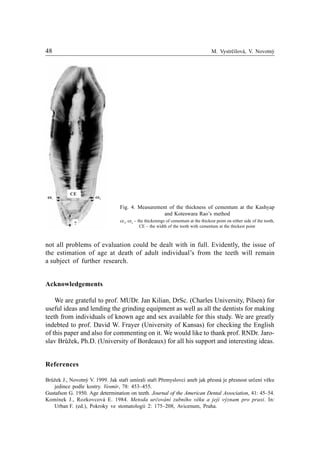
Fig. 4. Measurement of the thickness of cementum at the Kashyap
and Koteswara Rao’s method
ce1
, ce2
– the thickenings of cementum at the thickest point on either side of the tooth,
CE – the width of the tooth with cementum at the thickest point
ce1 ce2
CE
?
Estimation of Age at Death Using Teeth 49
Johanson G. 1971. Age determination from human teeth: a critical evaluation with special consideration
of changes after fourteen years of age. Odontologisk Revy, 22, Supplement 21: 1–126.
Kashyap V.K., Koteswara Rao N.R. 1990. A modified Gustafson method of age estimation from teeth.
Forensic Science International, 47: 237–247.
Kilian J. 1975. K technice výbrusù zubù. Èeskoslovenská stomatologie, 75: 24–28.
Kilian J. 1986. Urèování vìku dospìlých osob podle chrupu. Doctor’s thesis, Plzeò.
Kilian J., Šídlo R., Merglová V. 1981. K problematice urèování stáøí jedince podle chrupu. Soudní
lékaøství, 26: 33–42, 49–54, 55–59.
Kilian J., Šídlo R., Vlèek E. 1984. Stanovení vìku podle chrupu u nìkterých pøíslušníkù rodu Pøemyslovcù.
Èeskoslovenská stomatologie, 84: 122–127.
Lopez-Nicolas M., Canteras M., Luna A. 1990. Age estimation by IBAS image analysis of teeth.
Forensic Science International, 45: 143–150.
Lucy D., Pollard A.M. 1995. Further Comments on the Estimation of Error Associated with the
Gustafson Dental Age Estimation Method. Journal of Forensic Sciences, 40: 222–7.
Maples W.R., Rice P.M. 1979. Some difficulties in the Gustafson dental age estimation. Journal of
Forensic Sciences, 24: 168–72.
Nkhumeleni F.S., Raubenheimer E.J., Monteith B.D. 1989. Gustafson’s method for age determination
revised. The Journal of Forensic Odonto-Stomatology, 7: 13–16.
Novotný V. 1981. Systémový pøístup v biologii a morfologii. Scripta medica (Brno), 54: 308–309.
Novotný V. 1996. Sexuální dimorfismus a identifikace pohlaví na kostøe èlovìka. Teoretická východiska,
metodologické problémy a praktická doporuèení. Habilitaèní spis, Masarykova univerzita v Brnì
(for review).
Solheim T. 1993. A new method for dental age estimation in adults. Forensic Science International,
59: 137–47.
Vlèek E., Kilian J. 1975. Age Determination of a Prince from the Pøemyslide Dynasty Buried in Tomb
No.98 in the St. George’s Basilica According to Preserved Teeth on the Basis of the Modified
Gustafson Method. Scripta medica (Brno), 48: 209–214.
Vlèek E., Mrklas L. 1975. Modification of the Gustafson Method of Determination of Age According to
Teeth on Prehistorical and Historical Osteological Material. Scripta medica (Brno), 48: 203–208.
Vystrèilová, M. (1999): Urèování dožitého vìku podle zubù. M.A. thesis. Katedra antropologie
Pøírodovìdecké fakulty Masarykovy Univerzity, Brno.
Xu Xiaohu, Philipsen H.P., Jablonski N.G., Pang K.M., Zhu J. 1992. Age estimation from the structure
of adult human teeth: review of the literature. Forensic Science International, 54: 23–28.
50 M. Vystrèilová, V. Novotný

ESTIMATION OF AGE AT DEATH USING TEETH

  • 1.
    Estimation of Ageat Death Using Teeth 39Variability and Evolution, 2000, Vol. 8: 39–49 ANALYSIS MICHAELA VYSTRÈILOVÁ1 , VLADIMÍR NOVOTNÝ1,2 1 Department of Anthropology, Faculty of Science, Masaryk University in Brno, Kotláøská 2, 611 37 Brno, Czech Republic 2 “Membre associé” UMR 5809 – CNRS, Laboratoire d’Anthropologie des Populations du Passé, Université Bordeaux 1 ESTIMATION OF AGE AT DEATH USING TEETH VYSTRÈILOVÁ M., NOVOTNÝ V. 2000. Estimation of age at death using teeth. Variability and Evolution, Vol. 8: 39–49, Tabs. 5, Figs. 4. Adam Mickiewicz University, Faculty of Biology, Institute of Anthropology, Poznañ. Abstract. Our research is based on the confrontation of modifications of Gustafson’s aging method with the aim of producing of up to date identification tables for practical anthropology. Sixty three ground sections were evaluated following the methods of Kilian and Kashyap – Koteswara Rao. Kilian’s method is based on the subjective evaluation of six markers: the degree of attrition, the secondary dentine, the secondary cementum, the resorption, the transparency and the position of epithelial attachment. Future study, the evaluation of the position of epithelial attachment was not taken into account. Kashyap and Koteswara Rao’s method is based on the quantitative evaluation of four markers: the abrasion, the secondary dentine, the secondary cementum and the transparency. The best results of age estimation were obtained using the Kilian’s method after multiple regression of all studied changes were applied (absolute mean error of estimation 4.97 years – 95% CI ±1.00). The identification tables were produced using the mutual relationship of the sum of point values and age (absolute mean error of estimation 6.58 years – 95% CI ±1.14 years). Whenever any of the variables are not included, the error of estimation increases. These methods do not estimate the actual age in years, but only class the individuals in relatively broad categories. Key words: teeth, estimation of age, Gustafson’s method, modifications, identification tables
  • 2.
    40 M. Vystrèilová,V. Novotný A (abrasion) G (gingiva) D (sec. dentin) C (sec. cementum) R (resorption) T (transparency) Introduction Age estimation of an unknown person based on the examination of bodily remains can be performed either by osteological or stomatological methods. Because the teeth are frequently better preserved than other material, their use for identification of an individual’s age at death is very important. Dental aging received considerable attention within the field of anthropology as well as forensic science. In children, age determination from the teeth is relatively simple and accurate; it is based on the stage of development and eruption of teeth (Komínek, Rozkovcová 1984). In adults, estimating age is more problematic. Out of many stomatological criteria the most common ones for the estimation of age at death of adult individuals involve changes in the hard tooth tissues. Gustafson was the first to devise the microscopic method for age estimation based on the histological examination of ground thin sections of teeth using a scale of 0–3 points (0; 1; 2; 3). He evalueted the extent of six changes correlated teeth with increasing age. These are: the degree of attrition (A), the position of epithelial attachment (G), the amount of secondary dentine (D), the cemental thickness (C), the degree of root resorption (R) and the transparency of root dentine (T) (Fig. 1). Their total value should correspond to a certain age. According to Gustafson the standard error of estimation for the single examination of the tooth Fig. 1. Figuration of changes in hard tooth tissues
  • 3.
    Estimation of Ageat Death Using Teeth 41 is ± 3.6 years (Gustafson 1950). However, this statement has been contested (Nkhumeleni et al. 1989; Lucy and Pollard 1995). The estimation of age performed on the basis of histological examination and evaluation of morphological changes in hard tooth tissues was believed to be one of the most reliable methods, yet it has become the subject of heavy criticism especially when used with past populations (Brùžek, Novotný 1999; Kilian et al. 1984; Vlèek, Kilian 1975). Nevertheless, the principle of the histological evaluation of the changes introduced by Gustafson has become the basis for all other techniques which aim at the increase of precision of measurement (Kilian 1986; Kashyap and Koteswara Rao 1990). Materials and methods The dental sample was collected from October 1997 to September 1998 with the help of dental surgeries. Acquired through extractions, the teeth were consecutively disinfected by 75% ethanol, provided by tablets with number and saved in boxes with the description until the histological examination. The following information was collected: exact date of birth of the patient, date of extraction of the tooth, sex, profession, type and place of the tooth in the dentition. In total, 147 one rooted teeth from 112 individuals were collected. Because the teeth were often pathological, many could not be used, mostly because of the missing crown or root. The final number of the teeth was 63 (31 of males and 32 of females). Ground sections were prepared at the Stomatological hospital of Charles University in Plzeò using Kilian’s grinding method on an instrument of his own construction (Kilian 1975). Following grinding and dehydratation, tooth sections were embed in Solakryl BMX (Penta, Prague) between a slide and a cover glass for microscopic observation. A substantial drawback of the technique is that the tooth is practically destroyed in the process of grinding. This disadvantage can be compensated by making exact copies of the tooth, before the grinding process. The ground sections were evaluated by two modifications of Gustafson’s method using the light microscope (Olympus BX 60) with the possibility of image analysis (Videotip – Tescan, Brno). When the research and evaluations of individual ground sections changes were performed the age, sex and profession of the individuals were not known (blind experiment). Kilian’s method is based on the evaluation of five of the six Gustafson markers. We did not score the epithelial attachment position because this evaluation is very difficult especially with the historical material (Vlèek, Mrklas 1975). The individual changes were classified using a seven point scale (0, 0.5, 1, ..., 3) in the Kilian’s method. We used the Kilian’s atlas of the histological changes for the evaluation (Kilian 1986). In the cases, where we could not decide if the change is 1 point or 1.5 point, the change was rated as 1.25 point. The ground sections were examined four times at low magnification (faktor 3.5; larger for details). The subsequent evaluation was always performed after a certain amount of time had elapsed. Only
  • 4.
    42 M. Vystrèilová,V. Novotný the last three measurements were used for the statistical evaluation and were expressed in percentages. (The maximum sum of point values regarding all five evaluated changes is 15, i.e. 100%). Because many authors recommend to replace the subjective point classification by objective data (Xu Xiaohu et al. 1992), we performed also the evaluation after Kashyap and Koteswara Rao’s method. This evaluation was performed with the use of image analysis (Videotip – Tescan, Brno). This method takes advantage of index values of various parameters of examined changes (i.e. A; D; C and T), which are calculated by relating the measured change to a fixed measurement of the tooth (Kashyap, Koteswara Rao 1990). All the statistical analyses were performed using SPSS software package (version 6.1) and the Microsoft Excel for Windows 95 (version 7.0). The relationships between measured histological changes (or sum of point values at the Kilian’s method) and age were analysed by computing the Pearson (r) and the Spearman (rs) rank correlation coefficient. Equations for age prediction were derived using least squares regression analysis. Absolute mean error of estimation was counted from absolute values of residuals (i.e. the actual value of the dependent variable minus the value predicted by the regression equation). The formulas for age prediction were also calculated from multiple regression analysis in both methods. Results Kilian’s method evaluation The correlation between individual histological changes and age is shown in the Table 1, 2. The resulting formula of age calculation for relationship between sum of point values (SPV) and age using the regression analysis was established as follows: AGE = SPV% + 2.27 1.12 r2 = 0.84; absolute mean error of estimation 6.58 years; 95% CI ± 1.14 (Fig. 2). Where r2 is the coefficient of determination, CI is the confidence interval. Table 1 Correlation (r – Pearson correlation coeficient) between individual histological changes and age of transformed values using Kilian’s evaluation ÖA ÖC ÖD ÖR ÖT In Age 0.76 0.84 0.90 0.83 0.84 Table 2 Correlation (r – Pearson correlation coefficient) between individual histological changes and age of transformed values in the evaluation after Kashyap and Koteswara Rao’s ÖAi lnCi lnDi ÖTi In Age 0.73 0.58 0.83 0.75 Xi – index value of an change, ln – natural logarithm
  • 5.
    Estimation of Ageat Death Using Teeth 43 Fig. 2. A graphic expression of the relations between the sum of point values of five researched changes (attrition, secondary dentine, secondary cementum, resorption and transparency) and age The resulting formula of age calculation for relationship between sum of point values with transparency not regarded (SPV–T) and age using the regression analysis was established as follows: AGE = (SPV – T%) + 3.42 1.16 r2 = 0.79; absolute mean error of estimation 7.08 years; 95% CI ± 2.08 (Fig. 3). Using these equations the identification tables for practical use in the field anthropology were calculated (Table 3, 4). However, the accuracy of these tables is limited to the error given about. The differences between the actual and predicted age of our sample are shown in the Table 5. Better results of age estimation were obtained after multiple regression analysis of all five changes was applied. The formula of age estimation from all studied changes using the multiple regression analysis was obtained as follows: AGE = e(2.47 + 0.01ÖA% +0.04ÖC% + 0.06ÖD% + 0.03ÖR% + 0.06ÖT%) where “e” is the base of natural logarithm (ln). r2 = 0.94; absolute mean error of estimation 4.97 years; 95% CI ± 1.00. The resulting formula of age estimation with transparency not regarded using the multiple regression analysis was established as follows: AGE = e(2.59 + 0.02ÖA% + 0.05ÖC% + 0.08ÖD% + 0.03ÖR%) r2 = 0.91; absolute mean error of estimation 5.97 years; 95% CI ± 1.23. 0 10 20 30 40 50 60 70 80 90 100 0 10 20 30 40 50 60 70 80 90 100 Age (years) Sumofpointvalues[%]
  • 6.
    44 M. Vystrèilová,V. Novotný Kashyap and Koteswara Rao’s evaluation We also run multiple regression analysis regarding all observed changes (their transformated index values) with age as dependent variable. The resulting formula of age estimation was then established as follows: AGE = e(2.41 + 0.04ÖAi% + 0.20lnDi% + 0.18lnCi% + 0.06ÖTi%) r2 = 0.81; absolute mean error of estimation 8.32 years; 95% CI ± 1.61. The resulting formula of age estimation with transparency not regarded was then established as follows: AGE = e(2.43 + 0.06ÖAi% + 0.22lnDi% + 0.20 lnCi%) r2 = 0.80; absolute mean error of estimation 8.85, 95% CI ± 1.76. (“i” is the index value of the change, for example “Ai” is the index value of the attrition, all index values were counted after formulas presented by Kashyap and Koteswara Rao in their study of 1990) Discussion and conclusions The teeth used in this study have been collected from different places and were extracted for many reasons. This variety of origins was considered suitable for computing the formulas for age prediction as it might better reflect the biological variation. Teeth from heterogeneous sources were used by Solheim (1993) as well. Fig. 3. A graphic expression of the relations between the sum of point values of four researched changes (attrition, secondary dentine, secondary cementum and resorption) and age 0 10 20 30 40 50 60 70 80 90 100 0 10 20 30 40 50 60 70 80 90 100 Age (years) Sumofpointvalueswithouttransparency[%]
  • 7.
    Estimation of Ageat Death Using Teeth 45 Teeth from homogeneous source, as used Maples and Rice (1979), might resulted in a stronger correlation with age, but this condition could not be keep in age estimation on an independent sample. Also for more reliable results it would be better to have the same number of teeth in all age categories. Unfortunately, our sample does not allow this. Analysis of the data revealed that Kilian’s method (absolute maximum error of estimation is 7.72 years at the 95% confidence interval) enables us to give more accurate estimations of age than Kashyap and Koteswara Rao’s method (absolute maximum error of estimation is 9.94 years at the 95% confidence interval). Thus, our results do not correspond with results of original Kashyap and Koteswara Rao’s Table 3 IDENTIFICATION TABLE I (for estimation of age with the use of the subjective classification including attrition, secondary dentine, secondary cementum, resorption and transparency SPV = A + D + C + R + T) Sum of point values Predicted Sum of point values Predicted [%] age [%] age 0 0.00 2.02 07.75 51.67 48.09 0.25 1.67 3.51 08 53.33 49.58 0.5 3.33 4.99 08.25 55.00 51.06 0.75 5.00 6.48 08.5 56.67 52.55 1 6.67 7.97 08.75 58.33 54.03 1.25 8.33 9.45 09 60.00 55.52 1.5 10.00 10.94 09.25 61.67 57.01 1.75 11.67 12.42 09.5 63.33 58.49 2 13.33 13.91 09.75 65.00 59.98 2.25 15.00 15.40 10 66.67 61.47 2.5 16.67 16.88 10.25 68.33 62.95 2.75 18.33 18.37 10.5 70.00 64.44 3 20.00 19.85 10.75 71.67 65.92 3.25 21.67 21.34 11 73.33 67.41 3.5 23.33 22.83 11.25 75.00 68.90 3.75 25.00 24.31 11.5 76.67 70.38 4 26.67 25.80 11.75 78.33 71.87 4.25 28.33 27.29 12 80.00 73.35 4.5 30.00 28.77 12.25 81.67 74.84 4.75 31.67 30.26 12.5 83.33 76.33 5 33.33 31.74 12.75 85.00 77.81 5.25 35.00 33.23 13 86.67 79.30 5.5 36.67 34.72 13.25 88.33 80.78 5.75 38.33 36.20 13.5 90.00 82.27 6 40.00 37.69 13.75 91.67 83.76 6.25 41.67 39.17 14 93.33 85.24 6.5 43.33 40.66 14.25 95.00 86.73 6.75 45.00 42.15 14.5 96.67 88.22 7 46.67 43.63 14.75 98.33 89.70 7.25 48.33 45.12 15 100.00 91.19 7.5 50.00 46.60
  • 8.
    46 M. Vystrèilová,V. Novotný method. Other authors as well (Lopez – Nicolaz et al. 1990) failed to get more accurate results with the use of morphometric technique. One of the reasons for this lower resolution may relate to the use of four variables in the Kashyap and Koteswara Rao’s method correspond to five in the Killian’s method. Our study results were similar to those using other methods (Gustafson 1950; Johanson 1971; Kilian et al. 1981). It is clear that if any of the variables are not included, the reliability of the regression model declines. From the correlation between histological changes and age, the smallest dependence was found between abrasion and age (r = 0.65) in the Kilian’s method, and between cementum apposition and age (r = 0.32) in the Kashyap and Koteswara Rao’s method. Abrasion is certainly affected also by other changes (as the diet) and not only by age. In the case of cementum apposition in the Kashyap and Koteswara Rao’s method was the least dependence caused by not suitable way of measurement. The Kashyap and Koteswara Rao’s method did not take into account the cementum apposition on the apex of the root, where the apposition is mostly largest (Fig. 4). Table 4 IDENTIFICATION TABLE II (for estimation of age with the use of subjective point classification including attrition, secondary dentine, secondary cementum and resorption SPV = A + D + C + R) Sum of point values Predicted Sum of point values Predicted [%] age [%] age 0 0.00 2.94 6.25 52.08 47.72 0.25 2.08 4.73 6.5 54.17 49.51 0.5 4.17 6.52 6.75 56.25 51.30 0.75 6.25 8.31 7 58.33 53.10 1 8.33 10.10 7.25 60.42 54.89 1.25 10.42 11.90 7.5 62.50 56.68 1.5 12.50 13.69 7.75 64.58 58.47 1.75 14.58 15.48 8 66.67 60.26 2 16.67 17.27 8.25 68.75 62.05 2.25 18.75 19.06 8.5 70.83 63.84 2.5 20.83 20.85 8.75 72.92 65.64 2.75 22.92 22.64 9 75.00 67.43 3 25.00 24.43 9.25 77.08 69.22 3.25 27.09 26.23 9.5 79.17 71.01 3,5 29.17 28.02 9.75 81.25 72.80 3.75 31.25 29.81 10 83.33 74.59 4 33.33 31.60 10.25 85.42 76.38 4.25 35.42 33.39 10.5 87.50 78.18 4.5 37.50 35.18 10.75 89.58 79.97 4.75 39.58 36.97 11 91.67 81.76 5 41.67 38.77 11.25 93.75 83.55 5.25 43.75 40.56 11.5 95.83 85.34 5.5 45.83 42.35 11.75 97.92 87.13 5.75 47.92 44.14 12 100.00 88.92 6 50.00 45.93
  • 9.
    Estimation of Ageat Death Using Teeth 47 The best results of age estimation using the Kilian’s method were obtained after multiple regression of all variables was applied (absolute maximum error of estimation is 4.97 years 95% CI ± 1.00). However, it is necessary to point out we calculated the absolute mean error of age estimation out of the basic sample which was used for obtaining the regression lines and formulas. We suggest that the actual absolute mean error of age estimation be calculated using a control sample of teeth in the future research. In conclusion these methods do not estimate direct relationship with age in years but they allow us to class individuals into a set of broad age categories (in 10 or 15 years) as did also other methods of age estimation. Naturally, because of the lengthy process of preparing the ground sections and especially because of the small amount of accessible material, not all questions could be answered and Table 5 The differences between actual (AA) and predicted age (PA) of our sample (for sum of point values (SPV) state the mean values from three independent evaluations) SPV SPV% PA AA SPV SPV% PA AA 0.17 01.11 03.01 12.20 08.67 57.78 53.54 37.72 0.33 02.22 04.00 16.00 08.75 58.33 54.03 47.05 0.50 03.33 04.99 12.51 08.75 58.33 54.03 55.02 0.50 03.33 04.99 12.66 09.00 60.00 55.52 50.00 0.50 03.33 04.99 13.03 09.00 60.00 55.52 63.86 0.58 03.89 05.49 16.00 09.08 60.55 56.01 56.41 1.00 06.67 07.97 17.00 09.25 61.67 57.01 68.28 2.42 16.11 16.39 22.80 09.33 62.22 57.50 41.00 2.67 17.78 17.87 22.84 09.50 63.33 58.49 50.94 5.08 33.89 32.24 34.48 09.50 63.33 58.49 52.10 5.42 36.11 34.22 43.21 09.50 63.33 58.49 54.00 6.42 42.78 40.17 37.72 09.58 63.89 58.99 66.87 7.17 47.78 44.62 40.38 09.75 65.00 59.98 63.77 7.17 47.78 44.62 43.21 10.00 66.67 61.47 66.88 7.33 48.89 45.61 42.11 10.08 67.22 61.96 75.98 7.42 49.45 46.11 42.11 10.17 67.78 62.46 66.87 7.42 49.45 46.11 47.05 10.33 68.89 63.44 50.33 7.58 50.55 47.10 50.33 10.33 68.89 63.44 54.00 7.67 51.11 47.60 47.05 10.33 68.89 63.44 62.00 7.75 51.67 48.09 49.00 10.33 68.89 63.44 63.71 7.75 51.67 48.09 55.00 10.67 71.11 65.43 63.77 7.83 52.22 48.58 42.38 11.17 74.45 68.40 86.37 7.83 52.22 48.58 53.00 11.33 75.55 69.39 77.52 8.08 53.89 50.07 49.00 11.67 77.78 71.37 77.52 8.17 54.45 50.57 48.63 11.83 78.89 72.36 71.00 8.42 56.11 52.05 42.11 11.83 78.89 72.36 77.52 8.50 56.67 52.55 42.11 12.25 81.67 74.84 71.00 8.50 56.67 52.55 50.00 12.33 82.22 75.33 63.77 8.50 56.67 52.55 54.49 12.83 85.55 78.31 86.37 8.58 57.22 53.04 39.71 13.67 91.11 83.26 66.88 8.58 57.22 53.04 40.38 14.00 93.33 85.24 77.52 8.58 57.22 53.04 50.00
  • 10.
    48 M. Vystrèilová,V. Novotný not all problems of evaluation could be dealt with in full. Evidently, the issue of the estimation of age at death of adult individual’s from the teeth will remain a subject of further research. Acknowledgements We are grateful to prof. MUDr. Jan Kilian, DrSc. (Charles University, Pilsen) for useful ideas and lending the grinding equipment as well as all the dentists for making teeth from individuals of known age and sex available for this study. We are greatly indebted to prof. David W. Frayer (University of Kansas) for checking the English of this paper and also for commenting on it. We would like to thank prof. RNDr. Jaro- slav Brùžek, Ph.D. (University of Bordeaux) for all his support and interesting ideas. References Brùžek J., Novotný V. 1999. Jak staøí umírali staøí Pøemyslovci aneb jak pøesná je pøesnost urèení vìku jedince podle kostry. Vesmír, 78: 453–455. Gustafson G. 1950. Age determination on teeth. Journal of the American Dental Association, 41: 45–54. Komínek J., Rozkovcová E. 1984. Metoda urèování zubního vìku a její význam pro praxi. In: Urban F. (ed.), Pokroky ve stomatologii 2: 175–208, Avicenum, Praha. Fig. 4. Measurement of the thickness of cementum at the Kashyap and Koteswara Rao’s method ce1 , ce2 – the thickenings of cementum at the thickest point on either side of the tooth, CE – the width of the tooth with cementum at the thickest point ce1 ce2 CE ?
  • 11.
    Estimation of Ageat Death Using Teeth 49 Johanson G. 1971. Age determination from human teeth: a critical evaluation with special consideration of changes after fourteen years of age. Odontologisk Revy, 22, Supplement 21: 1–126. Kashyap V.K., Koteswara Rao N.R. 1990. A modified Gustafson method of age estimation from teeth. Forensic Science International, 47: 237–247. Kilian J. 1975. K technice výbrusù zubù. Èeskoslovenská stomatologie, 75: 24–28. Kilian J. 1986. Urèování vìku dospìlých osob podle chrupu. Doctor’s thesis, Plzeò. Kilian J., Šídlo R., Merglová V. 1981. K problematice urèování stáøí jedince podle chrupu. Soudní lékaøství, 26: 33–42, 49–54, 55–59. Kilian J., Šídlo R., Vlèek E. 1984. Stanovení vìku podle chrupu u nìkterých pøíslušníkù rodu Pøemyslovcù. Èeskoslovenská stomatologie, 84: 122–127. Lopez-Nicolas M., Canteras M., Luna A. 1990. Age estimation by IBAS image analysis of teeth. Forensic Science International, 45: 143–150. Lucy D., Pollard A.M. 1995. Further Comments on the Estimation of Error Associated with the Gustafson Dental Age Estimation Method. Journal of Forensic Sciences, 40: 222–7. Maples W.R., Rice P.M. 1979. Some difficulties in the Gustafson dental age estimation. Journal of Forensic Sciences, 24: 168–72. Nkhumeleni F.S., Raubenheimer E.J., Monteith B.D. 1989. Gustafson’s method for age determination revised. The Journal of Forensic Odonto-Stomatology, 7: 13–16. Novotný V. 1981. Systémový pøístup v biologii a morfologii. Scripta medica (Brno), 54: 308–309. Novotný V. 1996. Sexuální dimorfismus a identifikace pohlaví na kostøe èlovìka. Teoretická východiska, metodologické problémy a praktická doporuèení. Habilitaèní spis, Masarykova univerzita v Brnì (for review). Solheim T. 1993. A new method for dental age estimation in adults. Forensic Science International, 59: 137–47. Vlèek E., Kilian J. 1975. Age Determination of a Prince from the Pøemyslide Dynasty Buried in Tomb No.98 in the St. George’s Basilica According to Preserved Teeth on the Basis of the Modified Gustafson Method. Scripta medica (Brno), 48: 209–214. Vlèek E., Mrklas L. 1975. Modification of the Gustafson Method of Determination of Age According to Teeth on Prehistorical and Historical Osteological Material. Scripta medica (Brno), 48: 203–208. Vystrèilová, M. (1999): Urèování dožitého vìku podle zubù. M.A. thesis. Katedra antropologie Pøírodovìdecké fakulty Masarykovy Univerzity, Brno. Xu Xiaohu, Philipsen H.P., Jablonski N.G., Pang K.M., Zhu J. 1992. Age estimation from the structure of adult human teeth: review of the literature. Forensic Science International, 54: 23–28.
  • 12.