TOPIC: Selection for Combining Ability
Dr S. Shanaz
Assoc. Prof
Division Of AGB
Types Of Gene action
• Additive Gene Action
The additive effect of all genes which influence the
character is known as additive genetic value or the breeding
value
• Non-additive Gene Action
i. It may be allelic: interaction between genes within locus
(dominance, overdominance)
ii. Or Non allelic : interaction between genes on same loci
or different chromosomes (epistasis)
Selection for additive and Non Additive Gene Action
• For Additive Gene Action:
Single Trait And Multitrait selection
• For Non Additive Gene Action:
 Cross Breeding:
Crossing of two different breeds or strains to take the advantage of
heterosis
 Recurrent Selection:
• Crossing large no. of individuals with a tester line (highly inbred )to
evaluate the progeny.
• Individuals giving best results are selected and intermated, process
is repeated over and over
Using Non Additive Gene Action
Reciprocal Recurrent Selection:
• Randomly selected individuals from each of two non
inbred strains are progeny tested in crosses with each
other
• Individuals giving best results in crosses from two strains
are intermated to continue their respective strains
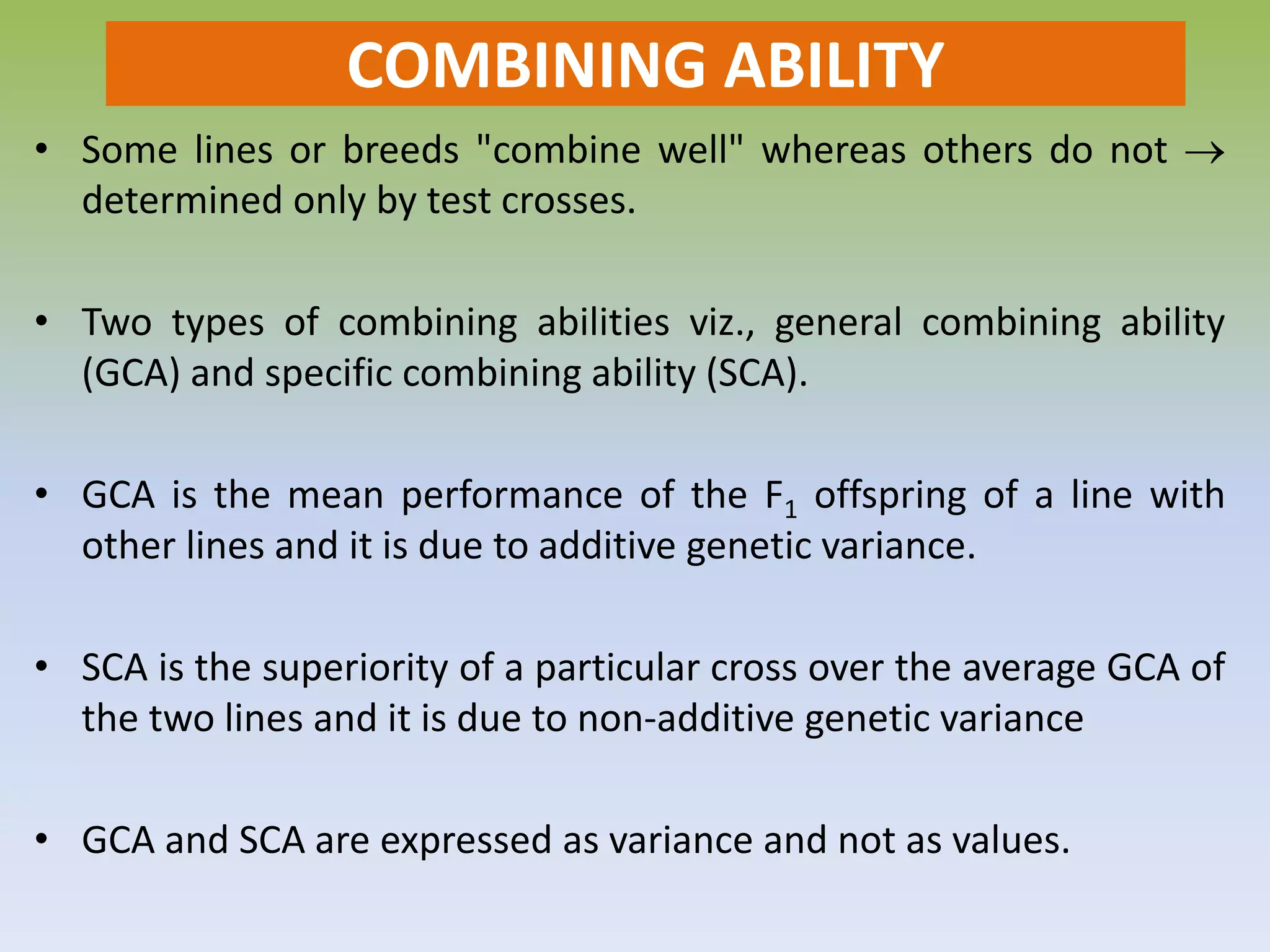
COMBINING ABILITY
• Some lines or breeds "combine well" whereas others do not 
determined only by test crosses.
• Two types of combining abilities viz., general combining ability
(GCA) and specific combining ability (SCA).
• GCA is the mean performance of the F1 offspring of a line with
other lines and it is due to additive genetic variance.
• SCA is the superiority of a particular cross over the average GCA of
the two lines and it is due to non-additive genetic variance
• GCA and SCA are expressed as variance and not as values.
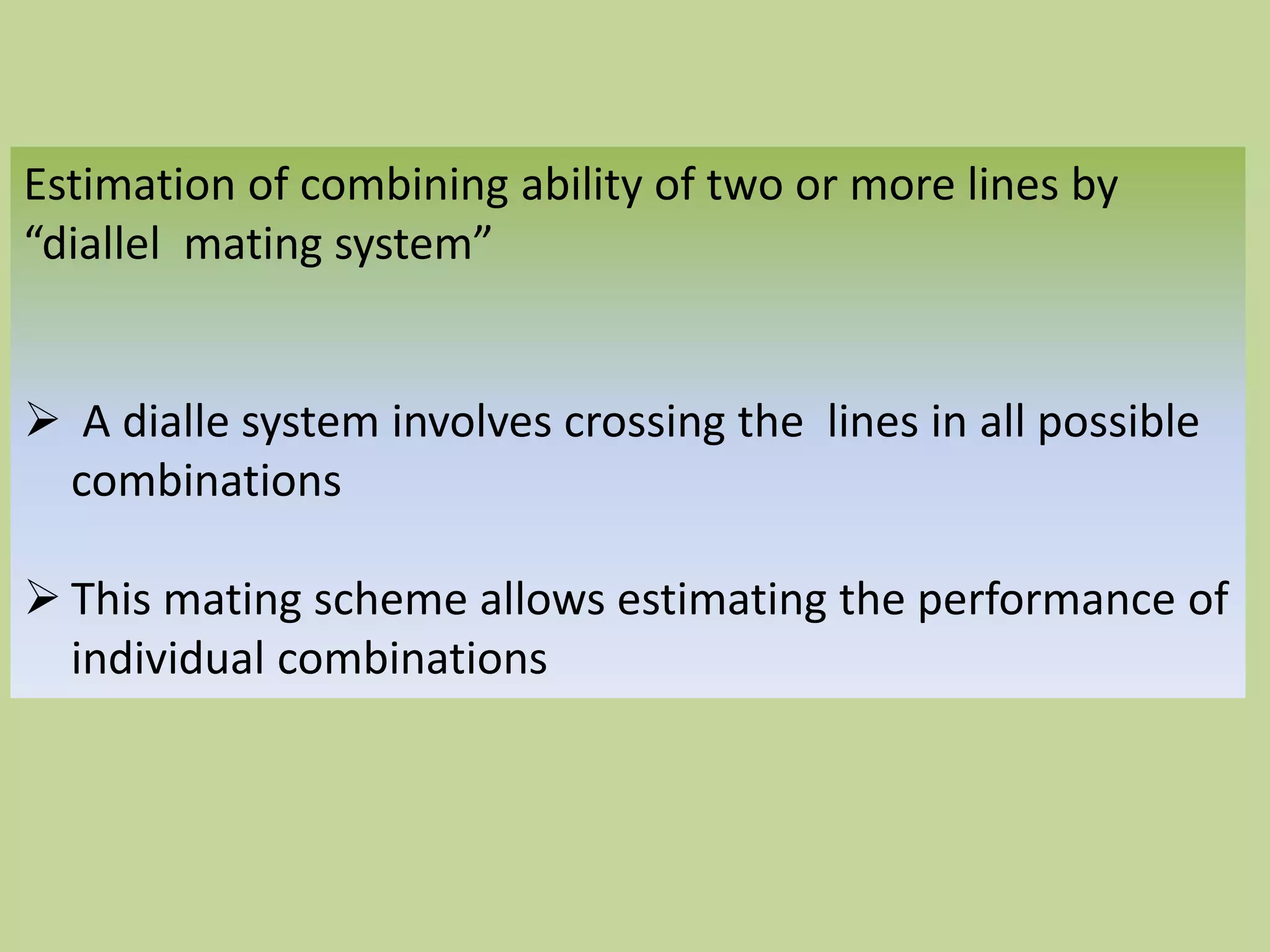
Estimation of combining ability of two or more lines by
“diallel mating system”
 A dialle system involves crossing the lines in all possible
combinations
 This mating scheme allows estimating the performance of
individual combinations
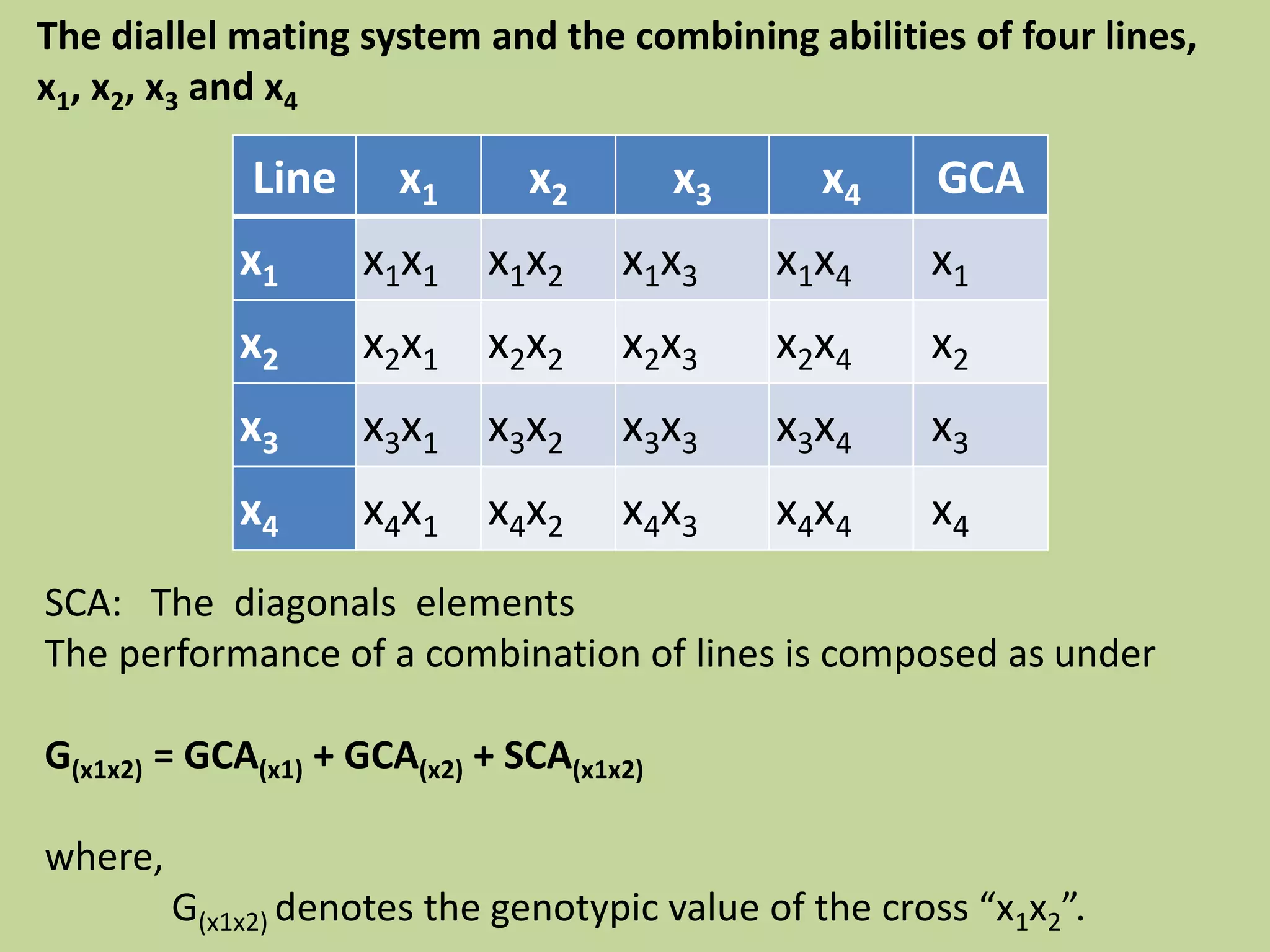
SCA: The diagonals elements
The performance of a combination of lines is composed as under
G(x1x2) = GCA(x1) + GCA(x2) + SCA(x1x2)
where,
G(x1x2) denotes the genotypic value of the cross “x1x2”.
Line x1 x2 x3 x4 GCA
x1 x1x1 x1x2 x1x3 x1x4 x1
x2 x2x1 x2x2 x2x3 x2x4 x2
x3 x3x1 x3x2 x3x3 x3x4 x3
x4 x4x1 x4x2 x4x3 x4x4 x4
The diallel mating system and the combining abilities of four lines,
x1, x2, x3 and x4
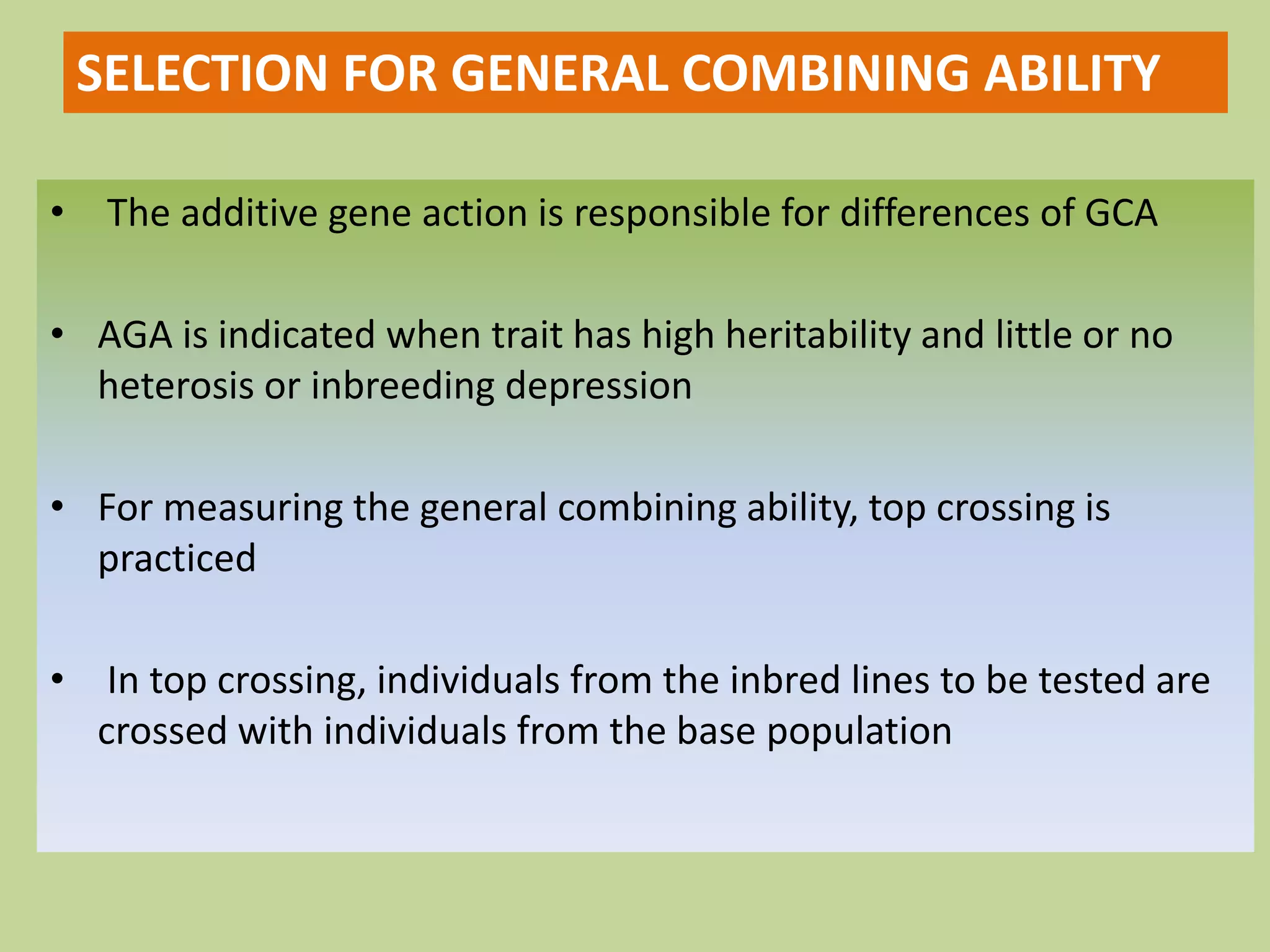
• The additive gene action is responsible for differences of GCA
• AGA is indicated when trait has high heritability and little or no
heterosis or inbreeding depression
• For measuring the general combining ability, top crossing is
practiced
• In top crossing, individuals from the inbred lines to be tested are
crossed with individuals from the base population
SELECTION FOR GENERAL COMBINING ABILITY
• Mean value of the progeny measures the GCA of the line 
The gametes of individuals from the base population are genetically
equivalent to the gametes of a random set of inbred lines derived
without selection from the base population
• Method is for comparing the general combining abilities of
different lines
• Allows us to choose the lines most likely to yield the best cross
among all the crosses that would be made between the available
lines
Selection for additive and Non Additive Gene Action
• For Additive Gene Action:
Single Trait And Multitrait selection
• For Non Additive Gene Action:
 Cross Breeding:
Crossing of two different breeds or strains to take the advantage of
heterosis
 Recurrent Selection:
• Crossing large no. of individuals with a tester line (highly inbred ) to
evaluate the progeny
• Individuals giving best results are selected and intermated, process
is repeated over and over
Using Non Additive Gene Action
Reciprocal Recurrent Selection:
• Randomly selected individuals from each of two non
inbred strains are progeny tested in crosses with each
other
• Individuals giving best results in crosses from two strains
are intermated to continue their respective strains
• The selection for SCA means to take advantage of hybrid
vigour , here NAGA is important
• Causes for differences in SCA are dominance,
overdominance or epistasis
• Specific combining ability of a cross cannot be measured
without making and testing that particular cross
• To estimate SCA, two lines should be developed which
differ in gene frequencies
SELECTION FOR SPECIFIC COMBINING ABILITY
SELECTION FOR GENERAL AND SPECIFIC COMBINING
ABILITY
• Two methods of selection are available viz., recurrent
selection and reciprocal recurrent selection
• Both these systems involve progeny testing
RECURRENT SELECTION
• The principle of recurrent selection is developed out of
convergent improvement
• Highly inbred line is selected as a tester ; large number of
individuals are crossed with this line and their progeny are
evaluated
• Those giving best progeny are subsequently inter mated and a
large number of their progeny are tested in the crosses on the
inbred tester
• Cycle is repeated over and over to take greater advantage of the
interaction of genes and the resultant overdominance by selecting
inbred lines during their developmental process for the purpose of
better complementing each other
• Success depends on ability of breeder to accumulate a
greater number of genes having additive effects in two
different parental lines that interact to greater advantage
• when tester is aa, the selected line would become AA;
the tester is BB, the selected line becomes bb etc
 Application of recurrent selection to Animal
breeding is more difficult than to plant breeding:
• Overall effects of inbreeding are deleterious
• The degree of fertility is lacking, depends on
survivability
• More number of animals are required and it
involves longer generation interval to make this
selection
RECIPROCAL RECURRENT SELECTION
• System of selection for increasing the combining ability of
two or more lines or breeds that nick or combine well
• Crossing the lines and selecting the individual to
reproduce each pure line on the basis of the
performance of their crossbred progeny make the two
lines more homozygous in opposite direction
• Method of selection between lines or families or breeds
to take advantages of overdominance, dominance,
epistasis, or only additive effects
• Selection in farm animals is carried out for more than one
trait, since one trait may be affected mostly by non-
additive gene action and another by additive gene action
or both
• Involves selection and improvement of the best and
mating the best to best  crossing the improved lines or
breeds for advantage of hybrid vigour (NAGA)
RECIPROCAL RECURRENT SELECTION
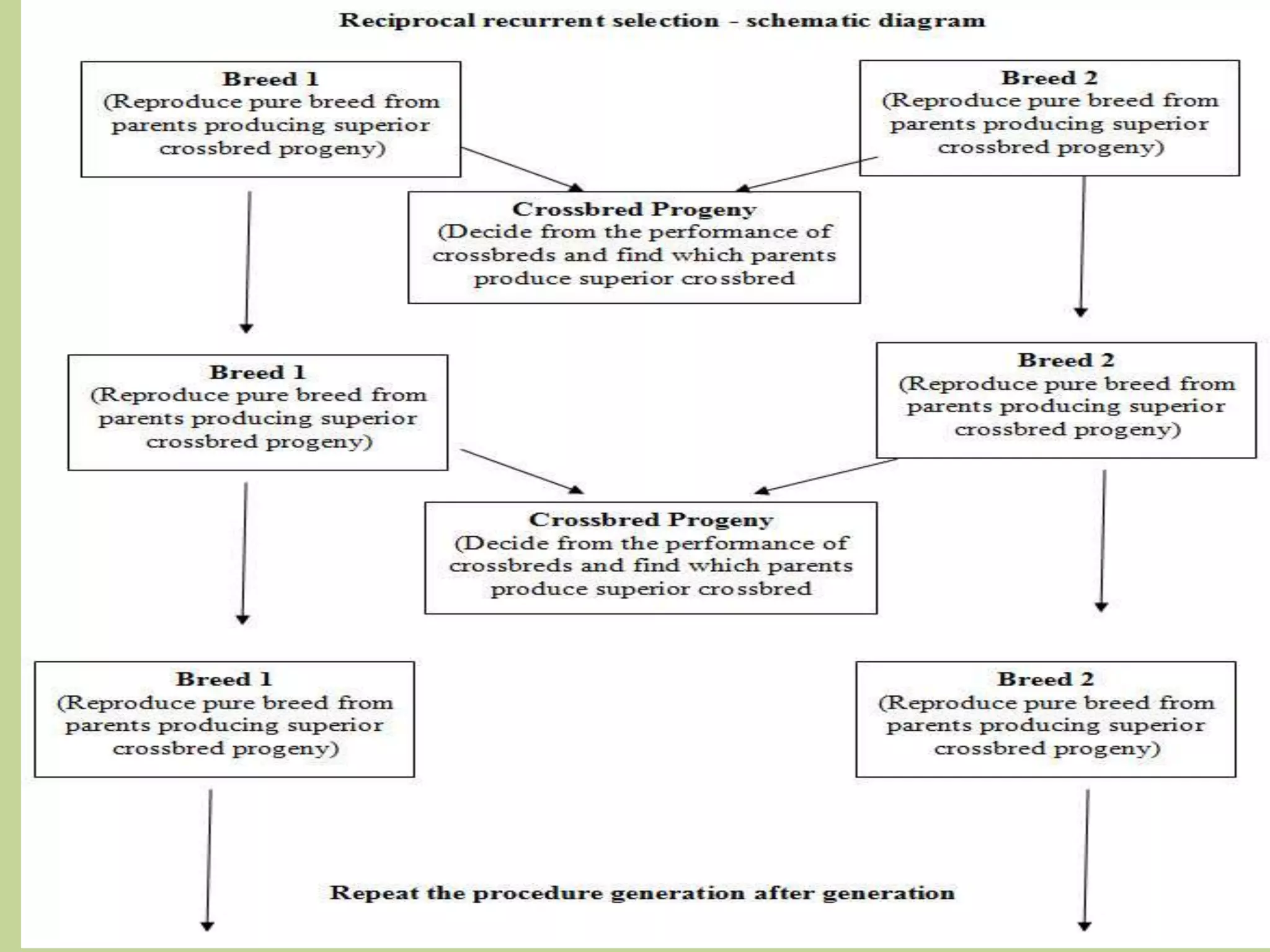
• Randomly selected representatives of each of the non-
inbred strains  progeny tested in crosses with the
other
• Those individuals of each strain having the best cross
progeny are then intermated to propagate their
respective strains
• Offspring from these within strain mating are again
progeny tested in crosses with the other
and the cycle repeated
Selection for Combining ability

Selection for Combining ability

  • 1.
    TOPIC: Selection forCombining Ability Dr S. Shanaz Assoc. Prof Division Of AGB
  • 2.
    Types Of Geneaction • Additive Gene Action The additive effect of all genes which influence the character is known as additive genetic value or the breeding value • Non-additive Gene Action i. It may be allelic: interaction between genes within locus (dominance, overdominance) ii. Or Non allelic : interaction between genes on same loci or different chromosomes (epistasis)
  • 3.
    Selection for additiveand Non Additive Gene Action • For Additive Gene Action: Single Trait And Multitrait selection • For Non Additive Gene Action:  Cross Breeding: Crossing of two different breeds or strains to take the advantage of heterosis  Recurrent Selection: • Crossing large no. of individuals with a tester line (highly inbred )to evaluate the progeny. • Individuals giving best results are selected and intermated, process is repeated over and over
  • 4.
    Using Non AdditiveGene Action Reciprocal Recurrent Selection: • Randomly selected individuals from each of two non inbred strains are progeny tested in crosses with each other • Individuals giving best results in crosses from two strains are intermated to continue their respective strains
  • 5.
    COMBINING ABILITY • Somelines or breeds "combine well" whereas others do not  determined only by test crosses. • Two types of combining abilities viz., general combining ability (GCA) and specific combining ability (SCA). • GCA is the mean performance of the F1 offspring of a line with other lines and it is due to additive genetic variance. • SCA is the superiority of a particular cross over the average GCA of the two lines and it is due to non-additive genetic variance • GCA and SCA are expressed as variance and not as values.
  • 6.
    Estimation of combiningability of two or more lines by “diallel mating system”  A dialle system involves crossing the lines in all possible combinations  This mating scheme allows estimating the performance of individual combinations
  • 7.
    SCA: The diagonalselements The performance of a combination of lines is composed as under G(x1x2) = GCA(x1) + GCA(x2) + SCA(x1x2) where, G(x1x2) denotes the genotypic value of the cross “x1x2”. Line x1 x2 x3 x4 GCA x1 x1x1 x1x2 x1x3 x1x4 x1 x2 x2x1 x2x2 x2x3 x2x4 x2 x3 x3x1 x3x2 x3x3 x3x4 x3 x4 x4x1 x4x2 x4x3 x4x4 x4 The diallel mating system and the combining abilities of four lines, x1, x2, x3 and x4
  • 8.
    • The additivegene action is responsible for differences of GCA • AGA is indicated when trait has high heritability and little or no heterosis or inbreeding depression • For measuring the general combining ability, top crossing is practiced • In top crossing, individuals from the inbred lines to be tested are crossed with individuals from the base population SELECTION FOR GENERAL COMBINING ABILITY
  • 9.
    • Mean valueof the progeny measures the GCA of the line  The gametes of individuals from the base population are genetically equivalent to the gametes of a random set of inbred lines derived without selection from the base population • Method is for comparing the general combining abilities of different lines • Allows us to choose the lines most likely to yield the best cross among all the crosses that would be made between the available lines
  • 10.
    Selection for additiveand Non Additive Gene Action • For Additive Gene Action: Single Trait And Multitrait selection • For Non Additive Gene Action:  Cross Breeding: Crossing of two different breeds or strains to take the advantage of heterosis  Recurrent Selection: • Crossing large no. of individuals with a tester line (highly inbred ) to evaluate the progeny • Individuals giving best results are selected and intermated, process is repeated over and over
  • 11.
    Using Non AdditiveGene Action Reciprocal Recurrent Selection: • Randomly selected individuals from each of two non inbred strains are progeny tested in crosses with each other • Individuals giving best results in crosses from two strains are intermated to continue their respective strains
  • 12.
    • The selectionfor SCA means to take advantage of hybrid vigour , here NAGA is important • Causes for differences in SCA are dominance, overdominance or epistasis • Specific combining ability of a cross cannot be measured without making and testing that particular cross • To estimate SCA, two lines should be developed which differ in gene frequencies SELECTION FOR SPECIFIC COMBINING ABILITY
  • 13.
    SELECTION FOR GENERALAND SPECIFIC COMBINING ABILITY • Two methods of selection are available viz., recurrent selection and reciprocal recurrent selection • Both these systems involve progeny testing
  • 14.
    RECURRENT SELECTION • Theprinciple of recurrent selection is developed out of convergent improvement • Highly inbred line is selected as a tester ; large number of individuals are crossed with this line and their progeny are evaluated • Those giving best progeny are subsequently inter mated and a large number of their progeny are tested in the crosses on the inbred tester • Cycle is repeated over and over to take greater advantage of the interaction of genes and the resultant overdominance by selecting inbred lines during their developmental process for the purpose of better complementing each other
  • 15.
    • Success dependson ability of breeder to accumulate a greater number of genes having additive effects in two different parental lines that interact to greater advantage • when tester is aa, the selected line would become AA; the tester is BB, the selected line becomes bb etc
  • 16.
     Application ofrecurrent selection to Animal breeding is more difficult than to plant breeding: • Overall effects of inbreeding are deleterious • The degree of fertility is lacking, depends on survivability • More number of animals are required and it involves longer generation interval to make this selection
  • 17.
    RECIPROCAL RECURRENT SELECTION •System of selection for increasing the combining ability of two or more lines or breeds that nick or combine well • Crossing the lines and selecting the individual to reproduce each pure line on the basis of the performance of their crossbred progeny make the two lines more homozygous in opposite direction
  • 18.
    • Method ofselection between lines or families or breeds to take advantages of overdominance, dominance, epistasis, or only additive effects • Selection in farm animals is carried out for more than one trait, since one trait may be affected mostly by non- additive gene action and another by additive gene action or both • Involves selection and improvement of the best and mating the best to best  crossing the improved lines or breeds for advantage of hybrid vigour (NAGA) RECIPROCAL RECURRENT SELECTION
  • 19.
    • Randomly selectedrepresentatives of each of the non- inbred strains  progeny tested in crosses with the other • Those individuals of each strain having the best cross progeny are then intermated to propagate their respective strains • Offspring from these within strain mating are again progeny tested in crosses with the other and the cycle repeated