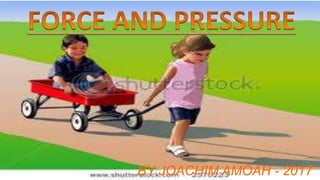
BY JOACHIM AMOAH - 2017
By the end of the session, the pupil will
be able to:
1. (5.3.1)Explain what is meant by
the term force.
2. (5.3.2)Describe the different types
of forces.
3. (5.3.3)Describe the effects of
forces on objects.
4. (5.3.4) Describe the
measurement of forces.
5. (5.3.5)Outline the effects of
friction on objects.
6. (5.3.6) Explain the term pressure.
7. (5.3.7) Demonstrate that pressure
in fluids acts equally in all
directions.
8. (5.3.8) demonstrate that pressure
in fluids increases with depth.
9. (5.3.9) Outline some uses of fluid
pressure.
Meaning Of Force.
Force is the push or pull exerted on
an object.
OR
Force is that which changes the
velocity of an object.
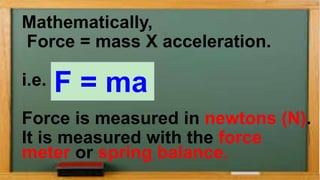
Mathematically,
Force = mass X acceleration.
i.e.
Force is measured in newtons (N).
It is measured with the force
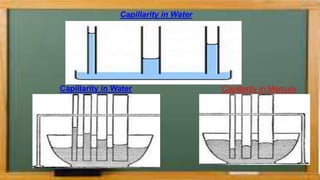
meter or spring balance.
F = ma
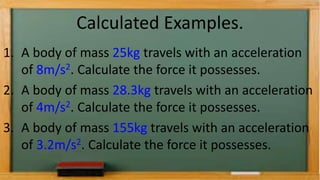
Calculated Examples.
1. A body of mass 25kg travels with an acceleration
of 8m/s2. Calculate the force it possesses.
2. A body of mass 28.3kg travels with an acceleration
of 4m/s2. Calculate the force it possesses.
3. A body of mass 155kg travels with an acceleration
of 3.2m/s2. Calculate the force it possesses.
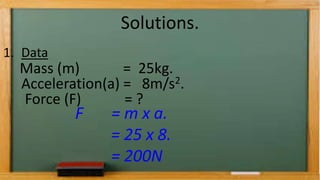
Solutions.
1. Data
Mass (m) = 25kg.
Acceleration(a) = 8m/s2.
Force (F) = ?
F = m x a.
= 25 x 8.
= 200N
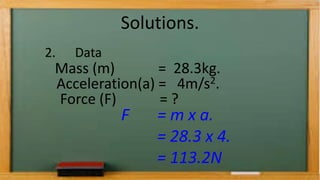
Solutions.
2. Data
Mass (m) = 28.3kg.
Acceleration(a) = 4m/s2.
Force (F) = ?
F = m x a.
= 28.3 x 4.
= 113.2N
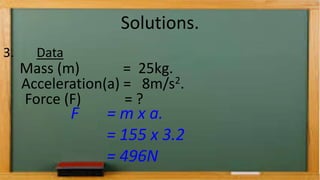
Solutions.
3. Data
Mass (m) = 25kg.
Acceleration(a) = 8m/s2.
Force (F) = ?
F = m x a.
= 155 x 3.2
= 496N
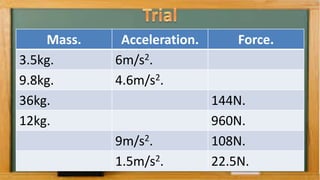
Mass. Acceleration. Force.
3.5kg. 6m/s2.
9.8kg. 4.6m/s2.
36kg. 144N.
12kg. 960N.
9m/s2. 108N.
1.5m/s2. 22.5N.
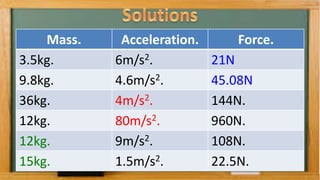
Mass. Acceleration. Force.
3.5kg. 6m/s2. 21N
9.8kg. 4.6m/s2. 45.08N
36kg. 4m/s2. 144N.
12kg. 80m/s2. 960N.
12kg. 9m/s2. 108N.
15kg. 1.5m/s2. 22.5N.
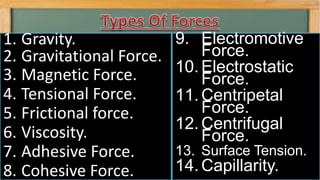
1. Gravity.
2. Gravitational Force.
3. Magnetic Force.
4. Tensional Force.
5. Frictional force.
6. Viscosity.
7. Adhesive Force.
8. Cohesive Force.
9. Electromotive
Force.
10. Electrostatic
Force.
11. Centripetal
Force.
12. Centrifugal
Force.
13. Surface Tension.
14. Capillarity.
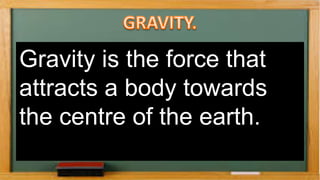
Gravity is the force that
attracts a body towards
the centre of the earth.
Gravitational force is the
force of attraction that a body
exerts towards another.
Magnetic force is the force
that attracts a body
towards or repels a body
away from a magnet.
Tensional force is the force
that exists in springs and
elastic materials.
This is the force of
attraction that exists
between molecules of
different kinds.
This is the force of
attraction that exists
between molecules of the
same kind.
This is the force that
drives electrons through a
circuit.
This is the force possessed
by stationary electric
charges.
This is the force which acts on
a body moving in a circular
path and is directed towards
the centre around which the
body is moving.
This is the force which acts on
a body moving in a circular
path and is directed away
from the centre around which
the body is moving.
This is the force that
opposes motion between
two surfaces that are in
contact.
1. Friction helps us to walk without slipping.
2. It helps moving vehicles to brake.
3. It helps stationary vehicles to move.
4. It helps vehicles to negotiate curves.
5. It helps to sharpen the blades of cutting
tools.
6. It helps to light safety matches.
7. It helps to lean ladders against walls.
1. Friction wears away the soles of
shoes and tyres.
2. It causes wear and tear of machine
parts and breaks them down.
3. It produces unwanted heat and
sound.
4. It reduces the efficiency of
machines.
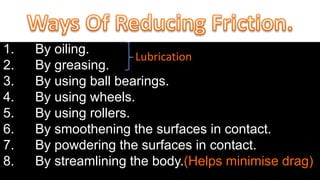
1. By oiling.
2. By greasing.
3. By using ball bearings.
4. By using wheels.
5. By using rollers.
6. By smoothening the surfaces in contact.
7. By powdering the surfaces in contact.
8. By streamlining the body.(Helps minimise drag)
Lubrication
This is the force that opposes
motion in fluids. It is also called
(viscous) drag.
It can be referred to as friction in
fluids.
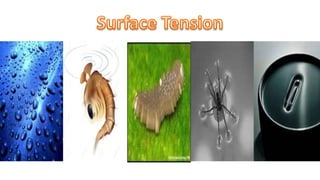
This is the force that makes
the surface of a liquid
behave like a stretched
elastic skin or material.
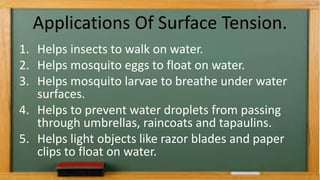
Applications Of Surface Tension.
1. Helps insects to walk on water.
2. Helps mosquito eggs to float on water.
3. Helps mosquito larvae to breathe under water
surfaces.
4. Helps to prevent water droplets from passing
through umbrellas, raincoats and tapaulins.
5. Helps light objects like razor blades and paper
clips to float on water.
1.By pouring kerosene onto the
surface of the water.
2.By adding oil to the surface of
water.
3.By adding soap or detergents
to the water.
NB
Substances that are added to
water to break its surface
tension are called surfactants.
This is the force which
enables liquids to either
rise or fall in capillary
tubes.
Capillarity in Water
Capillarity in Mercury
Capillarity in Water
1. Helps kerosene to rise up in wicks
of lanterns.
2. Helps to dry wet skin using towels.
3. Helps to dry the floor using the
mop.
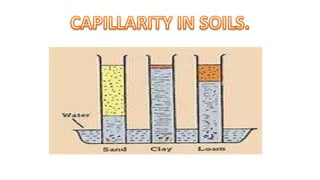
4. Helps water to rise up in soils.
5. It helps to dye artificial flowers.
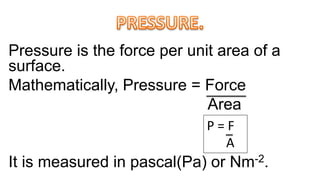
Pressure is the force per unit area of a
surface.
Mathematically, Pressure = Force
Area
It is measured in pascal(Pa) or Nm-2.
P = F
A
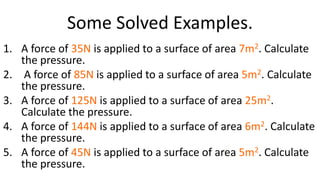
Some Solved Examples.
1. A force of 35N is applied to a surface of area 7m2. Calculate
the pressure.
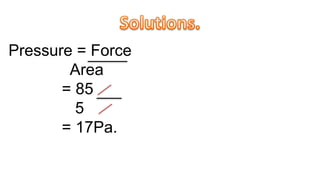
2. A force of 85N is applied to a surface of area 5m2. Calculate
the pressure.
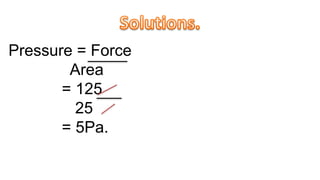
3. A force of 125N is applied to a surface of area 25m2.
Calculate the pressure.
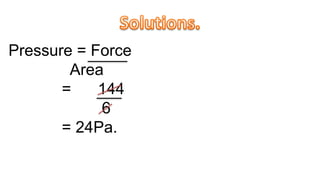
4. A force of 144N is applied to a surface of area 6m2. Calculate
the pressure.
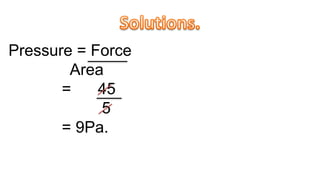
5. A force of 45N is applied to a surface of area 5m2. Calculate
the pressure.
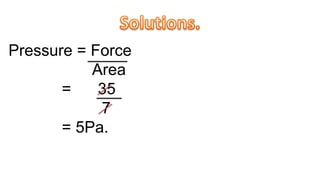
Pressure = Force
Area
= 35
7
= 5Pa.
Pressure = Force
Area
= 85
5
= 17Pa.
Pressure = Force
Area
= 125
25
= 5Pa.
Pressure = Force
Area
= 144
6
= 24Pa.
Pressure = Force
Area
= 45
5
= 9Pa.
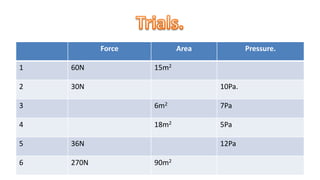
Force Area Pressure.
1 60N 15m2
2 30N 10Pa.
3 6m2 7Pa
4 18m2 5Pa
5 36N 12Pa
6 270N 90m2
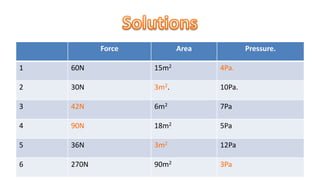
Force Area Pressure.
1 60N 15m2 4Pa.
2 30N 3m2. 10Pa.
3 42N 6m2 7Pa
4 90N 18m2 5Pa
5 36N 3m2 12Pa
6 270N 90m2 3Pa
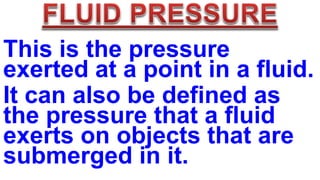
This is the pressure
exerted at a point in a fluid.
It can also be defined as
the pressure that a fluid
exerts on objects that are
submerged in it.
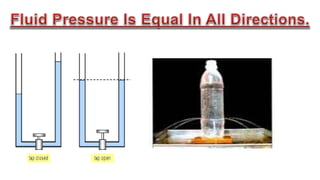
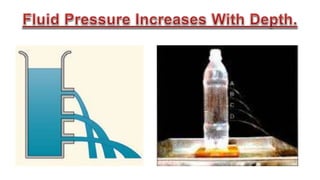
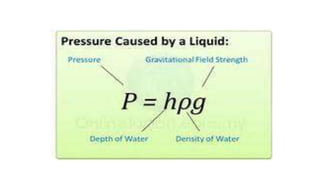
Fluid pressure
1.Is equal in all
directions.
2.Increases with depth.
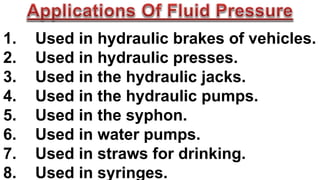
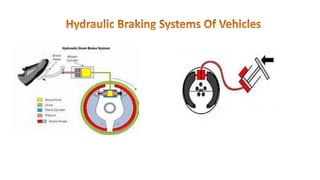
1. Used in hydraulic brakes of vehicles.
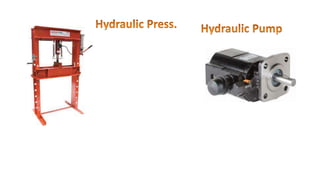
2. Used in hydraulic presses.
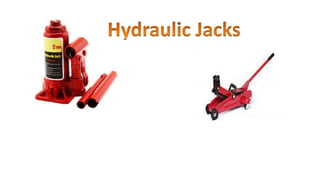
3. Used in the hydraulic jacks.
4. Used in the hydraulic pumps.
5. Used in the syphon.
6. Used in water pumps.
7. Used in straws for drinking.
8. Used in syringes.
ONLINE REFERENCES
https://www.britannica.com/science/surfactant
https://en.wikipedia.org/wiki/Pressure
https://www.oercommons.org/authoring/3490-
8th-standard-science-force-pressure/view

Force and pressure

  • 1.
  • 2.
    By the endof the session, the pupil will be able to: 1. (5.3.1)Explain what is meant by the term force. 2. (5.3.2)Describe the different types of forces. 3. (5.3.3)Describe the effects of forces on objects. 4. (5.3.4) Describe the measurement of forces. 5. (5.3.5)Outline the effects of friction on objects. 6. (5.3.6) Explain the term pressure. 7. (5.3.7) Demonstrate that pressure in fluids acts equally in all directions. 8. (5.3.8) demonstrate that pressure in fluids increases with depth. 9. (5.3.9) Outline some uses of fluid pressure.
  • 3.
    Meaning Of Force. Forceis the push or pull exerted on an object. OR Force is that which changes the velocity of an object.
  • 4.
    Mathematically, Force = massX acceleration. i.e. Force is measured in newtons (N). It is measured with the force meter or spring balance. F = ma
  • 5.
    Calculated Examples. 1. Abody of mass 25kg travels with an acceleration of 8m/s2. Calculate the force it possesses. 2. A body of mass 28.3kg travels with an acceleration of 4m/s2. Calculate the force it possesses. 3. A body of mass 155kg travels with an acceleration of 3.2m/s2. Calculate the force it possesses.
  • 6.
    Solutions. 1. Data Mass (m)= 25kg. Acceleration(a) = 8m/s2. Force (F) = ? F = m x a. = 25 x 8. = 200N
  • 7.
    Solutions. 2. Data Mass (m)= 28.3kg. Acceleration(a) = 4m/s2. Force (F) = ? F = m x a. = 28.3 x 4. = 113.2N
  • 8.
    Solutions. 3. Data Mass (m)= 25kg. Acceleration(a) = 8m/s2. Force (F) = ? F = m x a. = 155 x 3.2 = 496N
  • 9.
    Mass. Acceleration. Force. 3.5kg.6m/s2. 9.8kg. 4.6m/s2. 36kg. 144N. 12kg. 960N. 9m/s2. 108N. 1.5m/s2. 22.5N.
  • 10.
    Mass. Acceleration. Force. 3.5kg.6m/s2. 21N 9.8kg. 4.6m/s2. 45.08N 36kg. 4m/s2. 144N. 12kg. 80m/s2. 960N. 12kg. 9m/s2. 108N. 15kg. 1.5m/s2. 22.5N.
  • 11.
    1. Gravity. 2. GravitationalForce. 3. Magnetic Force. 4. Tensional Force. 5. Frictional force. 6. Viscosity. 7. Adhesive Force. 8. Cohesive Force. 9. Electromotive Force. 10. Electrostatic Force. 11. Centripetal Force. 12. Centrifugal Force. 13. Surface Tension. 14. Capillarity.
  • 12.
    Gravity is theforce that attracts a body towards the centre of the earth.
  • 13.
    Gravitational force isthe force of attraction that a body exerts towards another.
  • 14.
    Magnetic force isthe force that attracts a body towards or repels a body away from a magnet.
  • 15.
    Tensional force isthe force that exists in springs and elastic materials.
  • 16.
    This is theforce of attraction that exists between molecules of different kinds.
  • 17.
    This is theforce of attraction that exists between molecules of the same kind.
  • 18.
    This is theforce that drives electrons through a circuit.
  • 19.
    This is theforce possessed by stationary electric charges.
  • 20.
    This is theforce which acts on a body moving in a circular path and is directed towards the centre around which the body is moving.
  • 21.
    This is theforce which acts on a body moving in a circular path and is directed away from the centre around which the body is moving.
  • 22.
    This is theforce that opposes motion between two surfaces that are in contact.
  • 23.
    1. Friction helpsus to walk without slipping. 2. It helps moving vehicles to brake. 3. It helps stationary vehicles to move. 4. It helps vehicles to negotiate curves. 5. It helps to sharpen the blades of cutting tools. 6. It helps to light safety matches. 7. It helps to lean ladders against walls.
  • 24.
    1. Friction wearsaway the soles of shoes and tyres. 2. It causes wear and tear of machine parts and breaks them down. 3. It produces unwanted heat and sound. 4. It reduces the efficiency of machines.
  • 25.
    1. By oiling. 2.By greasing. 3. By using ball bearings. 4. By using wheels. 5. By using rollers. 6. By smoothening the surfaces in contact. 7. By powdering the surfaces in contact. 8. By streamlining the body.(Helps minimise drag) Lubrication
  • 26.
    This is theforce that opposes motion in fluids. It is also called (viscous) drag. It can be referred to as friction in fluids.
  • 27.
    This is theforce that makes the surface of a liquid behave like a stretched elastic skin or material.
  • 29.
    Applications Of SurfaceTension. 1. Helps insects to walk on water. 2. Helps mosquito eggs to float on water. 3. Helps mosquito larvae to breathe under water surfaces. 4. Helps to prevent water droplets from passing through umbrellas, raincoats and tapaulins. 5. Helps light objects like razor blades and paper clips to float on water.
  • 30.
    1.By pouring keroseneonto the surface of the water. 2.By adding oil to the surface of water. 3.By adding soap or detergents to the water.
  • 31.
    NB Substances that areadded to water to break its surface tension are called surfactants.
  • 32.
    This is theforce which enables liquids to either rise or fall in capillary tubes.
  • 33.
    Capillarity in Water Capillarityin Mercury Capillarity in Water
  • 35.
    1. Helps keroseneto rise up in wicks of lanterns. 2. Helps to dry wet skin using towels. 3. Helps to dry the floor using the mop. 4. Helps water to rise up in soils. 5. It helps to dye artificial flowers.
  • 37.
    Pressure is theforce per unit area of a surface. Mathematically, Pressure = Force Area It is measured in pascal(Pa) or Nm-2. P = F A
  • 38.
    Some Solved Examples. 1.A force of 35N is applied to a surface of area 7m2. Calculate the pressure. 2. A force of 85N is applied to a surface of area 5m2. Calculate the pressure. 3. A force of 125N is applied to a surface of area 25m2. Calculate the pressure. 4. A force of 144N is applied to a surface of area 6m2. Calculate the pressure. 5. A force of 45N is applied to a surface of area 5m2. Calculate the pressure.
  • 39.
  • 40.
  • 41.
  • 42.
  • 43.
  • 44.
    Force Area Pressure. 160N 15m2 2 30N 10Pa. 3 6m2 7Pa 4 18m2 5Pa 5 36N 12Pa 6 270N 90m2
  • 45.
    Force Area Pressure. 160N 15m2 4Pa. 2 30N 3m2. 10Pa. 3 42N 6m2 7Pa 4 90N 18m2 5Pa 5 36N 3m2 12Pa 6 270N 90m2 3Pa
  • 46.
    This is thepressure exerted at a point in a fluid. It can also be defined as the pressure that a fluid exerts on objects that are submerged in it.
  • 47.
    Fluid pressure 1.Is equalin all directions. 2.Increases with depth.
  • 51.
    1. Used inhydraulic brakes of vehicles. 2. Used in hydraulic presses. 3. Used in the hydraulic jacks. 4. Used in the hydraulic pumps. 5. Used in the syphon. 6. Used in water pumps. 7. Used in straws for drinking. 8. Used in syringes.
  • 55.