FORCE AND PRESSURE
CLASS - 8
PM
2
PM
Force
Force is the push or pull on an object.
Unit: S.I. : newton (N), C.G.S. : dyne
Forces are due to interaction:
An interaction of one object on another object
results in a force between the two objects.
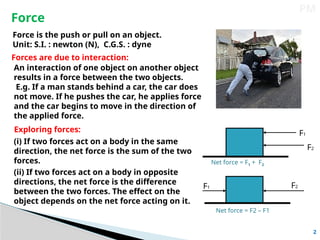
E.g. If a man stands behind a car, the car does
not move. If he pushes the car, he applies force
and the car begins to move in the direction of
the applied force.
Exploring forces:
(i) If two forces act on a body in the same
direction, the net force is the sum of the two
forces.
(ii) If two forces act on a body in opposite
directions, the net force is the difference
between the two forces. The effect on the
object depends on the net force acting on it.
Net force = F1 + F2
F1
F2
Net force = F2 – F1
F1 F2
3
PM
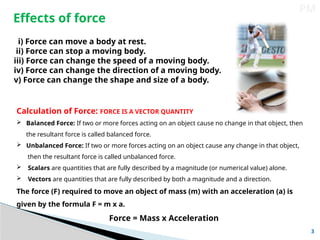
i) Force can move a body at rest.
ii) Force can stop a moving body.
iii) Force can change the speed of a moving body.
iv) Force can change the direction of a moving body.
v) Force can change the shape and size of a body.
Effects of force
Calculation of Force: FORCE IS A VECTOR QUANTITY
 Balanced Force: If two or more forces acting on an object cause no change in that object, then
the resultant force is called balanced force.
 Unbalanced Force: If two or more forces acting on an object cause any change in that object,
then the resultant force is called unbalanced force.
 Scalars are quantities that are fully described by a magnitude (or numerical value) alone.
 Vectors are quantities that are fully described by both a magnitude and a direction.
The force (F) required to move an object of mass (m) with an acceleration (a) is
given by the formula F = m x a.
Force = Mass x Acceleration
4
PM
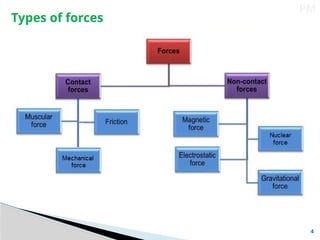
Types of forces
5
PM
Contact forces
A contact force is a force that acts at the point of contact between two
objects, in contrast to body forces.
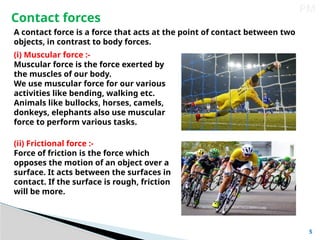
(i) Muscular force :-
Muscular force is the force exerted by
the muscles of our body.
We use muscular force for our various
activities like bending, walking etc.
Animals like bullocks, horses, camels,
donkeys, elephants also use muscular
force to perform various tasks.
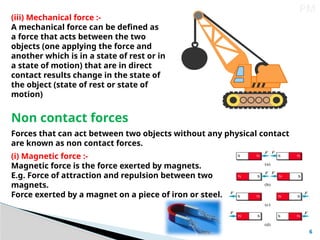
(ii) Frictional force :-
Force of friction is the force which
opposes the motion of an object over a
surface. It acts between the surfaces in
contact. If the surface is rough, friction
will be more.
6
PM
Non contact forces
Forces that can act between two objects without any physical contact
are known as non contact forces.
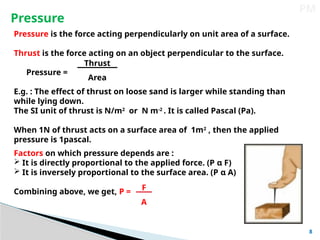
(i) Magnetic force :-
Magnetic force is the force exerted by magnets.
E.g. Force of attraction and repulsion between two
magnets.
Force exerted by a magnet on a piece of iron or steel.
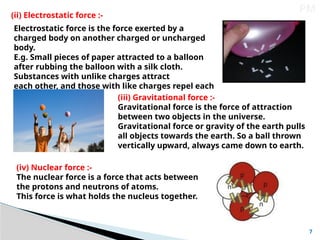
(iii) Mechanical force :-
A mechanical force can be defined as
a force that acts between the two
objects (one applying the force and
another which is in a state of rest or in
a state of motion) that are in direct
contact results change in the state of
the object (state of rest or state of
motion)
7
PM
(ii) Electrostatic force :-
Electrostatic force is the force exerted by a
charged body on another charged or uncharged
body.
E.g. Small pieces of paper attracted to a balloon
after rubbing the balloon with a silk cloth.
Substances with unlike charges attract
each other, and those with like charges repel each
other. (iii) Gravitational force :-
Gravitational force is the force of attraction
between two objects in the universe.
Gravitational force or gravity of the earth pulls
all objects towards the earth. So a ball thrown
vertically upward, always came down to earth.
(iv) Nuclear force :-
The nuclear force is a force that acts between
the protons and neutrons of atoms.
This force is what holds the nucleus together.
8
PM
Pressure is the force acting perpendicularly on unit area of a surface.
Thrust is the force acting on an object perpendicular to the surface.
Pressure =
E.g. : The effect of thrust on loose sand is larger while standing than
while lying down.
The SI unit of thrust is N/m2
or N m-2
. It is called Pascal (Pa).
When 1N of thrust acts on a surface area of 1m2
, then the applied
pressure is 1pascal.
Pressure
Thrust
Area
Factors on which pressure depends are :
 It is directly proportional to the applied force. (P α F)
 It is inversely proportional to the surface area. (P α A)
Combining above, we get, P = F
A
9
PM
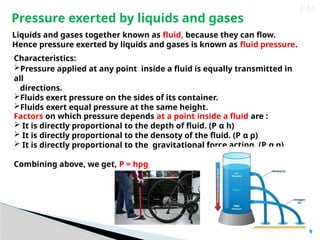
Pressure exerted by liquids and gases
Liquids and gases together known as fluid, because they can flow.
Hence pressure exerted by liquids and gases is known as fluid pressure.
Characteristics:
Pressure applied at any point inside a fluid is equally transmitted in
all
directions.
Fluids exert pressure on the sides of its container.
Fluids exert equal pressure at the same height.
Factors on which pressure depends at a point inside a fluid are :
 It is directly proportional to the depth of fluid. (P α h)
 It is directly proportional to the densoty of the fluid. (P α ρ)
 It is directly proportional to the gravitational force acting. (P α g)
Combining above, we get, P = hρg
10
PM
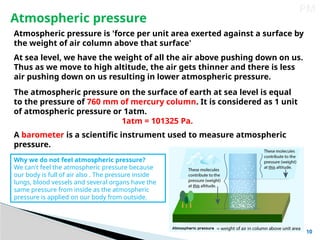
Atmospheric pressure
Atmospheric pressure is 'force per unit area exerted against a surface by
the weight of air column above that surface'
At sea level, we have the weight of all the air above pushing down on us.
Thus as we move to high altitude, the air gets thinner and there is less
air pushing down on us resulting in lower atmospheric pressure.
The atmospheric pressure on the surface of earth at sea level is equal
to the pressure of 760 mm of mercury column. It is considered as 1 unit
of atmospheric pressure or 1atm.
1atm = 101325 Pa.
A barometer is a scientific instrument used to measure atmospheric
pressure.
Why we do not feel atmospheric pressure?
We can't feel the atmospheric pressure because
our body is full of air also . The pressure inside
lungs, blood vessels and several organs have the
same pressure from inside as the atmospheric
pressure is applied on our body from outside.
11
PM
RECAPITULATION
Force could be a push or a pull.
A force arises due to the interaction between two objects.
Force has magnitude as well as direction.
A change in the speed of an object or the direction of its motion or
both implies a change in its state of motion.
Force acting on an object may cause a change in its state of motion or
a change in its shape.
A force can act on an object with or without being in contact with it.
Force per unit area is called pressure.
Liquids and gases exert pressure on the walls of their containers.
The pressure exerted by air around us is known as atmospheric
pressure.
12
THANK YOU
PM

CBSE CLASS-8 Physics - force and pressure.pptx

  • 1.
  • 2.
    2 PM Force Force is thepush or pull on an object. Unit: S.I. : newton (N), C.G.S. : dyne Forces are due to interaction: An interaction of one object on another object results in a force between the two objects. E.g. If a man stands behind a car, the car does not move. If he pushes the car, he applies force and the car begins to move in the direction of the applied force. Exploring forces: (i) If two forces act on a body in the same direction, the net force is the sum of the two forces. (ii) If two forces act on a body in opposite directions, the net force is the difference between the two forces. The effect on the object depends on the net force acting on it. Net force = F1 + F2 F1 F2 Net force = F2 – F1 F1 F2
  • 3.
    3 PM i) Force canmove a body at rest. ii) Force can stop a moving body. iii) Force can change the speed of a moving body. iv) Force can change the direction of a moving body. v) Force can change the shape and size of a body. Effects of force Calculation of Force: FORCE IS A VECTOR QUANTITY  Balanced Force: If two or more forces acting on an object cause no change in that object, then the resultant force is called balanced force.  Unbalanced Force: If two or more forces acting on an object cause any change in that object, then the resultant force is called unbalanced force.  Scalars are quantities that are fully described by a magnitude (or numerical value) alone.  Vectors are quantities that are fully described by both a magnitude and a direction. The force (F) required to move an object of mass (m) with an acceleration (a) is given by the formula F = m x a. Force = Mass x Acceleration
  • 4.
  • 5.
    5 PM Contact forces A contactforce is a force that acts at the point of contact between two objects, in contrast to body forces. (i) Muscular force :- Muscular force is the force exerted by the muscles of our body. We use muscular force for our various activities like bending, walking etc. Animals like bullocks, horses, camels, donkeys, elephants also use muscular force to perform various tasks. (ii) Frictional force :- Force of friction is the force which opposes the motion of an object over a surface. It acts between the surfaces in contact. If the surface is rough, friction will be more.
  • 6.
    6 PM Non contact forces Forcesthat can act between two objects without any physical contact are known as non contact forces. (i) Magnetic force :- Magnetic force is the force exerted by magnets. E.g. Force of attraction and repulsion between two magnets. Force exerted by a magnet on a piece of iron or steel. (iii) Mechanical force :- A mechanical force can be defined as a force that acts between the two objects (one applying the force and another which is in a state of rest or in a state of motion) that are in direct contact results change in the state of the object (state of rest or state of motion)
  • 7.
    7 PM (ii) Electrostatic force:- Electrostatic force is the force exerted by a charged body on another charged or uncharged body. E.g. Small pieces of paper attracted to a balloon after rubbing the balloon with a silk cloth. Substances with unlike charges attract each other, and those with like charges repel each other. (iii) Gravitational force :- Gravitational force is the force of attraction between two objects in the universe. Gravitational force or gravity of the earth pulls all objects towards the earth. So a ball thrown vertically upward, always came down to earth. (iv) Nuclear force :- The nuclear force is a force that acts between the protons and neutrons of atoms. This force is what holds the nucleus together.
  • 8.
    8 PM Pressure is theforce acting perpendicularly on unit area of a surface. Thrust is the force acting on an object perpendicular to the surface. Pressure = E.g. : The effect of thrust on loose sand is larger while standing than while lying down. The SI unit of thrust is N/m2 or N m-2 . It is called Pascal (Pa). When 1N of thrust acts on a surface area of 1m2 , then the applied pressure is 1pascal. Pressure Thrust Area Factors on which pressure depends are :  It is directly proportional to the applied force. (P α F)  It is inversely proportional to the surface area. (P α A) Combining above, we get, P = F A
  • 9.
    9 PM Pressure exerted byliquids and gases Liquids and gases together known as fluid, because they can flow. Hence pressure exerted by liquids and gases is known as fluid pressure. Characteristics: Pressure applied at any point inside a fluid is equally transmitted in all directions. Fluids exert pressure on the sides of its container. Fluids exert equal pressure at the same height. Factors on which pressure depends at a point inside a fluid are :  It is directly proportional to the depth of fluid. (P α h)  It is directly proportional to the densoty of the fluid. (P α ρ)  It is directly proportional to the gravitational force acting. (P α g) Combining above, we get, P = hρg
  • 10.
    10 PM Atmospheric pressure Atmospheric pressureis 'force per unit area exerted against a surface by the weight of air column above that surface' At sea level, we have the weight of all the air above pushing down on us. Thus as we move to high altitude, the air gets thinner and there is less air pushing down on us resulting in lower atmospheric pressure. The atmospheric pressure on the surface of earth at sea level is equal to the pressure of 760 mm of mercury column. It is considered as 1 unit of atmospheric pressure or 1atm. 1atm = 101325 Pa. A barometer is a scientific instrument used to measure atmospheric pressure. Why we do not feel atmospheric pressure? We can't feel the atmospheric pressure because our body is full of air also . The pressure inside lungs, blood vessels and several organs have the same pressure from inside as the atmospheric pressure is applied on our body from outside.
  • 11.
    11 PM RECAPITULATION Force could bea push or a pull. A force arises due to the interaction between two objects. Force has magnitude as well as direction. A change in the speed of an object or the direction of its motion or both implies a change in its state of motion. Force acting on an object may cause a change in its state of motion or a change in its shape. A force can act on an object with or without being in contact with it. Force per unit area is called pressure. Liquids and gases exert pressure on the walls of their containers. The pressure exerted by air around us is known as atmospheric pressure.
  • 12.