Human Brain
Made By Rehet Kaur Bhatia 8D
This Photo by Unknown Author is licensed under CC BY-SA
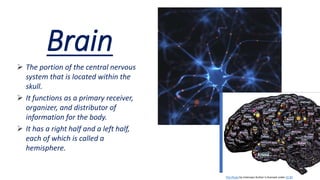
Brain
 The portion of the central nervous
system that is located within the
skull.
 It functions as a primary receiver,
organizer, and distributor of
information for the body.
 It has a right half and a left half,
each of which is called a
hemisphere.
This Photo by Unknown Author is licensed under CC BY
Few Facts On Brain
1) Human Brain Weights 3 pounds
 2) It comprises 60% of fat and is one of the fattest
organs in the human body.
3) Human brain has the capacity to generate
approximately 23 watts of power when awake.
4) Of the total blood and oxygen that is produced
in our body, the brain gets 20% of it.
5) When the blood supply to the brain stops, it is
almost after 8-10 seconds that the brain starts
losing the consciousness.
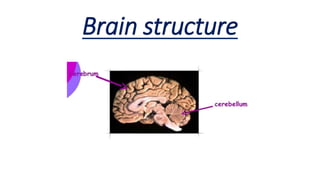
Brain structure
Cerebellum
The portion of the brain that is in the back of the head, between the
cerebrum and the brain stem.
 It is involved in the control of voluntary and involuntary movement as
well as balance.
Helps in fine movement coordination
Helps in balance and equilibrium
Gives muscle tone
Gives a sense of body position
This Photo by Unknown Author is licensed under CC BY-SA
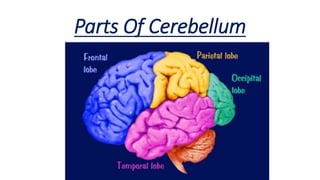
Parts Of Cerebellum
Frontal Lobe
• The part of each hemisphere of the brain located
behind the forehead.
• serves to regulate and mediate the higher intellectual
functions.
• The frontal lobes are important for controlling
thoughts, reasoning, and behaviors.
• They also Help In forming Memories
• Along with Comparing Objects.
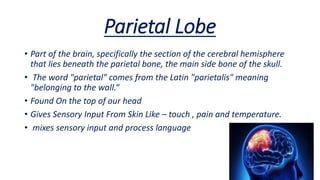
Parietal Lobe
• Part of the brain, specifically the section of the cerebral hemisphere
that lies beneath the parietal bone, the main side bone of the skull.
• The word "parietal" comes from the Latin "parietalis" meaning
"belonging to the wall.“
• Found On the top of our head
• Gives Sensory Input From Skin Like – touch , pain and temperature.
• mixes sensory input and process language
Occipital
• Located at the back of head.
• Located near the occipital bone
• responsible for interpreting the visual world around the
body
• Correspondingly helps us differentiate and understand
distinct colors.
• As soon as an Offspring is born, this lobe begins
to function.
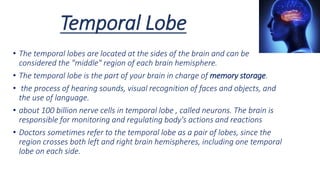
Temporal Lobe
• The temporal lobes are located at the sides of the brain and can be
considered the "middle" region of each brain hemisphere.
• The temporal lobe is the part of your brain in charge of memory storage.
• the process of hearing sounds, visual recognition of faces and objects, and
the use of language.
• about 100 billion nerve cells in temporal lobe , called neurons. The brain is
responsible for monitoring and regulating body's actions and reactions
• Doctors sometimes refer to the temporal lobe as a pair of lobes, since the
region crosses both left and right brain hemispheres, including one temporal
lobe on each side.
Neuron
• A neuron or nerve cell is an electrically excitable cell that communicates with
other cells via specialized connections called synapses.
• It is the main component of nervous tissue in all animals except sponges and
placozoa.
• Plants and fungi do not have nerve cells.
• The total number of neurons in the brain of a human is around a hundred
billion
Right And Left
Hemisphere of
Brain
Thank You For
Your Patience And
Time
This Photo by Unknown Author is licensed under CC BY

All about human brain !!!!!!!!!!!!!!!!!!!!!!!!!!!!! best

  • 1.
    Human Brain Made ByRehet Kaur Bhatia 8D This Photo by Unknown Author is licensed under CC BY-SA
  • 2.
    Brain  The portionof the central nervous system that is located within the skull.  It functions as a primary receiver, organizer, and distributor of information for the body.  It has a right half and a left half, each of which is called a hemisphere. This Photo by Unknown Author is licensed under CC BY
  • 3.
    Few Facts OnBrain 1) Human Brain Weights 3 pounds  2) It comprises 60% of fat and is one of the fattest organs in the human body. 3) Human brain has the capacity to generate approximately 23 watts of power when awake. 4) Of the total blood and oxygen that is produced in our body, the brain gets 20% of it. 5) When the blood supply to the brain stops, it is almost after 8-10 seconds that the brain starts losing the consciousness.
  • 4.
  • 5.
    Cerebellum The portion ofthe brain that is in the back of the head, between the cerebrum and the brain stem.  It is involved in the control of voluntary and involuntary movement as well as balance. Helps in fine movement coordination Helps in balance and equilibrium Gives muscle tone Gives a sense of body position This Photo by Unknown Author is licensed under CC BY-SA
  • 6.
  • 7.
    Frontal Lobe • Thepart of each hemisphere of the brain located behind the forehead. • serves to regulate and mediate the higher intellectual functions. • The frontal lobes are important for controlling thoughts, reasoning, and behaviors. • They also Help In forming Memories • Along with Comparing Objects.
  • 8.
    Parietal Lobe • Partof the brain, specifically the section of the cerebral hemisphere that lies beneath the parietal bone, the main side bone of the skull. • The word "parietal" comes from the Latin "parietalis" meaning "belonging to the wall.“ • Found On the top of our head • Gives Sensory Input From Skin Like – touch , pain and temperature. • mixes sensory input and process language
  • 9.
    Occipital • Located atthe back of head. • Located near the occipital bone • responsible for interpreting the visual world around the body • Correspondingly helps us differentiate and understand distinct colors. • As soon as an Offspring is born, this lobe begins to function.
  • 10.
    Temporal Lobe • Thetemporal lobes are located at the sides of the brain and can be considered the "middle" region of each brain hemisphere. • The temporal lobe is the part of your brain in charge of memory storage. • the process of hearing sounds, visual recognition of faces and objects, and the use of language. • about 100 billion nerve cells in temporal lobe , called neurons. The brain is responsible for monitoring and regulating body's actions and reactions • Doctors sometimes refer to the temporal lobe as a pair of lobes, since the region crosses both left and right brain hemispheres, including one temporal lobe on each side.
  • 11.
    Neuron • A neuronor nerve cell is an electrically excitable cell that communicates with other cells via specialized connections called synapses. • It is the main component of nervous tissue in all animals except sponges and placozoa. • Plants and fungi do not have nerve cells. • The total number of neurons in the brain of a human is around a hundred billion
  • 12.
  • 13.
    Thank You For YourPatience And Time This Photo by Unknown Author is licensed under CC BY