Biology | SPM Form 4 | Chapter 6: Nutrition 1
Food test
Test Procedure: Observation Conclusion
Presence of
starch (Iodine
test)
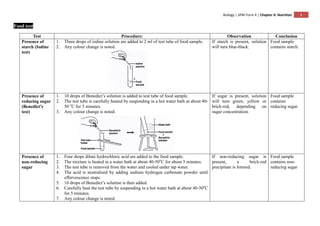
1. Three drops of iodine solution are added to 2 ml of test tube of food sample.
2. Any colour change is noted.
If starch is present, solution
will turn blue-black.
Food sample
contains starch.
Presence of
reducing sugar
(Benedict’s
test)
1. 10 drops of Benedict’s solution is added to test tube of food sample.
2. The test tube is carefully heated by suspending in a hot water bath at about 40-
50 o
C for 5 minutes.
3. Any colour change is noted.
If sugar is present, solution
will turn green, yellow or
brick-red, depending on
sugar concentration.
Food sample
contains
reducing sugar.
Presence of
non-reducing
sugar
1. Four drops dilute hydrochloric acid are added to the food sample.
2. The mixture is heated in a water bath at about 40-50o
C for about 5 minutes.
3. The test tube is removed from the water and cooled under tap water.
4. The acid is neutralised by adding sodium hydrogen carbonate powder until
effervescence stops.
5. 10 drops of Benedict’s solution is then added.
6. Carefully heat the test tube by suspending in a hot water bath at about 40-50o
C
for 5 minutes.
7. Any colour change is noted.
If non-reducing sugar is
present, a brick-red
precipitate is formed.
Food sample
contains non-
reducing sugar
Biology | SPM Form 4 | Chapter 6: Nutrition 2
Presence of
protein
A. Biuret Test
1. 20% of sodium hydroxide solution is added in excess to 2 ml of the food
sample.
2. A few drops of 1% copper (II) sulphate solution are added slowly to the
mixture.
3. The mixture is shaken gently and allowed to stand.
4. Any colour change is noted.
If protein is present, the
solution turns purple.
Food sample
contains protein.
B. Millon’s Reagent
1. Six drops Millon’s reagent is added to 2 ml of the food sample and the test
tube is boiled is boiled for 5 minutes.
2. After cooling, a few drops of 1% sodium nitrite is added the solution.
If protein is present, a brick-
red precipitate appears on the
surface of the solution.
Food sample
contains protein.
Biology | SPM Form 4 | Chapter 6: Nutrition 3
Presence of
lipid (Sudan III
test)
1. Add three drops of Sudan III stain to the test tube. The test tube is shaken
gently to mix.
2. Any colour change is noted.
If lipid is present, a red-
stained oil layer will separate
out and float on the water
surface.
Food sample
contains lipid.
Fat test 1. A small amount of food sample is rubbed on a piece of filter paper.
2. The filter paper is dried using a hair dryer.
3. The filter paper is held against the light and the observation is recorded.
Is there is a translucent mark,
then the sample contains fat.
Food sample
contains lipid.
Emulsion test 1. Add 2 ml of ethanol into the sample solution.
2. Fat droplets formed on the surface becomes an emulsion, the solution
becomes cloudy.
Sample that contains oil is
shown by the change in the
colour of the solution to
become cloudy.
Food sample
contains lipid.

chapter 6: nutrition-food test

  • 1.
    Biology | SPMForm 4 | Chapter 6: Nutrition 1 Food test Test Procedure: Observation Conclusion Presence of starch (Iodine test) 1. Three drops of iodine solution are added to 2 ml of test tube of food sample. 2. Any colour change is noted. If starch is present, solution will turn blue-black. Food sample contains starch. Presence of reducing sugar (Benedict’s test) 1. 10 drops of Benedict’s solution is added to test tube of food sample. 2. The test tube is carefully heated by suspending in a hot water bath at about 40- 50 o C for 5 minutes. 3. Any colour change is noted. If sugar is present, solution will turn green, yellow or brick-red, depending on sugar concentration. Food sample contains reducing sugar. Presence of non-reducing sugar 1. Four drops dilute hydrochloric acid are added to the food sample. 2. The mixture is heated in a water bath at about 40-50o C for about 5 minutes. 3. The test tube is removed from the water and cooled under tap water. 4. The acid is neutralised by adding sodium hydrogen carbonate powder until effervescence stops. 5. 10 drops of Benedict’s solution is then added. 6. Carefully heat the test tube by suspending in a hot water bath at about 40-50o C for 5 minutes. 7. Any colour change is noted. If non-reducing sugar is present, a brick-red precipitate is formed. Food sample contains non- reducing sugar
  • 2.
    Biology | SPMForm 4 | Chapter 6: Nutrition 2 Presence of protein A. Biuret Test 1. 20% of sodium hydroxide solution is added in excess to 2 ml of the food sample. 2. A few drops of 1% copper (II) sulphate solution are added slowly to the mixture. 3. The mixture is shaken gently and allowed to stand. 4. Any colour change is noted. If protein is present, the solution turns purple. Food sample contains protein. B. Millon’s Reagent 1. Six drops Millon’s reagent is added to 2 ml of the food sample and the test tube is boiled is boiled for 5 minutes. 2. After cooling, a few drops of 1% sodium nitrite is added the solution. If protein is present, a brick- red precipitate appears on the surface of the solution. Food sample contains protein.
  • 3.
    Biology | SPMForm 4 | Chapter 6: Nutrition 3 Presence of lipid (Sudan III test) 1. Add three drops of Sudan III stain to the test tube. The test tube is shaken gently to mix. 2. Any colour change is noted. If lipid is present, a red- stained oil layer will separate out and float on the water surface. Food sample contains lipid. Fat test 1. A small amount of food sample is rubbed on a piece of filter paper. 2. The filter paper is dried using a hair dryer. 3. The filter paper is held against the light and the observation is recorded. Is there is a translucent mark, then the sample contains fat. Food sample contains lipid. Emulsion test 1. Add 2 ml of ethanol into the sample solution. 2. Fat droplets formed on the surface becomes an emulsion, the solution becomes cloudy. Sample that contains oil is shown by the change in the colour of the solution to become cloudy. Food sample contains lipid.