Glycemic Index
and Diabetes
JOKHA AL-JASSASI
DIETITIAN
IBRI POLYCLINIC
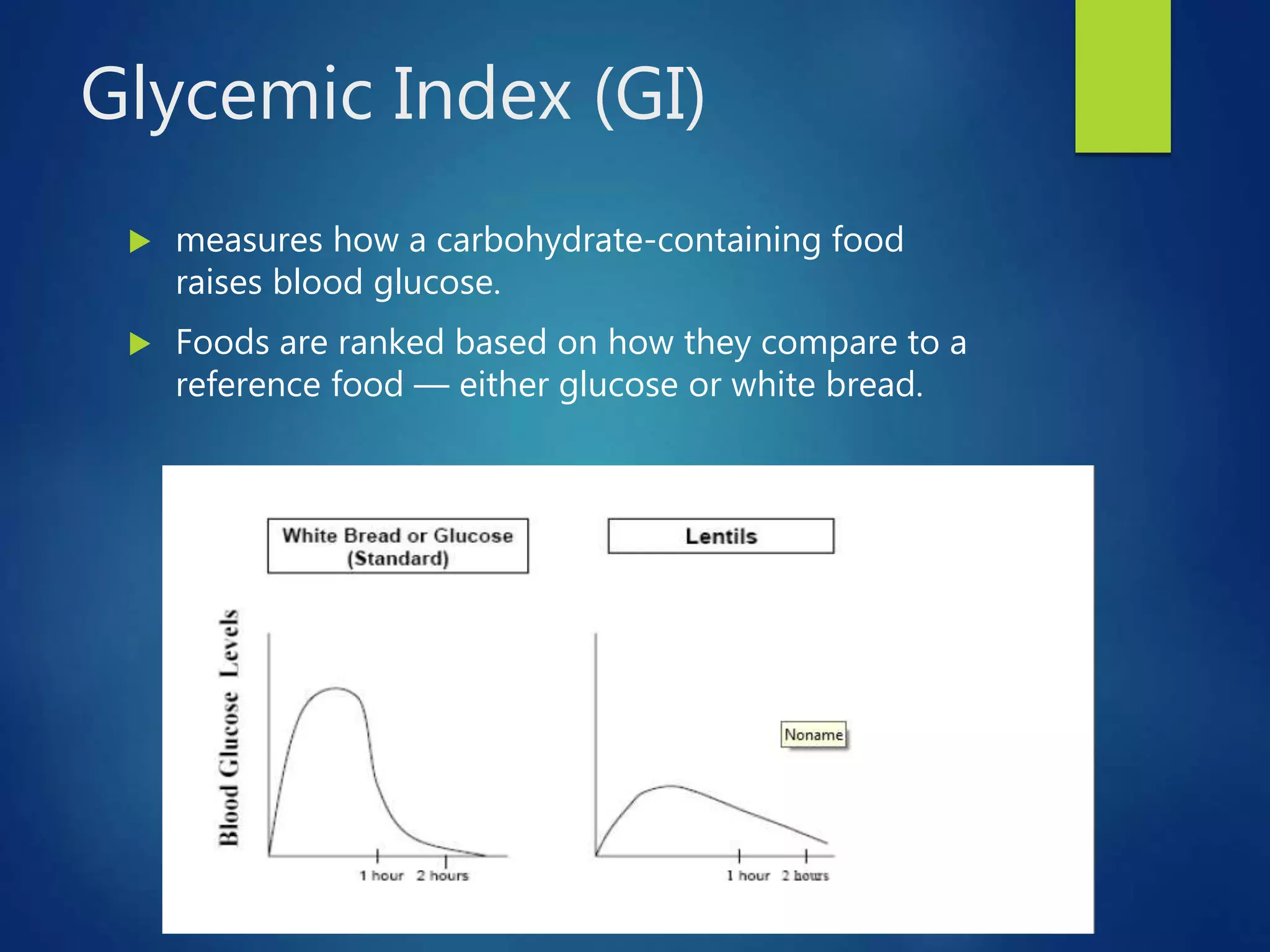
Glycemic Index (GI)
 measures how a carbohydrate-containing food
raises blood glucose.
 Foods are ranked based on how they compare to a
reference food — either glucose or white bread.
GI ranks
Key Low Medium High
Glycemic Index 55 or less 56 -69 70 or higher
Examples • 100% stone-
ground whole
wheat or
pumpernickel
bread
• Most fruits,
• Whole wheat,
• Quick oats
• Brown, wild or
basmati rice,
• White bread
or bagel
• Corn flakes,
• Puffed rice, br
an flakes,
• Shortgrain
white rice,
Factors Influencing GI Ranking
• Type of starch
Factors Influencing GI Ranking
Type of Starch
• Absorbs less water
• Molecules form tight clumps
• Slower rate of digestion
• Absorbs more water
• Molecules are more open
• Faster rate of digestion
Amylose Amylopectin
Lower GI
Kidney beans (28)
Higher GI
Russet potato (85)
Factors Influencing GI Ranking
• Type of starch
• Physical entrapment
Factors Influencing GI Ranking
Physical Entrapment
Endosperm
Bran
Germ
Bran acts as a physical barrier that
slows down enzymatic activity on the
internal starch layer.
Lower GI
Pumpernickel bread (50)
Higher GI
Bagel (72)
Factors Influencing GI Ranking
• Type of starch
• Physical entrapment
• Viscosity of fiber
Factors Influencing GI Ranking
Viscosity of Fiber
Viscous, soluble fibers transform intestinal
contents into gel-like matter that slows down
enzymatic activity on starch.
Lower GI
Apple (40)
Higher GI
Cheerios (74)
Factors Influencing GI Ranking
• Type of starch
• Physical entrapment
• Viscosity of fiber
• Fat and protein content
Factors Influencing GI Ranking
Fat & Protein Content
Fat and protein slow down gastric emptying,
and thus, slows down digestion of starch.
Lower GI
Potato chips (54)
Higher GI
Baked potato (85)
Factors Influencing GI Ranking
• Type of starch
• Physical entrapment
• Viscosity of fiber
• Fat and protein content
• Acid content
Factors Influencing GI Ranking
Acid Content
Acid slows down gastric emptying, and thus,
slows down the digestion of starch.
Lower GI
Sourdough wheat bread (54)
Higher GI
Wonder white bread (73)
Factors Influencing GI Ranking
• Type of starch
• Physical entrapment
• Viscosity of fiber
• Fat and protein content
• Acid content
• Food processing
Factors Influencing GI Ranking
Food Processing
Highly processed foods require less digestive
processing.
Lower GI
Old fashioned, rolled oats (51)
Higher GI
Quick, 1-minute oats (66)
Factors Influencing GI Ranking
• Type of starch
• Physical entrapment
• Viscosity of fiber
• Fat and protein content
• Acid content
• Food processing
• Cooking
Factors Influencing GI Ranking
Cooking
Cooking swells starch molecules and softens
foods, which speeds up the rate of digestion.
Lower GI
Al dente spaghetti – boiled
10 to 15 minutes (44)
Higher GI
Over-cooked spaghetti –
boiled 20 minutes (64)
Other Causes of Variability in the
Glycemic Index
 The particle size of the
food
 The degree of ripeness
 How long the food has
been stored
 The current meal, or the
meal before
 The pre-meal BG level
 The procedure for
measuring GI can vary
from study to study, so GI
tables can conflict
 Both intra-and
interpersonal responses
can vary significantly
What are the limitations of
using glycemic index?
 GI values were determined in studies where volunteers ate portions containing 50
grams of carbohydrate of each test food. 50 grams of carbohydrate from
popcorn is ten cups popped, while from white rice is about one cup cooked.
 There is a wide variation in values assigned to the same food depending on
reference source.
 GI values can vary depending on many factors
 GI values measured the effect of a test food when that food was eaten alone.
 The effect of food on blood sugar can vary from person to person.
 A lower GI value does not necessarily mean the food is a better choice. E.g a
chocolate candy bar vs. 1 cup of brown rice have =GI
glycemic load
 The glycemic load (GL) is an equation that takes into
account the planned portion size of a food as well as
the glycemic index of that food.
 GL = GI x CHOg per serving/100
 Is believed to better represent the glycemic impact of
more typical portions of foods
 Low GL = 10 or less
 Medium GL = 11-19
 High GL = 20 or more
Example of GL
 Example using white bread, GI = 70
 GL of 1sl = 70 X 15g/100 = 10.5
 GL of 2sl = 70 X 30g/100 = 21
 GL of 3sl = 70 X 45g/100 = 31.5
 So even a low GI food can have a high GL if the
portion is big enough. And, a high GI food can have a
lower GL if the portion is controlled
 Because GL is based upon GI, GL values of foods can
vary for the same reasons that GI can vary
Pictures of Low/High GI Meals & Snacks
GI = 60 GL = 48 GI = 42 GL = 31
Pictures of Low/High GI Meals & Snacks
GI = 85 GL = 48 GI = 39 GL = 22
Who may be interested in
the glycemic index?
 People who have diabetes may use GI values as an
additional tool for managing blood sugar levels.
 GI values can also be used when treating reactive
hypoglycemia.
 Studies have shown that when eating low GI foods,
people tend to snack less, which may be helpful in
weight control as well as blood sugar control.
GI & Diabetes
 Most GI studies have been conducted using non-diabetic
subjects
 The measurement of the glycemic response is almost always
stopped after 2 hour post-meal
 Studies which include subject with diabetes show greater
variability in GI response among people with diabetes
 The GI is based on a 50 gram load of carbohydrate -which can
be very different from a typical portion
 Studies demonstrate a small overall improvement in BG control
at best
 0.27-0.43 % drop in A1c.
 By contrast, standard Medical Nutritional Therapy has achieved a
1-2% point drop in A1c.
GI or Carbohydrate Counting?
 There is no one diet or meal plan that works for everyone with
diabetes. The important thing is to follow a meal plan that is
tailored to personal preferences and lifestyle
 Research shows that both the amount and the type of
carbohydrate in food affect blood glucose levels.
 Studies also show that the total amount of carbohydrate in food,
in general, is a stronger predictor of blood glucose response
than the GI.
 Based on the research, for most people with diabetes, the first tool
for managing blood glucose is some type of carbohydrate
counting.
 Combined GI with carbohydrate counting, it may provide an
additional benefit for achieving blood glucose goals for individuals
who can and want to put extra effort into monitoring their food
choices
 Meats and fats do have a GI ?
Yes
No
Case Study – “Amy”
Before
38 YO administrative assistant
Married, no children
Height: 5’7”
Weight: 320 lbs.=145kg
BMI: 50 (severe obesity)
Type 2 DM since age 35
A1c: 6.3 (Glucophage 500 mg)
BP: 148/90 (Altace 10 mg)
Case Study – Amy’s Before Diet
Breakfast: toasted bagel with cream cheese, 16 oz. orange juice, large
coffee with whole milk
Lunch: 6” roast beef & cheese sub sandwich w/ mayo, 20 oz. diet
Pepsi
Snack: (“all afternoon long”) 13 oz. bag Hershey miniature
chocolate bars
Dinner: ½ box macaroni & cheese (made w/ 2% milk), 3 beef hot
dogs on buns, water
Snack: 1 ½ cups ice cream
6250 Kcal: 43% CHO (666g), 11% PRO (173g), 46% fat (321g)
GI = 57 (moderate)
GL = 352 (very high)
Case Study – Amy’s After Diet
Breakfast: 2 slices 100% WW toast, 1 Tbsp natural, NSA peanut butter,
1 Tbsp all-fruit jelly, 1 cup fresh strawberries, large coffee w/ skim
milk
Lunch: 4 oz. grilled chicken breast, large green salad with varied
fresh vegetables & 2 Tbsp vinaigrette dressing, small boiled sweet
potato, orange, diet iced tea
Snack: 6 oz. light yogurt, ½ cup cherries (frozen)
Dinner: 4 oz. grilled salmon w/ lemon juice, 1 cup pasta w/ 1 cup
broccoli rabe, 1 Tbsp olive oil, water
Snack: apple
2150 Kcal: 47% CHO (251g), 19% PRO (104g), 34% fat (82g)
GI = 39 (low)
GL = 61 (low)
Case Study – “Amy”
Before
3 years later…
Case Study – “Amy”
After
Weight: 205 lbs=92 kg
BMI: 32 (mild obesity)
A1c: 5.2
BP: 120/60, RHR 47
Medications: none.
Referances
 Johanna Burani, American Diabetes Association, Southern
Regional Conference, Marco Island, Florida, May 26, 2006
 UCSF Diabetes Center Resources,
http://diabetes.ucsf.edu/sites/diabetes.ucsf.edu/files/PEDS
%20Glycemic%20Index.pdf , assessed on 28/10/2016
 American diabetes Association, Glycemic Index and
Diabetes, http://www.diabetes.org/food-and-
fitness/food/what-can-i-eat/understanding-
carbohydrates/glycemic-index-and-
diabetes.html?referrer=https://www.google.com/ Last
Edited: May 14, 2014, accessed on 28/10/2016
 Patty Haney, GLYCEMICINDEX: FROM RESEARCH TO
PRACTICE,
Thank you
Q?
You are
what
you
think.
So, be
positive
&
optimist
ic for
future

Glycemic index and diabetes

  • 1.
    Glycemic Index and Diabetes JOKHAAL-JASSASI DIETITIAN IBRI POLYCLINIC
  • 2.
    Glycemic Index (GI) measures how a carbohydrate-containing food raises blood glucose.  Foods are ranked based on how they compare to a reference food — either glucose or white bread.
  • 3.
    GI ranks Key LowMedium High Glycemic Index 55 or less 56 -69 70 or higher Examples • 100% stone- ground whole wheat or pumpernickel bread • Most fruits, • Whole wheat, • Quick oats • Brown, wild or basmati rice, • White bread or bagel • Corn flakes, • Puffed rice, br an flakes, • Shortgrain white rice,
  • 4.
    Factors Influencing GIRanking • Type of starch
  • 5.
    Factors Influencing GIRanking Type of Starch • Absorbs less water • Molecules form tight clumps • Slower rate of digestion • Absorbs more water • Molecules are more open • Faster rate of digestion Amylose Amylopectin Lower GI Kidney beans (28) Higher GI Russet potato (85)
  • 6.
    Factors Influencing GIRanking • Type of starch • Physical entrapment
  • 7.
    Factors Influencing GIRanking Physical Entrapment Endosperm Bran Germ Bran acts as a physical barrier that slows down enzymatic activity on the internal starch layer. Lower GI Pumpernickel bread (50) Higher GI Bagel (72)
  • 8.
    Factors Influencing GIRanking • Type of starch • Physical entrapment • Viscosity of fiber
  • 9.
    Factors Influencing GIRanking Viscosity of Fiber Viscous, soluble fibers transform intestinal contents into gel-like matter that slows down enzymatic activity on starch. Lower GI Apple (40) Higher GI Cheerios (74)
  • 10.
    Factors Influencing GIRanking • Type of starch • Physical entrapment • Viscosity of fiber • Fat and protein content
  • 11.
    Factors Influencing GIRanking Fat & Protein Content Fat and protein slow down gastric emptying, and thus, slows down digestion of starch. Lower GI Potato chips (54) Higher GI Baked potato (85)
  • 12.
    Factors Influencing GIRanking • Type of starch • Physical entrapment • Viscosity of fiber • Fat and protein content • Acid content
  • 13.
    Factors Influencing GIRanking Acid Content Acid slows down gastric emptying, and thus, slows down the digestion of starch. Lower GI Sourdough wheat bread (54) Higher GI Wonder white bread (73)
  • 14.
    Factors Influencing GIRanking • Type of starch • Physical entrapment • Viscosity of fiber • Fat and protein content • Acid content • Food processing
  • 15.
    Factors Influencing GIRanking Food Processing Highly processed foods require less digestive processing. Lower GI Old fashioned, rolled oats (51) Higher GI Quick, 1-minute oats (66)
  • 16.
    Factors Influencing GIRanking • Type of starch • Physical entrapment • Viscosity of fiber • Fat and protein content • Acid content • Food processing • Cooking
  • 17.
    Factors Influencing GIRanking Cooking Cooking swells starch molecules and softens foods, which speeds up the rate of digestion. Lower GI Al dente spaghetti – boiled 10 to 15 minutes (44) Higher GI Over-cooked spaghetti – boiled 20 minutes (64)
  • 18.
    Other Causes ofVariability in the Glycemic Index  The particle size of the food  The degree of ripeness  How long the food has been stored  The current meal, or the meal before  The pre-meal BG level  The procedure for measuring GI can vary from study to study, so GI tables can conflict  Both intra-and interpersonal responses can vary significantly
  • 19.
    What are thelimitations of using glycemic index?  GI values were determined in studies where volunteers ate portions containing 50 grams of carbohydrate of each test food. 50 grams of carbohydrate from popcorn is ten cups popped, while from white rice is about one cup cooked.  There is a wide variation in values assigned to the same food depending on reference source.  GI values can vary depending on many factors  GI values measured the effect of a test food when that food was eaten alone.  The effect of food on blood sugar can vary from person to person.  A lower GI value does not necessarily mean the food is a better choice. E.g a chocolate candy bar vs. 1 cup of brown rice have =GI
  • 20.
    glycemic load  Theglycemic load (GL) is an equation that takes into account the planned portion size of a food as well as the glycemic index of that food.  GL = GI x CHOg per serving/100  Is believed to better represent the glycemic impact of more typical portions of foods  Low GL = 10 or less  Medium GL = 11-19  High GL = 20 or more
  • 21.
    Example of GL Example using white bread, GI = 70  GL of 1sl = 70 X 15g/100 = 10.5  GL of 2sl = 70 X 30g/100 = 21  GL of 3sl = 70 X 45g/100 = 31.5  So even a low GI food can have a high GL if the portion is big enough. And, a high GI food can have a lower GL if the portion is controlled  Because GL is based upon GI, GL values of foods can vary for the same reasons that GI can vary
  • 23.
    Pictures of Low/HighGI Meals & Snacks GI = 60 GL = 48 GI = 42 GL = 31
  • 24.
    Pictures of Low/HighGI Meals & Snacks GI = 85 GL = 48 GI = 39 GL = 22
  • 25.
    Who may beinterested in the glycemic index?  People who have diabetes may use GI values as an additional tool for managing blood sugar levels.  GI values can also be used when treating reactive hypoglycemia.  Studies have shown that when eating low GI foods, people tend to snack less, which may be helpful in weight control as well as blood sugar control.
  • 26.
    GI & Diabetes Most GI studies have been conducted using non-diabetic subjects  The measurement of the glycemic response is almost always stopped after 2 hour post-meal  Studies which include subject with diabetes show greater variability in GI response among people with diabetes  The GI is based on a 50 gram load of carbohydrate -which can be very different from a typical portion  Studies demonstrate a small overall improvement in BG control at best  0.27-0.43 % drop in A1c.  By contrast, standard Medical Nutritional Therapy has achieved a 1-2% point drop in A1c.
  • 27.
    GI or CarbohydrateCounting?  There is no one diet or meal plan that works for everyone with diabetes. The important thing is to follow a meal plan that is tailored to personal preferences and lifestyle  Research shows that both the amount and the type of carbohydrate in food affect blood glucose levels.  Studies also show that the total amount of carbohydrate in food, in general, is a stronger predictor of blood glucose response than the GI.  Based on the research, for most people with diabetes, the first tool for managing blood glucose is some type of carbohydrate counting.  Combined GI with carbohydrate counting, it may provide an additional benefit for achieving blood glucose goals for individuals who can and want to put extra effort into monitoring their food choices
  • 28.
     Meats andfats do have a GI ? Yes No
  • 29.
    Case Study –“Amy” Before 38 YO administrative assistant Married, no children Height: 5’7” Weight: 320 lbs.=145kg BMI: 50 (severe obesity) Type 2 DM since age 35 A1c: 6.3 (Glucophage 500 mg) BP: 148/90 (Altace 10 mg)
  • 30.
    Case Study –Amy’s Before Diet Breakfast: toasted bagel with cream cheese, 16 oz. orange juice, large coffee with whole milk Lunch: 6” roast beef & cheese sub sandwich w/ mayo, 20 oz. diet Pepsi Snack: (“all afternoon long”) 13 oz. bag Hershey miniature chocolate bars Dinner: ½ box macaroni & cheese (made w/ 2% milk), 3 beef hot dogs on buns, water Snack: 1 ½ cups ice cream 6250 Kcal: 43% CHO (666g), 11% PRO (173g), 46% fat (321g) GI = 57 (moderate) GL = 352 (very high)
  • 31.
    Case Study –Amy’s After Diet Breakfast: 2 slices 100% WW toast, 1 Tbsp natural, NSA peanut butter, 1 Tbsp all-fruit jelly, 1 cup fresh strawberries, large coffee w/ skim milk Lunch: 4 oz. grilled chicken breast, large green salad with varied fresh vegetables & 2 Tbsp vinaigrette dressing, small boiled sweet potato, orange, diet iced tea Snack: 6 oz. light yogurt, ½ cup cherries (frozen) Dinner: 4 oz. grilled salmon w/ lemon juice, 1 cup pasta w/ 1 cup broccoli rabe, 1 Tbsp olive oil, water Snack: apple 2150 Kcal: 47% CHO (251g), 19% PRO (104g), 34% fat (82g) GI = 39 (low) GL = 61 (low)
  • 32.
    Case Study –“Amy” Before 3 years later…
  • 33.
    Case Study –“Amy” After Weight: 205 lbs=92 kg BMI: 32 (mild obesity) A1c: 5.2 BP: 120/60, RHR 47 Medications: none.
  • 34.
    Referances  Johanna Burani,American Diabetes Association, Southern Regional Conference, Marco Island, Florida, May 26, 2006  UCSF Diabetes Center Resources, http://diabetes.ucsf.edu/sites/diabetes.ucsf.edu/files/PEDS %20Glycemic%20Index.pdf , assessed on 28/10/2016  American diabetes Association, Glycemic Index and Diabetes, http://www.diabetes.org/food-and- fitness/food/what-can-i-eat/understanding- carbohydrates/glycemic-index-and- diabetes.html?referrer=https://www.google.com/ Last Edited: May 14, 2014, accessed on 28/10/2016  Patty Haney, GLYCEMICINDEX: FROM RESEARCH TO PRACTICE,
  • 35.
    Thank you Q? You are what you think. So,be positive & optimist ic for future