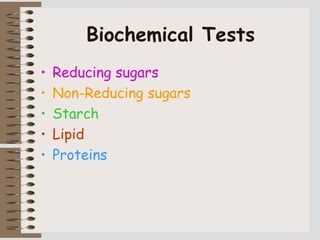
Biochemical Tests
• Reducing sugars
• Non-Reducing sugars
• Starch
• Lipid
• Proteins
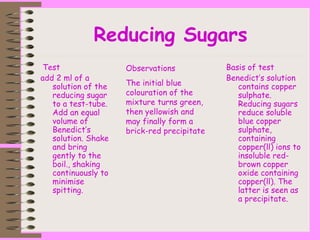
Reducing Sugars
Test
add 2 ml of a
solution of the
reducing sugar
to a test-tube.
Add an equal
volume of
Benedict’s
solution. Shake
and bring
gently to the
boil., shaking
continuously to
minimise
spitting.
Basis of test
Benedict’s solution
contains copper
sulphate.
Reducing sugars
reduce soluble
blue copper
sulphate,
containing
copper(ll) ions to
insoluble red-
brown copper
oxide containing
copper(ll). The
latter is seen as
a precipitate.
Observations
The initial blue
colouration of the
mixture turns green,
then yellowish and
may finally form a
brick-red precipitate
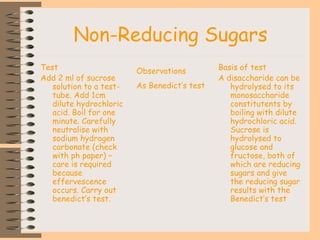
Non-Reducing Sugars
Test
Add 2 ml of sucrose
solution to a test-
tube. Add 1cm
dilute hydrochloric
acid. Boil for one
minute. Carefully
neutralise with
sodium hydrogen
carbonate (check
with ph paper) –
care is required
because
effervescence
occurs. Carry out
benedict’s test.
Basis of test
A disaccharide can be
hydrolysed to its
monosaccharide
constitutents by
boiling with dilute
hydrochloric acid.
Sucrose is
hydrolysed to
glucose and
fructose, both of
which are reducing
sugars and give
the reducing sugar
results with the
Benedict’s test
Observations
As Benedict’s test
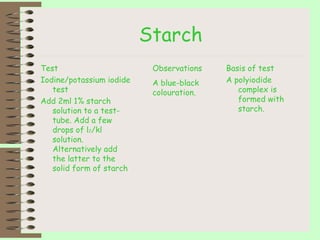
Starch
Test
Iodine/potassium iodide
test
Add 2ml 1% starch
solution to a test-
tube. Add a few
drops of l2/kl
solution.
Alternatively add
the latter to the
solid form of starch
Basis of test
A polyiodide
complex is
formed with
starch.
Observations
A blue-black
colouration.
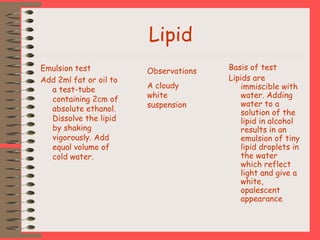
Lipid
Emulsion test
Add 2ml fat or oil to
a test-tube
containing 2cm of
absolute ethanol.
Dissolve the lipid
by shaking
vigorously. Add
equal volume of
cold water.
Basis of test
Lipids are
immiscible with
water. Adding
water to a
solution of the
lipid in alcohol
results in an
emulsion of tiny
lipid droplets in
the water
which reflect
light and give a
white,
opalescent
appearance
Observations
A cloudy
white
suspension
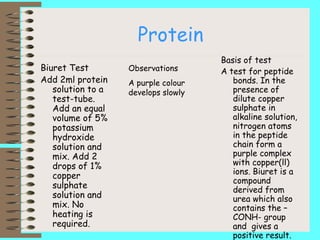
Protein
Biuret Test
Add 2ml protein
solution to a
test-tube.
Add an equal
volume of 5%
potassium
hydroxide
solution and
mix. Add 2
drops of 1%
copper
sulphate
solution and
mix. No
heating is
required.
Basis of test
A test for peptide
bonds. In the
presence of
dilute copper
sulphate in
alkaline solution,
nitrogen atoms
in the peptide
chain form a
purple complex
with copper(ll)
ions. Biuret is a
compound
derived from
urea which also
contains the –
CONH- group
and gives a
positive result.
Observations
A purple colour
develops slowly
Protein
Biuret Test
Add 2ml protein
solution to a
test-tube.
Add an equal
volume of 5%
potassium
hydroxide
solution and
mix. Add 2
drops of 1%
copper
sulphate
solution and
mix. No
heating is
required.
Basis of test
A test for peptide
bonds. In the
presence of
dilute copper
sulphate in
alkaline solution,
nitrogen atoms
in the peptide
chain form a
purple complex
with copper(ll)
ions. Biuret is a
compound
derived from
urea which also
contains the –
CONH- group
and gives a
positive result.
Observations
A purple colour
develops slowly

Biochemical tests presentation

  • 1.
    Biochemical Tests • Reducingsugars • Non-Reducing sugars • Starch • Lipid • Proteins
  • 2.
    Reducing Sugars Test add 2ml of a solution of the reducing sugar to a test-tube. Add an equal volume of Benedict’s solution. Shake and bring gently to the boil., shaking continuously to minimise spitting. Basis of test Benedict’s solution contains copper sulphate. Reducing sugars reduce soluble blue copper sulphate, containing copper(ll) ions to insoluble red- brown copper oxide containing copper(ll). The latter is seen as a precipitate. Observations The initial blue colouration of the mixture turns green, then yellowish and may finally form a brick-red precipitate
  • 3.
    Non-Reducing Sugars Test Add 2ml of sucrose solution to a test- tube. Add 1cm dilute hydrochloric acid. Boil for one minute. Carefully neutralise with sodium hydrogen carbonate (check with ph paper) – care is required because effervescence occurs. Carry out benedict’s test. Basis of test A disaccharide can be hydrolysed to its monosaccharide constitutents by boiling with dilute hydrochloric acid. Sucrose is hydrolysed to glucose and fructose, both of which are reducing sugars and give the reducing sugar results with the Benedict’s test Observations As Benedict’s test
  • 4.
    Starch Test Iodine/potassium iodide test Add 2ml1% starch solution to a test- tube. Add a few drops of l2/kl solution. Alternatively add the latter to the solid form of starch Basis of test A polyiodide complex is formed with starch. Observations A blue-black colouration.
  • 5.
    Lipid Emulsion test Add 2mlfat or oil to a test-tube containing 2cm of absolute ethanol. Dissolve the lipid by shaking vigorously. Add equal volume of cold water. Basis of test Lipids are immiscible with water. Adding water to a solution of the lipid in alcohol results in an emulsion of tiny lipid droplets in the water which reflect light and give a white, opalescent appearance Observations A cloudy white suspension
  • 6.
    Protein Biuret Test Add 2mlprotein solution to a test-tube. Add an equal volume of 5% potassium hydroxide solution and mix. Add 2 drops of 1% copper sulphate solution and mix. No heating is required. Basis of test A test for peptide bonds. In the presence of dilute copper sulphate in alkaline solution, nitrogen atoms in the peptide chain form a purple complex with copper(ll) ions. Biuret is a compound derived from urea which also contains the – CONH- group and gives a positive result. Observations A purple colour develops slowly
  • 7.
    Protein Biuret Test Add 2mlprotein solution to a test-tube. Add an equal volume of 5% potassium hydroxide solution and mix. Add 2 drops of 1% copper sulphate solution and mix. No heating is required. Basis of test A test for peptide bonds. In the presence of dilute copper sulphate in alkaline solution, nitrogen atoms in the peptide chain form a purple complex with copper(ll) ions. Biuret is a compound derived from urea which also contains the – CONH- group and gives a positive result. Observations A purple colour develops slowly