THE CHEMISTRY OF LIFE
Objectives:
1. Define the term functional group and give the functional group or groups characteristic of
an acid, an amino acid, a carbohydrate, a fatty acid, and an alcohol.
2. Describe how to carry out a simple laboratory test for a monosaccharide, a polysaccharide, a
protein, and a fat.
3. Describe how a protein can be broken down into its building blocks, amino acids.
4. Show by thin-layer chromatography that different amino acids have different substances.
Introduction:
An element is a particular type of atom that is different from the atoms of all the other elements. The
elements most abundant in living material are:
Carbon=C

Nitrogen =N

Hydrogen=H

Sulfur=S

Oxygen=O

Phosphorous=P

These are by far the most abundant elements in biological systems: they can be combined in enormous
variety to make up the chemical molecules on which life is based. In most biological molecules atoms
are held together by covalent bonds in which electrons are shared between adjacent atoms. Ionic
bonds, hydrogen bonds and disulfide bonds are also important. If you are not sure how each of these
bonds is formed, please refer to your text and review them.
Fortunately for us, covalent bonds are not very easily broken down under ordinary conditions. Some
small molecules are especially stable and are used as the building block subunits or monomers of very
large molecules called polymers. A polymer often consists of many similar subunits strung together in a
long chain. It is easier to break down a polymer into its monomer subunits than to break apart the
subunits themselves.
Biological types of molecules can be categorized on the basis of the presence of similar parts called
functional groups.

1
Identification of Biological Molecules
Molecules of a certain class have similar chemical properties because they have the same functional
groups. A chemical test that is sensitive to these groups can be used to identify molecules that are in
that class. Practice the following tests by using them to see what various foods contain. In each test, you
will be including a substance that does not react in the test to serve as a negative control. A substance
known to give a reaction in the test would be a positive control.
Carbohydrates
These molecules usually contain the aldehyde and alcohol functional groups. Certain mono- and
disaccharides can be detected by their aldehyde groups. Some polysaccharides can be detected because
of their specific three-dimensional structure. Carbohydrates, which are water soluble or hydrophilic
substances, are not detected by their hydroxyl groups.
Can you suggest a reason why?

Benedict’s test for Reducing Sugar
This reducing sugar test depends on a free aldehyde group. Monosaccharides and some disaccharides
have a free aldehyde group and consequently will react to give a positive Benedict’s test. Such a sugar
acts as a reducing agent. The reaction goes like this:
BENEDICT’S REAGENT + REDUCING SUGAR HEAT→BENEDICT’S REAGENT + ACID SUGAR
This is a typical oxidation –reduction reaction in which oxidation of the sugar occurs simultaneously with
reduction of the Benedict’s reagent. Some disaccharides (e.g. sucrose) and all polysaccharides (e.g.
starch) are not reducing sugars because they do not have free aldehyde groups.
You’ll use the Benedict’s test to compare the reducing sugar content of onion juice with that of potato
juice:
Procedure:
1. Mark 3 test tubes at 1cm and 3cm from the bottom
2. Add onion juice up to the 1-cm mark of tube #1.
3. Add potato juice to the 1cm mark of the tube #2 and water to the 1-cm mark of tube #3
4. Add Benedict’s reagent to the 3 cm marks of all 3 tubes and mix.
5. Heat the tubes for 3 minutes in a boiling water bath.
2
6. Remove the tubes using the tongs provided and compare the colours.
A change from clear blue to red or orange indicates an abundance of reducing sugars. A change to green
indicates the presence of a smaller amount of reducing sugar.
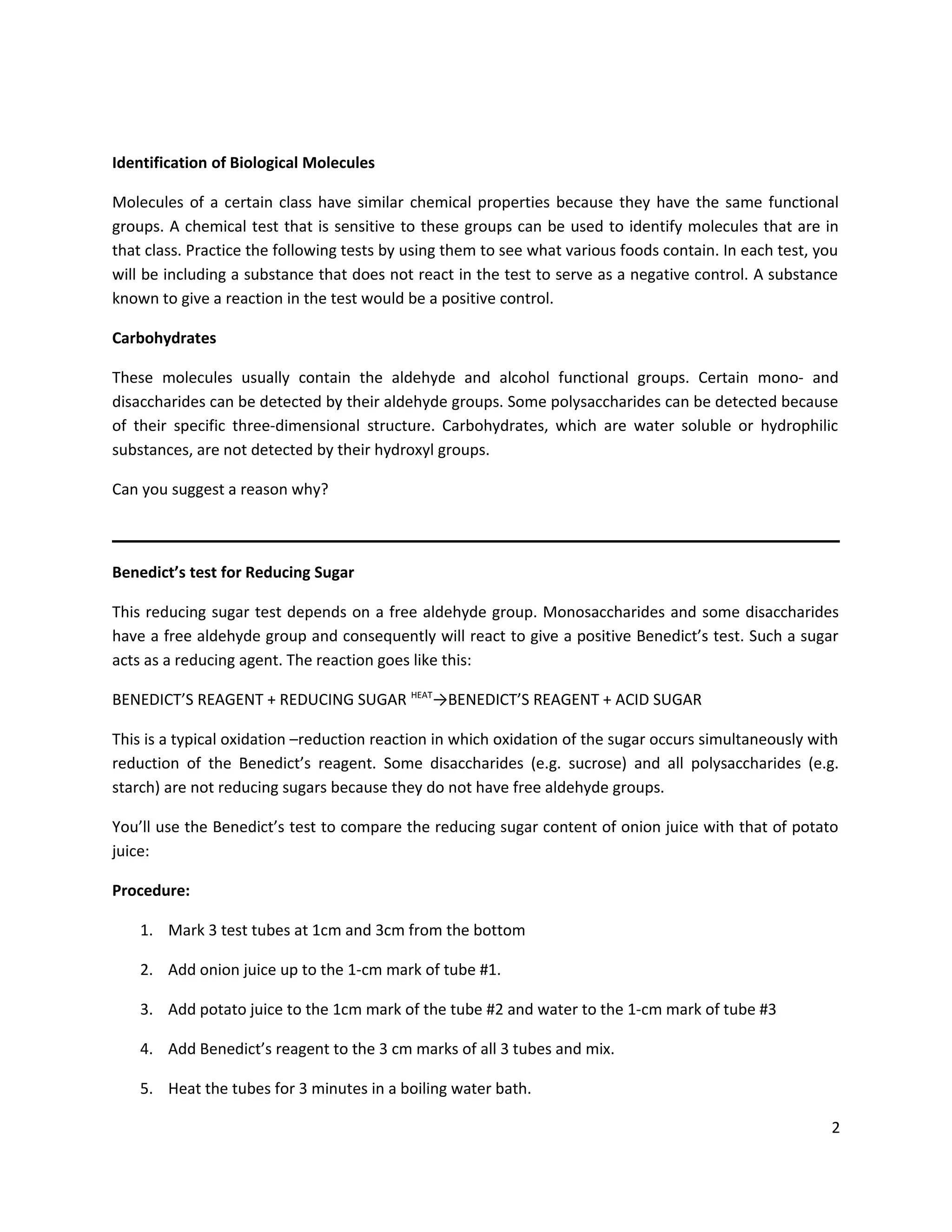
Results:
Benedict’s test: Green to red is positive
Tube

Substance

1

Onion juice

2

Potato juice

3

colour

Reducing
present?

sugar

Water

Iodine test for starch
Another test, the iodine test, can be used to distinguish starch from mono-, di-, and other
polysaccharides. Starch is a polymer of glucose in which chains are coiled up in a particular way so that
they interact with the iodine molecules to give a distinctive blue-black colour. Other polymers, even
those of glucose, lack the precise coiled structure of starch and do not give the dark colour. Thus the
iodine test is a specific test for starch that depends on the precise three-dimensional coiling of this
glucose polymer so that it can interact with iodine.
Compare the starch content of onions and potatoes.
Procedure:
1. Mark 3 tubes at 1cm
2. Fill one to the mark with onion juice, another with potato juice, and the third with water.
3. Add 3 drops of iodine to each tube and mix.

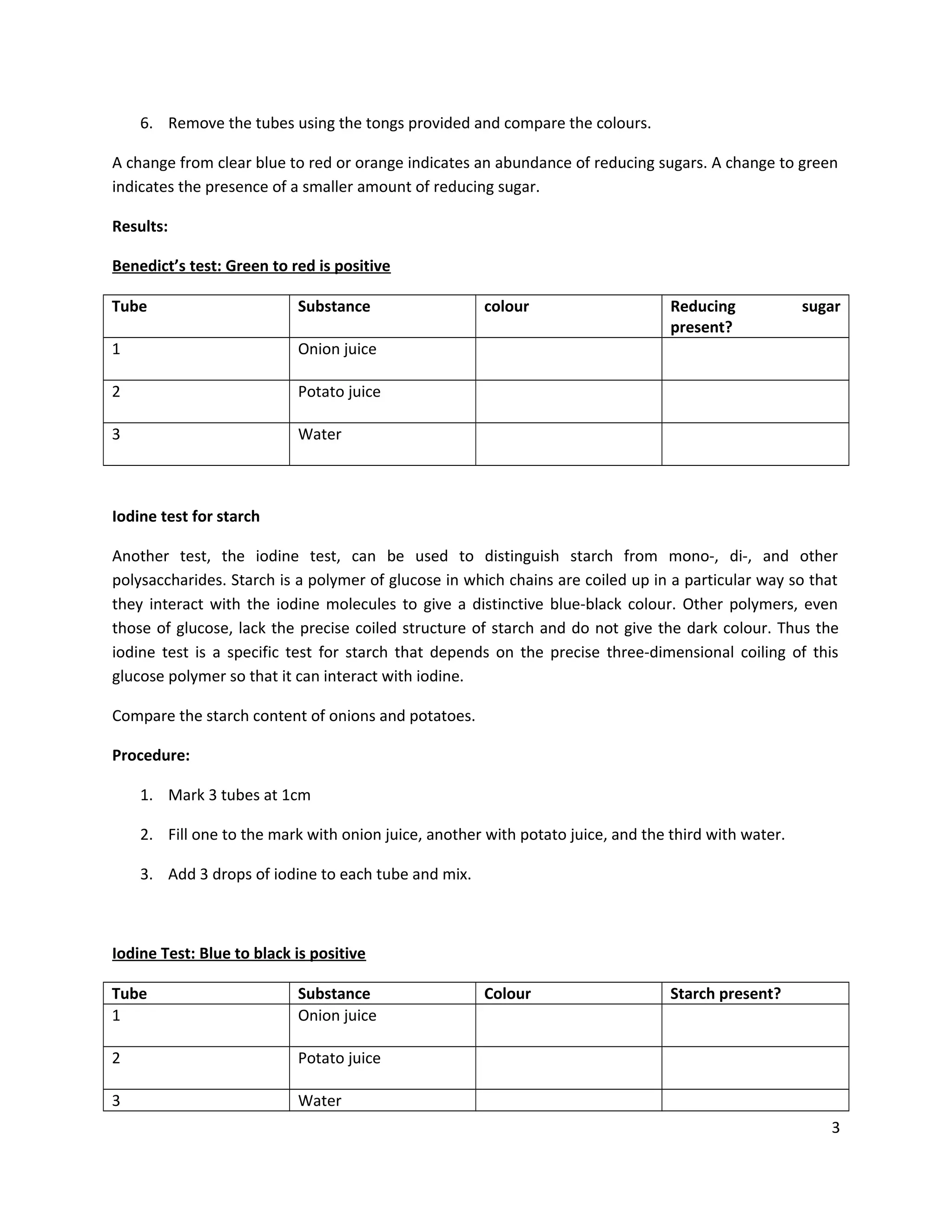
Iodine Test: Blue to black is positive
Tube
1

Substance
Onion juice

2

Potato juice

3

Colour

Starch present?

Water
3
A positive test will give a blue-black colour. A yellow or brown result is negative.

Sudan III test for fat:
A typical fat is a hydrophobic molecule consisting of a glycerol molecule joined to three fatty acids. The
hydroxyl groups of the glycerol react with the carboxyl groups of the fatty acids in a condensation
reaction, so these functional groups are no longer available for a test reaction. The Sudan III test
depends on the detection of the hydrocarbon groups in the three fatty acid tails. The coloured dye,
Sudan III, and the hydrocarbon groups are non polar and stick tightly together in their polar
surroundings. This simple hydrophobic interaction is the basis for this test.
Since fats are not very soluble in water, extracts of four foods have been made using 95% ethanol and
placed into test tubes. A fifth tube contains only water to be used as a control. Test each of the five
tubes for the presence of fat.
Procedure:
1. Using a pencil, mark a filter paper disc with a “W” (water), “F” (flour), “G” (wheat germ), “C”
(coconut), and an “M” (margarine) so that the letters are fairly equally spaced on the filter
paper. Draw a circle next to each letter.
2. Using Pasteur pipettes, add a small drop from each tube to the appropriate circled spot on
the filter paper. (Use only the dedicated pipet provided with each solution, and return the
pipet to its proper solution when you are finished using it.)
3. Allow the filter paper to completely dry.
4. Soak the paper for 3 minutes in Sudan III solution.
5. Use forceps to remove the paper from the stain.
6. Rinse the paper in a water bath for one minute.
7. Examine the intensity of staining for the five spots and rate the four foods as 0= no colour,
+=faint orange colour, + + = definite orange colour.

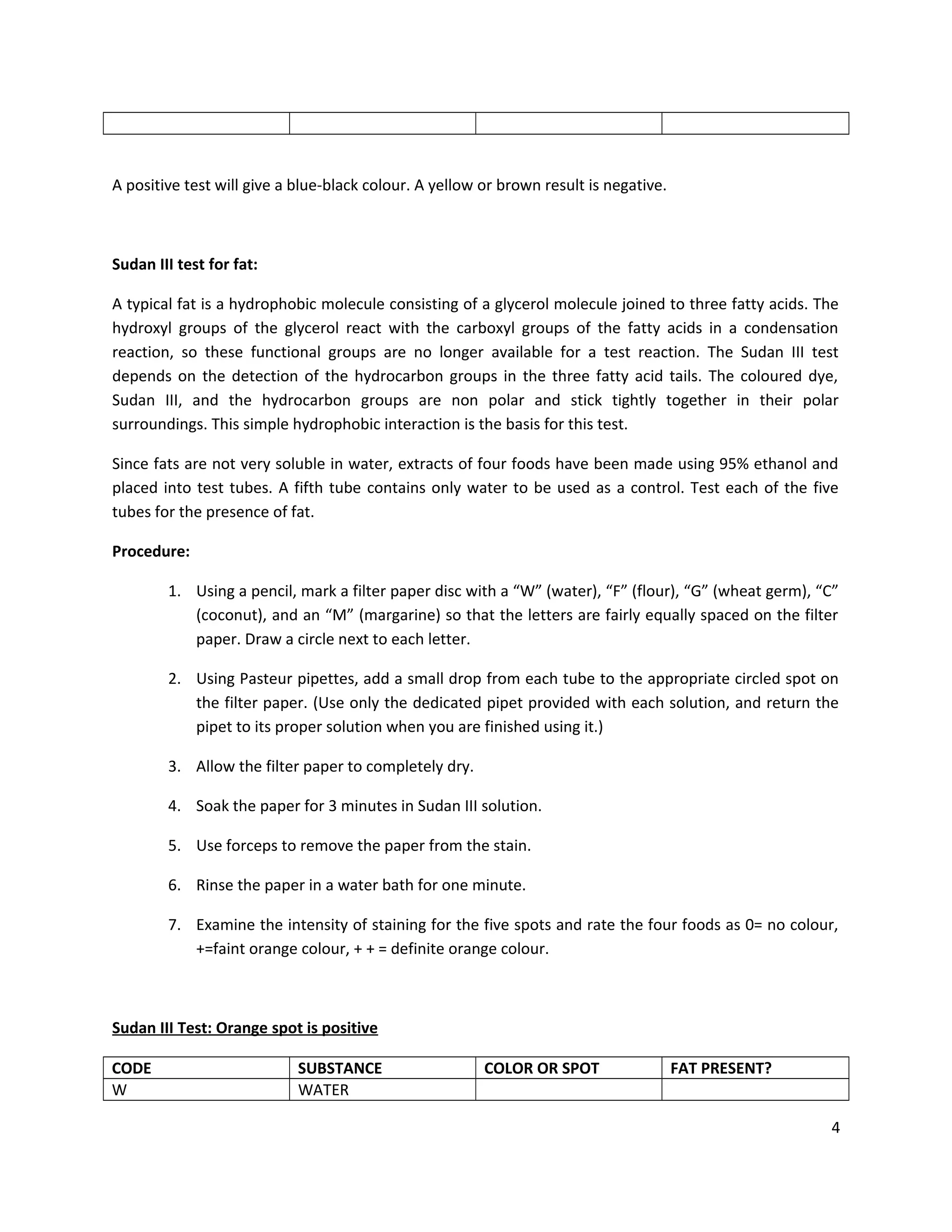
Sudan III Test: Orange spot is positive
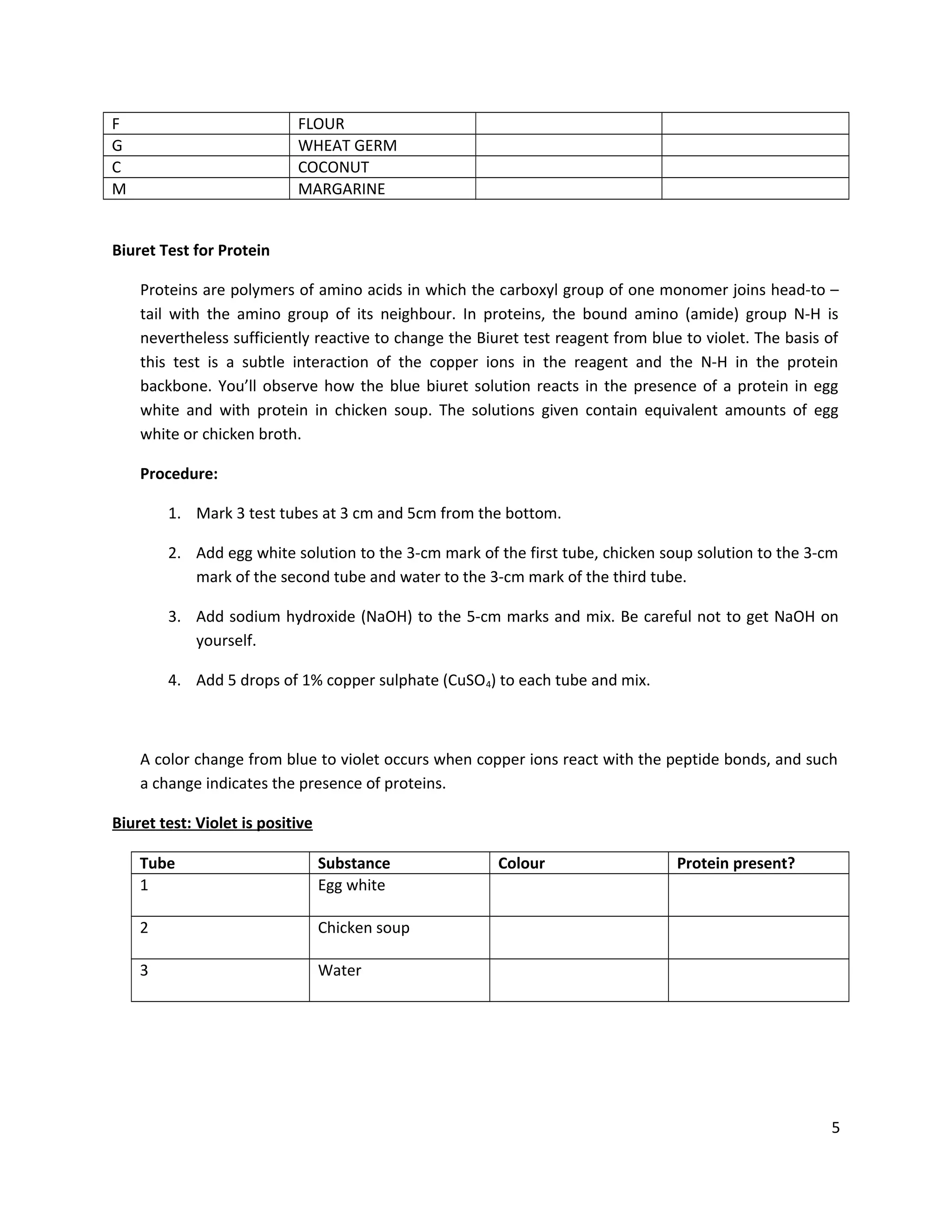
CODE
W

SUBSTANCE
WATER

COLOR OR SPOT

FAT PRESENT?
4
F
G
C
M

FLOUR
WHEAT GERM
COCONUT
MARGARINE

Biuret Test for Protein
Proteins are polymers of amino acids in which the carboxyl group of one monomer joins head-to –
tail with the amino group of its neighbour. In proteins, the bound amino (amide) group N-H is
nevertheless sufficiently reactive to change the Biuret test reagent from blue to violet. The basis of
this test is a subtle interaction of the copper ions in the reagent and the N-H in the protein
backbone. You’ll observe how the blue biuret solution reacts in the presence of a protein in egg
white and with protein in chicken soup. The solutions given contain equivalent amounts of egg
white or chicken broth.
Procedure:
1. Mark 3 test tubes at 3 cm and 5cm from the bottom.
2. Add egg white solution to the 3-cm mark of the first tube, chicken soup solution to the 3-cm
mark of the second tube and water to the 3-cm mark of the third tube.
3. Add sodium hydroxide (NaOH) to the 5-cm marks and mix. Be careful not to get NaOH on
yourself.
4. Add 5 drops of 1% copper sulphate (CuSO 4) to each tube and mix.

A color change from blue to violet occurs when copper ions react with the peptide bonds, and such
a change indicates the presence of proteins.
Biuret test: Violet is positive
Tube
1

Substance
Egg white

2

Chicken soup

3

Colour

Protein present?

Water

5
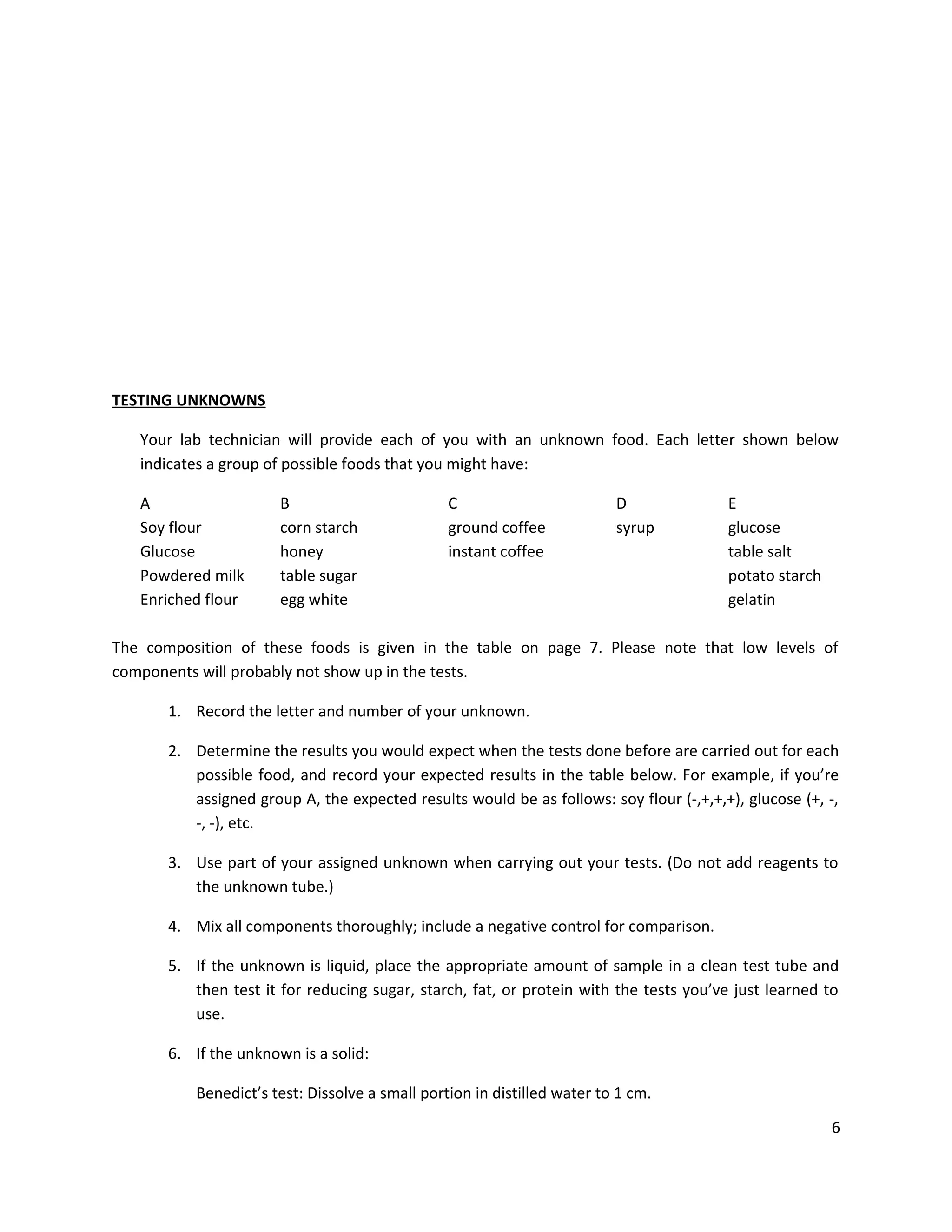
TESTING UNKNOWNS
Your lab technician will provide each of you with an unknown food. Each letter shown below
indicates a group of possible foods that you might have:
A
Soy flour
Glucose
Powdered milk
Enriched flour

B
corn starch
honey
table sugar
egg white

C
ground coffee
instant coffee

D
syrup

E
glucose
table salt
potato starch
gelatin

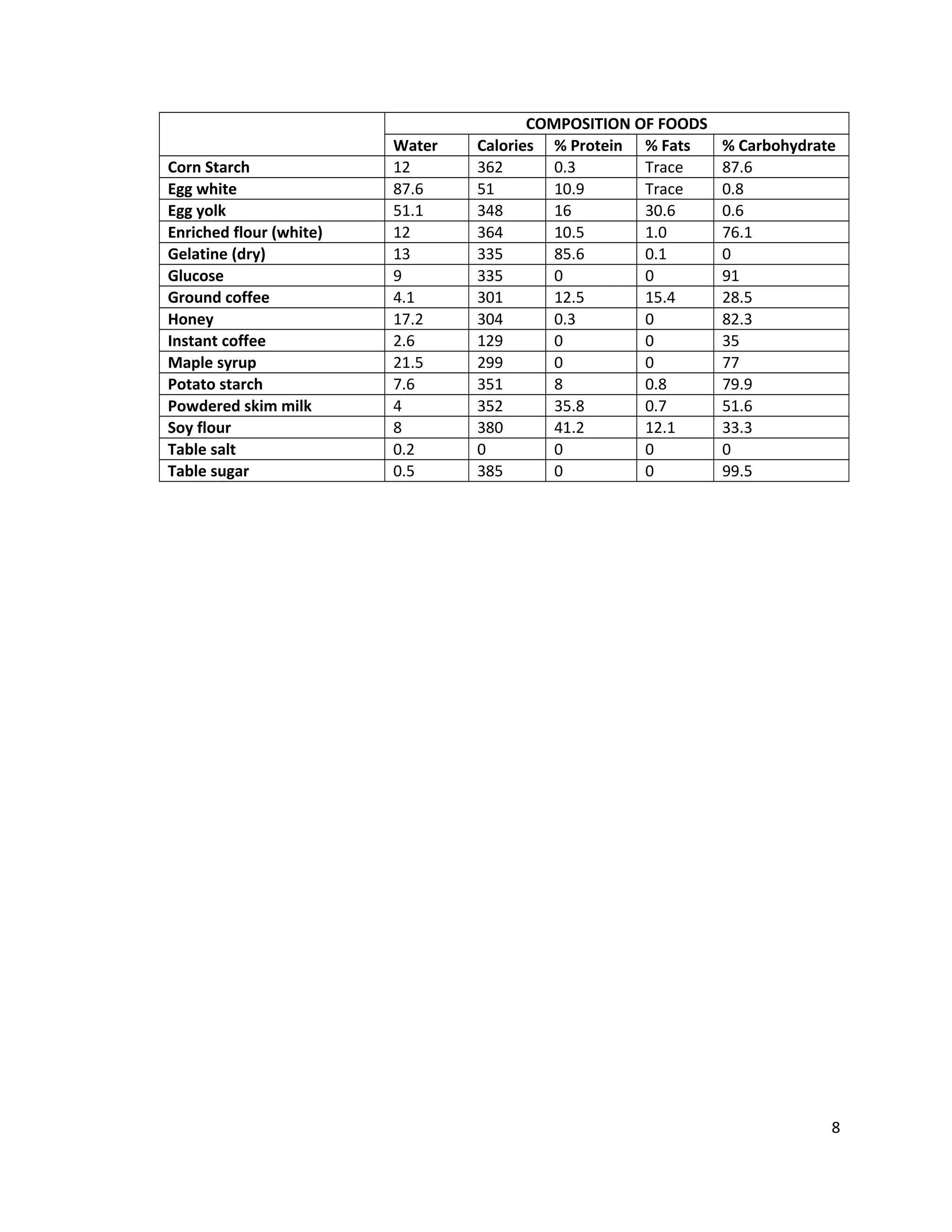
The composition of these foods is given in the table on page 7. Please note that low levels of
components will probably not show up in the tests.
1. Record the letter and number of your unknown.
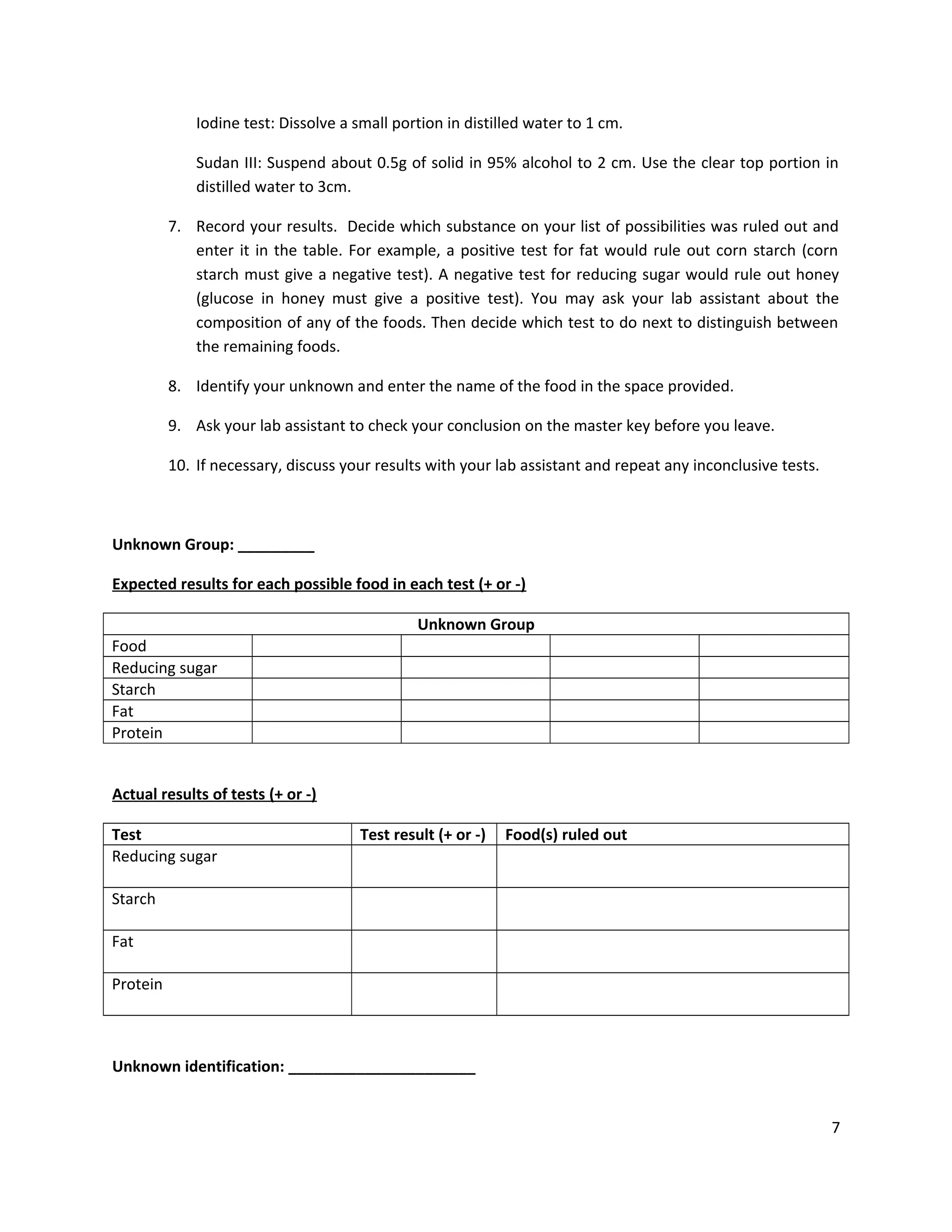
2. Determine the results you would expect when the tests done before are carried out for each
possible food, and record your expected results in the table below. For example, if you’re
assigned group A, the expected results would be as follows: soy flour (-,+,+,+), glucose (+, -,
-, -), etc.
3. Use part of your assigned unknown when carrying out your tests. (Do not add reagents to
the unknown tube.)
4. Mix all components thoroughly; include a negative control for comparison.
5. If the unknown is liquid, place the appropriate amount of sample in a clean test tube and
then test it for reducing sugar, starch, fat, or protein with the tests you’ve just learned to
use.
6. If the unknown is a solid:
Benedict’s test: Dissolve a small portion in distilled water to 1 cm.
6
Iodine test: Dissolve a small portion in distilled water to 1 cm.
Sudan III: Suspend about 0.5g of solid in 95% alcohol to 2 cm. Use the clear top portion in
distilled water to 3cm.
7. Record your results. Decide which substance on your list of possibilities was ruled out and
enter it in the table. For example, a positive test for fat would rule out corn starch (corn
starch must give a negative test). A negative test for reducing sugar would rule out honey
(glucose in honey must give a positive test). You may ask your lab assistant about the
composition of any of the foods. Then decide which test to do next to distinguish between
the remaining foods.
8. Identify your unknown and enter the name of the food in the space provided.
9. Ask your lab assistant to check your conclusion on the master key before you leave.
10. If necessary, discuss your results with your lab assistant and repeat any inconclusive tests.

Unknown Group: _________
Expected results for each possible food in each test (+ or -)
Unknown Group
Food
Reducing sugar
Starch
Fat
Protein
Actual results of tests (+ or -)
Test
Reducing sugar

Test result (+ or -)

Food(s) ruled out

Starch
Fat
Protein

Unknown identification: ______________________
7
Corn Starch
Egg white
Egg yolk
Enriched flour (white)
Gelatine (dry)
Glucose
Ground coffee
Honey
Instant coffee
Maple syrup
Potato starch
Powdered skim milk
Soy flour
Table salt
Table sugar

Water
12
87.6
51.1
12
13
9
4.1
17.2
2.6
21.5
7.6
4
8
0.2
0.5

COMPOSITION OF FOODS
Calories % Protein % Fats
362
0.3
Trace
51
10.9
Trace
348
16
30.6
364
10.5
1.0
335
85.6
0.1
335
0
0
301
12.5
15.4
304
0.3
0
129
0
0
299
0
0
351
8
0.8
352
35.8
0.7
380
41.2
12.1
0
0
0
385
0
0

% Carbohydrate
87.6
0.8
0.6
76.1
0
91
28.5
82.3
35
77
79.9
51.6
33.3
0
99.5

8

2 biomolecules

  • 1.
    THE CHEMISTRY OFLIFE Objectives: 1. Define the term functional group and give the functional group or groups characteristic of an acid, an amino acid, a carbohydrate, a fatty acid, and an alcohol. 2. Describe how to carry out a simple laboratory test for a monosaccharide, a polysaccharide, a protein, and a fat. 3. Describe how a protein can be broken down into its building blocks, amino acids. 4. Show by thin-layer chromatography that different amino acids have different substances. Introduction: An element is a particular type of atom that is different from the atoms of all the other elements. The elements most abundant in living material are: Carbon=C Nitrogen =N Hydrogen=H Sulfur=S Oxygen=O Phosphorous=P These are by far the most abundant elements in biological systems: they can be combined in enormous variety to make up the chemical molecules on which life is based. In most biological molecules atoms are held together by covalent bonds in which electrons are shared between adjacent atoms. Ionic bonds, hydrogen bonds and disulfide bonds are also important. If you are not sure how each of these bonds is formed, please refer to your text and review them. Fortunately for us, covalent bonds are not very easily broken down under ordinary conditions. Some small molecules are especially stable and are used as the building block subunits or monomers of very large molecules called polymers. A polymer often consists of many similar subunits strung together in a long chain. It is easier to break down a polymer into its monomer subunits than to break apart the subunits themselves. Biological types of molecules can be categorized on the basis of the presence of similar parts called functional groups. 1
  • 2.
    Identification of BiologicalMolecules Molecules of a certain class have similar chemical properties because they have the same functional groups. A chemical test that is sensitive to these groups can be used to identify molecules that are in that class. Practice the following tests by using them to see what various foods contain. In each test, you will be including a substance that does not react in the test to serve as a negative control. A substance known to give a reaction in the test would be a positive control. Carbohydrates These molecules usually contain the aldehyde and alcohol functional groups. Certain mono- and disaccharides can be detected by their aldehyde groups. Some polysaccharides can be detected because of their specific three-dimensional structure. Carbohydrates, which are water soluble or hydrophilic substances, are not detected by their hydroxyl groups. Can you suggest a reason why? Benedict’s test for Reducing Sugar This reducing sugar test depends on a free aldehyde group. Monosaccharides and some disaccharides have a free aldehyde group and consequently will react to give a positive Benedict’s test. Such a sugar acts as a reducing agent. The reaction goes like this: BENEDICT’S REAGENT + REDUCING SUGAR HEAT→BENEDICT’S REAGENT + ACID SUGAR This is a typical oxidation –reduction reaction in which oxidation of the sugar occurs simultaneously with reduction of the Benedict’s reagent. Some disaccharides (e.g. sucrose) and all polysaccharides (e.g. starch) are not reducing sugars because they do not have free aldehyde groups. You’ll use the Benedict’s test to compare the reducing sugar content of onion juice with that of potato juice: Procedure: 1. Mark 3 test tubes at 1cm and 3cm from the bottom 2. Add onion juice up to the 1-cm mark of tube #1. 3. Add potato juice to the 1cm mark of the tube #2 and water to the 1-cm mark of tube #3 4. Add Benedict’s reagent to the 3 cm marks of all 3 tubes and mix. 5. Heat the tubes for 3 minutes in a boiling water bath. 2
  • 3.
    6. Remove thetubes using the tongs provided and compare the colours. A change from clear blue to red or orange indicates an abundance of reducing sugars. A change to green indicates the presence of a smaller amount of reducing sugar. Results: Benedict’s test: Green to red is positive Tube Substance 1 Onion juice 2 Potato juice 3 colour Reducing present? sugar Water Iodine test for starch Another test, the iodine test, can be used to distinguish starch from mono-, di-, and other polysaccharides. Starch is a polymer of glucose in which chains are coiled up in a particular way so that they interact with the iodine molecules to give a distinctive blue-black colour. Other polymers, even those of glucose, lack the precise coiled structure of starch and do not give the dark colour. Thus the iodine test is a specific test for starch that depends on the precise three-dimensional coiling of this glucose polymer so that it can interact with iodine. Compare the starch content of onions and potatoes. Procedure: 1. Mark 3 tubes at 1cm 2. Fill one to the mark with onion juice, another with potato juice, and the third with water. 3. Add 3 drops of iodine to each tube and mix. Iodine Test: Blue to black is positive Tube 1 Substance Onion juice 2 Potato juice 3 Colour Starch present? Water 3
  • 4.
    A positive testwill give a blue-black colour. A yellow or brown result is negative. Sudan III test for fat: A typical fat is a hydrophobic molecule consisting of a glycerol molecule joined to three fatty acids. The hydroxyl groups of the glycerol react with the carboxyl groups of the fatty acids in a condensation reaction, so these functional groups are no longer available for a test reaction. The Sudan III test depends on the detection of the hydrocarbon groups in the three fatty acid tails. The coloured dye, Sudan III, and the hydrocarbon groups are non polar and stick tightly together in their polar surroundings. This simple hydrophobic interaction is the basis for this test. Since fats are not very soluble in water, extracts of four foods have been made using 95% ethanol and placed into test tubes. A fifth tube contains only water to be used as a control. Test each of the five tubes for the presence of fat. Procedure: 1. Using a pencil, mark a filter paper disc with a “W” (water), “F” (flour), “G” (wheat germ), “C” (coconut), and an “M” (margarine) so that the letters are fairly equally spaced on the filter paper. Draw a circle next to each letter. 2. Using Pasteur pipettes, add a small drop from each tube to the appropriate circled spot on the filter paper. (Use only the dedicated pipet provided with each solution, and return the pipet to its proper solution when you are finished using it.) 3. Allow the filter paper to completely dry. 4. Soak the paper for 3 minutes in Sudan III solution. 5. Use forceps to remove the paper from the stain. 6. Rinse the paper in a water bath for one minute. 7. Examine the intensity of staining for the five spots and rate the four foods as 0= no colour, +=faint orange colour, + + = definite orange colour. Sudan III Test: Orange spot is positive CODE W SUBSTANCE WATER COLOR OR SPOT FAT PRESENT? 4
  • 5.
    F G C M FLOUR WHEAT GERM COCONUT MARGARINE Biuret Testfor Protein Proteins are polymers of amino acids in which the carboxyl group of one monomer joins head-to – tail with the amino group of its neighbour. In proteins, the bound amino (amide) group N-H is nevertheless sufficiently reactive to change the Biuret test reagent from blue to violet. The basis of this test is a subtle interaction of the copper ions in the reagent and the N-H in the protein backbone. You’ll observe how the blue biuret solution reacts in the presence of a protein in egg white and with protein in chicken soup. The solutions given contain equivalent amounts of egg white or chicken broth. Procedure: 1. Mark 3 test tubes at 3 cm and 5cm from the bottom. 2. Add egg white solution to the 3-cm mark of the first tube, chicken soup solution to the 3-cm mark of the second tube and water to the 3-cm mark of the third tube. 3. Add sodium hydroxide (NaOH) to the 5-cm marks and mix. Be careful not to get NaOH on yourself. 4. Add 5 drops of 1% copper sulphate (CuSO 4) to each tube and mix. A color change from blue to violet occurs when copper ions react with the peptide bonds, and such a change indicates the presence of proteins. Biuret test: Violet is positive Tube 1 Substance Egg white 2 Chicken soup 3 Colour Protein present? Water 5
  • 6.
    TESTING UNKNOWNS Your labtechnician will provide each of you with an unknown food. Each letter shown below indicates a group of possible foods that you might have: A Soy flour Glucose Powdered milk Enriched flour B corn starch honey table sugar egg white C ground coffee instant coffee D syrup E glucose table salt potato starch gelatin The composition of these foods is given in the table on page 7. Please note that low levels of components will probably not show up in the tests. 1. Record the letter and number of your unknown. 2. Determine the results you would expect when the tests done before are carried out for each possible food, and record your expected results in the table below. For example, if you’re assigned group A, the expected results would be as follows: soy flour (-,+,+,+), glucose (+, -, -, -), etc. 3. Use part of your assigned unknown when carrying out your tests. (Do not add reagents to the unknown tube.) 4. Mix all components thoroughly; include a negative control for comparison. 5. If the unknown is liquid, place the appropriate amount of sample in a clean test tube and then test it for reducing sugar, starch, fat, or protein with the tests you’ve just learned to use. 6. If the unknown is a solid: Benedict’s test: Dissolve a small portion in distilled water to 1 cm. 6
  • 7.
    Iodine test: Dissolvea small portion in distilled water to 1 cm. Sudan III: Suspend about 0.5g of solid in 95% alcohol to 2 cm. Use the clear top portion in distilled water to 3cm. 7. Record your results. Decide which substance on your list of possibilities was ruled out and enter it in the table. For example, a positive test for fat would rule out corn starch (corn starch must give a negative test). A negative test for reducing sugar would rule out honey (glucose in honey must give a positive test). You may ask your lab assistant about the composition of any of the foods. Then decide which test to do next to distinguish between the remaining foods. 8. Identify your unknown and enter the name of the food in the space provided. 9. Ask your lab assistant to check your conclusion on the master key before you leave. 10. If necessary, discuss your results with your lab assistant and repeat any inconclusive tests. Unknown Group: _________ Expected results for each possible food in each test (+ or -) Unknown Group Food Reducing sugar Starch Fat Protein Actual results of tests (+ or -) Test Reducing sugar Test result (+ or -) Food(s) ruled out Starch Fat Protein Unknown identification: ______________________ 7
  • 8.
    Corn Starch Egg white Eggyolk Enriched flour (white) Gelatine (dry) Glucose Ground coffee Honey Instant coffee Maple syrup Potato starch Powdered skim milk Soy flour Table salt Table sugar Water 12 87.6 51.1 12 13 9 4.1 17.2 2.6 21.5 7.6 4 8 0.2 0.5 COMPOSITION OF FOODS Calories % Protein % Fats 362 0.3 Trace 51 10.9 Trace 348 16 30.6 364 10.5 1.0 335 85.6 0.1 335 0 0 301 12.5 15.4 304 0.3 0 129 0 0 299 0 0 351 8 0.8 352 35.8 0.7 380 41.2 12.1 0 0 0 385 0 0 % Carbohydrate 87.6 0.8 0.6 76.1 0 91 28.5 82.3 35 77 79.9 51.6 33.3 0 99.5 8