QUALITY CONTROL AND ASSURANCE OF MILK AND ITS PRODUCTS Industrial Training at Verka Milk Plant, Mohali Jagjit Singh B.Tech. Biotech. 1040070095
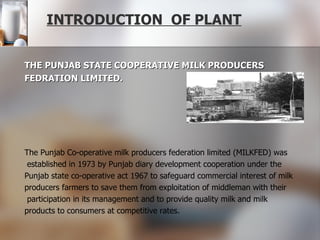
INTRODUCTION  OF PLANT THE PUNJAB STATE COOPERATIVE MILK PRODUCERS FEDRATION LIMITED. The Punjab Co-operative milk producers federation limited (MILKFED) was established in 1973 by Punjab diary development cooperation under the  Punjab state co-operative act 1967 to safeguard commercial interest of milk  producers farmers to save them from exploitation of middleman with their participation in its management and to provide quality milk and milk  products to consumers at competitive rates.
Verka Plant Mohali It was registered on 05.07.1978 under Punjab Cooperative Societies Act, 1961.  It was established in 1980 by Punjab dairy  development Cooperation. The capacity of plant was 1.00 lac Litre per day in the beginning, but now the capacity is about 4 lac Litre per day.  It has 3 tier system:- Cooperative Societies at village level  Milk Union at District level  Federation as an Apex Body at State level
About  Milk  Milk is a white liquid produced by the mammary glands of mammals. It provides the primary source of nutrition for young mammals before they are able to digest other types of food. A glass of cow's milk containing 100 ml contains 69 calories of energy; 5.2 grams carbohydrates; 3.7 grams of fat; 3.3 grams protein; vitamin A, vitamin D, and 125 mg of calcium.
 
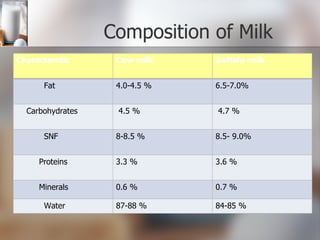
  Composition of Milk  Characterstic  Cow milk  Buffalo milk Fat 4.0-4.5 % 6.5-7.0% Carbohydrates  4.5 % 4.7 % SNF 8-8.5 % 8.5- 9.0% Proteins 3.3 % 3.6 % Minerals 0.6 % 0.7 % Water 87-88 % 84-85 %
Objective The objective of my project is to check the quality control of milk and milk product and also to know the processing. Quality control objective is: To maintain the shelf life of the product Ensures the maintenance and standards of specification and standard of products within prescribe tolerance limit. To prevent the transmission of communicable diseases from milk to man. To check the presence of adultarants. The consumer expects to pay a fair price for milk and milk  products of acceptable to excellent quality.
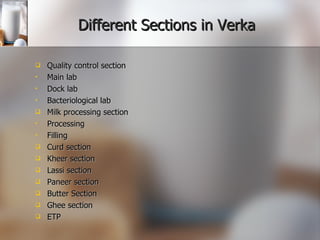
Different Sections in Verka Quality control section Main lab Dock lab Bacteriological lab Milk processing section Processing Filling Curd section Kheer section Lassi section Paneer section Butter Section Ghee section ETP
Raw Milk Reception Dock Verka follows a strict system of quality assurance to maintain a high quality of milk provided to the consumer.  The milk is received from local societies at Village level, where chilling centres are installed.  On the basis of some main tests the milk is graded into categories.
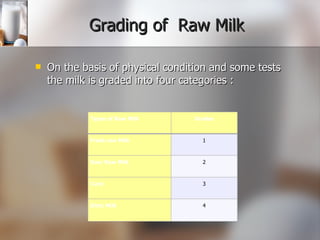
Grading of  Raw Milk On the basis of physical condition and some tests the milk is graded into four categories : Types of Raw Milk Grades Fresh raw Milk 1 Sour Raw Milk 2 Curd 3 Dirty Milk 4
After that Raw milk is sucked by means of vacuum from the truck and collected in dump tank. Send to chillers to drop down the temperature of the raw milk. Every batch of incoming milk is tested for Fat, SNF, Acidity and bacteriological quality, adulterants and presence of any preservative.
In the Plant there are three main labs: Dock Lab Quality Control (Q.C.) Lab Microbiological Lab
Dock Lab In Dock Lab raw milk, pasteurized milk, butter milk, Skim milk, are checked w.r.t. the chemical quality. Various tests are performed over milk in this lab. Acidity Test Fat and SNF Test MBRT Test Adulteration Test
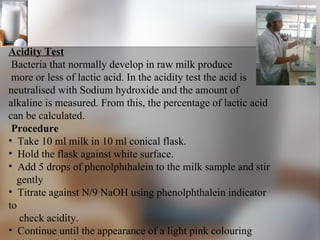
Acidity Test Bacteria that normally develop in raw milk produce more or less of lactic acid. In the acidity test the acid is neutralised with Sodium hydroxide and the amount of  alkaline is measured. From this, the percentage of lactic acid can be calculated.  Procedure Take 10 ml milk in 10 ml conical flask.  Hold the flask against white surface. Add 5 drops of phenolphthalein to the milk sample and stir gently  Titrate against N/9 NaOH using phenolphthalein indicator to check acidity. Continue until the appearance of a light pink colouring which persists for 10-20 seconds.
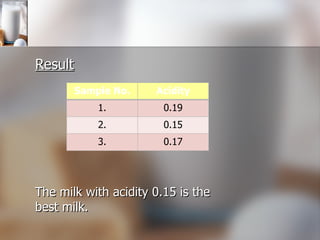
Result The milk with acidity 0.15 is the best milk. Sample No. Acidity 1. 0.19 2. 0.15 3. 0.17
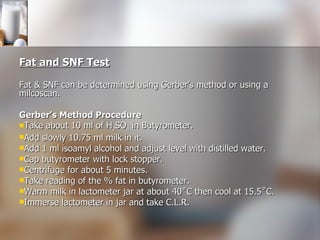
Fat and SNF Test Fat & SNF can be determined using Gerber’s method or using a milcoscan. Gerber’s Method  Procedure Take about 10 ml of H 2 SO 4  in Butyrometer. Add slowly 10.75 ml milk in it. Add 1 ml isoamyl alcohol and adjust level with distilled water. Cap butyrometer with lock stopper. Centrifuge for about 5 minutes. Take reading of the % fat in butyrometer. Warm milk in lactometer jar at about 40˚C then cool at 15.5˚C. Immerse lactometer in jar and take C.L.R.
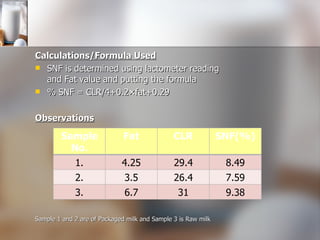
Calculations/Formula Used SNF is determined using lactometer reading and Fat value and putting the formula % SNF = CLR/4+0.2×fat+0.29 Observations Sample 1 and 2 are of Packaged milk and Sample 3 is Raw milk Sample No. Fat CLR SNF(%) 1. 4.25 29.4 8.49 2. 3.5 26.4 7.59 3. 6.7 31 9.38
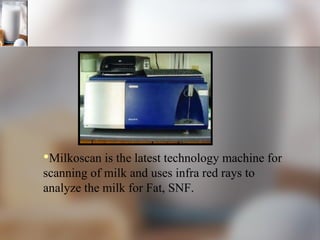
Milkoscan is the latest technology machine for scanning of milk and uses infra red rays to analyze the milk for Fat, SNF.
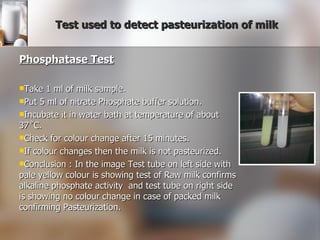
Test used to detect pasteurization of milk Phosphatase Test Take 1 ml of milk sample. Put 5 ml of nitrate Phosphate buffer solution. Incubate it in water bath at temperature of about 37˚C. Check for colour change after 15 minutes. If colour changes then the milk is not pasteurized. Conclusion : In the image Test tube on left side with pale yellow colour is showing test of Raw milk confirms alkaline phosphate activity  and test tube on right side is showing no colour change in case of packed milk confirming Pasteurization.
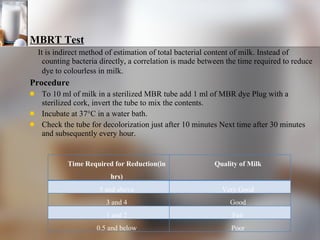
MBRT Test It is indirect method of estimation of total bacterial content of milk. Instead of counting bacteria directly, a correlation is made between the time required to reduce dye to colourless in milk.   Procedure To 10 ml of milk in a sterilized MBR tube add 1 ml of MBR dye Plug with a sterilized cork, invert the tube to mix the contents. Incubate at 37°C in a water bath. Check the tube for decolorization just after 10 minutes Next time after 30 minutes and subsequently every hour. Time Required for Reduction(in hrs) Quality of Milk 5 and above Very Good 3 and 4 Good 1 and 2 Fair 0.5 and below Poor
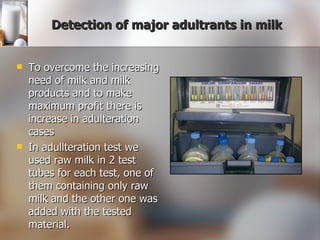
Detection of major adultrants in milk To overcome the increasing need of milk and milk products and to make maximum profit there is increase in adulteration cases In adullteration test we used raw milk in 2 test tubes for each test, one of them containing only raw milk and the other one was added with the tested material.
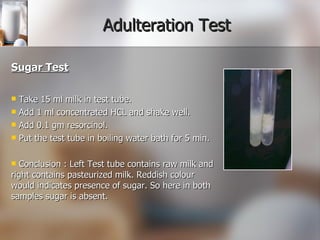
Adulteration Test Sugar Test   Take 15 ml milk in test tube. Add 1 ml concentrated HCL and shake well. Add 0.1 gm resorcinol. Put the test tube in boiling water bath for 5 min. Conclusion : Left Test tube contains raw milk and right contains pasteurized milk. Reddish colour  would indicates presence of sugar. So here in both samples sugar is absent.
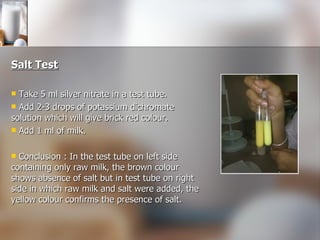
Salt Test Take 5 ml silver nitrate in a test tube. Add 2-3 drops of potassium dichromate solution which will give brick red colour. Add 1 ml of milk. Conclusion : In the test tube on left side containing only raw milk, the brown colour shows absence of salt but in test tube on right side in which raw milk and salt were added, the yellow colour confirms the presence of salt.
Urea test Procedure Take 2 ml milk in a test tube.  Add 2 ml DMAB solution and mix the contents. Observations Yellow Colour is observed. Result Appearance of yellow color indicates the presence of urea.
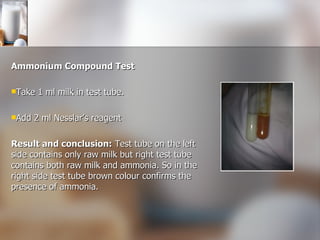
Ammonium Compound Test Take 1 ml milk in test tube. Add 2 ml Nesslar’s reagent Result and conclusion:  Test tube on the left side contains only raw milk but right test tube contains both raw milk and ammonia. So in the right side test tube brown colour confirms the presence of ammonia.
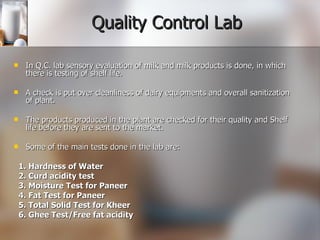
Quality Control Lab In Q.C. lab sensory evaluation of milk and milk products is done, in which there is testing of shelf life. A check is put over cleanliness of dairy equipments and overall sanitization of plant.  The products produced in the plant are checked for their quality and Shelf life before they are sent to the market. Some of the main tests done in the lab are: 1. Hardness of Water  2. Curd acidity test 3. Moisture Test for Paneer 4. Fat Test for Paneer 5. Total Solid Test for Kheer 6. Ghee Test/Free fat acidity
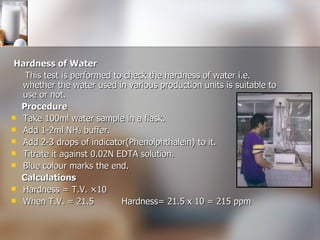
Hardness of Water  This test is performed to   check the hardness of water i.e. whether the water used in various production units is suitable to use or not.   Procedure Take 100ml water sample in a flask. Add 1-2ml NH₃ buffer. Add 2-3 drops of indicator(Phenolphthalein) to it. Titrate it against 0.02N EDTA solution. Blue colour marks the end. Calculations Hardness = T.V. ×10 When T.V. = 21.5  Hardness= 21.5 x 10 = 215 ppm
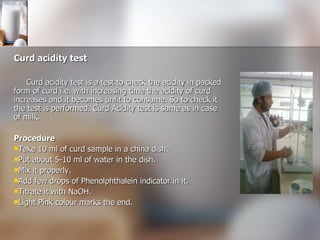
Curd acidity test Curd acidity test is a test to check the acidity in packed form of curd i.e. with increasing time the acidity of curd increases and it becomes unfit to consume. So to check it the test is performed. Curd Acidity test is same as in case of milk. Procedure Take 10 ml of curd sample in a china dish. Put about 5-10 ml of water in the dish. Mix it properly. Add few drops of Phenolphthalein indicator in it.  Titrate it with NaOH. Light Pink colour marks the end.
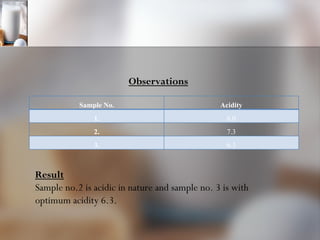
Result Sample no.2 is acidic in nature and sample no. 3 is with optimum acidity 6.3. Observations Sample No. Acidity 1. 6.0 2. 7.3 3. 6.3
Moisture Test for Paneer This test is done to check the presence of moisture in paneer in packed form, as more moisture may lead to microbial activity. Procedure Take an empty dish and take its weight as W 1 .  Put about 3g of crushed paneer in it, weigh it and mark it as W 2 . Put the dish in oven for about 4 hrs. Measure the weight and mark it as W 3 .  Calculations W 2 -W 1 =A W 3 -W 2 =B B/A×100= Moisture
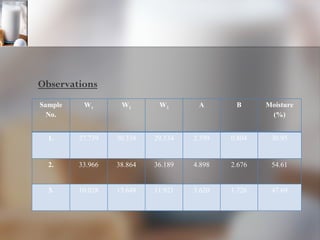
Observations Sample No. W 1 W 2 W 3 A B Moisture (%) 1. 27.739 30.338 29.534 2.599 0.804 30.95 2. 33.966 38.864 36.189 4.898 2.676 54.61 3. 10.028 13.648 11.921 3.620 1.726 47.69
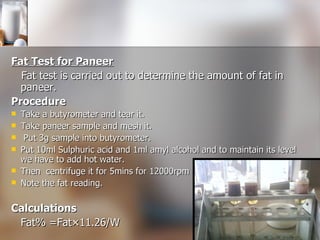
Fat Test for Paneer Fat test is carried out to determine the amount of fat in paneer. Procedure Take a butyrometer and tear it. Take paneer sample and mesh it. Put 3g sample into butyrometer. Put 10ml Sulphuric acid and 1ml amyl alcohol and to maintain its level we have to add hot water.  Then  centrifuge it for 5mins for 12000rpm  Note the fat reading. Calculations Fat% =Fat×11.26/W
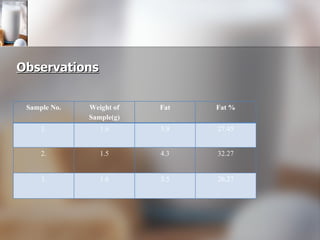
Observations Sample No. Weight of Sample(g) Fat Fat % 1. 1.6 3.9 27.45 2. 1.5 4.3 32.27 3. 1.6 3.5 26.27
Total Solid Test for Kheer This test is done to check the presence of total solids in Kheer in packed form. Procedure Take an empty dish and take its weight as W 1 .  Put about 3g of Kheer in it, and mark it as W 2 . Put the dish in oven (30˚C) for about 4 hrs. Measure the weight and mark it as W 3 .  Calculations W 2 -W 1 =A W 3 -W 1 =B %T.S. =B/A×100
Observations Sample No. W 1 W 2 W 3 A B T.S. 1. 26.8056 31.0029 27.9556 4.1973 1.1500 27.4 2. 23.2825 27.8048 24.5351 4.5223 1.2526 27.7 3. 12.7029 16.7761 13.8230 4.0732 1.1201 27.5
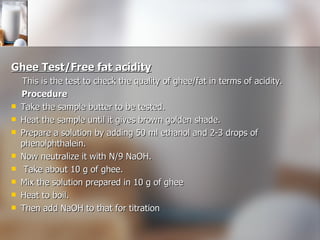
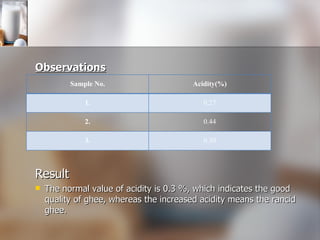
Ghee Test/Free fat acidity This is the test to check the quality of ghee/fat in terms of acidity.  Procedure Take the sample butter to be tested. Heat the sample until it gives brown golden shade. Prepare a solution by adding 50 ml ethanol and 2-3 drops of phenolphthalein. Now neutralize it with N/9 NaOH. Take about 10 g of ghee. Mix the solution prepared in 10 g of ghee Heat to boil. Then add NaOH to that for titration
Observations Result The normal value of acidity is 0.3 %, which indicates the good quality of ghee, whereas the increased acidity means the rancid ghee. Sample No. Acidity(%) 1. 0.27 2. 0.44 3. 0.30
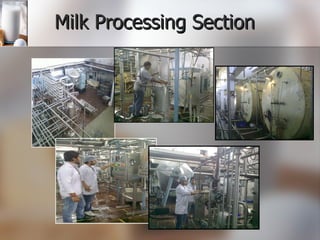
Milk Processing Section
 
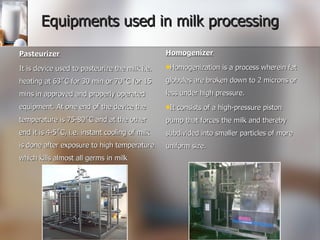
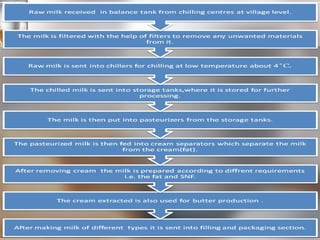
Equipments used in milk processing Pasteurizer It is device used to pasteurize the milk i.e. heating at 63˚C for 30 min or 70˚C for 15 mins in approved and properly operated equipment. At one end of the device the temperature is 75-80˚C and at the other end it is 4-5˚C, i.e. instant cooling of milk is done after exposure to high temperature which kills almost all germs in milk Homogenizer Homogenization is a process wherein fat globules are broken down to 2 microns or less under high pressure. It consists of a high-pressure piston pump that forces the milk and thereby subdivided into smaller particles of more uniform size.
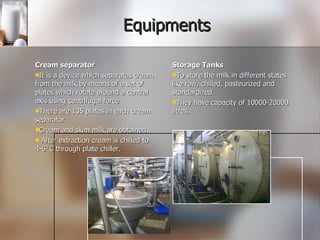
Equipments Cream separator It is a device which separates cream from the milk by means of a set of plates which rotate around a central axis using centrifugal force There are 135 plates in each cream separator. Cream and skim milk are obtained. After extraction cream is chilled to 4-6˚C through plate chiller. Storage Tanks To store the milk in different states like raw, chilled, pasteurized and standardized. They have capacity of 10000-20000 litres.
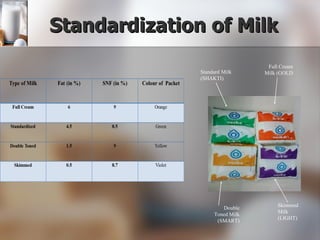
Standardization of Milk  Full Cream Milk (GOLD Skimmed Milk (LIGHT) Standard Milk (SHAKTI) Double Toned Milk (SMART)
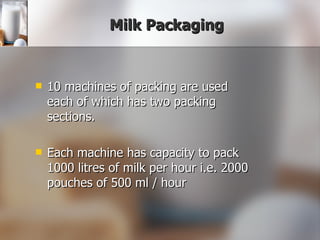
Milk Packaging 10 machines of packing are used each of which has two packing sections. Each machine has capacity to pack 1000 litres of milk per hour i.e. 2000 pouches of 500 ml / hour
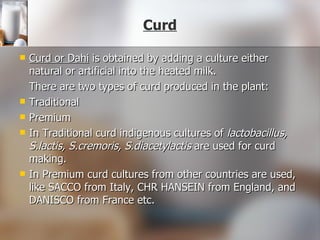
  Curd Curd or Dahi  is obtained by adding a culture either natural or artificial into the heated milk.  There are two types of curd produced in the plant: Traditional  Premium In Traditional curd indigenous cultures of  lactobacillus, S.lactis, S.cremoris, S.diacetylactis  are used for curd making.  In Premium curd cultures from other countries are used, like SACCO from Italy, CHR HANSEIN from England, and DANISCO from France etc.
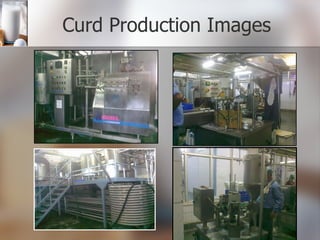
Curd Production Images
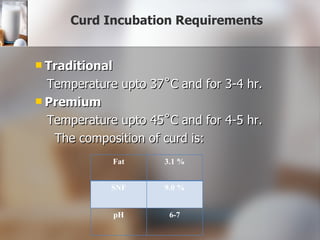
Curd Incubation Requirements Traditional Temperature upto 37˚C and for 3-4 hr. Premium Temperature upto 45˚C and for 4-5 hr. The composition of curd is: Fat 3.1 % SNF 9.0 % pH 6-7
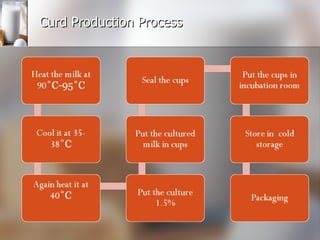
Curd Production Process
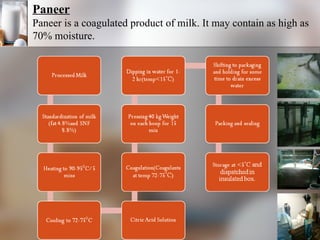
Paneer Paneer is a coagulated product of milk. It may contain as high as 70% moisture.
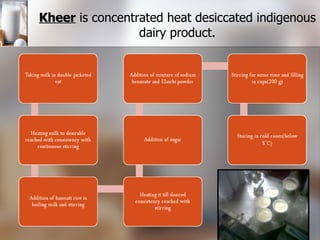
Kheer  is concentrated heat desiccated indigenous dairy product.
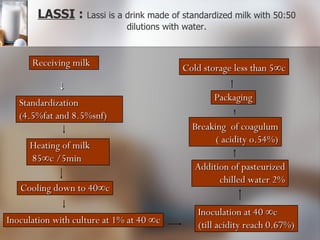
LASSI  :  Lassi is a drink made of standardized milk with 50:50 dilutions with water. Receiving milk ↓ Standardization (4.5%fat and 8.5%snf) Heating of milk 85°c /5min Cooling down to 40°c Inoculation with culture at 1% at 40 °c Inoculation at 40 °c (till acidity reach 0.67%) Addition of pasteurized chilled water 2% Breaking  of coagulum ( acidity o.54%) Packaging Cold storage less than 5°c
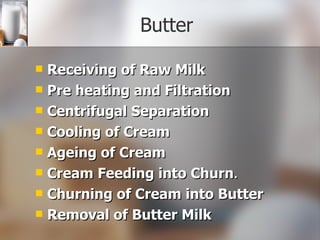
Butter Receiving of Raw Milk Pre heating and Filtration Centrifugal Separation  Cooling of Cream Ageing of Cream Cream Feeding into Churn . Churning of Cream into Butter Removal of Butter Milk
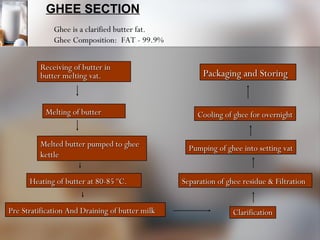
Receiving of butter in butter melting vat. Melting of butter Melted butter pumped to ghee kettle Heating of butter at 80-85 ºC. Pre Stratification And Draining of butter milk Separation of ghee residue & Filtration Clarification Pumping of ghee into setting vat Cooling of ghee for overnight Packaging and Storing GHEE SECTION Ghee is a clarified butter fat. Ghee Composition:   FAT - 99.9%
Whey Whey is nutritious byproduct from cheese containing valuable nutrients like lactase, protein, minerals and vitamin etc. which have great value as human food. Whey consists : 45-50% of total milk solid 70% of  milk sugar 20% of  milk protein 70-90% of milk minerals And almost all the water soluble vitamins originally present in milk
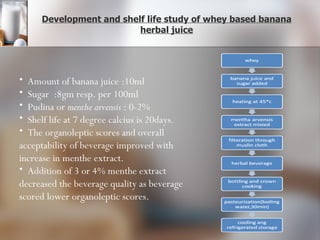
Development and shelf life study of whey based banana herbal juice Amount of banana juice :10ml Sugar  :8gm resp. per 100ml  Pudina or  menthe arvensis  : 0-2% Shelf life at 7 degree calcius is 20days. The organoleptic scores and overall acceptability of beverage improved with increase in menthe extract. Addition of 3 or 4% menthe extract decreased the beverage quality as beverage scored lower organoleptic scores.
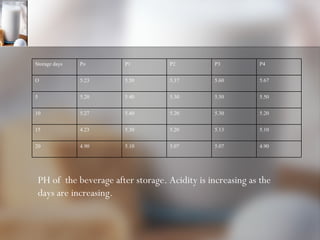
PH of  the beverage after storage. Acidity is increasing as the days are increasing. 4.90 5.07 5.07 5.10 4.90 20 5.10 5.13 5.20 5.30 4.23 15 5.20 5.30 5.20 5.40 5.27 10 5.50 5.50 5.30 5.40 5.20 5 5.67 5.60 5.37 5.50 5.23 O P4 P3 P2 P1 Po Storage days
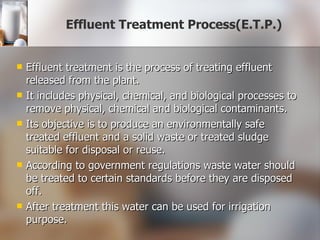
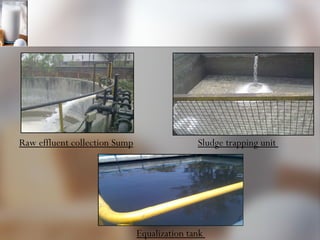
  Effluent Treatment Process(E.T.P.) Effluent treatment is the process of treating effluent released from the plant.  It includes physical, chemical, and biological processes to remove physical, chemical and biological contaminants.  Its objective is to produce an environmentally safe treated effluent and a solid waste or treated sludge suitable for disposal or reuse.  According to government regulations waste water should be treated to certain standards before they are disposed off. After treatment this water can be used for irrigation purpose.
The effluent treatment facility consists of the following units •  Effluent collection sump •  Sludge removal chamber •  Chemical solution dosing systems •  Aeration Tanks •  Secondary clarifier •  Sludge drying beds
Raw effluent collection Sump   Sludge trapping unit  Equalization tank
Parallel arrangement of two aeration tanks  Secondary clarifier  Sludge drying beds
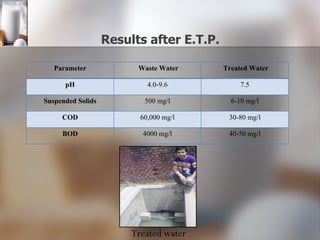
Results after E.T.P. Treated water   Parameter Waste Water Treated Water pH 4.0-9.6 7.5 Suspended Solids 500 mg/l 6-10 mg/l COD 60,000 mg/l 30-80 mg/l BOD 4000 mg/l 40-50 mg/l
Result and Discussion The results of various quality tests performed under training program are summarised below. 26-28 % Paneer Fat 6. 27.5  T.S. Kheer 7 No. Parameter Optimum Value 1. Acidity of Milk 0.15 2. Fat of Milk 4.5-6.5 % 3. Hardness of water 215 4. Curd acidity 6.3 5. Paneer Moisture 45-55% 8. Ghee Test 0.3 %
THANK YOU

Milk Analysis In Verka

  • 1.
    QUALITY CONTROL ANDASSURANCE OF MILK AND ITS PRODUCTS Industrial Training at Verka Milk Plant, Mohali Jagjit Singh B.Tech. Biotech. 1040070095
  • 2.
    INTRODUCTION OFPLANT THE PUNJAB STATE COOPERATIVE MILK PRODUCERS FEDRATION LIMITED. The Punjab Co-operative milk producers federation limited (MILKFED) was established in 1973 by Punjab diary development cooperation under the Punjab state co-operative act 1967 to safeguard commercial interest of milk producers farmers to save them from exploitation of middleman with their participation in its management and to provide quality milk and milk products to consumers at competitive rates.
  • 3.
    Verka Plant MohaliIt was registered on 05.07.1978 under Punjab Cooperative Societies Act, 1961. It was established in 1980 by Punjab dairy development Cooperation. The capacity of plant was 1.00 lac Litre per day in the beginning, but now the capacity is about 4 lac Litre per day. It has 3 tier system:- Cooperative Societies at village level Milk Union at District level Federation as an Apex Body at State level
  • 4.
    About Milk Milk is a white liquid produced by the mammary glands of mammals. It provides the primary source of nutrition for young mammals before they are able to digest other types of food. A glass of cow's milk containing 100 ml contains 69 calories of energy; 5.2 grams carbohydrates; 3.7 grams of fat; 3.3 grams protein; vitamin A, vitamin D, and 125 mg of calcium.
  • 5.
  • 6.
    Compositionof Milk Characterstic Cow milk Buffalo milk Fat 4.0-4.5 % 6.5-7.0% Carbohydrates 4.5 % 4.7 % SNF 8-8.5 % 8.5- 9.0% Proteins 3.3 % 3.6 % Minerals 0.6 % 0.7 % Water 87-88 % 84-85 %
  • 7.
    Objective The objectiveof my project is to check the quality control of milk and milk product and also to know the processing. Quality control objective is: To maintain the shelf life of the product Ensures the maintenance and standards of specification and standard of products within prescribe tolerance limit. To prevent the transmission of communicable diseases from milk to man. To check the presence of adultarants. The consumer expects to pay a fair price for milk and milk products of acceptable to excellent quality.
  • 8.
    Different Sections inVerka Quality control section Main lab Dock lab Bacteriological lab Milk processing section Processing Filling Curd section Kheer section Lassi section Paneer section Butter Section Ghee section ETP
  • 9.
    Raw Milk ReceptionDock Verka follows a strict system of quality assurance to maintain a high quality of milk provided to the consumer. The milk is received from local societies at Village level, where chilling centres are installed. On the basis of some main tests the milk is graded into categories.
  • 10.
    Grading of Raw Milk On the basis of physical condition and some tests the milk is graded into four categories : Types of Raw Milk Grades Fresh raw Milk 1 Sour Raw Milk 2 Curd 3 Dirty Milk 4
  • 11.
    After that Rawmilk is sucked by means of vacuum from the truck and collected in dump tank. Send to chillers to drop down the temperature of the raw milk. Every batch of incoming milk is tested for Fat, SNF, Acidity and bacteriological quality, adulterants and presence of any preservative.
  • 12.
    In the Plantthere are three main labs: Dock Lab Quality Control (Q.C.) Lab Microbiological Lab
  • 13.
    Dock Lab InDock Lab raw milk, pasteurized milk, butter milk, Skim milk, are checked w.r.t. the chemical quality. Various tests are performed over milk in this lab. Acidity Test Fat and SNF Test MBRT Test Adulteration Test
  • 14.
    Acidity Test Bacteriathat normally develop in raw milk produce more or less of lactic acid. In the acidity test the acid is neutralised with Sodium hydroxide and the amount of alkaline is measured. From this, the percentage of lactic acid can be calculated. Procedure Take 10 ml milk in 10 ml conical flask. Hold the flask against white surface. Add 5 drops of phenolphthalein to the milk sample and stir gently Titrate against N/9 NaOH using phenolphthalein indicator to check acidity. Continue until the appearance of a light pink colouring which persists for 10-20 seconds.
  • 15.
    Result The milkwith acidity 0.15 is the best milk. Sample No. Acidity 1. 0.19 2. 0.15 3. 0.17
  • 16.
    Fat and SNFTest Fat & SNF can be determined using Gerber’s method or using a milcoscan. Gerber’s Method Procedure Take about 10 ml of H 2 SO 4 in Butyrometer. Add slowly 10.75 ml milk in it. Add 1 ml isoamyl alcohol and adjust level with distilled water. Cap butyrometer with lock stopper. Centrifuge for about 5 minutes. Take reading of the % fat in butyrometer. Warm milk in lactometer jar at about 40˚C then cool at 15.5˚C. Immerse lactometer in jar and take C.L.R.
  • 17.
    Calculations/Formula Used SNFis determined using lactometer reading and Fat value and putting the formula % SNF = CLR/4+0.2×fat+0.29 Observations Sample 1 and 2 are of Packaged milk and Sample 3 is Raw milk Sample No. Fat CLR SNF(%) 1. 4.25 29.4 8.49 2. 3.5 26.4 7.59 3. 6.7 31 9.38
  • 18.
    Milkoscan is thelatest technology machine for scanning of milk and uses infra red rays to analyze the milk for Fat, SNF.
  • 19.
    Test used todetect pasteurization of milk Phosphatase Test Take 1 ml of milk sample. Put 5 ml of nitrate Phosphate buffer solution. Incubate it in water bath at temperature of about 37˚C. Check for colour change after 15 minutes. If colour changes then the milk is not pasteurized. Conclusion : In the image Test tube on left side with pale yellow colour is showing test of Raw milk confirms alkaline phosphate activity and test tube on right side is showing no colour change in case of packed milk confirming Pasteurization.
  • 20.
    MBRT Test Itis indirect method of estimation of total bacterial content of milk. Instead of counting bacteria directly, a correlation is made between the time required to reduce dye to colourless in milk. Procedure To 10 ml of milk in a sterilized MBR tube add 1 ml of MBR dye Plug with a sterilized cork, invert the tube to mix the contents. Incubate at 37°C in a water bath. Check the tube for decolorization just after 10 minutes Next time after 30 minutes and subsequently every hour. Time Required for Reduction(in hrs) Quality of Milk 5 and above Very Good 3 and 4 Good 1 and 2 Fair 0.5 and below Poor
  • 21.
    Detection of majoradultrants in milk To overcome the increasing need of milk and milk products and to make maximum profit there is increase in adulteration cases In adullteration test we used raw milk in 2 test tubes for each test, one of them containing only raw milk and the other one was added with the tested material.
  • 22.
    Adulteration Test SugarTest Take 15 ml milk in test tube. Add 1 ml concentrated HCL and shake well. Add 0.1 gm resorcinol. Put the test tube in boiling water bath for 5 min. Conclusion : Left Test tube contains raw milk and right contains pasteurized milk. Reddish colour would indicates presence of sugar. So here in both samples sugar is absent.
  • 23.
    Salt Test Take5 ml silver nitrate in a test tube. Add 2-3 drops of potassium dichromate solution which will give brick red colour. Add 1 ml of milk. Conclusion : In the test tube on left side containing only raw milk, the brown colour shows absence of salt but in test tube on right side in which raw milk and salt were added, the yellow colour confirms the presence of salt.
  • 24.
    Urea test ProcedureTake 2 ml milk in a test tube. Add 2 ml DMAB solution and mix the contents. Observations Yellow Colour is observed. Result Appearance of yellow color indicates the presence of urea.
  • 25.
    Ammonium Compound TestTake 1 ml milk in test tube. Add 2 ml Nesslar’s reagent Result and conclusion: Test tube on the left side contains only raw milk but right test tube contains both raw milk and ammonia. So in the right side test tube brown colour confirms the presence of ammonia.
  • 26.
    Quality Control LabIn Q.C. lab sensory evaluation of milk and milk products is done, in which there is testing of shelf life. A check is put over cleanliness of dairy equipments and overall sanitization of plant. The products produced in the plant are checked for their quality and Shelf life before they are sent to the market. Some of the main tests done in the lab are: 1. Hardness of Water 2. Curd acidity test 3. Moisture Test for Paneer 4. Fat Test for Paneer 5. Total Solid Test for Kheer 6. Ghee Test/Free fat acidity
  • 27.
    Hardness of Water This test is performed to check the hardness of water i.e. whether the water used in various production units is suitable to use or not. Procedure Take 100ml water sample in a flask. Add 1-2ml NH₃ buffer. Add 2-3 drops of indicator(Phenolphthalein) to it. Titrate it against 0.02N EDTA solution. Blue colour marks the end. Calculations Hardness = T.V. ×10 When T.V. = 21.5 Hardness= 21.5 x 10 = 215 ppm
  • 28.
    Curd acidity testCurd acidity test is a test to check the acidity in packed form of curd i.e. with increasing time the acidity of curd increases and it becomes unfit to consume. So to check it the test is performed. Curd Acidity test is same as in case of milk. Procedure Take 10 ml of curd sample in a china dish. Put about 5-10 ml of water in the dish. Mix it properly. Add few drops of Phenolphthalein indicator in it. Titrate it with NaOH. Light Pink colour marks the end.
  • 29.
    Result Sample no.2is acidic in nature and sample no. 3 is with optimum acidity 6.3. Observations Sample No. Acidity 1. 6.0 2. 7.3 3. 6.3
  • 30.
    Moisture Test forPaneer This test is done to check the presence of moisture in paneer in packed form, as more moisture may lead to microbial activity. Procedure Take an empty dish and take its weight as W 1 . Put about 3g of crushed paneer in it, weigh it and mark it as W 2 . Put the dish in oven for about 4 hrs. Measure the weight and mark it as W 3 . Calculations W 2 -W 1 =A W 3 -W 2 =B B/A×100= Moisture
  • 31.
    Observations Sample No.W 1 W 2 W 3 A B Moisture (%) 1. 27.739 30.338 29.534 2.599 0.804 30.95 2. 33.966 38.864 36.189 4.898 2.676 54.61 3. 10.028 13.648 11.921 3.620 1.726 47.69
  • 32.
    Fat Test forPaneer Fat test is carried out to determine the amount of fat in paneer. Procedure Take a butyrometer and tear it. Take paneer sample and mesh it. Put 3g sample into butyrometer. Put 10ml Sulphuric acid and 1ml amyl alcohol and to maintain its level we have to add hot water. Then centrifuge it for 5mins for 12000rpm Note the fat reading. Calculations Fat% =Fat×11.26/W
  • 33.
    Observations Sample No.Weight of Sample(g) Fat Fat % 1. 1.6 3.9 27.45 2. 1.5 4.3 32.27 3. 1.6 3.5 26.27
  • 34.
    Total Solid Testfor Kheer This test is done to check the presence of total solids in Kheer in packed form. Procedure Take an empty dish and take its weight as W 1 . Put about 3g of Kheer in it, and mark it as W 2 . Put the dish in oven (30˚C) for about 4 hrs. Measure the weight and mark it as W 3 . Calculations W 2 -W 1 =A W 3 -W 1 =B %T.S. =B/A×100
  • 35.
    Observations Sample No.W 1 W 2 W 3 A B T.S. 1. 26.8056 31.0029 27.9556 4.1973 1.1500 27.4 2. 23.2825 27.8048 24.5351 4.5223 1.2526 27.7 3. 12.7029 16.7761 13.8230 4.0732 1.1201 27.5
  • 36.
    Ghee Test/Free fatacidity This is the test to check the quality of ghee/fat in terms of acidity. Procedure Take the sample butter to be tested. Heat the sample until it gives brown golden shade. Prepare a solution by adding 50 ml ethanol and 2-3 drops of phenolphthalein. Now neutralize it with N/9 NaOH. Take about 10 g of ghee. Mix the solution prepared in 10 g of ghee Heat to boil. Then add NaOH to that for titration
  • 37.
    Observations Result Thenormal value of acidity is 0.3 %, which indicates the good quality of ghee, whereas the increased acidity means the rancid ghee. Sample No. Acidity(%) 1. 0.27 2. 0.44 3. 0.30
  • 38.
  • 39.
  • 40.
    Equipments used inmilk processing Pasteurizer It is device used to pasteurize the milk i.e. heating at 63˚C for 30 min or 70˚C for 15 mins in approved and properly operated equipment. At one end of the device the temperature is 75-80˚C and at the other end it is 4-5˚C, i.e. instant cooling of milk is done after exposure to high temperature which kills almost all germs in milk Homogenizer Homogenization is a process wherein fat globules are broken down to 2 microns or less under high pressure. It consists of a high-pressure piston pump that forces the milk and thereby subdivided into smaller particles of more uniform size.
  • 41.
    Equipments Cream separatorIt is a device which separates cream from the milk by means of a set of plates which rotate around a central axis using centrifugal force There are 135 plates in each cream separator. Cream and skim milk are obtained. After extraction cream is chilled to 4-6˚C through plate chiller. Storage Tanks To store the milk in different states like raw, chilled, pasteurized and standardized. They have capacity of 10000-20000 litres.
  • 42.
    Standardization of Milk Full Cream Milk (GOLD Skimmed Milk (LIGHT) Standard Milk (SHAKTI) Double Toned Milk (SMART)
  • 43.
    Milk Packaging 10machines of packing are used each of which has two packing sections. Each machine has capacity to pack 1000 litres of milk per hour i.e. 2000 pouches of 500 ml / hour
  • 44.
    CurdCurd or Dahi is obtained by adding a culture either natural or artificial into the heated milk. There are two types of curd produced in the plant: Traditional Premium In Traditional curd indigenous cultures of lactobacillus, S.lactis, S.cremoris, S.diacetylactis are used for curd making. In Premium curd cultures from other countries are used, like SACCO from Italy, CHR HANSEIN from England, and DANISCO from France etc.
  • 45.
  • 46.
    Curd Incubation RequirementsTraditional Temperature upto 37˚C and for 3-4 hr. Premium Temperature upto 45˚C and for 4-5 hr. The composition of curd is: Fat 3.1 % SNF 9.0 % pH 6-7
  • 47.
  • 48.
    Paneer Paneer isa coagulated product of milk. It may contain as high as 70% moisture.
  • 49.
    Kheer isconcentrated heat desiccated indigenous dairy product.
  • 50.
    LASSI : Lassi is a drink made of standardized milk with 50:50 dilutions with water. Receiving milk ↓ Standardization (4.5%fat and 8.5%snf) Heating of milk 85°c /5min Cooling down to 40°c Inoculation with culture at 1% at 40 °c Inoculation at 40 °c (till acidity reach 0.67%) Addition of pasteurized chilled water 2% Breaking of coagulum ( acidity o.54%) Packaging Cold storage less than 5°c
  • 51.
    Butter Receiving ofRaw Milk Pre heating and Filtration Centrifugal Separation Cooling of Cream Ageing of Cream Cream Feeding into Churn . Churning of Cream into Butter Removal of Butter Milk
  • 52.
    Receiving of butterin butter melting vat. Melting of butter Melted butter pumped to ghee kettle Heating of butter at 80-85 ºC. Pre Stratification And Draining of butter milk Separation of ghee residue & Filtration Clarification Pumping of ghee into setting vat Cooling of ghee for overnight Packaging and Storing GHEE SECTION Ghee is a clarified butter fat. Ghee Composition: FAT - 99.9%
  • 53.
    Whey Whey isnutritious byproduct from cheese containing valuable nutrients like lactase, protein, minerals and vitamin etc. which have great value as human food. Whey consists : 45-50% of total milk solid 70% of milk sugar 20% of milk protein 70-90% of milk minerals And almost all the water soluble vitamins originally present in milk
  • 54.
    Development and shelflife study of whey based banana herbal juice Amount of banana juice :10ml Sugar :8gm resp. per 100ml Pudina or menthe arvensis : 0-2% Shelf life at 7 degree calcius is 20days. The organoleptic scores and overall acceptability of beverage improved with increase in menthe extract. Addition of 3 or 4% menthe extract decreased the beverage quality as beverage scored lower organoleptic scores.
  • 55.
    PH of the beverage after storage. Acidity is increasing as the days are increasing. 4.90 5.07 5.07 5.10 4.90 20 5.10 5.13 5.20 5.30 4.23 15 5.20 5.30 5.20 5.40 5.27 10 5.50 5.50 5.30 5.40 5.20 5 5.67 5.60 5.37 5.50 5.23 O P4 P3 P2 P1 Po Storage days
  • 56.
    EffluentTreatment Process(E.T.P.) Effluent treatment is the process of treating effluent released from the plant. It includes physical, chemical, and biological processes to remove physical, chemical and biological contaminants. Its objective is to produce an environmentally safe treated effluent and a solid waste or treated sludge suitable for disposal or reuse. According to government regulations waste water should be treated to certain standards before they are disposed off. After treatment this water can be used for irrigation purpose.
  • 57.
    The effluent treatmentfacility consists of the following units • Effluent collection sump • Sludge removal chamber • Chemical solution dosing systems • Aeration Tanks • Secondary clarifier • Sludge drying beds
  • 58.
    Raw effluent collectionSump Sludge trapping unit Equalization tank
  • 59.
    Parallel arrangement oftwo aeration tanks Secondary clarifier Sludge drying beds
  • 60.
    Results after E.T.P.Treated water Parameter Waste Water Treated Water pH 4.0-9.6 7.5 Suspended Solids 500 mg/l 6-10 mg/l COD 60,000 mg/l 30-80 mg/l BOD 4000 mg/l 40-50 mg/l
  • 61.
    Result and DiscussionThe results of various quality tests performed under training program are summarised below. 26-28 % Paneer Fat 6. 27.5 T.S. Kheer 7 No. Parameter Optimum Value 1. Acidity of Milk 0.15 2. Fat of Milk 4.5-6.5 % 3. Hardness of water 215 4. Curd acidity 6.3 5. Paneer Moisture 45-55% 8. Ghee Test 0.3 %
  • 62.