
1
An Assignment Presentation
On
Course No.: HWE- 7.3 ( POST HARVEST HANDLING AND
VALUE ADDITION IN HORTICULTURE CROPS )
Present To:- Presented
By :-
Prof. Alok Nath Shubham Kumar
College of Horticulture
S.D. Agricultural University,
Jagudan, 382710
2
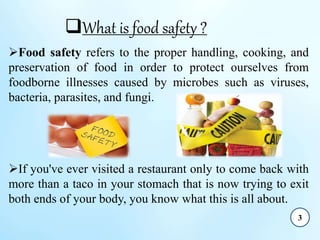
What is food safety ?
Food safety refers to the proper handling, cooking, and
preservation of food in order to protect ourselves from
foodborne illnesses caused by microbes such as viruses,
bacteria, parasites, and fungi.
If you've ever visited a restaurant only to come back with
more than a taco in your stomach that is now trying to exit
both ends of your body, you know what this is all about.
3
Fever, nausea, vomiting, diarrhea, stomach aches,
muscles aches, and more can be caused by a
foodborne illness.
This is why food safety is so important! If someone
avoids proper food safety guidelines, they can cause
themself or others to fall very ill and, in more serious
cases, even die!
To make sure you avoid this, it's important to learn
about proper food safety guidelines pertaining to the
preparation of food.
4
Introduction
•What is FSSAI ?
Food Safety and Standards Authority of India
(FSSAI) is an autonomous body established under
the Ministry of Health & Family Welfare, Government
of India.
The FSSAI has been established under the Food
Safety and Standards Act, 2006 which is a
consolidating statute related to food safety and
regulation in India.
5
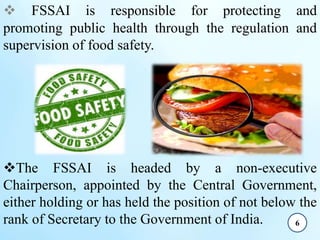
 FSSAI is responsible for protecting and
promoting public health through the regulation and
supervision of food safety.
The FSSAI is headed by a non-executive
Chairperson, appointed by the Central Government,
either holding or has held the position of not below the
rank of Secretary to the Government of India.

6
Location of fssai offices
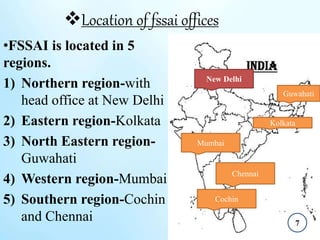
•FSSAI is located in 5
regions.
1) Northern region-with
head office at New Delhi
2) Eastern region-Kolkata
3) North Eastern region-
Guwahati
4) Western region-Mumbai
5) Southern region-Cochin
and Chennai 7
New Delhi
Kolkata
Guwahati
Mumbai
Cochin
Chennai
History
FSSAI was established by Former Union Health
Minister Dr Anbumani Ramadoss, Government of
India on 5th September 2008 under Food Safety and
Standards Act, 2006.
8
Aim of fssai
 The FSSAI is responsible for setting standards for
food so that there is one body to deal with and no
confusion in the minds of consumers, traders,
manufacturers, and investors.
1) Lay down science-based standards for articles of
food
2) To regulate manufacture, storage, distribution, sale
and import of food
3) To facilitate food safety
9
The following are the statutory powers that the FSS
Act, 2006 gives to the Food Safety and Standards
Authority of India (FSSAI).
1) Framing of regulations to lay down food safety
standards
2) Laying down guidelines for accreditation of
laboratories for food testing
3) Providing scientific advice and technical support to the
Central Government
4) Contributing to the development of international
technical standards in food
5) Collecting and collating data regarding food
consumption, contamination, emerging risks etc.
6) Disseminating information and promoting awareness
about food safety and nutrition in India 10
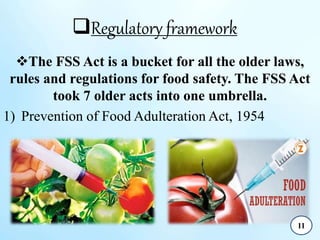
Regulatory framework
The FSS Act is a bucket for all the older laws,
rules and regulations for food safety. The FSS Act
took 7 older acts into one umbrella.
1) Prevention of Food Adulteration Act, 1954
The FSS Act is a bucket for all the older laws,
rules and regulations for food safety. The FSS Act
took 7 older acts into one umbrella.
1) Prevention of Food Adulteration Act, 1954
11
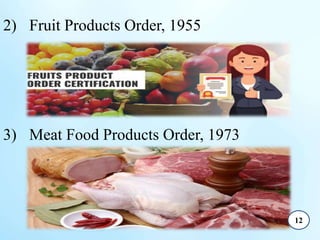
2) Fruit Products Order, 1955
3) Meat Food Products Order, 1973
12
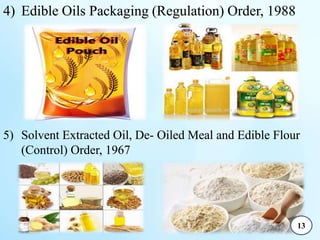
4) Edible Oils Packaging (Regulation) Order, 19884) Edible Oils Packaging (Regulation) Order, 1988
5) Solvent Extracted Oil, De- Oiled Meal and Edible Flour
(Control) Order, 1967
5) Solvent Extracted Oil, De- Oiled Meal and Edible Flour
(Control) Order, 1967
13
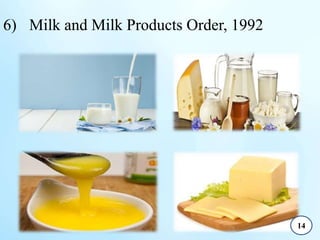
6) Milk and Milk Products Order, 19926) Milk and Milk Products Order, 1992
14
Departments of fssai
1) Import Division
2) International Co-operation
3) Regulatory Compliance Division (RCD)
4) Food Safety Management System (FSMS) Division
5) Risk Assessment and R&D division (RARD)
6) Information Education Communication (IEC) Division
7) Regulation and Codex Division
8) Quality Assurance/ lab Division
9) HR Division
10)Standards Division 15
Research and quality assurance
Research
•FSSAI has set certain guidelines for food safety
research. The Research and Development division is
responsible for research with the following objectives
1) Generate new knowledge that would help in continuously
updating and upgrading food safety standards which are
compatible with international organizations
2) Carry out evidence based studies for improving or
building policies.
16
Quality Assurance
•FSSAI has been mandated to perform various
functions related to quality and standards of food.
•These functions in addition to others include “Laying
down procedure and guidelines for notification of the
accredited laboratories as per ISO17025”.
The FSSAI notified laboratories that are
classified as:
1) FSSAI notified NABL accredited labs- 112
2) State Labs-72
3) Referral Labs-14 17
Standards
Standards framed by FSSAI are prescribed under
Food Safety and Standards (Food Product Standards
and Food Additives) Regulation, 2011
Food Safety and Standards (Packaging and
Labelling) Regulation, 2011
Food Safety and Standards (Contaminants, Toxins,
and Residues) Regulations, 2011.
18
•The FSSAI has prescribed standards for
following food products:
Dairy products and analogues
Fats, oils and fat emulsions
Fruits and vegetable products
Cereal and cereal products
Meat and meat products
Fish and fish products
Sweets & confectionery
Sweetening agents including honey
Salt, spices, condiments and related products
Beverages, (other than dairy and fruits & vegetables based)
Other food product and ingredients
Proprietary food
Irradiation of food 19
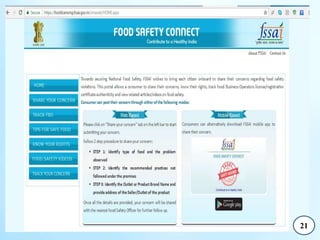
Consumer outreach
Consumers can connect to FSSAI through various channels
or call Toll free Number 1800112100.
Recently an online platform called ‘Food Safety Voice’ has
been launched which helps consumers to register their
complaints and feedbacks about food safety issues related to
adulterated food, unsafe food, substandard food, labeling
defects in food and misleading claims & advertisements
related to various food products.
20
21
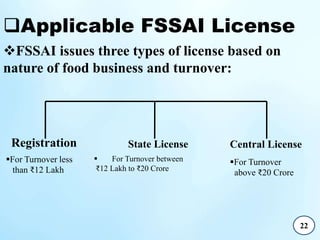
Applicable FSSAI License
FSSAI issues three types of license based on
nature of food business and turnover:
Registration State License Central License
For Turnover less
than ₹12 Lakh
 For Turnover between
₹12 Lakh to ₹20 Crore
For Turnover
above ₹20 Crore
22
applying for fssai regestration
Step 1 : Register as new user .
Open https://foodlicensing.fssai.gov.in/index.aspx
For signing up as new user the applicant will have to fill the
following basic detail
Name,
Adress,
State,
Distric,
Email id,
Mobile number,
User id
Password 6 to 20 character including at least one special
character
23
Step 2 : Login to FSSAI site newly created login
detail .
Logging to FSSAI website
Step 3 : Apply for Registration
Click “Apply for Registration”
Select State of Premises for which “Registration” is being
applied from the drop down
Click on Proceed
Based on the selected business and turnover the applicant
will be directed to fill Form A i.e. for FSSAI Registration
24
The applicant will have to fill in following details:-
Basic detail like name of the applicant, designation, contact
detail, kind of business
Address of the premises where the food business is located
The kind of Business selected in the first page will be
automatically selected. If the applicant wants to add more
business types they can select any other kind of Business.
Add details of food items proposed to be manufactured or
sold from the dropdown list.
Submit the required documents.
To submit the documents electronically click on ‘Choose
File’ and select the file from your system and click on
‘Upload’.
On attaching the required documents the applicant will have
to click ‘Submit’ button for online filling of form. 25
Once the applicant selects the payment gateway it would
redirect to the page for making final submission.
Select Treasury Challan and enter GNR number.
On submission of the application the receipt would be
generated, Click on ‘View Application’ to take print out of
Application (Form-A).
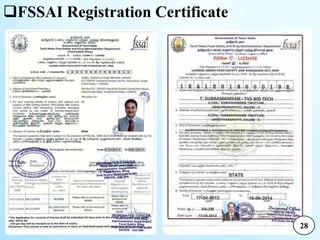
Step 4 : FSSAI Registration Certificate
Approximately within 7 days from the submission of the
form the applicant will receive a status whether the form has
been accepted or rejected.
26
In case the form is rejected the applicant will receive a
written communication form the Registration Authority stating
the reasons of rejection and will be asked to either give certain
clarification or submit additional documents.
Within 40 – 45 days of submission of the form the applicant
the Registration Authority will grant registration.
27
FSSAI Registration Certificate
28
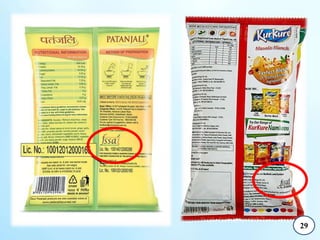
29
Reference
https://en.wikipedia.org/wiki/Food_safety
https://www.foodsafety.gov
https://medlineplus.gov/foodsafety.html
https://fssai.gov.in/home.html
https://kidshealth.org/en/teens/food-safety.html
30
Food safety and standards

Food safety and standards

  • 1.
  • 2.
    An Assignment Presentation On CourseNo.: HWE- 7.3 ( POST HARVEST HANDLING AND VALUE ADDITION IN HORTICULTURE CROPS ) Present To:- Presented By :- Prof. Alok Nath Shubham Kumar College of Horticulture S.D. Agricultural University, Jagudan, 382710 2
  • 3.
    What is foodsafety ? Food safety refers to the proper handling, cooking, and preservation of food in order to protect ourselves from foodborne illnesses caused by microbes such as viruses, bacteria, parasites, and fungi. If you've ever visited a restaurant only to come back with more than a taco in your stomach that is now trying to exit both ends of your body, you know what this is all about. 3
  • 4.
    Fever, nausea, vomiting,diarrhea, stomach aches, muscles aches, and more can be caused by a foodborne illness. This is why food safety is so important! If someone avoids proper food safety guidelines, they can cause themself or others to fall very ill and, in more serious cases, even die! To make sure you avoid this, it's important to learn about proper food safety guidelines pertaining to the preparation of food. 4
  • 5.
    Introduction •What is FSSAI? Food Safety and Standards Authority of India (FSSAI) is an autonomous body established under the Ministry of Health & Family Welfare, Government of India. The FSSAI has been established under the Food Safety and Standards Act, 2006 which is a consolidating statute related to food safety and regulation in India. 5
  • 6.
     FSSAI isresponsible for protecting and promoting public health through the regulation and supervision of food safety. The FSSAI is headed by a non-executive Chairperson, appointed by the Central Government, either holding or has held the position of not below the rank of Secretary to the Government of India.  6
  • 7.
    Location of fssaioffices •FSSAI is located in 5 regions. 1) Northern region-with head office at New Delhi 2) Eastern region-Kolkata 3) North Eastern region- Guwahati 4) Western region-Mumbai 5) Southern region-Cochin and Chennai 7 New Delhi Kolkata Guwahati Mumbai Cochin Chennai
  • 8.
    History FSSAI was establishedby Former Union Health Minister Dr Anbumani Ramadoss, Government of India on 5th September 2008 under Food Safety and Standards Act, 2006. 8
  • 9.
    Aim of fssai The FSSAI is responsible for setting standards for food so that there is one body to deal with and no confusion in the minds of consumers, traders, manufacturers, and investors. 1) Lay down science-based standards for articles of food 2) To regulate manufacture, storage, distribution, sale and import of food 3) To facilitate food safety 9
  • 10.
    The following arethe statutory powers that the FSS Act, 2006 gives to the Food Safety and Standards Authority of India (FSSAI). 1) Framing of regulations to lay down food safety standards 2) Laying down guidelines for accreditation of laboratories for food testing 3) Providing scientific advice and technical support to the Central Government 4) Contributing to the development of international technical standards in food 5) Collecting and collating data regarding food consumption, contamination, emerging risks etc. 6) Disseminating information and promoting awareness about food safety and nutrition in India 10
  • 11.
    Regulatory framework The FSSAct is a bucket for all the older laws, rules and regulations for food safety. The FSS Act took 7 older acts into one umbrella. 1) Prevention of Food Adulteration Act, 1954 The FSS Act is a bucket for all the older laws, rules and regulations for food safety. The FSS Act took 7 older acts into one umbrella. 1) Prevention of Food Adulteration Act, 1954 11
  • 12.
    2) Fruit ProductsOrder, 1955 3) Meat Food Products Order, 1973 12
  • 13.
    4) Edible OilsPackaging (Regulation) Order, 19884) Edible Oils Packaging (Regulation) Order, 1988 5) Solvent Extracted Oil, De- Oiled Meal and Edible Flour (Control) Order, 1967 5) Solvent Extracted Oil, De- Oiled Meal and Edible Flour (Control) Order, 1967 13
  • 14.
    6) Milk andMilk Products Order, 19926) Milk and Milk Products Order, 1992 14
  • 15.
    Departments of fssai 1)Import Division 2) International Co-operation 3) Regulatory Compliance Division (RCD) 4) Food Safety Management System (FSMS) Division 5) Risk Assessment and R&D division (RARD) 6) Information Education Communication (IEC) Division 7) Regulation and Codex Division 8) Quality Assurance/ lab Division 9) HR Division 10)Standards Division 15
  • 16.
    Research and qualityassurance Research •FSSAI has set certain guidelines for food safety research. The Research and Development division is responsible for research with the following objectives 1) Generate new knowledge that would help in continuously updating and upgrading food safety standards which are compatible with international organizations 2) Carry out evidence based studies for improving or building policies. 16
  • 17.
    Quality Assurance •FSSAI hasbeen mandated to perform various functions related to quality and standards of food. •These functions in addition to others include “Laying down procedure and guidelines for notification of the accredited laboratories as per ISO17025”. The FSSAI notified laboratories that are classified as: 1) FSSAI notified NABL accredited labs- 112 2) State Labs-72 3) Referral Labs-14 17
  • 18.
    Standards Standards framed byFSSAI are prescribed under Food Safety and Standards (Food Product Standards and Food Additives) Regulation, 2011 Food Safety and Standards (Packaging and Labelling) Regulation, 2011 Food Safety and Standards (Contaminants, Toxins, and Residues) Regulations, 2011. 18
  • 19.
    •The FSSAI hasprescribed standards for following food products: Dairy products and analogues Fats, oils and fat emulsions Fruits and vegetable products Cereal and cereal products Meat and meat products Fish and fish products Sweets & confectionery Sweetening agents including honey Salt, spices, condiments and related products Beverages, (other than dairy and fruits & vegetables based) Other food product and ingredients Proprietary food Irradiation of food 19
  • 20.
    Consumer outreach Consumers canconnect to FSSAI through various channels or call Toll free Number 1800112100. Recently an online platform called ‘Food Safety Voice’ has been launched which helps consumers to register their complaints and feedbacks about food safety issues related to adulterated food, unsafe food, substandard food, labeling defects in food and misleading claims & advertisements related to various food products. 20
  • 21.
  • 22.
    Applicable FSSAI License FSSAIissues three types of license based on nature of food business and turnover: Registration State License Central License For Turnover less than ₹12 Lakh  For Turnover between ₹12 Lakh to ₹20 Crore For Turnover above ₹20 Crore 22
  • 23.
    applying for fssairegestration Step 1 : Register as new user . Open https://foodlicensing.fssai.gov.in/index.aspx For signing up as new user the applicant will have to fill the following basic detail Name, Adress, State, Distric, Email id, Mobile number, User id Password 6 to 20 character including at least one special character 23
  • 24.
    Step 2 :Login to FSSAI site newly created login detail . Logging to FSSAI website Step 3 : Apply for Registration Click “Apply for Registration” Select State of Premises for which “Registration” is being applied from the drop down Click on Proceed Based on the selected business and turnover the applicant will be directed to fill Form A i.e. for FSSAI Registration 24
  • 25.
    The applicant willhave to fill in following details:- Basic detail like name of the applicant, designation, contact detail, kind of business Address of the premises where the food business is located The kind of Business selected in the first page will be automatically selected. If the applicant wants to add more business types they can select any other kind of Business. Add details of food items proposed to be manufactured or sold from the dropdown list. Submit the required documents. To submit the documents electronically click on ‘Choose File’ and select the file from your system and click on ‘Upload’. On attaching the required documents the applicant will have to click ‘Submit’ button for online filling of form. 25
  • 26.
    Once the applicantselects the payment gateway it would redirect to the page for making final submission. Select Treasury Challan and enter GNR number. On submission of the application the receipt would be generated, Click on ‘View Application’ to take print out of Application (Form-A). Step 4 : FSSAI Registration Certificate Approximately within 7 days from the submission of the form the applicant will receive a status whether the form has been accepted or rejected. 26
  • 27.
    In case theform is rejected the applicant will receive a written communication form the Registration Authority stating the reasons of rejection and will be asked to either give certain clarification or submit additional documents. Within 40 – 45 days of submission of the form the applicant the Registration Authority will grant registration. 27
  • 28.
  • 29.
  • 30.