AGMARK
Presented by
Shaik Mohammed
M. Pharm 1st Year
Food Analysis
Department of Pharmaceutical Analysis
Introduction
 Directorate of Marketing & Inspection (DMI) in the Department of Agriculture,
Cooperation and Farmers Welfare, Ministry of Agriculture, Cooperation &Farmers
Welfare is implementing the provisions of Agricultural Produce (Grading &Marking)
Act, 1937.
 The concept of food quality assurance in India started with the enactment of
Agricultural Produce (Grading & Marking) Act, 1937 and amended in 1986 by
passing bill in our parliament.
 The term AGMARK was coined by joining the words
• ‘Ag’ means Agriculture .
• ‘Mark’ for a Certification Mark .
 Agmark acts as a quality bench mark or authenticity for all agricultural products in
India.
 The Act empowers the Central Government to make Rules for:
a) fixing grade designations to indicate quality of any scheduled article.
b) defining the quality indicated by every grade designation, and
c) specifying grade designation marks to represent particular grade designation.
 As per provision in Section 3 of the Act, General Grading and Marking Rules, 1988
are notified in which the detailed procedures for
Grant of Certificate of Authorization.
Setting up of laboratories.
Issue of Certificate of Agmark Grading.
Action on irregularities.
Consumer protection measures, etc.
Certificate of Authorization
• It is given to the packers authorizing them to grade their commodity under
AGMARK.
• Period of validity will be 5 years.
• For granting new certificate of authorization separate application for each commodity
should be produced.
• There are more than 6000 Certificate of Authorisation holders throughout the
country.
• These Certificate of Authorisation holders grade and mark the agricultural
commodity through the laboratories approved for the purpose.
• After the due inquiry only,the Certificate of Authorization will be issued under the
act.
• Grade standards notified as per the provisions of the Act are popularly called
AGMARK Standards.These standards differentiate between quality and 2-3 grades
are prescribed for each commodity.
• Grades help farmers to get prices for agricultural commodities as per the quality
produced by them and consumers get the desired quality.
• AGMARK(Grading and Marketing) Act covers 222 different categories of
agricultural products and commodities including on pulses, cereals, essential oils,
vegetable oils, fruits and vegetables and other semi-processed commodities.
• Agmark certification is extremely vital for all retailers and wholesalers across the
country in order to sell their products to large base of customers.
Standardization and Grading of Agricultural Commodities
 Grading provides a description of the quality of the consignment and
assists in the formation of a legally binding agreement.
 It facilitates proper marketing of agricultural commodities.
 It also ensures that agricultural commodities move through the market
faster and without obstructions.
 This also facilitates transactions without physical verification by the
distant buyers.
Advantages
of Grading
Brings
confidence
between buyer
& seller
Facilitates
interstate &
international
marketing
Disagreements
solved in Good
manner
Ensures
stability of the
price
Sanction of
loan is easy for
the farmers
Arbitrary
fixation of
price by
middlemen is
eliminated
Brings about
the
improvement
of the crop
Reduces risk
of producer &
seller in
transactions
Future
marketing is
facilitated
Helps in
implementation
of contract
farming
Formulation of Grade Standards
Standards of agricultural commodities are framed in a scientific way. Basically, it
involves the following steps:
 Based on the national priority, necessity and demand, the agricultural commodity(for
which grade standards are to be framed) is selected.
 A sampling plan is prepared based on the areas in which the commodity is grown,
processed and traded.
 Physical and chemical parameters to determine the purity and quality of the
commodity are identified.
 Samples of the commodity are collected by the field offices from growing areas,
whole sale and retail markets as per the sampling plan.
The samples are analysed in the Regional Agmark Laboratories and
Central Agmark Laboratory for the identified parameters.
Analytical data obtained is statistically analysed and Central Agmark
Laboratory suggests the limits of various quality parameters for different
grades.
The specifications of the commodity prescribed in Prevention of Food
Adulteration Rules, 1955 and international standards viz. Codex
Alimentarius Commission, ISO, etc. are consulted.
The relevant Committee on Agmark standards discusses the draft
standards with trade, industry and consumer organizations.
Preliminary Grading & Marking Rules for the Commodity are drafted
and are vetted by the Ministry of Law & Justice, translated into Hindi
and published in the Gazette of India for inviting comments and
suggestions from all stake holders.
The comments/suggestions received are considered and final notification
is drafted, vetted by the Ministry of Law & Justice, translated into Hindi
and published in the Gazette of India.
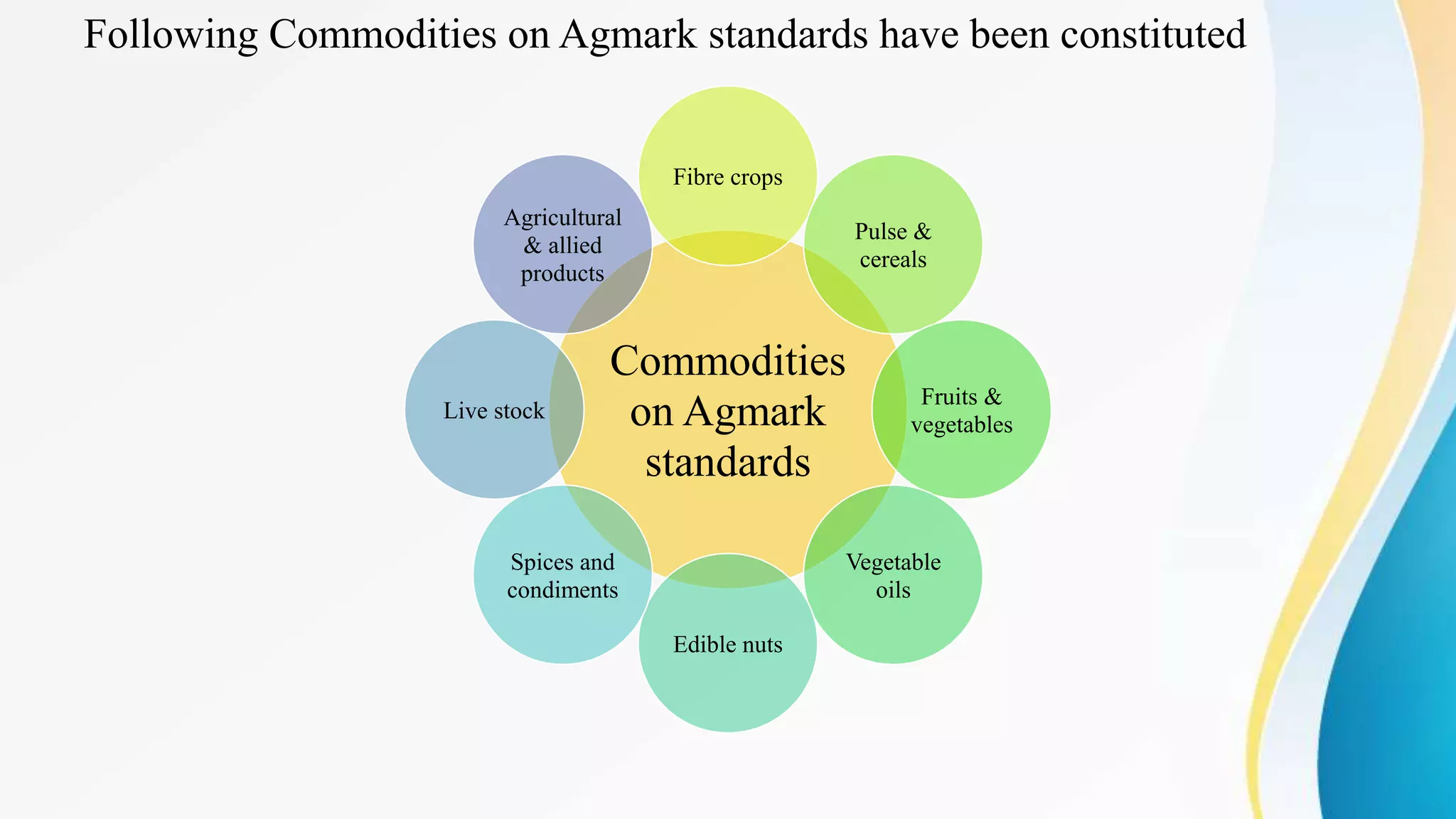
Following Commodities on Agmark standards have been constituted
Commodities
on Agmark
standards
Fibre crops
Pulse &
cereals
Fruits &
vegetables
Vegetable
oils
Edible nuts
Spices and
condiments
Live stock
Agricultural
& allied
products
Infrastructure for the Certification Programme
• DMI(Directorate of Marketing and Inspection) is headed by Agricultural
Marketing Adviser to the Government of India.
• DMI has head quarters at Faridabad and 11 Regional Offices and 26 Sub-
offices spread all over the country to implement the certification
programme.
• Head Office at Faridabad attends to the policy matters and
framing/revision of standards.
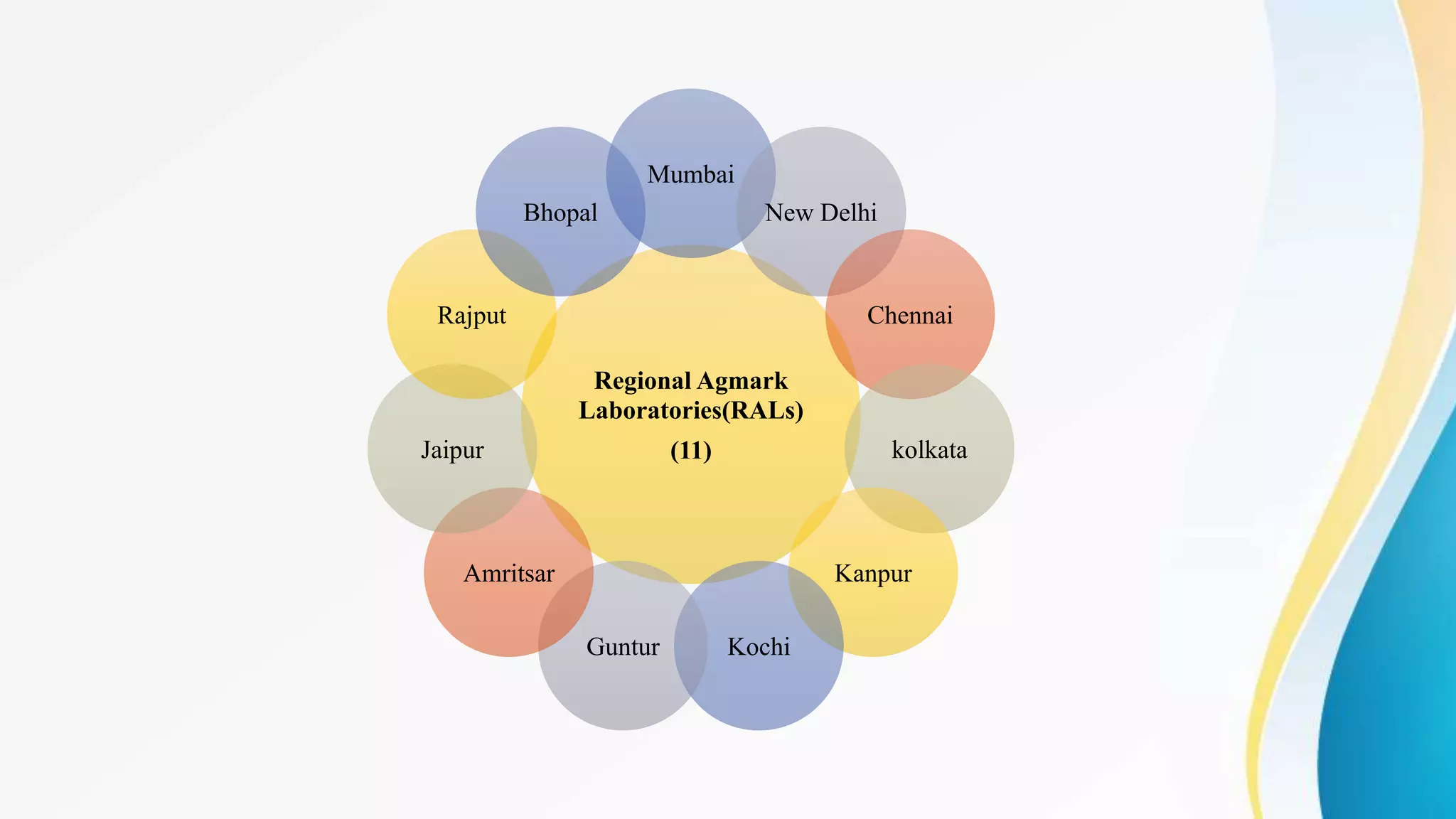
• 11 RALs spread all over the country provide analytical support for the
analysis of research samples and check samples drawn from the
authorized packers’ premises and market.
• These RALs analyse private samples also received from any stake holder
on payment basis.
• Central Agmark Laboratory at Nagpur is the apex laboratory.
Regional Agmark
Laboratories(RALs)
(11)
Mumbai
New Delhi
Chennai
kolkata
Kanpur
Kochi
Guntur
Amritsar
Jaipur
Rajput
Bhopal
Role of Regional Agmark Laboratory & Central Agmark
Laboratories
These RAL(s) are assigned to carry out the following important functions:
Analysis of research samples of agricultural commodities for framing
their standards.
Analysis of check samples of Agmark certified commodities for ensuring
conformance with prescribed standards.
Training the chemists of authorized packers/approved laboratories in the
grading of agricultural commodities.
• The testing done across these laboratories include
– Chemical analysis,
– Microbiological analysis,
– Pesticide residue, and
– Antitoxin analysis
• Some of the products are whole spices, ground spices, ghee, butter,
vegetable oils, mustard oil, honey, food grains (wheat), wheat products
(atta, suji, and maida), gram flour, soyabean seed, bengal gram, ginger,
oil cake, essential oil, oils and fats, animal casings, meat and food
products.
CAL, Nagpur works as the apex laboratory and is primarily engaged in research
activities and in association with RAL (s) also undertakes to
i. Evolve new methods and standardize the already existing methods of analysis /
tests of food & agricultural commodities including meat products;
ii. Formulation of specifications for new commodities for bringing under the purview
of Agmark.
iii. Revision of Specifications of various commodities i.e. agricultural & food products
including meat products etc,
iv. Create awareness among consumers and traders with regard to grading,
standardization and quality of various food & agricultural products.
Labeling Requirements on AGMARK Certified Products
All products certified under Agmark should
have Agmark insignia and following details
printed on them.
i. Name and address of the authorized packer
ii. Name of the commodity
iii. Grade
iv. Lot/Batch No.
v. Date of packing.
vi. Best Before Date
vii. Net Weight /Volume
viii. Maximum Retail Price.
ix. List of ingredients in descending order of their
wt. (in case of mixed spices, etc).
Documents to be given along with application
1. Sketch of the premises
2. Declaration regarding
i. Proprietorship/Partnership etc
ii. Ownership of the premises
iii. Ownership of trade brand label
iv. Use of good grade quality containers for packing commodities. All declarations has to given by
notary public.
3. A copy of licence from Panchayat/Municipality.
4. Bank reference:- Letter from the bank regarding the transaction to the packer with the bank.
5. List of machinery.
6. Specimen signature of authorized persons attested by the proprietor/managing partner.
7. Medical fitness certificate of employee.
8. Specimen copy and sketch of trade brand label.
• Consumers not satisfied with the quality of agricultural produce certified under
Agmark, can make a complaint to the Agricultural Marketing Adviser giving full
particulars regarding Agmark label/replica serial number, lot no., date of packing,
best before date, trade brand, name and address of the authorized packer and the
name and address of the seller.
• Whenever the complaint is found to be genuine, action as deemed fit will be taken
against the concerned authorized packer as per provision in APGM Act-1937
Thank you

Agmark

  • 1.
    AGMARK Presented by Shaik Mohammed M.Pharm 1st Year Food Analysis Department of Pharmaceutical Analysis
  • 2.
    Introduction  Directorate ofMarketing & Inspection (DMI) in the Department of Agriculture, Cooperation and Farmers Welfare, Ministry of Agriculture, Cooperation &Farmers Welfare is implementing the provisions of Agricultural Produce (Grading &Marking) Act, 1937.  The concept of food quality assurance in India started with the enactment of Agricultural Produce (Grading & Marking) Act, 1937 and amended in 1986 by passing bill in our parliament.  The term AGMARK was coined by joining the words • ‘Ag’ means Agriculture . • ‘Mark’ for a Certification Mark .  Agmark acts as a quality bench mark or authenticity for all agricultural products in India.
  • 3.
     The Actempowers the Central Government to make Rules for: a) fixing grade designations to indicate quality of any scheduled article. b) defining the quality indicated by every grade designation, and c) specifying grade designation marks to represent particular grade designation.  As per provision in Section 3 of the Act, General Grading and Marking Rules, 1988 are notified in which the detailed procedures for Grant of Certificate of Authorization. Setting up of laboratories. Issue of Certificate of Agmark Grading. Action on irregularities. Consumer protection measures, etc.
  • 4.
    Certificate of Authorization •It is given to the packers authorizing them to grade their commodity under AGMARK. • Period of validity will be 5 years. • For granting new certificate of authorization separate application for each commodity should be produced. • There are more than 6000 Certificate of Authorisation holders throughout the country. • These Certificate of Authorisation holders grade and mark the agricultural commodity through the laboratories approved for the purpose. • After the due inquiry only,the Certificate of Authorization will be issued under the act.
  • 5.
    • Grade standardsnotified as per the provisions of the Act are popularly called AGMARK Standards.These standards differentiate between quality and 2-3 grades are prescribed for each commodity. • Grades help farmers to get prices for agricultural commodities as per the quality produced by them and consumers get the desired quality. • AGMARK(Grading and Marketing) Act covers 222 different categories of agricultural products and commodities including on pulses, cereals, essential oils, vegetable oils, fruits and vegetables and other semi-processed commodities. • Agmark certification is extremely vital for all retailers and wholesalers across the country in order to sell their products to large base of customers.
  • 6.
    Standardization and Gradingof Agricultural Commodities  Grading provides a description of the quality of the consignment and assists in the formation of a legally binding agreement.  It facilitates proper marketing of agricultural commodities.  It also ensures that agricultural commodities move through the market faster and without obstructions.  This also facilitates transactions without physical verification by the distant buyers.
  • 7.
    Advantages of Grading Brings confidence between buyer &seller Facilitates interstate & international marketing Disagreements solved in Good manner Ensures stability of the price Sanction of loan is easy for the farmers Arbitrary fixation of price by middlemen is eliminated Brings about the improvement of the crop Reduces risk of producer & seller in transactions Future marketing is facilitated Helps in implementation of contract farming
  • 8.
    Formulation of GradeStandards Standards of agricultural commodities are framed in a scientific way. Basically, it involves the following steps:  Based on the national priority, necessity and demand, the agricultural commodity(for which grade standards are to be framed) is selected.  A sampling plan is prepared based on the areas in which the commodity is grown, processed and traded.  Physical and chemical parameters to determine the purity and quality of the commodity are identified.  Samples of the commodity are collected by the field offices from growing areas, whole sale and retail markets as per the sampling plan.
  • 9.
    The samples areanalysed in the Regional Agmark Laboratories and Central Agmark Laboratory for the identified parameters. Analytical data obtained is statistically analysed and Central Agmark Laboratory suggests the limits of various quality parameters for different grades. The specifications of the commodity prescribed in Prevention of Food Adulteration Rules, 1955 and international standards viz. Codex Alimentarius Commission, ISO, etc. are consulted.
  • 10.
    The relevant Committeeon Agmark standards discusses the draft standards with trade, industry and consumer organizations. Preliminary Grading & Marking Rules for the Commodity are drafted and are vetted by the Ministry of Law & Justice, translated into Hindi and published in the Gazette of India for inviting comments and suggestions from all stake holders. The comments/suggestions received are considered and final notification is drafted, vetted by the Ministry of Law & Justice, translated into Hindi and published in the Gazette of India.
  • 11.
    Following Commodities onAgmark standards have been constituted Commodities on Agmark standards Fibre crops Pulse & cereals Fruits & vegetables Vegetable oils Edible nuts Spices and condiments Live stock Agricultural & allied products
  • 12.
    Infrastructure for theCertification Programme • DMI(Directorate of Marketing and Inspection) is headed by Agricultural Marketing Adviser to the Government of India. • DMI has head quarters at Faridabad and 11 Regional Offices and 26 Sub- offices spread all over the country to implement the certification programme. • Head Office at Faridabad attends to the policy matters and framing/revision of standards.
  • 13.
    • 11 RALsspread all over the country provide analytical support for the analysis of research samples and check samples drawn from the authorized packers’ premises and market. • These RALs analyse private samples also received from any stake holder on payment basis. • Central Agmark Laboratory at Nagpur is the apex laboratory.
  • 14.
  • 15.
    Role of RegionalAgmark Laboratory & Central Agmark Laboratories These RAL(s) are assigned to carry out the following important functions: Analysis of research samples of agricultural commodities for framing their standards. Analysis of check samples of Agmark certified commodities for ensuring conformance with prescribed standards. Training the chemists of authorized packers/approved laboratories in the grading of agricultural commodities.
  • 16.
    • The testingdone across these laboratories include – Chemical analysis, – Microbiological analysis, – Pesticide residue, and – Antitoxin analysis • Some of the products are whole spices, ground spices, ghee, butter, vegetable oils, mustard oil, honey, food grains (wheat), wheat products (atta, suji, and maida), gram flour, soyabean seed, bengal gram, ginger, oil cake, essential oil, oils and fats, animal casings, meat and food products.
  • 17.
    CAL, Nagpur worksas the apex laboratory and is primarily engaged in research activities and in association with RAL (s) also undertakes to i. Evolve new methods and standardize the already existing methods of analysis / tests of food & agricultural commodities including meat products; ii. Formulation of specifications for new commodities for bringing under the purview of Agmark. iii. Revision of Specifications of various commodities i.e. agricultural & food products including meat products etc, iv. Create awareness among consumers and traders with regard to grading, standardization and quality of various food & agricultural products.
  • 18.
    Labeling Requirements onAGMARK Certified Products All products certified under Agmark should have Agmark insignia and following details printed on them. i. Name and address of the authorized packer ii. Name of the commodity iii. Grade iv. Lot/Batch No. v. Date of packing. vi. Best Before Date vii. Net Weight /Volume viii. Maximum Retail Price. ix. List of ingredients in descending order of their wt. (in case of mixed spices, etc).
  • 19.
    Documents to begiven along with application 1. Sketch of the premises 2. Declaration regarding i. Proprietorship/Partnership etc ii. Ownership of the premises iii. Ownership of trade brand label iv. Use of good grade quality containers for packing commodities. All declarations has to given by notary public. 3. A copy of licence from Panchayat/Municipality. 4. Bank reference:- Letter from the bank regarding the transaction to the packer with the bank. 5. List of machinery. 6. Specimen signature of authorized persons attested by the proprietor/managing partner. 7. Medical fitness certificate of employee. 8. Specimen copy and sketch of trade brand label.
  • 20.
    • Consumers notsatisfied with the quality of agricultural produce certified under Agmark, can make a complaint to the Agricultural Marketing Adviser giving full particulars regarding Agmark label/replica serial number, lot no., date of packing, best before date, trade brand, name and address of the authorized packer and the name and address of the seller. • Whenever the complaint is found to be genuine, action as deemed fit will be taken against the concerned authorized packer as per provision in APGM Act-1937
  • 21.

Editor's Notes

  • #9 how the grade standards are created
  • #10 The objectives of the CAC include the protection of the health of consumers and the assurance of fair practices in the food trade.