UNIT-3 (MRA-204T)
FOOD SAFETY AND STANDARDS ACT, 2006
Under the guidance of:
Dr. Lakshmi prasanthi Nori
Professor
Department of regulatory Affairs
Presented by:
Ms. P. Jaya durga
Drug Regulatory Affairs
222306
Shree Vishnu College Of Pharmacy
CONTENTS:
• Introduction
• Scope of the Act.
• Need for the new act.
• Salient features of the act.
• Chapters of FSS act.
• FSS act rules, 2011.
• Important regulations of FSS act.
• FSSAI
INTRODUCTION:
• The Food Safety & Standards Act, 2006 is act to consolidate the laws
relating to food and to establish the Food Safety and Standards Authority of
India for laying down science based standards for articles of food and to
regulate their manufacture, storage, distribution, sale and import, to ensure
availability of sale and wholesome food for human consumption.
• The Food Safety and Standards Act, 2006 was passed by parliament with the
intention:
 To converge 8 different laws into one comprehensive act.
 To have single regulatory body.
SCOPE OF THE ACT:
The Act covers activities throughout the food distribution chain,
from primary production through distribution to retail and catering.
The Act gives the government powers to make regulations on
matters of food safety.
The Food Safety & Standards Authority of India is the principal
Government Authority responsible for preparing specific regulations
under the Act.
Need for the new act:
FSSA initiates harmonization of India’s food regulations as
per international standards.
It establishes a new national regulatory body, the Food Safety
and Standards Authority of India (FSSAI) to develop science
based standards.
All food imports will therefore be subject to the provisions of
the FSSA and rules and regulations which as notified by the
Government on 5th of August 2011 will be applicable.
SALIENT FEATURES OF THE ACT:
 To ensure that all food meets consumers expectations in terms of
nature, substance and quality and is not misleading.
 To provide legal powers and specify offences in relation to public
health and consumers interest.
 To shift from regulatory regime to self compliance through Food
Safety Management system.
 Science based standards.
Chapters of the FSS act
Chapter I – Preliminary (Section 1-3).
Chapter II – Food safety & standards Authority of India (Section 4-17).
Chapter III – General principles of Food Safety (Section 18).
Chapter IV – General provisions as to articles of food (Section 19-24).
Chapter V – Provisions relating to import (Section 25).
Chapter VI – Special responsibilities as to food safety (Section 26,27,28).
Chapter VII – Enforcement of the act (Section 29-42).
Chapter VIII – Analysis of food (Section 43-47).
Chapter IX – Offences & Penalties (Section 48-67).
Chapter X – Adjudication & Food Safety Appellate Tribunal (Section 68-
80).
Chapter XI – Finance, Accounts, Audit and Reports (Section 81-84).
Chapter XII – Miscellaneous (Section 85-101).
FSS act rules, 2011
Under section 91, it empowered the central government to make rules by
notification in the official gazette, for carrying out provisions of the act.
Some of them are namely:
→ Qualifications of Food Safety officer.
→ Qualifications of Food analysts.
→ Procedure to be followed in adjudication of cases.
→ Any other matter relating to procedure and powers tribunal under
clause.
→ The fee to be paid for preferring an appeal to the high court.
Important regulations of FSS act
♦ FSSAI Business Transaction Regulations, 2010.
♦ FSS (Licensing and Registration) Regulations, 2011.
♦ FSS (Packaging and Labelling) Regulations, 2011.
♦ FSS (Food Product Standard & Food Additive) Regulations, 2011.
♦ FSS (Prohibition and Restriction on sales) Regulations, 2011.
♦ FSS (Contaminants, Toxins and Residues) Regulations, 2011.
♦ FSS (Laboratory and sampling analysis) Regulations, 2011.
♦ FSS (Food or Health Supplements, Nutraceuticals, Foods for special
dietary uses, Foods for special medical purpose, Functional Foods and
novel food) Regulations, 2016.
♦ FSS (Food Recall Procedure) Regulation, 2017.
♦ FSS (Import) Regulation, 2017.
INTRODUCTION
• The Food Safety and Standards Authority of India (FSSAI) has been established
under Food Safety and Standards Act, 2006 in India which consolidates various acts
and orders that were in existence to handle food related issues in various Ministries
and Departments.
• FSSAI has been created for laying down science-based standards for articles of food
and to regulate their manufacture, storage, distribution, sale and import to ensure
availability of safe and wholesome food for human consumption.
Highlights of the Food Safety and Standard Act
The Act also aims to establish a single reference point for all matters relating to food
safety and standards, by moving from multi- level, multi- departmental control to a
single line of command.
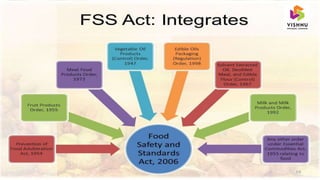
Various central Acts like
• Prevention of Food Adulteration Act,1954,
• Fruit Products Order , 1955,
• Meat Food Products Order,1973,
• Vegetable Oil Products (Control) Order, 1947,
• Edible Oils Packaging (Regulation)Order 1988,
• Solvent Extracted Oil, De- Oiled Meal and Edible Flour (Control) Order, 1967,
• Milk and Milk Products Order, 1992 etc…
• It will be repealed after commencement of FSS Act, 2006.
FSSAI full form is the Food Safety and Standards Authority of India (FSSAI) which
is an autonomous body established under the Ministry of Health & Family Welfare,
Government of India.
Meaning of FSSAI
FSSAI is an authority to provide a food license to every food business in India.
FSSAI makes sure that the food business runs with appropriate license and a quality
check. The food businesses are required to follow the FSSAI rules and guidelines.
FSSAI is in entirely responsible for setting the standard and principles and controls
for the welfare of food businesses in India.
FSSAI - Food Safety and Standards Authority of India
WHAT IS FSSAI REGISTRATION (FOOD LICENSE)
• FSSAI - Food Safety and Standards Authority of India is an autonomous
body established under the Ministry of Health & Family Welfare,
Government of India. The FSSAI has been established under the Food
Safety and Standards Act, 2006 which is a consolidating statute related to
food safety and regulation in India. It is an organization that monitors and
governs the food business in India.
• FSSAI License is responsible for protecting and promoting public health
through the regulation and supervision of food safety.
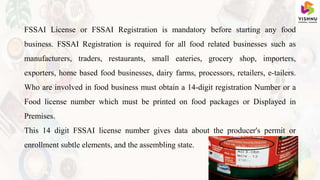
FSSAI License or FSSAI Registration is mandatory before starting any food
business. FSSAI Registration is required for all food related businesses such as
manufacturers, traders, restaurants, small eateries, grocery shop, importers,
exporters, home based food businesses, dairy farms, processors, retailers, e-tailers.
Who are involved in food business must obtain a 14-digit registration Number or a
Food license number which must be printed on food packages or Displayed in
Premises.
This 14 digit FSSAI license number gives data about the producer's permit or
enrollment subtle elements, and the assembling state.
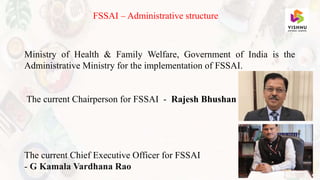
FSSAI – Administrative structure
Ministry of Health & Family Welfare, Government of India is the
Administrative Ministry for the implementation of FSSAI.
The current Chairperson for FSSAI - Rajesh Bhushan
The current Chief Executive Officer for FSSAI
- G Kamala Vardhana Rao
Locations:
FSSAI is located in 5 regions
• Northern Region – With head office at New Delhi
• Eastern Region – Kolkata
• North Eastern Region – Guwahati
• Western Region – Mumbai
• Southern Region – Chennai
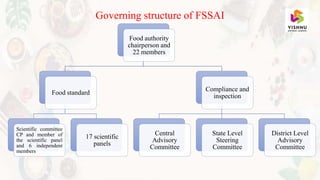
Governing structure of FSSAI
Food authority
chairperson and
22 members
Food standard
Scientific committee
CP and member of
the scientific panel
and 6 independent
members
17 scientific
panels
Compliance and
inspection
Central
Advisory
Committee
State Level
Steering
Committee
District Level
Advisory
Committee
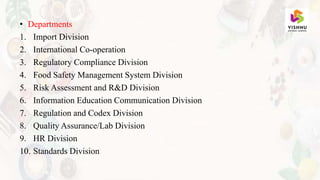
• Departments
1. Import Division
2. International Co-operation
3. Regulatory Compliance Division
4. Food Safety Management System Division
5. Risk Assessment and R&D Division
6. Information Education Communication Division
7. Regulation and Codex Division
8. Quality Assurance/Lab Division
9. HR Division
10. Standards Division
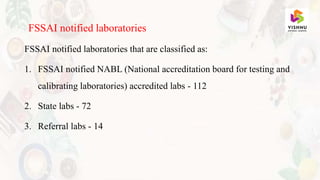
FSSAI notified laboratories that are classified as:
1. FSSAI notified NABL (National accreditation board for testing and
calibrating laboratories) accredited labs - 112
2. State labs - 72
3. Referral labs - 14
FSSAI notified laboratories
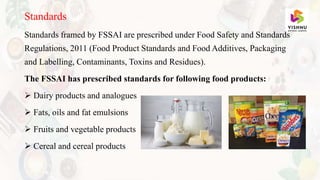
Standards framed by FSSAI are prescribed under Food Safety and Standards
Regulations, 2011 (Food Product Standards and Food Additives, Packaging
and Labelling, Contaminants, Toxins and Residues).
The FSSAI has prescribed standards for following food products:
 Dairy products and analogues
 Fats, oils and fat emulsions
 Fruits and vegetable products
 Cereal and cereal products
Standards
Meat and meat products
 Fish and fish products
 Sweet and confectionery
 Sweetening agents including honey
 Salt, spices, condiments and related products
 Beverages, (other than dairy, fruits and vegetables based)
 Other food product and ingredients
 Proprietary food
 Irradiation of food
FSSAI issues three types of license based on nature of food business
and turnover:
1. Registration: For Turnover less than 12 Lakh
2. State License: For Turnover between 12 Lakh to 20 Crore
3. Central License: For Turnover above 20 Crore
Applicable FSSAI License
Food products with FSSAI mark
FSSAI has been mandated by the FSS Act, 2006 for performing
the following functions:
• Framing of Regulations to lay down the Standards and guidelines in relation to articles
of food and specifying appropriate system of enforcing various standards thus notified.
• Laying down mechanisms and guidelines for accreditation of certification bodies
engaged in certification of food safety management system for food businesses.
• Laying down procedure and guidelines for accreditation of laboratories and
notification of the accredited laboratories.
• To provide scientific advice and technical support to Central Government and State
Governments in the matters of framing the policy and rules in areas which have a
direct or indirect bearing of food safety and nutrition.
• Collect and collate data regarding food consumption, incidence and prevalence of
biological risk, contaminants in food, residues of various, contaminants in foods
products, identification of emerging risks and introduction of rapid alert system.
• Creating an information network across the country so that the public, consumers,
Panchayats etc receive rapid, reliable and objective information about food safety and
issues of concern.
• Provide training programmes for persons who are involved or intend to get involved in
food businesses.
• Contribute to the development of international technical standards for food, sanitary
and phyto-sanitary standards.
• Promote general awareness about food safety and food standards.
• Consumers can connect to FSSAI through various channels or call Toll
Free Number 1800112100
• An online platform called ‘Food Safety Voice’ has been launched
which helps consumers to register their complaints and feedbacks
about food safety issues related to adulterated food, unsafe food,
substandard food, labelling defects in food and misleading claims and
advertisements related to various food products.
Consumer out reach
1. What is the food safety and standards act 2006?
2. Explain organization and functions of FSSAI?
3. Discuss the rules and regulations of FSS Act?
FSS and FSSAI Act

FSS and FSSAI Act

  • 1.
    UNIT-3 (MRA-204T) FOOD SAFETYAND STANDARDS ACT, 2006 Under the guidance of: Dr. Lakshmi prasanthi Nori Professor Department of regulatory Affairs Presented by: Ms. P. Jaya durga Drug Regulatory Affairs 222306 Shree Vishnu College Of Pharmacy
  • 2.
    CONTENTS: • Introduction • Scopeof the Act. • Need for the new act. • Salient features of the act. • Chapters of FSS act. • FSS act rules, 2011. • Important regulations of FSS act. • FSSAI
  • 3.
    INTRODUCTION: • The FoodSafety & Standards Act, 2006 is act to consolidate the laws relating to food and to establish the Food Safety and Standards Authority of India for laying down science based standards for articles of food and to regulate their manufacture, storage, distribution, sale and import, to ensure availability of sale and wholesome food for human consumption. • The Food Safety and Standards Act, 2006 was passed by parliament with the intention:  To converge 8 different laws into one comprehensive act.  To have single regulatory body.
  • 5.
    SCOPE OF THEACT: The Act covers activities throughout the food distribution chain, from primary production through distribution to retail and catering. The Act gives the government powers to make regulations on matters of food safety. The Food Safety & Standards Authority of India is the principal Government Authority responsible for preparing specific regulations under the Act.
  • 6.
    Need for thenew act: FSSA initiates harmonization of India’s food regulations as per international standards. It establishes a new national regulatory body, the Food Safety and Standards Authority of India (FSSAI) to develop science based standards. All food imports will therefore be subject to the provisions of the FSSA and rules and regulations which as notified by the Government on 5th of August 2011 will be applicable.
  • 7.
    SALIENT FEATURES OFTHE ACT:  To ensure that all food meets consumers expectations in terms of nature, substance and quality and is not misleading.  To provide legal powers and specify offences in relation to public health and consumers interest.  To shift from regulatory regime to self compliance through Food Safety Management system.  Science based standards.
  • 8.
    Chapters of theFSS act Chapter I – Preliminary (Section 1-3). Chapter II – Food safety & standards Authority of India (Section 4-17). Chapter III – General principles of Food Safety (Section 18). Chapter IV – General provisions as to articles of food (Section 19-24). Chapter V – Provisions relating to import (Section 25). Chapter VI – Special responsibilities as to food safety (Section 26,27,28).
  • 9.
    Chapter VII –Enforcement of the act (Section 29-42). Chapter VIII – Analysis of food (Section 43-47). Chapter IX – Offences & Penalties (Section 48-67). Chapter X – Adjudication & Food Safety Appellate Tribunal (Section 68- 80). Chapter XI – Finance, Accounts, Audit and Reports (Section 81-84). Chapter XII – Miscellaneous (Section 85-101).
  • 10.
    FSS act rules,2011 Under section 91, it empowered the central government to make rules by notification in the official gazette, for carrying out provisions of the act. Some of them are namely: → Qualifications of Food Safety officer. → Qualifications of Food analysts. → Procedure to be followed in adjudication of cases. → Any other matter relating to procedure and powers tribunal under clause. → The fee to be paid for preferring an appeal to the high court.
  • 11.
    Important regulations ofFSS act ♦ FSSAI Business Transaction Regulations, 2010. ♦ FSS (Licensing and Registration) Regulations, 2011. ♦ FSS (Packaging and Labelling) Regulations, 2011. ♦ FSS (Food Product Standard & Food Additive) Regulations, 2011. ♦ FSS (Prohibition and Restriction on sales) Regulations, 2011. ♦ FSS (Contaminants, Toxins and Residues) Regulations, 2011. ♦ FSS (Laboratory and sampling analysis) Regulations, 2011.
  • 12.
    ♦ FSS (Foodor Health Supplements, Nutraceuticals, Foods for special dietary uses, Foods for special medical purpose, Functional Foods and novel food) Regulations, 2016. ♦ FSS (Food Recall Procedure) Regulation, 2017. ♦ FSS (Import) Regulation, 2017.
  • 14.
    INTRODUCTION • The FoodSafety and Standards Authority of India (FSSAI) has been established under Food Safety and Standards Act, 2006 in India which consolidates various acts and orders that were in existence to handle food related issues in various Ministries and Departments. • FSSAI has been created for laying down science-based standards for articles of food and to regulate their manufacture, storage, distribution, sale and import to ensure availability of safe and wholesome food for human consumption. Highlights of the Food Safety and Standard Act The Act also aims to establish a single reference point for all matters relating to food safety and standards, by moving from multi- level, multi- departmental control to a single line of command.
  • 15.
    Various central Actslike • Prevention of Food Adulteration Act,1954, • Fruit Products Order , 1955, • Meat Food Products Order,1973, • Vegetable Oil Products (Control) Order, 1947, • Edible Oils Packaging (Regulation)Order 1988, • Solvent Extracted Oil, De- Oiled Meal and Edible Flour (Control) Order, 1967, • Milk and Milk Products Order, 1992 etc… • It will be repealed after commencement of FSS Act, 2006.
  • 16.
    FSSAI full formis the Food Safety and Standards Authority of India (FSSAI) which is an autonomous body established under the Ministry of Health & Family Welfare, Government of India. Meaning of FSSAI FSSAI is an authority to provide a food license to every food business in India. FSSAI makes sure that the food business runs with appropriate license and a quality check. The food businesses are required to follow the FSSAI rules and guidelines. FSSAI is in entirely responsible for setting the standard and principles and controls for the welfare of food businesses in India. FSSAI - Food Safety and Standards Authority of India
  • 17.
    WHAT IS FSSAIREGISTRATION (FOOD LICENSE) • FSSAI - Food Safety and Standards Authority of India is an autonomous body established under the Ministry of Health & Family Welfare, Government of India. The FSSAI has been established under the Food Safety and Standards Act, 2006 which is a consolidating statute related to food safety and regulation in India. It is an organization that monitors and governs the food business in India. • FSSAI License is responsible for protecting and promoting public health through the regulation and supervision of food safety.
  • 18.
    FSSAI License orFSSAI Registration is mandatory before starting any food business. FSSAI Registration is required for all food related businesses such as manufacturers, traders, restaurants, small eateries, grocery shop, importers, exporters, home based food businesses, dairy farms, processors, retailers, e-tailers. Who are involved in food business must obtain a 14-digit registration Number or a Food license number which must be printed on food packages or Displayed in Premises. This 14 digit FSSAI license number gives data about the producer's permit or enrollment subtle elements, and the assembling state.
  • 19.
    FSSAI – Administrativestructure Ministry of Health & Family Welfare, Government of India is the Administrative Ministry for the implementation of FSSAI. The current Chairperson for FSSAI - Rajesh Bhushan The current Chief Executive Officer for FSSAI - G Kamala Vardhana Rao
  • 20.
    Locations: FSSAI is locatedin 5 regions • Northern Region – With head office at New Delhi • Eastern Region – Kolkata • North Eastern Region – Guwahati • Western Region – Mumbai • Southern Region – Chennai
  • 21.
    Governing structure ofFSSAI Food authority chairperson and 22 members Food standard Scientific committee CP and member of the scientific panel and 6 independent members 17 scientific panels Compliance and inspection Central Advisory Committee State Level Steering Committee District Level Advisory Committee
  • 22.
    • Departments 1. ImportDivision 2. International Co-operation 3. Regulatory Compliance Division 4. Food Safety Management System Division 5. Risk Assessment and R&D Division 6. Information Education Communication Division 7. Regulation and Codex Division 8. Quality Assurance/Lab Division 9. HR Division 10. Standards Division
  • 23.
    FSSAI notified laboratoriesthat are classified as: 1. FSSAI notified NABL (National accreditation board for testing and calibrating laboratories) accredited labs - 112 2. State labs - 72 3. Referral labs - 14 FSSAI notified laboratories
  • 24.
    Standards framed byFSSAI are prescribed under Food Safety and Standards Regulations, 2011 (Food Product Standards and Food Additives, Packaging and Labelling, Contaminants, Toxins and Residues). The FSSAI has prescribed standards for following food products:  Dairy products and analogues  Fats, oils and fat emulsions  Fruits and vegetable products  Cereal and cereal products Standards
  • 25.
    Meat and meatproducts  Fish and fish products  Sweet and confectionery  Sweetening agents including honey  Salt, spices, condiments and related products  Beverages, (other than dairy, fruits and vegetables based)  Other food product and ingredients  Proprietary food  Irradiation of food
  • 26.
    FSSAI issues threetypes of license based on nature of food business and turnover: 1. Registration: For Turnover less than 12 Lakh 2. State License: For Turnover between 12 Lakh to 20 Crore 3. Central License: For Turnover above 20 Crore Applicable FSSAI License
  • 27.
  • 28.
    FSSAI has beenmandated by the FSS Act, 2006 for performing the following functions: • Framing of Regulations to lay down the Standards and guidelines in relation to articles of food and specifying appropriate system of enforcing various standards thus notified. • Laying down mechanisms and guidelines for accreditation of certification bodies engaged in certification of food safety management system for food businesses. • Laying down procedure and guidelines for accreditation of laboratories and notification of the accredited laboratories. • To provide scientific advice and technical support to Central Government and State Governments in the matters of framing the policy and rules in areas which have a direct or indirect bearing of food safety and nutrition.
  • 29.
    • Collect andcollate data regarding food consumption, incidence and prevalence of biological risk, contaminants in food, residues of various, contaminants in foods products, identification of emerging risks and introduction of rapid alert system. • Creating an information network across the country so that the public, consumers, Panchayats etc receive rapid, reliable and objective information about food safety and issues of concern. • Provide training programmes for persons who are involved or intend to get involved in food businesses. • Contribute to the development of international technical standards for food, sanitary and phyto-sanitary standards. • Promote general awareness about food safety and food standards.

  • 30.
    • Consumers canconnect to FSSAI through various channels or call Toll Free Number 1800112100 • An online platform called ‘Food Safety Voice’ has been launched which helps consumers to register their complaints and feedbacks about food safety issues related to adulterated food, unsafe food, substandard food, labelling defects in food and misleading claims and advertisements related to various food products. Consumer out reach
  • 31.
    1. What isthe food safety and standards act 2006? 2. Explain organization and functions of FSSAI? 3. Discuss the rules and regulations of FSS Act?