The document provides an overview of the Codex Alimentarius, which establishes international food standards to protect consumer health and ensure fair practices. It is developed by the Codex Alimentarius Commission, a joint program of the UN Food and Agriculture Organization and World Health Organization. The Codex sets standards for food hygiene, additives, contaminants, labeling and more. It aims to harmonize regulations to facilitate international food trade while still maintaining safety.
In this document
Powered by AI
Introduction to Codex Alimentarius highlights international food standards, food safety and hygiene regulations, as well as consumer protection in the food industry.
Codex Commission's formation for food safety standards, its structure, roles, and objectives to protect consumer health and promote fair trade.
Details regarding the organization and management of the Codex Alimentarius Commission and its operational committees.
Descriptions of various Codex committees that focus on specific food related standards and trade issues.
Clarification of 'food' under Codex rules, alongside the importance of Codex standards, codes, and guidelines.
Details on codex standards, guidelines, and codes of practice as essential tools for ensuring food safety and integrity.
Defining food additives and the principles of food labeling established by Codex to ensure consumer awareness and safety.
Summary of significant achievements including food standards, codes of practice, evaluated pesticides, and food additives.
Acknowledgment of contributions and a summary of the presentation.
INTRODUCTION
• Codex Alimentariusis a group of international food
standards, adopted by the Codex Alimentarius
Commission and uniformly presented.
• The very term Codex Alimentarius is taken from the
Latin term Codex Alimentarius, meaning Food Law
or Legal Food Code.
• The Codex Alimentarius standards cover all basic food
types, raw, semi-processed and processed, that are
intended for distribution to the costumers.
2
3.
Cont..
• The regulationsof the Codex refer to food
hygiene and quality, including microbiological
standards, food additives, pesticides and
residues from veterinary drugs, contaminants, food
labeling and marketing, methods for sampling
and hazard analysis, food import and
export, certification system, etc.
3
4.
Codex Alimentarius
• Ensuresthat products complying with Codex standards
can be sold on the international market without
compromising health or interests of consumers.
• Codex standards ensure product is safe internationally.
• Review of member laws based in internationally
accepted scientific and technological standards.
4
5.
Codex Commission
• DevelopedCodex in 1962.
• Subsidiary of Food and Agriculture Organization
(FAO), United Nations (UN)and World Health
Organization (WHO).
• Joint venture between FAO and WHO to
formulate internationally accepted food safety
standards for protection of human health and to
ensure fair trade practices.
5
6.
Codex Commission
• Coordinationof all food standards.
• Initiation and supervision of draft standards
• Finalization of food standards.
• Publication of standards worldwide.
• Amend standards in face of new technology.
6
7.
Structure of CodexCommission
• Inter-governmental body
• Open to all UN member nations
• Currently 165 members.
• Executive Committee oversees Commission
activities (Chair, 3 vice chairs and 7others)
• Secretariat oversees Executive Committee
– Located at FAO in Rome
7
8.
Purpose of theCodex Alimentarius
8
“ To protect consumer health and
economic interests and to secure
fair trade practices in the food
industry ”
9.
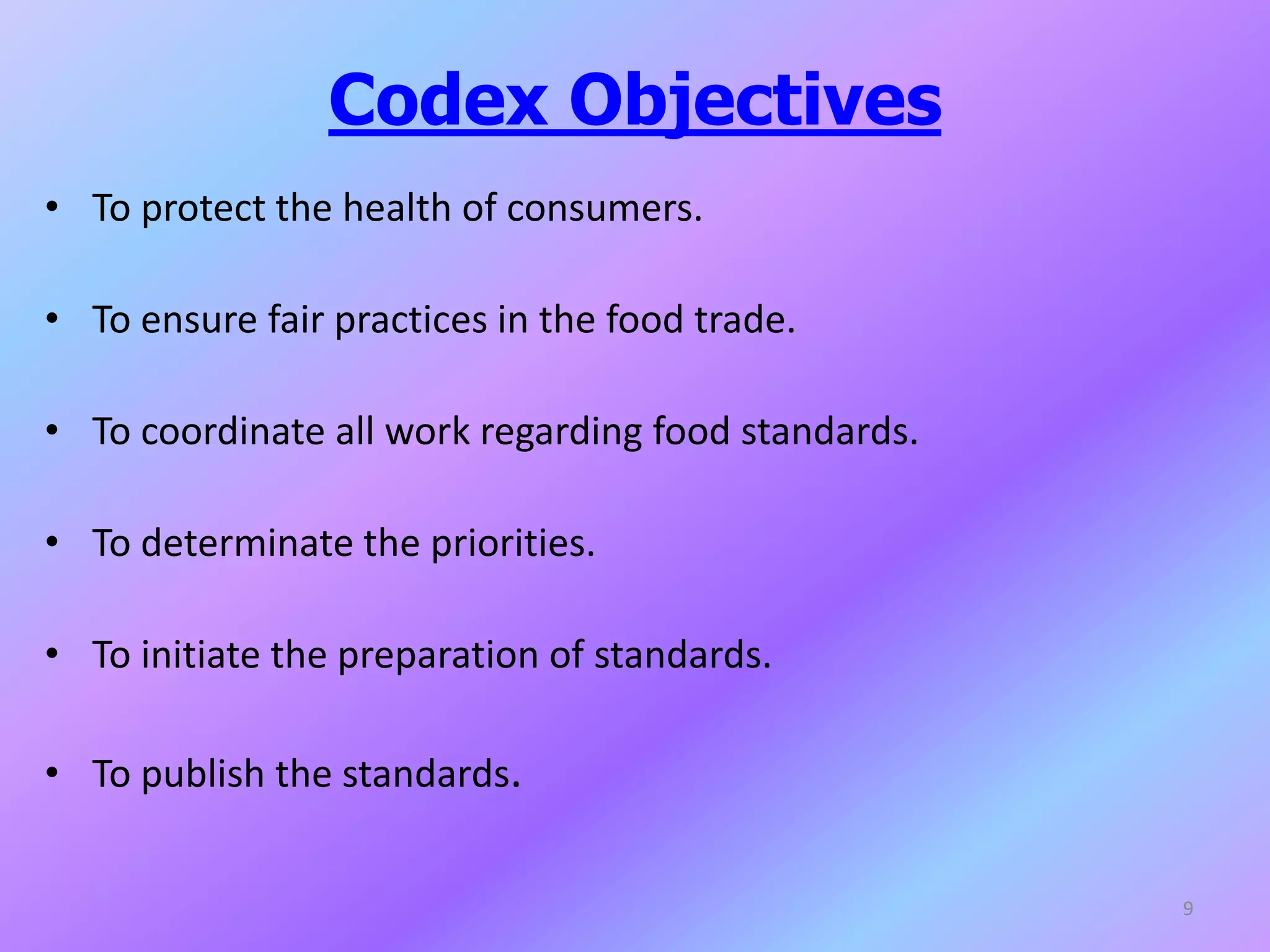
Codex Objectives
• Toprotect the health of consumers.
• To ensure fair practices in the food trade.
• To coordinate all work regarding food standards.
• To determinate the priorities.
• To initiate the preparation of standards.
• To publish the standards.
9
10.
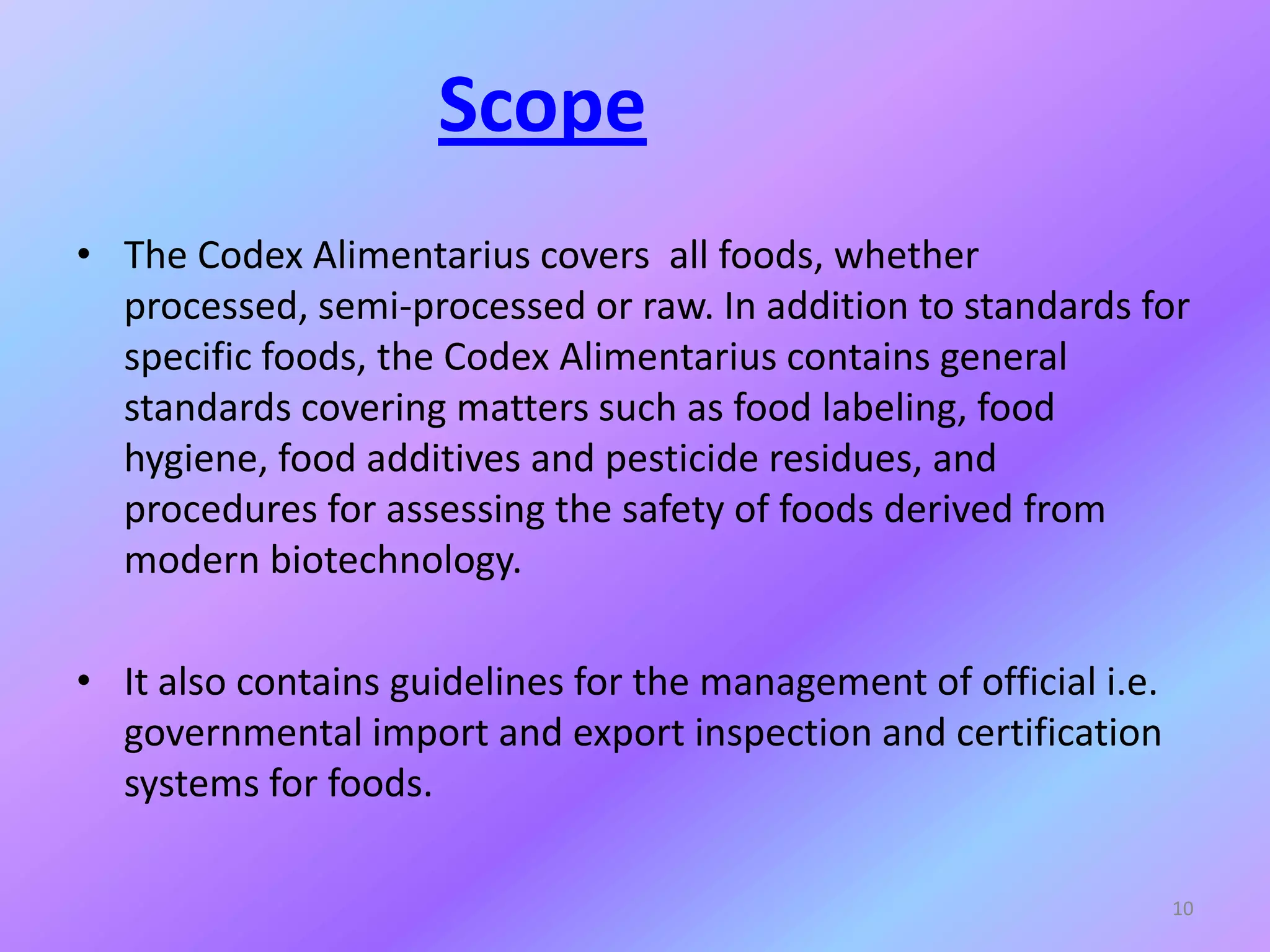
Scope
• The CodexAlimentarius covers all foods, whether
processed, semi-processed or raw. In addition to standards for
specific foods, the Codex Alimentarius contains general
standards covering matters such as food labeling, food
hygiene, food additives and pesticide residues, and
procedures for assessing the safety of foods derived from
modern biotechnology.
• It also contains guidelines for the management of official i.e.
governmental import and export inspection and certification
systems for foods.
10
11.
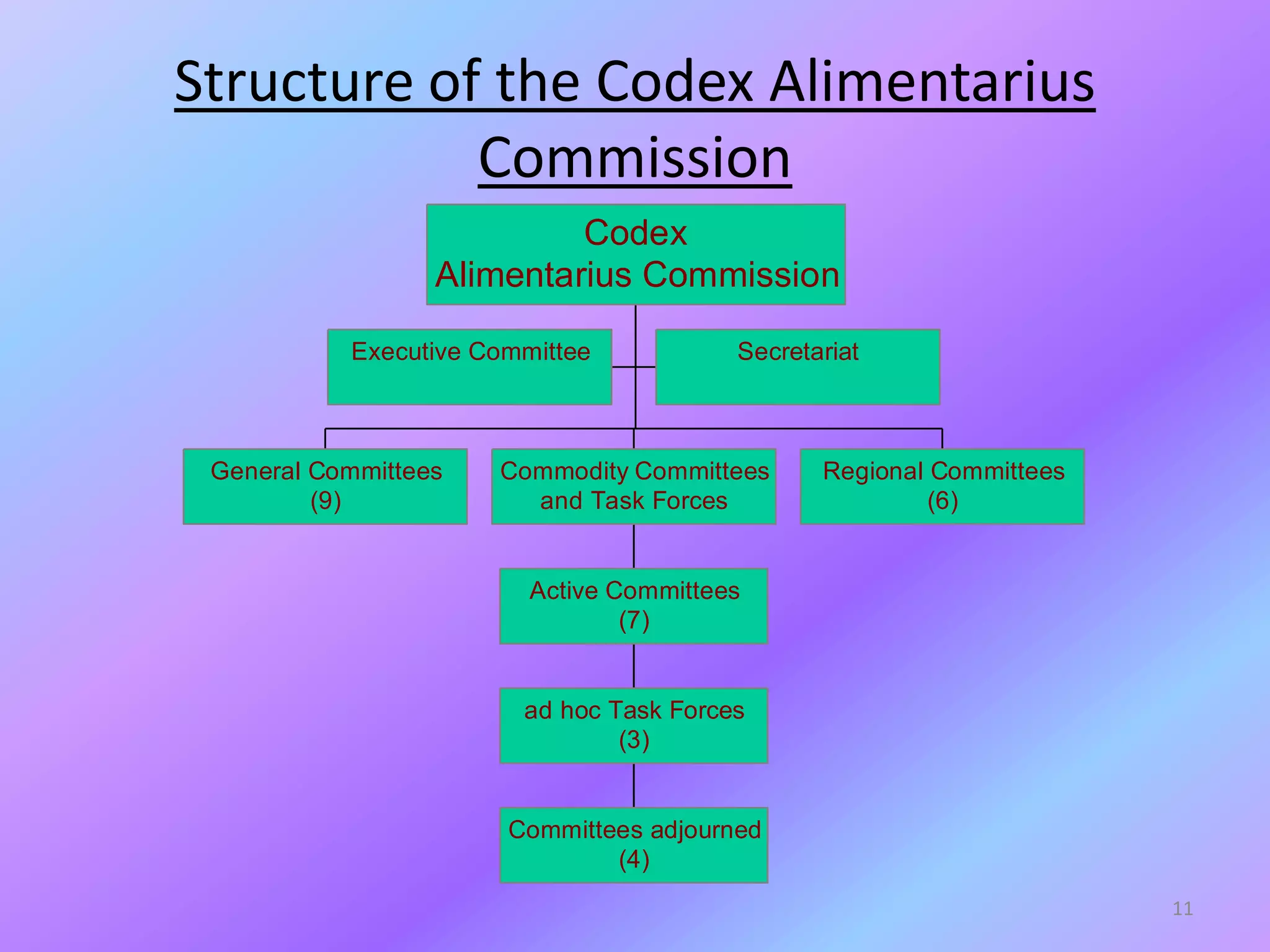
Structure of theCodex Alimentarius
Commission
11
Executive Committee Secretariat
General Committees
(9)
Committees adjourned
(4)
ad hoc Task Forces
(3)
Active Committees
(7)
Commodity Committees
and Task Forces
Regional Committees
(6)
Codex
Alimentarius Commission
12.
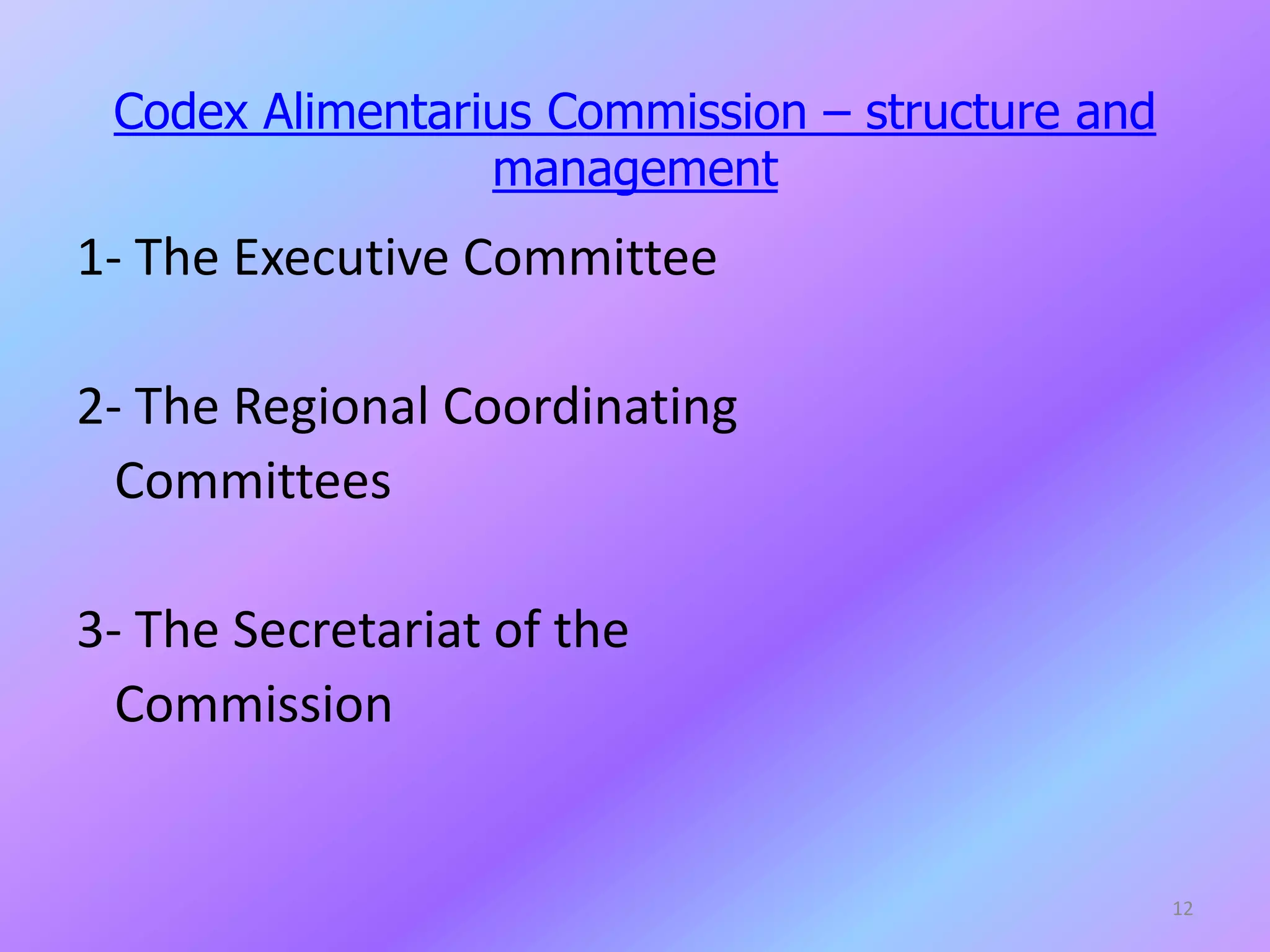
Codex Alimentarius Commission– structure and
management
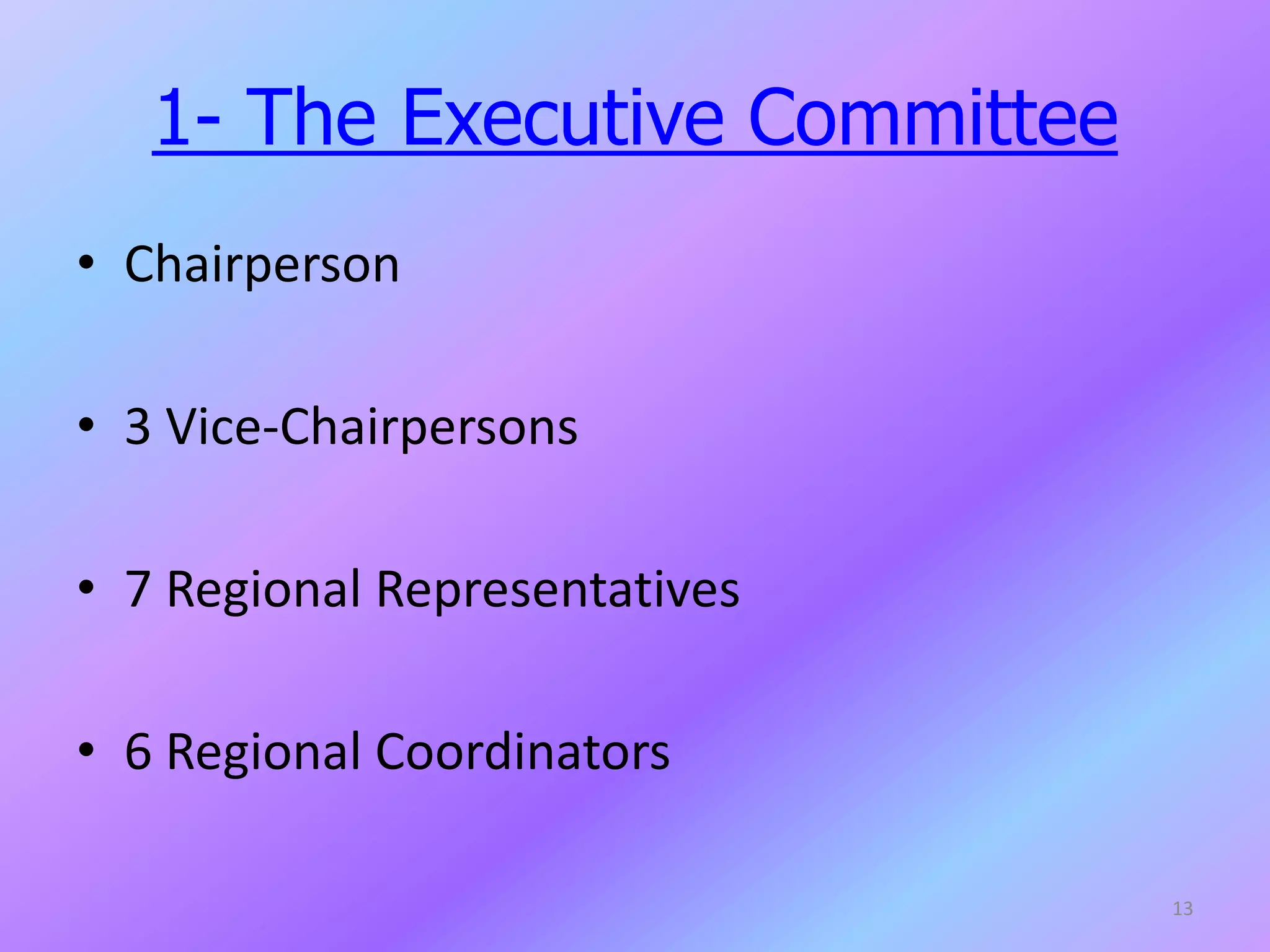
1- The Executive Committee
2- The Regional Coordinating
Committees
3- The Secretariat of the
Commission
12
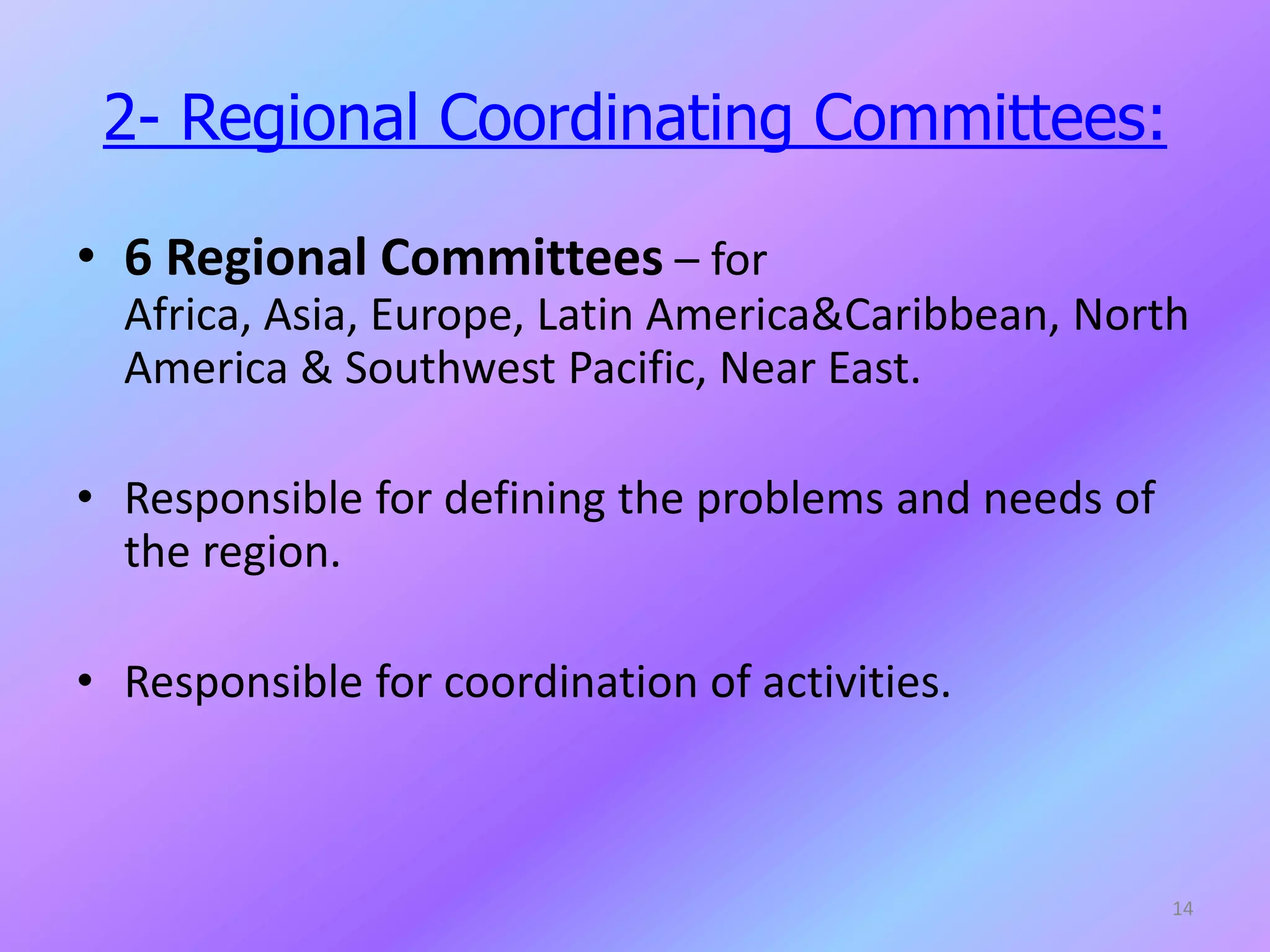
2- Regional CoordinatingCommittees:
• 6 Regional Committees – for
Africa, Asia, Europe, Latin America&Caribbean, North
America & Southwest Pacific, Near East.
• Responsible for defining the problems and needs of
the region.
• Responsible for coordination of activities.
14
15.
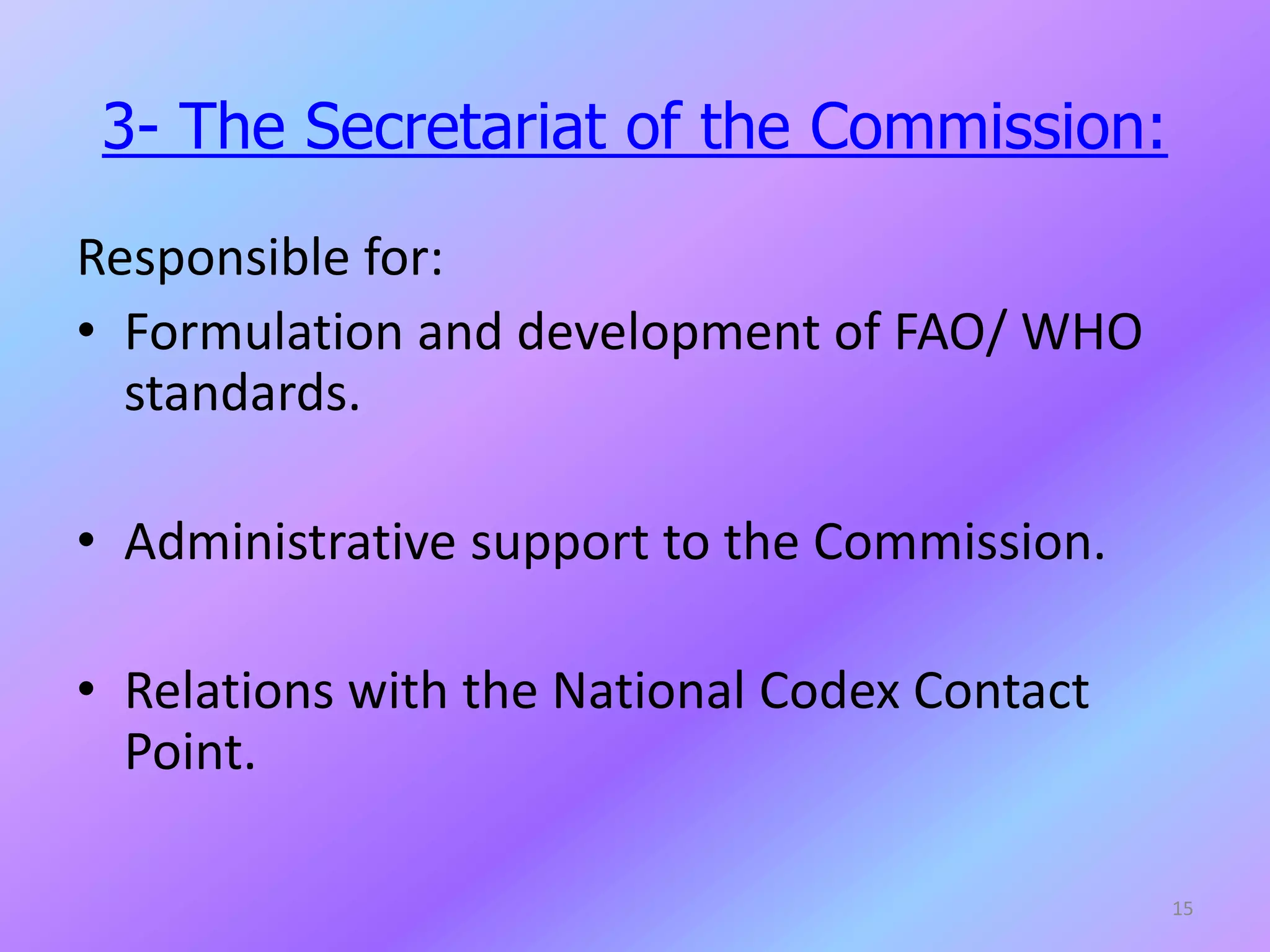
3- The Secretariatof the Commission:
Responsible for:
• Formulation and development of FAO/ WHO
standards.
• Administrative support to the Commission.
• Relations with the National Codex Contact
Point.
15
16.
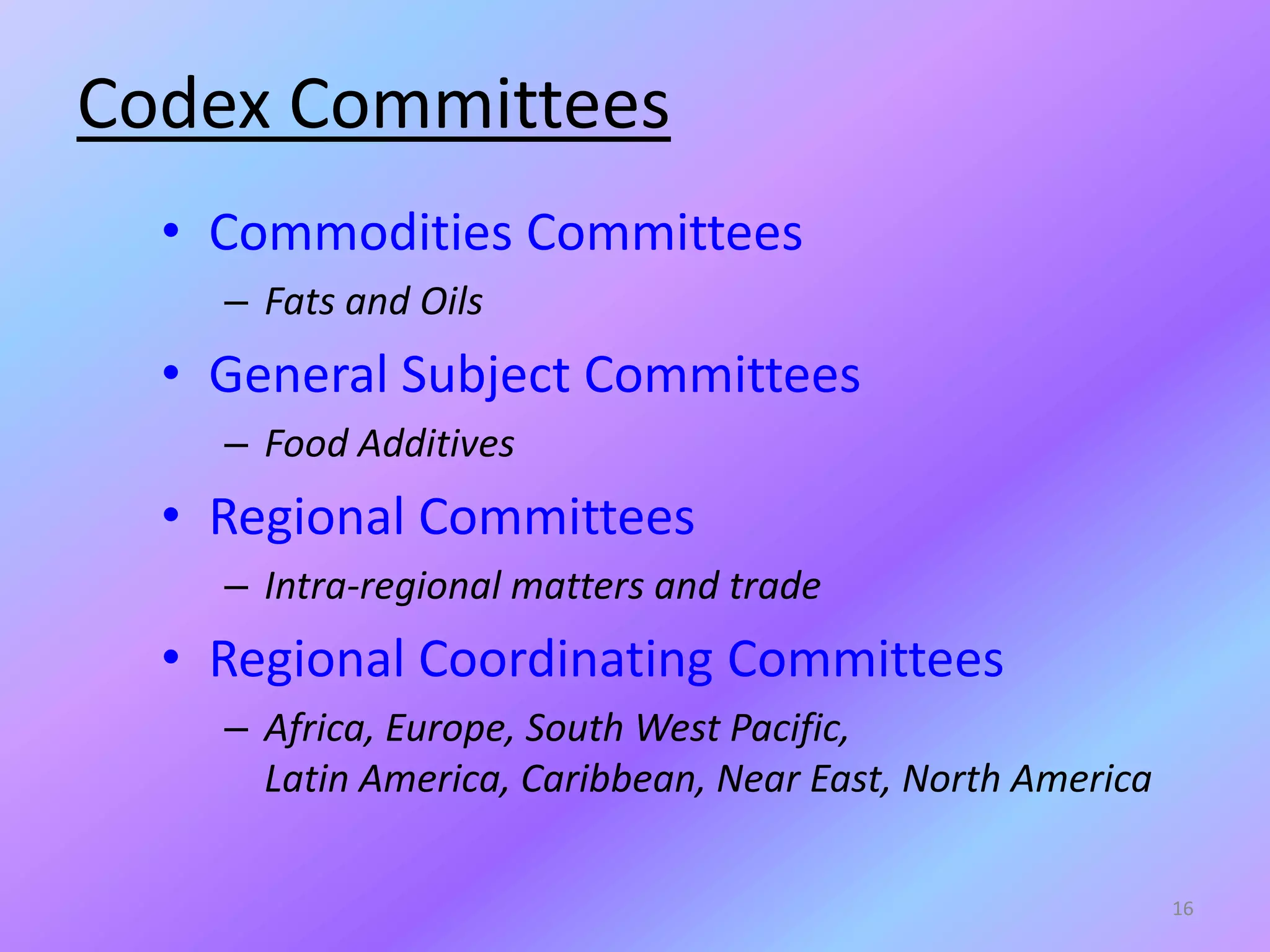
Codex Committees
• CommoditiesCommittees
– Fats and Oils
• General Subject Committees
– Food Additives
• Regional Committees
– Intra-regional matters and trade
• Regional Coordinating Committees
– Africa, Europe, South West Pacific,
Latin America, Caribbean, Near East, North America
16
17.
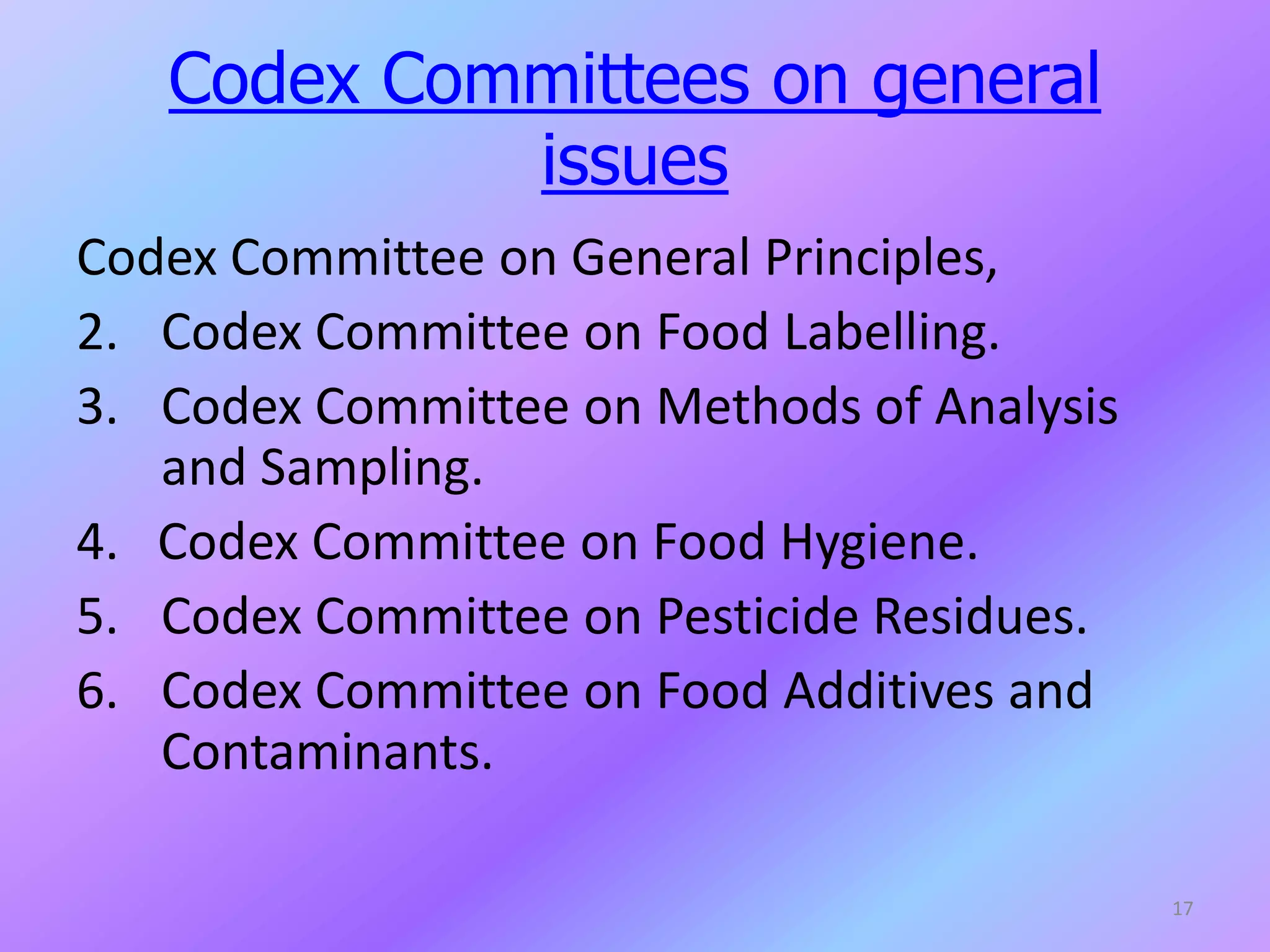
Codex Committees ongeneral
issues
Codex Committee on General Principles,
2. Codex Committee on Food Labelling.
3. Codex Committee on Methods of Analysis
and Sampling.
4. Codex Committee on Food Hygiene.
5. Codex Committee on Pesticide Residues.
6. Codex Committee on Food Additives and
Contaminants.
17
18.
Cont..
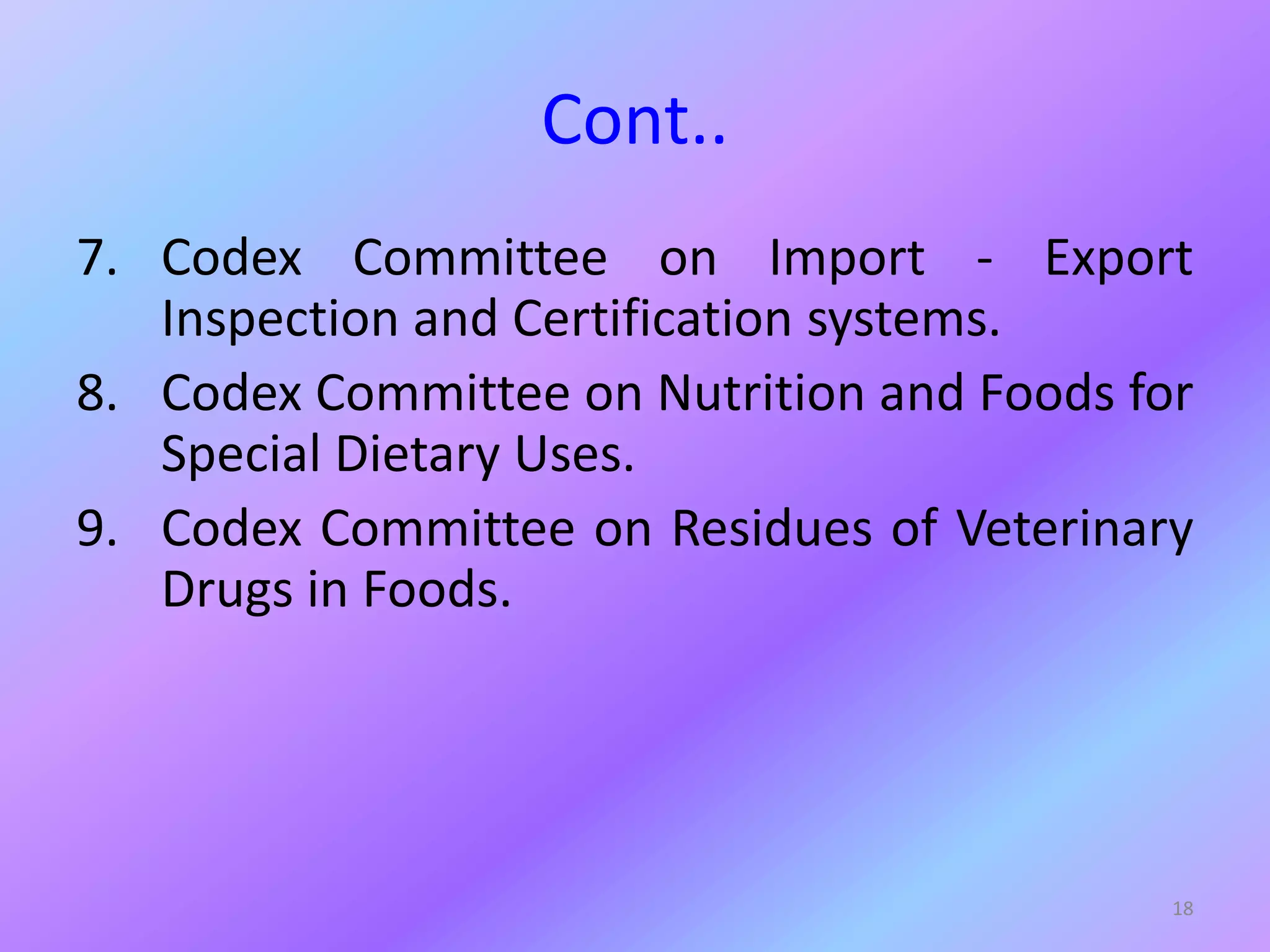
7. Codex Committeeon Import - Export
Inspection and Certification systems.
8. Codex Committee on Nutrition and Foods for
Special Dietary Uses.
9. Codex Committee on Residues of Veterinary
Drugs in Foods.
18
19.
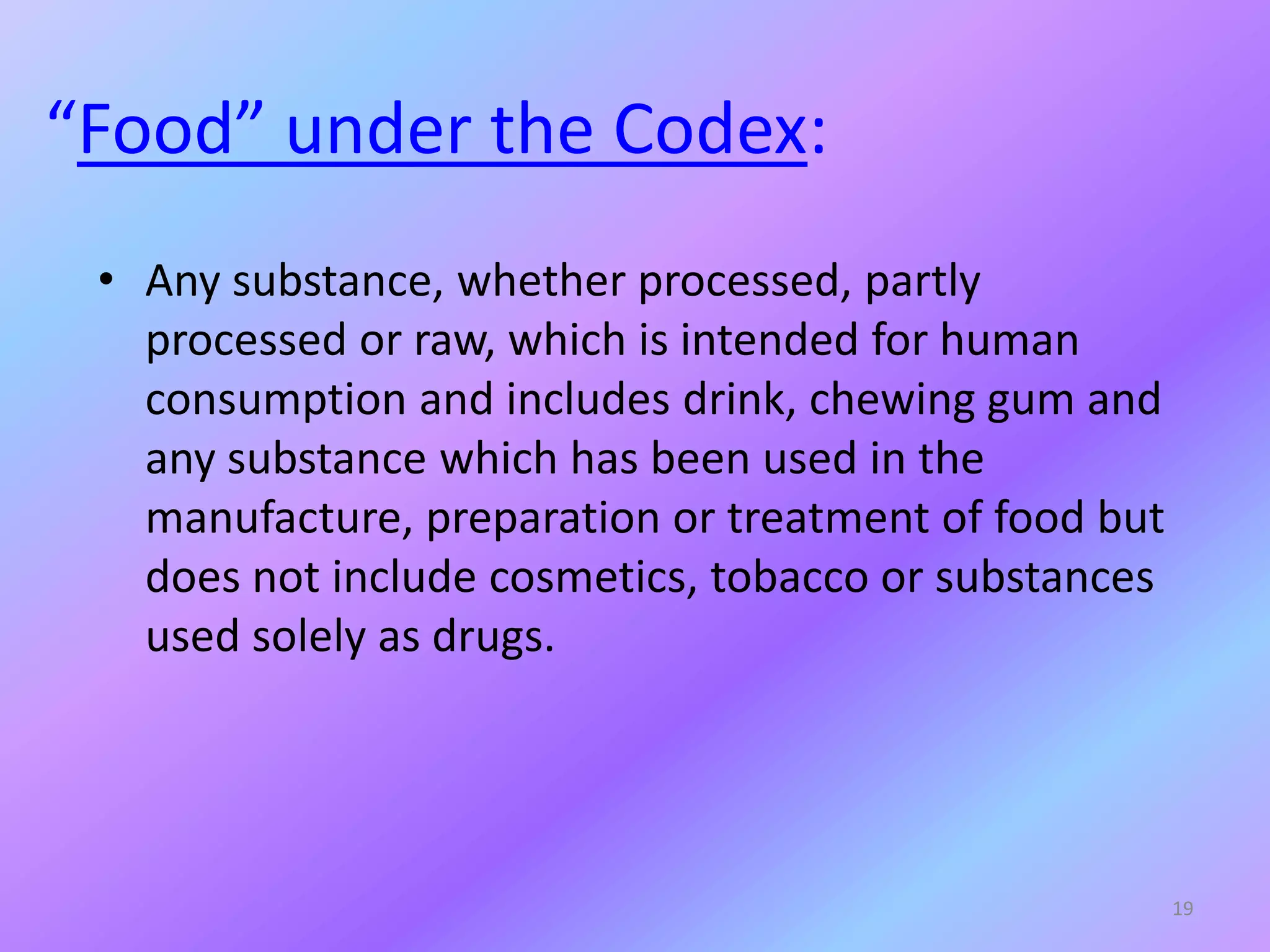
“Food” under theCodex:
• Any substance, whether processed, partly
processed or raw, which is intended for human
consumption and includes drink, chewing gum and
any substance which has been used in the
manufacture, preparation or treatment of food but
does not include cosmetics, tobacco or substances
used solely as drugs.
19
20.
Codex Legal Tools:
•Codex Standards
• Codes of Practices
• Guidelines and Recommendations
20
21.
Codex Standards
• Foodrequirements intended to provide
consumers with a sound, wholesome food
product free from adulteration, correctly
labeled and presented.
• International acceptance most importance
consideration next to safety.
21
22.
Codex Standards
• Prescribedformat used to develop each
standard. Must include:
– Name, scope, description, essential
composition and quality factors, food
additives, contaminants, hygiene, weights and
measures, labeling and methods of analysis
and sampling.
22
23.
Codes of Practice
•Advisory text issued to all members.
• Designed to assist members in achieving
purposes of Codex.
• Individual members decide how to use code
• Typically describe “hygiene” requirements
– “Adequate” / “Acceptable”.
• Considered “checklist” of requirements for
enforcement authorities (Jurisdictional
Prerequisites).
23
24.
Guidelines and Recommendations
•Basic tool used to help member nations in
elaboration of their standards to conform to Codex.
• Not binding but accepted worldwide.
• Very useful to developing countries.
• Example: “Code of Ethics for International Trade in
Food”.
• Commission can make guidelines “quasi-binding”
– i.e. SPS Agreement guidelines.
24
25.
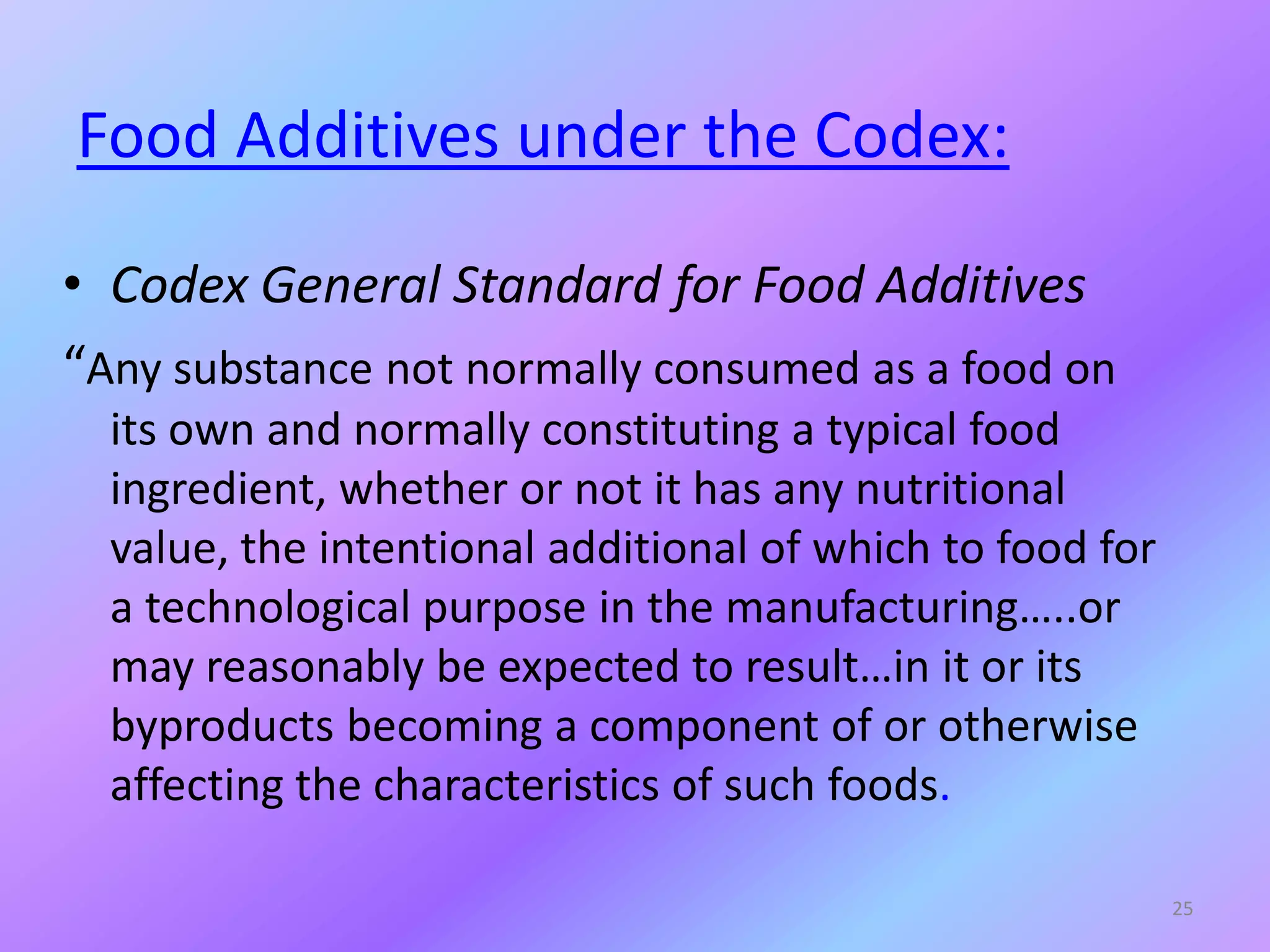
Food Additives underthe Codex:
• Codex General Standard for Food Additives
“Any substance not normally consumed as a food on
its own and normally constituting a typical food
ingredient, whether or not it has any nutritional
value, the intentional additional of which to food for
a technological purpose in the manufacturing…..or
may reasonably be expected to result…in it or its
byproducts becoming a component of or otherwise
affecting the characteristics of such foods.
25
26.
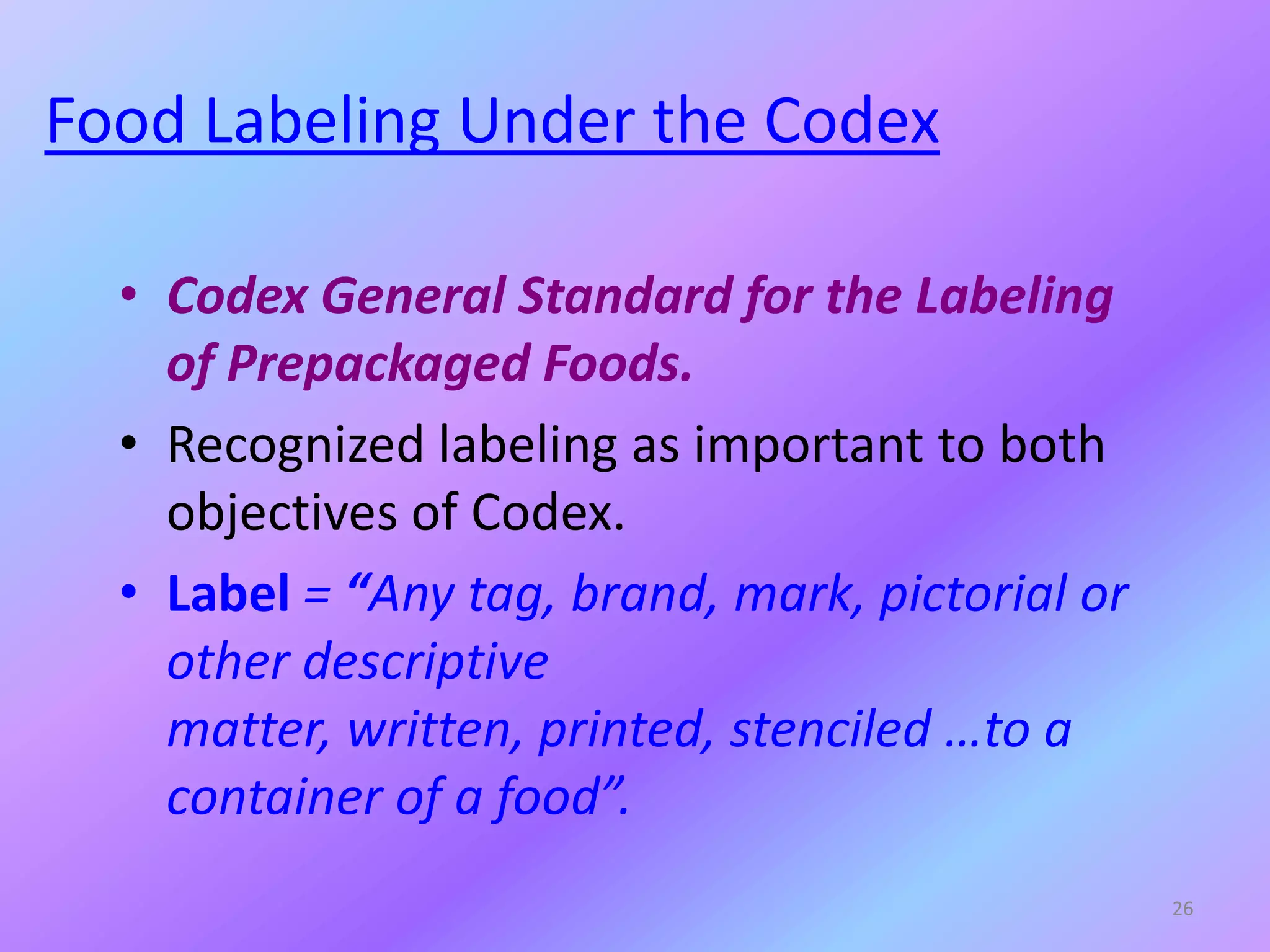
Food Labeling Underthe Codex
• Codex General Standard for the Labeling
of Prepackaged Foods.
• Recognized labeling as important to both
objectives of Codex.
• Label = “Any tag, brand, mark, pictorial or
other descriptive
matter, written, printed, stenciled …to a
container of a food”.
26
27.
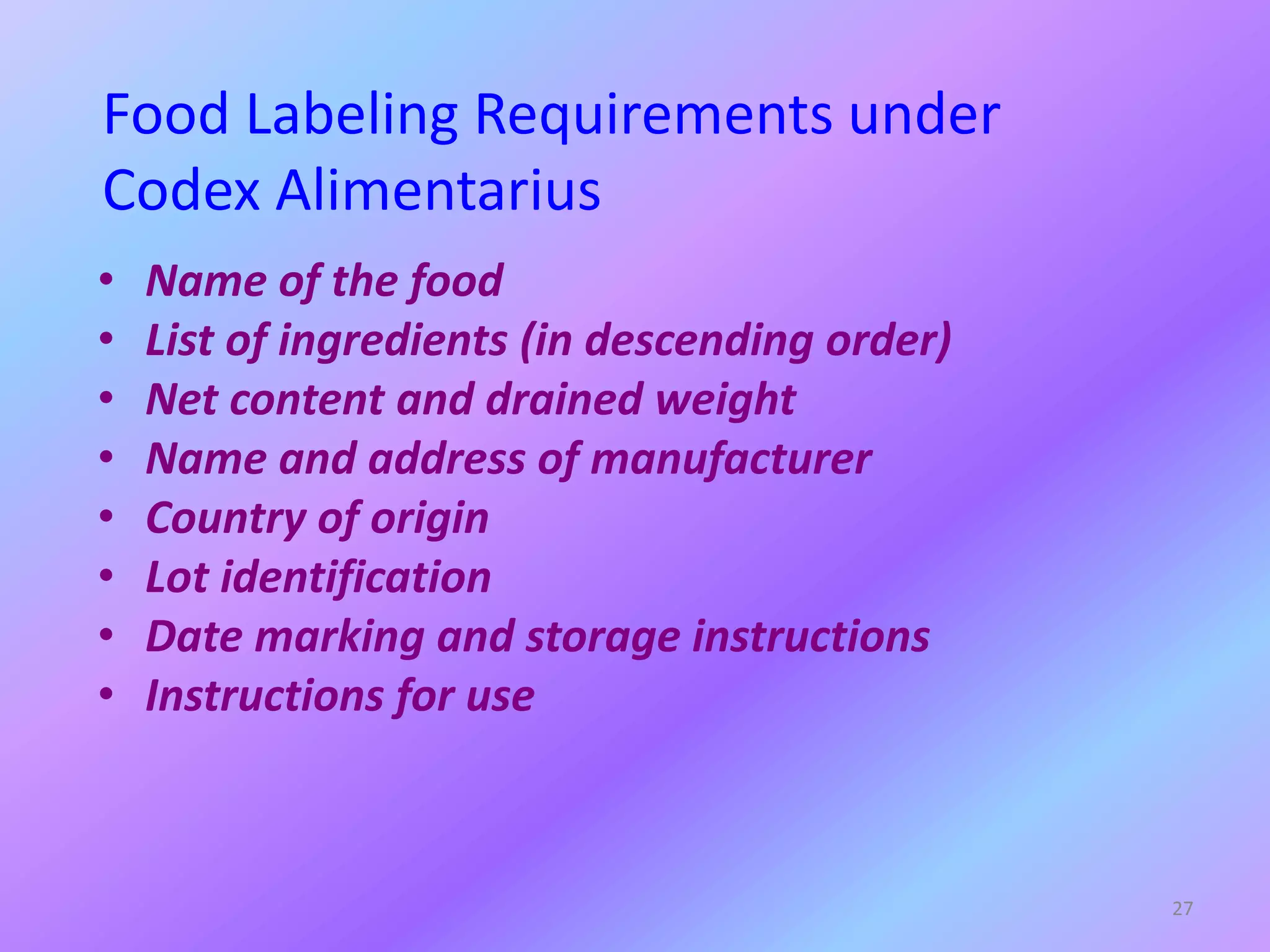
Food Labeling Requirementsunder
Codex Alimentarius
• Name of the food
• List of ingredients (in descending order)
• Net content and drained weight
• Name and address of manufacturer
• Country of origin
• Lot identification
• Date marking and storage instructions
• Instructions for use
27
28.
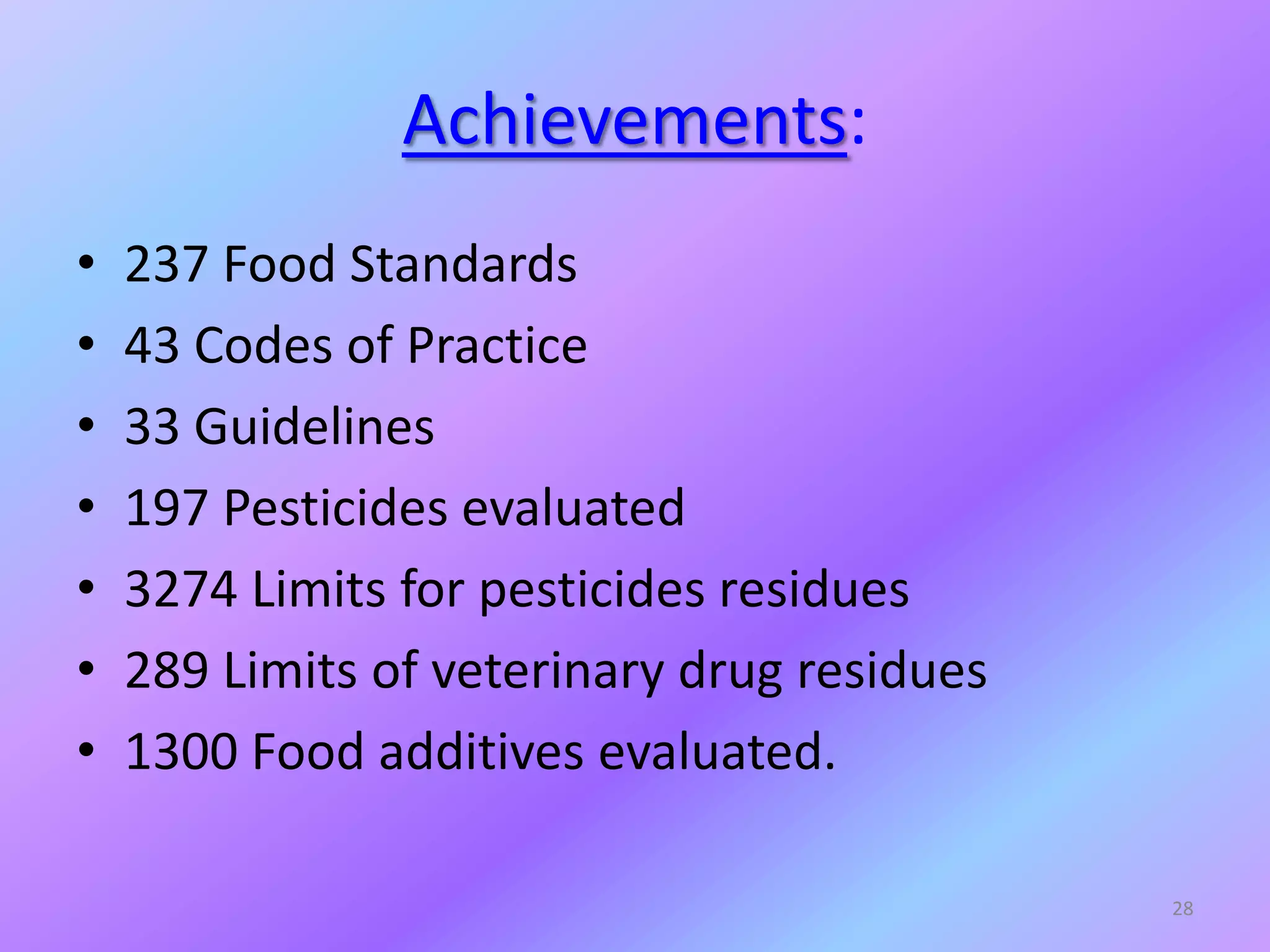
Achievements:
• 237 FoodStandards
• 43 Codes of Practice
• 33 Guidelines
• 197 Pesticides evaluated
• 3274 Limits for pesticides residues
• 289 Limits of veterinary drug residues
• 1300 Food additives evaluated.
28