
FSSAI
By: Harveer Singh
twitter.com/iastoss
+91-880-2009-420
This PPT is for educational purpose only. The learner is expected to supplement the video lecture
with this ppt. The content is taken from various daily and weekly publications. Due care has been
taken in preparing the material but the tutor or superprofs would not be responsible for any error
or consequences arising out of it.
1
FOOD SAFETY LEGISLATION - the need……
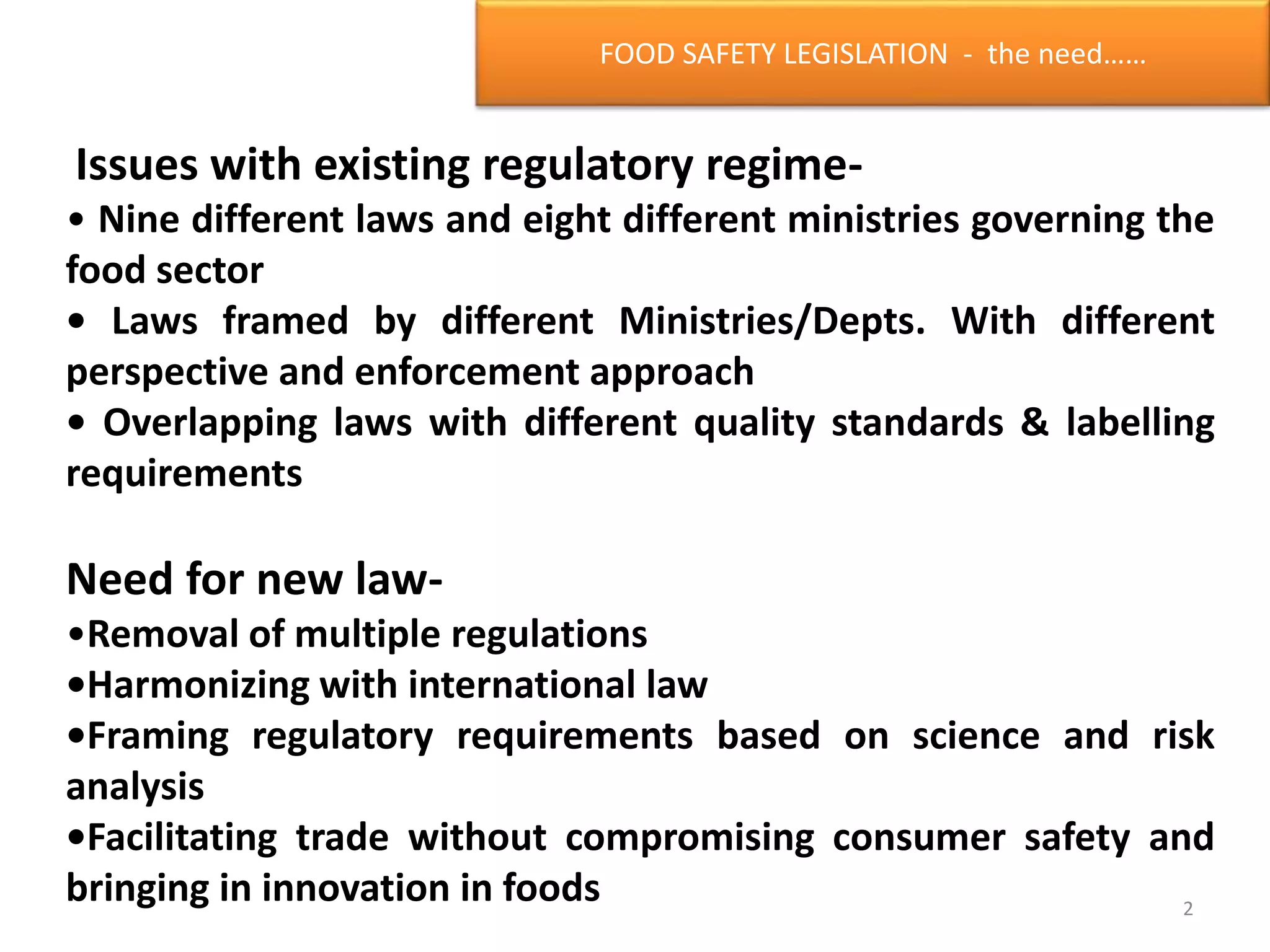
Issues with existing regulatory regime-
• Nine different laws and eight different ministries governing the
food sector
• Laws framed by different Ministries/Depts. With different
perspective and enforcement approach
• Overlapping laws with different quality standards & labelling
requirements
Need for new law-
•Removal of multiple regulations
•Harmonizing with international law
•Framing regulatory requirements based on science and risk
analysis
•Facilitating trade without compromising consumer safety and
bringing in innovation in foods 2
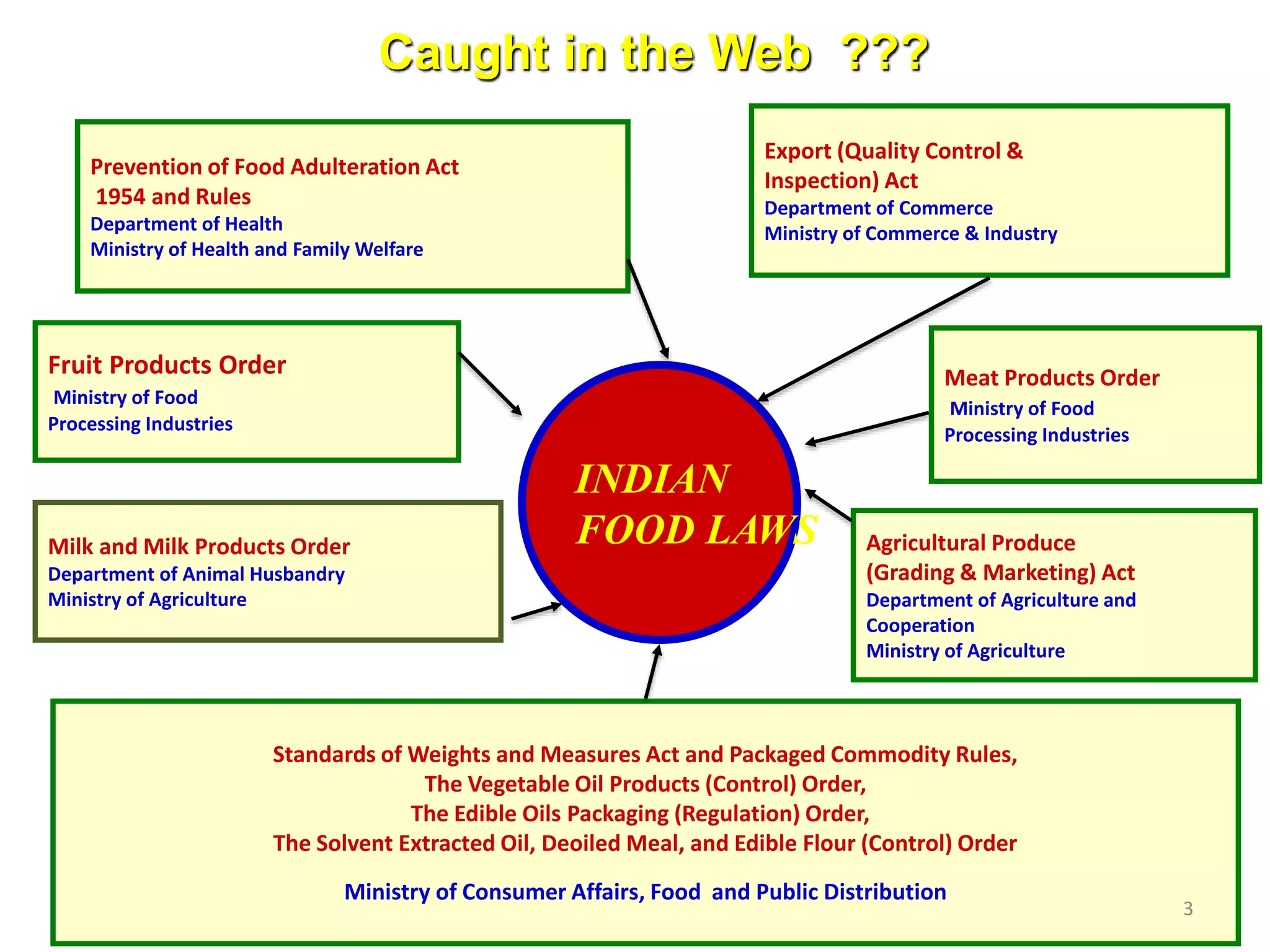
INDIAN
FOOD LAWS
Prevention of Food Adulteration Act
1954 and Rules
Department of Health
Ministry of Health and Family Welfare
Fruit Products Order
Ministry of Food
Processing Industries
Milk and Milk Products Order
Department of Animal Husbandry
Ministry of Agriculture
Agricultural Produce
(Grading & Marketing) Act
Department of Agriculture and
Cooperation
Ministry of Agriculture
Standards of Weights and Measures Act and Packaged Commodity Rules,
The Vegetable Oil Products (Control) Order,
The Edible Oils Packaging (Regulation) Order,
The Solvent Extracted Oil, Deoiled Meal, and Edible Flour (Control) Order
Ministry of Consumer Affairs, Food and Public Distribution
Export (Quality Control &
Inspection) Act
Department of Commerce
Ministry of Commerce & Industry
Caught in the Web ???
Meat Products Order
Ministry of Food
Processing Industries
3
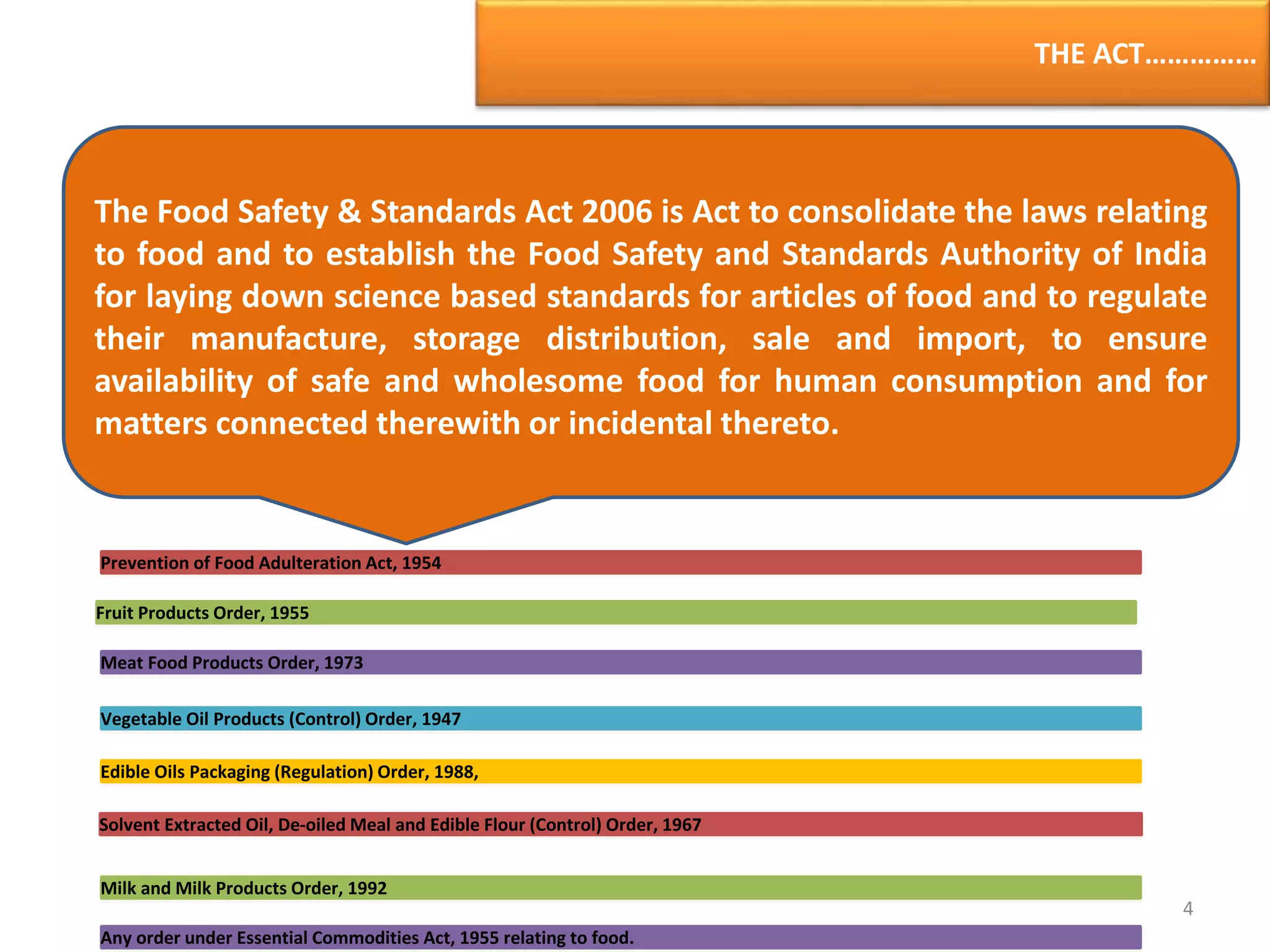
THE ACT……………
Prevention of Food Adulteration Act, 1954
Fruit Products Order, 1955
Meat Food Products Order, 1973
Vegetable Oil Products (Control) Order, 1947
Edible Oils Packaging (Regulation) Order, 1988,
Solvent Extracted Oil, De-oiled Meal and Edible Flour (Control) Order, 1967
Milk and Milk Products Order, 1992
Any order under Essential Commodities Act, 1955 relating to food.
The Food Safety & Standards Act 2006 is Act to consolidate the laws relating
to food and to establish the Food Safety and Standards Authority of India
for laying down science based standards for articles of food and to regulate
their manufacture, storage distribution, sale and import, to ensure
availability of safe and wholesome food for human consumption and for
matters connected therewith or incidental thereto.
4
SALIENT FEATURE OF THE ACT……………
 To ensure that all food meets consumers’
expectations in terms of nature, substance and quality
and is not misleadingly presents;
 To provide legal powers and specify offences in
relation to public health and consumers’ interest;
 To shift from regulatory regime to self compliance
through Food Safety Management system.
 Science based standards
 Proprietary food, novel food, GM food, dietary
supplements, nutraceuticals etc brought into the ambit
of the new act.
5
SCOPE OF THE ACT……………
 The Act covers activities throughout the food
distribution chain, from primary production through
distribution to retail and catering.
 The Act gives the Government powers to make
regulations on matters of food safety.
 The Food Safety & Standards Authority of India is the
principal Government Authority responsible for
preparing specific regulations under the Act.
6
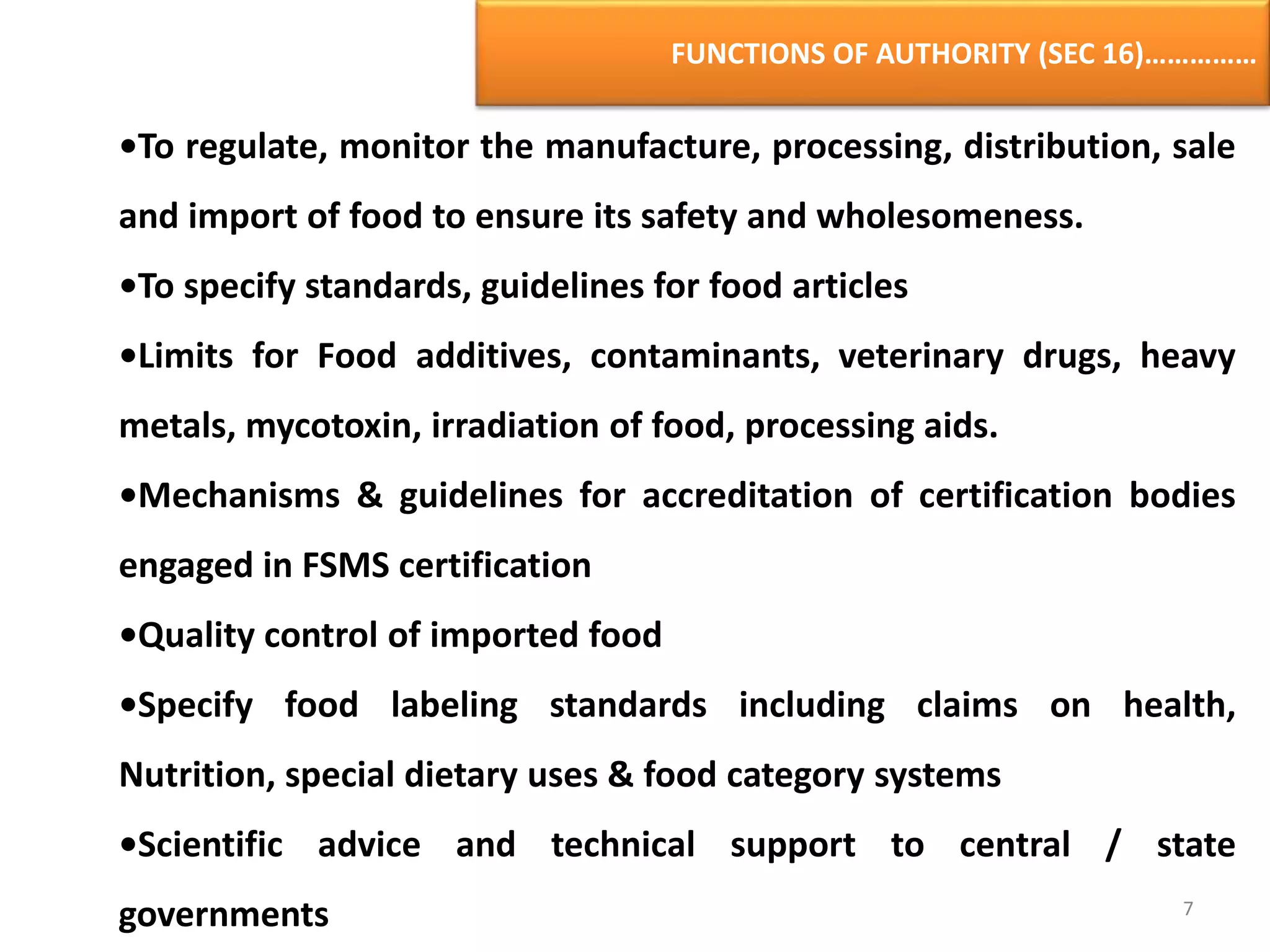
FUNCTIONS OF AUTHORITY (SEC 16)……………
•To regulate, monitor the manufacture, processing, distribution, sale
and import of food to ensure its safety and wholesomeness.
•To specify standards, guidelines for food articles
•Limits for Food additives, contaminants, veterinary drugs, heavy
metals, mycotoxin, irradiation of food, processing aids.
•Mechanisms & guidelines for accreditation of certification bodies
engaged in FSMS certification
•Quality control of imported food
•Specify food labeling standards including claims on health,
Nutrition, special dietary uses & food category systems
•Scientific advice and technical support to central / state
governments 7
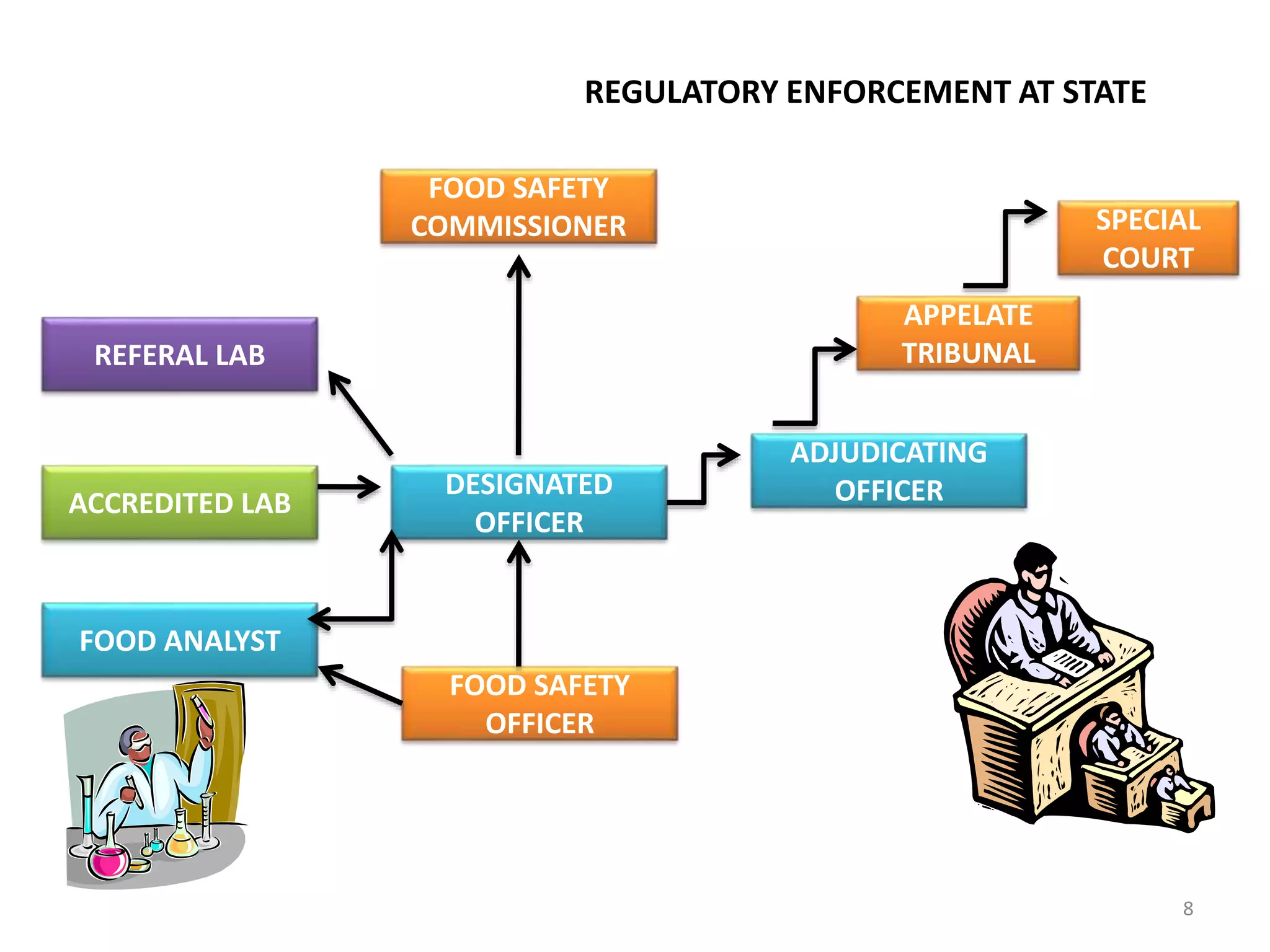
APPELATE
TRIBUNAL
FOOD SAFETY
COMMISSIONER
FOOD SAFETY
OFFICER
ACCREDITED LAB
REFERAL LAB
FOOD ANALYST
DESIGNATED
OFFICER
ADJUDICATING
OFFICER
SPECIAL
COURT
REGULATORY ENFORCEMENT AT STATE
8
ROLE OF STATE AS PER THE ACT….
ROLES & RESPONSIBILITIES OF FOOD SAFETY COMMISSIONER
Prohibit in the interest of public health, the manufacture,
storage, distribution, or sale of any article of food.
Carry out survey/inspection of the food processing units in the
state to find out compliance of prescribed standards.
Conduct training programmes for the personnel engaged in food
safety.
Ensure efficient and uniform implementation of the standards
and other requirements of food safety.
Sanction prosecution for offences punishable with imprisonment
under this Act.
9
ROLE OF STATE AS PER THE ACT….
ROLES & RESPONSIBILITIES OF DESIGNATED OFFICER
Issue or cancel license of Food Business Operator.
Prohibit sale in contravention of this Act.
Receive report and samples of articles of food from Food
Safety Officer and get them analyzed.
Make recommendation to the Commissioner of Food Safety
for sanction to launch prosecutions
Sanction prosecution
Maintain record of all inspections made by Food Safety
Officers
Get complaints investigated in respect of any contravention of
the provision of this Act or against FSO
10
ROLE OF STATE AS PER THE ACT….
ROLES & RESPONSIBILITIES OF FOOD SAFETY OFFICER
Taking samples of food intended for sale
Seize any articles of food which appears to be in contravention
of this Act
Enter and inspect any place where food is manufactured, or
stored for sale
 May after giving notice, cause unsafe food destroyed
Seize any adulterant found in possession of a manufacturer or
distributor
Can be penalised for harassment of business operator (There is
provision for penalising Complainant for false complaint)
11
ENFORCEMENT OF PROVISIONS OF THE ACT….
 Article 31 lays down Licensing and Registration conditions which
are compulsory for any food business.
Any person desirous to commence or carry on any food business
shall make an application to grant of a License to the Designated
Officer alongwith fees.
In case a license is not issued within two months from the date
of making the application or his application is not rejected, the
applicant may start his food business after expiry of the said
period.
The provision of obtaining a licence for carrying on any food
business shall not apply to a petty retailer, hawker, itinerant
vendor or a temporary stall holder or small scale or cottage or such
other industries relating to food business or tiny Food Business
Operator. But they shall have Registration with the Designated
Officer. 12
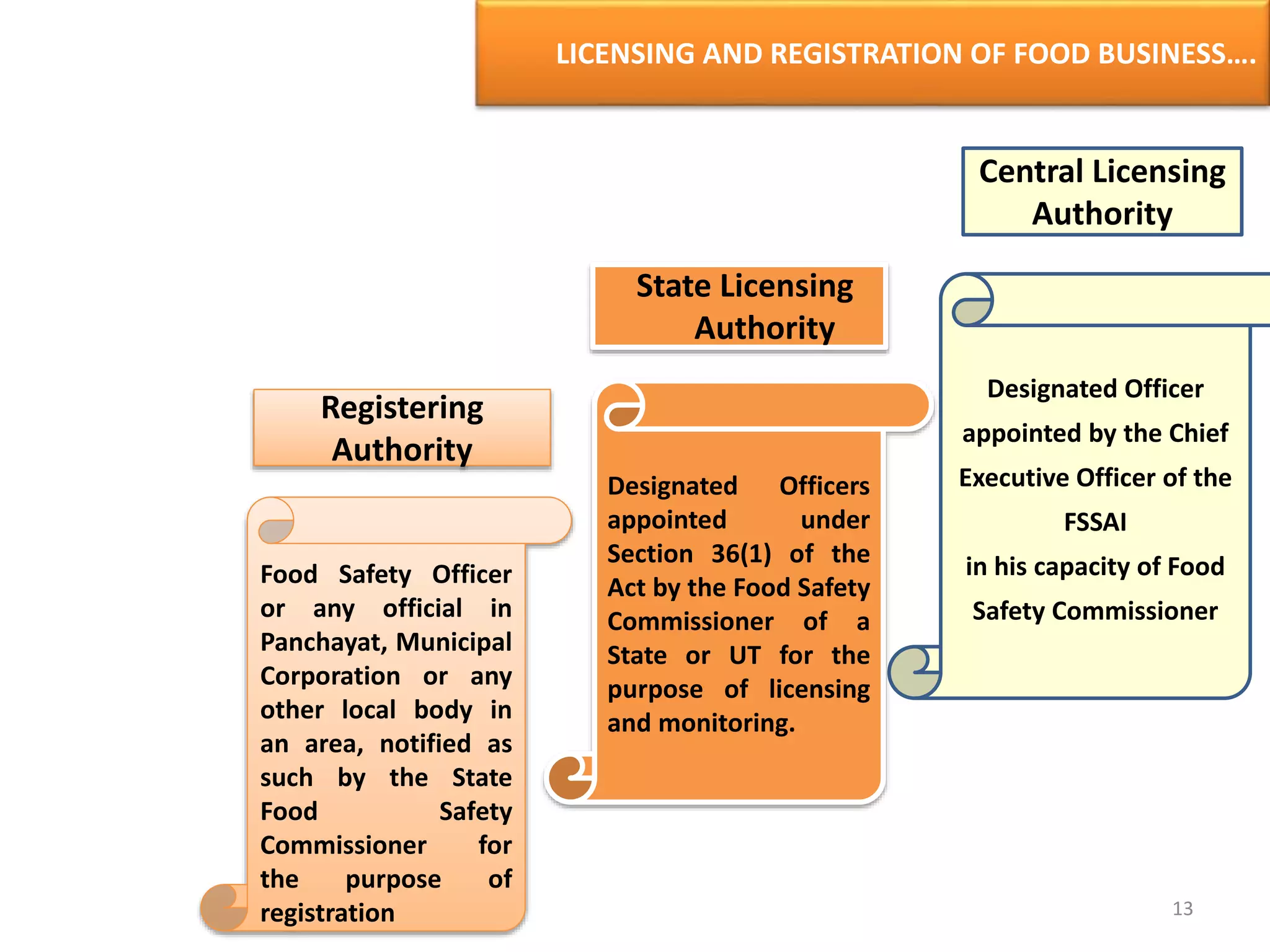
LICENSING AND REGISTRATION OF FOOD BUSINESS….
Central Licensing
Authority
State Licensing
Authority
Registering
Authority
Designated Officer
appointed by the Chief
Executive Officer of the
FSSAI
in his capacity of Food
Safety Commissioner
Food Safety Officer
or any official in
Panchayat, Municipal
Corporation or any
other local body in
an area, notified as
such by the State
Food Safety
Commissioner for
the purpose of
registration
Designated Officers
appointed under
Section 36(1) of the
Act by the Food Safety
Commissioner of a
State or UT for the
purpose of licensing
and monitoring.
13
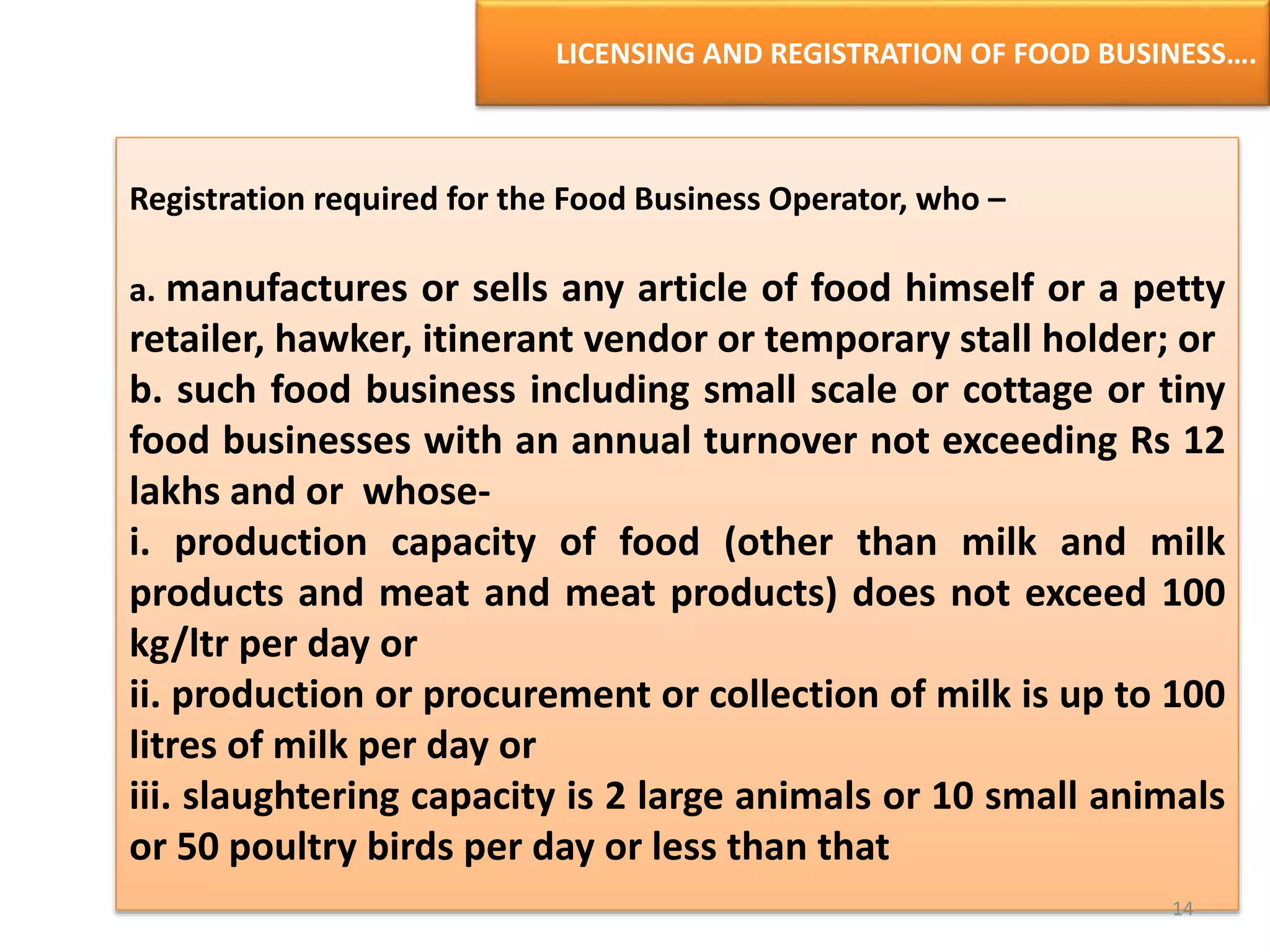
LICENSING AND REGISTRATION OF FOOD BUSINESS….
Registration required for the Food Business Operator, who –
a. manufactures or sells any article of food himself or a petty
retailer, hawker, itinerant vendor or temporary stall holder; or
b. such food business including small scale or cottage or tiny
food businesses with an annual turnover not exceeding Rs 12
lakhs and or whose-
i. production capacity of food (other than milk and milk
products and meat and meat products) does not exceed 100
kg/ltr per day or
ii. production or procurement or collection of milk is up to 100
litres of milk per day or
iii. slaughtering capacity is 2 large animals or 10 small animals
or 50 poultry birds per day or less than that
14
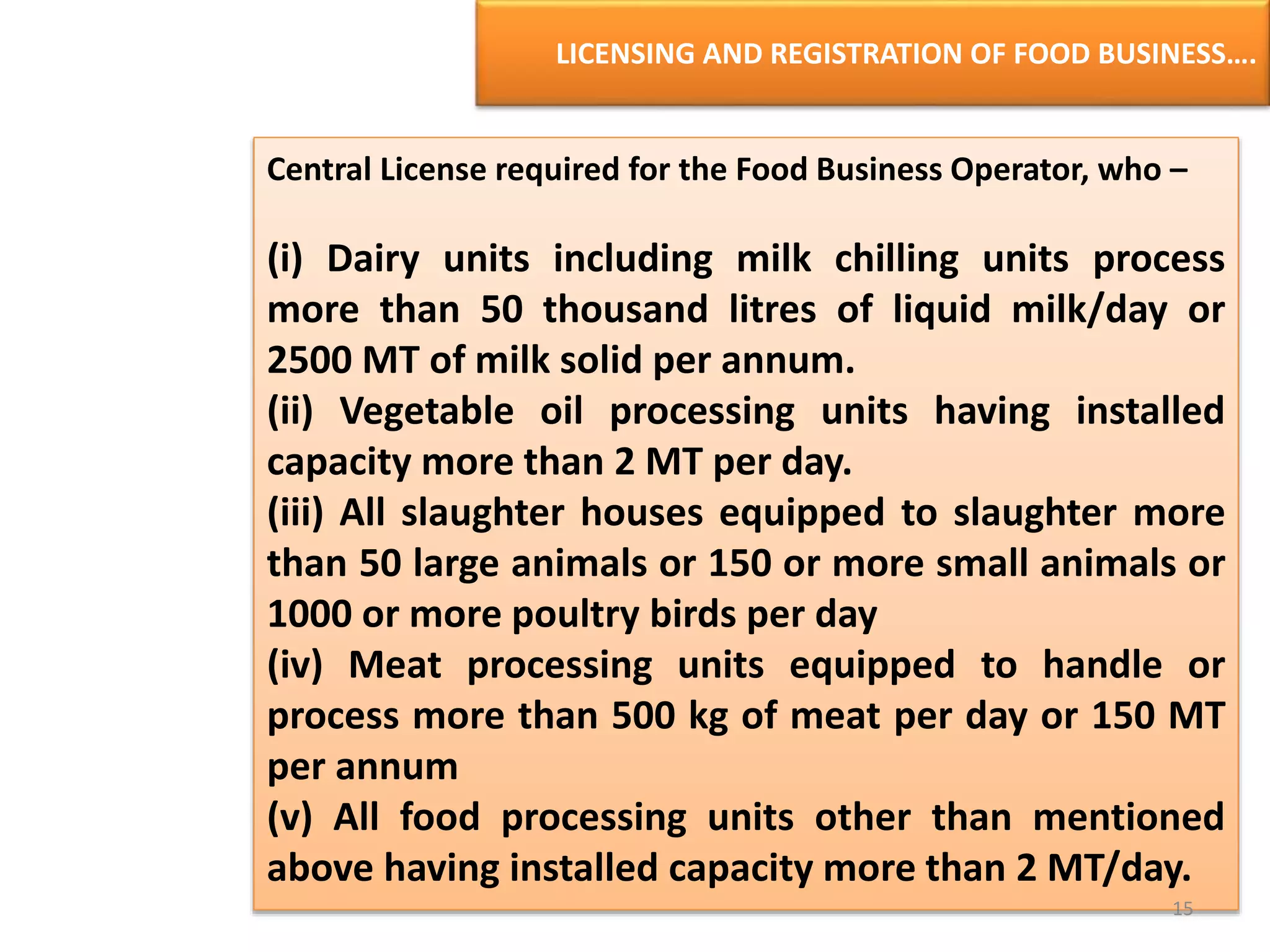
LICENSING AND REGISTRATION OF FOOD BUSINESS….
Central License required for the Food Business Operator, who –
(i) Dairy units including milk chilling units process
more than 50 thousand litres of liquid milk/day or
2500 MT of milk solid per annum.
(ii) Vegetable oil processing units having installed
capacity more than 2 MT per day.
(iii) All slaughter houses equipped to slaughter more
than 50 large animals or 150 or more small animals or
1000 or more poultry birds per day
(iv) Meat processing units equipped to handle or
process more than 500 kg of meat per day or 150 MT
per annum
(v) All food processing units other than mentioned
above having installed capacity more than 2 MT/day.
15
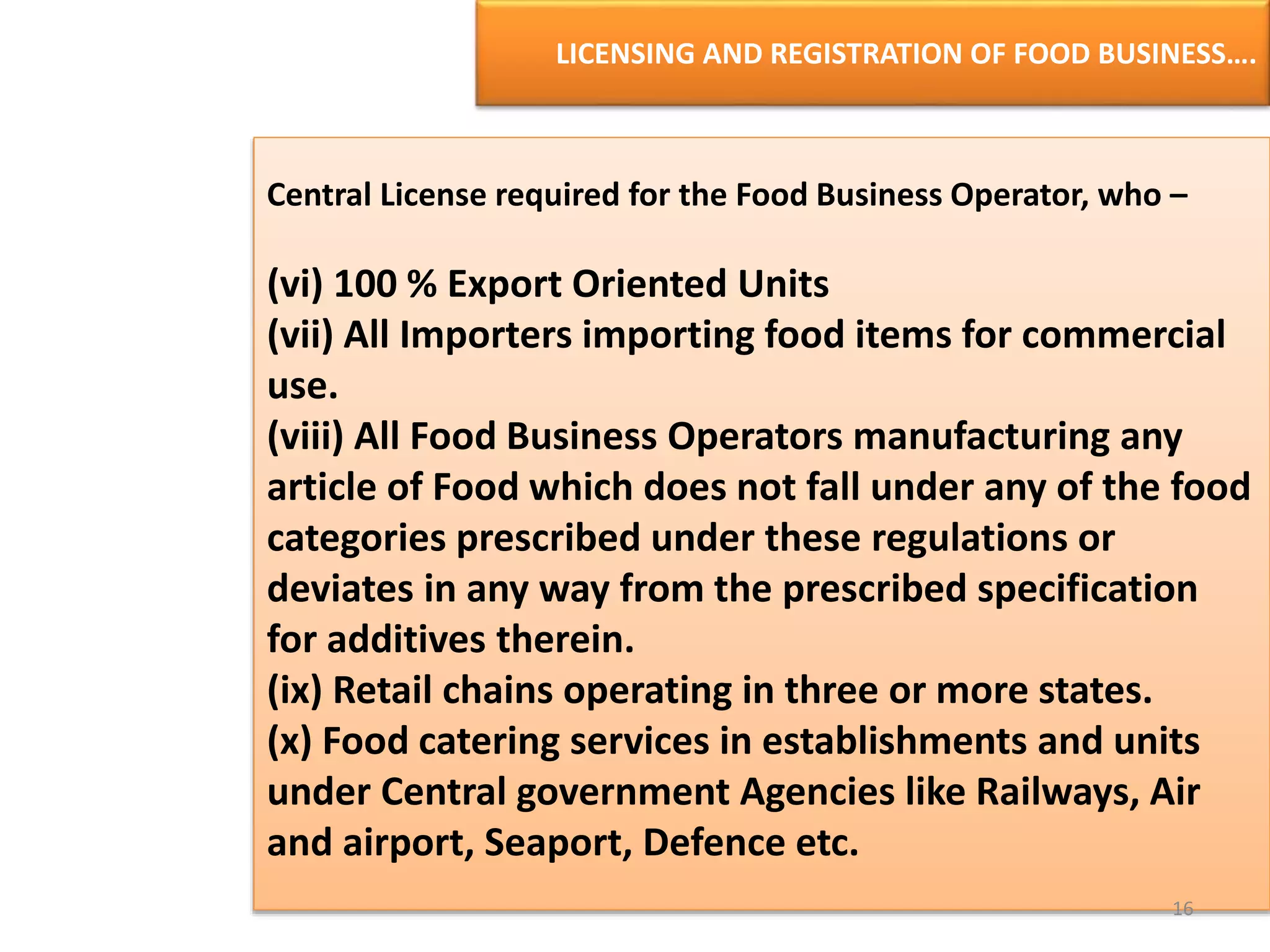
LICENSING AND REGISTRATION OF FOOD BUSINESS….
Central License required for the Food Business Operator, who –
(vi) 100 % Export Oriented Units
(vii) All Importers importing food items for commercial
use.
(viii) All Food Business Operators manufacturing any
article of Food which does not fall under any of the food
categories prescribed under these regulations or
deviates in any way from the prescribed specification
for additives therein.
(ix) Retail chains operating in three or more states.
(x) Food catering services in establishments and units
under Central government Agencies like Railways, Air
and airport, Seaport, Defence etc.
16
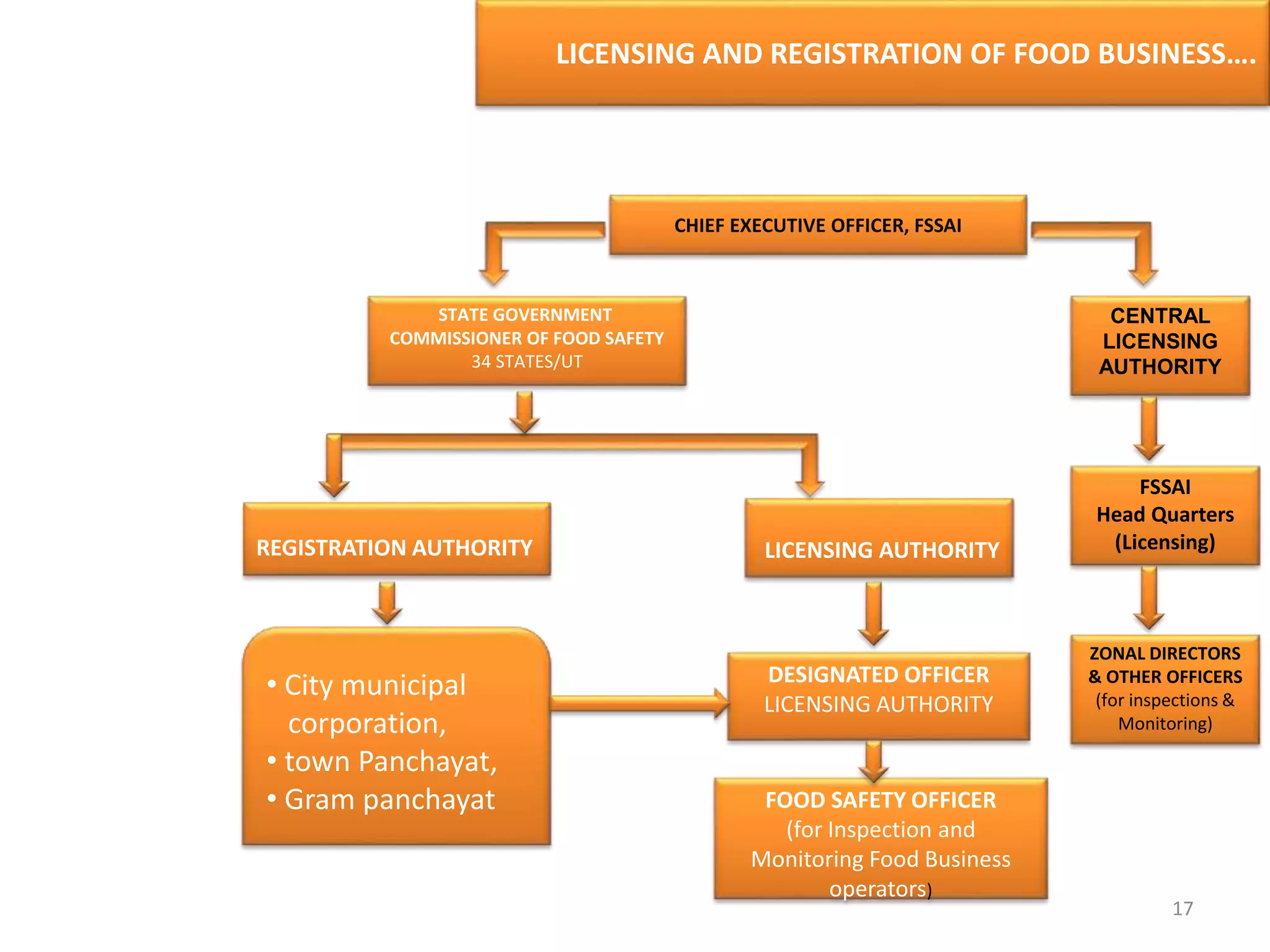
LICENSING AND REGISTRATION OF FOOD BUSINESS….
CENTRAL
LICENSING
AUTHORITY
FSSAI
Head Quarters
(Licensing)
ZONAL DIRECTORS
& OTHER OFFICERS
(for inspections &
Monitoring)
STATE GOVERNMENT
COMMISSIONER OF FOOD SAFETY
34 STATES/UT
LICENSING AUTHORITY
FOOD SAFETY OFFICER
(for Inspection and
Monitoring Food Business
operators)
DESIGNATED OFFICER
LICENSING AUTHORITY
• City municipal
corporation,
• town Panchayat,
• Gram panchayat
CHIEF EXECUTIVE OFFICER, FSSAI
REGISTRATION AUTHORITY
17
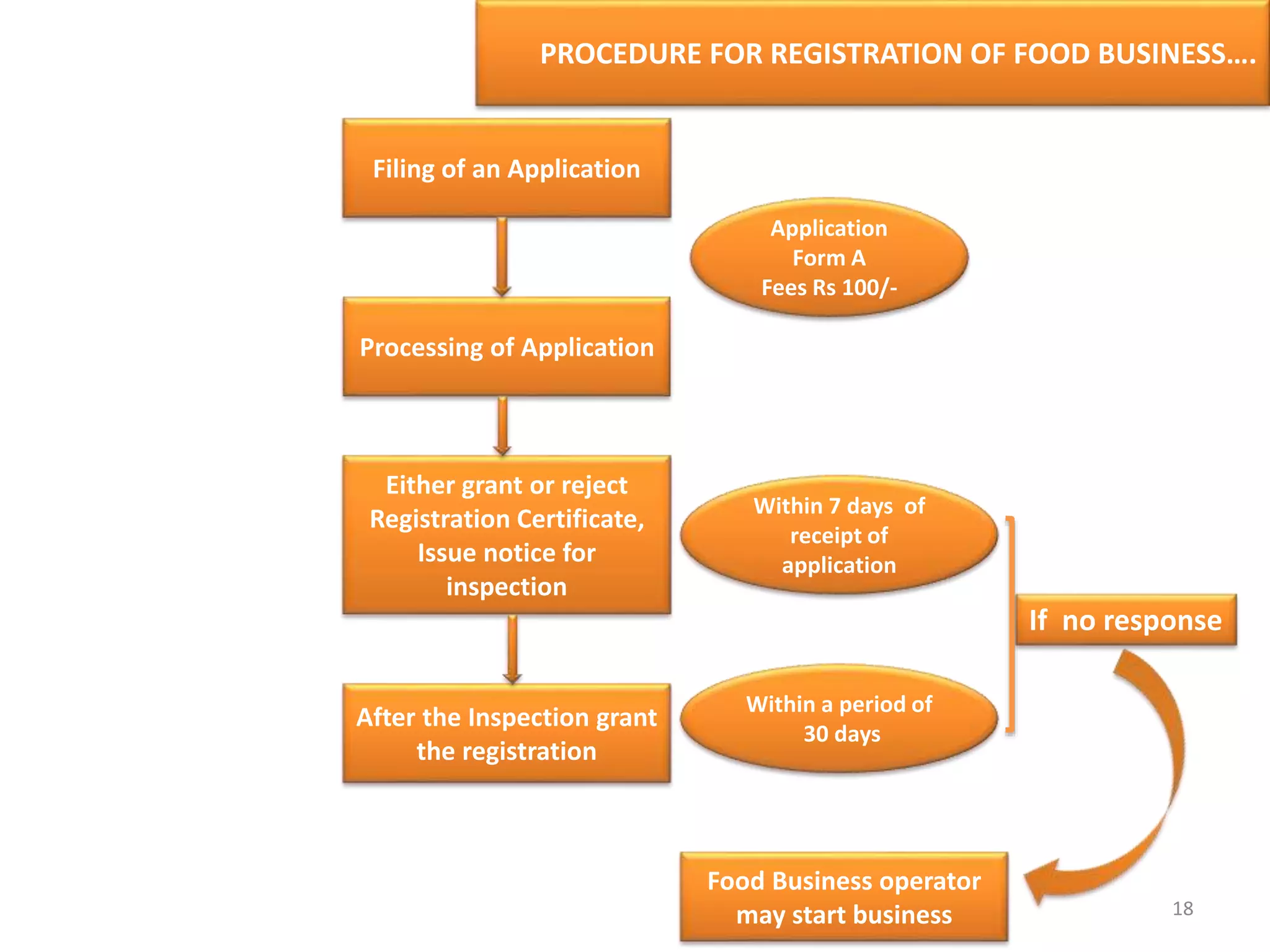
PROCEDURE FOR REGISTRATION OF FOOD BUSINESS….
Filing of an Application
Processing of Application
Either grant or reject
Registration Certificate,
Issue notice for
inspection
After the Inspection grant
the registration
Application
Form A
Fees Rs 100/-
Within 7 days of
receipt of
application
Within a period of
30 days
Food Business operator
may start business
If no response
18
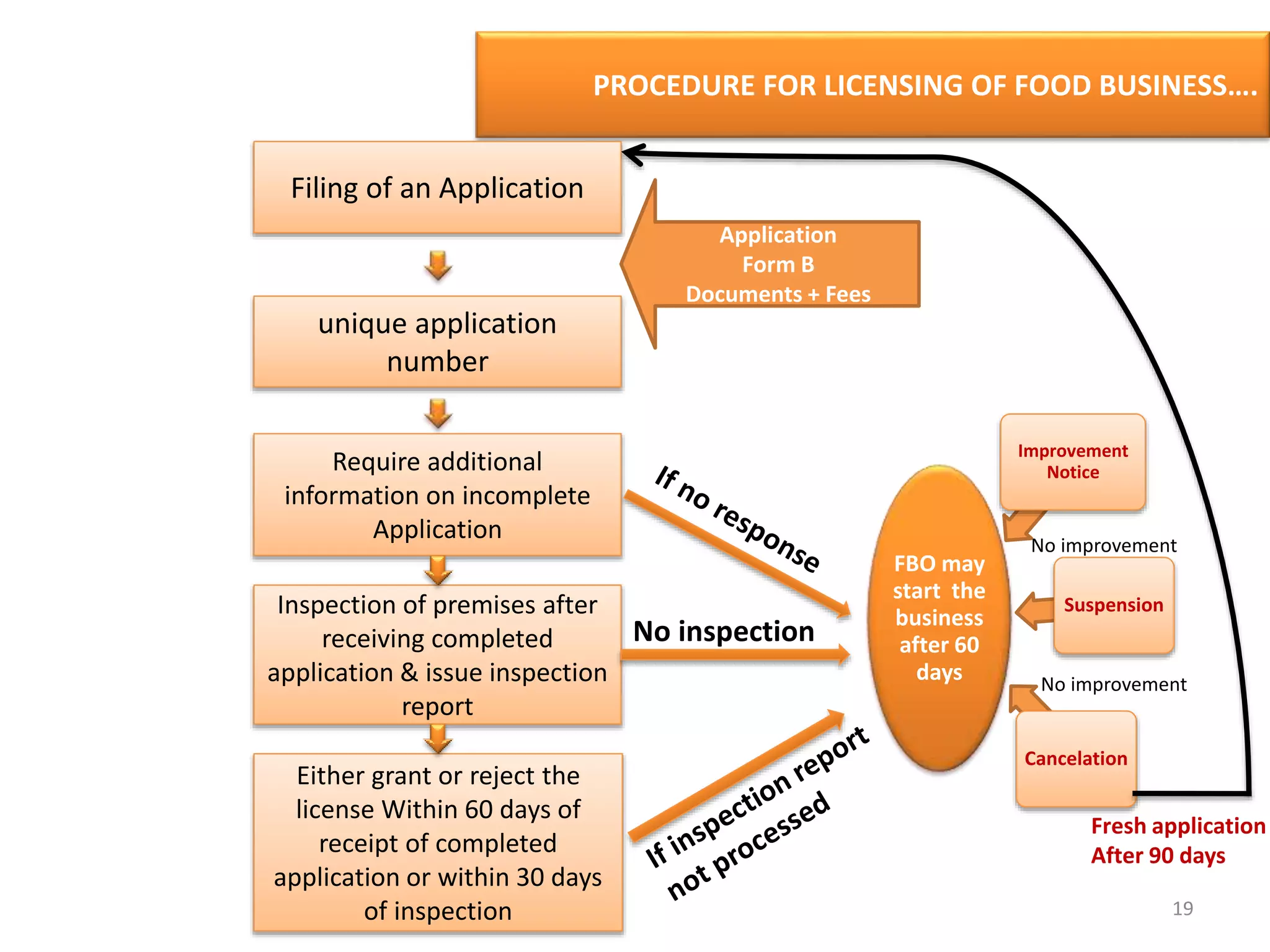
PROCEDURE FOR LICENSING OF FOOD BUSINESS….
Filing of an Application
unique application
number
Require additional
information on incomplete
Application
Application
Form B
Documents + Fees
Inspection of premises after
receiving completed
application & issue inspection
report
Either grant or reject the
license Within 60 days of
receipt of completed
application or within 30 days
of inspection
FBO may
start the
business
after 60
days
Suspension
Improvement
Notice
Cancelation
No inspection
No improvement
No improvement
Fresh application
After 90 days
19
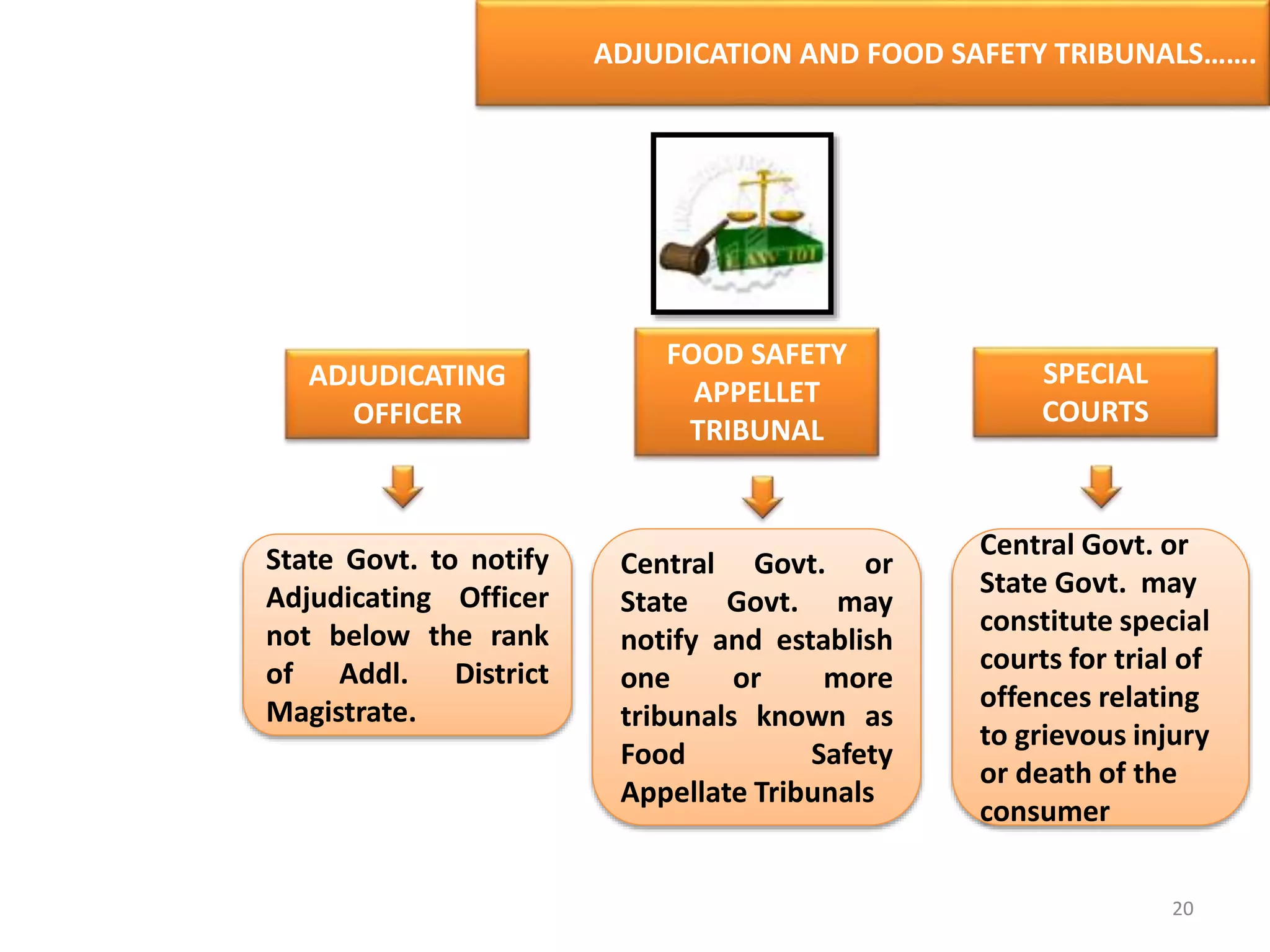
ADJUDICATION AND FOOD SAFETY TRIBUNALS…….
ADJUDICATING
OFFICER
FOOD SAFETY
APPELLET
TRIBUNAL
SPECIAL
COURTS
State Govt. to notify
Adjudicating Officer
not below the rank
of Addl. District
Magistrate.
Central Govt. or
State Govt. may
notify and establish
one or more
tribunals known as
Food Safety
Appellate Tribunals
Central Govt. or
State Govt. may
constitute special
courts for trial of
offences relating
to grievous injury
or death of the
consumer
20
ENFORCEMENT OF THE ACT……….
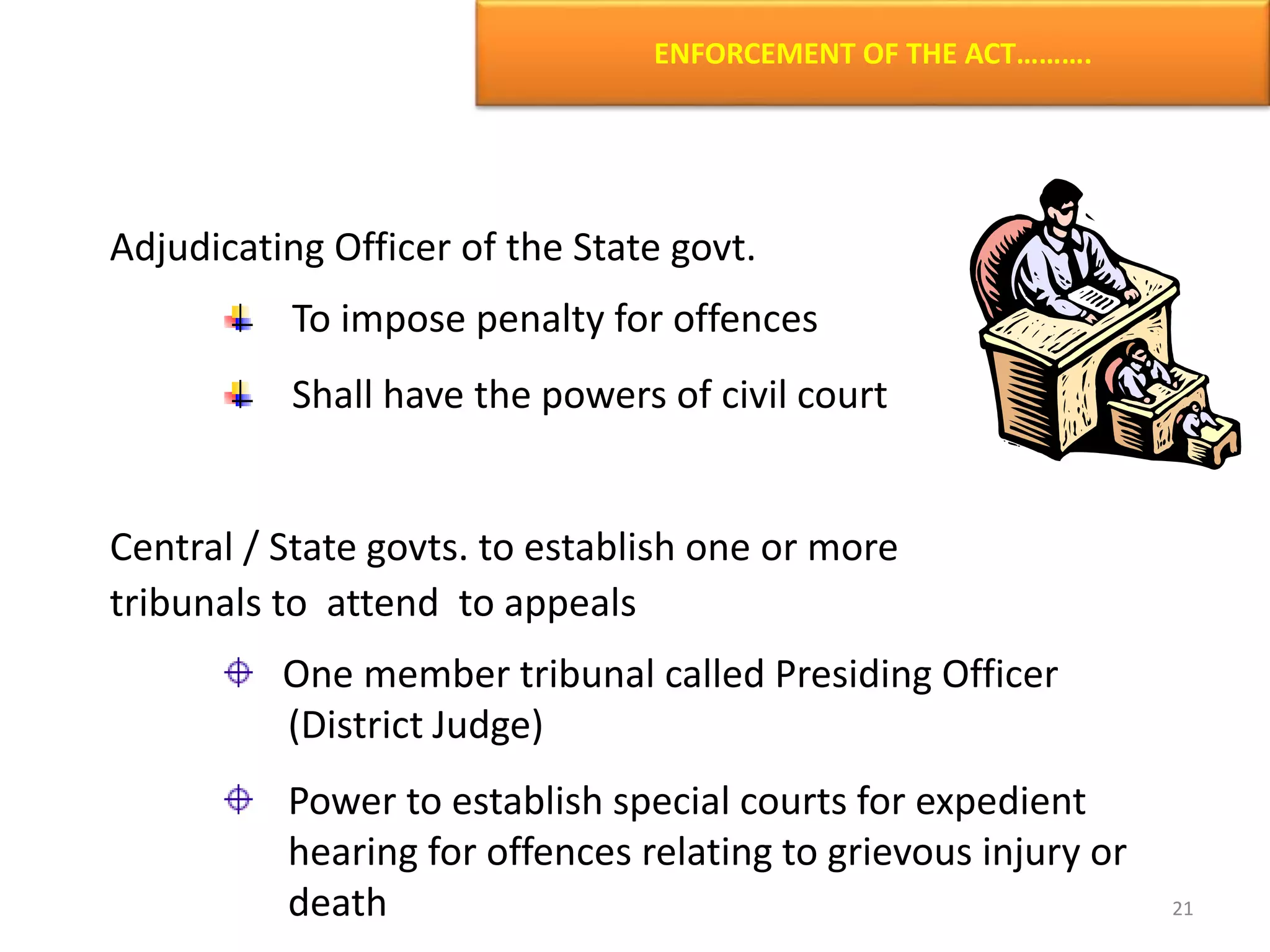
Adjudicating Officer of the State govt.
To impose penalty for offences
Shall have the powers of civil court
Central / State govts. to establish one or more
tribunals to attend to appeals
One member tribunal called Presiding Officer
(District Judge)
Power to establish special courts for expedient
hearing for offences relating to grievous injury or
death 21
ENFORCEMENT OF THE ACT……….
Offences:
¤ Causing food to be injurious
¤ Abstracting any constituent
¤ Deliberate adulteration
¤ Nonconformance in Label
information etc.,
22
ENFORCEMENT OF THE ACT……….
¤ Substandard food: Upto Rs. 2.00 lakhs
¤ Misbranded: Upto Rs. 3.00 lakhs
¤ Misleading advertisement : Upto Rs. 10.00 lakhs
¤ Food with extraneous matter: Upto Rs. 1.00 lakhs
¤ Fail to meet the requirements as directed by FSO: Upto Rs. 2.00 lakhs
¤ Unhygienic / unsanitary preparations: Upto Rs. 1.00 lakhs
¤ Adulterant not injurious to health: Upto Rs. 2.00 lakhs
¤ Adulterant injurious to health: Upto Rs. 10.00 lakhs
¤ Unsafe food – but does not cause immediate injury : 6 months
imprisonment with fine of Rs.1.0 lakh
Penalties:
23
¤ Unsafe food causing non-grievous injury :
1 year imprisonment with fine of Rs. 3.00 lakh
Compensation in case for injury :
upto Rs.1.00 lakh
¤ Causing grievous injury : 6 years imprisonment with
fine of Rs. 5.00 lakh
Compensation in case for grievous injury :
upto Rs.3.00 lakh
¤ Causing death : 7 years or life imprisonment
and fine of Rs. 10.00 lakh
Compensation in case of death :
upto Rs. 5.00 lakh minimum
Penalties:
24
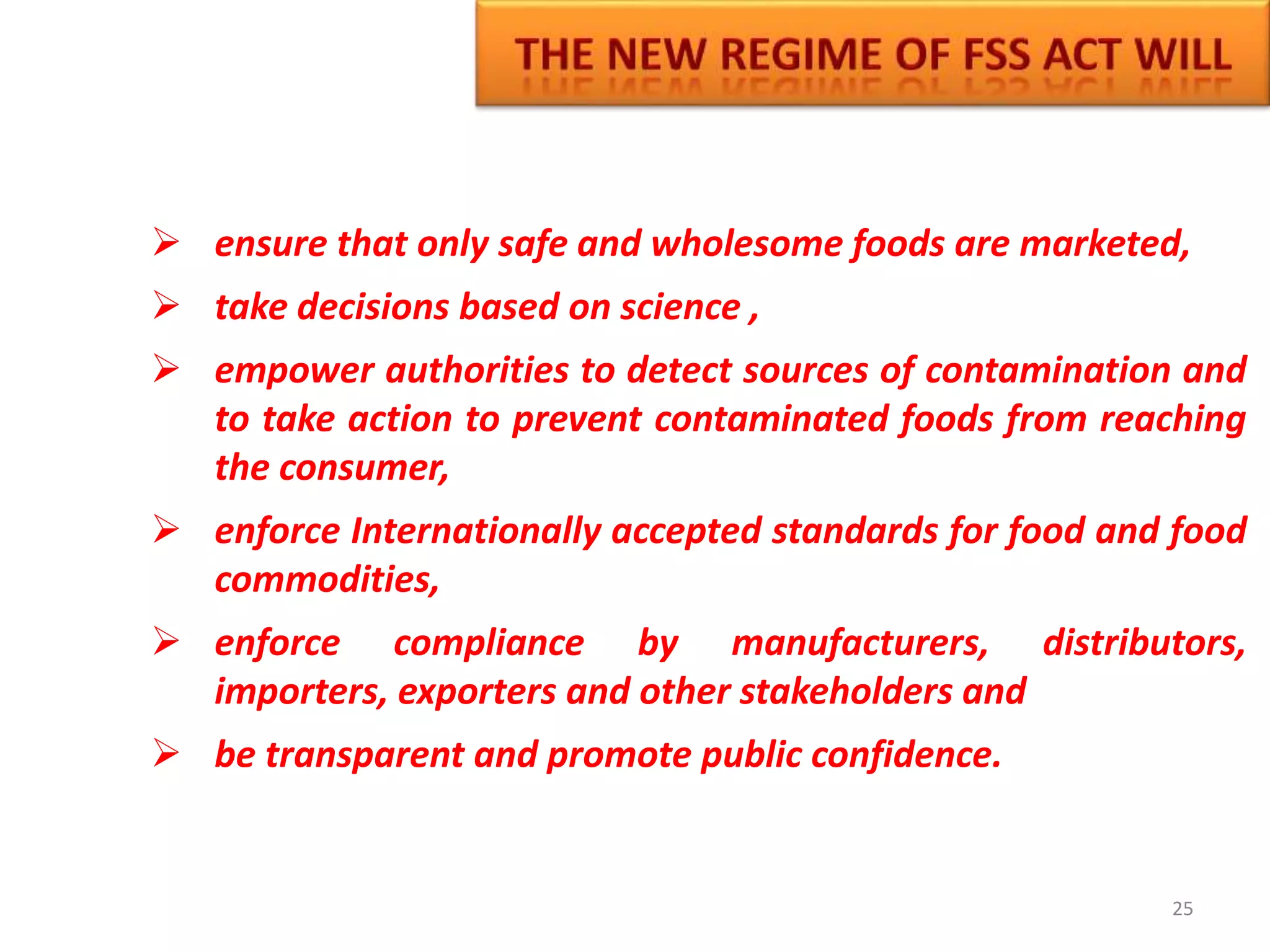
 ensure that only safe and wholesome foods are marketed,
 take decisions based on science ,
 empower authorities to detect sources of contamination and
to take action to prevent contaminated foods from reaching
the consumer,
 enforce Internationally accepted standards for food and food
commodities,
 enforce compliance by manufacturers, distributors,
importers, exporters and other stakeholders and
 be transparent and promote public confidence.
25
26
27
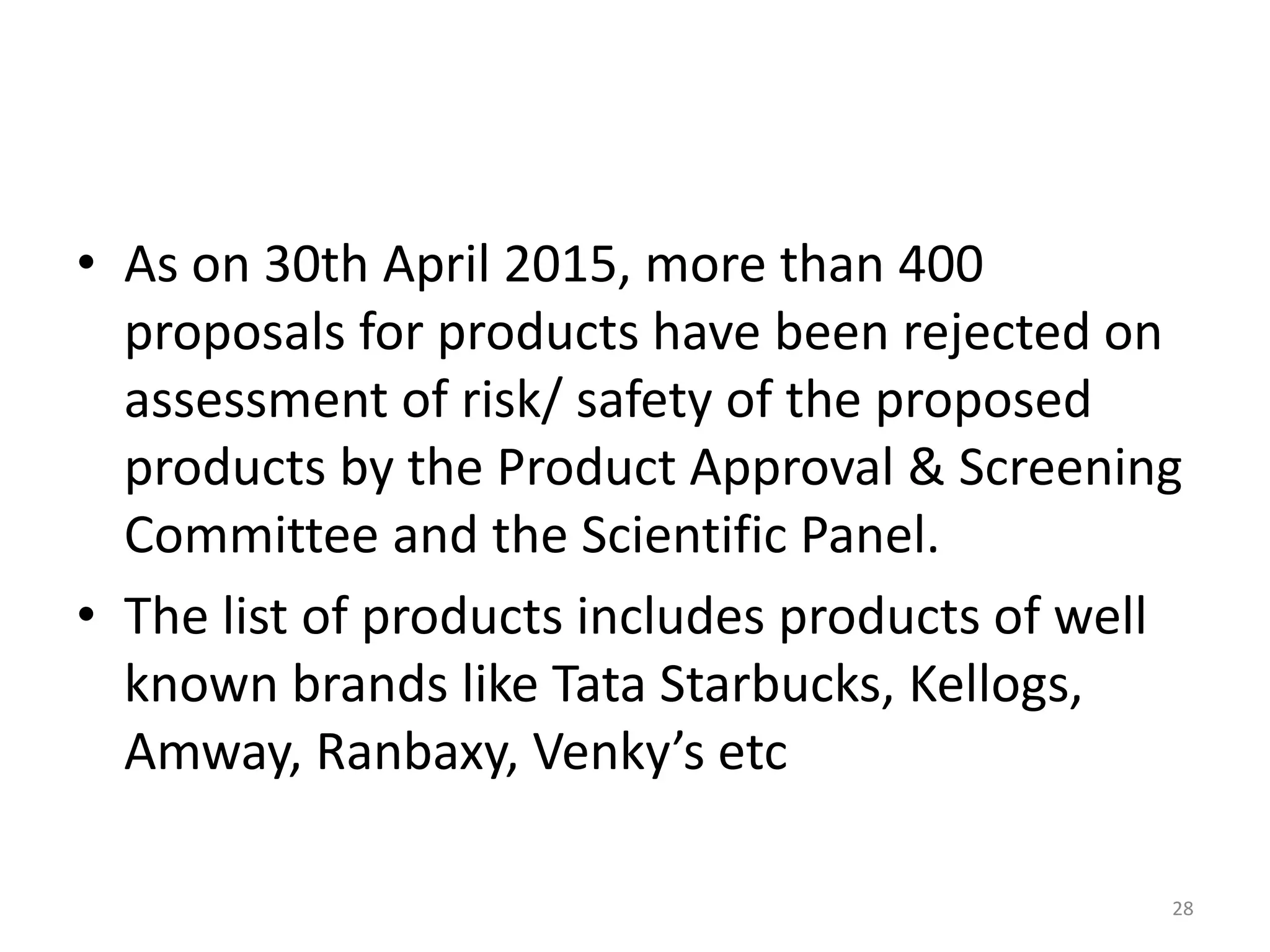
• As on 30th April 2015, more than 400
proposals for products have been rejected on
assessment of risk/ safety of the proposed
products by the Product Approval & Screening
Committee and the Scientific Panel.
• The list of products includes products of well
known brands like Tata Starbucks, Kellogs,
Amway, Ranbaxy, Venky’s etc
28
Thank You.
• For any
feedback/query/word of
thanks, the Tutor can be
contacted at
harveersinh@gmail.com
29

Lecture # 36 food industry fssai explained

  • 1.
    FSSAI By: Harveer Singh twitter.com/iastoss +91-880-2009-420 ThisPPT is for educational purpose only. The learner is expected to supplement the video lecture with this ppt. The content is taken from various daily and weekly publications. Due care has been taken in preparing the material but the tutor or superprofs would not be responsible for any error or consequences arising out of it. 1
  • 2.
    FOOD SAFETY LEGISLATION- the need…… Issues with existing regulatory regime- • Nine different laws and eight different ministries governing the food sector • Laws framed by different Ministries/Depts. With different perspective and enforcement approach • Overlapping laws with different quality standards & labelling requirements Need for new law- •Removal of multiple regulations •Harmonizing with international law •Framing regulatory requirements based on science and risk analysis •Facilitating trade without compromising consumer safety and bringing in innovation in foods 2
  • 3.
    INDIAN FOOD LAWS Prevention ofFood Adulteration Act 1954 and Rules Department of Health Ministry of Health and Family Welfare Fruit Products Order Ministry of Food Processing Industries Milk and Milk Products Order Department of Animal Husbandry Ministry of Agriculture Agricultural Produce (Grading & Marketing) Act Department of Agriculture and Cooperation Ministry of Agriculture Standards of Weights and Measures Act and Packaged Commodity Rules, The Vegetable Oil Products (Control) Order, The Edible Oils Packaging (Regulation) Order, The Solvent Extracted Oil, Deoiled Meal, and Edible Flour (Control) Order Ministry of Consumer Affairs, Food and Public Distribution Export (Quality Control & Inspection) Act Department of Commerce Ministry of Commerce & Industry Caught in the Web ??? Meat Products Order Ministry of Food Processing Industries 3
  • 4.
    THE ACT…………… Prevention ofFood Adulteration Act, 1954 Fruit Products Order, 1955 Meat Food Products Order, 1973 Vegetable Oil Products (Control) Order, 1947 Edible Oils Packaging (Regulation) Order, 1988, Solvent Extracted Oil, De-oiled Meal and Edible Flour (Control) Order, 1967 Milk and Milk Products Order, 1992 Any order under Essential Commodities Act, 1955 relating to food. The Food Safety & Standards Act 2006 is Act to consolidate the laws relating to food and to establish the Food Safety and Standards Authority of India for laying down science based standards for articles of food and to regulate their manufacture, storage distribution, sale and import, to ensure availability of safe and wholesome food for human consumption and for matters connected therewith or incidental thereto. 4
  • 5.
    SALIENT FEATURE OFTHE ACT……………  To ensure that all food meets consumers’ expectations in terms of nature, substance and quality and is not misleadingly presents;  To provide legal powers and specify offences in relation to public health and consumers’ interest;  To shift from regulatory regime to self compliance through Food Safety Management system.  Science based standards  Proprietary food, novel food, GM food, dietary supplements, nutraceuticals etc brought into the ambit of the new act. 5
  • 6.
    SCOPE OF THEACT……………  The Act covers activities throughout the food distribution chain, from primary production through distribution to retail and catering.  The Act gives the Government powers to make regulations on matters of food safety.  The Food Safety & Standards Authority of India is the principal Government Authority responsible for preparing specific regulations under the Act. 6
  • 7.
    FUNCTIONS OF AUTHORITY(SEC 16)…………… •To regulate, monitor the manufacture, processing, distribution, sale and import of food to ensure its safety and wholesomeness. •To specify standards, guidelines for food articles •Limits for Food additives, contaminants, veterinary drugs, heavy metals, mycotoxin, irradiation of food, processing aids. •Mechanisms & guidelines for accreditation of certification bodies engaged in FSMS certification •Quality control of imported food •Specify food labeling standards including claims on health, Nutrition, special dietary uses & food category systems •Scientific advice and technical support to central / state governments 7
  • 8.
    APPELATE TRIBUNAL FOOD SAFETY COMMISSIONER FOOD SAFETY OFFICER ACCREDITEDLAB REFERAL LAB FOOD ANALYST DESIGNATED OFFICER ADJUDICATING OFFICER SPECIAL COURT REGULATORY ENFORCEMENT AT STATE 8
  • 9.
    ROLE OF STATEAS PER THE ACT…. ROLES & RESPONSIBILITIES OF FOOD SAFETY COMMISSIONER Prohibit in the interest of public health, the manufacture, storage, distribution, or sale of any article of food. Carry out survey/inspection of the food processing units in the state to find out compliance of prescribed standards. Conduct training programmes for the personnel engaged in food safety. Ensure efficient and uniform implementation of the standards and other requirements of food safety. Sanction prosecution for offences punishable with imprisonment under this Act. 9
  • 10.
    ROLE OF STATEAS PER THE ACT…. ROLES & RESPONSIBILITIES OF DESIGNATED OFFICER Issue or cancel license of Food Business Operator. Prohibit sale in contravention of this Act. Receive report and samples of articles of food from Food Safety Officer and get them analyzed. Make recommendation to the Commissioner of Food Safety for sanction to launch prosecutions Sanction prosecution Maintain record of all inspections made by Food Safety Officers Get complaints investigated in respect of any contravention of the provision of this Act or against FSO 10
  • 11.
    ROLE OF STATEAS PER THE ACT…. ROLES & RESPONSIBILITIES OF FOOD SAFETY OFFICER Taking samples of food intended for sale Seize any articles of food which appears to be in contravention of this Act Enter and inspect any place where food is manufactured, or stored for sale  May after giving notice, cause unsafe food destroyed Seize any adulterant found in possession of a manufacturer or distributor Can be penalised for harassment of business operator (There is provision for penalising Complainant for false complaint) 11
  • 12.
    ENFORCEMENT OF PROVISIONSOF THE ACT….  Article 31 lays down Licensing and Registration conditions which are compulsory for any food business. Any person desirous to commence or carry on any food business shall make an application to grant of a License to the Designated Officer alongwith fees. In case a license is not issued within two months from the date of making the application or his application is not rejected, the applicant may start his food business after expiry of the said period. The provision of obtaining a licence for carrying on any food business shall not apply to a petty retailer, hawker, itinerant vendor or a temporary stall holder or small scale or cottage or such other industries relating to food business or tiny Food Business Operator. But they shall have Registration with the Designated Officer. 12
  • 13.
    LICENSING AND REGISTRATIONOF FOOD BUSINESS…. Central Licensing Authority State Licensing Authority Registering Authority Designated Officer appointed by the Chief Executive Officer of the FSSAI in his capacity of Food Safety Commissioner Food Safety Officer or any official in Panchayat, Municipal Corporation or any other local body in an area, notified as such by the State Food Safety Commissioner for the purpose of registration Designated Officers appointed under Section 36(1) of the Act by the Food Safety Commissioner of a State or UT for the purpose of licensing and monitoring. 13
  • 14.
    LICENSING AND REGISTRATIONOF FOOD BUSINESS…. Registration required for the Food Business Operator, who – a. manufactures or sells any article of food himself or a petty retailer, hawker, itinerant vendor or temporary stall holder; or b. such food business including small scale or cottage or tiny food businesses with an annual turnover not exceeding Rs 12 lakhs and or whose- i. production capacity of food (other than milk and milk products and meat and meat products) does not exceed 100 kg/ltr per day or ii. production or procurement or collection of milk is up to 100 litres of milk per day or iii. slaughtering capacity is 2 large animals or 10 small animals or 50 poultry birds per day or less than that 14
  • 15.
    LICENSING AND REGISTRATIONOF FOOD BUSINESS…. Central License required for the Food Business Operator, who – (i) Dairy units including milk chilling units process more than 50 thousand litres of liquid milk/day or 2500 MT of milk solid per annum. (ii) Vegetable oil processing units having installed capacity more than 2 MT per day. (iii) All slaughter houses equipped to slaughter more than 50 large animals or 150 or more small animals or 1000 or more poultry birds per day (iv) Meat processing units equipped to handle or process more than 500 kg of meat per day or 150 MT per annum (v) All food processing units other than mentioned above having installed capacity more than 2 MT/day. 15
  • 16.
    LICENSING AND REGISTRATIONOF FOOD BUSINESS…. Central License required for the Food Business Operator, who – (vi) 100 % Export Oriented Units (vii) All Importers importing food items for commercial use. (viii) All Food Business Operators manufacturing any article of Food which does not fall under any of the food categories prescribed under these regulations or deviates in any way from the prescribed specification for additives therein. (ix) Retail chains operating in three or more states. (x) Food catering services in establishments and units under Central government Agencies like Railways, Air and airport, Seaport, Defence etc. 16
  • 17.
    LICENSING AND REGISTRATIONOF FOOD BUSINESS…. CENTRAL LICENSING AUTHORITY FSSAI Head Quarters (Licensing) ZONAL DIRECTORS & OTHER OFFICERS (for inspections & Monitoring) STATE GOVERNMENT COMMISSIONER OF FOOD SAFETY 34 STATES/UT LICENSING AUTHORITY FOOD SAFETY OFFICER (for Inspection and Monitoring Food Business operators) DESIGNATED OFFICER LICENSING AUTHORITY • City municipal corporation, • town Panchayat, • Gram panchayat CHIEF EXECUTIVE OFFICER, FSSAI REGISTRATION AUTHORITY 17
  • 18.
    PROCEDURE FOR REGISTRATIONOF FOOD BUSINESS…. Filing of an Application Processing of Application Either grant or reject Registration Certificate, Issue notice for inspection After the Inspection grant the registration Application Form A Fees Rs 100/- Within 7 days of receipt of application Within a period of 30 days Food Business operator may start business If no response 18
  • 19.
    PROCEDURE FOR LICENSINGOF FOOD BUSINESS…. Filing of an Application unique application number Require additional information on incomplete Application Application Form B Documents + Fees Inspection of premises after receiving completed application & issue inspection report Either grant or reject the license Within 60 days of receipt of completed application or within 30 days of inspection FBO may start the business after 60 days Suspension Improvement Notice Cancelation No inspection No improvement No improvement Fresh application After 90 days 19
  • 20.
    ADJUDICATION AND FOODSAFETY TRIBUNALS……. ADJUDICATING OFFICER FOOD SAFETY APPELLET TRIBUNAL SPECIAL COURTS State Govt. to notify Adjudicating Officer not below the rank of Addl. District Magistrate. Central Govt. or State Govt. may notify and establish one or more tribunals known as Food Safety Appellate Tribunals Central Govt. or State Govt. may constitute special courts for trial of offences relating to grievous injury or death of the consumer 20
  • 21.
    ENFORCEMENT OF THEACT………. Adjudicating Officer of the State govt. To impose penalty for offences Shall have the powers of civil court Central / State govts. to establish one or more tribunals to attend to appeals One member tribunal called Presiding Officer (District Judge) Power to establish special courts for expedient hearing for offences relating to grievous injury or death 21
  • 22.
    ENFORCEMENT OF THEACT………. Offences: ¤ Causing food to be injurious ¤ Abstracting any constituent ¤ Deliberate adulteration ¤ Nonconformance in Label information etc., 22
  • 23.
    ENFORCEMENT OF THEACT………. ¤ Substandard food: Upto Rs. 2.00 lakhs ¤ Misbranded: Upto Rs. 3.00 lakhs ¤ Misleading advertisement : Upto Rs. 10.00 lakhs ¤ Food with extraneous matter: Upto Rs. 1.00 lakhs ¤ Fail to meet the requirements as directed by FSO: Upto Rs. 2.00 lakhs ¤ Unhygienic / unsanitary preparations: Upto Rs. 1.00 lakhs ¤ Adulterant not injurious to health: Upto Rs. 2.00 lakhs ¤ Adulterant injurious to health: Upto Rs. 10.00 lakhs ¤ Unsafe food – but does not cause immediate injury : 6 months imprisonment with fine of Rs.1.0 lakh Penalties: 23
  • 24.
    ¤ Unsafe foodcausing non-grievous injury : 1 year imprisonment with fine of Rs. 3.00 lakh Compensation in case for injury : upto Rs.1.00 lakh ¤ Causing grievous injury : 6 years imprisonment with fine of Rs. 5.00 lakh Compensation in case for grievous injury : upto Rs.3.00 lakh ¤ Causing death : 7 years or life imprisonment and fine of Rs. 10.00 lakh Compensation in case of death : upto Rs. 5.00 lakh minimum Penalties: 24
  • 25.
     ensure thatonly safe and wholesome foods are marketed,  take decisions based on science ,  empower authorities to detect sources of contamination and to take action to prevent contaminated foods from reaching the consumer,  enforce Internationally accepted standards for food and food commodities,  enforce compliance by manufacturers, distributors, importers, exporters and other stakeholders and  be transparent and promote public confidence. 25
  • 26.
  • 27.
  • 28.
    • As on30th April 2015, more than 400 proposals for products have been rejected on assessment of risk/ safety of the proposed products by the Product Approval & Screening Committee and the Scientific Panel. • The list of products includes products of well known brands like Tata Starbucks, Kellogs, Amway, Ranbaxy, Venky’s etc 28
  • 29.
    Thank You. • Forany feedback/query/word of thanks, the Tutor can be contacted at harveersinh@gmail.com 29