The Food Safety and Standards Authority of India
(FSSAI)
It has been established under Food Safety and Standards , 2006 which
consolidates various acts & orders that have hitherto handled food related issues
in various Ministries and Departments
FSSAI has been created for laying down science based standards for articles of
food and to regulate their manufacture, storage, distribution, sale and import to
ensure availability of safe and wholesome food for human consumption
Highlights of the Food Safety and Standard Act,
2006
 Various central Acts like Prevention of Food Adulteration Act,1954,Fruit
Products Order , 1955, Meat Food Products Order,1973,
 Vegetable Oil Products (Control) Order, 1947,Edible Oils Packaging
(Regulation)Order 1988, Solvent Extracted Oil, De- Oiled Meal and Edible Flour
(Control) Order, 1967, Milk and Milk Products Order, 1992 etc will be repealed
after commencement of FSS Act, 2006
Establishment of the Authority
Ministry Health & Family Welfare, Government of India is the
Administrative Ministry for the implementation of FSSAI. The
Chairperson and Chief Executive Officer of Food Safety and
Standards Authority of India (FSSAI) have already been appointed
by Government of India. The Chairperson is in the rank of
Secretary to Government of India.
FSSAI has been mandated by the FSS Act,
2006 for performing the following functions:
 Framing of Regulations to lay down the Standards and
guidelines in relation to articles of food and specifying appropriate
system of enforcing various standards thus notified
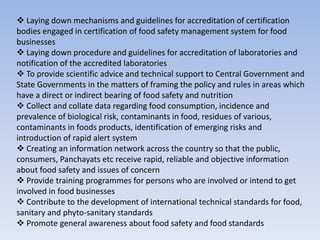
 Laying down mechanisms and guidelines for accreditation of certification
bodies engaged in certification of food safety management system for food
businesses
 Laying down procedure and guidelines for accreditation of laboratories and
notification of the accredited laboratories
 To provide scientific advice and technical support to Central Government and
State Governments in the matters of framing the policy and rules in areas which
have a direct or indirect bearing of food safety and nutrition
 Collect and collate data regarding food consumption, incidence and
prevalence of biological risk, contaminants in food, residues of various,
contaminants in foods products, identification of emerging risks and
introduction of rapid alert system
 Creating an information network across the country so that the public,
consumers, Panchayats etc receive rapid, reliable and objective information
about food safety and issues of concern
 Provide training programmes for persons who are involved or intend to get
involved in food businesses
 Contribute to the development of international technical standards for food,
sanitary and phyto-sanitary standards
 Promote general awareness about food safety and food standards
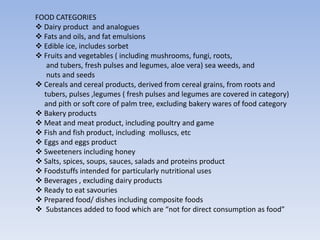
FOOD CATEGORIES
 Dairy product and analogues
 Fats and oils, and fat emulsions
 Edible ice, includes sorbet
 Fruits and vegetables ( including mushrooms, fungi, roots,
and tubers, fresh pulses and legumes, aloe vera) sea weeds, and
nuts and seeds
 Cereals and cereal products, derived from cereal grains, from roots and
tubers, pulses ,legumes ( fresh pulses and legumes are covered in category)
and pith or soft core of palm tree, excluding bakery wares of food category
 Bakery products
 Meat and meat product, including poultry and game
 Fish and fish product, including molluscs, etc
 Eggs and eggs product
 Sweeteners including honey
 Salts, spices, soups, sauces, salads and proteins product
 Foodstuffs intended for particularly nutritional uses
 Beverages , excluding dairy products
 Ready to eat savouries
 Prepared food/ dishes including composite foods
 Substances added to food which are “not for direct consumption as food”
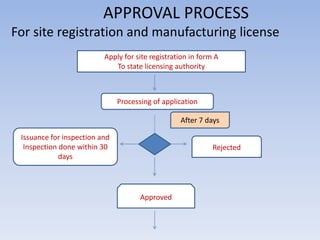
APPROVAL PROCESS
For site registration and manufacturing license
Apply for site registration in form A
To state licensing authority
Processing of application
After 7 days
Issuance for inspection and
Inspection done within 30
days
Approved
Rejected
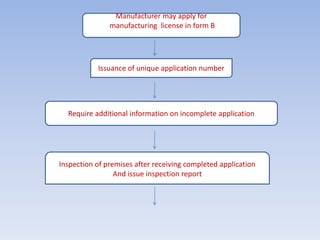
Manufacturer may apply for
manufacturing license in form B
Issuance of unique application number
Require additional information on incomplete application
Inspection of premises after receiving completed application
And issue inspection report
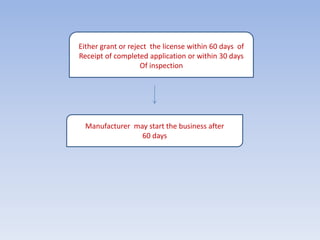
Either grant or reject the license within 60 days of
Receipt of completed application or within 30 days
Of inspection
Manufacturer may start the business after
60 days
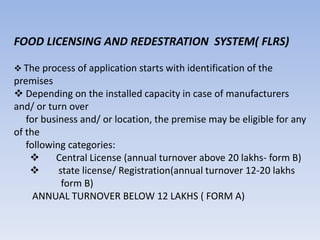
FOOD LICENSING AND REDESTRATION SYSTEM( FLRS)
 The process of application starts with identification of the
premises
 Depending on the installed capacity in case of manufacturers
and/ or turn over
for business and/ or location, the premise may be eligible for any
of the
following categories:
 Central License (annual turnover above 20 lakhs- form B)
 state license/ Registration(annual turnover 12-20 lakhs
form B)
ANNUAL TURNOVER BELOW 12 LAKHS ( FORM A)
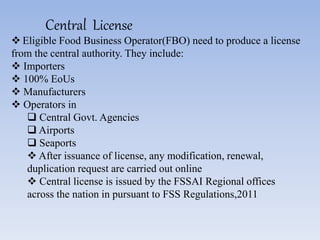
Central License
 Eligible Food Business Operator(FBO) need to produce a license
from the central authority. They include:
 Importers
 100% EoUs
 Manufacturers
 Operators in
 Central Govt. Agencies
 Airports
 Seaports
 After issuance of license, any modification, renewal,
duplication request are carried out online
 Central license is issued by the FSSAI Regional offices
across the nation in pursuant to FSS Regulations,2011
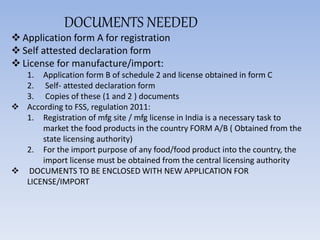
DOCUMENTS NEEDED
 Application form A for registration
 Self attested declaration form
 License for manufacture/import:
1. Application form B of schedule 2 and license obtained in form C
2. Self- attested declaration form
3. Copies of these (1 and 2 ) documents
 According to FSS, regulation 2011:
1. Registration of mfg site / mfg license in India is a necessary task to
market the food products in the country FORM A/B ( Obtained from the
state licensing authority)
2. For the import purpose of any food/food product into the country, the
import license must be obtained from the central licensing authority
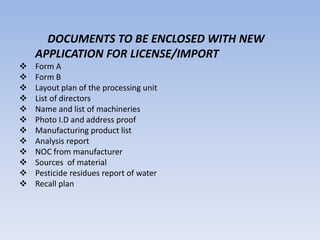
 DOCUMENTS TO BE ENCLOSED WITH NEW APPLICATION FOR
LICENSE/IMPORT
DOCUMENTS TO BE ENCLOSED WITH NEW
APPLICATION FOR LICENSE/IMPORT
 Form A
 Form B
 Layout plan of the processing unit
 List of directors
 Name and list of machineries
 Photo I.D and address proof
 Manufacturing product list
 Analysis report
 NOC from manufacturer
 Sources of material
 Pesticide residues report of water
 Recall plan
STATE LICENSE AND REGISTRATION
 Eligible Food Business Operator( FBO) need to produce a license form the state
authority . They include,
 Manufacturers
 Storage
 Retailers
 Transporters
 Marketers
 Distributors
 After issuance of license, any modification, renewal, duplicate request are
carried out
online
 State license I issued by the State Authorities operation in each state in
pursuant to
FSS regulations, 2011.
DOCUMENTS NEEDED SAME AS IN CENTRAL LICENSE
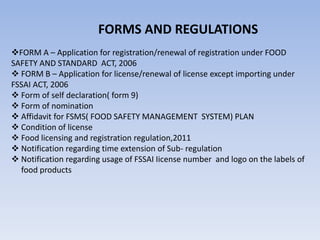
FORMS AND REGULATIONS
FORM A – Application for registration/renewal of registration under FOOD
SAFETY AND STANDARD ACT, 2006
 FORM B – Application for license/renewal of license except importing under
FSSAI ACT, 2006
 Form of self declaration( form 9)
 Form of nomination
 Affidavit for FSMS( FOOD SAFETY MANAGEMENT SYSTEM) PLAN
 Condition of license
 Food licensing and registration regulation,2011
 Notification regarding time extension of Sub- regulation
 Notification regarding usage of FSSAI Iicense number and logo on the labels of
food products
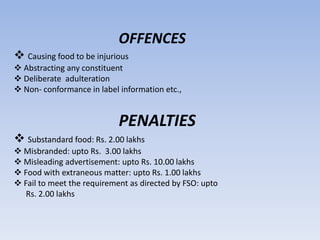
OFFENCES
 Causing food to be injurious
 Abstracting any constituent
 Deliberate adulteration
 Non- conformance in label information etc.,
PENALTIES
 Substandard food: Rs. 2.00 lakhs
 Misbranded: upto Rs. 3.00 lakhs
 Misleading advertisement: upto Rs. 10.00 lakhs
 Food with extraneous matter: upto Rs. 1.00 lakhs
 Fail to meet the requirement as directed by FSO: upto
Rs. 2.00 lakhs
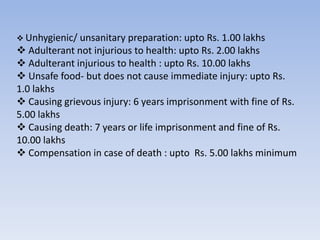
 Unhygienic/ unsanitary preparation: upto Rs. 1.00 lakhs
 Adulterant not injurious to health: upto Rs. 2.00 lakhs
 Adulterant injurious to health : upto Rs. 10.00 lakhs
 Unsafe food- but does not cause immediate injury: upto Rs.
1.0 lakhs
 Causing grievous injury: 6 years imprisonment with fine of Rs.
5.00 lakhs
 Causing death: 7 years or life imprisonment and fine of Rs.
10.00 lakhs
 Compensation in case of death : upto Rs. 5.00 lakhs minimum
REFERENCES
 http://www.fssai.gov.in/
http://www.fssai.gov.in/about FSSAI/Introducction.aspx
http://www.fssai.gov.in/About FSSAI/FSSAct.aspx
http://foodlicensing.fssai.gov.in/index.aspx
Fssai

Fssai

  • 2.
    The Food Safetyand Standards Authority of India (FSSAI) It has been established under Food Safety and Standards , 2006 which consolidates various acts & orders that have hitherto handled food related issues in various Ministries and Departments FSSAI has been created for laying down science based standards for articles of food and to regulate their manufacture, storage, distribution, sale and import to ensure availability of safe and wholesome food for human consumption Highlights of the Food Safety and Standard Act, 2006  Various central Acts like Prevention of Food Adulteration Act,1954,Fruit Products Order , 1955, Meat Food Products Order,1973,  Vegetable Oil Products (Control) Order, 1947,Edible Oils Packaging (Regulation)Order 1988, Solvent Extracted Oil, De- Oiled Meal and Edible Flour (Control) Order, 1967, Milk and Milk Products Order, 1992 etc will be repealed after commencement of FSS Act, 2006
  • 3.
    Establishment of theAuthority Ministry Health & Family Welfare, Government of India is the Administrative Ministry for the implementation of FSSAI. The Chairperson and Chief Executive Officer of Food Safety and Standards Authority of India (FSSAI) have already been appointed by Government of India. The Chairperson is in the rank of Secretary to Government of India. FSSAI has been mandated by the FSS Act, 2006 for performing the following functions:  Framing of Regulations to lay down the Standards and guidelines in relation to articles of food and specifying appropriate system of enforcing various standards thus notified
  • 4.
     Laying downmechanisms and guidelines for accreditation of certification bodies engaged in certification of food safety management system for food businesses  Laying down procedure and guidelines for accreditation of laboratories and notification of the accredited laboratories  To provide scientific advice and technical support to Central Government and State Governments in the matters of framing the policy and rules in areas which have a direct or indirect bearing of food safety and nutrition  Collect and collate data regarding food consumption, incidence and prevalence of biological risk, contaminants in food, residues of various, contaminants in foods products, identification of emerging risks and introduction of rapid alert system  Creating an information network across the country so that the public, consumers, Panchayats etc receive rapid, reliable and objective information about food safety and issues of concern  Provide training programmes for persons who are involved or intend to get involved in food businesses  Contribute to the development of international technical standards for food, sanitary and phyto-sanitary standards  Promote general awareness about food safety and food standards
  • 5.
    FOOD CATEGORIES  Dairyproduct and analogues  Fats and oils, and fat emulsions  Edible ice, includes sorbet  Fruits and vegetables ( including mushrooms, fungi, roots, and tubers, fresh pulses and legumes, aloe vera) sea weeds, and nuts and seeds  Cereals and cereal products, derived from cereal grains, from roots and tubers, pulses ,legumes ( fresh pulses and legumes are covered in category) and pith or soft core of palm tree, excluding bakery wares of food category  Bakery products  Meat and meat product, including poultry and game  Fish and fish product, including molluscs, etc  Eggs and eggs product  Sweeteners including honey  Salts, spices, soups, sauces, salads and proteins product  Foodstuffs intended for particularly nutritional uses  Beverages , excluding dairy products  Ready to eat savouries  Prepared food/ dishes including composite foods  Substances added to food which are “not for direct consumption as food”
  • 6.
    APPROVAL PROCESS For siteregistration and manufacturing license Apply for site registration in form A To state licensing authority Processing of application After 7 days Issuance for inspection and Inspection done within 30 days Approved Rejected
  • 7.
    Manufacturer may applyfor manufacturing license in form B Issuance of unique application number Require additional information on incomplete application Inspection of premises after receiving completed application And issue inspection report
  • 8.
    Either grant orreject the license within 60 days of Receipt of completed application or within 30 days Of inspection Manufacturer may start the business after 60 days
  • 9.
    FOOD LICENSING ANDREDESTRATION SYSTEM( FLRS)  The process of application starts with identification of the premises  Depending on the installed capacity in case of manufacturers and/ or turn over for business and/ or location, the premise may be eligible for any of the following categories:  Central License (annual turnover above 20 lakhs- form B)  state license/ Registration(annual turnover 12-20 lakhs form B) ANNUAL TURNOVER BELOW 12 LAKHS ( FORM A)
  • 10.
    Central License  EligibleFood Business Operator(FBO) need to produce a license from the central authority. They include:  Importers  100% EoUs  Manufacturers  Operators in  Central Govt. Agencies  Airports  Seaports  After issuance of license, any modification, renewal, duplication request are carried out online  Central license is issued by the FSSAI Regional offices across the nation in pursuant to FSS Regulations,2011
  • 11.
    DOCUMENTS NEEDED  Applicationform A for registration  Self attested declaration form  License for manufacture/import: 1. Application form B of schedule 2 and license obtained in form C 2. Self- attested declaration form 3. Copies of these (1 and 2 ) documents  According to FSS, regulation 2011: 1. Registration of mfg site / mfg license in India is a necessary task to market the food products in the country FORM A/B ( Obtained from the state licensing authority) 2. For the import purpose of any food/food product into the country, the import license must be obtained from the central licensing authority  DOCUMENTS TO BE ENCLOSED WITH NEW APPLICATION FOR LICENSE/IMPORT
  • 12.
    DOCUMENTS TO BEENCLOSED WITH NEW APPLICATION FOR LICENSE/IMPORT  Form A  Form B  Layout plan of the processing unit  List of directors  Name and list of machineries  Photo I.D and address proof  Manufacturing product list  Analysis report  NOC from manufacturer  Sources of material  Pesticide residues report of water  Recall plan
  • 13.
    STATE LICENSE ANDREGISTRATION  Eligible Food Business Operator( FBO) need to produce a license form the state authority . They include,  Manufacturers  Storage  Retailers  Transporters  Marketers  Distributors  After issuance of license, any modification, renewal, duplicate request are carried out online  State license I issued by the State Authorities operation in each state in pursuant to FSS regulations, 2011. DOCUMENTS NEEDED SAME AS IN CENTRAL LICENSE
  • 14.
    FORMS AND REGULATIONS FORMA – Application for registration/renewal of registration under FOOD SAFETY AND STANDARD ACT, 2006  FORM B – Application for license/renewal of license except importing under FSSAI ACT, 2006  Form of self declaration( form 9)  Form of nomination  Affidavit for FSMS( FOOD SAFETY MANAGEMENT SYSTEM) PLAN  Condition of license  Food licensing and registration regulation,2011  Notification regarding time extension of Sub- regulation  Notification regarding usage of FSSAI Iicense number and logo on the labels of food products
  • 15.
    OFFENCES  Causing foodto be injurious  Abstracting any constituent  Deliberate adulteration  Non- conformance in label information etc., PENALTIES  Substandard food: Rs. 2.00 lakhs  Misbranded: upto Rs. 3.00 lakhs  Misleading advertisement: upto Rs. 10.00 lakhs  Food with extraneous matter: upto Rs. 1.00 lakhs  Fail to meet the requirement as directed by FSO: upto Rs. 2.00 lakhs
  • 16.
     Unhygienic/ unsanitarypreparation: upto Rs. 1.00 lakhs  Adulterant not injurious to health: upto Rs. 2.00 lakhs  Adulterant injurious to health : upto Rs. 10.00 lakhs  Unsafe food- but does not cause immediate injury: upto Rs. 1.0 lakhs  Causing grievous injury: 6 years imprisonment with fine of Rs. 5.00 lakhs  Causing death: 7 years or life imprisonment and fine of Rs. 10.00 lakhs  Compensation in case of death : upto Rs. 5.00 lakhs minimum
  • 17.