Food Safety in India : A Regulatory
overview
Ms Vinod Kotwal
Director (Codex)
FSSAI
9th December 2014
New Delhi
1
2
Food Control
--- a mandatory regulatory activity of enforcement by national
or local authorities to provide consumer protection and ensure
that all food during production, handling, storage, processing,
and distribution are safe, wholesome and fit for human
consumption; conform to safety and quality requirements; and
are honestly and accurately labelled as prescribed by law.
3
•
• The challenge for food regulators is to maintain a food regulatory
system that delivers safe food for the population, enables consumers to
make informed choices and also maintains public confidence in the
food regulations.
• Public confidence in the food regulations will depend, firstly, on
evidence that there is a low level of risk and, secondly, on assurance
that adequate systems are in place to monitor and analyse food, and to
respond when situations of potential harm occur.
• Providing evidence (risk assessment) that there is a low level of risk
requires a method of analysing food risks that is evidence-based and
transparent, and results in effective management strategies (risk
management) which can be communicated clearly to consumers (risk
communication). 4
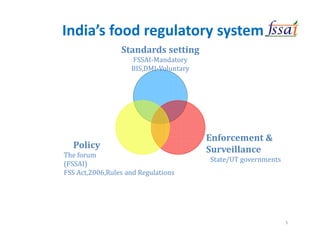
India’s food regulatory system
Standards setting
FSSAI-Mandatory
BIS,DMI-Voluntary
Enforcement &
Surveillance
State/UT governments
Policy
The forum
(FSSAI)
FSS Act,2006,Rules and Regulations
5
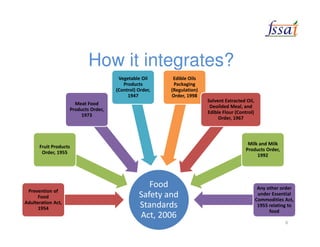
How it integrates?
Food
Safety and
Standards
Act, 2006
Prevention of
Food
Adulteration Act,
1954
Fruit Products
Order, 1955
Meat Food
Products Order,
1973
Vegetable Oil
Products
(Control) Order,
1947
Edible Oils
Packaging
(Regulation)
Order, 1998
Solvent Extracted Oil,
Deoilded Meal, and
Edible Flour (Control)
Order, 1967
Milk and Milk
Products Order,
1992
Any other order
under Essential
Commodities Act,
1955 relating to
food
6
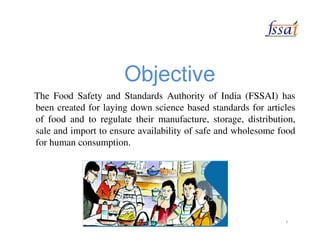
Objective
The Food Safety and Standards Authority of India (FSSAI) has
been created for laying down science based standards for articles
of food and to regulate their manufacture, storage, distribution,
sale and import to ensure availability of safe and wholesome food
for human consumption.
7
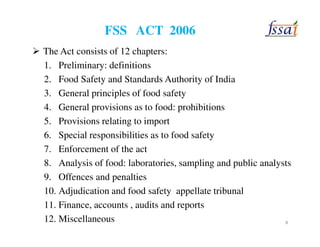
FSS ACT 2006
The Act consists of 12 chapters:
1. Preliminary: definitions
2. Food Safety and Standards Authority of India
3. General principles of food safety
4. General provisions as to food: prohibitions
5. Provisions relating to import
6. Special responsibilities as to food safety
7. Enforcement of the act
8. Analysis of food: laboratories, sampling and public analysts
9. Offences and penalties
10. Adjudication and food safety appellate tribunal
11. Finance, accounts , audits and reports
12. Miscellaneous 8
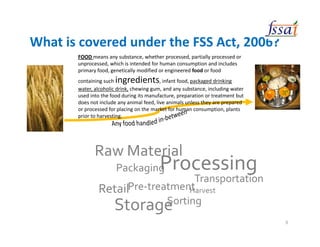
Raw Material
Packaging
Retail
Processing
Transportation
Harvest
StorageSorting
Pre-treatment
What is covered under the FSS Act, 2006?
FOOD means any substance, whether processed, partially processed or
unprocessed, which is intended for human consumption and includes
primary food, genetically modified or engineered food or food
containing such ingredients, infant food, packaged drinking
water, alcoholic drink, chewing gum, and any substance, including water
used into the food during its manufacture, preparation or treatment but
does not include any animal feed, live animals unless they are prepared
or processed for placing on the market for human consumption, plants
prior to harvesting.
9
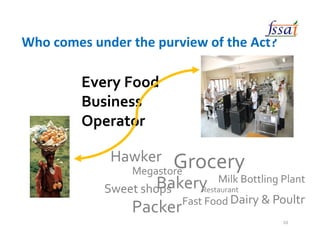
Every Food
Business
Operator
Who comes under the purview of the Act?
Hawker
Megastore
Sweet shops
Grocery
Bakery Milk Bottling Plant
Restaurant
PackerFast Food Dairy & Poultry
10
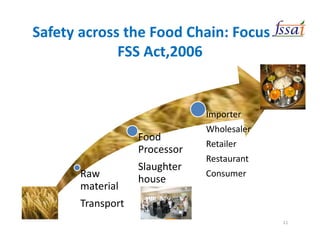
Safety across the Food Chain: Focus of
FSS Act,2006
Raw
material
Transport
Food
Processor
Slaughter
house
Importer
Wholesaler
Retailer
Restaurant
Consumer
11
Section 25 - Imports
• No person can import
– Any unsafe or misbranded or sub-standard food or food containing
extraneous matter
– Any article of food for the import of which a licence is required
– Any article of food in contravention of any other provision of this Act
• The Central Government shall, while prohibiting, restricting
or otherwise regulating import of articles of food under the
Foreign Trade (Development and Regulation ) Act, 1992,
follow the standards laid down by the Food Authority
12
Food Safety and Standards Regulations under
FSS Act
Section 92 (1)- provides Food Authority with the previous
approval of Central Government and after previous
publication, by notification, make regulations consistent with
this Act and Rules made there under.
FSSAI drafted Regulations through extensive consultation and
deliberations/meetings with various stakeholders.
Rules and 6 Regulations have been notified in the gazette of
India on 1st August, 2011 and came into force on 5th August,
2011
There is an urgent need to simplify the process of notification
so that more standards and Regulations can be notified
quickly
13
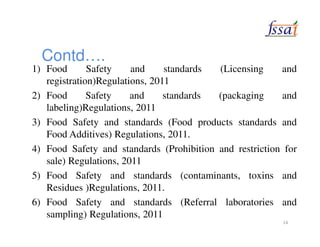
Contd….
1) Food Safety and standards (Licensing and
registration)Regulations, 2011
2) Food Safety and standards (packaging and
labeling)Regulations, 2011
3) Food Safety and standards (Food products standards and
Food Additives) Regulations, 2011.
4) Food Safety and standards (Prohibition and restriction for
sale) Regulations, 2011
5) Food Safety and standards (contaminants, toxins and
Residues )Regulations, 2011.
6) Food Safety and standards (Referral laboratories and
sampling) Regulations, 2011
14
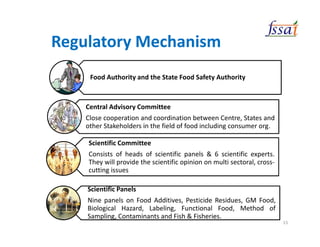
Central Advisory Committee
Close cooperation and coordination between Centre, States and
other Stakeholders in the field of food including consumer org.
Scientific Committee
Consists of heads of scientific panels & 6 scientific experts.
They will provide the scientific opinion on multi sectoral, cross-
cutting issues
Scientific Panels
Nine panels on Food Additives, Pesticide Residues, GM Food,
Biological Hazard, Labeling, Functional Food, Method of
Sampling, Contaminants and Fish & Fisheries.
Food Authority and the State Food Safety Authority
Regulatory Mechanism
15
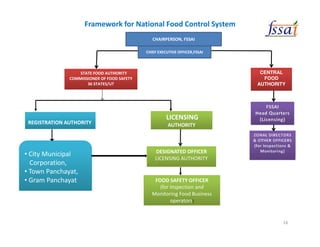
CENTRAL
FOOD
AUTHORITY
Framework for National Food Control System
CHAIRPERSON, FSSAI
STATE FOOD AUTHORITY
COMMISSIONER OF FOOD SAFETY
36 STATES/UT
LICENSING
AUTHORITY
FOOD SAFETY OFFICER
(for Inspection and
Monitoring Food Business
operators)
REGISTRATION AUTHORITY
DESIGNATED OFFICER
LICENSING AUTHORITY
• City Municipal
Corporation,
• Town Panchayat,
• Gram Panchayat
CHIEF EXECUTIVE OFFICER,FSSAI
16
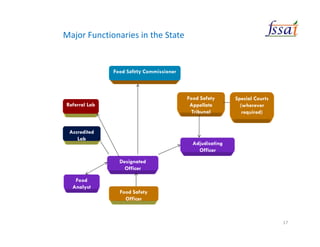
Food Safety Commissioner
Designated
Officer
Food Safety
Officer
Food
Analyst
Adjudicating
Officer
Food Safety
Appellate
Tribunal
Special Courts
(wherever
required)
Accredited
Lab
Referral Lab
Major Functionaries in the State
17
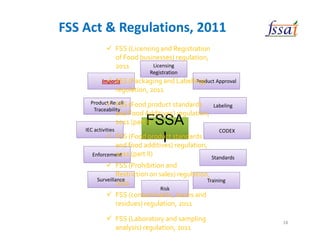
Imports
Licensing
Registration
Product Approval
Labeling
Standards
Training
Risk
Surveillance
Enforcement
IEC activities
Product Recall
Traceability
CODEX
FSSA
I
FSSA
I
FSS (Licensing and Registration
of Food businesses) regulation,
2011
FSS (Packaging and Labelling)
regulation, 2011
FSS (Food product standards
and Food Additives) regulation,
2011 (part I)
FSS (Food product standards
and food additives) regulation,
2011 (part II)
FSS (Prohibition and
Restriction on sales) regulation,
2011
FSS (contaminants, toxins and
residues) regulation, 2011
FSS (Laboratory and sampling
analysis) regulation, 2011
FSS Act & Regulations, 2011
18
Imports
Standards
Product Approval
Labeling
CODEX
Training
Risk
Surveillance
Enforcement
Programs
Product Recall
Traceability
I
FSSA
I
StandardsStandardsStandardsStandards
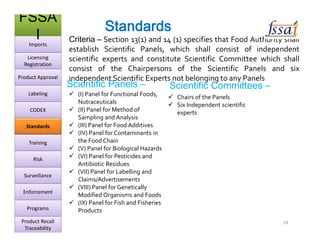
Criteria – Section 13(1) and 14 (1) specifies that Food Authority shall
establish Scientific Panels, which shall consist of independent
scientific experts and constitute Scientific Committee which shall
consist of the Chairpersons of the Scientific Panels and six
independent Scientific Experts not belonging to any Panels
Scientific Committees –
Chairs of the Panels
Six Independent scientific
experts
Scientific Panels –
(I) Panel for Functional Foods,
Nutraceuticals
(II) Panel for Method of
Sampling and Analysis
(III) Panel for Food Additives
(IV) Panel for Contaminants in
the Food Chain
(V) Panel for Biological Hazards
(VI) Panel for Pesticides and
Antibiotic Residues
(VII) Panel for Labelling and
Claims/Advertisements
(VIII) Panel for Genetically
Modified Organisms and Foods
(IX) Panel for Fish and Fisheries
Products
Licensing
Registration
19
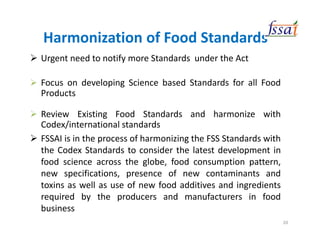
Harmonization of Food Standards
Urgent need to notify more Standards under the Act
Focus on developing Science based Standards for all Food
Products
Review Existing Food Standards and harmonize with
Codex/international standards
FSSAI is in the process of harmonizing the FSS Standards with
the Codex Standards to consider the latest development in
food science across the globe, food consumption pattern,
new specifications, presence of new contaminants and
toxins as well as use of new food additives and ingredients
required by the producers and manufacturers in food
business
20
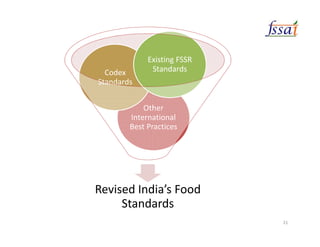
Revised India’s Food
Standards
Other
International
Best Practices
Codex
Standards
Existing FSSR
Standards
21
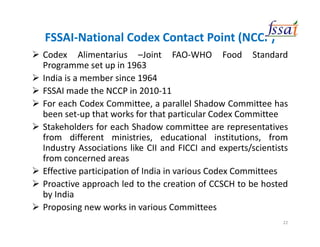
FSSAI-National Codex Contact Point (NCCP)
Codex Alimentarius –Joint FAO-WHO Food Standard
Programme set up in 1963
India is a member since 1964
FSSAI made the NCCP in 2010-11
For each Codex Committee, a parallel Shadow Committee has
been set-up that works for that particular Codex Committee
Stakeholders for each Shadow committee are representatives
from different ministries, educational institutions, from
Industry Associations like CII and FICCI and experts/scientists
from concerned areas
Effective participation of India in various Codex Committees
Proactive approach led to the creation of CCSCH to be hosted
by India
Proposing new works in various Committees
22
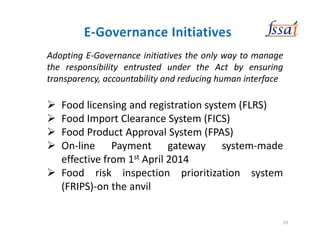
Adopting E-Governance initiatives the only way to manage
the responsibility entrusted under the Act by ensuring
transparency, accountability and reducing human interface
Food licensing and registration system (FLRS)
Food Import Clearance System (FICS)
Food Product Approval System (FPAS)
On-line Payment gateway system-made
effective from 1st April 2014
Food risk inspection prioritization system
(FRIPS)-on the anvil
23
Building blocks
Science based Food
Quality & Safety
Standards
Regulations and
science based
standards for all
types of foods
Harmonize Domestic
and International
Food Standards
Effective Food Safety
Regulation &
Integrated Food
Quality Testing & Risk
based Surveillance
Enforcement
through States
Networked
Laboratories for
Food Testing
Surveillance through
Risk based Approach
Support Services &
Communication
Capacity Building,
Training & Education
for all Stakeholders
Community
Outreach promotion
Programmes to
increase the
confidence of the
consumer
24
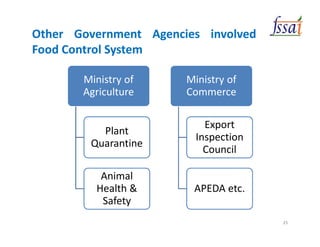
Other Government Agencies involved in
Food Control System
Ministry of
Agriculture
Plant
Quarantine
Animal
Health &
Safety
Ministry of
Commerce
Export
Inspection
Council
APEDA etc.
25
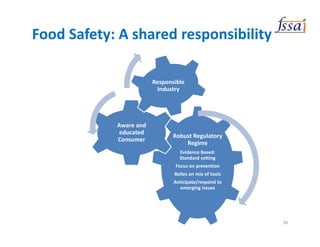
Food Safety: A shared responsibility
Robust Regulatory
Regime
Evidence Based:
Standard setting
Focus on prevention
Relies on mix of tools
Anticipate/respond to
emerging issues
Aware and
educated
Consumer
Responsible
Industry
26
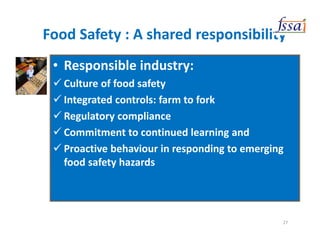
Food Safety : A shared responsibility
• Responsible industry:
Culture of food safety
Integrated controls: farm to fork
Regulatory compliance
Commitment to continued learning and
Proactive behaviour in responding to emerging
food safety hazards
27
Food Safety : A shared responsibility
• Aware and educated consumer:
Aware of risks and benefits,
Active on advice to select and handle foods
Adapt her/his food choices and her/his Diet to
his/her health status
28
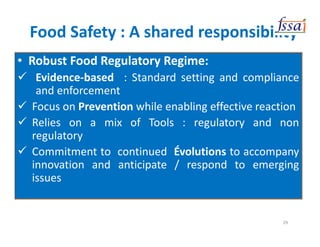
Food Safety : A shared responsibility
• Robust Food Regulatory Regime:
Evidence-based : Standard setting and compliance
and enforcement
Focus on Prevention while enabling effective reaction
Relies on a mix of Tools : regulatory and non
regulatory
Commitment to continued Évolutions to accompany
innovation and anticipate / respond to emerging
issues
29
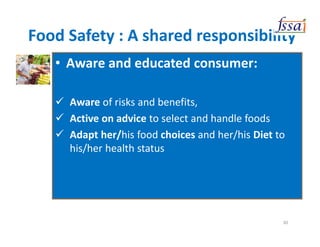
Food Safety : A shared responsibility
• Aware and educated consumer:
Aware of risks and benefits,
Active on advice to select and handle foods
Adapt her/his food choices and her/his Diet to
his/her health status
30
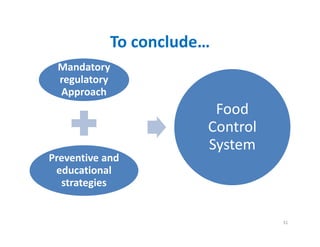
To conclude…
Mandatory
regulatory
Approach
Preventive and
educational
strategies
Food
Control
System
31
Thank You
32

Food Control System in India

  • 1.
    Food Safety inIndia : A Regulatory overview Ms Vinod Kotwal Director (Codex) FSSAI 9th December 2014 New Delhi 1
  • 2.
  • 3.
    Food Control --- amandatory regulatory activity of enforcement by national or local authorities to provide consumer protection and ensure that all food during production, handling, storage, processing, and distribution are safe, wholesome and fit for human consumption; conform to safety and quality requirements; and are honestly and accurately labelled as prescribed by law. 3
  • 4.
    • • The challengefor food regulators is to maintain a food regulatory system that delivers safe food for the population, enables consumers to make informed choices and also maintains public confidence in the food regulations. • Public confidence in the food regulations will depend, firstly, on evidence that there is a low level of risk and, secondly, on assurance that adequate systems are in place to monitor and analyse food, and to respond when situations of potential harm occur. • Providing evidence (risk assessment) that there is a low level of risk requires a method of analysing food risks that is evidence-based and transparent, and results in effective management strategies (risk management) which can be communicated clearly to consumers (risk communication). 4
  • 5.
    India’s food regulatorysystem Standards setting FSSAI-Mandatory BIS,DMI-Voluntary Enforcement & Surveillance State/UT governments Policy The forum (FSSAI) FSS Act,2006,Rules and Regulations 5
  • 6.
    How it integrates? Food Safetyand Standards Act, 2006 Prevention of Food Adulteration Act, 1954 Fruit Products Order, 1955 Meat Food Products Order, 1973 Vegetable Oil Products (Control) Order, 1947 Edible Oils Packaging (Regulation) Order, 1998 Solvent Extracted Oil, Deoilded Meal, and Edible Flour (Control) Order, 1967 Milk and Milk Products Order, 1992 Any other order under Essential Commodities Act, 1955 relating to food 6
  • 7.
    Objective The Food Safetyand Standards Authority of India (FSSAI) has been created for laying down science based standards for articles of food and to regulate their manufacture, storage, distribution, sale and import to ensure availability of safe and wholesome food for human consumption. 7
  • 8.
    FSS ACT 2006 TheAct consists of 12 chapters: 1. Preliminary: definitions 2. Food Safety and Standards Authority of India 3. General principles of food safety 4. General provisions as to food: prohibitions 5. Provisions relating to import 6. Special responsibilities as to food safety 7. Enforcement of the act 8. Analysis of food: laboratories, sampling and public analysts 9. Offences and penalties 10. Adjudication and food safety appellate tribunal 11. Finance, accounts , audits and reports 12. Miscellaneous 8
  • 9.
    Raw Material Packaging Retail Processing Transportation Harvest StorageSorting Pre-treatment What iscovered under the FSS Act, 2006? FOOD means any substance, whether processed, partially processed or unprocessed, which is intended for human consumption and includes primary food, genetically modified or engineered food or food containing such ingredients, infant food, packaged drinking water, alcoholic drink, chewing gum, and any substance, including water used into the food during its manufacture, preparation or treatment but does not include any animal feed, live animals unless they are prepared or processed for placing on the market for human consumption, plants prior to harvesting. 9
  • 10.
    Every Food Business Operator Who comesunder the purview of the Act? Hawker Megastore Sweet shops Grocery Bakery Milk Bottling Plant Restaurant PackerFast Food Dairy & Poultry 10
  • 11.
    Safety across theFood Chain: Focus of FSS Act,2006 Raw material Transport Food Processor Slaughter house Importer Wholesaler Retailer Restaurant Consumer 11
  • 12.
    Section 25 -Imports • No person can import – Any unsafe or misbranded or sub-standard food or food containing extraneous matter – Any article of food for the import of which a licence is required – Any article of food in contravention of any other provision of this Act • The Central Government shall, while prohibiting, restricting or otherwise regulating import of articles of food under the Foreign Trade (Development and Regulation ) Act, 1992, follow the standards laid down by the Food Authority 12
  • 13.
    Food Safety andStandards Regulations under FSS Act Section 92 (1)- provides Food Authority with the previous approval of Central Government and after previous publication, by notification, make regulations consistent with this Act and Rules made there under. FSSAI drafted Regulations through extensive consultation and deliberations/meetings with various stakeholders. Rules and 6 Regulations have been notified in the gazette of India on 1st August, 2011 and came into force on 5th August, 2011 There is an urgent need to simplify the process of notification so that more standards and Regulations can be notified quickly 13
  • 14.
    Contd…. 1) Food Safetyand standards (Licensing and registration)Regulations, 2011 2) Food Safety and standards (packaging and labeling)Regulations, 2011 3) Food Safety and standards (Food products standards and Food Additives) Regulations, 2011. 4) Food Safety and standards (Prohibition and restriction for sale) Regulations, 2011 5) Food Safety and standards (contaminants, toxins and Residues )Regulations, 2011. 6) Food Safety and standards (Referral laboratories and sampling) Regulations, 2011 14
  • 15.
    Central Advisory Committee Closecooperation and coordination between Centre, States and other Stakeholders in the field of food including consumer org. Scientific Committee Consists of heads of scientific panels & 6 scientific experts. They will provide the scientific opinion on multi sectoral, cross- cutting issues Scientific Panels Nine panels on Food Additives, Pesticide Residues, GM Food, Biological Hazard, Labeling, Functional Food, Method of Sampling, Contaminants and Fish & Fisheries. Food Authority and the State Food Safety Authority Regulatory Mechanism 15
  • 16.
    CENTRAL FOOD AUTHORITY Framework for NationalFood Control System CHAIRPERSON, FSSAI STATE FOOD AUTHORITY COMMISSIONER OF FOOD SAFETY 36 STATES/UT LICENSING AUTHORITY FOOD SAFETY OFFICER (for Inspection and Monitoring Food Business operators) REGISTRATION AUTHORITY DESIGNATED OFFICER LICENSING AUTHORITY • City Municipal Corporation, • Town Panchayat, • Gram Panchayat CHIEF EXECUTIVE OFFICER,FSSAI 16
  • 17.
    Food Safety Commissioner Designated Officer FoodSafety Officer Food Analyst Adjudicating Officer Food Safety Appellate Tribunal Special Courts (wherever required) Accredited Lab Referral Lab Major Functionaries in the State 17
  • 18.
    Imports Licensing Registration Product Approval Labeling Standards Training Risk Surveillance Enforcement IEC activities ProductRecall Traceability CODEX FSSA I FSSA I FSS (Licensing and Registration of Food businesses) regulation, 2011 FSS (Packaging and Labelling) regulation, 2011 FSS (Food product standards and Food Additives) regulation, 2011 (part I) FSS (Food product standards and food additives) regulation, 2011 (part II) FSS (Prohibition and Restriction on sales) regulation, 2011 FSS (contaminants, toxins and residues) regulation, 2011 FSS (Laboratory and sampling analysis) regulation, 2011 FSS Act & Regulations, 2011 18
  • 19.
    Imports Standards Product Approval Labeling CODEX Training Risk Surveillance Enforcement Programs Product Recall Traceability I FSSA I StandardsStandardsStandardsStandards Criteria– Section 13(1) and 14 (1) specifies that Food Authority shall establish Scientific Panels, which shall consist of independent scientific experts and constitute Scientific Committee which shall consist of the Chairpersons of the Scientific Panels and six independent Scientific Experts not belonging to any Panels Scientific Committees – Chairs of the Panels Six Independent scientific experts Scientific Panels – (I) Panel for Functional Foods, Nutraceuticals (II) Panel for Method of Sampling and Analysis (III) Panel for Food Additives (IV) Panel for Contaminants in the Food Chain (V) Panel for Biological Hazards (VI) Panel for Pesticides and Antibiotic Residues (VII) Panel for Labelling and Claims/Advertisements (VIII) Panel for Genetically Modified Organisms and Foods (IX) Panel for Fish and Fisheries Products Licensing Registration 19
  • 20.
    Harmonization of FoodStandards Urgent need to notify more Standards under the Act Focus on developing Science based Standards for all Food Products Review Existing Food Standards and harmonize with Codex/international standards FSSAI is in the process of harmonizing the FSS Standards with the Codex Standards to consider the latest development in food science across the globe, food consumption pattern, new specifications, presence of new contaminants and toxins as well as use of new food additives and ingredients required by the producers and manufacturers in food business 20
  • 21.
    Revised India’s Food Standards Other International BestPractices Codex Standards Existing FSSR Standards 21
  • 22.
    FSSAI-National Codex ContactPoint (NCCP) Codex Alimentarius –Joint FAO-WHO Food Standard Programme set up in 1963 India is a member since 1964 FSSAI made the NCCP in 2010-11 For each Codex Committee, a parallel Shadow Committee has been set-up that works for that particular Codex Committee Stakeholders for each Shadow committee are representatives from different ministries, educational institutions, from Industry Associations like CII and FICCI and experts/scientists from concerned areas Effective participation of India in various Codex Committees Proactive approach led to the creation of CCSCH to be hosted by India Proposing new works in various Committees 22
  • 23.
    Adopting E-Governance initiativesthe only way to manage the responsibility entrusted under the Act by ensuring transparency, accountability and reducing human interface Food licensing and registration system (FLRS) Food Import Clearance System (FICS) Food Product Approval System (FPAS) On-line Payment gateway system-made effective from 1st April 2014 Food risk inspection prioritization system (FRIPS)-on the anvil 23
  • 24.
    Building blocks Science basedFood Quality & Safety Standards Regulations and science based standards for all types of foods Harmonize Domestic and International Food Standards Effective Food Safety Regulation & Integrated Food Quality Testing & Risk based Surveillance Enforcement through States Networked Laboratories for Food Testing Surveillance through Risk based Approach Support Services & Communication Capacity Building, Training & Education for all Stakeholders Community Outreach promotion Programmes to increase the confidence of the consumer 24
  • 25.
    Other Government Agenciesinvolved in Food Control System Ministry of Agriculture Plant Quarantine Animal Health & Safety Ministry of Commerce Export Inspection Council APEDA etc. 25
  • 26.
    Food Safety: Ashared responsibility Robust Regulatory Regime Evidence Based: Standard setting Focus on prevention Relies on mix of tools Anticipate/respond to emerging issues Aware and educated Consumer Responsible Industry 26
  • 27.
    Food Safety :A shared responsibility • Responsible industry: Culture of food safety Integrated controls: farm to fork Regulatory compliance Commitment to continued learning and Proactive behaviour in responding to emerging food safety hazards 27
  • 28.
    Food Safety :A shared responsibility • Aware and educated consumer: Aware of risks and benefits, Active on advice to select and handle foods Adapt her/his food choices and her/his Diet to his/her health status 28
  • 29.
    Food Safety :A shared responsibility • Robust Food Regulatory Regime: Evidence-based : Standard setting and compliance and enforcement Focus on Prevention while enabling effective reaction Relies on a mix of Tools : regulatory and non regulatory Commitment to continued Évolutions to accompany innovation and anticipate / respond to emerging issues 29
  • 30.
    Food Safety :A shared responsibility • Aware and educated consumer: Aware of risks and benefits, Active on advice to select and handle foods Adapt her/his food choices and her/his Diet to his/her health status 30
  • 31.
  • 32.