FOOD SAFETY AND
STANDARDS
AUTHORITY OF INDIA
FSSAI
• The Food Safety and Standards Authority of India (FSSAI)
has been established under Food Safety and Standards , 2006
which consolidates various acts & orders that have hitherto
handled food related issues in various Departments.
• The FSSAI is responsible for setting standards for food so that
there is one body to deal with and no confusion in the minds of
consumers, traders, manufacturers, and investors.
Highlights of Food Safety and
Standard Act, 2006
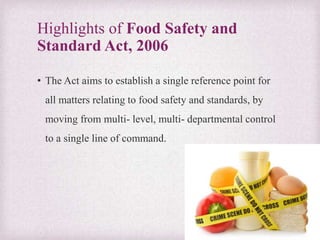
• The Act aims to establish a single reference point for
all matters relating to food safety and standards, by
moving from multi- level, multi- departmental control
to a single line of command.
The FSS Act
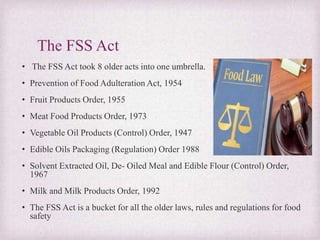
• The FSS Act took 8 older acts into one umbrella.
• Prevention of Food Adulteration Act, 1954
• Fruit Products Order, 1955
• Meat Food Products Order, 1973
• Vegetable Oil Products (Control) Order, 1947
• Edible Oils Packaging (Regulation) Order 1988
• Solvent Extracted Oil, De- Oiled Meal and Edible Flour (Control) Order,
1967
• Milk and Milk Products Order, 1992
• The FSS Act is a bucket for all the older laws, rules and regulations for food
safety
FSSAI – Administrative structure
• Ministry of Health & Family Welfare, Government of India is the
Administrative Ministry of Food Safety and Standards Authority of India.
• The FSSAI is headed by a non-executive Chairperson, appointed by the
Central Government, either holding or has held the position of not below the
rank of Secretary to the Government of India.
• The FSSAI consists of a chairperson & 22 members.
• Ashish Bahuguna is the current Chairperson for FSSAI and Pawan Kumar
Agarwal is the current Chief Executive Officer for FSSAI. mbers.
Location
• FSSAI is located in 5 regions
• Northern Region – With head office at New Delhi
• Eastern Region- Kolkata
• North Eastern Region- Guwahati
• Western region- Mumbai
• Southern Region- Cochin and Chennai
Ashish BahugunaHead office at New Delhi
Aims
• The main aim of FSSAI is to
1. Lay down science-based standards for articles of
food
2. To regulate manufacture, storage, distribution, sale
and import of food
3. To facilitate food safety
Powers or Functions of FSSAI
1. Framing of regulations to lay down food safety standards
2. Laying down guidelines for accreditation of laboratories for
food testing
3. Providing scientific advice and technical support to the
Central Government
4. Contributing to the development of international technical
standards in food
5. Collecting and collating data regarding food consumption,
contamination, emerging risks etc.
6. Disseminating information and promoting awareness about
food safety and nutrition in India
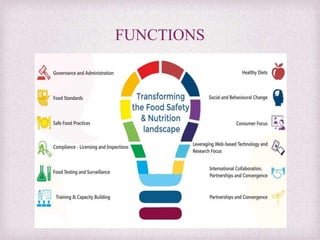
FUNCTIONS
Departments
1. Import Division
2. International Co-operation
3. Regulatory Compliance Division (RCD)
4. Food Safety Management System (FSMS) Division
5. Risk Assessment and R&D division (RARD)
6. Information Education Communication (IEC) Division
7. Regulation and Codex Division
8. Quality Assurance/ lab Division
9. HR Division
10. Standards Division
Research and Quality assurance
• Research
The Research and Development division is responsible for research with the
following objectives:
1. Generate new knowledge that would help in continuously updating and upgrading
food safety standards which are compatible with international organizations
2. Carry out evidence based studies for improving or building policies
• Quality Assurance
1. FSSAI has been mandated to perform various functions related to quality and
standards of food.
2. These functions in addition to others include “Laying down procedure and
guidelines for notification of the accredited laboratories
FSSAI notified laboratories
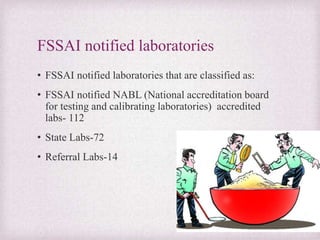
• FSSAI notified laboratories that are classified as:
• FSSAI notified NABL (National accreditation board
for testing and calibrating laboratories) accredited
labs- 112
• State Labs-72
• Referral Labs-14
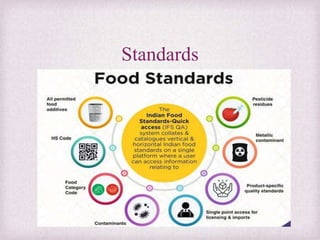
Standards
• Standards framed by FSSAI are prescribed under Food Safety and Standards Regulations,
2011 (Food Product Standards and Food Additives, Packaging and Labelling,
Contaminants, Toxins, and Residues).
• The FSSAI has prescribed standards for following food products:
 Dairy products and analogues
 Fats, oils and fat emulsions
 Fruits and vegetable products
 Cereal and cereal products
 Meat and meat products
 Fish and fish products
 Sweets & confectionery
 Sweetening agents including
honey
 Salt, spices, condiments and
related products
 Beverages, (other than dairy and
fruits & vegetables based)
 Other food product and
ingredients
 Proprietary food
 Irradiation of food
Standards
Applicable FSSAI License
• FSSAI issues three types of license based on nature of food
business and turnover:
1. Registration: For Turnover less than 12 Lakh
2. State License: For Turnover between 12 Lakh to 20 Crore
3. Central License: For Turnover above 20 Crore
• Other criteria like the location of the business, number of
retail stores etc. is needed while evaluating the nature of
license applicable.
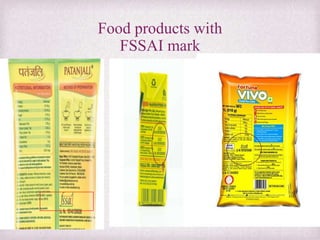
Food products with
FSSAI mark
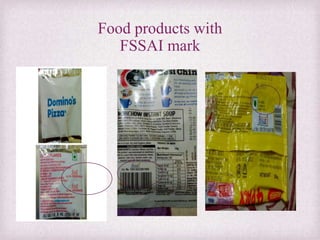
Food products with
FSSAI mark
Consumer outreach
• Consumers can connect to FSSAI through various channels or call
Toll free Number 1800112100.
• An online platform called ‘Food Safety Voice’ has been launched
which helps consumers to register their complaints and feedbacks
about food safety issues related to adulterated food, unsafe food,
substandard food, labeling defects in food and misleading claims
& advertisements related to various food products.
Thank you
By
Gauri Gatade
Thejeswini H

FSSAI

  • 1.
  • 2.
    FSSAI • The FoodSafety and Standards Authority of India (FSSAI) has been established under Food Safety and Standards , 2006 which consolidates various acts & orders that have hitherto handled food related issues in various Departments. • The FSSAI is responsible for setting standards for food so that there is one body to deal with and no confusion in the minds of consumers, traders, manufacturers, and investors.
  • 3.
    Highlights of FoodSafety and Standard Act, 2006 • The Act aims to establish a single reference point for all matters relating to food safety and standards, by moving from multi- level, multi- departmental control to a single line of command.
  • 4.
    The FSS Act •The FSS Act took 8 older acts into one umbrella. • Prevention of Food Adulteration Act, 1954 • Fruit Products Order, 1955 • Meat Food Products Order, 1973 • Vegetable Oil Products (Control) Order, 1947 • Edible Oils Packaging (Regulation) Order 1988 • Solvent Extracted Oil, De- Oiled Meal and Edible Flour (Control) Order, 1967 • Milk and Milk Products Order, 1992 • The FSS Act is a bucket for all the older laws, rules and regulations for food safety
  • 5.
    FSSAI – Administrativestructure • Ministry of Health & Family Welfare, Government of India is the Administrative Ministry of Food Safety and Standards Authority of India. • The FSSAI is headed by a non-executive Chairperson, appointed by the Central Government, either holding or has held the position of not below the rank of Secretary to the Government of India. • The FSSAI consists of a chairperson & 22 members. • Ashish Bahuguna is the current Chairperson for FSSAI and Pawan Kumar Agarwal is the current Chief Executive Officer for FSSAI. mbers.
  • 6.
    Location • FSSAI islocated in 5 regions • Northern Region – With head office at New Delhi • Eastern Region- Kolkata • North Eastern Region- Guwahati • Western region- Mumbai • Southern Region- Cochin and Chennai
  • 7.
  • 8.
    Aims • The mainaim of FSSAI is to 1. Lay down science-based standards for articles of food 2. To regulate manufacture, storage, distribution, sale and import of food 3. To facilitate food safety
  • 9.
    Powers or Functionsof FSSAI 1. Framing of regulations to lay down food safety standards 2. Laying down guidelines for accreditation of laboratories for food testing 3. Providing scientific advice and technical support to the Central Government 4. Contributing to the development of international technical standards in food 5. Collecting and collating data regarding food consumption, contamination, emerging risks etc. 6. Disseminating information and promoting awareness about food safety and nutrition in India
  • 10.
  • 11.
    Departments 1. Import Division 2.International Co-operation 3. Regulatory Compliance Division (RCD) 4. Food Safety Management System (FSMS) Division 5. Risk Assessment and R&D division (RARD) 6. Information Education Communication (IEC) Division 7. Regulation and Codex Division 8. Quality Assurance/ lab Division 9. HR Division 10. Standards Division
  • 12.
    Research and Qualityassurance • Research The Research and Development division is responsible for research with the following objectives: 1. Generate new knowledge that would help in continuously updating and upgrading food safety standards which are compatible with international organizations 2. Carry out evidence based studies for improving or building policies • Quality Assurance 1. FSSAI has been mandated to perform various functions related to quality and standards of food. 2. These functions in addition to others include “Laying down procedure and guidelines for notification of the accredited laboratories
  • 13.
    FSSAI notified laboratories •FSSAI notified laboratories that are classified as: • FSSAI notified NABL (National accreditation board for testing and calibrating laboratories) accredited labs- 112 • State Labs-72 • Referral Labs-14
  • 14.
    Standards • Standards framedby FSSAI are prescribed under Food Safety and Standards Regulations, 2011 (Food Product Standards and Food Additives, Packaging and Labelling, Contaminants, Toxins, and Residues). • The FSSAI has prescribed standards for following food products:  Dairy products and analogues  Fats, oils and fat emulsions  Fruits and vegetable products  Cereal and cereal products  Meat and meat products  Fish and fish products  Sweets & confectionery  Sweetening agents including honey  Salt, spices, condiments and related products  Beverages, (other than dairy and fruits & vegetables based)  Other food product and ingredients  Proprietary food  Irradiation of food
  • 15.
  • 16.
    Applicable FSSAI License •FSSAI issues three types of license based on nature of food business and turnover: 1. Registration: For Turnover less than 12 Lakh 2. State License: For Turnover between 12 Lakh to 20 Crore 3. Central License: For Turnover above 20 Crore • Other criteria like the location of the business, number of retail stores etc. is needed while evaluating the nature of license applicable.
  • 17.
  • 18.
  • 19.
    Consumer outreach • Consumerscan connect to FSSAI through various channels or call Toll free Number 1800112100. • An online platform called ‘Food Safety Voice’ has been launched which helps consumers to register their complaints and feedbacks about food safety issues related to adulterated food, unsafe food, substandard food, labeling defects in food and misleading claims & advertisements related to various food products.
  • 20.