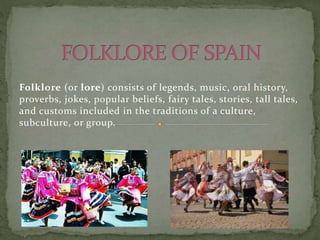
Folklore (or lore) consists of legends, music, oral history,
proverbs, jokes, popular beliefs, fairy tales, stories, tall tales,
and customs included in the traditions of a culture,
subculture, or group.
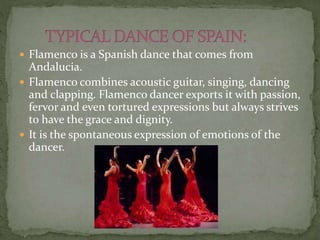
 Flamenco is a Spanish dance that comes from
Andalucia.
 Flamenco combines acoustic guitar, singing, dancing
and clapping. Flamenco dancer exports it with passion,
fervor and even tortured expressions but always strives
to have the grace and dignity.
 It is the spontaneous expression of emotions of the
dancer.
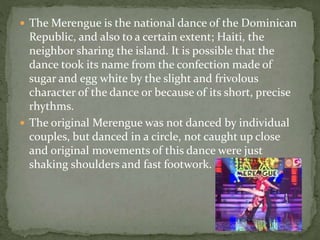
 The Merengue is the national dance of the Dominican
Republic, and also to a certain extent; Haiti, the
neighbor sharing the island. It is possible that the
dance took its name from the confection made of
sugar and egg white by the slight and frivolous
character of the dance or because of its short, precise
rhythms.
 The original Merengue was not danced by individual
couples, but danced in a circle, not caught up close
and original movements of this dance were just
shaking shoulders and fast footwork.
 Tango is one of the most fascinating dances. It
originated in Spain or Morocco, was introduced to the
New World by the Spanish settlers, and eventually
returned to Spain.
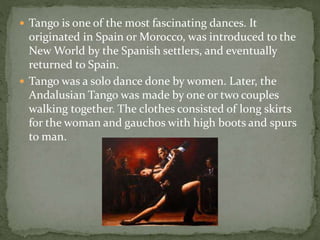
 Tango was a solo dance done by women. Later, the
Andalusian Tango was made by one or two couples
walking together. The clothes consisted of long skirts
for the woman and gauchos with high boots and spurs
to man.
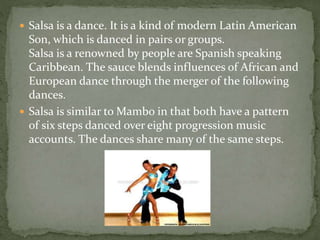
 Salsa is a dance. It is a kind of modern Latin American
Son, which is danced in pairs or groups.
Salsa is a renowned by people are Spanish speaking
Caribbean. The sauce blends influences of African and
European dance through the merger of the following
dances.
 Salsa is similar to Mambo in that both have a pattern
of six steps danced over eight progression music
accounts. The dances share many of the same steps.
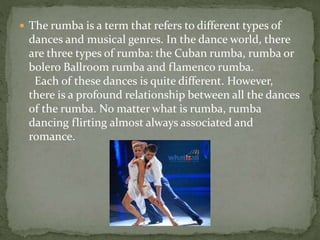
 The rumba is a term that refers to different types of
dances and musical genres. In the dance world, there
are three types of rumba: the Cuban rumba, rumba or
bolero Ballroom rumba and flamenco rumba.
Each of these dances is quite different. However,
there is a profound relationship between all the dances
of the rumba. No matter what is rumba, rumba
dancing flirting almost always associated and
romance.
Folklore of spain sofia y bea....

Folklore of spain sofia y bea....

  • 1.
    Folklore (or lore)consists of legends, music, oral history, proverbs, jokes, popular beliefs, fairy tales, stories, tall tales, and customs included in the traditions of a culture, subculture, or group.
  • 2.
     Flamenco isa Spanish dance that comes from Andalucia.  Flamenco combines acoustic guitar, singing, dancing and clapping. Flamenco dancer exports it with passion, fervor and even tortured expressions but always strives to have the grace and dignity.  It is the spontaneous expression of emotions of the dancer.
  • 3.
     The Merengueis the national dance of the Dominican Republic, and also to a certain extent; Haiti, the neighbor sharing the island. It is possible that the dance took its name from the confection made of sugar and egg white by the slight and frivolous character of the dance or because of its short, precise rhythms.  The original Merengue was not danced by individual couples, but danced in a circle, not caught up close and original movements of this dance were just shaking shoulders and fast footwork.
  • 4.
     Tango isone of the most fascinating dances. It originated in Spain or Morocco, was introduced to the New World by the Spanish settlers, and eventually returned to Spain.  Tango was a solo dance done by women. Later, the Andalusian Tango was made by one or two couples walking together. The clothes consisted of long skirts for the woman and gauchos with high boots and spurs to man.

  • 5.
     Salsa isa dance. It is a kind of modern Latin American Son, which is danced in pairs or groups. Salsa is a renowned by people are Spanish speaking Caribbean. The sauce blends influences of African and European dance through the merger of the following dances.  Salsa is similar to Mambo in that both have a pattern of six steps danced over eight progression music accounts. The dances share many of the same steps.
  • 6.
     The rumbais a term that refers to different types of dances and musical genres. In the dance world, there are three types of rumba: the Cuban rumba, rumba or bolero Ballroom rumba and flamenco rumba. Each of these dances is quite different. However, there is a profound relationship between all the dances of the rumba. No matter what is rumba, rumba dancing flirting almost always associated and romance.