By: Santos, Alejandro, Tomás, Pepe, Jesus, y Rudy
5-6
   Los bailores- Flamenco dancers
   El cantante- the singer
   El canto- the song
   Las castañuelas- the castanets
   Las palmas- handclapping
   El zapateo- footwork; dance performed with
    high heels.
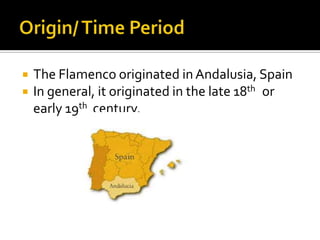
   The Flamenco originated in Andalusia, Spain
   In general, it originated in the late 18th or
    early 19th century.
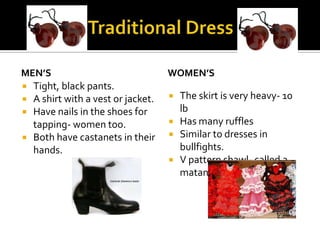
MEN’S                              WOMEN’S
 Tight, black pants.
 A shirt with a vest or jacket.      The skirt is very heavy- 10
 Have nails in the shoes for          lb
  tapping- women too.                 Has many ruffles
 Both have castanets in their        Similar to dresses in
  hands.                               bullfights.
                                      V pattern shawl- called a
                                       matan.
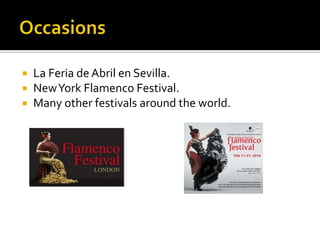
   La Feria de Abril en Sevilla.
   New York Flamenco Festival.
   Many other festivals around the world.
   http://www.youtube.com/watch?feature=player_detailpage&v=OQ-ie12Eqck
   Guitar
   Flamenco Guitae
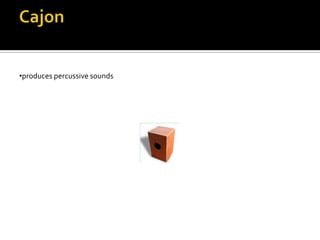
   Cajon
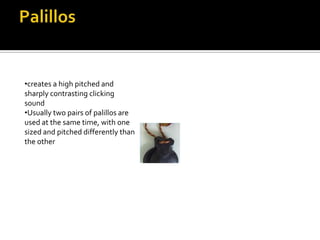
   Palillos
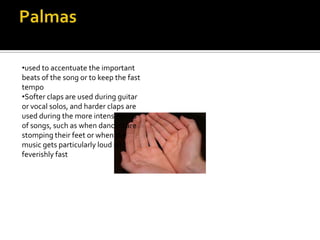
   Palmas
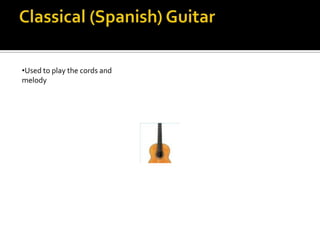
•Used to play the cords and
melody
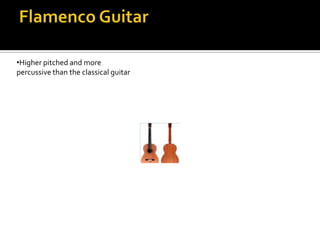
•Higher pitched and more
percussive than the classical guitar
•produces percussive sounds
•creates a high pitched and
sharply contrasting clicking
sound
•Usually two pairs of palillos are
used at the same time, with one
sized and pitched differently than
the other
•used to accentuate the important
beats of the song or to keep the fast
tempo
•Softer claps are used during guitar
or vocal solos, and harder claps are
used during the more intense parts
of songs, such as when dancers are
stomping their feet or when the
music gets particularly loud and
feverishly fast
   Los bailaores ~ Flamenco dancers
   el cantante ~ Singer
   el canto ~ song
   lascastañuelas~ castanets
   laspalmas ~ handclapping
   el zapateo~ footwork; dance performed with
    high heels
The flamenco powerpoint 56

The flamenco powerpoint 56

  • 1.
    By: Santos, Alejandro,Tomás, Pepe, Jesus, y Rudy 5-6
  • 2.
    Los bailores- Flamenco dancers  El cantante- the singer  El canto- the song  Las castañuelas- the castanets  Las palmas- handclapping  El zapateo- footwork; dance performed with high heels.
  • 3.
    The Flamenco originated in Andalusia, Spain  In general, it originated in the late 18th or early 19th century.
  • 4.
    MEN’S WOMEN’S  Tight, black pants.  A shirt with a vest or jacket.  The skirt is very heavy- 10  Have nails in the shoes for lb tapping- women too.  Has many ruffles  Both have castanets in their  Similar to dresses in hands. bullfights.  V pattern shawl- called a matan.
  • 5.
    La Feria de Abril en Sevilla.  New York Flamenco Festival.  Many other festivals around the world.
  • 6.
    http://www.youtube.com/watch?feature=player_detailpage&v=OQ-ie12Eqck
  • 7.
    Guitar  Flamenco Guitae  Cajon  Palillos  Palmas
  • 8.
    •Used to playthe cords and melody
  • 9.
    •Higher pitched andmore percussive than the classical guitar
  • 10.
  • 11.
    •creates a highpitched and sharply contrasting clicking sound •Usually two pairs of palillos are used at the same time, with one sized and pitched differently than the other
  • 12.
    •used to accentuatethe important beats of the song or to keep the fast tempo •Softer claps are used during guitar or vocal solos, and harder claps are used during the more intense parts of songs, such as when dancers are stomping their feet or when the music gets particularly loud and feverishly fast
  • 13.
    Los bailaores ~ Flamenco dancers  el cantante ~ Singer  el canto ~ song  lascastañuelas~ castanets  laspalmas ~ handclapping  el zapateo~ footwork; dance performed with high heels