CLASSIFICATION
OF SOCIAL
DANCES
BY: SAMANTHA MAE M. LATIGAY
9-SPJ ENGLISH
SOCIAL
DANCES
--Social dances are dances that have social
functions and context. Social dances are
intended for participation rather than
performance. They are often danced merely to
socialise and for entertainment, though they
may have ceremonial, competitive and erotic
functions. Wikipedia
--a non-competitive version of ballroom and
latin dancing. It is comprised of all the same
dances, like Foxtrot, Tango, Swing, or Cha-
Cha, but designed to be used in practical
settings like wedding receptions, nightclubs,
business functions, or informal gatherings.
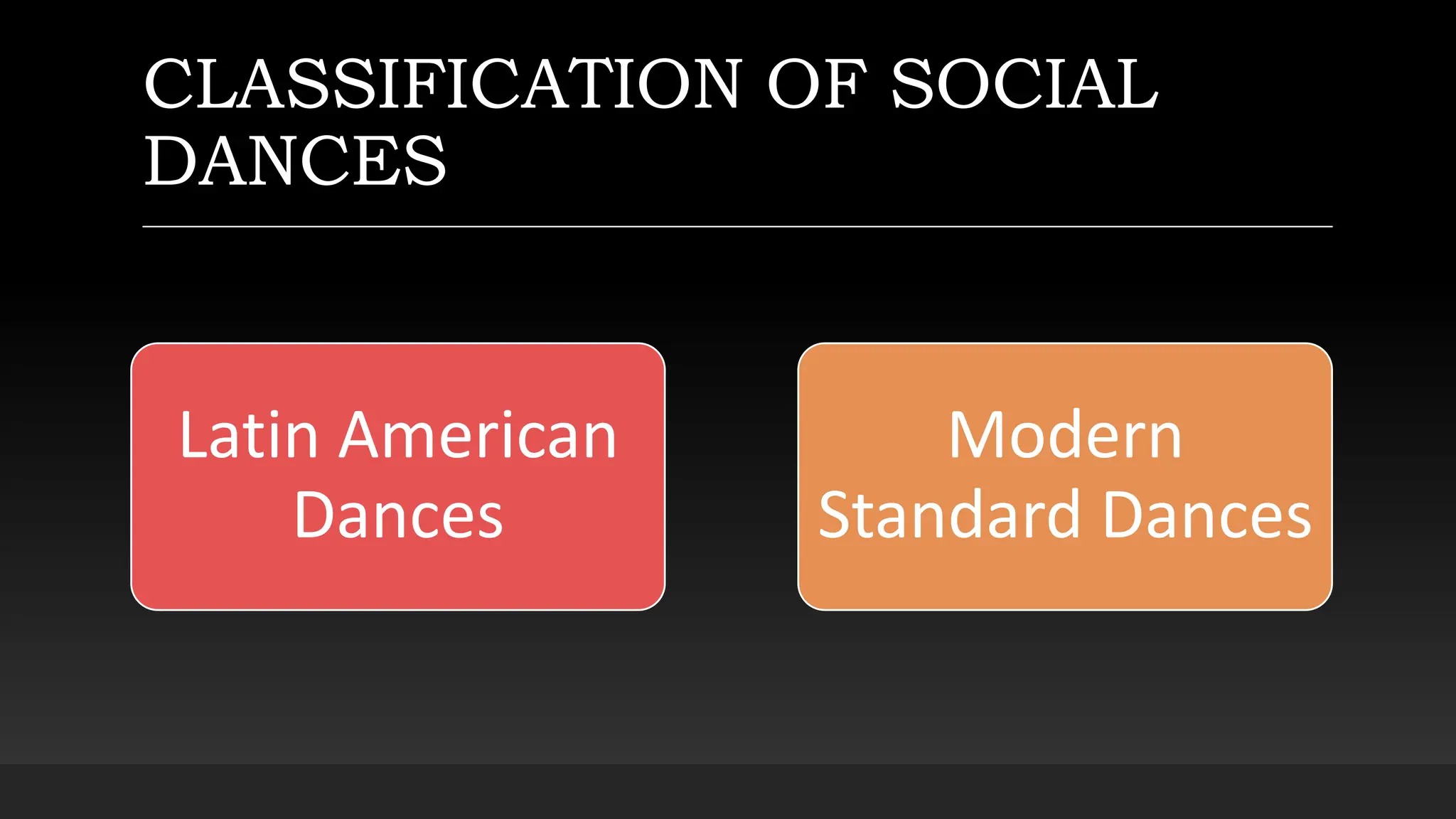
CLASSIFICATION OF SOCIAL
DANCES
Latin American
Dances
Modern
Standard Dances
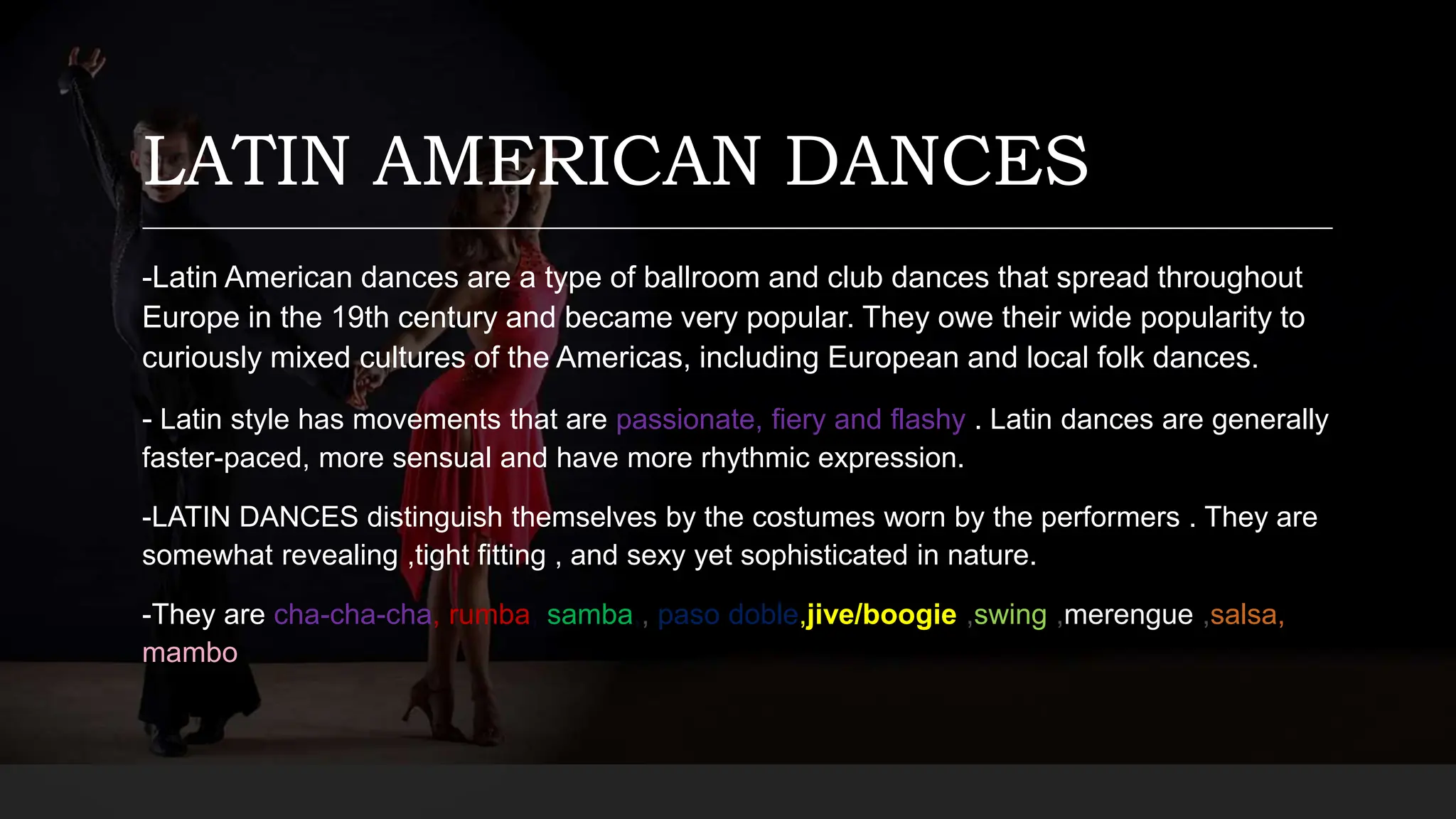
LATIN AMERICAN DANCES
-Latin American dances are a type of ballroom and club dances that spread throughout
Europe in the 19th century and became very popular. They owe their wide popularity to
curiously mixed cultures of the Americas, including European and local folk dances.
- Latin style has movements that are passionate, fiery and flashy . Latin dances are generally
faster-paced, more sensual and have more rhythmic expression.
-LATIN DANCES distinguish themselves by the costumes worn by the performers . They are
somewhat revealing ,tight fitting , and sexy yet sophisticated in nature.
-They are cha-cha-cha, rumba, samba,, paso doble,jive/boogie ,swing ,merengue ,salsa,
mambo
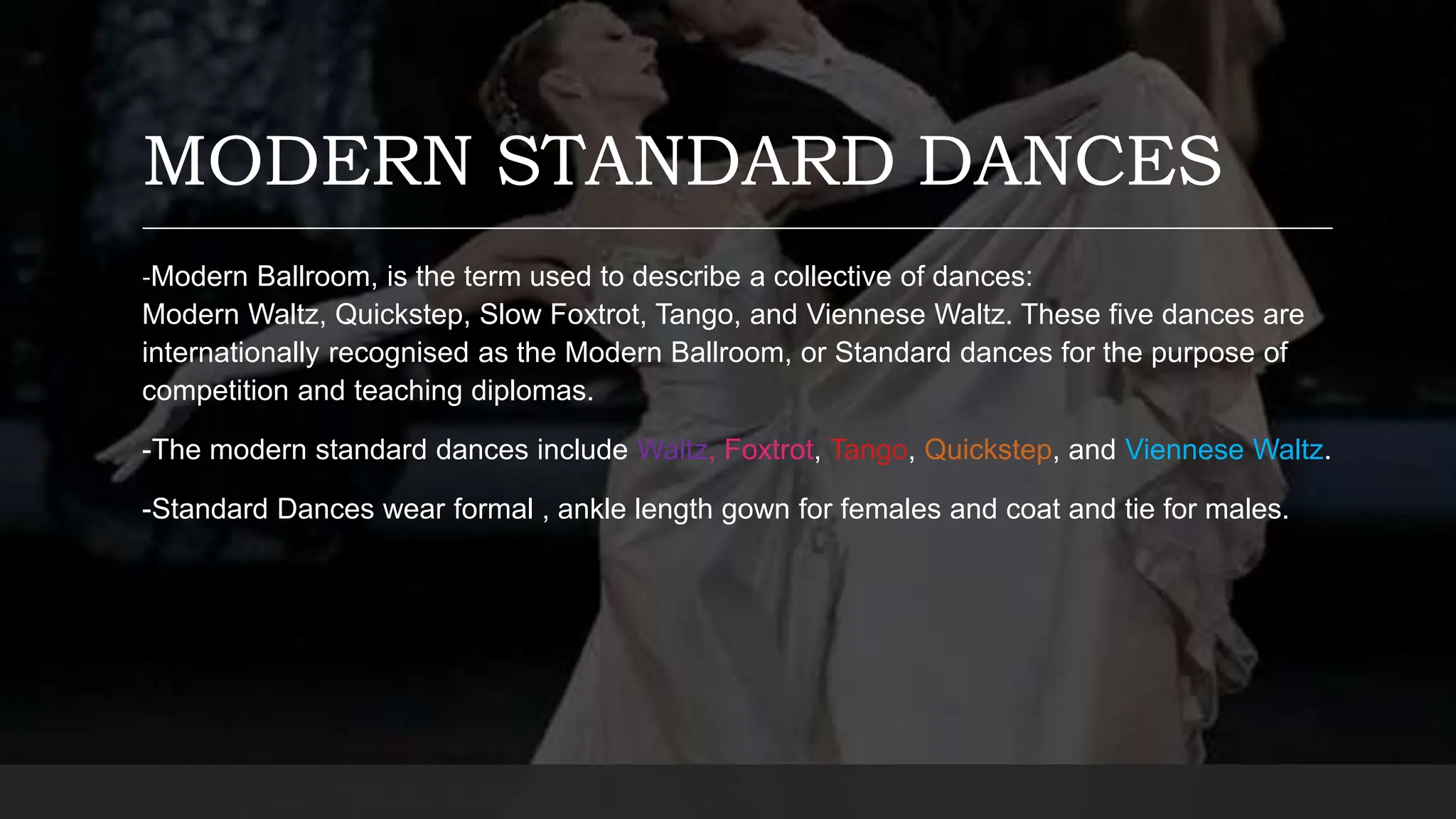
MODERN STANDARD DANCES
-Modern Ballroom, is the term used to describe a collective of dances:
Modern Waltz, Quickstep, Slow Foxtrot, Tango, and Viennese Waltz. These five dances are
internationally recognised as the Modern Ballroom, or Standard dances for the purpose of
competition and teaching diplomas.
-The modern standard dances include Waltz, Foxtrot, Tango, Quickstep, and Viennese Waltz.
-Standard Dances wear formal , ankle length gown for females and coat and tie for males.
DANCE’S
ORIGIN
Latin American dances origin Modern Standard dances origin
Cha-cha Cuba Slow Waltz Austria
Rumba Cuba Tango Argentina
Samba Brazil Viennese Waltz Vienna
Paso doble Spain Foxtrot USA
Jive /boogie USA Quickstep USA
Swing USA
Merengue Dominican Republic
Salsa Cuba
Mambo Cuba
Latin American dances
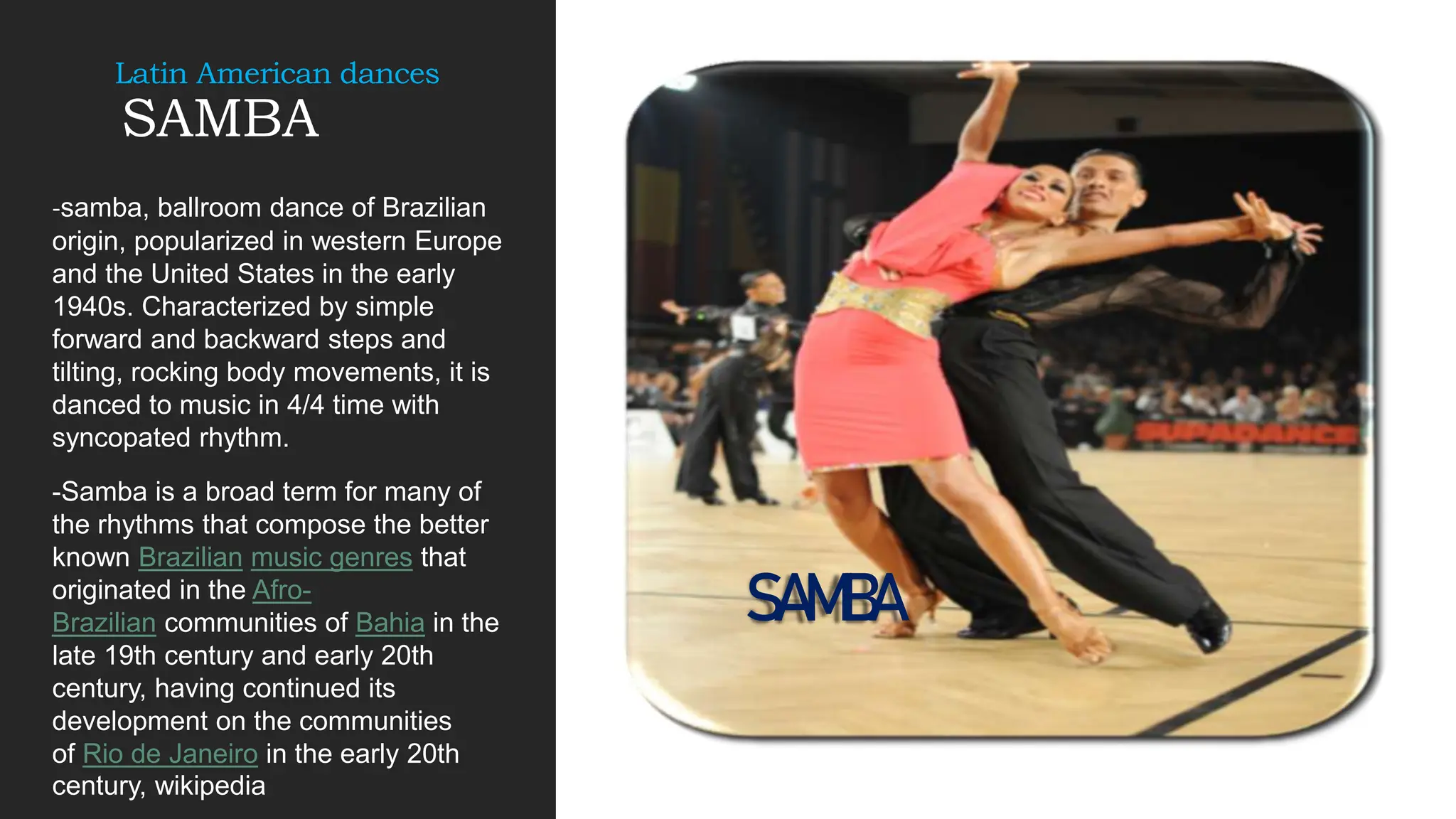
SAMBA
SAMBA
-samba, ballroom dance of Brazilian
origin, popularized in western Europe
and the United States in the early
1940s. Characterized by simple
forward and backward steps and
tilting, rocking body movements, it is
danced to music in 4/4 time with
syncopated rhythm.
-Samba is a broad term for many of
the rhythms that compose the better
known Brazilian music genres that
originated in the Afro-
Brazilian communities of Bahia in the
late 19th century and early 20th
century, having continued its
development on the communities
of Rio de Janeiro in the early 20th
century, wikipedia
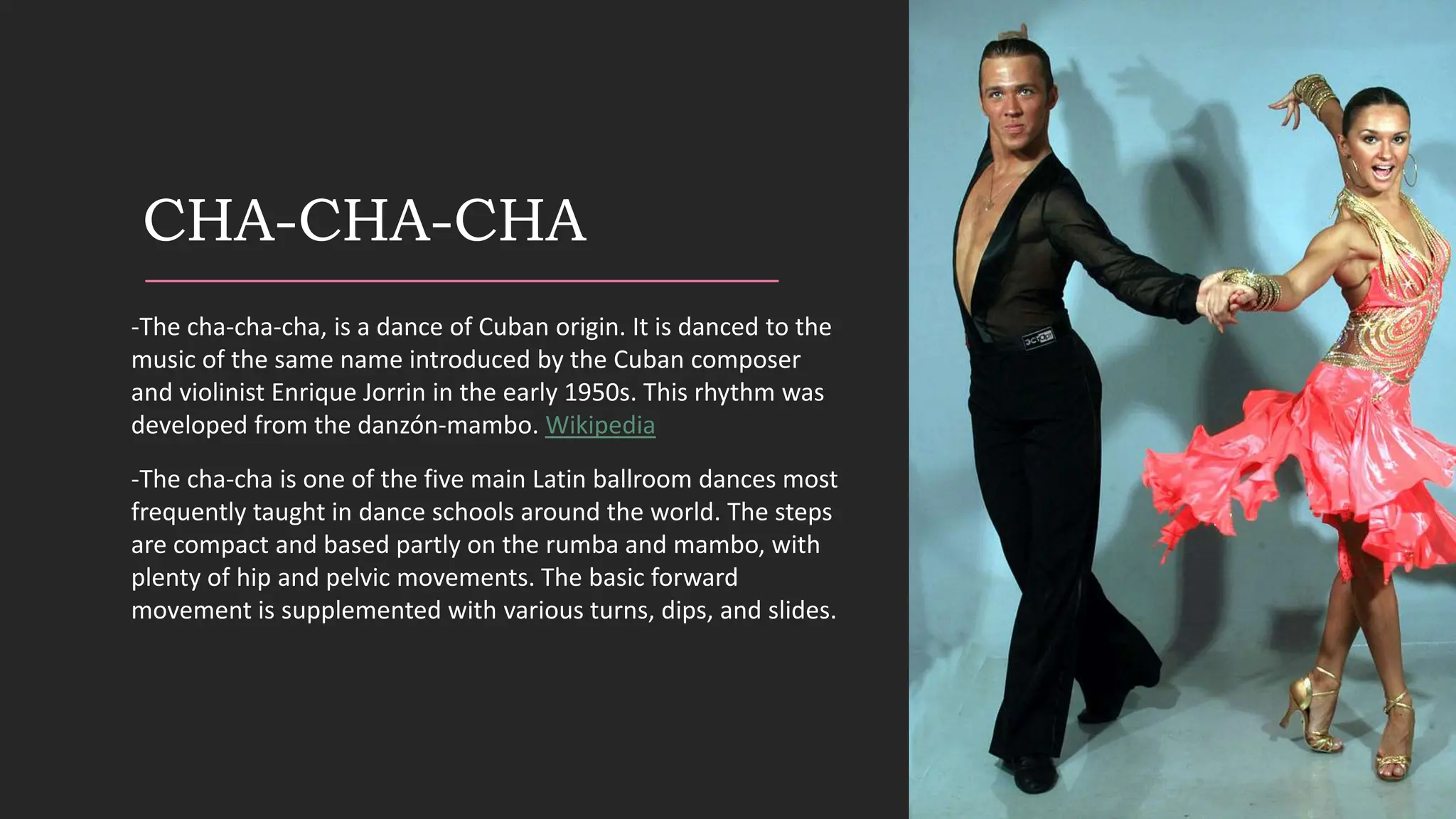
CHA-CHA-CHA
-The cha-cha-cha, is a dance of Cuban origin. It is danced to the
music of the same name introduced by the Cuban composer
and violinist Enrique Jorrin in the early 1950s. This rhythm was
developed from the danzón-mambo. Wikipedia
-The cha-cha is one of the five main Latin ballroom dances most
frequently taught in dance schools around the world. The steps
are compact and based partly on the rumba and mambo, with
plenty of hip and pelvic movements. The basic forward
movement is supplemented with various turns, dips, and slides.
RUMBA
-Rumba, ballroom dance of Afro-Cuban
folk-dance origin that became
internationally popular in the early
20th century. Best known for the
dancers' subtle side to side hip
movements with the torso erect, the
rumba is danced with a basic pattern of
two quick side steps and a slow
forward step.
-Rumba is often called the “dance of
love”, distinguished by it's romantic
feel. It is a non=progressive dance with
continuous, flowing Cuban motion
which gives Rumba its sensual look.
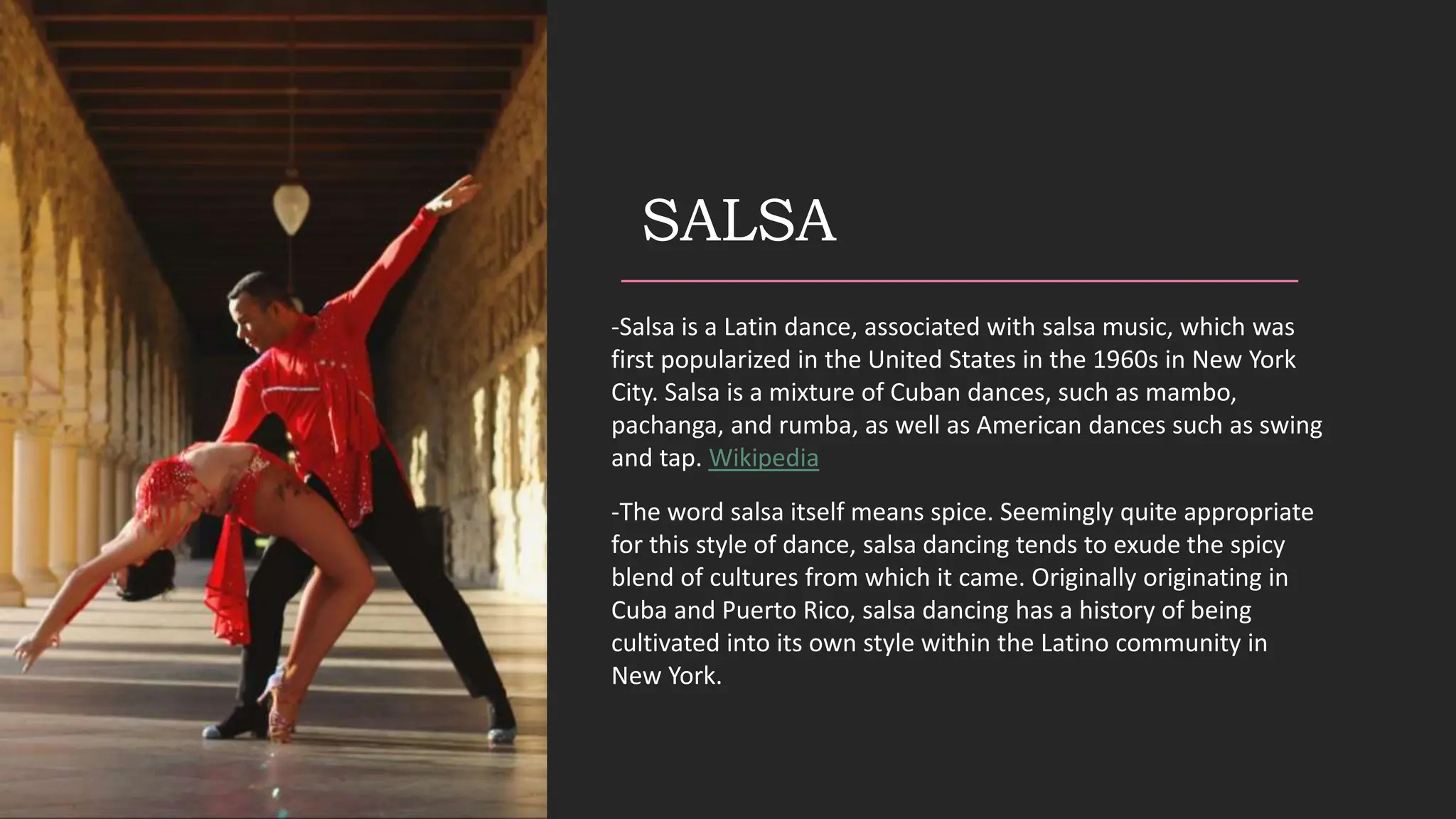
SALSA
-Salsa is a Latin dance, associated with salsa music, which was
first popularized in the United States in the 1960s in New York
City. Salsa is a mixture of Cuban dances, such as mambo,
pachanga, and rumba, as well as American dances such as swing
and tap. Wikipedia
-The word salsa itself means spice. Seemingly quite appropriate
for this style of dance, salsa dancing tends to exude the spicy
blend of cultures from which it came. Originally originating in
Cuba and Puerto Rico, salsa dancing has a history of being
cultivated into its own style within the Latino community in
New York.
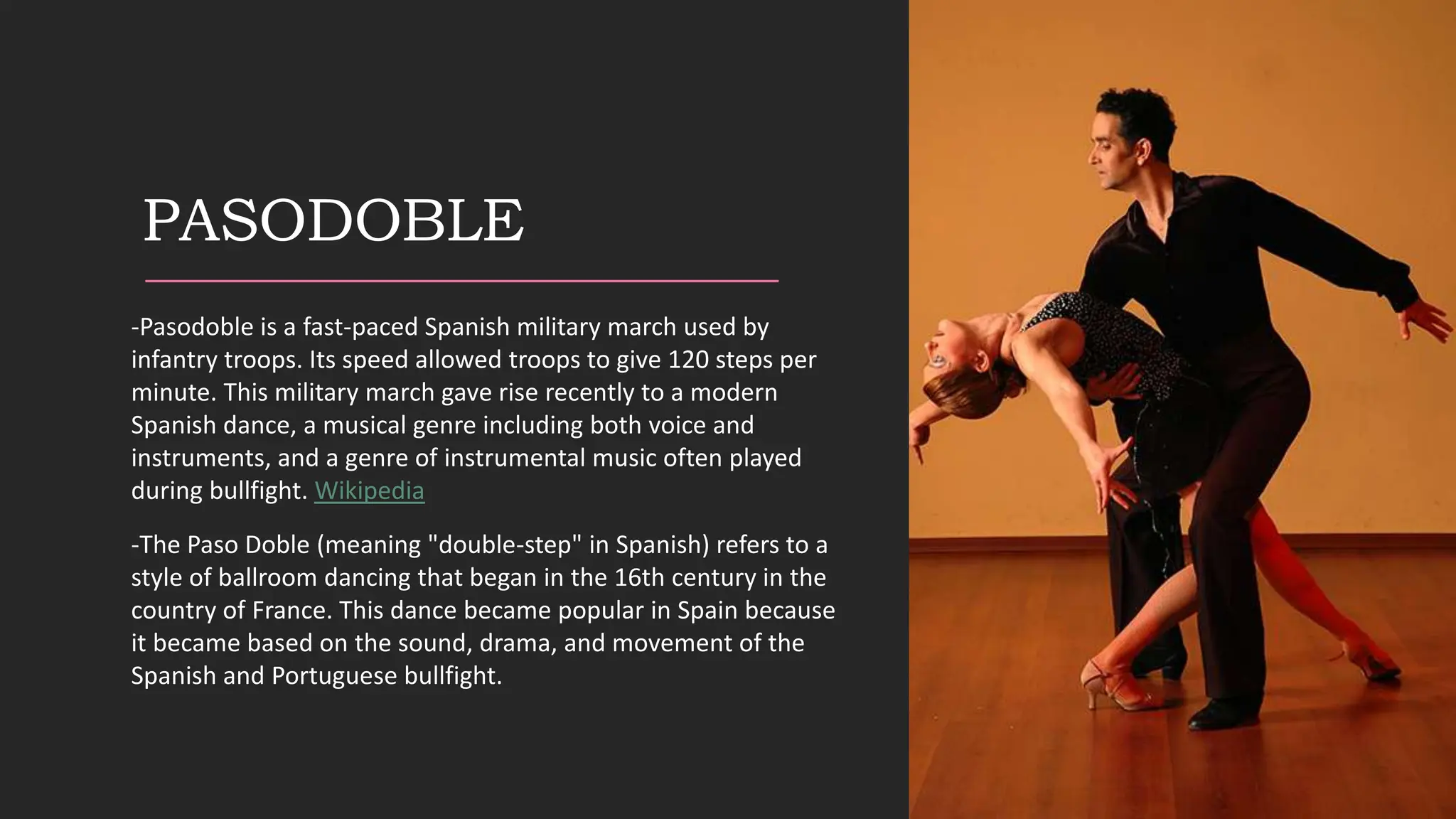
PASODOBLE
-Pasodoble is a fast-paced Spanish military march used by
infantry troops. Its speed allowed troops to give 120 steps per
minute. This military march gave rise recently to a modern
Spanish dance, a musical genre including both voice and
instruments, and a genre of instrumental music often played
during bullfight. Wikipedia
-The Paso Doble (meaning "double-step" in Spanish) refers to a
style of ballroom dancing that began in the 16th century in the
country of France. This dance became popular in Spain because
it became based on the sound, drama, and movement of the
Spanish and Portuguese bullfight.
Modern Standard dances
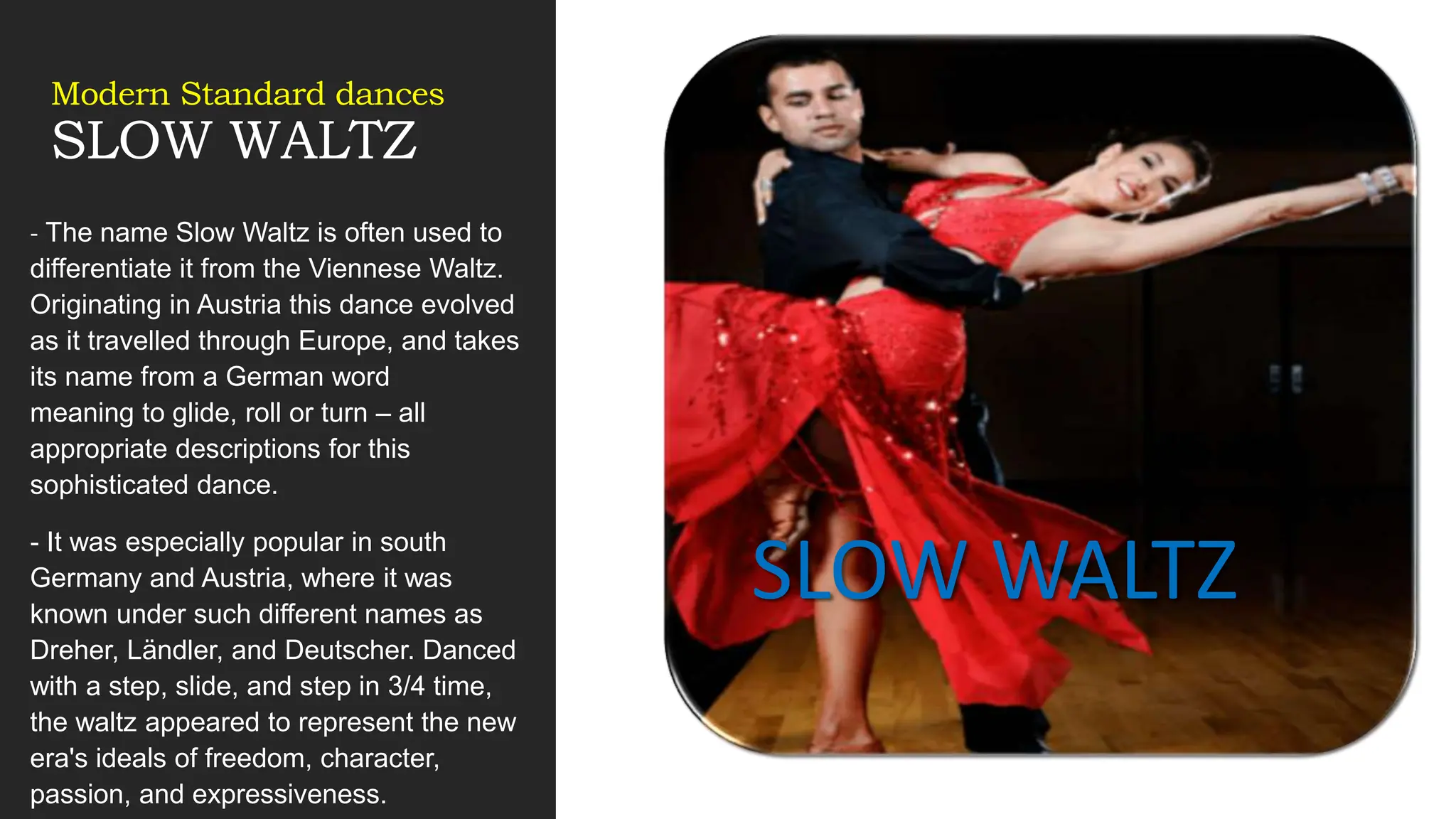
SLOW WALTZ
- The name Slow Waltz is often used to
differentiate it from the Viennese Waltz.
Originating in Austria this dance evolved
as it travelled through Europe, and takes
its name from a German word
meaning to glide, roll or turn – all
appropriate descriptions for this
sophisticated dance.
- It was especially popular in south
Germany and Austria, where it was
known under such different names as
Dreher, Ländler, and Deutscher. Danced
with a step, slide, and step in 3/4 time,
the waltz appeared to represent the new
era's ideals of freedom, character,
passion, and expressiveness.
SLOW WALTZ
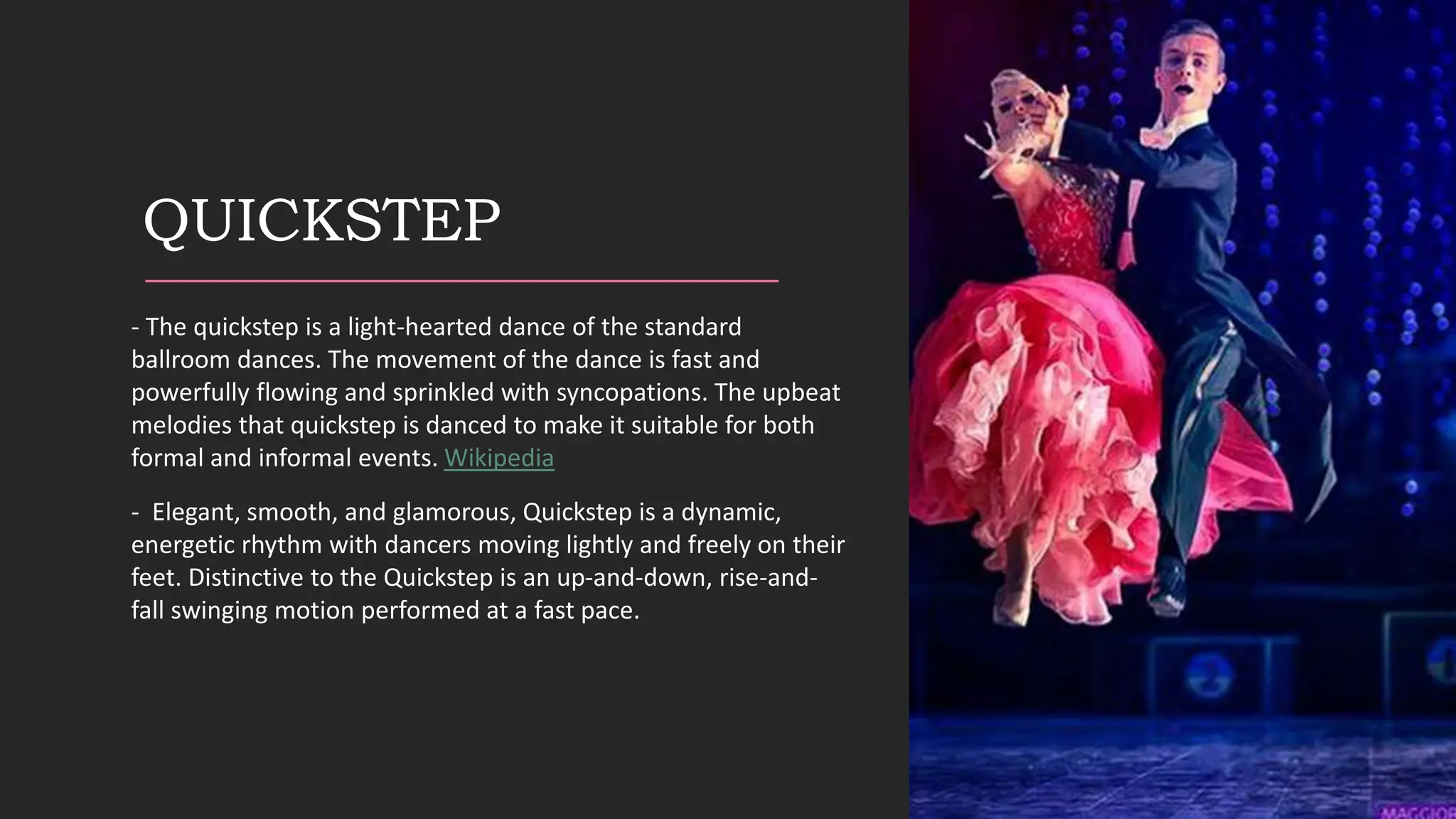
QUICKSTEP
- The quickstep is a light-hearted dance of the standard
ballroom dances. The movement of the dance is fast and
powerfully flowing and sprinkled with syncopations. The upbeat
melodies that quickstep is danced to make it suitable for both
formal and informal events. Wikipedia
- Elegant, smooth, and glamorous, Quickstep is a dynamic,
energetic rhythm with dancers moving lightly and freely on their
feet. Distinctive to the Quickstep is an up-and-down, rise-and-
fall swinging motion performed at a fast pace.
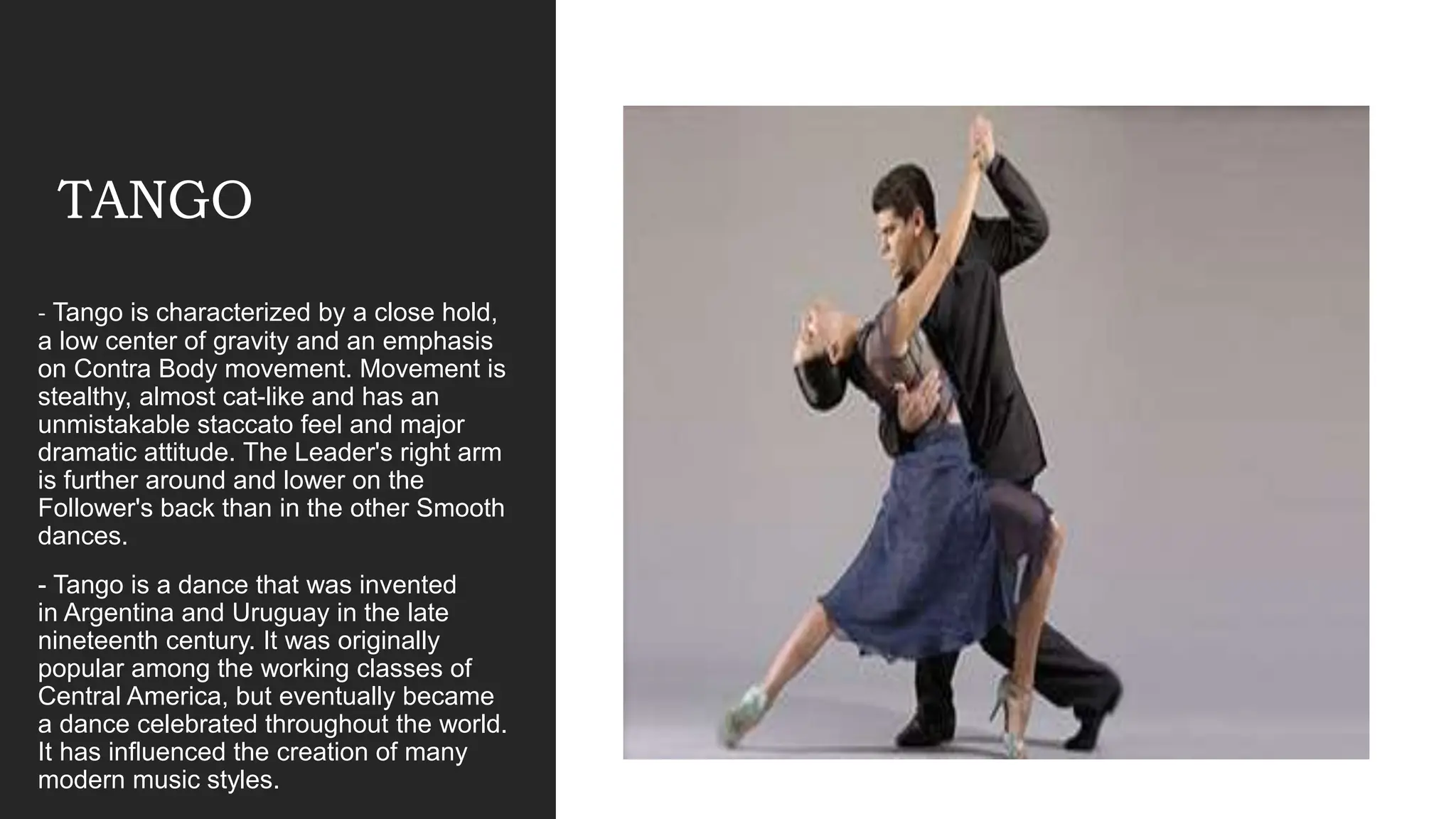
TANGO
- Tango is characterized by a close hold,
a low center of gravity and an emphasis
on Contra Body movement. Movement is
stealthy, almost cat-like and has an
unmistakable staccato feel and major
dramatic attitude. The Leader's right arm
is further around and lower on the
Follower's back than in the other Smooth
dances.
- Tango is a dance that was invented
in Argentina and Uruguay in the late
nineteenth century. It was originally
popular among the working classes of
Central America, but eventually became
a dance celebrated throughout the world.
It has influenced the creation of many
modern music styles.
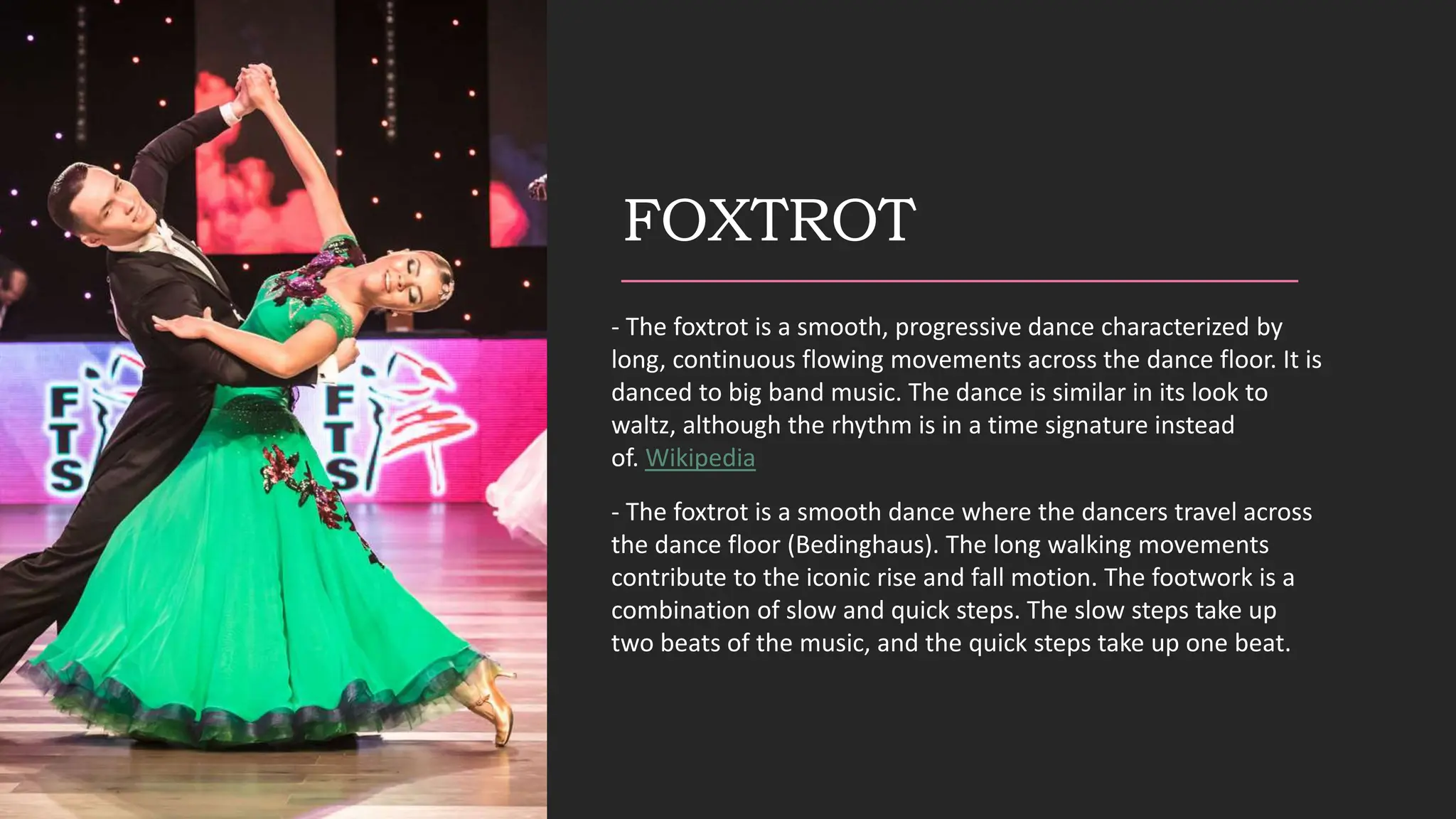
FOXTROT
- The foxtrot is a smooth, progressive dance characterized by
long, continuous flowing movements across the dance floor. It is
danced to big band music. The dance is similar in its look to
waltz, although the rhythm is in a time signature instead
of. Wikipedia
- The foxtrot is a smooth dance where the dancers travel across
the dance floor (Bedinghaus). The long walking movements
contribute to the iconic rise and fall motion. The footwork is a
combination of slow and quick steps. The slow steps take up
two beats of the music, and the quick steps take up one beat.
VIENNESE
WALTZ
- Viennese waltz is a genre of
ballroom dance. At least four different
meanings are recognized. In the
historically first sense, the name may
refer to several versions of the waltz,
including the earliest waltzes done in
ballroom dancing, danced to the music
of Viennese waltz. Wikipedia
- The Viennese Waltz is the oldest of
the ballroom dances still practiced
today. Originally a folk dance in rural
Austria and Germany, it's a fast,
vibrant and sometimes dizzying dance
that requires quick but smooth and
elegant turns.
OTHER LATIN DANCES

CLASSIFICATION OF SOCIAL DANCES powerpoint

  • 1.
  • 2.
    SOCIAL DANCES --Social dances aredances that have social functions and context. Social dances are intended for participation rather than performance. They are often danced merely to socialise and for entertainment, though they may have ceremonial, competitive and erotic functions. Wikipedia --a non-competitive version of ballroom and latin dancing. It is comprised of all the same dances, like Foxtrot, Tango, Swing, or Cha- Cha, but designed to be used in practical settings like wedding receptions, nightclubs, business functions, or informal gatherings.
  • 3.
    CLASSIFICATION OF SOCIAL DANCES LatinAmerican Dances Modern Standard Dances
  • 4.
    LATIN AMERICAN DANCES -LatinAmerican dances are a type of ballroom and club dances that spread throughout Europe in the 19th century and became very popular. They owe their wide popularity to curiously mixed cultures of the Americas, including European and local folk dances. - Latin style has movements that are passionate, fiery and flashy . Latin dances are generally faster-paced, more sensual and have more rhythmic expression. -LATIN DANCES distinguish themselves by the costumes worn by the performers . They are somewhat revealing ,tight fitting , and sexy yet sophisticated in nature. -They are cha-cha-cha, rumba, samba,, paso doble,jive/boogie ,swing ,merengue ,salsa, mambo
  • 5.
    MODERN STANDARD DANCES -ModernBallroom, is the term used to describe a collective of dances: Modern Waltz, Quickstep, Slow Foxtrot, Tango, and Viennese Waltz. These five dances are internationally recognised as the Modern Ballroom, or Standard dances for the purpose of competition and teaching diplomas. -The modern standard dances include Waltz, Foxtrot, Tango, Quickstep, and Viennese Waltz. -Standard Dances wear formal , ankle length gown for females and coat and tie for males.
  • 6.
    DANCE’S ORIGIN Latin American dancesorigin Modern Standard dances origin Cha-cha Cuba Slow Waltz Austria Rumba Cuba Tango Argentina Samba Brazil Viennese Waltz Vienna Paso doble Spain Foxtrot USA Jive /boogie USA Quickstep USA Swing USA Merengue Dominican Republic Salsa Cuba Mambo Cuba
  • 7.
    Latin American dances SAMBA SAMBA -samba,ballroom dance of Brazilian origin, popularized in western Europe and the United States in the early 1940s. Characterized by simple forward and backward steps and tilting, rocking body movements, it is danced to music in 4/4 time with syncopated rhythm. -Samba is a broad term for many of the rhythms that compose the better known Brazilian music genres that originated in the Afro- Brazilian communities of Bahia in the late 19th century and early 20th century, having continued its development on the communities of Rio de Janeiro in the early 20th century, wikipedia
  • 8.
    CHA-CHA-CHA -The cha-cha-cha, isa dance of Cuban origin. It is danced to the music of the same name introduced by the Cuban composer and violinist Enrique Jorrin in the early 1950s. This rhythm was developed from the danzón-mambo. Wikipedia -The cha-cha is one of the five main Latin ballroom dances most frequently taught in dance schools around the world. The steps are compact and based partly on the rumba and mambo, with plenty of hip and pelvic movements. The basic forward movement is supplemented with various turns, dips, and slides.
  • 9.
    RUMBA -Rumba, ballroom danceof Afro-Cuban folk-dance origin that became internationally popular in the early 20th century. Best known for the dancers' subtle side to side hip movements with the torso erect, the rumba is danced with a basic pattern of two quick side steps and a slow forward step. -Rumba is often called the “dance of love”, distinguished by it's romantic feel. It is a non=progressive dance with continuous, flowing Cuban motion which gives Rumba its sensual look.
  • 10.
    SALSA -Salsa is aLatin dance, associated with salsa music, which was first popularized in the United States in the 1960s in New York City. Salsa is a mixture of Cuban dances, such as mambo, pachanga, and rumba, as well as American dances such as swing and tap. Wikipedia -The word salsa itself means spice. Seemingly quite appropriate for this style of dance, salsa dancing tends to exude the spicy blend of cultures from which it came. Originally originating in Cuba and Puerto Rico, salsa dancing has a history of being cultivated into its own style within the Latino community in New York.
  • 11.
    PASODOBLE -Pasodoble is afast-paced Spanish military march used by infantry troops. Its speed allowed troops to give 120 steps per minute. This military march gave rise recently to a modern Spanish dance, a musical genre including both voice and instruments, and a genre of instrumental music often played during bullfight. Wikipedia -The Paso Doble (meaning "double-step" in Spanish) refers to a style of ballroom dancing that began in the 16th century in the country of France. This dance became popular in Spain because it became based on the sound, drama, and movement of the Spanish and Portuguese bullfight.
  • 12.
    Modern Standard dances SLOWWALTZ - The name Slow Waltz is often used to differentiate it from the Viennese Waltz. Originating in Austria this dance evolved as it travelled through Europe, and takes its name from a German word meaning to glide, roll or turn – all appropriate descriptions for this sophisticated dance. - It was especially popular in south Germany and Austria, where it was known under such different names as Dreher, Ländler, and Deutscher. Danced with a step, slide, and step in 3/4 time, the waltz appeared to represent the new era's ideals of freedom, character, passion, and expressiveness. SLOW WALTZ
  • 13.
    QUICKSTEP - The quickstepis a light-hearted dance of the standard ballroom dances. The movement of the dance is fast and powerfully flowing and sprinkled with syncopations. The upbeat melodies that quickstep is danced to make it suitable for both formal and informal events. Wikipedia - Elegant, smooth, and glamorous, Quickstep is a dynamic, energetic rhythm with dancers moving lightly and freely on their feet. Distinctive to the Quickstep is an up-and-down, rise-and- fall swinging motion performed at a fast pace.
  • 14.
    TANGO - Tango ischaracterized by a close hold, a low center of gravity and an emphasis on Contra Body movement. Movement is stealthy, almost cat-like and has an unmistakable staccato feel and major dramatic attitude. The Leader's right arm is further around and lower on the Follower's back than in the other Smooth dances. - Tango is a dance that was invented in Argentina and Uruguay in the late nineteenth century. It was originally popular among the working classes of Central America, but eventually became a dance celebrated throughout the world. It has influenced the creation of many modern music styles.
  • 15.
    FOXTROT - The foxtrotis a smooth, progressive dance characterized by long, continuous flowing movements across the dance floor. It is danced to big band music. The dance is similar in its look to waltz, although the rhythm is in a time signature instead of. Wikipedia - The foxtrot is a smooth dance where the dancers travel across the dance floor (Bedinghaus). The long walking movements contribute to the iconic rise and fall motion. The footwork is a combination of slow and quick steps. The slow steps take up two beats of the music, and the quick steps take up one beat.
  • 16.
    VIENNESE WALTZ - Viennese waltzis a genre of ballroom dance. At least four different meanings are recognized. In the historically first sense, the name may refer to several versions of the waltz, including the earliest waltzes done in ballroom dancing, danced to the music of Viennese waltz. Wikipedia - The Viennese Waltz is the oldest of the ballroom dances still practiced today. Originally a folk dance in rural Austria and Germany, it's a fast, vibrant and sometimes dizzying dance that requires quick but smooth and elegant turns.
  • 17.