Español 3 Tema 4 búsqueda web                               Nombre_____________

                 Usa los siguientes sitios web para buscar información sobre los
                 temas de la lista.

                 http://www.donquijote.org/culture/

                 http://www.espanole.org/artes

                 a. ¿Quíen es? o ¿Qué es?
                 b. ¿En qué país?
                 c. ¿Por qué es importante?---una descripción de 3-5 lineas en inglés y
                 d. una foto.

                 la danza
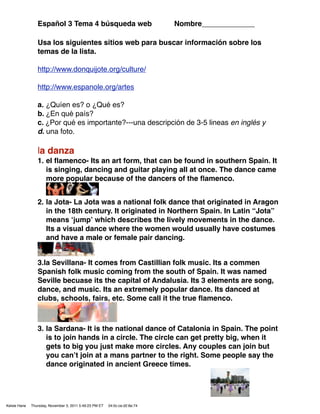
                 1. el flamenco- Its an art form, that can be found in southern Spain. It
                    is singing, dancing and guitar playing all at once. The dance came
                    more popular because of the dancers of the flamenco.


                 2. la Jota- La Jota was a national folk dance that originated in Aragon
                    in the 18th century. It originated in Northern Spain. In Latin “Jota”
                    means ʻjumpʼ which describes the lively movements in the dance.
                    Its a visual dance where the women would usually have costumes
                    and have a male or female pair dancing.


                 3.la Sevillana- It comes from Castillian folk music. Its a commen
                 Spanish folk music coming from the south of Spain. It was named
                 Seville becuase its the capital of Andalusia. Its 3 elements are song,
                 dance, and music. Its an extremely popular dance. Its danced at
                 clubs, schools, fairs, etc. Some call it the true flamenco.


                 3. la Sardana- It is the national dance of Catalonia in Spain. The point
                    is to join hands in a circle. The circle can get pretty big, when it
                    gets to big you just make more circles. Any couples can join but
                    you canʼt join at a mans partner to the right. Some people say the
                    dance originated in ancient Greece times.


Kelsie Hane   Thursday, November 3, 2011 5:49:23 PM ET   04:0c:ce:d2:6e:74
Español 3 Tema 4 búsqueda web                               Nombre_____________


                 5. El Tango- Nearly every city in Argentina knows of the tango. Its a
                    very intimate dance. In 1880 in Buenos Aires, the capital of
                    Argentina immigrants from Europe and Africa were looking for
                    companionship. And through all the hard times came the tango.


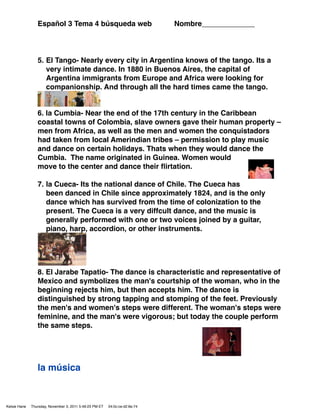
                 6. la Cumbia- Near the end of the 17th century in the Caribbean
                 coastal towns of Colombia, slave owners gave their human property –
                 men from Africa, as well as the men and women the conquistadors
                 had taken from local Amerindian tribes – permission to play music
                 and dance on certain holidays. Thats when they would dance the
                 Cumbia. The name originated in Guinea. Women would
                 move to the center and dance their flirtation.

                 7. la Cueca- Its the national dance of Chile. The Cueca has
                    been danced in Chile since approximately 1824, and is the only
                    dance which has survived from the time of colonization to the
                    present. The Cueca is a very diffcult dance, and the music is
                    generally performed with one or two voices joined by a guitar,
                    piano, harp, accordion, or other instruments.


                 8. El Jarabe Tapatio- The dance is characteristic and representative of
                 Mexico and symbolizes the man's courtship of the woman, who in the
                 beginning rejects him, but then accepts him. The dance is
                 distinguished by strong tapping and stomping of the feet. Previously
                 the men's and women's steps were different. The woman's steps were
                 feminine, and the man's were vigorous; but today the couple perform
                 the same steps.


                 la música


Kelsie Hane   Thursday, November 3, 2011 5:49:23 PM ET   04:0c:ce:d2:6e:74
Español 3 Tema 4 búsqueda web                               Nombre_____________

                 9. Mariachis y Charros- Its one of Mexicans symbols. They are easily
                    recognizable with their large wide brim sombrero hats and
                    embroidered “charro” outfits. The legend claims that some French
                    soldiers witnessed a Mexican rural wedding in which there was a
                    group playing songs. One of the soldiers asked the translator
                    “What is it?” and the translator responded “ç´est un mariage”. And
                    so the word “mariage” became popular and eventually evolved into
                    the word “mariachi”.


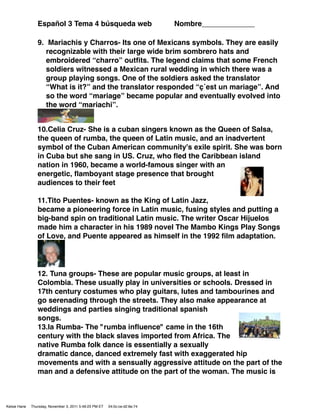
                 10.Celia Cruz- She is a cuban singers known as the Queen of Salsa,
                 the queen of rumba, the queen of Latin music, and an inadvertent
                 symbol of the Cuban American community's exile spirit. She was born
                 in Cuba but she sang in US. Cruz, who fled the Caribbean island
                 nation in 1960, became a world-famous singer with an
                 energetic, flamboyant stage presence that brought
                 audiences to their feet

                 11.Tito Puentes- known as the King of Latin Jazz,
                 became a pioneering force in Latin music, fusing styles and putting a
                 big-band spin on traditional Latin music. The writer Oscar Hijuelos
                 made him a character in his 1989 novel The Mambo Kings Play Songs
                 of Love, and Puente appeared as himself in the 1992 film adaptation.


                 12. Tuna groups- These are popular music groups, at least in
                 Colombia. These usually play in universities or schools. Dressed in
                 17th century costumes who play guitars, lutes and tambourines and
                 go serenading through the streets. They also make appearance at
                 weddings and parties singing traditional spanish
                 songs.
                 13.la Rumba- The "rumba influence" came in the 16th
                 century with the black slaves imported from Africa. The
                 native Rumba folk dance is essentially a sexually
                 dramatic dance, danced extremely fast with exaggerated hip
                 movements and with a sensually aggressive attitude on the part of the
                 man and a defensive attitude on the part of the woman. The music is


Kelsie Hane   Thursday, November 3, 2011 5:49:23 PM ET   04:0c:ce:d2:6e:74
Español 3 Tema 4 búsqueda web                               Nombre_____________

                 played with a staccato beat in keeping with the vigorous
                 expressive movements of the dancers. Accompanying
                 instruments include the maracas, the claves, the marimbola,
                 and the drums.
                 14. Manual de Falla- Born in 1876 in Cadiz, the historical
                 seaport town at the southern-most tip of Andalucia, Manuel
                 de Falla is the greatest Spanish composer of this century.
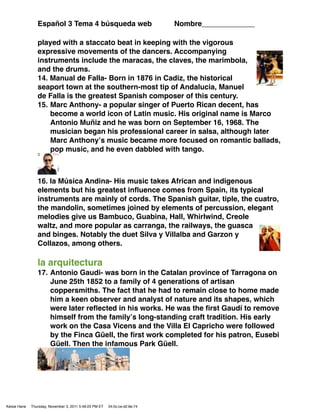
                 15. Marc Anthony- a popular singer of Puerto Rican decent, has
                     become a world icon of Latin music. His original name is Marco
                     Antonio Muñiz and he was born on September 16, 1968. The
                     musician began his professional career in salsa, although later
                     Marc Anthonyʼs music became more focused on romantic ballads,
                     pop music, and he even dabbled with tango.


                 16. la Música Andina- His music takes African and indigenous
                 elements but his greatest influence comes from Spain, its typical
                 instruments are mainly of cords. The Spanish guitar, tiple, the cuatro,
                 the mandolin, sometimes joined by elements of percussion, elegant
                 melodies give us Bambuco, Guabina, Hall, Whirlwind, Creole
                 waltz, and more popular as carranga, the railways, the guasca
                 and binges. Notably the duet Silva y Villalba and Garzon y
                 Collazos, among others.

                 la arquitectura
                 17. Antonio Gaudi- was born in the Catalan province of Tarragona on
                     June 25th 1852 to a family of 4 generations of artisan
                     coppersmiths. The fact that he had to remain close to home made
                     him a keen observer and analyst of nature and its shapes, which
                     were later reflected in his works. He was the first Gaudí to remove
                     himself from the familyʼs long-standing craft tradition. His early
                     work on the Casa Vicens and the Villa El Capricho were followed
                     by the Finca Güell, the first work completed for his patron, Eusebi
                     Güell. Then the infamous Park Güell.


Kelsie Hane   Thursday, November 3, 2011 5:49:23 PM ET   04:0c:ce:d2:6e:74
Español 3 Tema 4 búsqueda web                               Nombre_____________

                 18. La Sagrada Familia- La Sagrada Familia, or Holy Family Church, is
                     Antoni Gaudi's most ambitious work, and construction is still
                     ongoing. The questionable construction work isnʼt the only threat
                     to the structure. Concerns for the foundations of the cathedral
                     have been raised after approval was given earlier this year for a
                     high-speed link between Madrid and Barcelona that passes within
                     meters of the structure.


                 19. Park Guell- Parque GÃell, or Guell Park, by Antoni Gaudi is
                     surrounded by an undulating mosaic wall. The assignment of this
                     project was made by the count of Güell as an aristocratic city-
                     garden with single-family residences. The project finally wasn't a
                     success and consequently it became a municipality property and
                     since 1923 being transformed in a public park.


                 20.La Alhambra- The greatest concern of the architects of the
                 Alhambra was to cover every single space with decoration, no matter
                 the size of the space. It is located in Granada, Spain. It was made from
                 1338-1390. Its a palace type of building. Bearing masonry was the
                 construction system.


                 21.El Escorial- ocated some 30 miles northwest of Madrid in the
                 foothills of the Sierra de Guadarrama, was built as a monument to
                 commemorate the Spanish victory over the French. It used to be the
                 largest building in the world. Its a giant building of granite.


                 22. Teotihuacan- the largest city in Mesoamerica during the Classic
                     period, developed a complex urban civilization. Teotihuacán


Kelsie Hane   Thursday, November 3, 2011 5:49:23 PM ET   04:0c:ce:d2:6e:74
Español 3 Tema 4 búsqueda web                               Nombre_____________

                        means The City of the Gods, or Where Men Become Gods. Its
                        located in Mexico. The plazas, avenues, and great pyramids of the
                        city of Teotihuacán were laid out as a symbolic sacred landscape
                        of artificial foothills and mountains. it was discovered in 1971, and
                        was built over a natural cave with four chambers.


                 23. Chichen Itzá- Its located in Chichen Itza, Mexico. Chichen Itza is
                 the most visited archaeological site in the peninsula of Yucatan, due
                 to its extraordinary architecture beauty and its geographical location.
                 The construction began in the 7th century and the city reached its
                 peak after the Toltecs came in the 10th century.


                 el cine
                 24.Pedro Almódovar- He was born in Spain. He was the most
                 successful and internationally known Spanish film director,
                 screenwriter and producer of his generation alone. he is often
                 described as a "women's director" because many of his films have
                 revolved around strong, sympathetic female characters. Heʼs
                 propelled the careers of Spainʼs most influential actors like Penélope
                 Cruz and Antonio Banderas.


                 la obra de teatro-
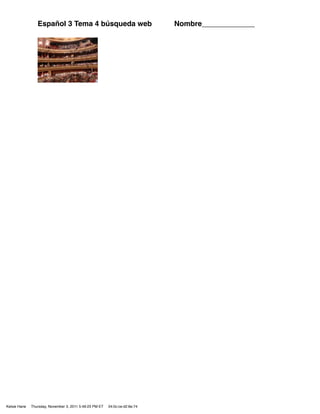
                 25. la Zarzuela-is a Spanish lyric-dramatic genre that alternates
                     between spoken and sung scenes, the latter incorporating
                     operatic and popular song, as well as dance. The etymology of the
                     name is not totally certain but some propose it may derive from
                     the name of a Royal hunting lodge, the Palacio de la Zarzuela near
                     Madrid, where, allegedly, this type of entertainment was first
                     presented to the court.[1] The palace was named after the place
                     called "La Zarzuela" because of the profusion of brambles (zarzas)
                     that grew there and so the festivities held within the walls became
                     known as "Zarzuelas".


Kelsie Hane   Thursday, November 3, 2011 5:49:23 PM ET   04:0c:ce:d2:6e:74
Español 3 Tema 4 búsqueda web                               Nombre_____________


Kelsie Hane   Thursday, November 3, 2011 5:49:23 PM ET   04:0c:ce:d2:6e:74

!!Sp3 t5webquestallartes

  • 1.
    Español 3 Tema4 búsqueda web Nombre_____________ Usa los siguientes sitios web para buscar información sobre los temas de la lista. http://www.donquijote.org/culture/ http://www.espanole.org/artes a. ¿Quíen es? o ¿Qué es? b. ¿En qué país? c. ¿Por qué es importante?---una descripción de 3-5 lineas en inglés y d. una foto. la danza 1. el flamenco- Its an art form, that can be found in southern Spain. It is singing, dancing and guitar playing all at once. The dance came more popular because of the dancers of the flamenco. 2. la Jota- La Jota was a national folk dance that originated in Aragon in the 18th century. It originated in Northern Spain. In Latin “Jota” means ʻjumpʼ which describes the lively movements in the dance. Its a visual dance where the women would usually have costumes and have a male or female pair dancing. 3.la Sevillana- It comes from Castillian folk music. Its a commen Spanish folk music coming from the south of Spain. It was named Seville becuase its the capital of Andalusia. Its 3 elements are song, dance, and music. Its an extremely popular dance. Its danced at clubs, schools, fairs, etc. Some call it the true flamenco. 3. la Sardana- It is the national dance of Catalonia in Spain. The point is to join hands in a circle. The circle can get pretty big, when it gets to big you just make more circles. Any couples can join but you canʼt join at a mans partner to the right. Some people say the dance originated in ancient Greece times. Kelsie Hane Thursday, November 3, 2011 5:49:23 PM ET 04:0c:ce:d2:6e:74
  • 2.
    Español 3 Tema4 búsqueda web Nombre_____________ 5. El Tango- Nearly every city in Argentina knows of the tango. Its a very intimate dance. In 1880 in Buenos Aires, the capital of Argentina immigrants from Europe and Africa were looking for companionship. And through all the hard times came the tango. 6. la Cumbia- Near the end of the 17th century in the Caribbean coastal towns of Colombia, slave owners gave their human property – men from Africa, as well as the men and women the conquistadors had taken from local Amerindian tribes – permission to play music and dance on certain holidays. Thats when they would dance the Cumbia. The name originated in Guinea. Women would move to the center and dance their flirtation. 7. la Cueca- Its the national dance of Chile. The Cueca has been danced in Chile since approximately 1824, and is the only dance which has survived from the time of colonization to the present. The Cueca is a very diffcult dance, and the music is generally performed with one or two voices joined by a guitar, piano, harp, accordion, or other instruments. 8. El Jarabe Tapatio- The dance is characteristic and representative of Mexico and symbolizes the man's courtship of the woman, who in the beginning rejects him, but then accepts him. The dance is distinguished by strong tapping and stomping of the feet. Previously the men's and women's steps were different. The woman's steps were feminine, and the man's were vigorous; but today the couple perform the same steps. la música Kelsie Hane Thursday, November 3, 2011 5:49:23 PM ET 04:0c:ce:d2:6e:74
  • 3.
    Español 3 Tema4 búsqueda web Nombre_____________ 9. Mariachis y Charros- Its one of Mexicans symbols. They are easily recognizable with their large wide brim sombrero hats and embroidered “charro” outfits. The legend claims that some French soldiers witnessed a Mexican rural wedding in which there was a group playing songs. One of the soldiers asked the translator “What is it?” and the translator responded “ç´est un mariage”. And so the word “mariage” became popular and eventually evolved into the word “mariachi”. 10.Celia Cruz- She is a cuban singers known as the Queen of Salsa, the queen of rumba, the queen of Latin music, and an inadvertent symbol of the Cuban American community's exile spirit. She was born in Cuba but she sang in US. Cruz, who fled the Caribbean island nation in 1960, became a world-famous singer with an energetic, flamboyant stage presence that brought audiences to their feet 11.Tito Puentes- known as the King of Latin Jazz, became a pioneering force in Latin music, fusing styles and putting a big-band spin on traditional Latin music. The writer Oscar Hijuelos made him a character in his 1989 novel The Mambo Kings Play Songs of Love, and Puente appeared as himself in the 1992 film adaptation. 12. Tuna groups- These are popular music groups, at least in Colombia. These usually play in universities or schools. Dressed in 17th century costumes who play guitars, lutes and tambourines and go serenading through the streets. They also make appearance at weddings and parties singing traditional spanish songs. 13.la Rumba- The "rumba influence" came in the 16th century with the black slaves imported from Africa. The native Rumba folk dance is essentially a sexually dramatic dance, danced extremely fast with exaggerated hip movements and with a sensually aggressive attitude on the part of the man and a defensive attitude on the part of the woman. The music is Kelsie Hane Thursday, November 3, 2011 5:49:23 PM ET 04:0c:ce:d2:6e:74
  • 4.
    Español 3 Tema4 búsqueda web Nombre_____________ played with a staccato beat in keeping with the vigorous expressive movements of the dancers. Accompanying instruments include the maracas, the claves, the marimbola, and the drums. 14. Manual de Falla- Born in 1876 in Cadiz, the historical seaport town at the southern-most tip of Andalucia, Manuel de Falla is the greatest Spanish composer of this century. 15. Marc Anthony- a popular singer of Puerto Rican decent, has become a world icon of Latin music. His original name is Marco Antonio Muñiz and he was born on September 16, 1968. The musician began his professional career in salsa, although later Marc Anthonyʼs music became more focused on romantic ballads, pop music, and he even dabbled with tango. 16. la Música Andina- His music takes African and indigenous elements but his greatest influence comes from Spain, its typical instruments are mainly of cords. The Spanish guitar, tiple, the cuatro, the mandolin, sometimes joined by elements of percussion, elegant melodies give us Bambuco, Guabina, Hall, Whirlwind, Creole waltz, and more popular as carranga, the railways, the guasca and binges. Notably the duet Silva y Villalba and Garzon y Collazos, among others. la arquitectura 17. Antonio Gaudi- was born in the Catalan province of Tarragona on June 25th 1852 to a family of 4 generations of artisan coppersmiths. The fact that he had to remain close to home made him a keen observer and analyst of nature and its shapes, which were later reflected in his works. He was the first Gaudí to remove himself from the familyʼs long-standing craft tradition. His early work on the Casa Vicens and the Villa El Capricho were followed by the Finca Güell, the first work completed for his patron, Eusebi Güell. Then the infamous Park Güell. Kelsie Hane Thursday, November 3, 2011 5:49:23 PM ET 04:0c:ce:d2:6e:74
  • 5.
    Español 3 Tema4 búsqueda web Nombre_____________ 18. La Sagrada Familia- La Sagrada Familia, or Holy Family Church, is Antoni Gaudi's most ambitious work, and construction is still ongoing. The questionable construction work isnʼt the only threat to the structure. Concerns for the foundations of the cathedral have been raised after approval was given earlier this year for a high-speed link between Madrid and Barcelona that passes within meters of the structure. 19. Park Guell- Parque GÃell, or Guell Park, by Antoni Gaudi is surrounded by an undulating mosaic wall. The assignment of this project was made by the count of Güell as an aristocratic city- garden with single-family residences. The project finally wasn't a success and consequently it became a municipality property and since 1923 being transformed in a public park. 20.La Alhambra- The greatest concern of the architects of the Alhambra was to cover every single space with decoration, no matter the size of the space. It is located in Granada, Spain. It was made from 1338-1390. Its a palace type of building. Bearing masonry was the construction system. 21.El Escorial- ocated some 30 miles northwest of Madrid in the foothills of the Sierra de Guadarrama, was built as a monument to commemorate the Spanish victory over the French. It used to be the largest building in the world. Its a giant building of granite. 22. Teotihuacan- the largest city in Mesoamerica during the Classic period, developed a complex urban civilization. Teotihuacán Kelsie Hane Thursday, November 3, 2011 5:49:23 PM ET 04:0c:ce:d2:6e:74
  • 6.
    Español 3 Tema4 búsqueda web Nombre_____________ means The City of the Gods, or Where Men Become Gods. Its located in Mexico. The plazas, avenues, and great pyramids of the city of Teotihuacán were laid out as a symbolic sacred landscape of artificial foothills and mountains. it was discovered in 1971, and was built over a natural cave with four chambers. 23. Chichen Itzá- Its located in Chichen Itza, Mexico. Chichen Itza is the most visited archaeological site in the peninsula of Yucatan, due to its extraordinary architecture beauty and its geographical location. The construction began in the 7th century and the city reached its peak after the Toltecs came in the 10th century. el cine 24.Pedro Almódovar- He was born in Spain. He was the most successful and internationally known Spanish film director, screenwriter and producer of his generation alone. he is often described as a "women's director" because many of his films have revolved around strong, sympathetic female characters. Heʼs propelled the careers of Spainʼs most influential actors like Penélope Cruz and Antonio Banderas. la obra de teatro- 25. la Zarzuela-is a Spanish lyric-dramatic genre that alternates between spoken and sung scenes, the latter incorporating operatic and popular song, as well as dance. The etymology of the name is not totally certain but some propose it may derive from the name of a Royal hunting lodge, the Palacio de la Zarzuela near Madrid, where, allegedly, this type of entertainment was first presented to the court.[1] The palace was named after the place called "La Zarzuela" because of the profusion of brambles (zarzas) that grew there and so the festivities held within the walls became known as "Zarzuelas". Kelsie Hane Thursday, November 3, 2011 5:49:23 PM ET 04:0c:ce:d2:6e:74
  • 7.
    Español 3 Tema4 búsqueda web Nombre_____________ Kelsie Hane Thursday, November 3, 2011 5:49:23 PM ET 04:0c:ce:d2:6e:74