Foliar Fertilizers
INTRODUCTION
Foliar nutrition is a technique of feeding plants by
applying liquid fertilizer directly to their leaves.
Plants are able to absorb essential elements through
their leaves.
The absorption takes place faster through their stomata
but total absorption may be as great through the
epidermis.
Plants are also able to absorb nutrients through their
bark.
Foliar nutrient uptake is a means of rapid nutrient
supply, especially when soil nutrient availability or root
activity is reduced.
IMPORTANCE & SCOPE
 Foliar nutrient uptake is a means of rapid nutrient supply, when soil
nutrient availability or root activity is reduced.
 Foliar Spray is also the method of choice when prompt correction of
nutrient deficiencies is required.
 Nutrient sprays can be applied at any point of time during the
growing season to improve the appearance and colour, size and
quality of fruits.
 Foliar fertilization can be applied in combination with herbicides,
insecticides, fungicides etc.
 During adverse conditions such as drought, disease or insect attack,
foliar sprays are more effective.
 Nutrients can be applied directly to site of metabolism.
 It can increases yields from 12% to 25%.
 More than 90% of the fertilizer is utilized by the plant.
 Foliar applied fertilizers are up to 20 times more effective than
the soil applied fertilizers.
 Foliar feeding bypasses nutrient uptake through root .
 Deficiencies can be corrected within the short time period.
NEED OF FOLIAR FEEDING
MECHANISM OF FOLIAR FEEDING
 Nutrient must enter into the leaf before entering into the
cytoplasm of the leaf cell.
 Nutrient must effectively penetrate the outer cuticle and
wall of the epidermal cell.
 Once penetration has occurred, nutrient absorption by the
cell is similar to absorption by the roots.
 Among all the components the cuticle offers the greatest
resistance to the nutrients.
1.Proper Growth Stage:
Foliar applications should be timed to provide needed nutrients
during the yield potential determining time frame of plant
development, which favorably influence the post reproductive
development stages.
2.Proper Crop Condition:
Crops that are nutritionally sound will be most likely to respond to
foliar feeding.
 Crops under heat or moisture stress show less response to foliar
applications due to lower leaf & stem absorption rates and poor vigor.
Foliar feeding does benefit crop performance and yield if an
application was made prior to heat or moisture stress.
METHOD
3.Proper Meteorological Conditions
Environmental influences, such as time of day, temperature,
humidity and wind speed influence the physical and biological
aspects of foliar applications due to effect on Plant tissue
permeability.
Sr. No Meteorological
Conditions
Mineral Nutrient Sprays
1 Time of Day late evening; after 6:00 p.m.
early morning; before 9:00 am
2 Temperature Between 25-30 C Temp.
3 Humidity greater than 70% relative humidity
4 Wind Speed less than 5 mph
 Fertilizer Materials:
1. Not all fertilizers are suitable for use as a foliar spray. The primary
objective of a foliar application is to allow for maximum absorption
of nutrients into the plant tissue; foliar fertilizer formulations should
meet certain standards in order to minimize foliage damage.
2. Qualifications for fertilizer materials follow:
High solubility.
Low salt index.
High purity.
 Nitrogen Materials:
1. Urea is the most suitable nitrogen source for foliar applications, due
to it’s low salt index and high solubility in comparison to other
nitrogen sources.
2. Urea utilized in foliar sprays should be low in biuret content to
lessen urea foliage burn.
Types of fertilizer material
Phosphorus Materials:
1. A combination of poly and ortho-phosphates shown to lessen leaf burn
and aid in leaf phosphate absorption . The polyphosphate advantage
may also be due to supplying both ortho and polyphosphate forms.
Potassium Materials:
2. Depending on availability, potassium polyphosphates are an excellent
source of low salt index, highly soluble potassium.
3. Potassium sulfate- low salt index, but a rather low solubility.
4. Potassium hydroxide, potassium nitrate and potassium thiosulfate -low
salt index and high solubility characteristics.
Secondary and Micronutrient Materials:
1. Foliar application of secondary nutrients can be highly effective, but
because of difficulties associated with leaf tissue absorption and
translocation choosing the correct fertilizer sources for these nutrients
becomes very critical.
1. Spray during the cooler and more humid times of the day.
2. Spray when wind is low.
3. Never spray plants under very stress of moisture.
4. Test for possible side effects or photo-toxicity by a small trial,
spraying a week prior to intended commercial treatments.
5. After spraying rinse thoroughly the sprayer and all it’s parts
with fresh water.
For Successful Foliar Fertilization
1) If a deficiency exists, then foliar application would be one
means of providing a quick method to fix the problem.
2) When the absorption of plant nutrients is disturbed by weeds,
poor aeration, low soil temperature, frequent rainfall etc Nutrients
absorbed through the foliage strengthen the plant and help
recovering root uptake.
3) The purpose of foliar feeding is not to replace soil fertilization.
It is usually a supplement way to compensate nutrients deficiency.
ADVANTAGES OF FOLIAR NUTREINTS
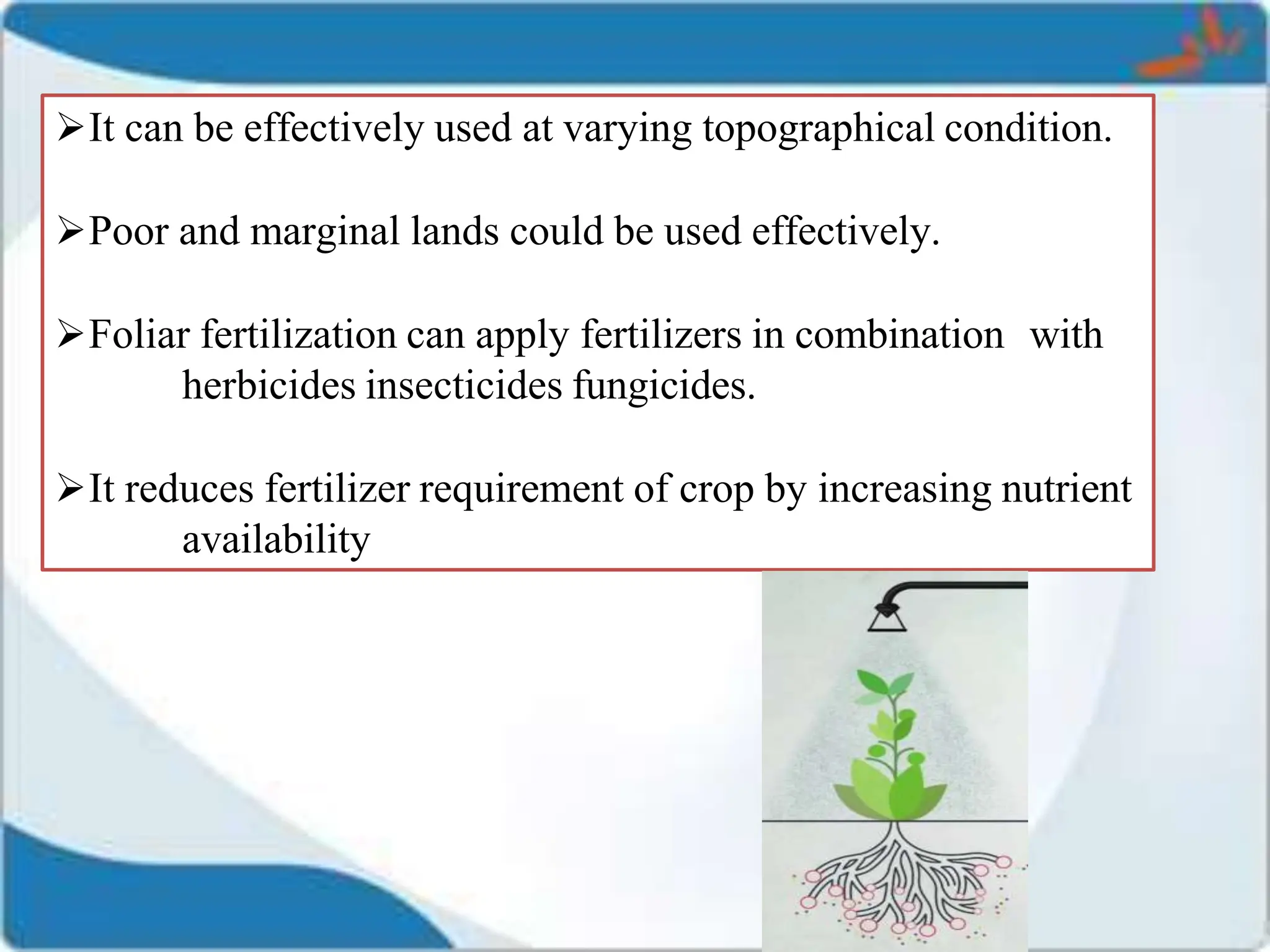
It can be effectively used at varying topographical condition.
Poor and marginal lands could be used effectively.
Foliar fertilization can apply fertilizers in combination with
herbicides insecticides fungicides.
It reduces fertilizer requirement of crop by increasing nutrient
availability
DISADVANTAGES OF FOLIAR NUTRITION
1) If concentrations of nutrients in the foliar spray are too high,
then leaf damage can occur and in severe cases may kill the plant.
2) If rain occurs shortly after an application, most of the spray will
be washed off the leaves and reapplication will be necessary.
3) Foliar fertilization is unable to meet the total plant requirements
for the major nutrients N, P and K
Toxicity may be the result of osmotic or direct elemental effects.
 Osmotic toxicity is due to dehydration of cells by salt solution.
 Elemental toxicity occurs by excessive entry of elements into the
metabolic space.
 Elemental toxicity is also due to excessive concentration of the
formulation used.
Toxicity of foliar applications is extremely important but poorly
understood process.
Toxicity of Foliar Applications
 Possibility of foliar burn (with high concentration).
 Solubility problems especially with cold water.
 Requirement of correct weather condition.
 Incompatible with certain agrochemicals.
 Nutrient absorption affected by plant factors.
LIMITATION OF FOLIAR FEEDING
CONCLUSION
Foliar nutrition increases significantly higher values of
growth attributes like number of branches, height,
number of flowers and dry matter accumulation.
An increase in yield attributes such as number of pods
per plant, pod weight per plant, test weight and grain
yield per plant observed with liquid fertilizers in
different legumes.
Foliar application of the correct nutrients in relatively
low concentrations at critical stages in crop development
contributes significantly to higher yields and improved
quality.
Fture Strategies…
 There is need of research
combination of Pesticide and Herbicide with water
finding on the use of various
soluble
fertilizer. It help to minimize cost of cultivation and labour
charges.
 As such, use of foliar feeding could really proved a blessing for
Indian farming and may pave way for another green revolution
and provide support to boost agricultural production and export.
 Though foliar feeding technique approach is quite new in India
and is in limited use due to its complicacy, it may be useful for
high value crops particularly in drought affected areas.
 Need to find out Multinutrients.

foliar application nutrients to plant.pptx

  • 1.
  • 2.
    INTRODUCTION Foliar nutrition isa technique of feeding plants by applying liquid fertilizer directly to their leaves. Plants are able to absorb essential elements through their leaves. The absorption takes place faster through their stomata but total absorption may be as great through the epidermis. Plants are also able to absorb nutrients through their bark. Foliar nutrient uptake is a means of rapid nutrient supply, especially when soil nutrient availability or root activity is reduced.
  • 3.
    IMPORTANCE & SCOPE Foliar nutrient uptake is a means of rapid nutrient supply, when soil nutrient availability or root activity is reduced.  Foliar Spray is also the method of choice when prompt correction of nutrient deficiencies is required.  Nutrient sprays can be applied at any point of time during the growing season to improve the appearance and colour, size and quality of fruits.  Foliar fertilization can be applied in combination with herbicides, insecticides, fungicides etc.  During adverse conditions such as drought, disease or insect attack, foliar sprays are more effective.
  • 4.
     Nutrients canbe applied directly to site of metabolism.  It can increases yields from 12% to 25%.  More than 90% of the fertilizer is utilized by the plant.  Foliar applied fertilizers are up to 20 times more effective than the soil applied fertilizers.  Foliar feeding bypasses nutrient uptake through root .  Deficiencies can be corrected within the short time period. NEED OF FOLIAR FEEDING
  • 5.
    MECHANISM OF FOLIARFEEDING  Nutrient must enter into the leaf before entering into the cytoplasm of the leaf cell.  Nutrient must effectively penetrate the outer cuticle and wall of the epidermal cell.  Once penetration has occurred, nutrient absorption by the cell is similar to absorption by the roots.  Among all the components the cuticle offers the greatest resistance to the nutrients.
  • 6.
    1.Proper Growth Stage: Foliarapplications should be timed to provide needed nutrients during the yield potential determining time frame of plant development, which favorably influence the post reproductive development stages. 2.Proper Crop Condition: Crops that are nutritionally sound will be most likely to respond to foliar feeding.  Crops under heat or moisture stress show less response to foliar applications due to lower leaf & stem absorption rates and poor vigor. Foliar feeding does benefit crop performance and yield if an application was made prior to heat or moisture stress. METHOD
  • 7.
    3.Proper Meteorological Conditions Environmentalinfluences, such as time of day, temperature, humidity and wind speed influence the physical and biological aspects of foliar applications due to effect on Plant tissue permeability. Sr. No Meteorological Conditions Mineral Nutrient Sprays 1 Time of Day late evening; after 6:00 p.m. early morning; before 9:00 am 2 Temperature Between 25-30 C Temp. 3 Humidity greater than 70% relative humidity 4 Wind Speed less than 5 mph
  • 8.
     Fertilizer Materials: 1.Not all fertilizers are suitable for use as a foliar spray. The primary objective of a foliar application is to allow for maximum absorption of nutrients into the plant tissue; foliar fertilizer formulations should meet certain standards in order to minimize foliage damage. 2. Qualifications for fertilizer materials follow: High solubility. Low salt index. High purity.  Nitrogen Materials: 1. Urea is the most suitable nitrogen source for foliar applications, due to it’s low salt index and high solubility in comparison to other nitrogen sources. 2. Urea utilized in foliar sprays should be low in biuret content to lessen urea foliage burn. Types of fertilizer material
  • 9.
    Phosphorus Materials: 1. Acombination of poly and ortho-phosphates shown to lessen leaf burn and aid in leaf phosphate absorption . The polyphosphate advantage may also be due to supplying both ortho and polyphosphate forms. Potassium Materials: 2. Depending on availability, potassium polyphosphates are an excellent source of low salt index, highly soluble potassium. 3. Potassium sulfate- low salt index, but a rather low solubility. 4. Potassium hydroxide, potassium nitrate and potassium thiosulfate -low salt index and high solubility characteristics. Secondary and Micronutrient Materials: 1. Foliar application of secondary nutrients can be highly effective, but because of difficulties associated with leaf tissue absorption and translocation choosing the correct fertilizer sources for these nutrients becomes very critical.
  • 10.
    1. Spray duringthe cooler and more humid times of the day. 2. Spray when wind is low. 3. Never spray plants under very stress of moisture. 4. Test for possible side effects or photo-toxicity by a small trial, spraying a week prior to intended commercial treatments. 5. After spraying rinse thoroughly the sprayer and all it’s parts with fresh water. For Successful Foliar Fertilization
  • 11.
    1) If adeficiency exists, then foliar application would be one means of providing a quick method to fix the problem. 2) When the absorption of plant nutrients is disturbed by weeds, poor aeration, low soil temperature, frequent rainfall etc Nutrients absorbed through the foliage strengthen the plant and help recovering root uptake. 3) The purpose of foliar feeding is not to replace soil fertilization. It is usually a supplement way to compensate nutrients deficiency. ADVANTAGES OF FOLIAR NUTREINTS
  • 12.
    It can beeffectively used at varying topographical condition. Poor and marginal lands could be used effectively. Foliar fertilization can apply fertilizers in combination with herbicides insecticides fungicides. It reduces fertilizer requirement of crop by increasing nutrient availability
  • 13.
    DISADVANTAGES OF FOLIARNUTRITION 1) If concentrations of nutrients in the foliar spray are too high, then leaf damage can occur and in severe cases may kill the plant. 2) If rain occurs shortly after an application, most of the spray will be washed off the leaves and reapplication will be necessary. 3) Foliar fertilization is unable to meet the total plant requirements for the major nutrients N, P and K
  • 14.
    Toxicity may bethe result of osmotic or direct elemental effects.  Osmotic toxicity is due to dehydration of cells by salt solution.  Elemental toxicity occurs by excessive entry of elements into the metabolic space.  Elemental toxicity is also due to excessive concentration of the formulation used. Toxicity of foliar applications is extremely important but poorly understood process. Toxicity of Foliar Applications
  • 15.
     Possibility offoliar burn (with high concentration).  Solubility problems especially with cold water.  Requirement of correct weather condition.  Incompatible with certain agrochemicals.  Nutrient absorption affected by plant factors. LIMITATION OF FOLIAR FEEDING
  • 18.
    CONCLUSION Foliar nutrition increasessignificantly higher values of growth attributes like number of branches, height, number of flowers and dry matter accumulation. An increase in yield attributes such as number of pods per plant, pod weight per plant, test weight and grain yield per plant observed with liquid fertilizers in different legumes. Foliar application of the correct nutrients in relatively low concentrations at critical stages in crop development contributes significantly to higher yields and improved quality.
  • 19.
    Fture Strategies…  Thereis need of research combination of Pesticide and Herbicide with water finding on the use of various soluble fertilizer. It help to minimize cost of cultivation and labour charges.  As such, use of foliar feeding could really proved a blessing for Indian farming and may pave way for another green revolution and provide support to boost agricultural production and export.  Though foliar feeding technique approach is quite new in India and is in limited use due to its complicacy, it may be useful for high value crops particularly in drought affected areas.  Need to find out Multinutrients.