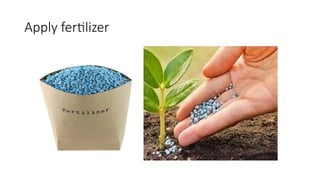
Apply fertilizer
What is fertilizer
-a chemical or natural substance added to soil or land to increase its fertility.
Fertilizers are simply plant nutrients applied to agricultural fields to
supplement required elements found naturally in the soil.
-come either as organic or inorganic compounds.
Organic compounds are those that contain carbon atom as major
structural element.
Inorganic materials is consist of chemical combinations (salt or minerals)
of two or more elements.
Why do plants need fertilizers?
Nutrient inputs as fertilizers fill the gap between what the
crop needs and what is currently present in the soil, water,
and air (indigenous supply).
Method used should be practical, effective, and cost
efficient
Method used affects nutrient availability for plant use
Fertilizer must be dissolved and reach plant roots
With chemical fertilizers (eew) the element
percentages are usually in varying
proporitions to suit different plants and
fertilizer needs. Also, if given the chance for
you to compare NPK percentages of organic
and inorganic fertilizers you’ll notice that
inorganic fertilizers usually have higher NPK
than organic fertilizers. Here in the Philippines
the approved maximum NPK for organic
fertilizer is around 10%.
Any fertilizer that has higher NPK than the approved
limit is considered to be either inorganic or fortified
organic fertilizer. That basically means that your
fertilizer has sythetic or chemical elements in it.
Other than NPK, most fertilizers, both organic and
inorganic usually contain traces of other elements
important to a plant’s health. Importance and
function
of every trace element varies greatly but each has
one
purpose, to nourish a plant in its own way.
Other trace elements in fertilizers
include calcium, magnesium, iron,
copper, manganeze, boron, sulfur and
molybdenum. Your plant will quick to
remind you if ever they are lacking of
these mentioned elements by showing
deficiency symptoms, either by
changing their color or by withering.
PICKING THE RIGHT FERTILIZER
FOR YOUR PLANTS
As mentioned above, fertilizers come in two major types. Water
solubles and solid types. Just like any choices in life, each has pros
and cons. Solid type of fertilizers deliver food to a plant slowly (but
surely). They are the go-to fertilizers if you’re aiming for longevity. As
nutrients are usually distributed when you water your plant, they do
not leach out of the soil as rapidly as their water-soluble
counterparts. If you’re looking for a quick fix, you might want to go
for water-soluble fertilizers. Water soluble-fertilizers acts fast but you
need to apply more frequently than its rival, the solid types.
SO, WHEN DO YOU FERTILIZE?
This is tricky since most fertilizers has their own fertilization
protocols. We strongly suggest you read instructions and
recommended dosage of your chosen fertilizers in the leaflets or
on its packaging.
Generally for any solid-type of fertilizer you can fertilizer once
every 2 weeks and every 2-3 days for foliar fertilizers. There’s
actually no concrete rule on when to apply your fertilizer. There
are only guides and recommendations so be wise and ask around
for further tips and info.
3 PRIME CHEMICAL ELEMENTS IN FERTILIZERS
Whether organic or inorganic you’ll encounter
these three prime chemical elements in your
fertilizers.
K = Potassium plays a key role in helping plants
digest and manufacture their foods.
N = Nitrogen promotes healthy leaf growth by
stimulating the production of chlorophyll (the
main chemical involved in photosynthesis—
how plants convert sunlight to food).
Most plants need the most nitrogen during the
early reproductive stages when the plant is
growing quickly. This is the point in the season
where application of nitrogen rich fertilizers is
highly recommended.
P = Phosphorus supports the vigorous
development of roots, stems, blossoms, and
fruits.
More efficient utilization of fertilizer
phosphorus is generally obtained by applying
the fertilizer shortly before planting the crop.
K = Potassium plays a key role in helping
plants digest and manufacture their foods.
Types
of
fertilizers
LIQUID BASED FERTILIZERS
Liquid based fertilizers are usually dilluted in
water and is applied by watering it directly to
plants. Your liquid fertilizer can either be the
common water-soluble fertilizer or the foliar
type.
WATER-SOLUBLE FERTILIZER
With this fertilizer, nutrients are “fed” into the
plants while you water. Water-soluble fertilizers
usually come in concentrated form which requires
you to dillute them first prior administering.
Dillution rate varies from brand to brand so make
sure that you read your chosen fertilizer’s manual
before using them.
FOLIAR FERTILIZER
Another type of liquid fertilizer, foliar fertilizer’s
route of entry is via plants’ leaves. Instead of
watering it to the soil, foliar fertilizers are
generally applied to the leaves. Just like water-
soluble fertilizers dilution rate varies from brand
to brand
SOLID TYPE FERTILIZERS
Solid type of fertilizers usually come in different forms. You
can buy them in powder, pelletized, spike or even in crumble
form. There are a lot of choices depending how often you
want to fertilizer your plants. Generally speaking fertilizers in
powder form are the fastest to act on your plants while
pellets, spikes and crumbles gradually release as you water
your plants.
As with any solid type of fertilizer, they are
usually administered directly on the soil
either before or during the planting season.
Unlike water-soluble fertilizers, solid types
has the capability to “rehabilitate” your soil
and bring back its lost nutrients.
Forms of organic fertilizers:
• Natural organic derived from
plants or animals as
manures, crop residues
• Synthetic organic materials
which are usually organic
compounds like urea [CO
(NH2)2] calcium cyanide
(CaCNa), and urea-form.
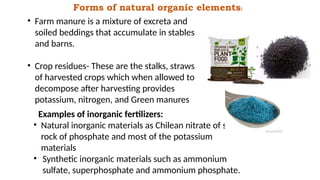
Examples of inorganic fertilizers:
• Natural inorganic materials as Chilean nitrate of soda,
rock of phosphate and most of the potassium
materials
• Synthetic inorganic materials such as ammonium
sulfate, superphosphate and ammonium phosphate.
Forms of natural organic elements:
• Farm manure is a mixture of excreta and
soiled beddings that accumulate in stables
and barns.
• Crop residues- These are the stalks, straws
of harvested crops which when allowed to
decompose after harvesting provides
potassium, nitrogen, and Green manures
You can classify fertilizer materials according to the
number of fertilizer elements present in them. Below
is a classification of fertilizers:
• Single fertilizer or that contains only one element: urea,
ammonium sulfate, single superphosphate, muriate of
potash.
• Incomplete fertilizer or that containing only two elements:
ammonium phosphate, mono-ammonium phosphate.
• Complete fertilizer or that containing all the macro elements
as N, P, and K: 14-14-14 and 12-24-12.
• Mixed fertilizer or that containing two or more of the
elements which are supplied by two or more fertilizer
materials.
Fertilizer materials used to add to the fertility of the soil in order to
increase the growth or yield of crops.
Fertilization
is the practice of applying fertilizers to crops through the soil or to the
leaves of the plants.
FERTILIZER USE
Fertilizer use is based on basic principles of plant nutrition (e.g. nutrient
requirements of specific crops). Properties and behaviour of fertilizer in the soil,
properties of the soil, environmental conditions (e.g., availability of water, season of
the year, etc.), target yield and other considerations. Fertilizer use refers to
application practices, which answer the questions:
1. How much fertilizer to use;
2. What kind of fertilizer to use;
3. When to apply the fertilizer, and
4. How and where to apply the fertilizer.
METHODS OF FERTILIZER APPLICATION
1. Broadcast application. This involves spreading the fertilizer materials
evenly over the field before the last harrowing so the fertilizer will be
thoroughly mixed in the soil.
2. Topdressing. This is broadcast application of fertilizer over an already
established crop- This is usually practiced with nitrogen fertilizer when
localized application is not possible and often done in rice, lawns, and
pastures.
3. Side-dressing. Placing fertilizer to or beside the rows of crops as corn
or around plants or trees.
4. Localized placement. It has 5 types of application:
Side band (side dress) - fertilizer is applied along the side of seed or
plant.
In- the- row – fertilizer is applied along the bottom of the furrow,
slightly covered with soil and then seeds are planted.
Ring application – fertilizers are applied in band around trees in
shallow trench then covered lightly with soil. Distance from the base
depends on type of crop and age.
Hole application – fertilizers are dropped in holes around trees.
Spot application – fertilizers are applied on the side of each hill, e.g., in
vegetable like cabbage.
5. Foliar application
This method involves placing the fertilizer in solution form and sprayed to
the aerial [parts of the plant using a sprayer.
6.Applied with the seed. Fertilizer is applied together with the seed
either as broadcasted together or coating the seed with the fertilizer
using adhesive as Cellofas A or gum Arabic. This is same as pelleting
where the seed is placed inside the pellet and advisable in planting
legume seeds in acidic soil.
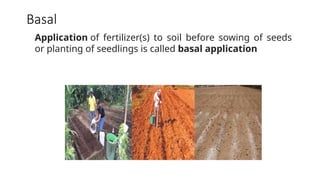
Basal
Application of fertilizer(s) to soil before sowing of seeds
or planting of seedlings is called basal application
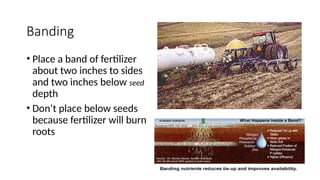
Banding
• Place a band of fertilizer
about two inches to sides
and two inches below seed
depth
• Don’t place below seeds
because fertilizer will burn
roots
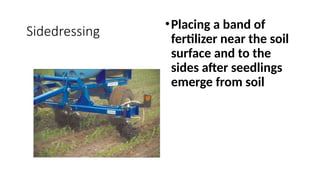
Sidedressing
•Placing a band of
fertilizer near the soil
surface and to the
sides after seedlings
emerge from soil
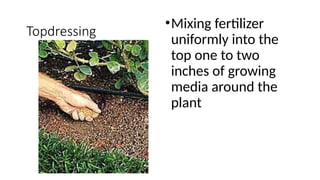
Topdressing
•Mixing fertilizer
uniformly into the
top one to two
inches of growing
media around the
plant
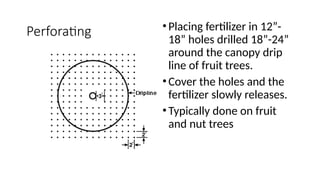
Perforating •Placing fertilizer in 12”-
18” holes drilled 18”-24”
around the canopy drip
line of fruit trees.
•Cover the holes and the
fertilizer slowly releases.
•Typically done on fruit
and nut trees
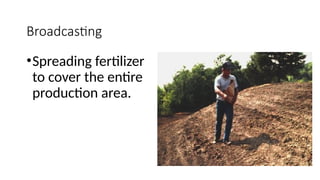
Broadcasting
•Spreading fertilizer
to cover the entire
production area.
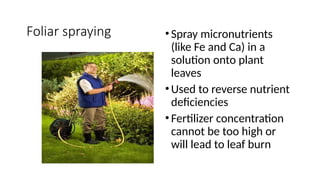
Foliar spraying • Spray micronutrients
(like Fe and Ca) in a
solution onto plant
leaves
• Used to reverse nutrient
deficiencies
• Fertilizer concentration
cannot be too high or
will lead to leaf burn
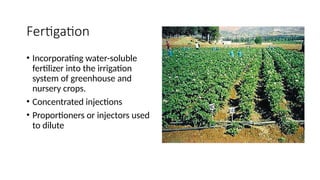
Fertigation
• Incorporating water-soluble
fertilizer into the irrigation
system of greenhouse and
nursery crops.
• Concentrated injections
• Proportioners or injectors used
to dilute
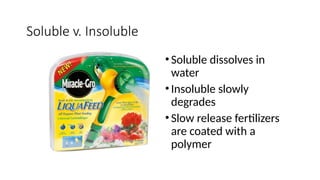
Soluble v. Insoluble
• Soluble dissolves in
water
• Insoluble slowly
degrades
• Slow release fertilizers
are coated with a
polymer
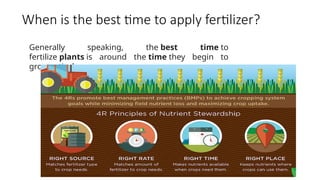
When is the best time to apply fertilizer?
Generally speaking, the best time to
fertilize plants is around the time they begin to
grow actively.
SOME TIPS WHEN APPLYING YOUR FERTILIZERS
OVER FERTILIZATION IS NOT COOL! In fact, they
may cause “burning” of your plants. Also avoid
applying fertilizer on a windy or overly rainy
days. This can cause your fertilizers to be
misplaced and ineffective. Never apply solid-
type of fertilizers when the soil is extremely dry
and be sure to water it thoroughly after
applying to prevent plant burn.

Fertlization application in the Philippines.pptx

  • 1.
  • 2.
    What is fertilizer -achemical or natural substance added to soil or land to increase its fertility. Fertilizers are simply plant nutrients applied to agricultural fields to supplement required elements found naturally in the soil. -come either as organic or inorganic compounds. Organic compounds are those that contain carbon atom as major structural element. Inorganic materials is consist of chemical combinations (salt or minerals) of two or more elements.
  • 3.
    Why do plantsneed fertilizers? Nutrient inputs as fertilizers fill the gap between what the crop needs and what is currently present in the soil, water, and air (indigenous supply). Method used should be practical, effective, and cost efficient Method used affects nutrient availability for plant use Fertilizer must be dissolved and reach plant roots
  • 4.
    With chemical fertilizers(eew) the element percentages are usually in varying proporitions to suit different plants and fertilizer needs. Also, if given the chance for you to compare NPK percentages of organic and inorganic fertilizers you’ll notice that inorganic fertilizers usually have higher NPK than organic fertilizers. Here in the Philippines the approved maximum NPK for organic fertilizer is around 10%.
  • 5.
    Any fertilizer thathas higher NPK than the approved limit is considered to be either inorganic or fortified organic fertilizer. That basically means that your fertilizer has sythetic or chemical elements in it. Other than NPK, most fertilizers, both organic and inorganic usually contain traces of other elements important to a plant’s health. Importance and function of every trace element varies greatly but each has one purpose, to nourish a plant in its own way.
  • 6.
    Other trace elementsin fertilizers include calcium, magnesium, iron, copper, manganeze, boron, sulfur and molybdenum. Your plant will quick to remind you if ever they are lacking of these mentioned elements by showing deficiency symptoms, either by changing their color or by withering.
  • 7.
    PICKING THE RIGHTFERTILIZER FOR YOUR PLANTS As mentioned above, fertilizers come in two major types. Water solubles and solid types. Just like any choices in life, each has pros and cons. Solid type of fertilizers deliver food to a plant slowly (but surely). They are the go-to fertilizers if you’re aiming for longevity. As nutrients are usually distributed when you water your plant, they do not leach out of the soil as rapidly as their water-soluble counterparts. If you’re looking for a quick fix, you might want to go for water-soluble fertilizers. Water soluble-fertilizers acts fast but you need to apply more frequently than its rival, the solid types.
  • 8.
    SO, WHEN DOYOU FERTILIZE? This is tricky since most fertilizers has their own fertilization protocols. We strongly suggest you read instructions and recommended dosage of your chosen fertilizers in the leaflets or on its packaging. Generally for any solid-type of fertilizer you can fertilizer once every 2 weeks and every 2-3 days for foliar fertilizers. There’s actually no concrete rule on when to apply your fertilizer. There are only guides and recommendations so be wise and ask around for further tips and info.
  • 9.
    3 PRIME CHEMICALELEMENTS IN FERTILIZERS Whether organic or inorganic you’ll encounter these three prime chemical elements in your fertilizers. K = Potassium plays a key role in helping plants digest and manufacture their foods.
  • 10.
    N = Nitrogenpromotes healthy leaf growth by stimulating the production of chlorophyll (the main chemical involved in photosynthesis— how plants convert sunlight to food). Most plants need the most nitrogen during the early reproductive stages when the plant is growing quickly. This is the point in the season where application of nitrogen rich fertilizers is highly recommended.
  • 11.
    P = Phosphorussupports the vigorous development of roots, stems, blossoms, and fruits. More efficient utilization of fertilizer phosphorus is generally obtained by applying the fertilizer shortly before planting the crop.
  • 12.
    K = Potassiumplays a key role in helping plants digest and manufacture their foods.
  • 13.
  • 14.
    LIQUID BASED FERTILIZERS Liquidbased fertilizers are usually dilluted in water and is applied by watering it directly to plants. Your liquid fertilizer can either be the common water-soluble fertilizer or the foliar type.
  • 15.
    WATER-SOLUBLE FERTILIZER With thisfertilizer, nutrients are “fed” into the plants while you water. Water-soluble fertilizers usually come in concentrated form which requires you to dillute them first prior administering. Dillution rate varies from brand to brand so make sure that you read your chosen fertilizer’s manual before using them.
  • 16.
    FOLIAR FERTILIZER Another typeof liquid fertilizer, foliar fertilizer’s route of entry is via plants’ leaves. Instead of watering it to the soil, foliar fertilizers are generally applied to the leaves. Just like water- soluble fertilizers dilution rate varies from brand to brand
  • 17.
    SOLID TYPE FERTILIZERS Solidtype of fertilizers usually come in different forms. You can buy them in powder, pelletized, spike or even in crumble form. There are a lot of choices depending how often you want to fertilizer your plants. Generally speaking fertilizers in powder form are the fastest to act on your plants while pellets, spikes and crumbles gradually release as you water your plants.
  • 18.
    As with anysolid type of fertilizer, they are usually administered directly on the soil either before or during the planting season. Unlike water-soluble fertilizers, solid types has the capability to “rehabilitate” your soil and bring back its lost nutrients.
  • 19.
    Forms of organicfertilizers: • Natural organic derived from plants or animals as manures, crop residues • Synthetic organic materials which are usually organic compounds like urea [CO (NH2)2] calcium cyanide (CaCNa), and urea-form.
  • 20.
    Examples of inorganicfertilizers: • Natural inorganic materials as Chilean nitrate of soda, rock of phosphate and most of the potassium materials • Synthetic inorganic materials such as ammonium sulfate, superphosphate and ammonium phosphate. Forms of natural organic elements: • Farm manure is a mixture of excreta and soiled beddings that accumulate in stables and barns. • Crop residues- These are the stalks, straws of harvested crops which when allowed to decompose after harvesting provides potassium, nitrogen, and Green manures
  • 21.
    You can classifyfertilizer materials according to the number of fertilizer elements present in them. Below is a classification of fertilizers: • Single fertilizer or that contains only one element: urea, ammonium sulfate, single superphosphate, muriate of potash. • Incomplete fertilizer or that containing only two elements: ammonium phosphate, mono-ammonium phosphate. • Complete fertilizer or that containing all the macro elements as N, P, and K: 14-14-14 and 12-24-12. • Mixed fertilizer or that containing two or more of the elements which are supplied by two or more fertilizer materials.
  • 22.
    Fertilizer materials usedto add to the fertility of the soil in order to increase the growth or yield of crops. Fertilization is the practice of applying fertilizers to crops through the soil or to the leaves of the plants. FERTILIZER USE Fertilizer use is based on basic principles of plant nutrition (e.g. nutrient requirements of specific crops). Properties and behaviour of fertilizer in the soil, properties of the soil, environmental conditions (e.g., availability of water, season of the year, etc.), target yield and other considerations. Fertilizer use refers to application practices, which answer the questions: 1. How much fertilizer to use; 2. What kind of fertilizer to use; 3. When to apply the fertilizer, and 4. How and where to apply the fertilizer.
  • 23.
    METHODS OF FERTILIZERAPPLICATION 1. Broadcast application. This involves spreading the fertilizer materials evenly over the field before the last harrowing so the fertilizer will be thoroughly mixed in the soil. 2. Topdressing. This is broadcast application of fertilizer over an already established crop- This is usually practiced with nitrogen fertilizer when localized application is not possible and often done in rice, lawns, and pastures. 3. Side-dressing. Placing fertilizer to or beside the rows of crops as corn or around plants or trees. 4. Localized placement. It has 5 types of application: Side band (side dress) - fertilizer is applied along the side of seed or plant. In- the- row – fertilizer is applied along the bottom of the furrow, slightly covered with soil and then seeds are planted.
  • 24.
    Ring application –fertilizers are applied in band around trees in shallow trench then covered lightly with soil. Distance from the base depends on type of crop and age. Hole application – fertilizers are dropped in holes around trees. Spot application – fertilizers are applied on the side of each hill, e.g., in vegetable like cabbage. 5. Foliar application This method involves placing the fertilizer in solution form and sprayed to the aerial [parts of the plant using a sprayer. 6.Applied with the seed. Fertilizer is applied together with the seed either as broadcasted together or coating the seed with the fertilizer using adhesive as Cellofas A or gum Arabic. This is same as pelleting where the seed is placed inside the pellet and advisable in planting legume seeds in acidic soil.
  • 25.
    Basal Application of fertilizer(s)to soil before sowing of seeds or planting of seedlings is called basal application
  • 26.
    Banding • Place aband of fertilizer about two inches to sides and two inches below seed depth • Don’t place below seeds because fertilizer will burn roots
  • 27.
    Sidedressing •Placing a bandof fertilizer near the soil surface and to the sides after seedlings emerge from soil
  • 28.
    Topdressing •Mixing fertilizer uniformly intothe top one to two inches of growing media around the plant
  • 29.
    Perforating •Placing fertilizerin 12”- 18” holes drilled 18”-24” around the canopy drip line of fruit trees. •Cover the holes and the fertilizer slowly releases. •Typically done on fruit and nut trees
  • 30.
  • 31.
    Foliar spraying •Spray micronutrients (like Fe and Ca) in a solution onto plant leaves • Used to reverse nutrient deficiencies • Fertilizer concentration cannot be too high or will lead to leaf burn
  • 32.
    Fertigation • Incorporating water-soluble fertilizerinto the irrigation system of greenhouse and nursery crops. • Concentrated injections • Proportioners or injectors used to dilute
  • 33.
    Soluble v. Insoluble •Soluble dissolves in water • Insoluble slowly degrades • Slow release fertilizers are coated with a polymer
  • 34.
    When is thebest time to apply fertilizer? Generally speaking, the best time to fertilize plants is around the time they begin to grow actively.
  • 35.
    SOME TIPS WHENAPPLYING YOUR FERTILIZERS OVER FERTILIZATION IS NOT COOL! In fact, they may cause “burning” of your plants. Also avoid applying fertilizer on a windy or overly rainy days. This can cause your fertilizers to be misplaced and ineffective. Never apply solid- type of fertilizers when the soil is extremely dry and be sure to water it thoroughly after applying to prevent plant burn.