V.Vijishree -2021004129
P.Vinotha - 2021004130
NUTRIENT MANAGEMENT CONCEPTS
Deductive, INM, IPNS
Tools - DSSIFER andVDK
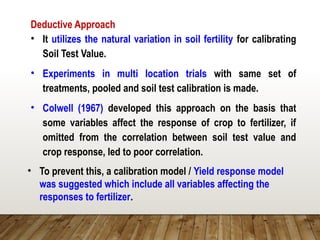
Deductive Approach
• It utilizes the natural variation in soil fertility for calibrating
Soil Test Value.
• Experiments in multi location trials with same set of
treatments, pooled and soil test calibration is made.
• Colwell (1967) developed this approach on the basis that
some variables affect the response of crop to fertilizer, if
omitted from the correlation between soil test value and
crop response, led to poor correlation.
• To prevent this, a calibration model / Yield response model
was suggested which include all variables affecting the
responses to fertilizer.
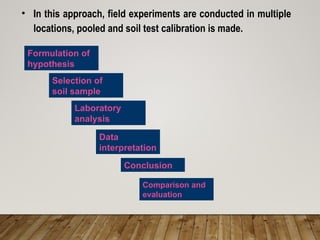
• In this approach, field experiments are conducted in multiple
locations, pooled and soil test calibration is made.
Formulation of
hypothesis
Selection of
soil sample
Laboratory
analysis
Data
interpretation
Comparison and
evaluation
Conclusion
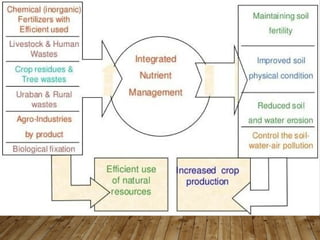
Integrated Nutrient Management
Principles of INM
 Assessment of basic soil fertility and climate
 Nature of the crop, cropping system and yield target
 Atleast 30% of NPK should be in organic forms
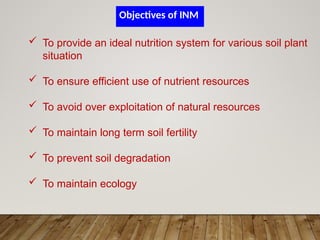
 To provide an ideal nutrition system for various soil plant
situation
 To ensure efficient use of nutrient resources
 To avoid over exploitation of natural resources
 To maintain long term soil fertility
 To prevent soil degradation
 To maintain ecology
Objectives of INM
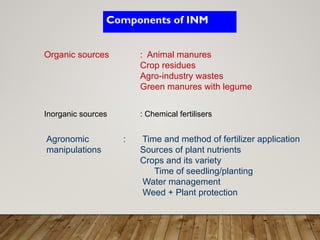
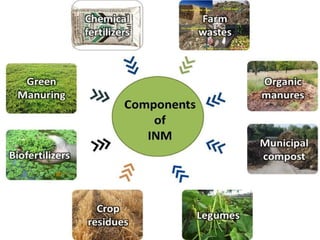
Components of INM
Organic sources : Animal manures
Crop residues
Agro-industry wastes
Green manures with legume
Inorganic sources : Chemical fertilisers
Agronomic : Time and method of fertilizer application
manipulations Sources of plant nutrients
Crops and its variety
Time of seedling/planting
Water management
Weed + Plant protection
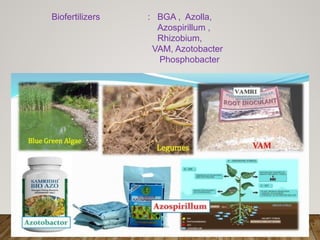
Biofertilizers : BGA , Azolla,
Azospirillum ,
Rhizobium,
VAM, Azotobacter
Phosphobacter
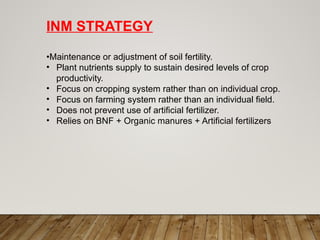
INM STRATEGY
•Maintenance or adjustment of soil fertility.
• Plant nutrients supply to sustain desired levels of crop
productivity.
• Focus on cropping system rather than on individual crop.
• Focus on farming system rather than an individual field.
• Does not prevent use of artificial fertilizer.
• Relies on BNF + Organic manures + Artificial fertilizers
https://youtu.be/LQECi-mTyUU?si=5V7KJLO7hfFO4tZ5
Integrated Plant Nutrient System
(IPNS)
Concept
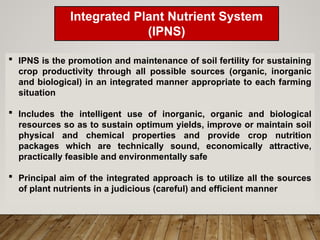
 IPNS is the promotion and maintenance of soil fertility for sustaining
crop productivity through all possible sources (organic, inorganic
and biological) in an integrated manner appropriate to each farming
situation
 Includes the intelligent use of inorganic, organic and biological
resources so as to sustain optimum yields, improve or maintain soil
physical and chemical properties and provide crop nutrition
packages which are technically sound, economically attractive,
practically feasible and environmentally safe
 Principal aim of the integrated approach is to utilize all the sources
of plant nutrients in a judicious (careful) and efficient manner
Concepts and principles of Integrated Nutrient Management (INM)
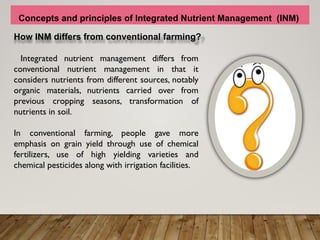
How INM differs from conventional farming?
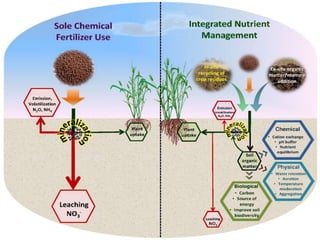
Integrated nutrient management differs from
conventional nutrient management in that it
considers nutrients from different sources, notably
organic materials, nutrients carried over from
previous cropping seasons, transformation of
nutrients in soil.
In conventional farming, people gave more
emphasis on grain yield through use of chemical
fertilizers, use of high yielding varieties and
chemical pesticides along with irrigation facilities.
In INM it integrates/combines the objectives of production
with ecology and environment, that is, optimum crop
nutrition, optimum functioning of the soil health, and
minimum nutrient losses or other adverse effect on the
environment.
Integrated Nutrient Management (INM) has to be
considered an integral part of any sustainable
agricultural system.
Decision Support System for Integrated
Fertiliser Recommendation (DSSIFER)
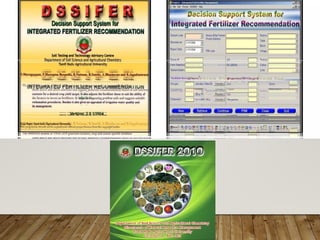
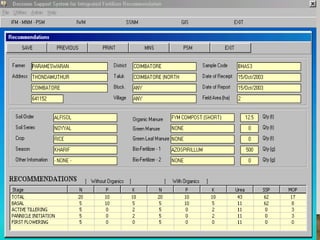
DSSIFER is a user friendly software and the updated
version (DSSIFER 2010) which is a computer based decision
support system, developed in Visual Basic 6.0 as a “Stand Alone”
version utilises the crop and location specific fertiliser
prescriptions evolved through Soil Test Crop Response based
Integrated Plant Nutrition System (STCR-IPNS) developed by
the ICAR-AICRP-STCR, Department of Soil Science and
Agricultural Chemistry, TNAU, Coimbatore and Mitscherlich-
Bray percentage sufficiency based recommendations developed
by the Soil Testing Wing of the State Department of Agriculture,
Tamil Nadu.
• If both recommendations are not available for a
particular soil – crop situation, the software can
generate prescriptions using blanket recommendations
but based on soil test values.
• Using this software, fertilizers doses can be prescribed
for about 1645 situations and for 190 agricultural and
horticultural crops along with fertilisation schedule.
• If site specific soil test values are not available, data base
included in the software on village fertility indices of all the
districts of Tamil Nadu will generate soil test based fertiliser
recommendation.

• Besides, farmers‘ resource based fertilizer prescriptions can
also be computed.
• Therefore, adoption of this technology will not only ensure site
specific balanced fertilisation to achieve targeted yield of
crops but also result in higher response ratio besides
sustaining soil fertility.
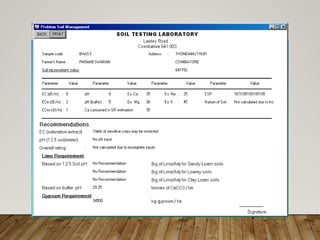
• In addition, the software also provides technology for problem soil
management and irrigation water quality appraisal.
• Moreover, STLs of all the organisations can generate and issue the
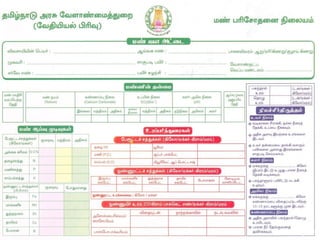
analytical report and recommendations in the form of Soil Health Card (both
in English &Tamil) which can be maintained by the farmers over long run.
• Fertilizer prescription: DSSIFER can help prescribe fertilizer doses.
• Soil disorder diagnosis: DSSIFER can help diagnose soil disorders like
salinity and alkalinity, and suggest ways to improve them.
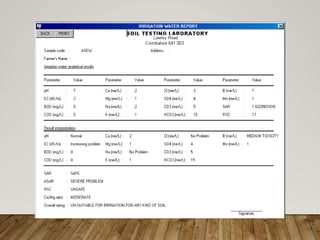
• Irrigation water quality: DSSIFER can help assess the quality of irrigation
water.
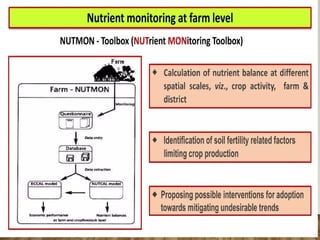
• Integrated plant nutrient supply system (IPNSS): DSSIFER can help monitor
soil health and assess the impact of IPNSS
Uses
• Visual Diagnostic Kit (VDK)
• It is a software for identifying nutrient deficiencies in crops
and management developed in the Department of Soil
Science and Agricultural Chemistry, TNAU, Coimabtore.
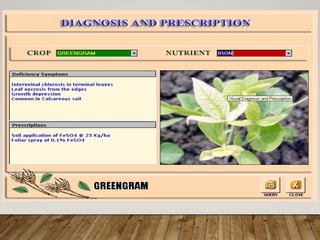
• VDK comprises of visual symptoms and specific
recommendations for the nutrient deficiency.
• It is also an interactive tool for the specific queries by the
farmer or the client.
• It is available in English and Tamil
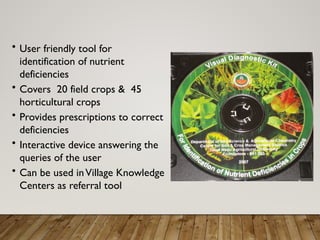
• User friendly tool for
identification of nutrient
deficiencies
• Covers 20 field crops & 45
horticultural crops
• Provides prescriptions to correct
deficiencies
• Interactive device answering the
queries of the user
• Can be used inVillage Knowledge
Centers as referral tool
Soil Science Nutrient management  (1).pptx

Soil Science Nutrient management (1).pptx

  • 1.
    V.Vijishree -2021004129 P.Vinotha -2021004130 NUTRIENT MANAGEMENT CONCEPTS Deductive, INM, IPNS Tools - DSSIFER andVDK
  • 2.
    Deductive Approach • Itutilizes the natural variation in soil fertility for calibrating Soil Test Value. • Experiments in multi location trials with same set of treatments, pooled and soil test calibration is made. • Colwell (1967) developed this approach on the basis that some variables affect the response of crop to fertilizer, if omitted from the correlation between soil test value and crop response, led to poor correlation. • To prevent this, a calibration model / Yield response model was suggested which include all variables affecting the responses to fertilizer.
  • 3.
    • In thisapproach, field experiments are conducted in multiple locations, pooled and soil test calibration is made. Formulation of hypothesis Selection of soil sample Laboratory analysis Data interpretation Comparison and evaluation Conclusion
  • 4.
    Integrated Nutrient Management Principlesof INM  Assessment of basic soil fertility and climate  Nature of the crop, cropping system and yield target  Atleast 30% of NPK should be in organic forms
  • 5.
     To providean ideal nutrition system for various soil plant situation  To ensure efficient use of nutrient resources  To avoid over exploitation of natural resources  To maintain long term soil fertility  To prevent soil degradation  To maintain ecology Objectives of INM
  • 6.
    Components of INM Organicsources : Animal manures Crop residues Agro-industry wastes Green manures with legume Inorganic sources : Chemical fertilisers Agronomic : Time and method of fertilizer application manipulations Sources of plant nutrients Crops and its variety Time of seedling/planting Water management Weed + Plant protection
  • 7.
    Biofertilizers : BGA, Azolla, Azospirillum , Rhizobium, VAM, Azotobacter Phosphobacter
  • 9.
    INM STRATEGY •Maintenance oradjustment of soil fertility. • Plant nutrients supply to sustain desired levels of crop productivity. • Focus on cropping system rather than on individual crop. • Focus on farming system rather than an individual field. • Does not prevent use of artificial fertilizer. • Relies on BNF + Organic manures + Artificial fertilizers
  • 11.
  • 12.
    Integrated Plant NutrientSystem (IPNS) Concept  IPNS is the promotion and maintenance of soil fertility for sustaining crop productivity through all possible sources (organic, inorganic and biological) in an integrated manner appropriate to each farming situation  Includes the intelligent use of inorganic, organic and biological resources so as to sustain optimum yields, improve or maintain soil physical and chemical properties and provide crop nutrition packages which are technically sound, economically attractive, practically feasible and environmentally safe  Principal aim of the integrated approach is to utilize all the sources of plant nutrients in a judicious (careful) and efficient manner
  • 13.
    Concepts and principlesof Integrated Nutrient Management (INM) How INM differs from conventional farming? Integrated nutrient management differs from conventional nutrient management in that it considers nutrients from different sources, notably organic materials, nutrients carried over from previous cropping seasons, transformation of nutrients in soil. In conventional farming, people gave more emphasis on grain yield through use of chemical fertilizers, use of high yielding varieties and chemical pesticides along with irrigation facilities.
  • 15.
    In INM itintegrates/combines the objectives of production with ecology and environment, that is, optimum crop nutrition, optimum functioning of the soil health, and minimum nutrient losses or other adverse effect on the environment. Integrated Nutrient Management (INM) has to be considered an integral part of any sustainable agricultural system.
  • 18.
    Decision Support Systemfor Integrated Fertiliser Recommendation (DSSIFER) DSSIFER is a user friendly software and the updated version (DSSIFER 2010) which is a computer based decision support system, developed in Visual Basic 6.0 as a “Stand Alone” version utilises the crop and location specific fertiliser prescriptions evolved through Soil Test Crop Response based Integrated Plant Nutrition System (STCR-IPNS) developed by the ICAR-AICRP-STCR, Department of Soil Science and Agricultural Chemistry, TNAU, Coimbatore and Mitscherlich- Bray percentage sufficiency based recommendations developed by the Soil Testing Wing of the State Department of Agriculture, Tamil Nadu.
  • 19.
    • If bothrecommendations are not available for a particular soil – crop situation, the software can generate prescriptions using blanket recommendations but based on soil test values. • Using this software, fertilizers doses can be prescribed for about 1645 situations and for 190 agricultural and horticultural crops along with fertilisation schedule.
  • 20.
    • If sitespecific soil test values are not available, data base included in the software on village fertility indices of all the districts of Tamil Nadu will generate soil test based fertiliser recommendation. • Besides, farmers‘ resource based fertilizer prescriptions can also be computed. • Therefore, adoption of this technology will not only ensure site specific balanced fertilisation to achieve targeted yield of crops but also result in higher response ratio besides sustaining soil fertility.
  • 21.
    • In addition,the software also provides technology for problem soil management and irrigation water quality appraisal. • Moreover, STLs of all the organisations can generate and issue the analytical report and recommendations in the form of Soil Health Card (both in English &Tamil) which can be maintained by the farmers over long run. • Fertilizer prescription: DSSIFER can help prescribe fertilizer doses. • Soil disorder diagnosis: DSSIFER can help diagnose soil disorders like salinity and alkalinity, and suggest ways to improve them. • Irrigation water quality: DSSIFER can help assess the quality of irrigation water. • Integrated plant nutrient supply system (IPNSS): DSSIFER can help monitor soil health and assess the impact of IPNSS Uses
  • 29.
    • Visual DiagnosticKit (VDK) • It is a software for identifying nutrient deficiencies in crops and management developed in the Department of Soil Science and Agricultural Chemistry, TNAU, Coimabtore. • VDK comprises of visual symptoms and specific recommendations for the nutrient deficiency. • It is also an interactive tool for the specific queries by the farmer or the client. • It is available in English and Tamil
  • 30.
    • User friendlytool for identification of nutrient deficiencies • Covers 20 field crops & 45 horticultural crops • Provides prescriptions to correct deficiencies • Interactive device answering the queries of the user • Can be used inVillage Knowledge Centers as referral tool