Name of the student :
Miss. Manjusha Baban
Tapkir.
Reg.No. :09/ 211
Discipline : Animal
Science
SEMINAR ON
Influence of foliar application of micronutrients
on pulses
Presented by
Miss. Ujwala Balasaheb jadhav
Reg no-2015A44ML
Research Guide
Bhagyaresha R. Gajbhiye
Assistant professor
Dep. Of soil sci. & Agril.chemistry
Collage of agriculture latur
Seminar incharge : Dr P.H. Vaidya
*PULSES
*Pulses are important source of dietary protein.
*Pulses have unique property of maintaining and
restoring soil fertility through biological nitrogen
fixation as well as conserving and improving
physical properties of soil by virtue of their deep root
system and leaf fall.
*Pulse crops leave behind reasonable quantity of
nitrogen in the soil and add up to 40kgN/ha.
(Handbook of Agril.)
*Intensive cropping and use of heavy doses of high
analysis fertilizers have induced the deficiencies of
micronutrients in many part of the country.
*To achieve high yields and sustaining same over
years, it becomes very necessary for the emerging
nutrient deficiencies.
*Balanced fertilization is inevitable to boost the crop
productivity.
*Among the micronutrients Zn, Fe, B, and Mo
improved the yield appreciably and foliar spray and
soil application proved to be economical in pulses
(Savithri et al., 2001).
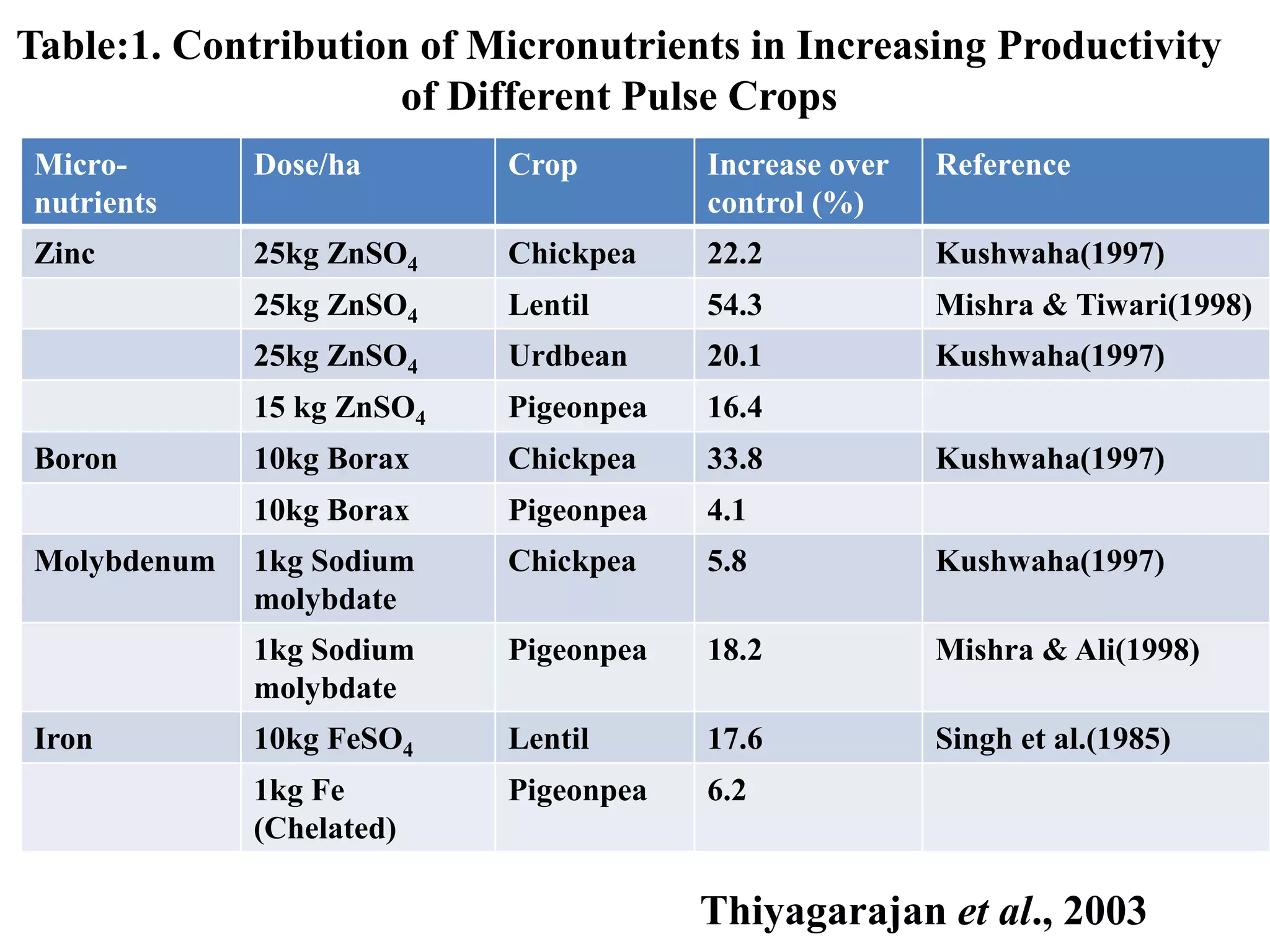
Table:1. Contribution of Micronutrients in Increasing Productivity
of Different Pulse Crops
Micro-
nutrients
Dose/ha Crop Increase over
control (%)
Reference
Zinc 25kg ZnSO4 Chickpea 22.2 Kushwaha(1997)
25kg ZnSO4 Lentil 54.3 Mishra & Tiwari(1998)
25kg ZnSO4 Urdbean 20.1 Kushwaha(1997)
15 kg ZnSO4 Pigeonpea 16.4
Boron 10kg Borax Chickpea 33.8 Kushwaha(1997)
10kg Borax Pigeonpea 4.1
Molybdenum 1kg Sodium
molybdate
Chickpea 5.8 Kushwaha(1997)
1kg Sodium
molybdate
Pigeonpea 18.2 Mishra & Ali(1998)
Iron 10kg FeSO4 Lentil 17.6 Singh et al.(1985)
1kg Fe
(Chelated)
Pigeonpea 6.2
Thiyagarajan et al., 2003
*
*Definition of foliar fertilization:
*The application of foliar sprays of one or more mineral
nutrients to plants to supplement traditional soil application
of fertilizers.
*Foliar feeding is a technique of a feeding nutrient to plant by
applying liquid fertilizer (either in solution or suspension)
directly to the crop canopy. If used wisely, it can more
efficient, economical environmental friendly target oriented
when used supplement soil fertilization now days, foliar
feeding is widely adopted strategy in modern crop
management
*
*There is a wealth of literature about foliar fertilization which
was first used as long ago as 1844 to correct plant chlorosis
with foliar sprays of iron (Gris, 1844).
*Used widely and for many years in horticulture (fruit and
vegetables)
*In row-crop agriculture the practice has only caught on in
the past two decades, although there is still some speculation
about the benefits and correct implementation of this practice
*
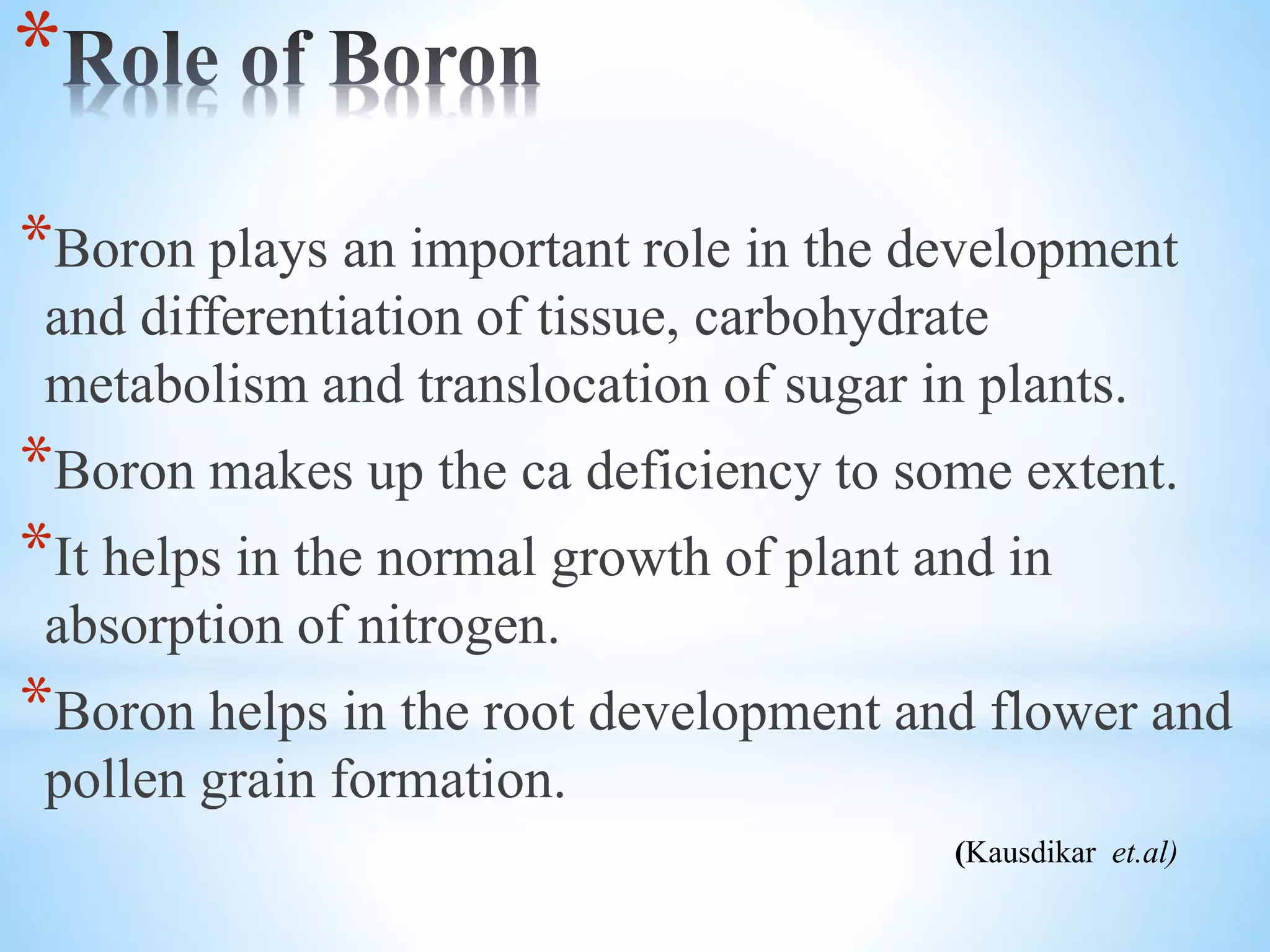
*In order for a foliar fertilizer nutrient to be utilized by the
plant for growth, it must first gain entry into the leaf prior to
entering the cytoplasm of a cell in the leaf.
*To achieve this the nutrient must effectively penetrate the
outer cuticle and the wall of the underlying epidermal cell.
*Once penetration has occurred, nutrient absorption by the
cell is similar to absorption by the roots.
*Of all the components of the pathway of foliar-applied
nutrients, the cuticle offers the greatest resistance
*
*Boron plays an important role in the development
and differentiation of tissue, carbohydrate
metabolism and translocation of sugar in plants.
*Boron makes up the ca deficiency to some extent.
*It helps in the normal growth of plant and in
absorption of nitrogen.
*Boron helps in the root development and flower and
pollen grain formation.
(Kausdikar et.al)
*
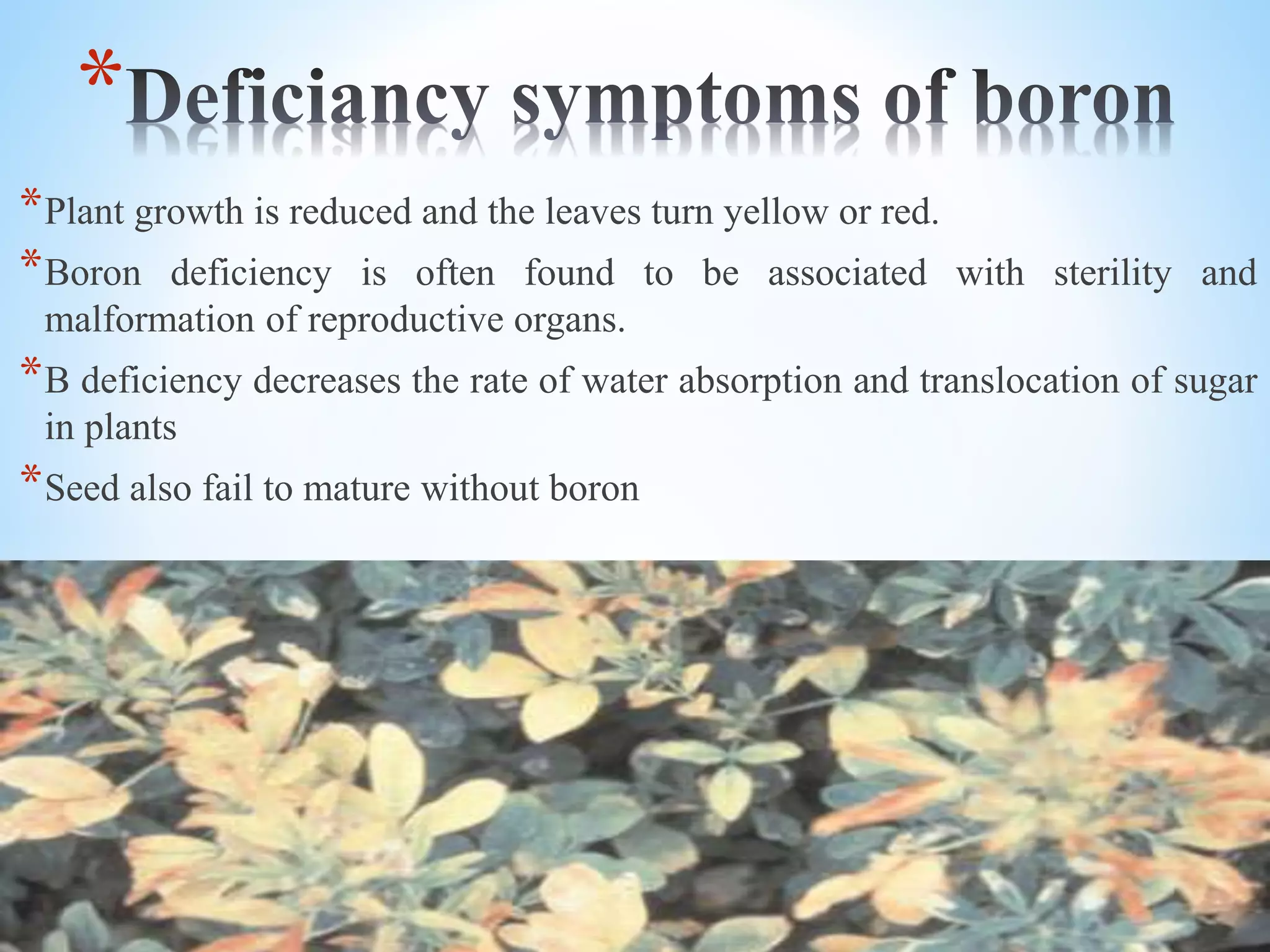
*Plant growth is reduced and the leaves turn yellow or red.
*Boron deficiency is often found to be associated with sterility and
malformation of reproductive organs.
*B deficiency decreases the rate of water absorption and translocation of sugar
in plants
*Seed also fail to mature without boron
*
*Required for N utilization.
*Legumes can not fix atmospheric N
Symbiotically without Mb.
(Kausdikar et.al.)
*
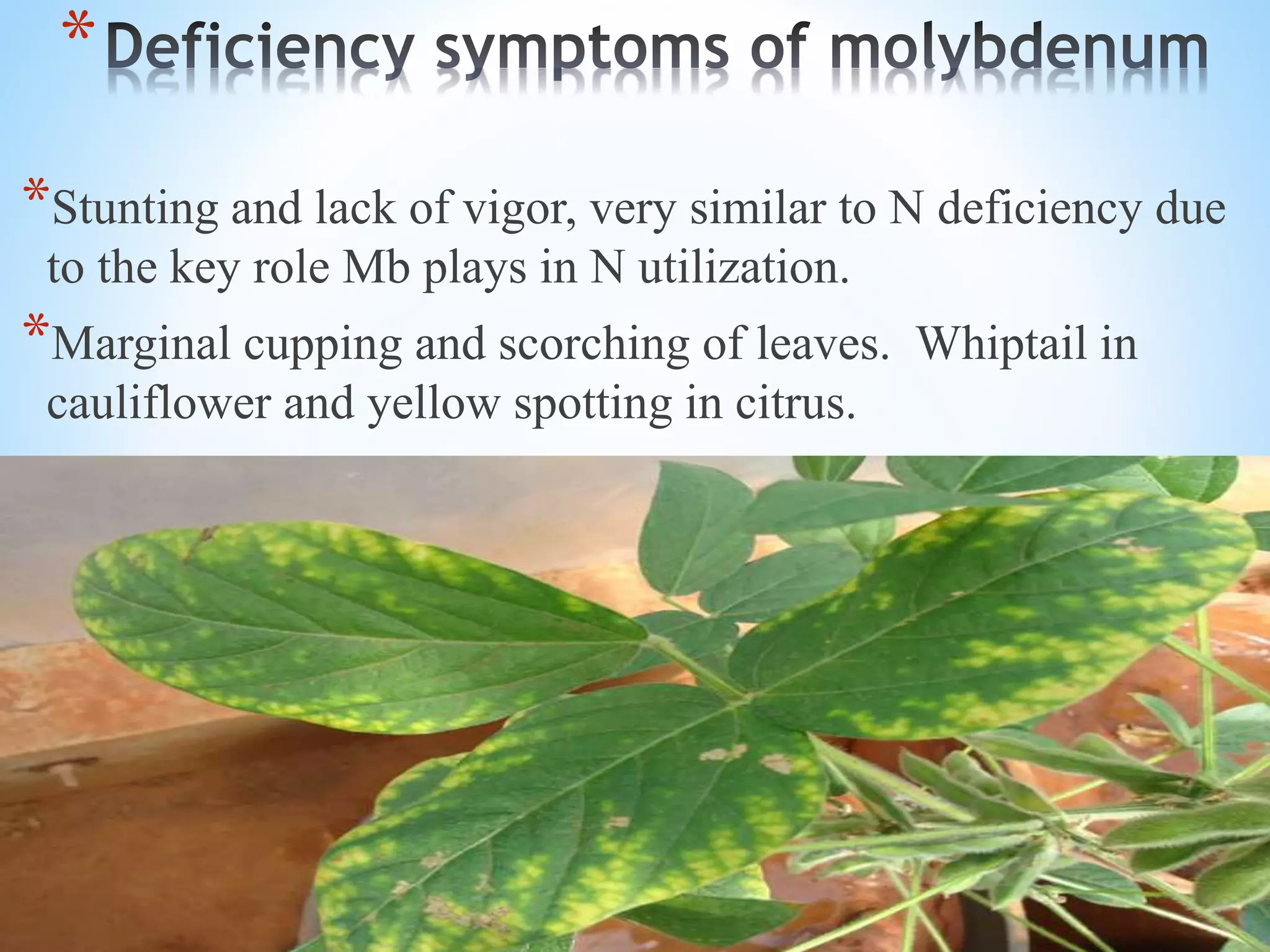
*Stunting and lack of vigor, very similar to N deficiency due
to the key role Mb plays in N utilization.
*Marginal cupping and scorching of leaves. Whiptail in
cauliflower and yellow spotting in citrus.
*
*It is imp constituent of chlorophyll and thus help in synthesis
of chlorophyll.
*It acts as catalyst in respiration.
*Aids in root metabolism.
*It has a role in enzyme reactions. However, the specific
function in growth and development of plant
*
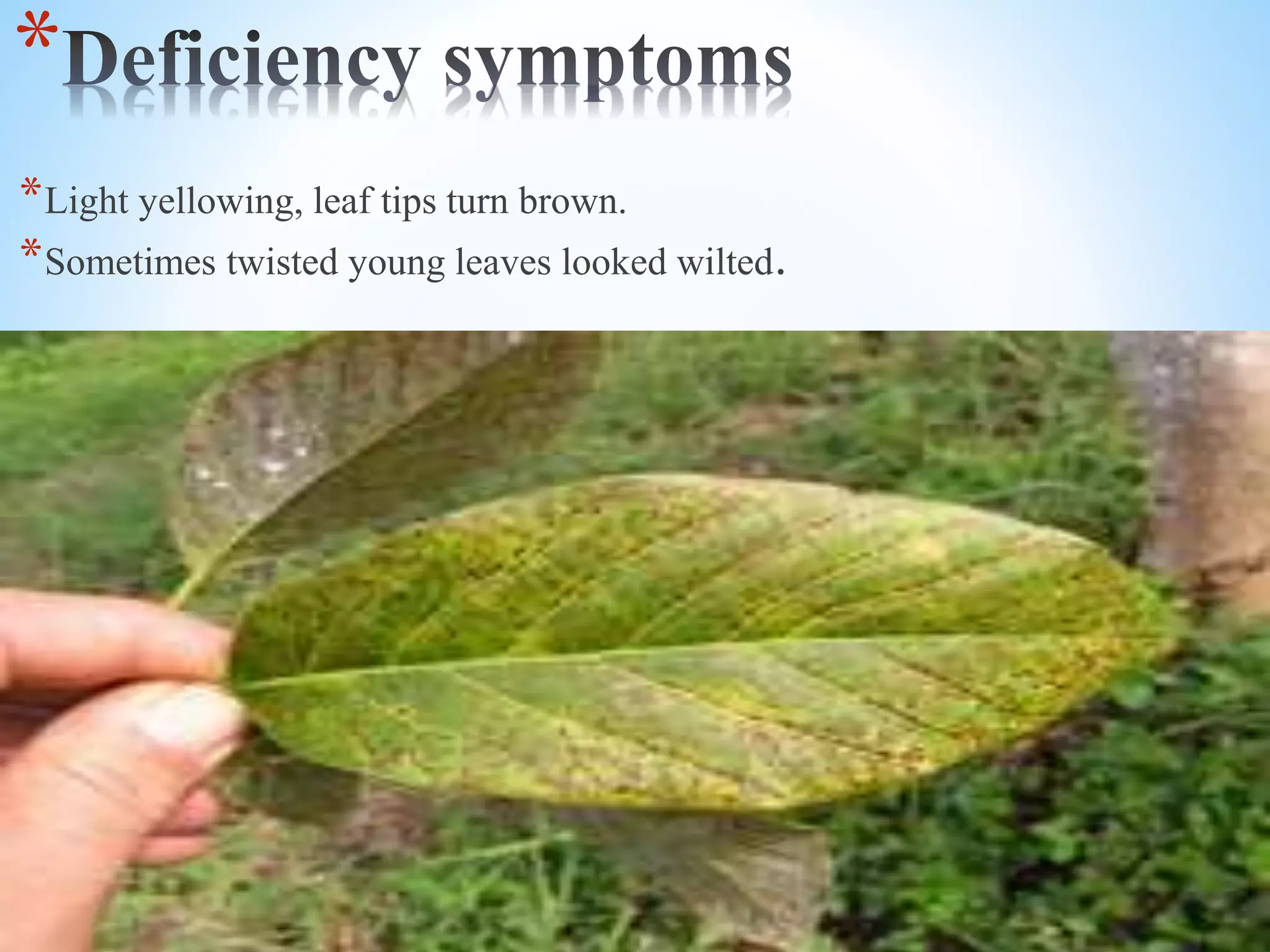
*Light yellowing, leaf tips turn brown.
*Sometimes twisted young leaves looked wilted.
*
*Manganese has a role in the formation of the plants naturally
occurring antifungal compounds, helping to fight disease
infection.
*It is involved in the enzymes that govern many biological
reactions in plant tissue.
*Manganese is also required for lignin formation, which
along with cellulose
*Foliar application are the most effective to prevent
manganese deficiency.
*
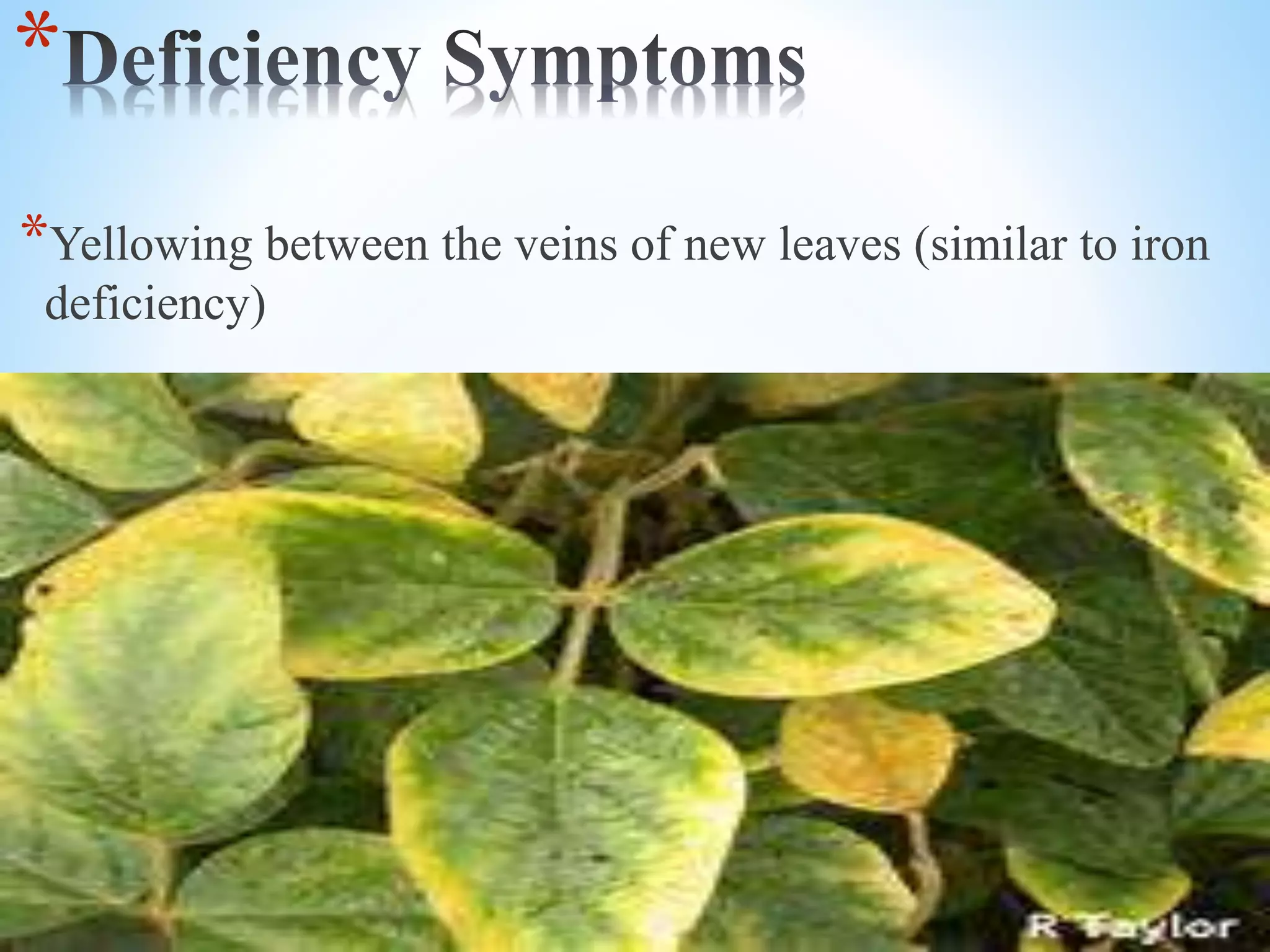
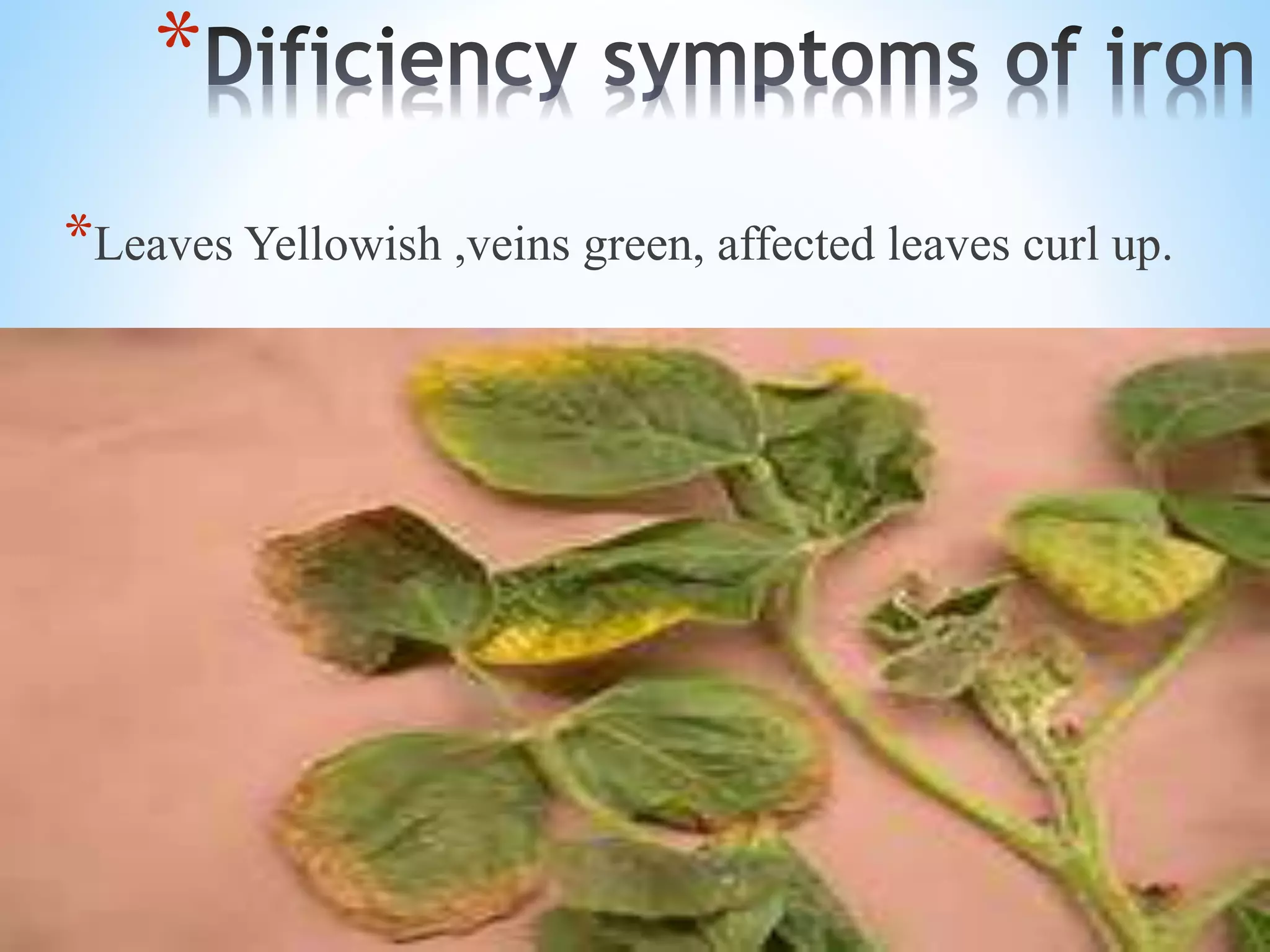
*Yellowing between the veins of new leaves (similar to iron
deficiency)
*
*iron is essential for the Maintenance of chlorophyll.
*Iron is also an essential component of the hemoglobin
molecule.
*In soybean plants, hemoglobin is a component of the
nodules.
*This may explain the lack of nodulation in field situations
where IDC is a serious problem.
*
*Leaves Yellowish ,veins green, affected leaves curl up.
*
*This micronutrient is essential for enzymes that are
involved in many metabolic reactions.
*Necessary for chlorophyll production.
*Necessary for starch formation.
*Aids in seed formation
*
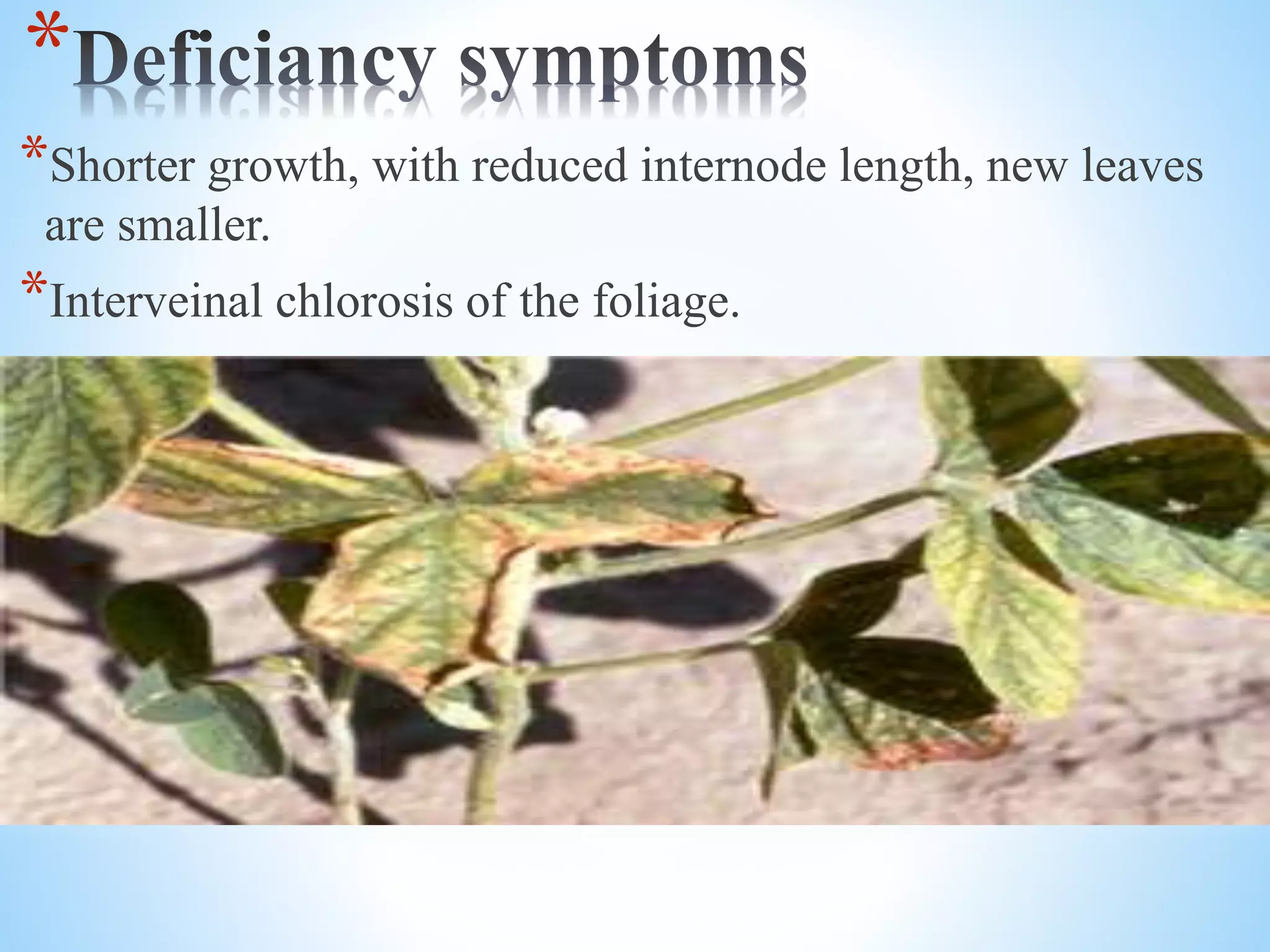
*Shorter growth, with reduced internode length, new leaves
are smaller.
*Interveinal chlorosis of the foliage.
*
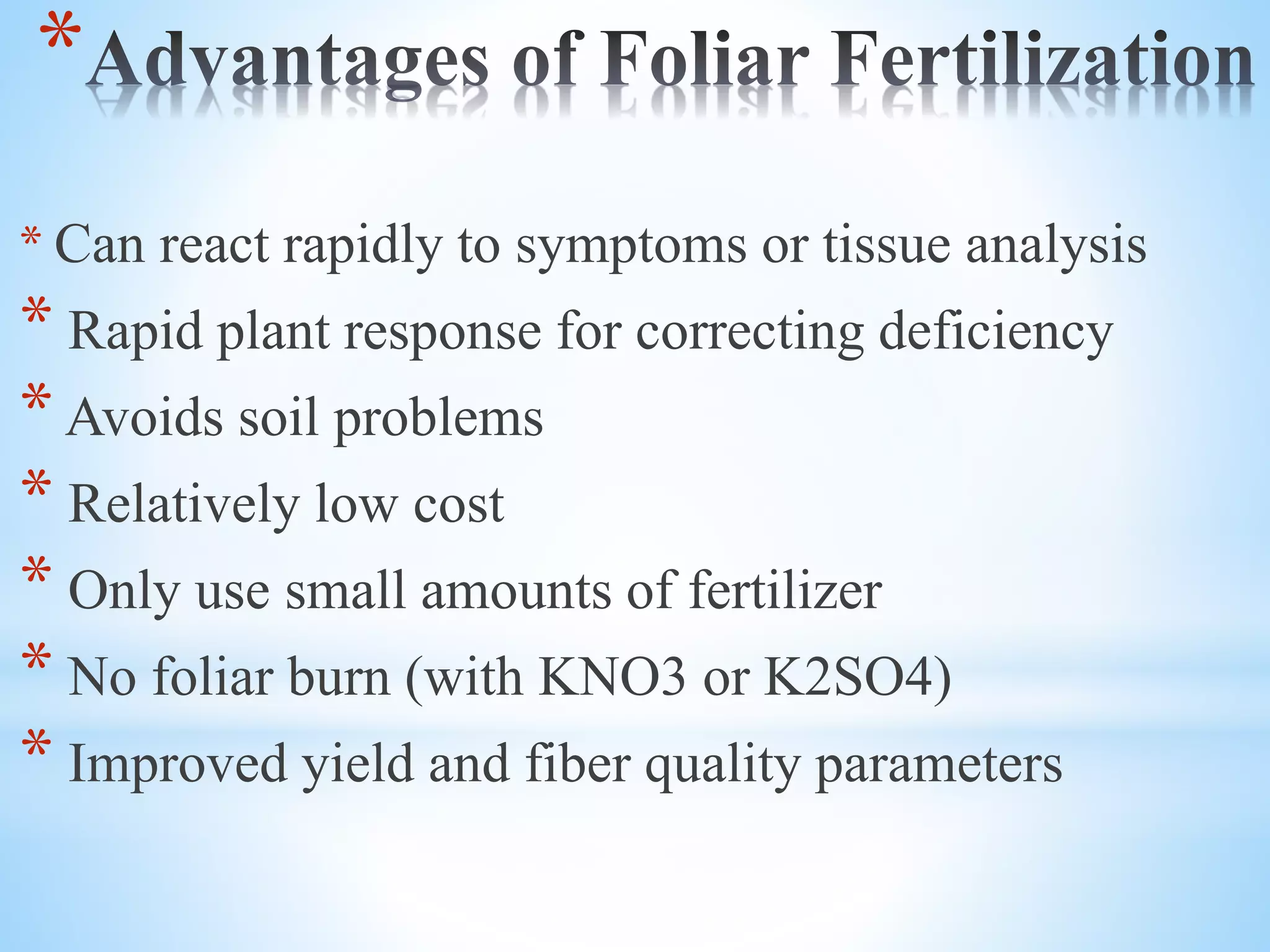
* Can react rapidly to symptoms or tissue analysis
* Rapid plant response for correcting deficiency
* Avoids soil problems
* Relatively low cost
* Only use small amounts of fertilizer
* No foliar burn (with KNO3 or K2SO4)
* Improved yield and fiber quality parameters
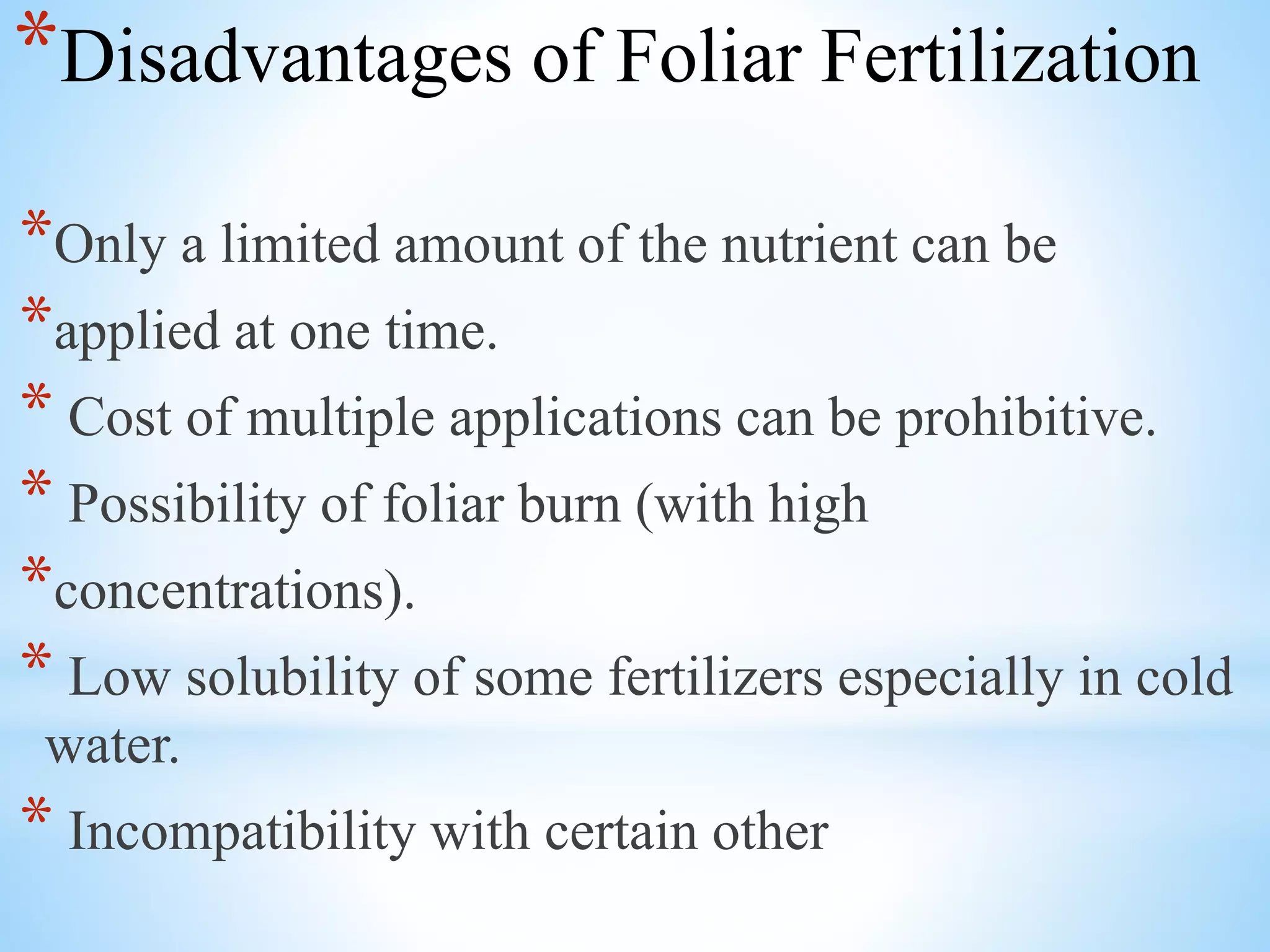
*Disadvantages of Foliar Fertilization
*Only a limited amount of the nutrient can be
*applied at one time.
* Cost of multiple applications can be prohibitive.
* Possibility of foliar burn (with high
*concentrations).
* Low solubility of some fertilizers especially in cold
water.
* Incompatibility with certain other
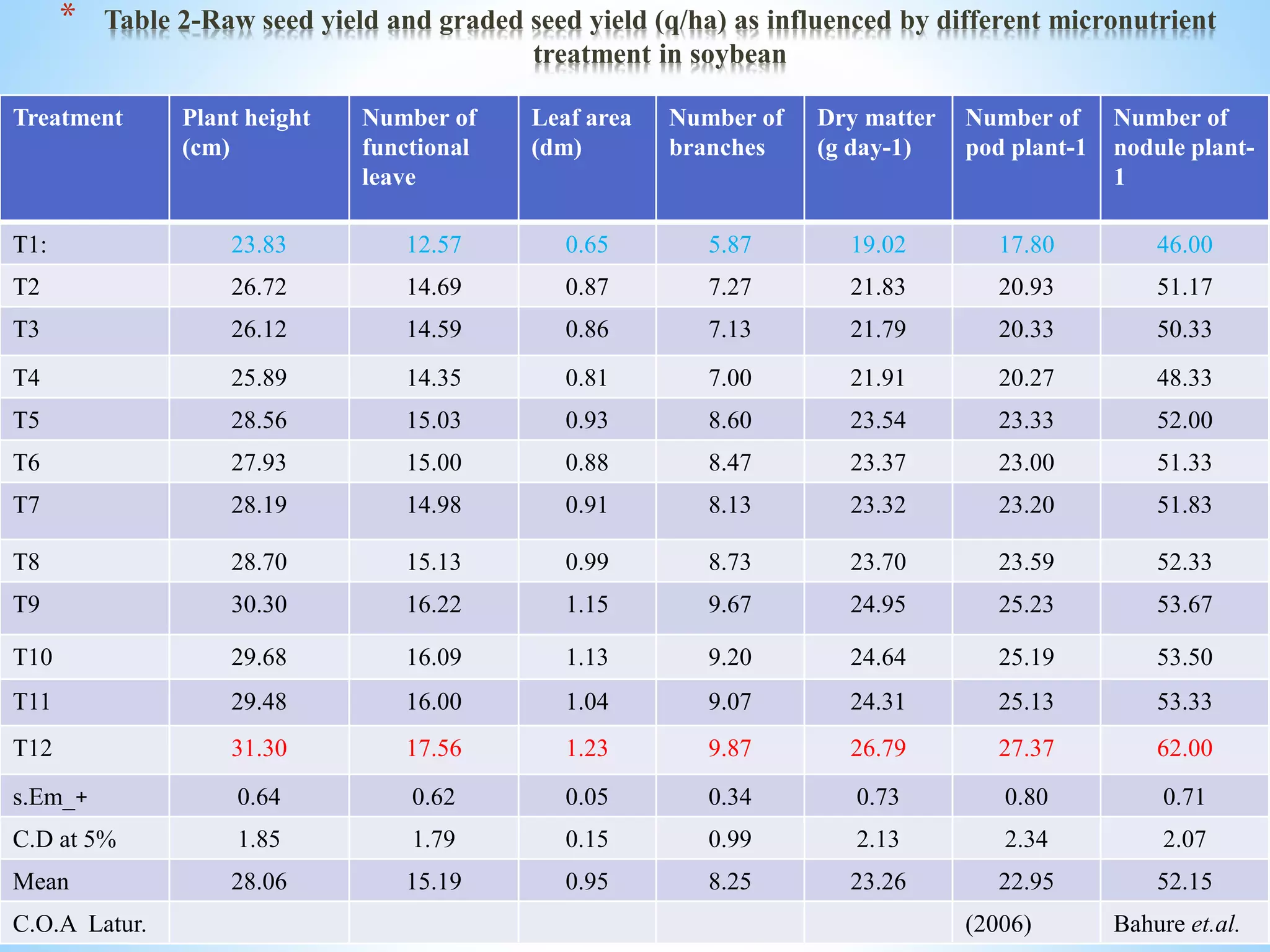
* Table 2-Raw seed yield and graded seed yield (q/ha) as influenced by different micronutrient
treatment in soybean
Treatment Plant height
(cm)
Number of
functional
leave
Leaf area
(dm)
Number of
branches
Dry matter
(g day-1)
Number of
pod plant-1
Number of
nodule plant-
1
T1: 23.83 12.57 0.65 5.87 19.02 17.80 46.00
T2 26.72 14.69 0.87 7.27 21.83 20.93 51.17
T3 26.12 14.59 0.86 7.13 21.79 20.33 50.33
T4 25.89 14.35 0.81 7.00 21.91 20.27 48.33
T5 28.56 15.03 0.93 8.60 23.54 23.33 52.00
T6 27.93 15.00 0.88 8.47 23.37 23.00 51.33
T7 28.19 14.98 0.91 8.13 23.32 23.20 51.83
T8 28.70 15.13 0.99 8.73 23.70 23.59 52.33
T9 30.30 16.22 1.15 9.67 24.95 25.23 53.67
T10 29.68 16.09 1.13 9.20 24.64 25.19 53.50
T11 29.48 16.00 1.04 9.07 24.31 25.13 53.33
T12 31.30 17.56 1.23 9.87 26.79 27.37 62.00
s.Em_+ 0.64 0.62 0.05 0.34 0.73 0.80 0.71
C.D at 5% 1.85 1.79 0.15 0.99 2.13 2.34 2.07
Mean 28.06 15.19 0.95 8.25 23.26 22.95 52.15
C.O.A Latur. (2006) Bahure et.al.
*
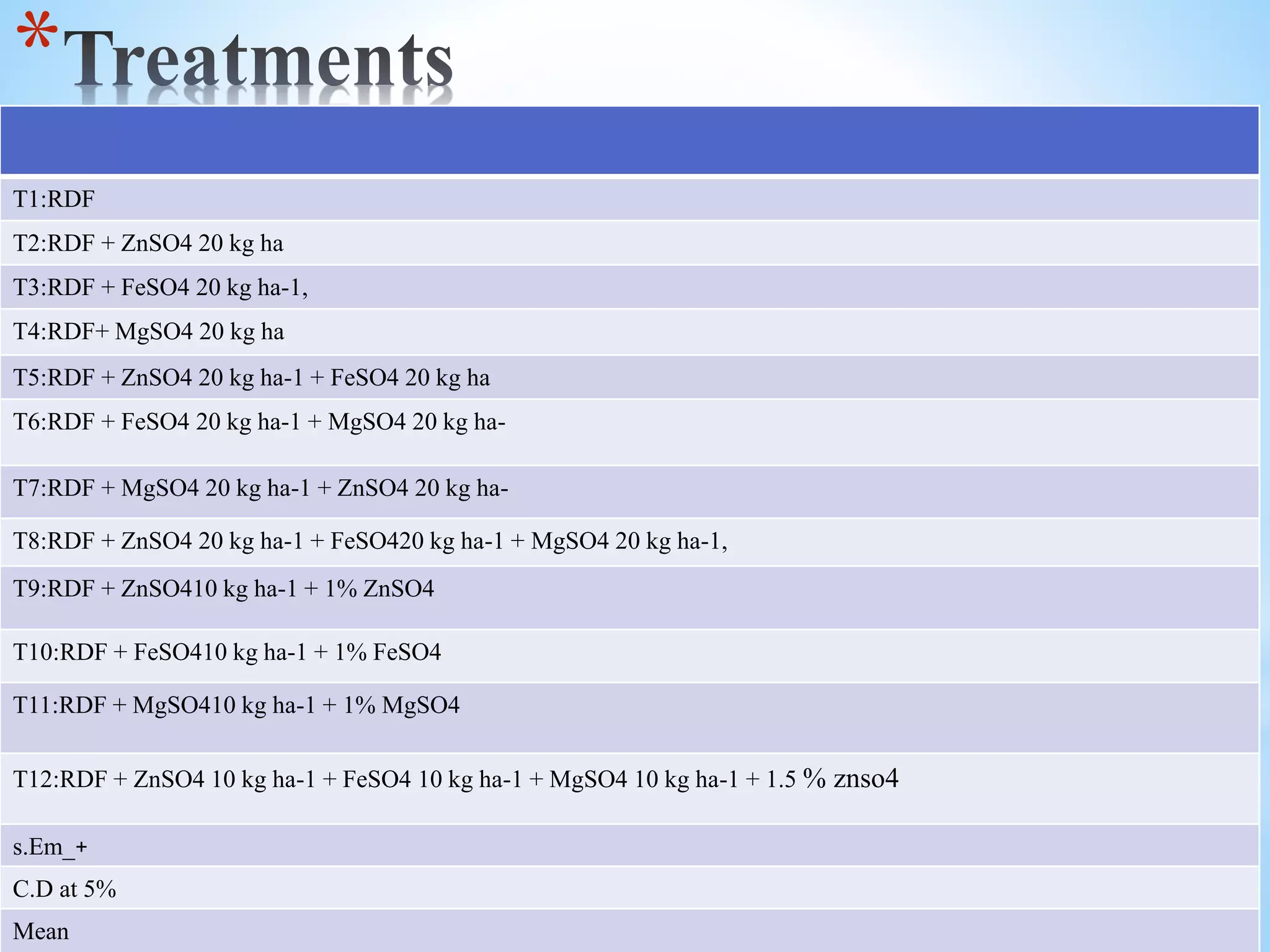
T1:RDF
T2:RDF + ZnSO4 20 kg ha
T3:RDF + FeSO4 20 kg ha-1,
T4:RDF+ MgSO4 20 kg ha
T5:RDF + ZnSO4 20 kg ha-1 + FeSO4 20 kg ha
T6:RDF + FeSO4 20 kg ha-1 + MgSO4 20 kg ha-
T7:RDF + MgSO4 20 kg ha-1 + ZnSO4 20 kg ha-
T8:RDF + ZnSO4 20 kg ha-1 + FeSO420 kg ha-1 + MgSO4 20 kg ha-1,
T9:RDF + ZnSO410 kg ha-1 + 1% ZnSO4
T10:RDF + FeSO410 kg ha-1 + 1% FeSO4
T11:RDF + MgSO410 kg ha-1 + 1% MgSO4
T12:RDF + ZnSO4 10 kg ha-1 + FeSO4 10 kg ha-1 + MgSO4 10 kg ha-1 + 1.5 % znso4
s.Em_+
C.D at 5%
Mean
*
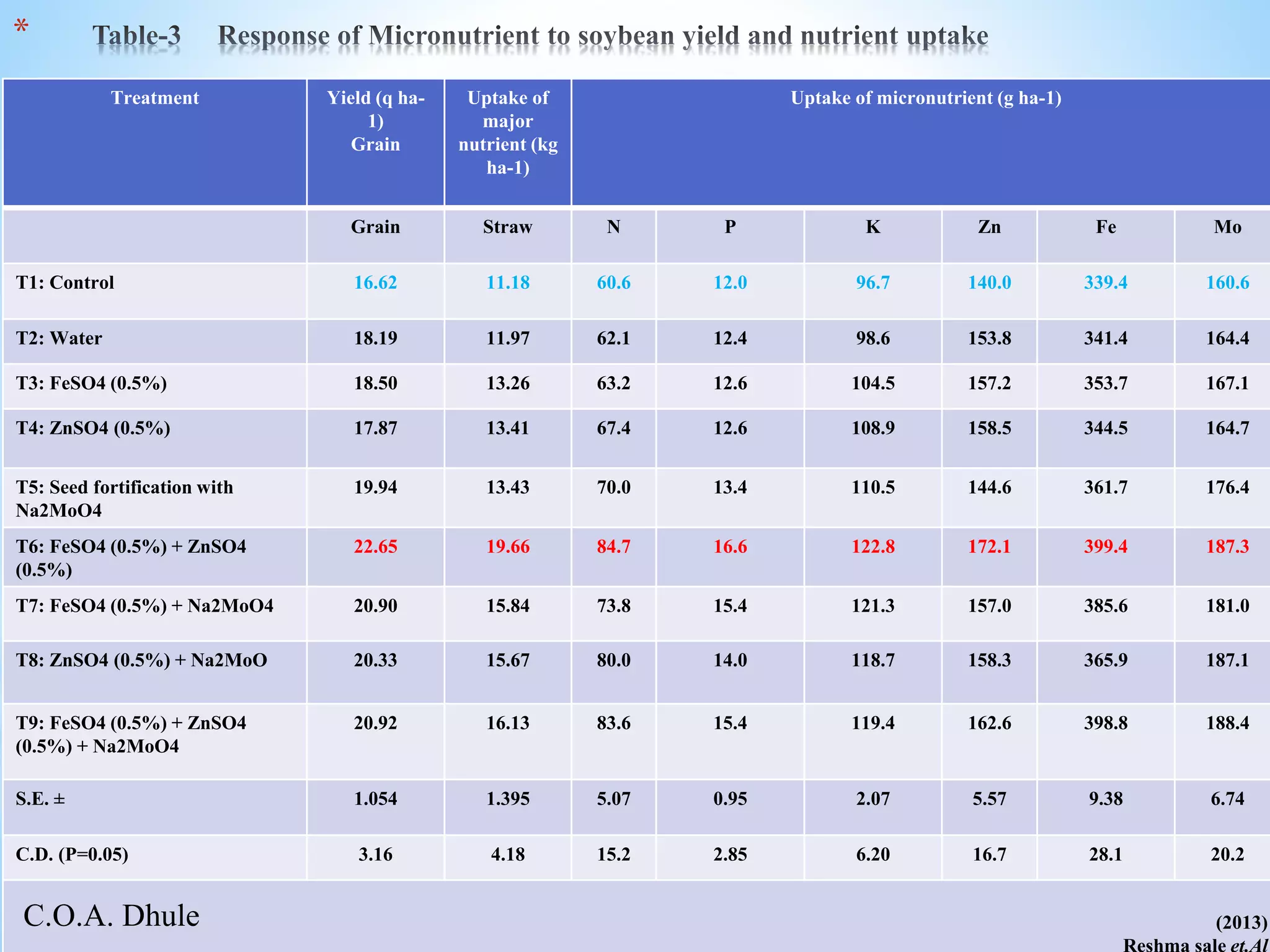
Treatment Yield (q ha-
1)
Grain
Uptake of
major
nutrient (kg
ha-1)
Uptake of micronutrient (g ha-1)
Grain Straw N P K Zn Fe Mo
T1: Control 16.62 11.18 60.6 12.0 96.7 140.0 339.4 160.6
T2: Water 18.19 11.97 62.1 12.4 98.6 153.8 341.4 164.4
T3: FeSO4 (0.5%) 18.50 13.26 63.2 12.6 104.5 157.2 353.7 167.1
T4: ZnSO4 (0.5%) 17.87 13.41 67.4 12.6 108.9 158.5 344.5 164.7
T5: Seed fortification with
Na2MoO4
19.94 13.43 70.0 13.4 110.5 144.6 361.7 176.4
T6: FeSO4 (0.5%) + ZnSO4
(0.5%)
22.65 19.66 84.7 16.6 122.8 172.1 399.4 187.3
T7: FeSO4 (0.5%) + Na2MoO4 20.90 15.84 73.8 15.4 121.3 157.0 385.6 181.0
T8: ZnSO4 (0.5%) + Na2MoO 20.33 15.67 80.0 14.0 118.7 158.3 365.9 187.1
T9: FeSO4 (0.5%) + ZnSO4
(0.5%) + Na2MoO4
20.92 16.13 83.6 15.4 119.4 162.6 398.8 188.4
S.E. ± 1.054 1.395 5.07 0.95 2.07 5.57 9.38 6.74
C.D. (P=0.05) 3.16 4.18 15.2 2.85 6.20 16.7 28.1 20.2
(2013)
Reshma sale et.Al
C.O.A. Dhule
*
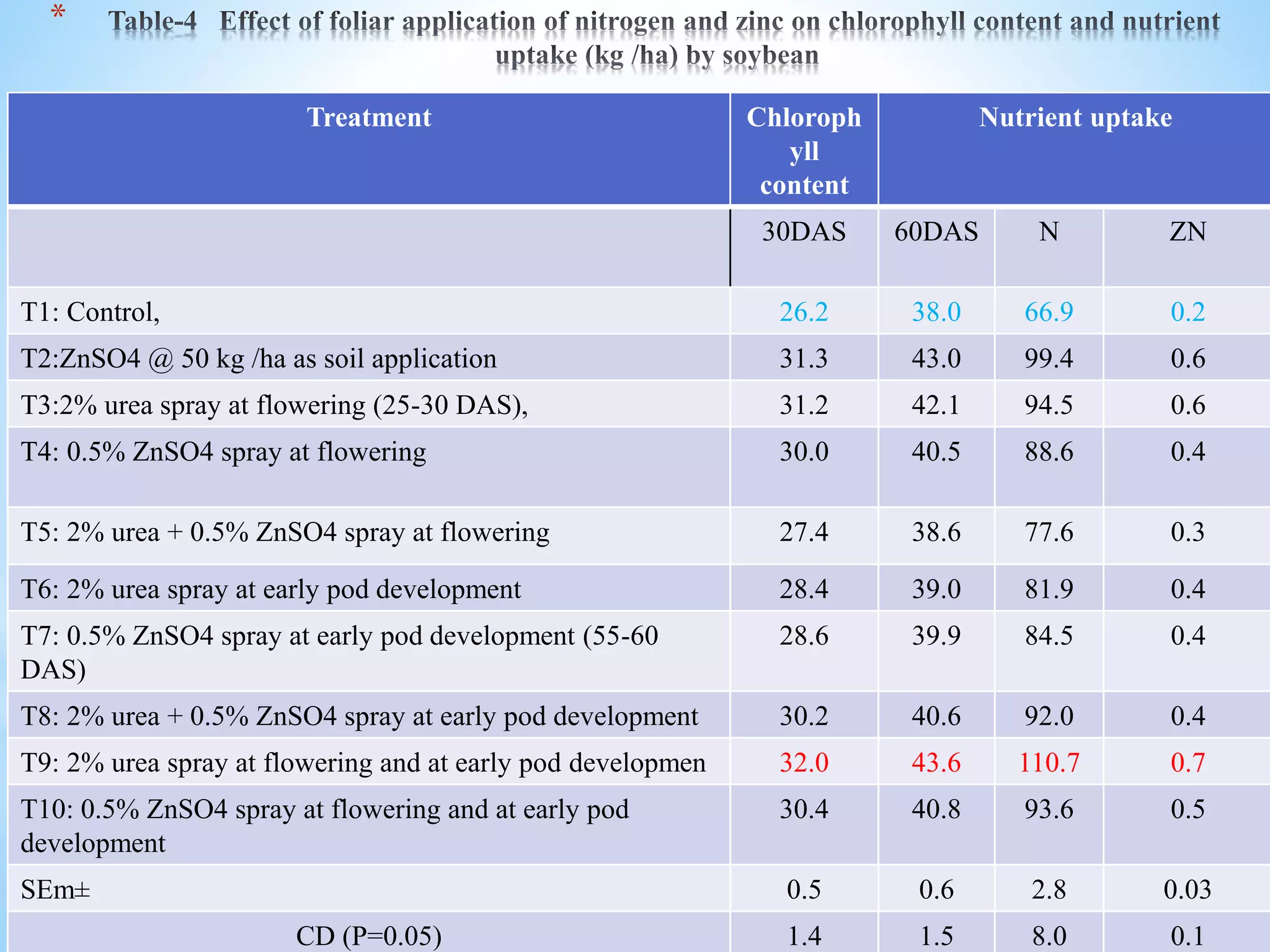
Treatment Chloroph
yll
content
Nutrient uptake
30DAS 60DAS N ZN
T1: Control, 26.2 38.0 66.9 0.2
T2:ZnSO4 @ 50 kg /ha as soil application 31.3 43.0 99.4 0.6
T3:2% urea spray at flowering (25-30 DAS), 31.2 42.1 94.5 0.6
T4: 0.5% ZnSO4 spray at flowering 30.0 40.5 88.6 0.4
T5: 2% urea + 0.5% ZnSO4 spray at flowering 27.4 38.6 77.6 0.3
T6: 2% urea spray at early pod development 28.4 39.0 81.9 0.4
T7: 0.5% ZnSO4 spray at early pod development (55-60
DAS)
28.6 39.9 84.5 0.4
T8: 2% urea + 0.5% ZnSO4 spray at early pod development 30.2 40.6 92.0 0.4
T9: 2% urea spray at flowering and at early pod developmen 32.0 43.6 110.7 0.7
T10: 0.5% ZnSO4 spray at flowering and at early pod
development
30.4 40.8 93.6 0.5
SEm± 0.5 0.6 2.8 0.03
CD (P=0.05) 1.4 1.5 8.0 0.1
*
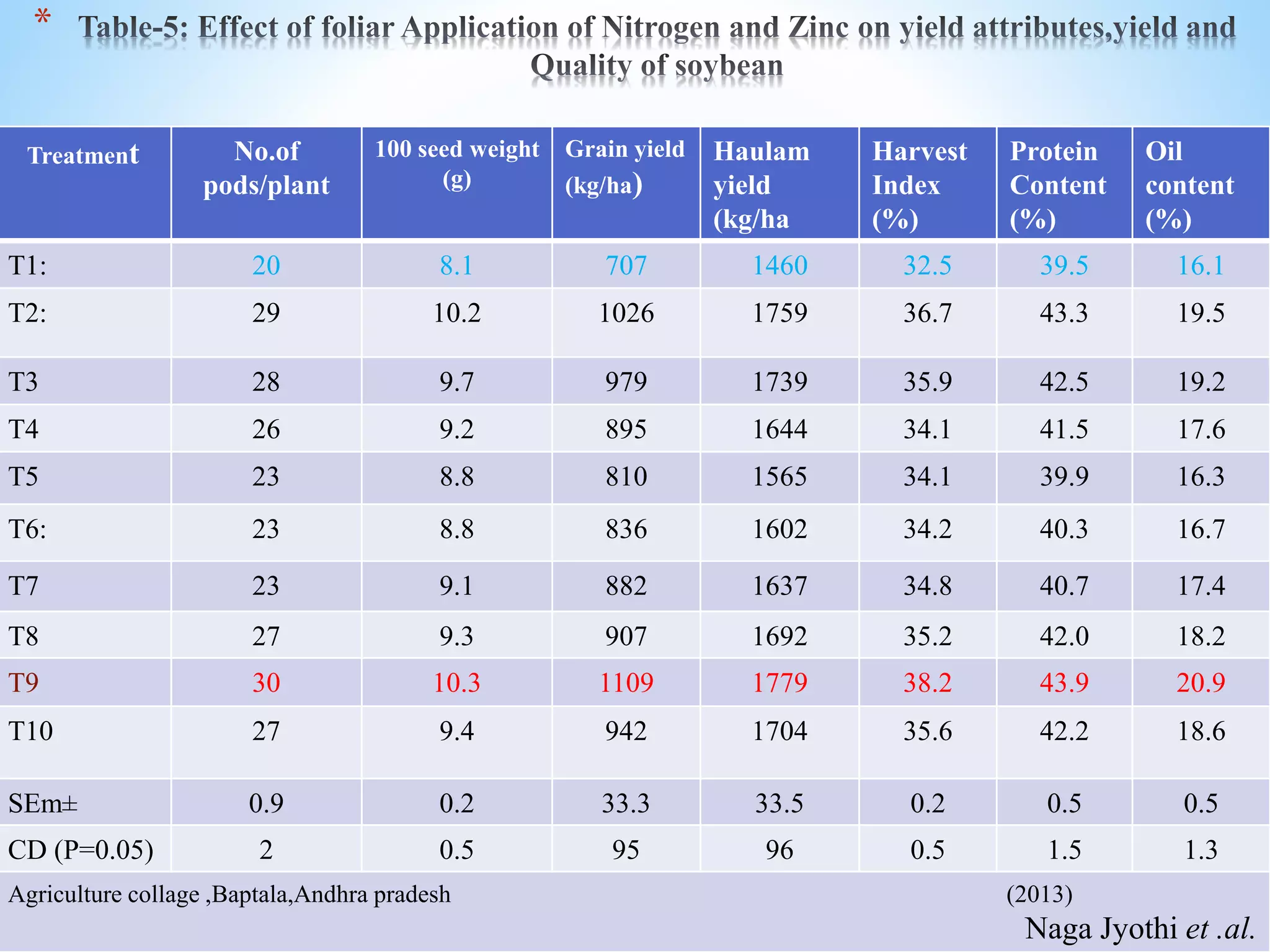
Treatment No.of
pods/plant
100 seed weight
(g)
Grain yield
(kg/ha)
Haulam
yield
(kg/ha
Harvest
Index
(%)
Protein
Content
(%)
Oil
content
(%)
T1: 20 8.1 707 1460 32.5 39.5 16.1
T2: 29 10.2 1026 1759 36.7 43.3 19.5
T3 28 9.7 979 1739 35.9 42.5 19.2
T4 26 9.2 895 1644 34.1 41.5 17.6
T5 23 8.8 810 1565 34.1 39.9 16.3
T6: 23 8.8 836 1602 34.2 40.3 16.7
T7 23 9.1 882 1637 34.8 40.7 17.4
T8 27 9.3 907 1692 35.2 42.0 18.2
T9 30 10.3 1109 1779 38.2 43.9 20.9
T10 27 9.4 942 1704 35.6 42.2 18.6
SEm± 0.9 0.2 33.3 33.5 0.2 0.5 0.5
CD (P=0.05) 2 0.5 95 96 0.5 1.5 1.3
Agriculture collage ,Baptala,Andhra pradesh (2013)
Naga Jyothi et .al.
*
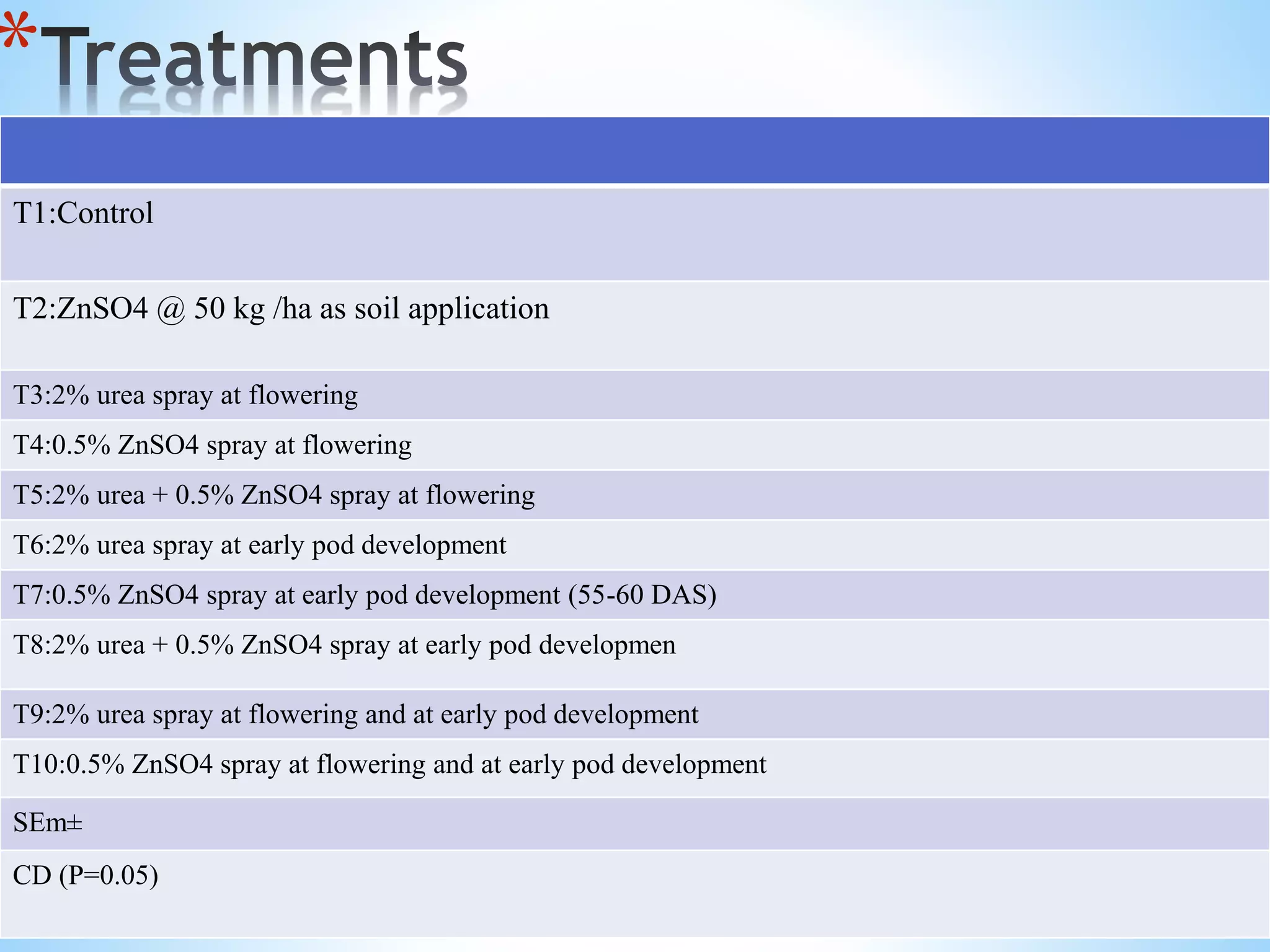
T1:Control
T2:ZnSO4 @ 50 kg /ha as soil application
T3:2% urea spray at flowering
T4:0.5% ZnSO4 spray at flowering
T5:2% urea + 0.5% ZnSO4 spray at flowering
T6:2% urea spray at early pod development
T7:0.5% ZnSO4 spray at early pod development (55-60 DAS)
T8:2% urea + 0.5% ZnSO4 spray at early pod developmen
T9:2% urea spray at flowering and at early pod development
T10:0.5% ZnSO4 spray at flowering and at early pod development
SEm±
CD (P=0.05)
*
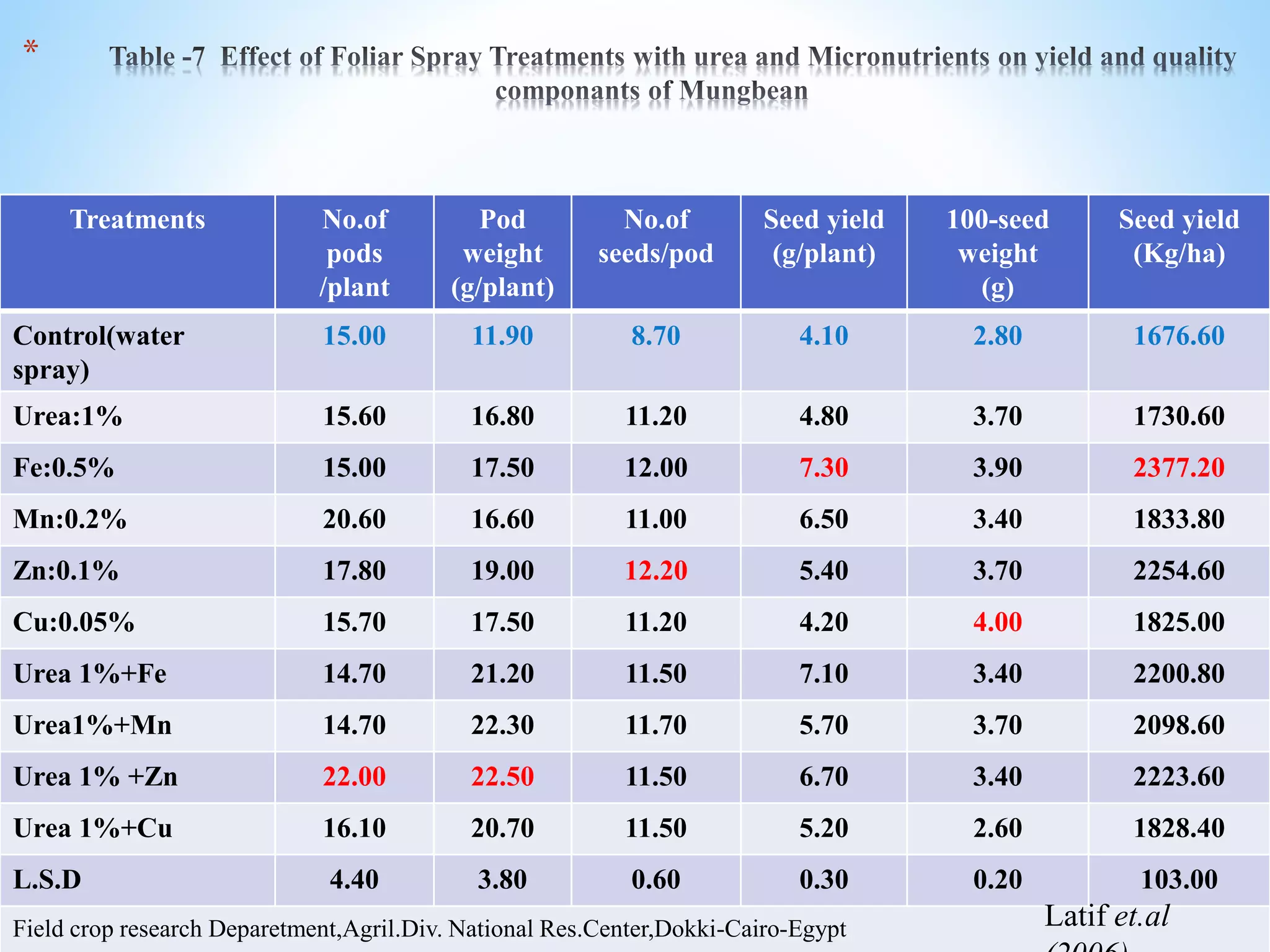
Treatments No.of
pods
/plant
Pod
weight
(g/plant)
No.of
seeds/pod
Seed yield
(g/plant)
100-seed
weight
(g)
Seed yield
(Kg/ha)
Control(water
spray)
15.00 11.90 8.70 4.10 2.80 1676.60
Urea:1% 15.60 16.80 11.20 4.80 3.70 1730.60
Fe:0.5% 15.00 17.50 12.00 7.30 3.90 2377.20
Mn:0.2% 20.60 16.60 11.00 6.50 3.40 1833.80
Zn:0.1% 17.80 19.00 12.20 5.40 3.70 2254.60
Cu:0.05% 15.70 17.50 11.20 4.20 4.00 1825.00
Urea 1%+Fe 14.70 21.20 11.50 7.10 3.40 2200.80
Urea1%+Mn 14.70 22.30 11.70 5.70 3.70 2098.60
Urea 1% +Zn 22.00 22.50 11.50 6.70 3.40 2223.60
Urea 1%+Cu 16.10 20.70 11.50 5.20 2.60 1828.40
L.S.D 4.40 3.80 0.60 0.30 0.20 103.00
Field crop research Deparetment,Agril.Div. National Res.Center,Dokki-Cairo-Egypt Latif et.al
*
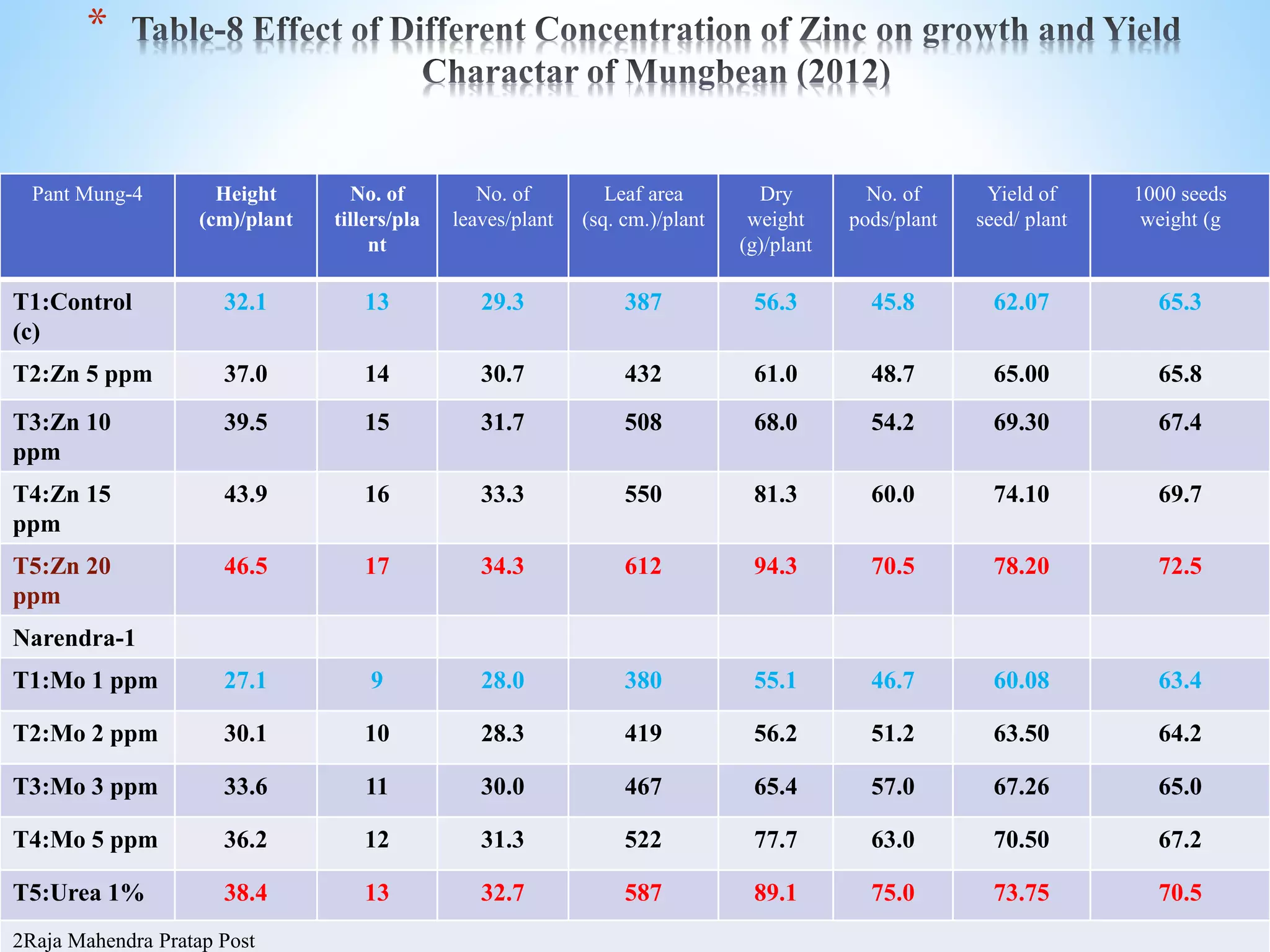
Pant Mung-4 Height
(cm)/plant
No. of
tillers/pla
nt
No. of
leaves/plant
Leaf area
(sq. cm.)/plant
Dry
weight
(g)/plant
No. of
pods/plant
Yield of
seed/ plant
1000 seeds
weight (g
T1:Control
(c)
32.1 13 29.3 387 56.3 45.8 62.07 65.3
T2:Zn 5 ppm 37.0 14 30.7 432 61.0 48.7 65.00 65.8
T3:Zn 10
ppm
39.5 15 31.7 508 68.0 54.2 69.30 67.4
T4:Zn 15
ppm
43.9 16 33.3 550 81.3 60.0 74.10 69.7
T5:Zn 20
ppm
46.5 17 34.3 612 94.3 70.5 78.20 72.5
Narendra-1
T1:Mo 1 ppm 27.1 9 28.0 380 55.1 46.7 60.08 63.4
T2:Mo 2 ppm 30.1 10 28.3 419 56.2 51.2 63.50 64.2
T3:Mo 3 ppm 33.6 11 30.0 467 65.4 57.0 67.26 65.0
T4:Mo 5 ppm 36.2 12 31.3 522 77.7 63.0 70.50 67.2
T5:Urea 1% 38.4 13 32.7 587 89.1 75.0 73.75 70.5
2Raja Mahendra Pratap Post
*
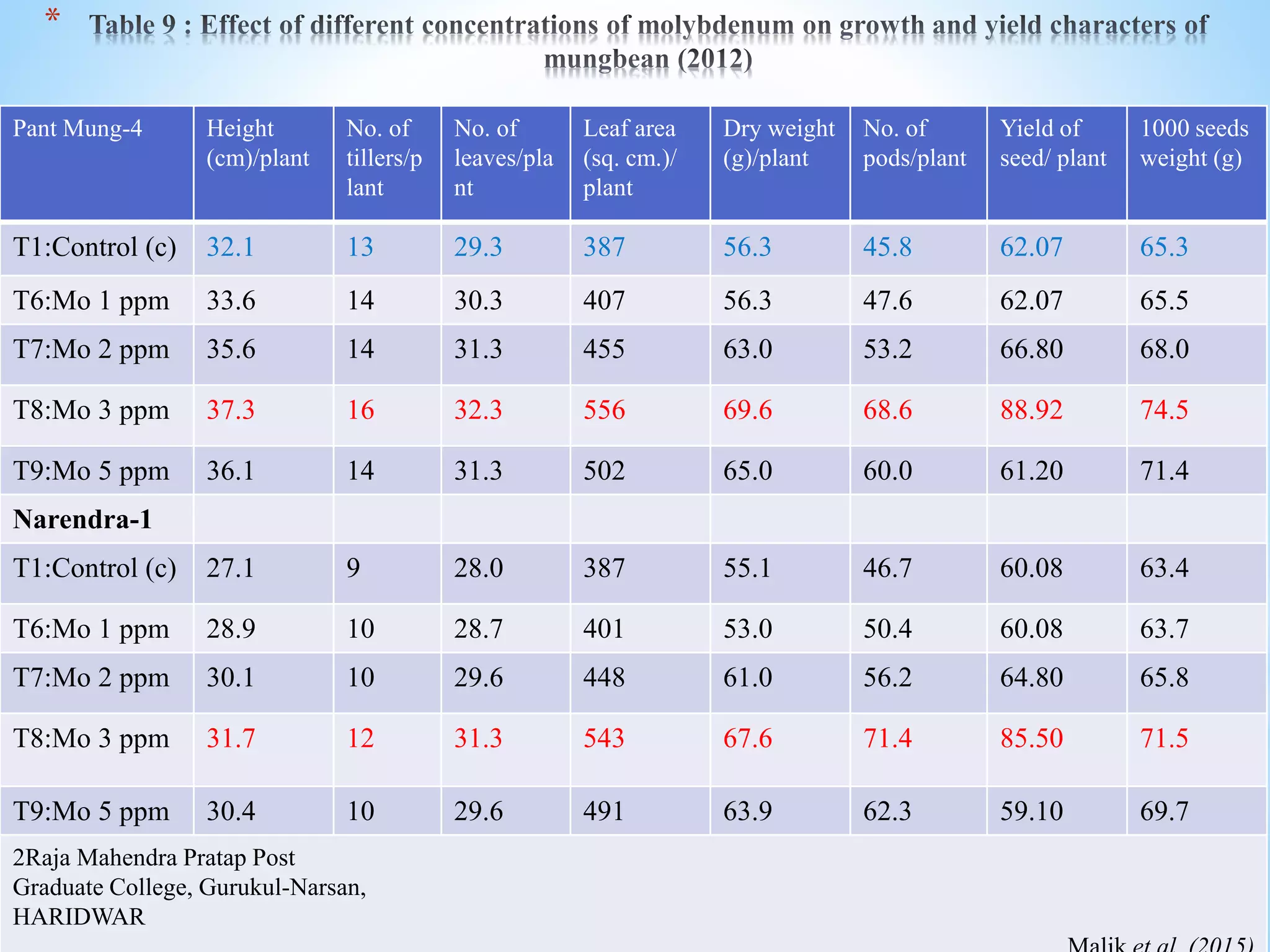
Pant Mung-4 Height
(cm)/plant
No. of
tillers/p
lant
No. of
leaves/pla
nt
Leaf area
(sq. cm.)/
plant
Dry weight
(g)/plant
No. of
pods/plant
Yield of
seed/ plant
1000 seeds
weight (g)
T1:Control (c) 32.1 13 29.3 387 56.3 45.8 62.07 65.3
T6:Mo 1 ppm 33.6 14 30.3 407 56.3 47.6 62.07 65.5
T7:Mo 2 ppm 35.6 14 31.3 455 63.0 53.2 66.80 68.0
T8:Mo 3 ppm 37.3 16 32.3 556 69.6 68.6 88.92 74.5
T9:Mo 5 ppm 36.1 14 31.3 502 65.0 60.0 61.20 71.4
Narendra-1
T1:Control (c) 27.1 9 28.0 387 55.1 46.7 60.08 63.4
T6:Mo 1 ppm 28.9 10 28.7 401 53.0 50.4 60.08 63.7
T7:Mo 2 ppm 30.1 10 29.6 448 61.0 56.2 64.80 65.8
T8:Mo 3 ppm 31.7 12 31.3 543 67.6 71.4 85.50 71.5
T9:Mo 5 ppm 30.4 10 29.6 491 63.9 62.3 59.10 69.7
2Raja Mahendra Pratap Post
Graduate College, Gurukul-Narsan,
HARIDWAR
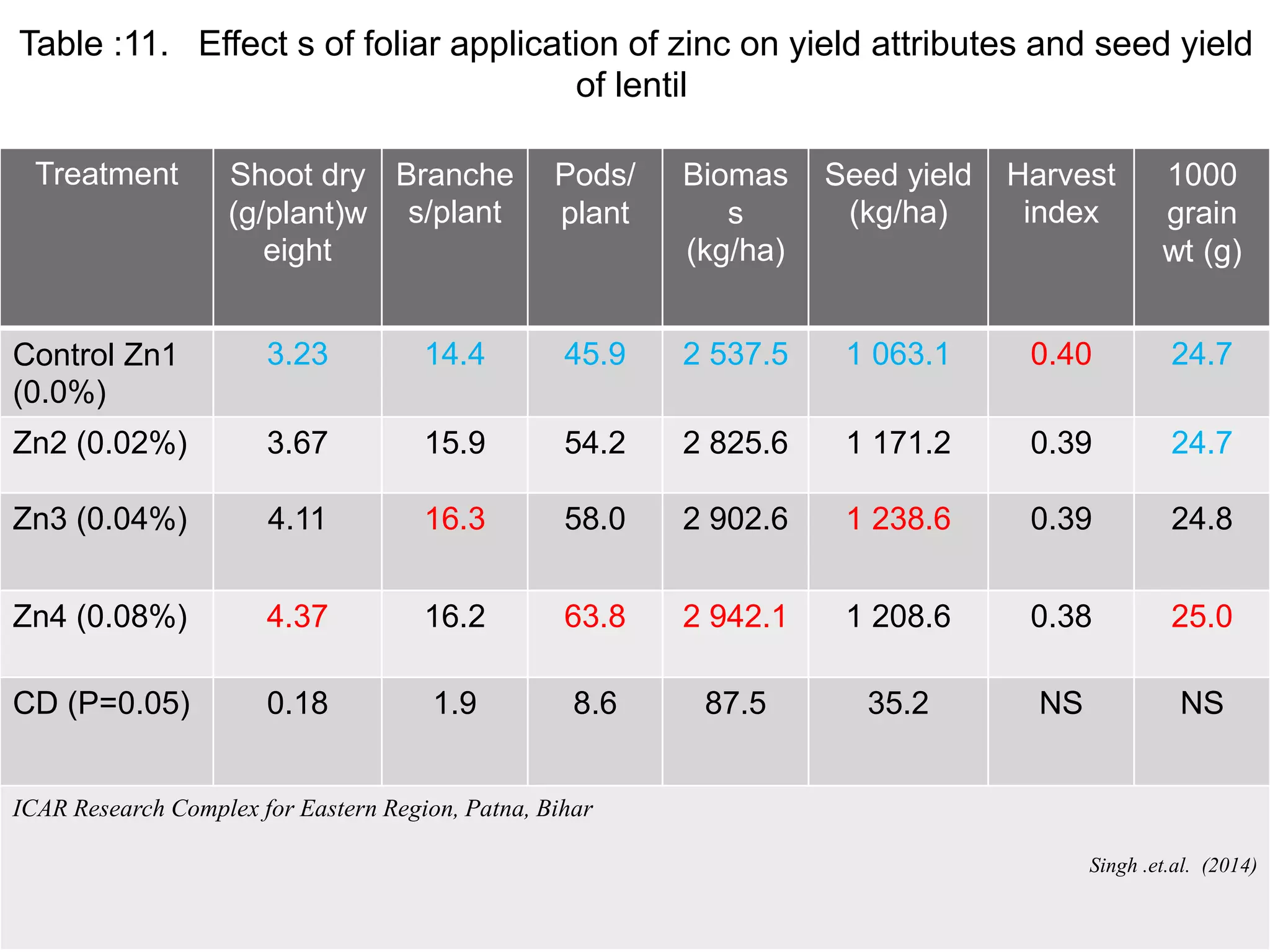
Table :11. Effect s of foliar application of zinc on yield attributes and seed yield
of lentil
Treatment Shoot dry
(g/plant)w
eight
Branche
s/plant
Pods/
plant
Biomas
s
(kg/ha)
Seed yield
(kg/ha)
Harvest
index
1000
grain
wt (g)
Control Zn1
(0.0%)
3.23 14.4 45.9 2 537.5 1 063.1 0.40 24.7
Zn2 (0.02%) 3.67 15.9 54.2 2 825.6 1 171.2 0.39 24.7
Zn3 (0.04%) 4.11 16.3 58.0 2 902.6 1 238.6 0.39 24.8
Zn4 (0.08%) 4.37 16.2 63.8 2 942.1 1 208.6 0.38 25.0
CD (P=0.05) 0.18 1.9 8.6 87.5 35.2 NS NS
ICAR Research Complex for Eastern Region, Patna, Bihar
Singh .et.al. (2014)
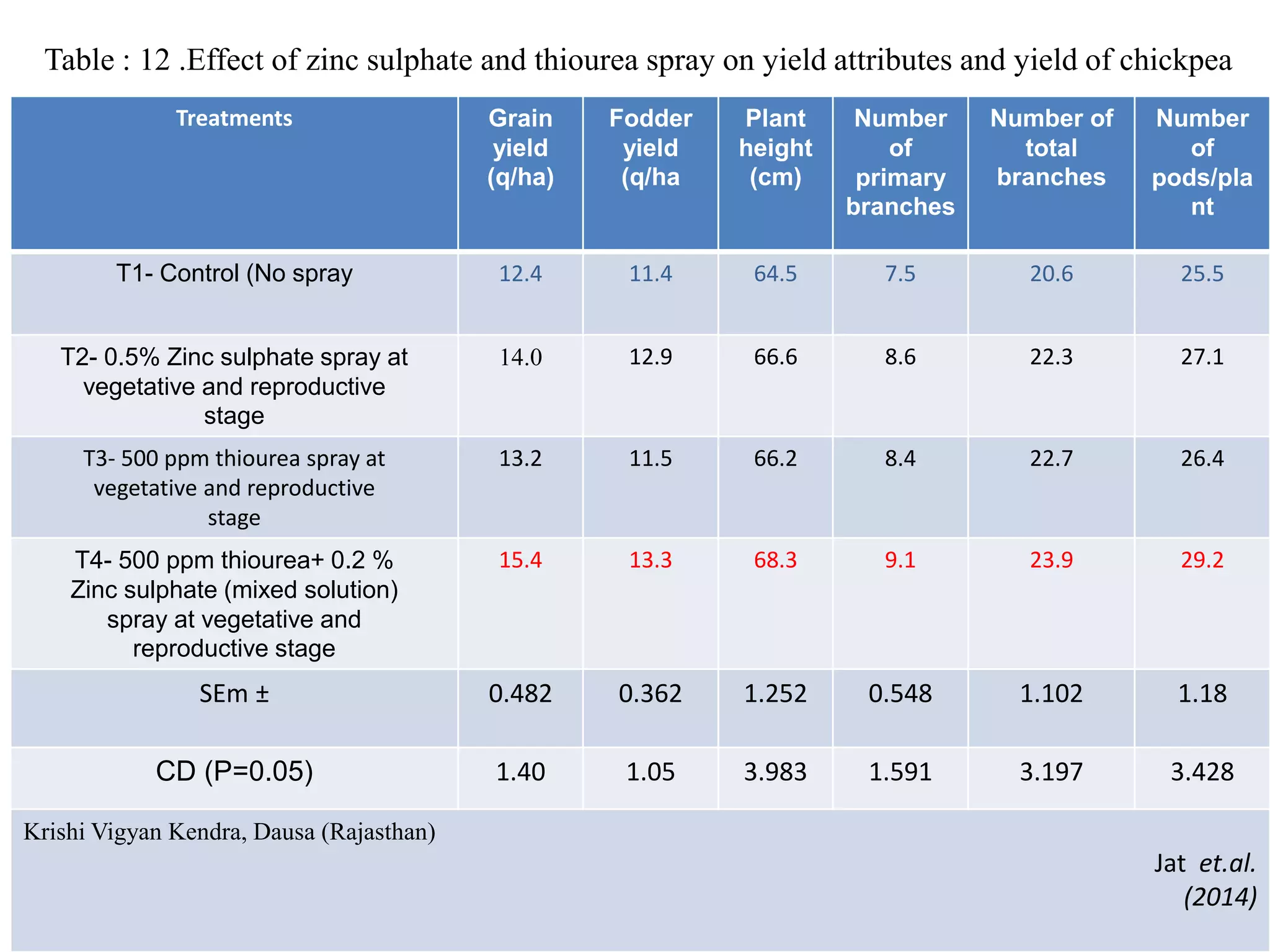
Table : 12 .Effect of zinc sulphate and thiourea spray on yield attributes and yield of chickpea
Treatments Grain
yield
(q/ha)
Fodder
yield
(q/ha
Plant
height
(cm)
Number
of
primary
branches
Number of
total
branches
Number
of
pods/pla
nt
T1- Control (No spray 12.4 11.4 64.5 7.5 20.6 25.5
T2- 0.5% Zinc sulphate spray at
vegetative and reproductive
stage
14.0 12.9 66.6 8.6 22.3 27.1
T3- 500 ppm thiourea spray at
vegetative and reproductive
stage
13.2 11.5 66.2 8.4 22.7 26.4
T4- 500 ppm thiourea+ 0.2 %
Zinc sulphate (mixed solution)
spray at vegetative and
reproductive stage
15.4 13.3 68.3 9.1 23.9 29.2
SEm ± 0.482 0.362 1.252 0.548 1.102 1.18
CD (P=0.05) 1.40 1.05 3.983 1.591 3.197 3.428
Krishi Vigyan Kendra, Dausa (Rajasthan)
Jat et.al.
(2014)
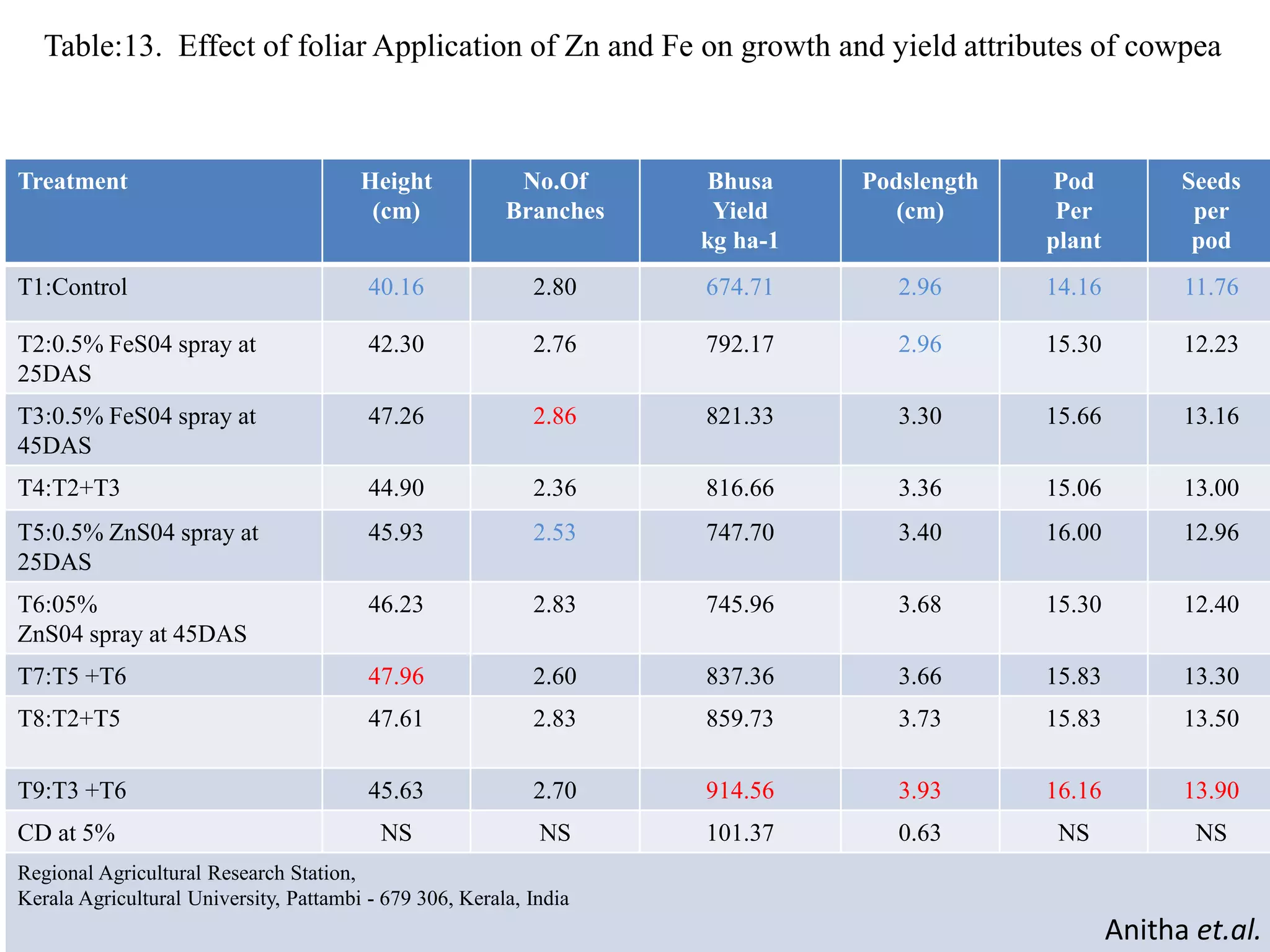
Table:13. Effect of foliar Application of Zn and Fe on growth and yield attributes of cowpea
Treatment Height
(cm)
No.Of
Branches
Bhusa
Yield
kg ha-1
Podslength
(cm)
Pod
Per
plant
Seeds
per
pod
T1:Control 40.16 2.80 674.71 2.96 14.16 11.76
T2:0.5% FeS04 spray at
25DAS
42.30 2.76 792.17 2.96 15.30 12.23
T3:0.5% FeS04 spray at
45DAS
47.26 2.86 821.33 3.30 15.66 13.16
T4:T2+T3 44.90 2.36 816.66 3.36 15.06 13.00
T5:0.5% ZnS04 spray at
25DAS
45.93 2.53 747.70 3.40 16.00 12.96
T6:05%
ZnS04 spray at 45DAS
46.23 2.83 745.96 3.68 15.30 12.40
T7:T5 +T6 47.96 2.60 837.36 3.66 15.83 13.30
T8:T2+T5 47.61 2.83 859.73 3.73 15.83 13.50
T9:T3 +T6 45.63 2.70 914.56 3.93 16.16 13.90
CD at 5% NS NS 101.37 0.63 NS NS
Regional Agricultural Research Station,
Kerala Agricultural University, Pattambi - 679 306, Kerala, India
Anitha et.al.
Conclusion
.
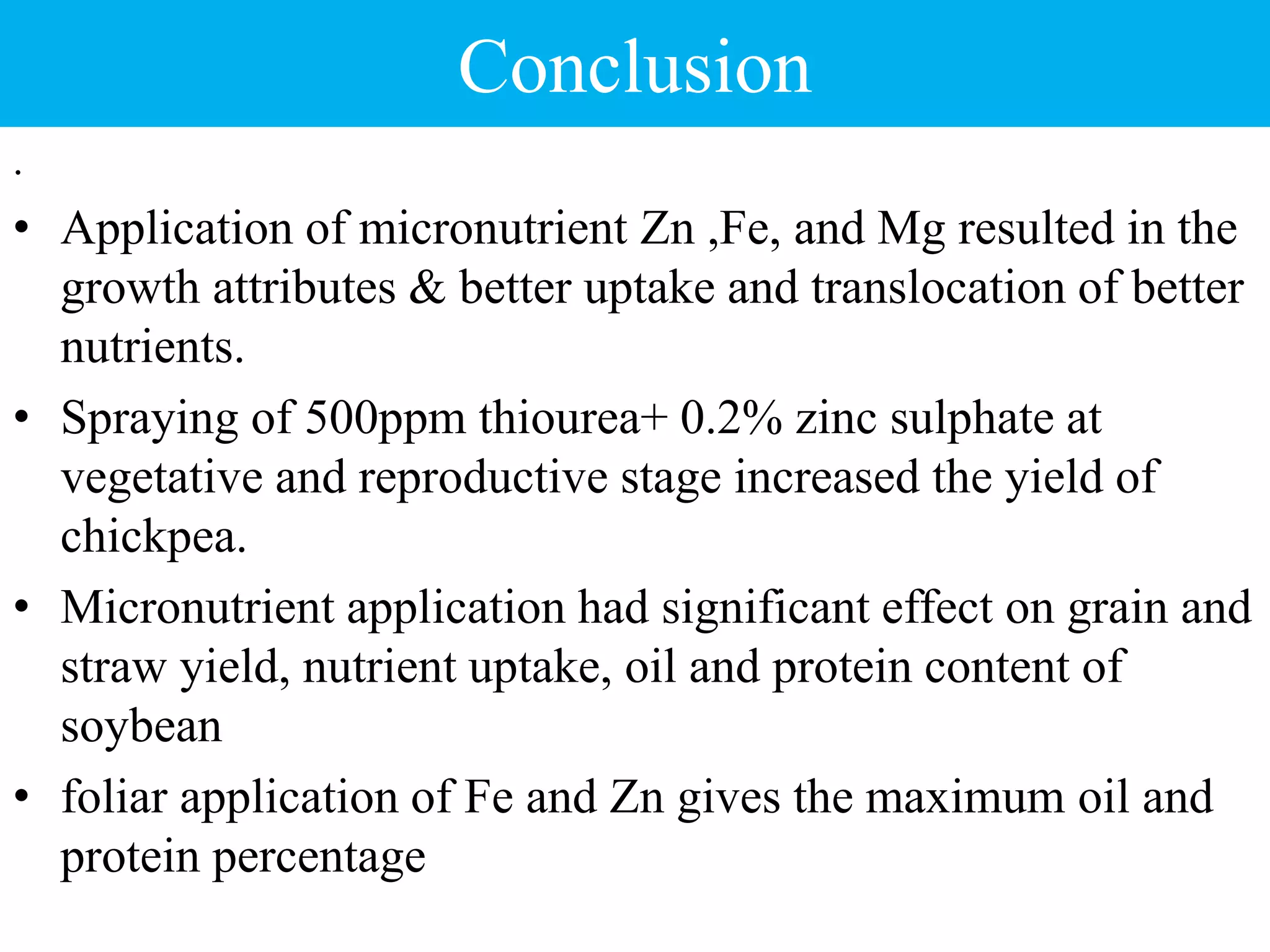
• Application of micronutrient Zn ,Fe, and Mg resulted in the
growth attributes & better uptake and translocation of better
nutrients.
• Spraying of 500ppm thiourea+ 0.2% zinc sulphate at
vegetative and reproductive stage increased the yield of
chickpea.
• Micronutrient application had significant effect on grain and
straw yield, nutrient uptake, oil and protein content of
soybean
• foliar application of Fe and Zn gives the maximum oil and
protein percentage
Influence of foliar application of micronutrients on pulses

Influence of foliar application of micronutrients on pulses

  • 1.
    Name of thestudent : Miss. Manjusha Baban Tapkir. Reg.No. :09/ 211 Discipline : Animal Science
  • 2.
    SEMINAR ON Influence offoliar application of micronutrients on pulses Presented by Miss. Ujwala Balasaheb jadhav Reg no-2015A44ML Research Guide Bhagyaresha R. Gajbhiye Assistant professor Dep. Of soil sci. & Agril.chemistry Collage of agriculture latur Seminar incharge : Dr P.H. Vaidya
  • 3.
    *PULSES *Pulses are importantsource of dietary protein. *Pulses have unique property of maintaining and restoring soil fertility through biological nitrogen fixation as well as conserving and improving physical properties of soil by virtue of their deep root system and leaf fall. *Pulse crops leave behind reasonable quantity of nitrogen in the soil and add up to 40kgN/ha. (Handbook of Agril.)
  • 4.
    *Intensive cropping anduse of heavy doses of high analysis fertilizers have induced the deficiencies of micronutrients in many part of the country. *To achieve high yields and sustaining same over years, it becomes very necessary for the emerging nutrient deficiencies. *Balanced fertilization is inevitable to boost the crop productivity. *Among the micronutrients Zn, Fe, B, and Mo improved the yield appreciably and foliar spray and soil application proved to be economical in pulses (Savithri et al., 2001).
  • 5.
    Table:1. Contribution ofMicronutrients in Increasing Productivity of Different Pulse Crops Micro- nutrients Dose/ha Crop Increase over control (%) Reference Zinc 25kg ZnSO4 Chickpea 22.2 Kushwaha(1997) 25kg ZnSO4 Lentil 54.3 Mishra & Tiwari(1998) 25kg ZnSO4 Urdbean 20.1 Kushwaha(1997) 15 kg ZnSO4 Pigeonpea 16.4 Boron 10kg Borax Chickpea 33.8 Kushwaha(1997) 10kg Borax Pigeonpea 4.1 Molybdenum 1kg Sodium molybdate Chickpea 5.8 Kushwaha(1997) 1kg Sodium molybdate Pigeonpea 18.2 Mishra & Ali(1998) Iron 10kg FeSO4 Lentil 17.6 Singh et al.(1985) 1kg Fe (Chelated) Pigeonpea 6.2 Thiyagarajan et al., 2003
  • 6.
    * *Definition of foliarfertilization: *The application of foliar sprays of one or more mineral nutrients to plants to supplement traditional soil application of fertilizers. *Foliar feeding is a technique of a feeding nutrient to plant by applying liquid fertilizer (either in solution or suspension) directly to the crop canopy. If used wisely, it can more efficient, economical environmental friendly target oriented when used supplement soil fertilization now days, foliar feeding is widely adopted strategy in modern crop management
  • 7.
    * *There is awealth of literature about foliar fertilization which was first used as long ago as 1844 to correct plant chlorosis with foliar sprays of iron (Gris, 1844). *Used widely and for many years in horticulture (fruit and vegetables) *In row-crop agriculture the practice has only caught on in the past two decades, although there is still some speculation about the benefits and correct implementation of this practice
  • 8.
    * *In order fora foliar fertilizer nutrient to be utilized by the plant for growth, it must first gain entry into the leaf prior to entering the cytoplasm of a cell in the leaf. *To achieve this the nutrient must effectively penetrate the outer cuticle and the wall of the underlying epidermal cell. *Once penetration has occurred, nutrient absorption by the cell is similar to absorption by the roots. *Of all the components of the pathway of foliar-applied nutrients, the cuticle offers the greatest resistance
  • 9.
    * *Boron plays animportant role in the development and differentiation of tissue, carbohydrate metabolism and translocation of sugar in plants. *Boron makes up the ca deficiency to some extent. *It helps in the normal growth of plant and in absorption of nitrogen. *Boron helps in the root development and flower and pollen grain formation. (Kausdikar et.al)
  • 10.
    * *Plant growth isreduced and the leaves turn yellow or red. *Boron deficiency is often found to be associated with sterility and malformation of reproductive organs. *B deficiency decreases the rate of water absorption and translocation of sugar in plants *Seed also fail to mature without boron
  • 11.
    * *Required for Nutilization. *Legumes can not fix atmospheric N Symbiotically without Mb. (Kausdikar et.al.)
  • 12.
    * *Stunting and lackof vigor, very similar to N deficiency due to the key role Mb plays in N utilization. *Marginal cupping and scorching of leaves. Whiptail in cauliflower and yellow spotting in citrus.
  • 13.
    * *It is impconstituent of chlorophyll and thus help in synthesis of chlorophyll. *It acts as catalyst in respiration. *Aids in root metabolism. *It has a role in enzyme reactions. However, the specific function in growth and development of plant
  • 14.
    * *Light yellowing, leaftips turn brown. *Sometimes twisted young leaves looked wilted.

  • 15.
    * *Manganese has arole in the formation of the plants naturally occurring antifungal compounds, helping to fight disease infection. *It is involved in the enzymes that govern many biological reactions in plant tissue. *Manganese is also required for lignin formation, which along with cellulose *Foliar application are the most effective to prevent manganese deficiency.
  • 16.
    * *Yellowing between theveins of new leaves (similar to iron deficiency)
  • 17.
    * *iron is essentialfor the Maintenance of chlorophyll. *Iron is also an essential component of the hemoglobin molecule. *In soybean plants, hemoglobin is a component of the nodules. *This may explain the lack of nodulation in field situations where IDC is a serious problem.
  • 18.
    * *Leaves Yellowish ,veinsgreen, affected leaves curl up.
  • 19.
    * *This micronutrient isessential for enzymes that are involved in many metabolic reactions. *Necessary for chlorophyll production. *Necessary for starch formation. *Aids in seed formation
  • 20.
    * *Shorter growth, withreduced internode length, new leaves are smaller. *Interveinal chlorosis of the foliage.
  • 21.
    * * Can reactrapidly to symptoms or tissue analysis * Rapid plant response for correcting deficiency * Avoids soil problems * Relatively low cost * Only use small amounts of fertilizer * No foliar burn (with KNO3 or K2SO4) * Improved yield and fiber quality parameters
  • 22.
    *Disadvantages of FoliarFertilization *Only a limited amount of the nutrient can be *applied at one time. * Cost of multiple applications can be prohibitive. * Possibility of foliar burn (with high *concentrations). * Low solubility of some fertilizers especially in cold water. * Incompatibility with certain other
  • 23.
    * Table 2-Rawseed yield and graded seed yield (q/ha) as influenced by different micronutrient treatment in soybean Treatment Plant height (cm) Number of functional leave Leaf area (dm) Number of branches Dry matter (g day-1) Number of pod plant-1 Number of nodule plant- 1 T1: 23.83 12.57 0.65 5.87 19.02 17.80 46.00 T2 26.72 14.69 0.87 7.27 21.83 20.93 51.17 T3 26.12 14.59 0.86 7.13 21.79 20.33 50.33 T4 25.89 14.35 0.81 7.00 21.91 20.27 48.33 T5 28.56 15.03 0.93 8.60 23.54 23.33 52.00 T6 27.93 15.00 0.88 8.47 23.37 23.00 51.33 T7 28.19 14.98 0.91 8.13 23.32 23.20 51.83 T8 28.70 15.13 0.99 8.73 23.70 23.59 52.33 T9 30.30 16.22 1.15 9.67 24.95 25.23 53.67 T10 29.68 16.09 1.13 9.20 24.64 25.19 53.50 T11 29.48 16.00 1.04 9.07 24.31 25.13 53.33 T12 31.30 17.56 1.23 9.87 26.79 27.37 62.00 s.Em_+ 0.64 0.62 0.05 0.34 0.73 0.80 0.71 C.D at 5% 1.85 1.79 0.15 0.99 2.13 2.34 2.07 Mean 28.06 15.19 0.95 8.25 23.26 22.95 52.15 C.O.A Latur. (2006) Bahure et.al.
  • 24.
    * T1:RDF T2:RDF + ZnSO420 kg ha T3:RDF + FeSO4 20 kg ha-1, T4:RDF+ MgSO4 20 kg ha T5:RDF + ZnSO4 20 kg ha-1 + FeSO4 20 kg ha T6:RDF + FeSO4 20 kg ha-1 + MgSO4 20 kg ha- T7:RDF + MgSO4 20 kg ha-1 + ZnSO4 20 kg ha- T8:RDF + ZnSO4 20 kg ha-1 + FeSO420 kg ha-1 + MgSO4 20 kg ha-1, T9:RDF + ZnSO410 kg ha-1 + 1% ZnSO4 T10:RDF + FeSO410 kg ha-1 + 1% FeSO4 T11:RDF + MgSO410 kg ha-1 + 1% MgSO4 T12:RDF + ZnSO4 10 kg ha-1 + FeSO4 10 kg ha-1 + MgSO4 10 kg ha-1 + 1.5 % znso4 s.Em_+ C.D at 5% Mean
  • 25.
    * Treatment Yield (qha- 1) Grain Uptake of major nutrient (kg ha-1) Uptake of micronutrient (g ha-1) Grain Straw N P K Zn Fe Mo T1: Control 16.62 11.18 60.6 12.0 96.7 140.0 339.4 160.6 T2: Water 18.19 11.97 62.1 12.4 98.6 153.8 341.4 164.4 T3: FeSO4 (0.5%) 18.50 13.26 63.2 12.6 104.5 157.2 353.7 167.1 T4: ZnSO4 (0.5%) 17.87 13.41 67.4 12.6 108.9 158.5 344.5 164.7 T5: Seed fortification with Na2MoO4 19.94 13.43 70.0 13.4 110.5 144.6 361.7 176.4 T6: FeSO4 (0.5%) + ZnSO4 (0.5%) 22.65 19.66 84.7 16.6 122.8 172.1 399.4 187.3 T7: FeSO4 (0.5%) + Na2MoO4 20.90 15.84 73.8 15.4 121.3 157.0 385.6 181.0 T8: ZnSO4 (0.5%) + Na2MoO 20.33 15.67 80.0 14.0 118.7 158.3 365.9 187.1 T9: FeSO4 (0.5%) + ZnSO4 (0.5%) + Na2MoO4 20.92 16.13 83.6 15.4 119.4 162.6 398.8 188.4 S.E. ± 1.054 1.395 5.07 0.95 2.07 5.57 9.38 6.74 C.D. (P=0.05) 3.16 4.18 15.2 2.85 6.20 16.7 28.1 20.2 (2013) Reshma sale et.Al C.O.A. Dhule
  • 26.
    * Treatment Chloroph yll content Nutrient uptake 30DAS60DAS N ZN T1: Control, 26.2 38.0 66.9 0.2 T2:ZnSO4 @ 50 kg /ha as soil application 31.3 43.0 99.4 0.6 T3:2% urea spray at flowering (25-30 DAS), 31.2 42.1 94.5 0.6 T4: 0.5% ZnSO4 spray at flowering 30.0 40.5 88.6 0.4 T5: 2% urea + 0.5% ZnSO4 spray at flowering 27.4 38.6 77.6 0.3 T6: 2% urea spray at early pod development 28.4 39.0 81.9 0.4 T7: 0.5% ZnSO4 spray at early pod development (55-60 DAS) 28.6 39.9 84.5 0.4 T8: 2% urea + 0.5% ZnSO4 spray at early pod development 30.2 40.6 92.0 0.4 T9: 2% urea spray at flowering and at early pod developmen 32.0 43.6 110.7 0.7 T10: 0.5% ZnSO4 spray at flowering and at early pod development 30.4 40.8 93.6 0.5 SEm± 0.5 0.6 2.8 0.03 CD (P=0.05) 1.4 1.5 8.0 0.1
  • 27.
    * Treatment No.of pods/plant 100 seedweight (g) Grain yield (kg/ha) Haulam yield (kg/ha Harvest Index (%) Protein Content (%) Oil content (%) T1: 20 8.1 707 1460 32.5 39.5 16.1 T2: 29 10.2 1026 1759 36.7 43.3 19.5 T3 28 9.7 979 1739 35.9 42.5 19.2 T4 26 9.2 895 1644 34.1 41.5 17.6 T5 23 8.8 810 1565 34.1 39.9 16.3 T6: 23 8.8 836 1602 34.2 40.3 16.7 T7 23 9.1 882 1637 34.8 40.7 17.4 T8 27 9.3 907 1692 35.2 42.0 18.2 T9 30 10.3 1109 1779 38.2 43.9 20.9 T10 27 9.4 942 1704 35.6 42.2 18.6 SEm± 0.9 0.2 33.3 33.5 0.2 0.5 0.5 CD (P=0.05) 2 0.5 95 96 0.5 1.5 1.3 Agriculture collage ,Baptala,Andhra pradesh (2013) Naga Jyothi et .al.
  • 28.
    * T1:Control T2:ZnSO4 @ 50kg /ha as soil application T3:2% urea spray at flowering T4:0.5% ZnSO4 spray at flowering T5:2% urea + 0.5% ZnSO4 spray at flowering T6:2% urea spray at early pod development T7:0.5% ZnSO4 spray at early pod development (55-60 DAS) T8:2% urea + 0.5% ZnSO4 spray at early pod developmen T9:2% urea spray at flowering and at early pod development T10:0.5% ZnSO4 spray at flowering and at early pod development SEm± CD (P=0.05)
  • 29.
    * Treatments No.of pods /plant Pod weight (g/plant) No.of seeds/pod Seed yield (g/plant) 100-seed weight (g) Seedyield (Kg/ha) Control(water spray) 15.00 11.90 8.70 4.10 2.80 1676.60 Urea:1% 15.60 16.80 11.20 4.80 3.70 1730.60 Fe:0.5% 15.00 17.50 12.00 7.30 3.90 2377.20 Mn:0.2% 20.60 16.60 11.00 6.50 3.40 1833.80 Zn:0.1% 17.80 19.00 12.20 5.40 3.70 2254.60 Cu:0.05% 15.70 17.50 11.20 4.20 4.00 1825.00 Urea 1%+Fe 14.70 21.20 11.50 7.10 3.40 2200.80 Urea1%+Mn 14.70 22.30 11.70 5.70 3.70 2098.60 Urea 1% +Zn 22.00 22.50 11.50 6.70 3.40 2223.60 Urea 1%+Cu 16.10 20.70 11.50 5.20 2.60 1828.40 L.S.D 4.40 3.80 0.60 0.30 0.20 103.00 Field crop research Deparetment,Agril.Div. National Res.Center,Dokki-Cairo-Egypt Latif et.al
  • 30.
    * Pant Mung-4 Height (cm)/plant No.of tillers/pla nt No. of leaves/plant Leaf area (sq. cm.)/plant Dry weight (g)/plant No. of pods/plant Yield of seed/ plant 1000 seeds weight (g T1:Control (c) 32.1 13 29.3 387 56.3 45.8 62.07 65.3 T2:Zn 5 ppm 37.0 14 30.7 432 61.0 48.7 65.00 65.8 T3:Zn 10 ppm 39.5 15 31.7 508 68.0 54.2 69.30 67.4 T4:Zn 15 ppm 43.9 16 33.3 550 81.3 60.0 74.10 69.7 T5:Zn 20 ppm 46.5 17 34.3 612 94.3 70.5 78.20 72.5 Narendra-1 T1:Mo 1 ppm 27.1 9 28.0 380 55.1 46.7 60.08 63.4 T2:Mo 2 ppm 30.1 10 28.3 419 56.2 51.2 63.50 64.2 T3:Mo 3 ppm 33.6 11 30.0 467 65.4 57.0 67.26 65.0 T4:Mo 5 ppm 36.2 12 31.3 522 77.7 63.0 70.50 67.2 T5:Urea 1% 38.4 13 32.7 587 89.1 75.0 73.75 70.5 2Raja Mahendra Pratap Post
  • 31.
    * Pant Mung-4 Height (cm)/plant No.of tillers/p lant No. of leaves/pla nt Leaf area (sq. cm.)/ plant Dry weight (g)/plant No. of pods/plant Yield of seed/ plant 1000 seeds weight (g) T1:Control (c) 32.1 13 29.3 387 56.3 45.8 62.07 65.3 T6:Mo 1 ppm 33.6 14 30.3 407 56.3 47.6 62.07 65.5 T7:Mo 2 ppm 35.6 14 31.3 455 63.0 53.2 66.80 68.0 T8:Mo 3 ppm 37.3 16 32.3 556 69.6 68.6 88.92 74.5 T9:Mo 5 ppm 36.1 14 31.3 502 65.0 60.0 61.20 71.4 Narendra-1 T1:Control (c) 27.1 9 28.0 387 55.1 46.7 60.08 63.4 T6:Mo 1 ppm 28.9 10 28.7 401 53.0 50.4 60.08 63.7 T7:Mo 2 ppm 30.1 10 29.6 448 61.0 56.2 64.80 65.8 T8:Mo 3 ppm 31.7 12 31.3 543 67.6 71.4 85.50 71.5 T9:Mo 5 ppm 30.4 10 29.6 491 63.9 62.3 59.10 69.7 2Raja Mahendra Pratap Post Graduate College, Gurukul-Narsan, HARIDWAR
  • 32.
    Table :11. Effects of foliar application of zinc on yield attributes and seed yield of lentil Treatment Shoot dry (g/plant)w eight Branche s/plant Pods/ plant Biomas s (kg/ha) Seed yield (kg/ha) Harvest index 1000 grain wt (g) Control Zn1 (0.0%) 3.23 14.4 45.9 2 537.5 1 063.1 0.40 24.7 Zn2 (0.02%) 3.67 15.9 54.2 2 825.6 1 171.2 0.39 24.7 Zn3 (0.04%) 4.11 16.3 58.0 2 902.6 1 238.6 0.39 24.8 Zn4 (0.08%) 4.37 16.2 63.8 2 942.1 1 208.6 0.38 25.0 CD (P=0.05) 0.18 1.9 8.6 87.5 35.2 NS NS ICAR Research Complex for Eastern Region, Patna, Bihar Singh .et.al. (2014)
  • 33.
    Table : 12.Effect of zinc sulphate and thiourea spray on yield attributes and yield of chickpea Treatments Grain yield (q/ha) Fodder yield (q/ha Plant height (cm) Number of primary branches Number of total branches Number of pods/pla nt T1- Control (No spray 12.4 11.4 64.5 7.5 20.6 25.5 T2- 0.5% Zinc sulphate spray at vegetative and reproductive stage 14.0 12.9 66.6 8.6 22.3 27.1 T3- 500 ppm thiourea spray at vegetative and reproductive stage 13.2 11.5 66.2 8.4 22.7 26.4 T4- 500 ppm thiourea+ 0.2 % Zinc sulphate (mixed solution) spray at vegetative and reproductive stage 15.4 13.3 68.3 9.1 23.9 29.2 SEm ± 0.482 0.362 1.252 0.548 1.102 1.18 CD (P=0.05) 1.40 1.05 3.983 1.591 3.197 3.428 Krishi Vigyan Kendra, Dausa (Rajasthan) Jat et.al. (2014)
  • 34.
    Table:13. Effect offoliar Application of Zn and Fe on growth and yield attributes of cowpea Treatment Height (cm) No.Of Branches Bhusa Yield kg ha-1 Podslength (cm) Pod Per plant Seeds per pod T1:Control 40.16 2.80 674.71 2.96 14.16 11.76 T2:0.5% FeS04 spray at 25DAS 42.30 2.76 792.17 2.96 15.30 12.23 T3:0.5% FeS04 spray at 45DAS 47.26 2.86 821.33 3.30 15.66 13.16 T4:T2+T3 44.90 2.36 816.66 3.36 15.06 13.00 T5:0.5% ZnS04 spray at 25DAS 45.93 2.53 747.70 3.40 16.00 12.96 T6:05% ZnS04 spray at 45DAS 46.23 2.83 745.96 3.68 15.30 12.40 T7:T5 +T6 47.96 2.60 837.36 3.66 15.83 13.30 T8:T2+T5 47.61 2.83 859.73 3.73 15.83 13.50 T9:T3 +T6 45.63 2.70 914.56 3.93 16.16 13.90 CD at 5% NS NS 101.37 0.63 NS NS Regional Agricultural Research Station, Kerala Agricultural University, Pattambi - 679 306, Kerala, India Anitha et.al.
  • 35.
    Conclusion . • Application ofmicronutrient Zn ,Fe, and Mg resulted in the growth attributes & better uptake and translocation of better nutrients. • Spraying of 500ppm thiourea+ 0.2% zinc sulphate at vegetative and reproductive stage increased the yield of chickpea. • Micronutrient application had significant effect on grain and straw yield, nutrient uptake, oil and protein content of soybean • foliar application of Fe and Zn gives the maximum oil and protein percentage