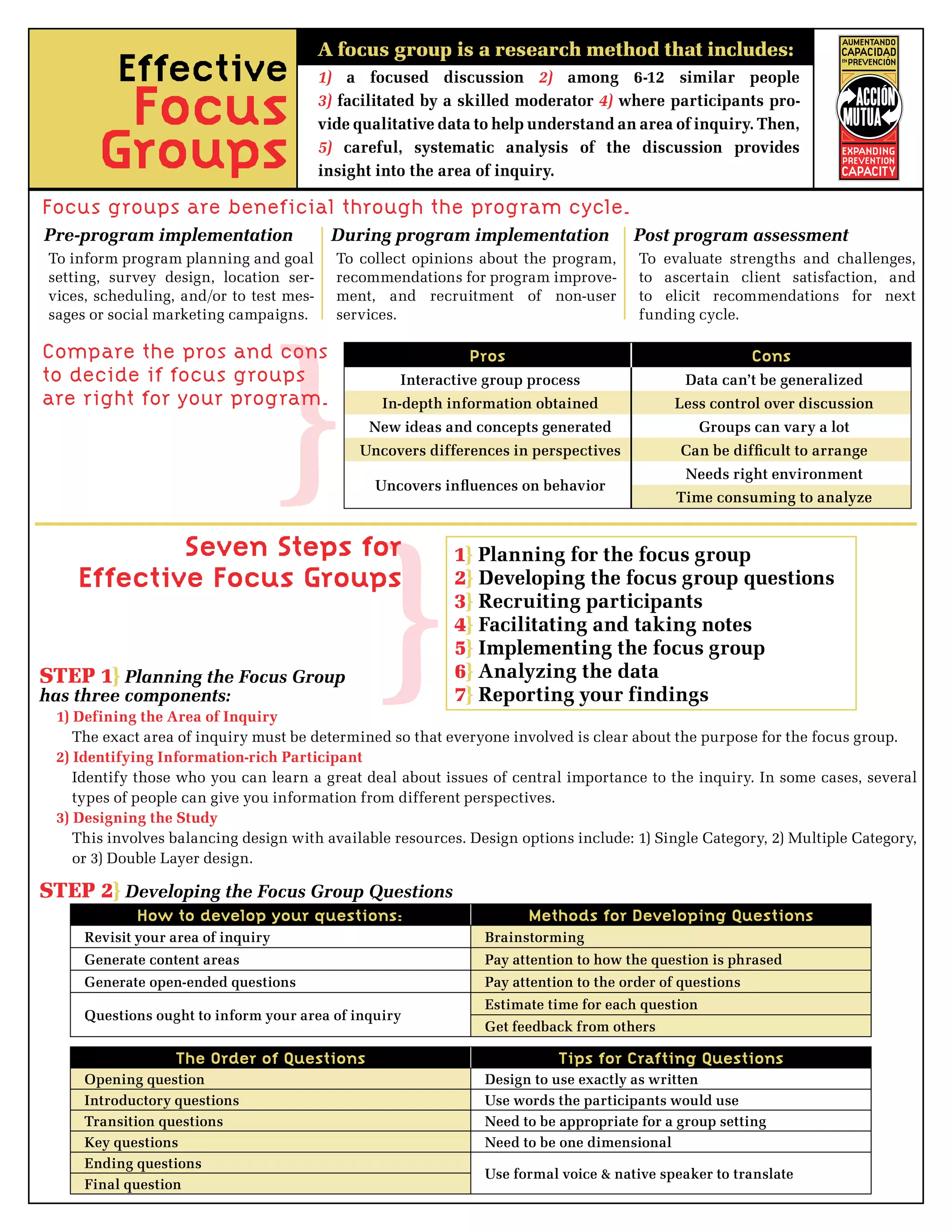
A focus group is a research method that includes:
         Effective                       1) a focused discussion 2) among 6-12 similar people

        Focus                            3) facilitated by a skilled moderator 4) where participants pro-
                                         vide qualitative data to help understand an area of inquiry. Then,

       Groups                            5) careful, systematic analysis of the discussion provides
                                         insight into the area of inquiry.

Focus groups are beneficial through the program cycle.
Pre-program implementation                During program implementation              Post program assessment
To inform program planning and goal        To collect opinions about the program,     To evaluate strengths and challenges,
setting, survey design, location ser-      recommendations for program improve-       to ascertain client satisfaction, and
vices, scheduling, and/or to test mes-     ment, and recruitment of non-user          to elicit recommendations for next
sages or social marketing campaigns.       services.                                  funding cycle.

Compare the pros and cons                                    Pros                                        Cons
to decide if focus groups                           Interactive group process                Data can’t be generalized
are right for your program.                      In-depth information obtained             Less control over discussion
                                               New ideas and concepts generated                  Groups can vary a lot
                                              Uncovers differences in perspectives          Can be difficult to arrange
                                                                                             Needs right environment
                                                Uncovers influences on behavior
                                                                                            Time consuming to analyze


            Seven Steps for                                1} Planning for the focus group
    Effective Focus Groups                                 2} Developing the focus group questions
                                                           3} Recruiting participants
                                                           4} Facilitating and taking notes
                                                           5} Implementing the focus group
Step 1} Planning the Focus Group                           6} Analyzing the data
has three components:                                      7} Reporting your findings
 1) Defining the Area of Inquiry
    The exact area of inquiry must be determined so that everyone involved is clear about the purpose for the focus group.
 2) Identifying Information-rich Participant
    Identify those who you can learn a great deal about issues of central importance to the inquiry. In some cases, several
    types of people can give you information from different perspectives.
 3) Designing the Study
    This involves balancing design with available resources. Design options include: 1) Single Category, 2) Multiple Category,
    or 3) Double Layer design.

Step 2} Developing the Focus Group Questions
            How to develop your questions:                           Methods for Developing Questions
     Revisit your area of inquiry                              Brainstorming
     Generate content areas                                    Pay attention to how the question is phrased
     Generate open-ended questions                             Pay attention to the order of questions
                                                               Estimate time for each question
     Questions ought to inform your area of inquiry
                                                               Get feedback from others

                  The Order of Questions                                  Tips for Crafting Questions
     Opening question                                          Design to use exactly as written
     Introductory questions                                    Use words the participants would use
     Transition questions                                      Need to be appropriate for a group setting
     Key questions                                             Need to be one dimensional
     Ending questions
                                                               Use formal voice & native speaker to translate
     Final question
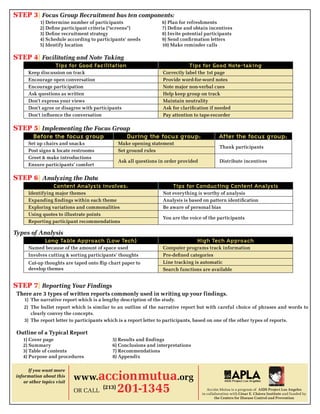
Step 3} Focus Group Recruitment has ten components:
            1) Determine number of participants                   6) Plan for refreshments
            2) Define participant criteria (“screens”)            7) Define and obtain incentives
            3) Define recruitment strategy                        8) Invite potential participants
            4) Schedule according to participants’ needs          9) Send confirmation letters
            5) Identify location                                  10) Make reminder calls

Step 4} Facilitating and Note Taking
                    Tips for Good Facilitation                                Tips for Good Note-taking
      Keep discussion on track                                    Correctly label the 1st page
      Encourage open conversation                                 Provide word-for-word notes
      Encourage participation                                     Note major non-verbal cues
      Ask questions as written                                    Help keep group on track
      Don’t express your views                                    Maintain neutrality
      Don’t agree or disagree with participants                   Ask for clarification if needed
      Don’t influence the conversation                            Pay attention to tape-recorder

Step 5} Implementing the Focus Group
        Before the focus group                    During the focus group:                     After the focus group:
      Set up chairs and snacks                 Make opening statement
                                                                                               Thank participants
      Post signs & locate restrooms            Set ground rules
      Greet & make introductions
                                               Ask all questions in order provided             Distribute incentives
      Ensure participants’ comfort

Step 6} Analyzing the Data
                   Content Analysis involves:                          Tips for Conducting Content Analysis
      Identifying major themes                                    Not everything is worthy of analysis
      Expanding findings within each theme                        Analysis is based on pattern identification
      Exploring variations and commonalities                      Be aware of personal bias
      Using quotes to illustrate points
                                                                  You are the voice of the participants
      Reporting participant recommendations

Types of Analysis
              Long Table Approach (Low Tech)                                      High Tech Approach
      Named because of the amount of space used                   Computer programs track information
      Involves cutting & sorting participants’ thoughts           Pre-defined categories
      Cut-up thoughts are taped onto flip chart paper to          Line tracking is automatic
      develop themes                                              Search functions are available


Step 7} Reporting Your Findings
 There are 3 types of written reports commonly used in writing up your findings.
    1) The narrative report which is a lengthy description of the study.
    2) The bullet report which is similar to an outline of the narrative report but with careful choice of phrases and words to
       clearly convey the concepts.
    3) The report letter to participants which is a report letter to participants, based on one of the other types of reports.

 Outline of a Typical Report
   1) Cover page                           5) Results and findings
   2) Summary                              6) Conclusions and interpretations
   3) Table of contents                    7) Recommendations
   4) Purpose and procedures               8) Appendix

      If you want more
information about this
    or other topics visit
                            www.accionmutua.org
                            or CaLL
                                       (213)
                                               201-1345                                 acción Mutua is a program of AIDS Project Los Angeles
                                                                                     in collaboration with César E. Chávez Institute and funded by
                                                                                             the Centers for Disease Control and Prevention

Am focus groups

  • 1.
    A focus groupis a research method that includes: Effective 1) a focused discussion 2) among 6-12 similar people Focus 3) facilitated by a skilled moderator 4) where participants pro- vide qualitative data to help understand an area of inquiry. Then, Groups 5) careful, systematic analysis of the discussion provides insight into the area of inquiry. Focus groups are beneficial through the program cycle. Pre-program implementation During program implementation Post program assessment To inform program planning and goal To collect opinions about the program, To evaluate strengths and challenges, setting, survey design, location ser- recommendations for program improve- to ascertain client satisfaction, and vices, scheduling, and/or to test mes- ment, and recruitment of non-user to elicit recommendations for next sages or social marketing campaigns. services. funding cycle. Compare the pros and cons Pros Cons to decide if focus groups Interactive group process Data can’t be generalized are right for your program. In-depth information obtained Less control over discussion New ideas and concepts generated Groups can vary a lot Uncovers differences in perspectives Can be difficult to arrange Needs right environment Uncovers influences on behavior Time consuming to analyze Seven Steps for 1} Planning for the focus group Effective Focus Groups 2} Developing the focus group questions 3} Recruiting participants 4} Facilitating and taking notes 5} Implementing the focus group Step 1} Planning the Focus Group 6} Analyzing the data has three components: 7} Reporting your findings 1) Defining the Area of Inquiry The exact area of inquiry must be determined so that everyone involved is clear about the purpose for the focus group. 2) Identifying Information-rich Participant Identify those who you can learn a great deal about issues of central importance to the inquiry. In some cases, several types of people can give you information from different perspectives. 3) Designing the Study This involves balancing design with available resources. Design options include: 1) Single Category, 2) Multiple Category, or 3) Double Layer design. Step 2} Developing the Focus Group Questions How to develop your questions: Methods for Developing Questions Revisit your area of inquiry Brainstorming Generate content areas Pay attention to how the question is phrased Generate open-ended questions Pay attention to the order of questions Estimate time for each question Questions ought to inform your area of inquiry Get feedback from others The Order of Questions Tips for Crafting Questions Opening question Design to use exactly as written Introductory questions Use words the participants would use Transition questions Need to be appropriate for a group setting Key questions Need to be one dimensional Ending questions Use formal voice & native speaker to translate Final question
  • 2.
    Step 3} FocusGroup Recruitment has ten components: 1) Determine number of participants 6) Plan for refreshments 2) Define participant criteria (“screens”) 7) Define and obtain incentives 3) Define recruitment strategy 8) Invite potential participants 4) Schedule according to participants’ needs 9) Send confirmation letters 5) Identify location 10) Make reminder calls Step 4} Facilitating and Note Taking Tips for Good Facilitation Tips for Good Note-taking Keep discussion on track Correctly label the 1st page Encourage open conversation Provide word-for-word notes Encourage participation Note major non-verbal cues Ask questions as written Help keep group on track Don’t express your views Maintain neutrality Don’t agree or disagree with participants Ask for clarification if needed Don’t influence the conversation Pay attention to tape-recorder Step 5} Implementing the Focus Group Before the focus group During the focus group: After the focus group: Set up chairs and snacks Make opening statement Thank participants Post signs & locate restrooms Set ground rules Greet & make introductions Ask all questions in order provided Distribute incentives Ensure participants’ comfort Step 6} Analyzing the Data Content Analysis involves: Tips for Conducting Content Analysis Identifying major themes Not everything is worthy of analysis Expanding findings within each theme Analysis is based on pattern identification Exploring variations and commonalities Be aware of personal bias Using quotes to illustrate points You are the voice of the participants Reporting participant recommendations Types of Analysis Long Table Approach (Low Tech) High Tech Approach Named because of the amount of space used Computer programs track information Involves cutting & sorting participants’ thoughts Pre-defined categories Cut-up thoughts are taped onto flip chart paper to Line tracking is automatic develop themes Search functions are available Step 7} Reporting Your Findings There are 3 types of written reports commonly used in writing up your findings. 1) The narrative report which is a lengthy description of the study. 2) The bullet report which is similar to an outline of the narrative report but with careful choice of phrases and words to clearly convey the concepts. 3) The report letter to participants which is a report letter to participants, based on one of the other types of reports. Outline of a Typical Report 1) Cover page 5) Results and findings 2) Summary 6) Conclusions and interpretations 3) Table of contents 7) Recommendations 4) Purpose and procedures 8) Appendix If you want more information about this or other topics visit www.accionmutua.org or CaLL (213) 201-1345 acción Mutua is a program of AIDS Project Los Angeles in collaboration with César E. Chávez Institute and funded by the Centers for Disease Control and Prevention