Maximum Clock Frequency The clock frequency for a synchronous sequential circuit is limited by the timing parameters of its flip-flops and gates. This limit is called  the maximum clock frequency  for the circuit. The  minimum clock period  is the reciprocal of this frequency. Relevant timing parameters Gates:  Propagation delays: min t PLH , min t PHL , max t PLH , max t PHL Flip-Flops: Propagation delays: min t PLH , min t PHL , max t PLH , max t PHL Setup time: t su Hold time: t h
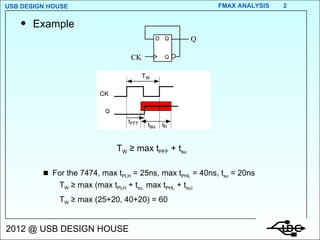
Example T W  ≥ max t PFF  + t su For the 7474, max t PLH  = 25ns, max t PHL  = 40ns, t su  = 20ns T W  ≥ max (max t PLH  + t su,  max t PHL  + t su) T W  ≥ max (25+20, 40+20) = 60
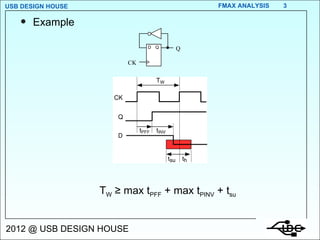
Example T W  ≥ max t PFF  + max t PINV  + t su
Example T W  ≥ max t PFF  + max t PMUX  + t su
Example Paths from Q1 to Q1: Paths from Q1 to Q2: Paths from Q2 to Q1: Paths from Q2 to Q2: None T W  ≥ max t PDFF  +t JKsu  = 20 +10 = 30 ns T W  ≥ max t PDFF  + max t AND  + t JKsu  = 20 + 12 + 10 = 42 ns T W  ≥ max t PJKFF  + t OR  + T Dsu  = 25 + 10 + 5 = 40 ns  T W  ≥ max t PJKFF  + max t AND  + t JKsu  = 25 + 12 + 10 = 47 ns TW ≥ 47 ns
Example T W  ≥ max t PFF  + max t PINV  + t su
Example T W  ≥ max t PFF  + max t PMUX  + t su
Example Paths from Q1 to Q1: Paths from Q1 to Q2: Paths from Q2 to Q1: Paths from Q2 to Q2: None T W  ≥ max t PDFF  +t JKsu  = 20 +10 = 30 ns T W  ≥ max t PDFF  + max t AND  + t JKsu  = 20 + 12 + 10 = 42 ns T W  ≥ max t PJKFF  + t OR  + T Dsu  = 25 + 10 + 5 = 40 ns  T W  ≥ max t PJKFF  + max t AND  + t JKsu  = 25 + 12 + 10 = 47 ns TW ≥ 47 ns

Fmax Analysis

  • 1.
    Maximum Clock FrequencyThe clock frequency for a synchronous sequential circuit is limited by the timing parameters of its flip-flops and gates. This limit is called the maximum clock frequency for the circuit. The minimum clock period is the reciprocal of this frequency. Relevant timing parameters Gates: Propagation delays: min t PLH , min t PHL , max t PLH , max t PHL Flip-Flops: Propagation delays: min t PLH , min t PHL , max t PLH , max t PHL Setup time: t su Hold time: t h
  • 2.
    Example T W ≥ max t PFF + t su For the 7474, max t PLH = 25ns, max t PHL = 40ns, t su = 20ns T W ≥ max (max t PLH + t su, max t PHL + t su) T W ≥ max (25+20, 40+20) = 60
  • 3.
    Example T W ≥ max t PFF + max t PINV + t su
  • 4.
    Example T W ≥ max t PFF + max t PMUX + t su
  • 5.
    Example Paths fromQ1 to Q1: Paths from Q1 to Q2: Paths from Q2 to Q1: Paths from Q2 to Q2: None T W ≥ max t PDFF +t JKsu = 20 +10 = 30 ns T W ≥ max t PDFF + max t AND + t JKsu = 20 + 12 + 10 = 42 ns T W ≥ max t PJKFF + t OR + T Dsu = 25 + 10 + 5 = 40 ns T W ≥ max t PJKFF + max t AND + t JKsu = 25 + 12 + 10 = 47 ns TW ≥ 47 ns
  • 6.
    Example T W ≥ max t PFF + max t PINV + t su
  • 7.
    Example T W ≥ max t PFF + max t PMUX + t su
  • 8.
    Example Paths fromQ1 to Q1: Paths from Q1 to Q2: Paths from Q2 to Q1: Paths from Q2 to Q2: None T W ≥ max t PDFF +t JKsu = 20 +10 = 30 ns T W ≥ max t PDFF + max t AND + t JKsu = 20 + 12 + 10 = 42 ns T W ≥ max t PJKFF + t OR + T Dsu = 25 + 10 + 5 = 40 ns T W ≥ max t PJKFF + max t AND + t JKsu = 25 + 12 + 10 = 47 ns TW ≥ 47 ns